
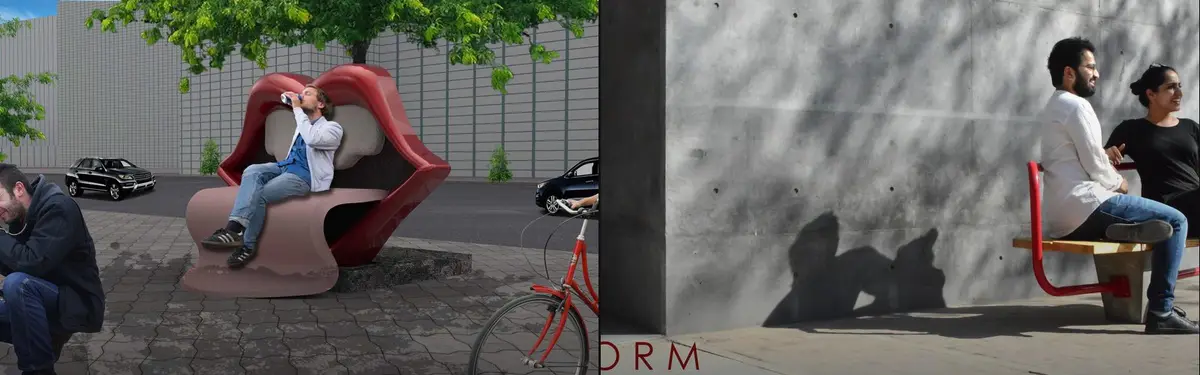


Street Furniture
Street furniture design encompasses public seating, shelters, and installations that shape urban spaces and community interaction.
Street furniture is the collective name for the objects installed in streets and public spaces for people to use: benches, lighting, bus shelters, kiosks, bins, bollards, drinking fountains, signs and the like. Each piece is small, but together they decide whether a street is somewhere to pass through quickly or somewhere to stop, sit, wait and meet.
What is street furniture?
Street furniture covers equipment placed along streets and roads for many purposes, from benches and post boxes to streetlamps and traffic signs. Designers usually group it by job. Seating includes benches, perches and leaning rails. Shelter covers bus stops, canopies and kiosks. Lighting and signage help people find their way and feel safe after dark. Service elements such as bins, cycle racks, drinking fountains and toilets keep a place usable, while bollards and planters separate people from traffic.
The field sits between product design and urban design. A bench is a product that can be drawn, prototyped and manufactured in thousands. Its value, though, depends on where it stands: facing the sun or the wall, near a doorway or stranded in the middle of a plaza. That is why street furniture belongs to the wider discipline of public space design and not only to the furniture catalogue. Placement must also respect pedestrian movement, road safety and the visual identity of a district, and the same bench or bollard can quietly control parking or block a pavement as well as offer a seat.
Unlike indoor furniture, these objects live outside all year, are used by strangers, belong to no one in particular and must survive weather, misuse and decades of maintenance budgets.
A short history of street furniture
Cities have always had wells, fountains and stone benches, but street furniture as a designed system arrived with the industrial city. When Paris built its Métro for the 1900 Exposition Universelle, Hector Guimard designed the first generation of station entrances between 1900 and 1913. He used cast iron set in concrete and glass, standardised parts such as railing cartouches and lit sign holders, and his own lettering, creating what became known as the Métro style. Some critics attacked them, his 1904 design for the Opéra station was rejected and many entrances were later demolished, but those that remain are now protected historical monuments.

In Britain, a 1924 competition produced Giles Gilbert Scott's K2 telephone kiosk, deployed around London from 1926. Scott's K6 followed in 1935 to mark the Silver Jubilee of George V. Smaller and cheaper than the K2, it was the first red kiosk used widely outside London, and the number of public telephones in the UK rose from 19,000 in 1935 to 35,000 by 1940. The red was chosen so the boxes would be easy to spot.

The modern understanding of street furniture comes from observation. From 1969 William H. Whyte and his assistants filmed and counted people in New York plazas and streets for the Street Life Project. His 1980 book and film, The Social Life of Small Urban Spaces, compared 18 small spaces in Manhattan and gave whole chapters to sitting space and to sun, wind, trees and water.
"What attracts people most, it would appear, is other people."
William H. Whyte, quoted by Project for Public Spaces
In Copenhagen, the Danish architect Jan Gehl was running parallel studies of public life, published in Life Between Buildings (1971). The practice he co-founded still describes its work as starting from clipboard counts of people in public space.
Key principles of street furniture design
Seating comes first
Whyte observed that people vote with their feet: they use spaces that are comfortable and easy to use, and ignore those that are not. New York's transport department makes the same case in policy terms: its public seating programme says that places to rest let people take longer journeys, helping bus riders, seniors and people with disabilities, and it has installed over 2,600 benches and leaning bars. Offer a choice of postures: backs and arms for older users, perches and leaning rails for short waits, open edges for groups.
Design for climate
A bench in full summer sun is empty at noon. Shade, shelter from wind and a dry surface matter as much as form. One member project traces street furniture back to its oldest source.
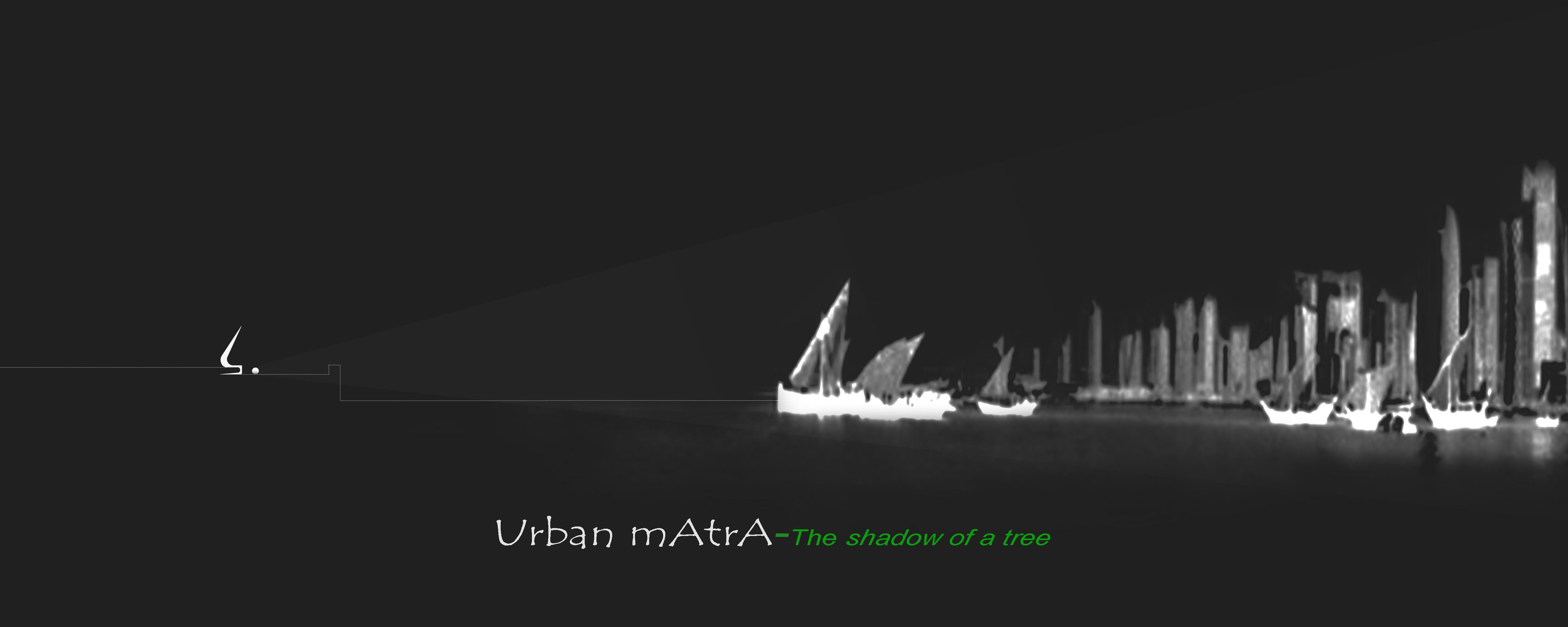
"mAtrA in Sanskrit means furniture, and the earliest known street furniture would be sitting under a tree."
Raymond C, Muzamil, ginu shajan and Nizam MA, Urban mAtrA
Urban mAtrA turns that idea into a foldable, movable "shadow of a tree", with materials explored for extreme climates. A uni.xyz journal places the module in Doha, where temperatures regularly pass 40°C.
Make waiting dignified
The bus shelter is where many people spend the most time with street furniture. TIRAVAM by Vasanth K S, an Editor's Choice in the Better Bus Stop competition, is set in Baroda and starts from changing people's perception of what a bus stop can be. A built example covered in a uni.xyz journal, the Offenbach Marktplatz transport hub by Just Architekten GmbH (2023), replaced a worn tent-like shelter with a planted canopy and an open, non-directional layout whose seating invites people in from all sides, turning a bus stop into a public space.

Think in families, not one-offs
Guimard's entrances and Scott's kiosks worked because they were systems: standard parts, one material language and recognisable colour, repeated across a city. A family of benches, bins, lamps and signs is cheaper to maintain and easier to read than a street of unrelated objects.
Help people find their way
Lighting and signage are furniture too. Good lighting lets a street stay in use after dark, and clear, consistent signs help strangers, while too many poles and panels create clutter that blocks pavements and wheelchairs.
Street furniture on uni.xyz
Members have produced a large body of seating, shelter and modular street systems, much of it through the Urbanscape and Better Bus Stop competitions. A pattern runs through them: furniture as a kit that adapts to its street, not a single object dropped into it.
The most liked project in this topic is +us by Alea Reid and Isabelle Jackson, which received the People's Choice Award in the Urbanscape: Symbiosis competition. It is a collection of pieces for the interstitial spaces created by a network, designed to invite interaction both between pedestrian and object and between people.

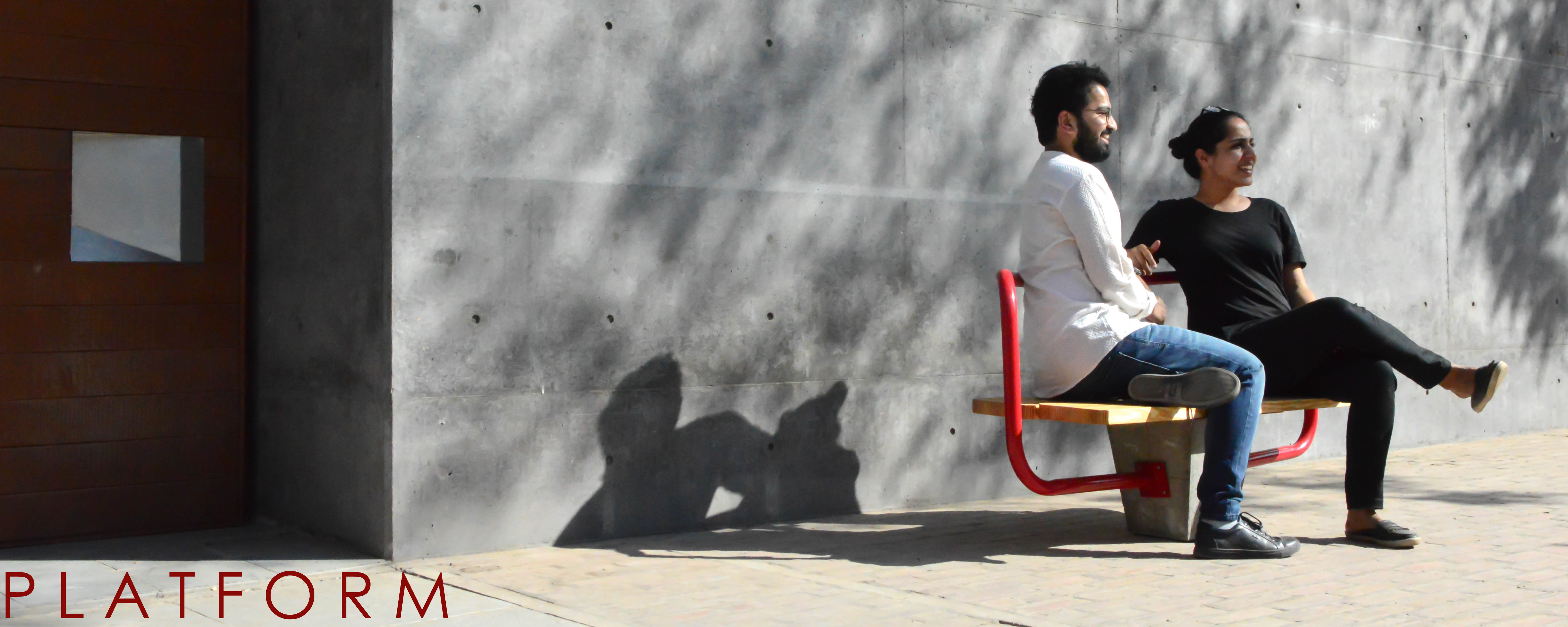
PLATFORM by Aliakbar gulam husain wala was the winning entry in the Urbanscape 2018 competition. It sits at the edge of the street as a module for one to four people, and the location of each unit is decided only after studying the surrounding area, a direct echo of Whyte's method.
Hume World by Aangi Shah and Niki Shah, a runner-up in the same competition, reads the Indian street on its own terms. It builds a modular kit of urban elements from existing infrastructural material, enhances recurring street elements and makes room for the informal sector.
Ribbons of Growth by David Morgan, Nurul Azman and Lyana Ibrahim, a runner-up in the Re-connect competition, proposes a modular system that expands social interaction while keeping safe distances.
The journal on The GATHERING-TIME, by Parham Karimi and Pedram Karimi and an Honorable Mention in Urbanscape 2018, looks at the University of Toronto's St George campus. Aerial analysis found dead gaps between buildings, and the team answered with banana plywood and stainless steel modules that pivot and combine, offer several body postures including leaning and sitting, and invite people to gather in small and large groups.

Climate is a strong theme. The journal on Revitalising the Sea Point Promenade, by Melanie Cook and Wendy Dixon, proposes recycled stone composite modules for Cape Town's coastline that seat people while harvesting rainwater, supporting indigenous planting and generating solar power, a response to the city's 2018 water crisis.
Testing on the street itself is another thread. The journal on Pulse by Danielle Aspitz describes a red and white ribbon of seating developed for the Market Street Prototyping Festival, where designers try out new urban furniture directly on the street. Its continuous curve has no armrests marking off individual territories, so people can sit upright, recline or lounge side by side, the opposite of the divided bench discussed below.
Challenges and future directions
The hardest question is who street furniture is for. Hostile architecture, also called defensive design, uses the built environment to steer behaviour and keep certain people away. Common examples are benches with armrests placed to stop people lying down, sloped sills, studs on flat surfaces and bins with small mouths. These measures often target people who rely on public space the most, including young people, poor people and homeless people. Whyte saw the problem decades ago.
"So-called 'undesirables' are not the problem. It is the measures taken to combat them that is the problem."
William H. Whyte, quoted by Project for Public Spaces

Designers face real pressures here, from councils worried about damage, rough sleeping or skateboarding to insurers and maintenance crews. The honest answer is to design for the widest range of users and to manage problems through care and services, not through discomfort aimed at everyone. Maintenance is the other quiet challenge: New York's transport department replaces benches that have been altered or damaged, and by law nearby property owners must clear snow and debris around them. Cities are also testing temporary furniture before committing, as in New York's Street Seats programme, where local partners install and maintain seating in the roadbed or on wide sidewalks. Hotter summers, electric charging and obsolete technology, from phone boxes to parking meters, will keep changing what the street needs.
Street furniture for students and designers
Street furniture is an ideal thesis or competition subject because it can be prototyped at full scale. Strong angles include a bus stop that works for the longest and hottest waits, a seating family for an informal market street, furniture that cools a pavement without a tree, or a guide to inclusive benches that answers hostile design. Start the way Whyte and Gehl did: sit in a real place for a day, count who uses it and where, then design. Test a full-size mock-up with real users before refining the details, and draw the maintenance plan as carefully as the object. Browse member work under urban furniture, and look for current briefs on the uni.xyz competitions page.
Frequently asked questions
What is street furniture?
Street furniture is the equipment installed in streets and public spaces for people to use, including benches, streetlights, bus shelters, kiosks, bins, bollards, drinking fountains and signs. The term is used in the UK, US, Australia, Canada and Ireland.
What are examples of street furniture?
Common examples are benches and leaning rails, bus shelters, street lamps, litter bins, cycle racks, bollards, planters, drinking fountains, newspaper and food kiosks, public toilets, telephone boxes and wayfinding signs. Some cities also place seating in former parking spaces, as New York does through its Street Seats programme.
What is hostile architecture?
Hostile architecture, or defensive design, uses elements of the built environment to discourage certain uses or users of public space. Examples include divided benches that prevent lying down, spikes on ledges and sloped sills. It is widely criticised because it mainly affects homeless and other vulnerable people.
Who designed the red telephone box?
The red telephone box was designed by Sir Giles Gilbert Scott. His K2 came from a 1924 competition, and his smaller K6 of 1935 became the most widespread version across the UK.
Why does street furniture matter for public life?
Seating, shade and shelter decide whether people can stay in a place. William H. Whyte found that people use spaces that are comfortable and easy to use, and that what attracts people most is other people. Transport agencies such as New York's also note that benches let older people and people with disabilities make longer journeys on foot.
References and further reading
- Street furniture, Wikipedia
- Paris Métro entrances by Hector Guimard, Wikipedia
- Red telephone box, Wikipedia
- William H. Whyte, Project for Public Spaces
- The Social Life of Small Urban Spaces, Wikipedia
- Jan Gehl, Wikipedia
- Gehl: Making cities for people, Gehl
- Seating, New York City Department of Transportation
- Street Seats, New York City Department of Transportation
- Hostile architecture, Wikipedia


Popular projects
View all 84 projects


Latest journals
View all 84 journals

1Y Architects Stacks Red Plastic Stools into a Tapering Tower for Foshan's Creative Week
In Foshan, China, a 36 m² installation turns the humble Cantonese red plastic stool into a steel-framed tower you can sit beneath and look up through.

OUT Architecture Turns a Coffee Cup Stain into a Broken Ring of Benches on a London Market Corner
A broken ring of steel and cork benches outside an Aldgate café reclaims an overlooked Petticoat Lane corner for the London Festival of Architecture 2026.

Hello Wood Stacks a Pink Timber Food Hall, Beer Garden and Tree Houses onto a Former Zürich Freight Yard
On an abandoned rail yard in Zürich West, a three-level CLT complex of terraces, tree houses and blue steel stairs turns street food into civic theatre.

Studio NOR Revives Beijing's 798·751 Train Street with a Modular Kit of Steel Frames and Converted Carriages
In Beijing's 798·751 Park, a former coal yard and rail terminus regains public life through lightweight steel pavilions and retrofitted train carriages.


