

Burr Studio's Blasón warehouse conversion in Madrid is a one-of-a-kind space
The team at Burr Studio did an amazing job of retaining the character of the original warehouse while still creating a modern and stylish interior

 Maru Serrano, courtesy of Burr Studio
Madrid's industrial architecture has been gradually disappearing over the past 30 years due to the shift of industrial activity from the city centre to its outskirts. This is primarily due to the "explosive rise" in property values in the city, which has resulted in the re-zoning of prime locations, according to Spanish design firm Burr Studio. The studio also points to changes in traffic density, noise, and environmental protection measures that have made it difficult for the industry to remain close to the central business district. As a result, industrial buildings in the city are at risk of extinction, with residential development being the most likely to take over former industrial sites. Urban planning regulations also encourage property owners to change the land use from industrial to residential, which often requires demolishing parts of the property, such as warehouses.
 Maru Serrano, courtesy of Burr Studio
BURR STUDIO CONVERTS BLASÓN WAREHOUSE IN MADRID To save and preserve Madrid's industrial history, Burr Studio created the Elements for Industrial Recovery project series. This series aims to inspire others to approach changes to the city's built environment in a way that protects industrial heritage. The team's proposals aim to provide alternatives for land use and occupation that extend the life of these industrial structures and prevent their demolition.
 Maru Serrano, courtesy of Burr Studio
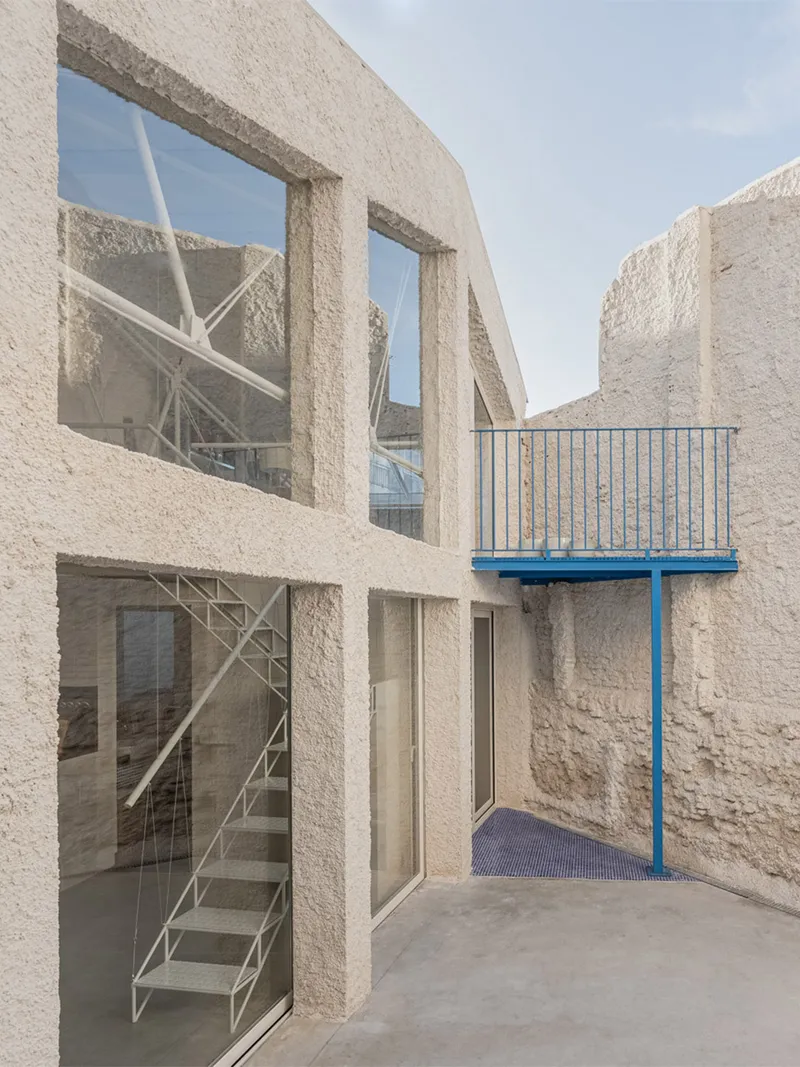
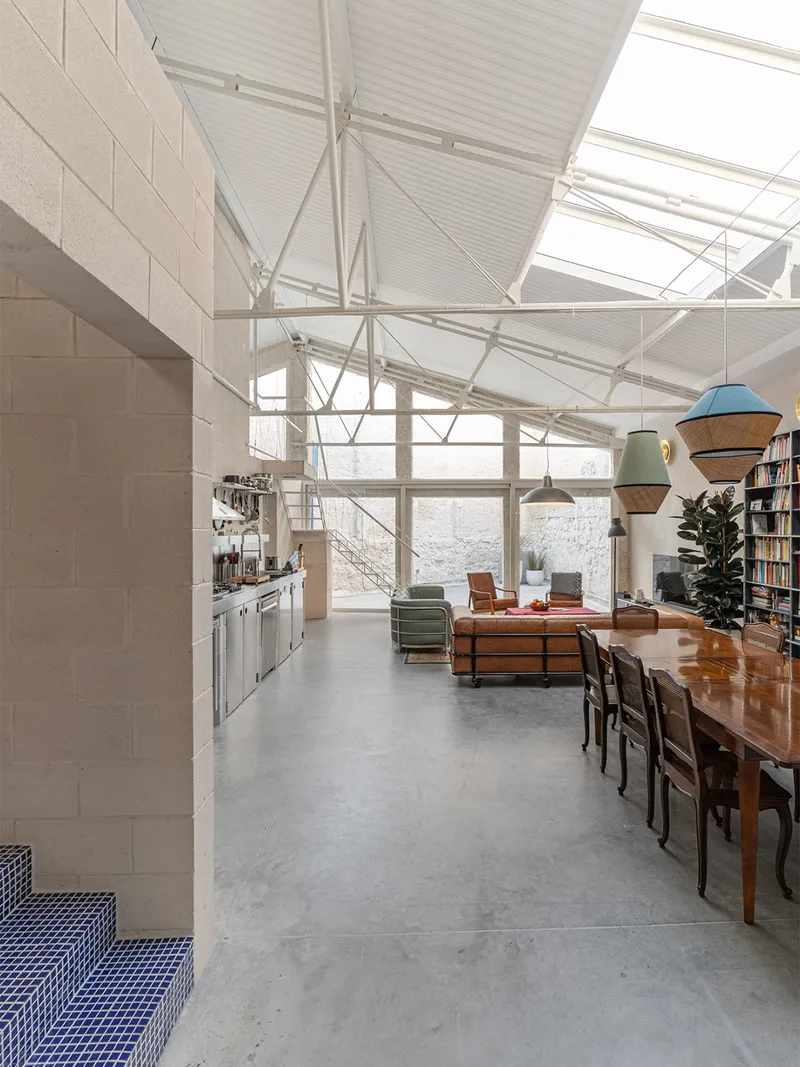
Blasón, the latest project in Burr's Elements for Industrial Recovery series, is a chic two-bedroom writer's residence located in a converted warehouse. The building's industrial roots are prominently displayed through the use of Tyrolean plaster on the existing walls. This plaster, with its creamy appearance, creates a cohesive surface while still allowing the patchwork of bumps and joins from the different wall materials to be identifiable. The single air volume connects all the spaces at different heights and serves as a storied backdrop for the residence.
 Maru Serrano, courtesy of Burr Studio
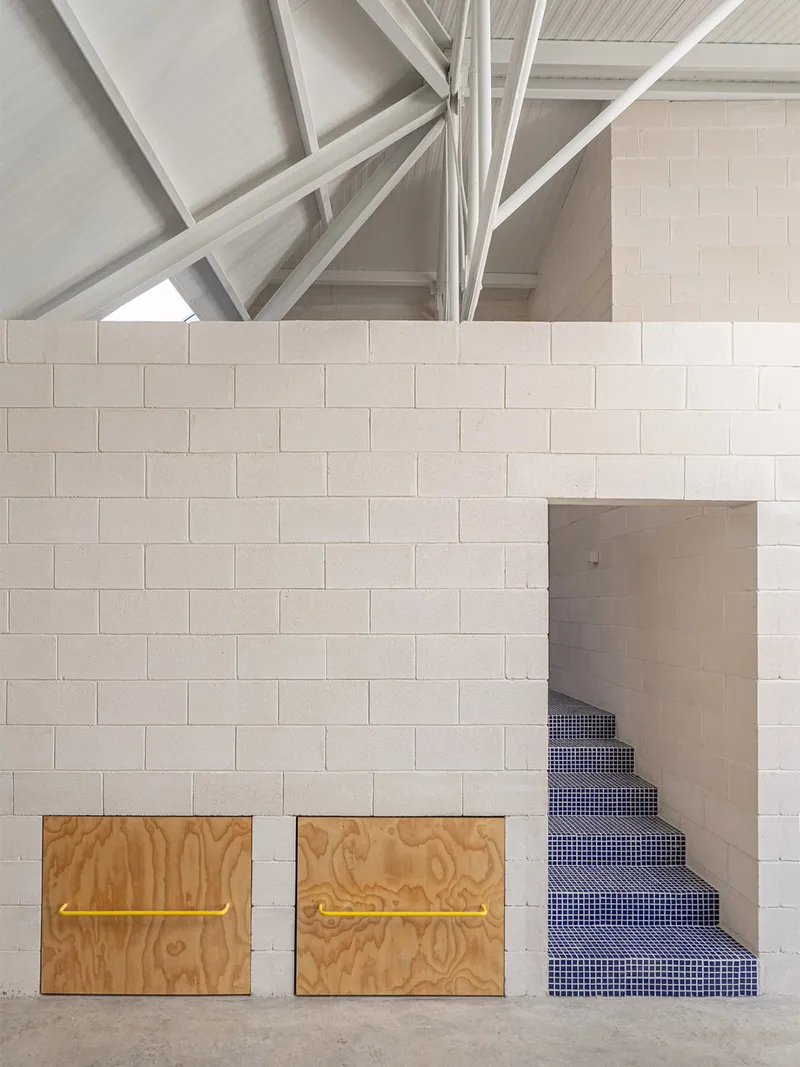
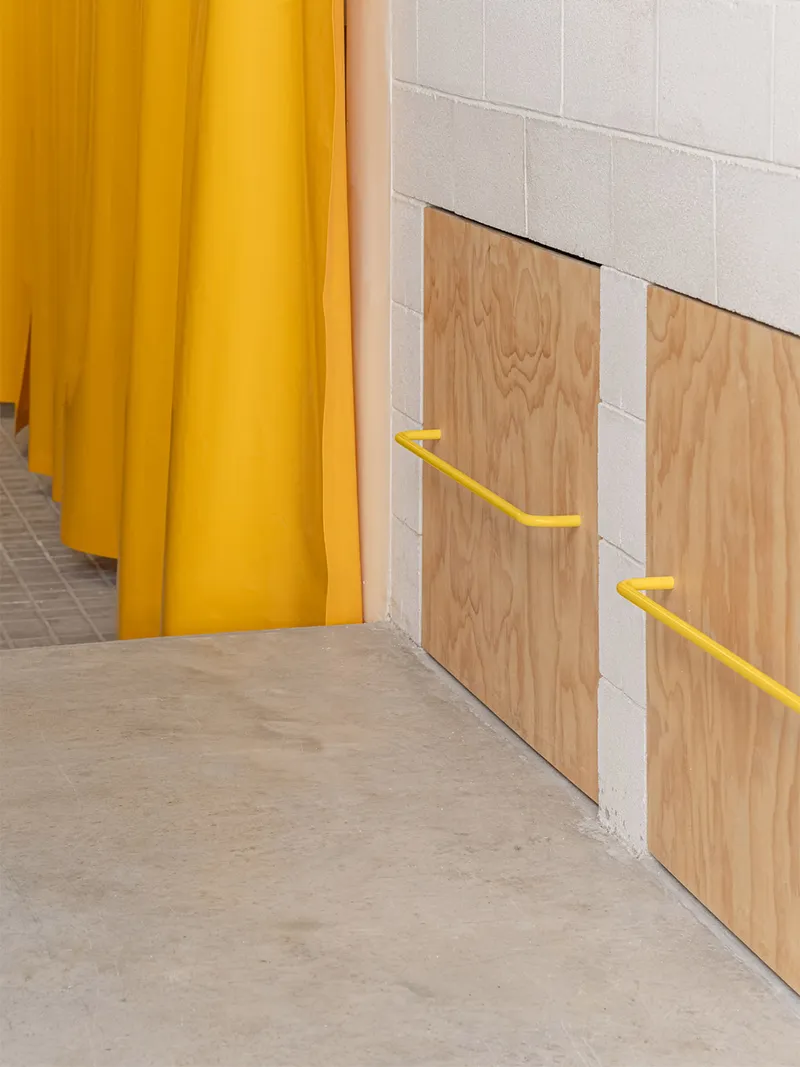
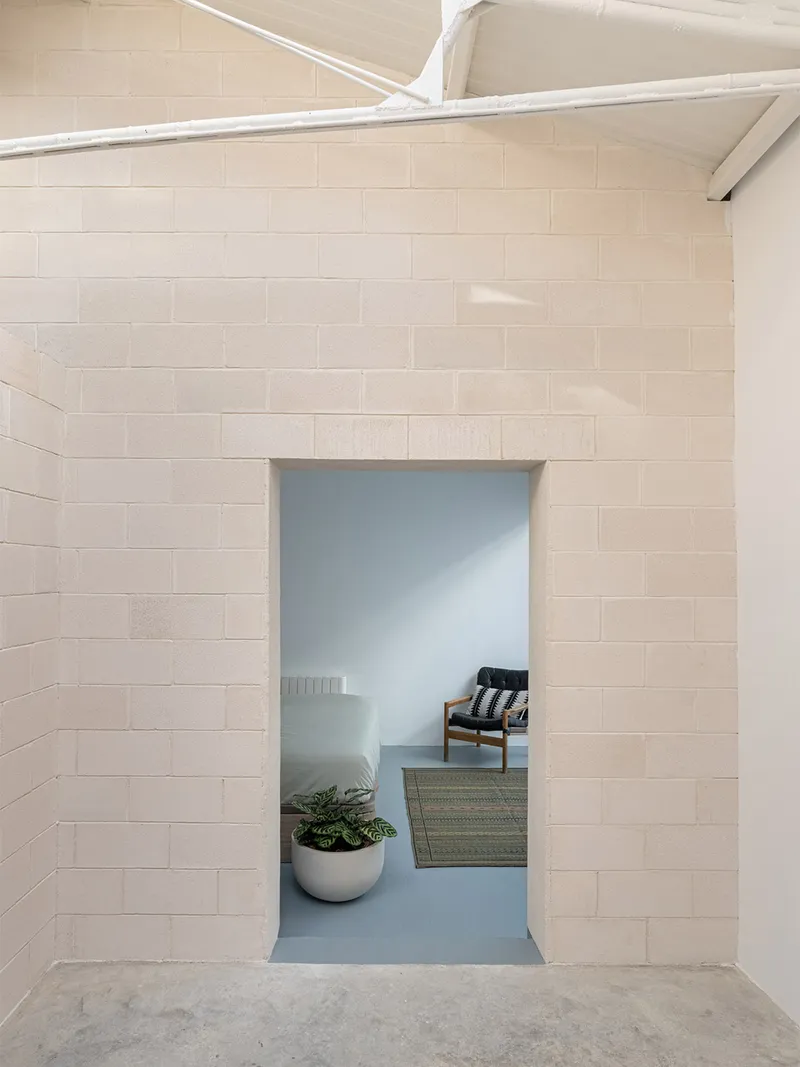
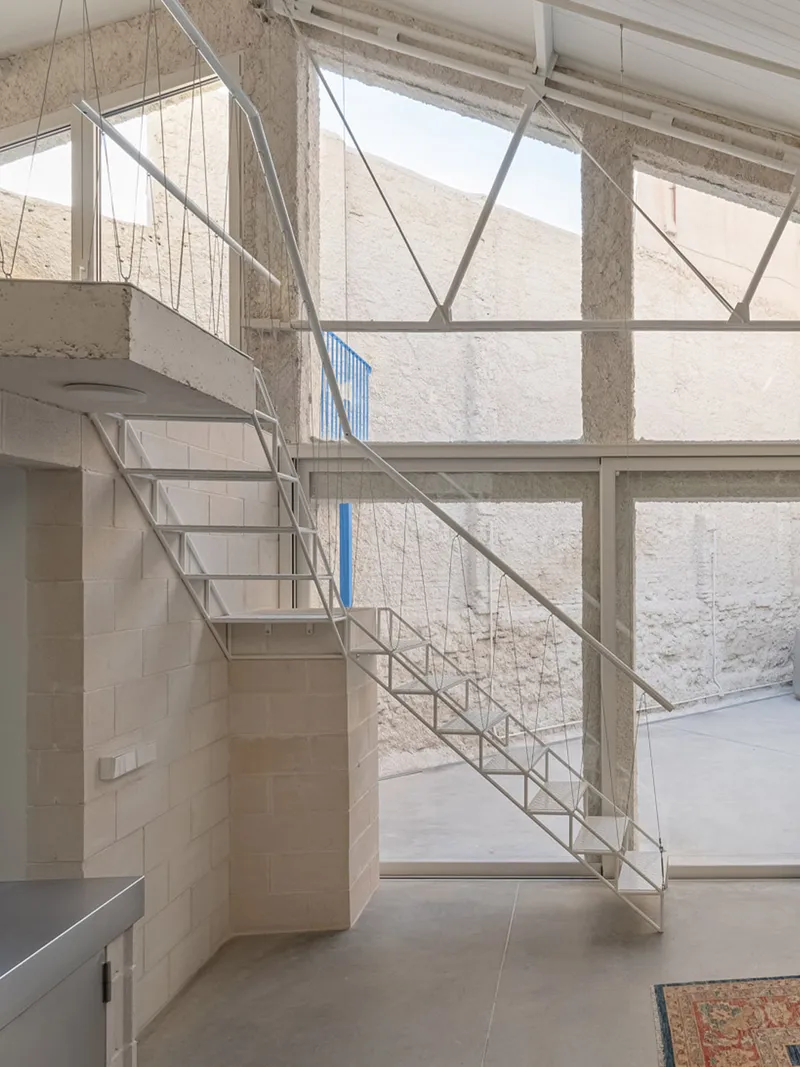
The Blasón residence is connected to a long boundary wall that connects the former warehouse to its neighbouring property. However, a new, more sturdy wall has been inserted into the centre of the residence. This central spine serves as a dividing line between the public and private areas of the home. The spine also serves as a hub for many of the home's amenities, including the kitchen, main bedroom and bathroom, guest bedroom, and a staircase leading to an upper-level office with a small blue balcony. The designers of the residence, the Burr team, describe how different elements of the spine create ledges, gaps, abutments, and buttresses. These features serve specific purposes, such as supporting the kitchen or providing a platform for a metal staircase leading to the study. Some of the ground-level voids have even been converted into storage bays with plywood cabinet faces.
 Maru Serrano, courtesy of Burr Studio
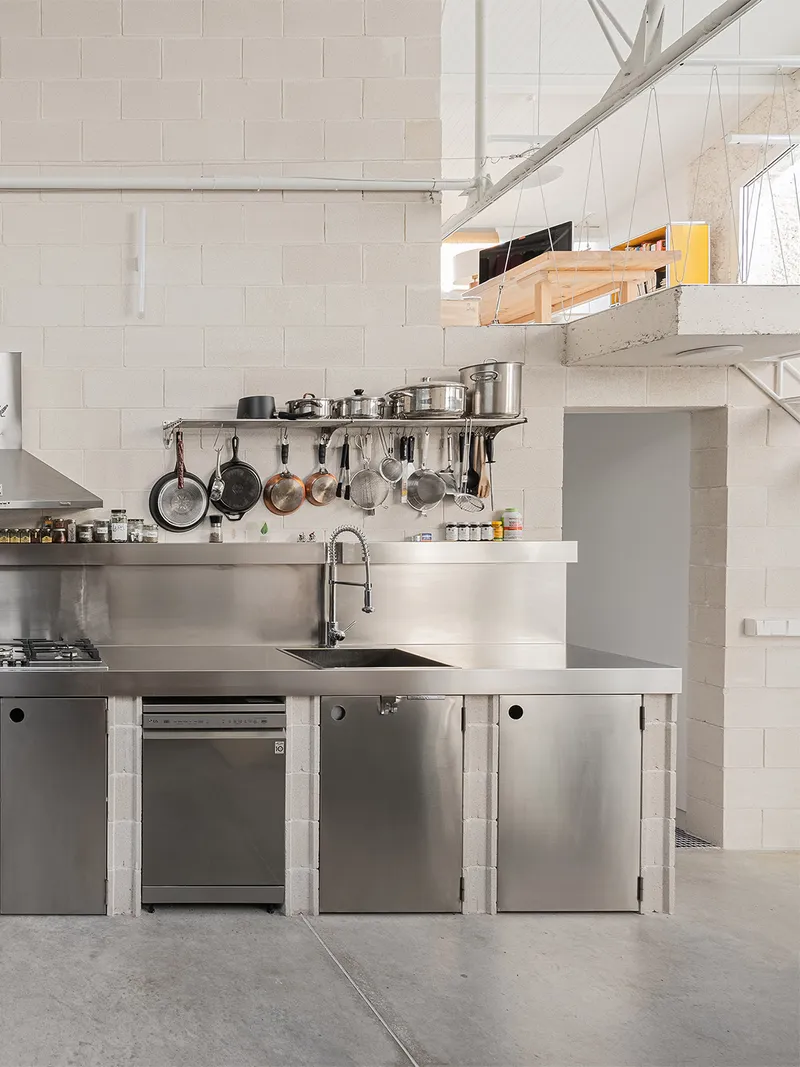
The white concrete brick wall, which is "superficially clad" to support certain features, divides the bedrooms and bathrooms from the shared areas of the house like the garage, gym, open-plan kitchen, dining, and living room. Major openings along the spine provide access to the bedrooms and bathrooms. In the kitchen, the wall is clad in stainless steel for the splashback, and in the bathrooms and bedrooms, it is covered in ceramic mosaic tiles for durability and easy maintenance, as well as to add colour.
 Maru Serrano, courtesy of Burr Studio
The roof of the building has an original metal structure that is described as "extremely slender" by Burr Studio. To increase its strength, the architects added steel bars without increasing the thickness of the elements. However, in order to restore the original design of the building, the architects had to remove the extensions that had been added over the years. These extensions had created internal courtyards, which the architects decided to restore in order to improve cross-ventilation and allow natural light into the interior spaces. The restoration of these courtyards also changed the appearance of the exterior and the rhythm of the facade.
"Our proposals aim to protect the industrial heritage of the city through land-use and occupation alternatives."
 Maru Serrano, courtesy of Burr Studio
 Maru Serrano, courtesy of Burr Studio
 Maru Serrano, courtesy of Burr Studio
 Maru Serrano, courtesy of Burr Studio
 Maru Serrano, courtesy of Burr Studio
 Maru Serrano, courtesy of Burr Studio
 Maru Serrano, courtesy of Burr Studio
 Maru Serrano, courtesy of Burr Studio
 Maru Serrano, courtesy of Burr Studio
References (1)

Popular Articles
Popular articles from the community


Tsunami Convergenics: Turning Catastrophic Ocean Forces into Underwater Housing Infrastructure
A speculative underwater settlement off the coast of Onagawa, Japan, treats tsunamis and typhoons as energy sources rather than threats.

The Amber Palace Opera: A Geological Fiction Surfaces on Tallinn's Baltic Waterfront
Pierre Brillard reimagines a Baltic legend as a public landscape, opera house, and waterfront promenade rooted in Tallinn's coastal identity.

Manzana Morphosis: Stretching Barcelona's Grid into a Living Landscape for 2050
A radical reworking of the Eixample manzana turns density into a tool for generous public space, vertical ecology, and environmental performance.
Faces of the Soviet Avant-Garde: Turning Moscow's Street Names into an Open-Air Museum
A network of sculptural installations across a Moscow residential district transforms forgotten architect names into spatial encounters with cultural memor

Similar Reads
You might also enjoy these articles
116 Rokeby Building, Collingwood
Sustainable Collingwood office building featuring double-skin façade, natural ventilation, rooftop amenities, and carbon-neutral design focused on wellbeing and longevity.
Contemporary Apartment Renovation in Spain: RV House by BIAN Opens Up to the Sea
A minimalist 1930s apartment in Santander is transformed into a flexible, sea-facing home through contemporary Spanish renovation.
3 Marías House: A Contemporary Mediterranean Courtyard Retreat by Bajet Giramé + Burckhardt
Mediterranean courtyard home blending traditional architecture with modern design, terracotta flooring, flexible interiors, sustainable climate strategies, and garden integration.
NZ10 Apartment by auba studio: Adaptive Reuse in Palma de Mallorca
Adaptive reuse apartment transforms bakery into light-filled home with patios, privacy layers, and wood interiors enhancing urban living experience.

Explore Residential Building Competitions
Discover active competitions in this discipline


Challenge to design mud housing for contemporary communities

Challenge to reimagine the Iron Throne

Photograph architecture without architects

Illustrate the lost glory of Angkor Wat - Render Challenge
Comments (0)
Please login or sign up to add comments
No comments yet. Be the first to comment!