
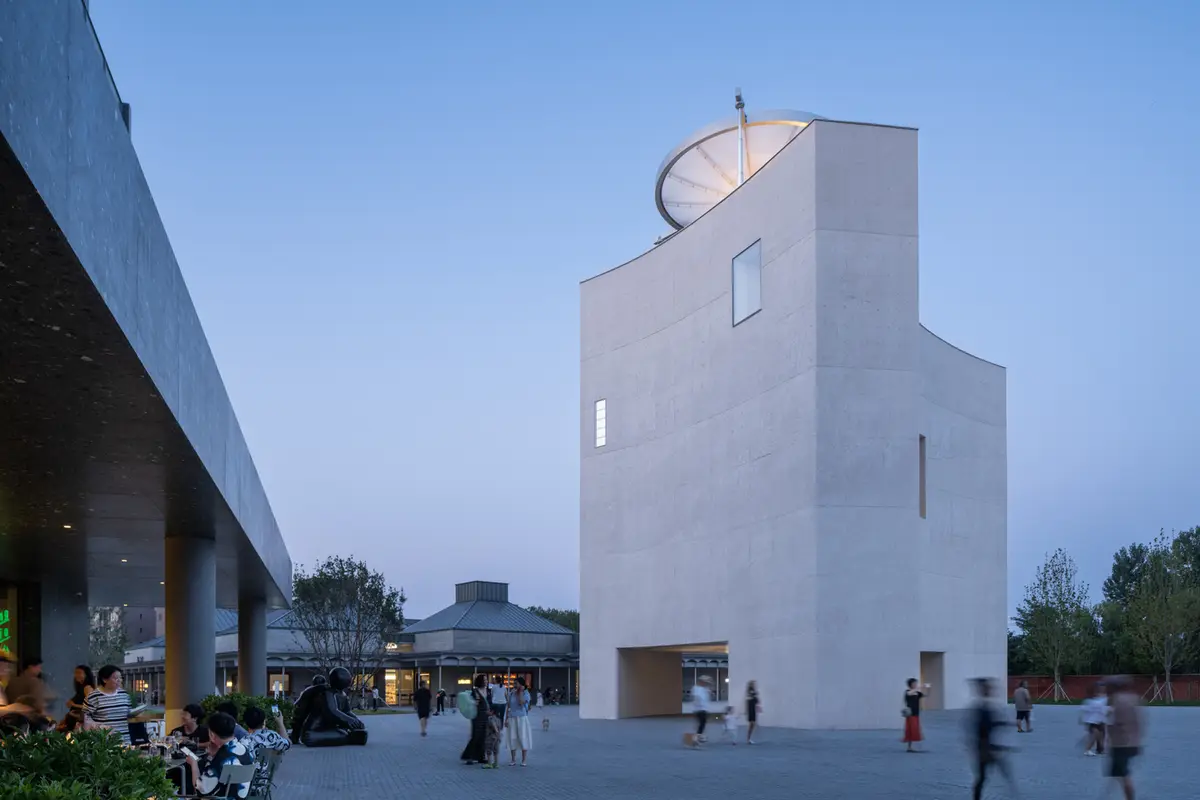
Vector Architects Plants a Concrete Music Instrument in the Heart of a Chinese Seaside Plaza
In Qinhuangdao's Aranya community, a retractable-roofed chapel channels sound through brass tubes from sky to earth.


Vector Architects has spent a decade building a quiet portfolio along the Aranya shoreline in Qinhuangdao, each project a precise negotiation between concrete, sea air, and contemplation. The Seashore Library, the Seashore Chapel, Restaurant y Sea: all three sit at the water's edge. The Chapel of Music breaks that pattern. Positioned not on the coast but at the center of Youyi Bay Plaza, it stakes a claim that architecture shaped by acoustics can hold its own as civic infrastructure, surrounded on all sides by the everyday rhythms of apartments, hotels, and market stalls.
What makes this building genuinely compelling is not its sculptural form, though the three concave walls are undeniably arresting. It is the vertical acoustic logic: a sunken stage on the upper level, nine brass sound transmission tubes threaded down through the seating, and a meditation rotunda below that receives music as a filtered, almost subterranean resonance. The section, not the plan, is the generative diagram. That inversion of how we typically organize a performance venue, with the audience above the stage and sound migrating downward, turns a 455-square-meter building into something genuinely experimental.
Three Walls and the Echo Principle
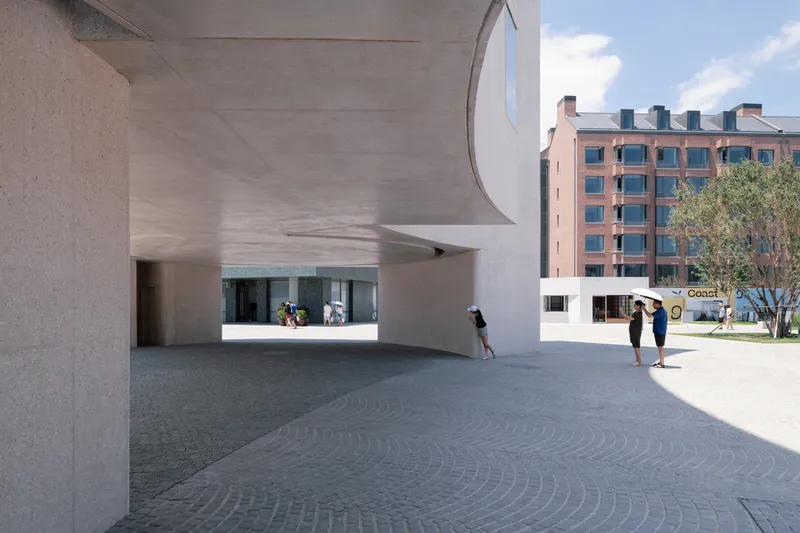
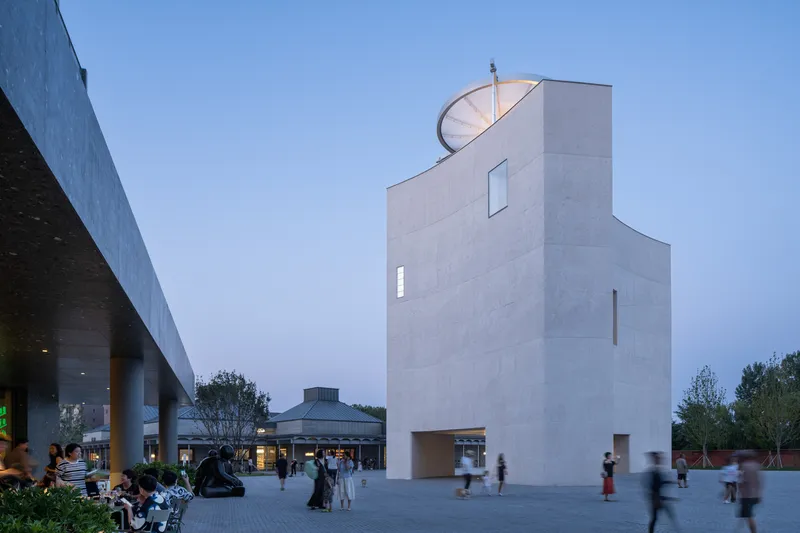
The building's exterior reads as a compact tower capped by a disc, its three concave facades drawn from the acoustic geometry of the Echo Wall encircling the Imperial Vault of Heaven in Beijing. Each curve responds to a different condition: pedestrian flows entering the plaza, the adjacency of market and canteen buildings to the north, and residential blocks to the west. The result is a form that simultaneously deflects and gathers, creating sheltered pockets at ground level while its upper volumes pull the eye upward.
Elevating the main volume off the ground is a deliberate civic gesture. The plaza remains permeable; visitors pass beneath the canopy on patterned stone paving without needing to engage the building at all. But the underside of that raised mass, with its curved concrete soffit and angled overhang, operates as a kind of urban living room, offering shade and rest in a community that swells with seasonal visitors.
Ascending the Ramp
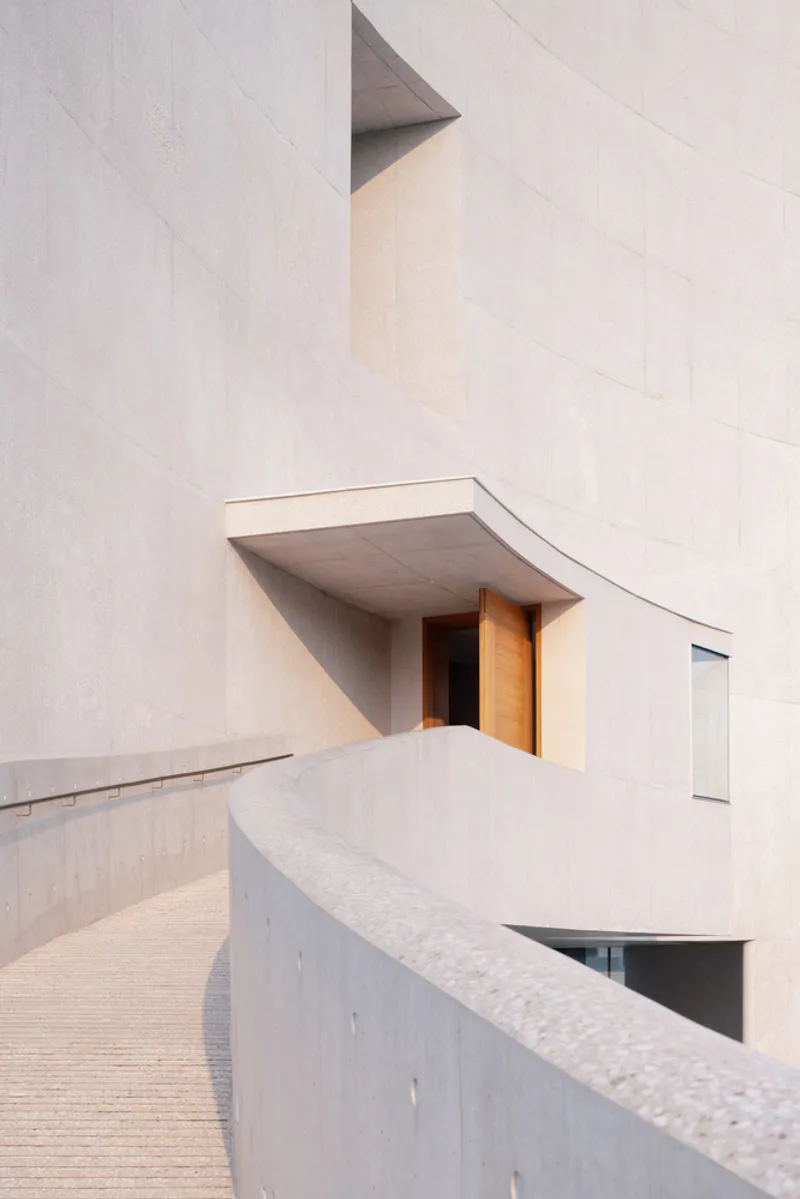
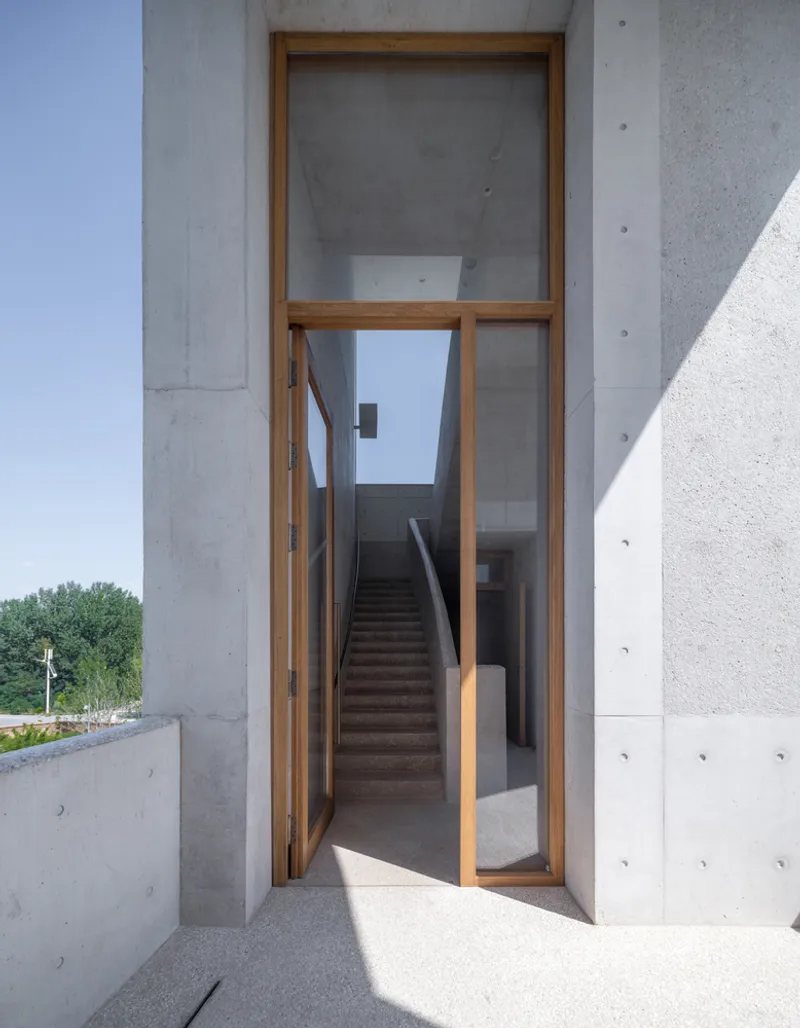
Entry is choreographed as a slow reveal. A long ramp, slightly offset from and parallel to the building's curving east wall, carries visitors up to a raised lobby. The timber door set within the deep concrete reveal signals a threshold between the noise of the plaza and the calibrated silence inside. Light narrows. The corridor compresses. By the time you reach the interior, your senses have already been recalibrated.
The detailing at these transition points is worth noting: fair-faced concrete meets teakwood framing with a precision that leaves no room for ornamental distraction. Everything is load-bearing, acoustically tuned, or both. The fifty-centimeter-wide gap where walls meet, fitted with operable glass panels, is not decorative. It introduces both daylight and breeze into the lower rotunda, keeping the meditation space alive rather than hermetically sealed.
The Skylight Music Hall
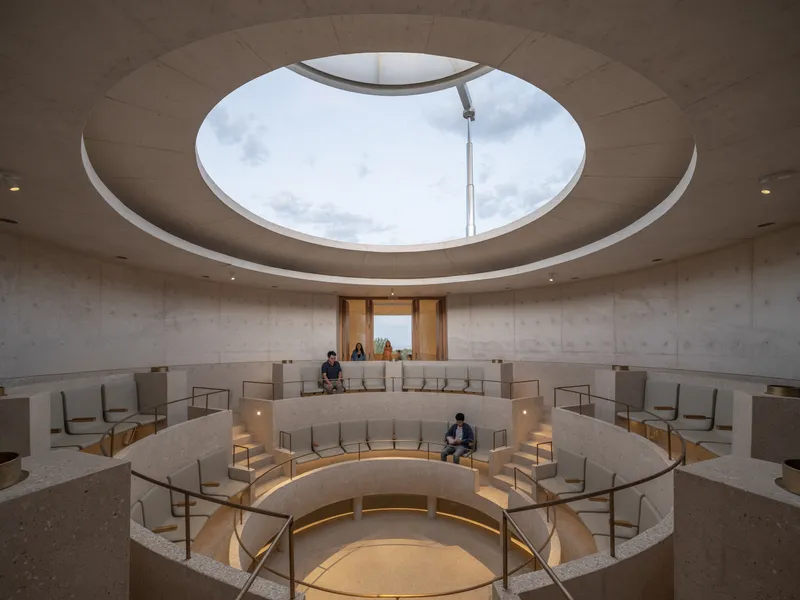
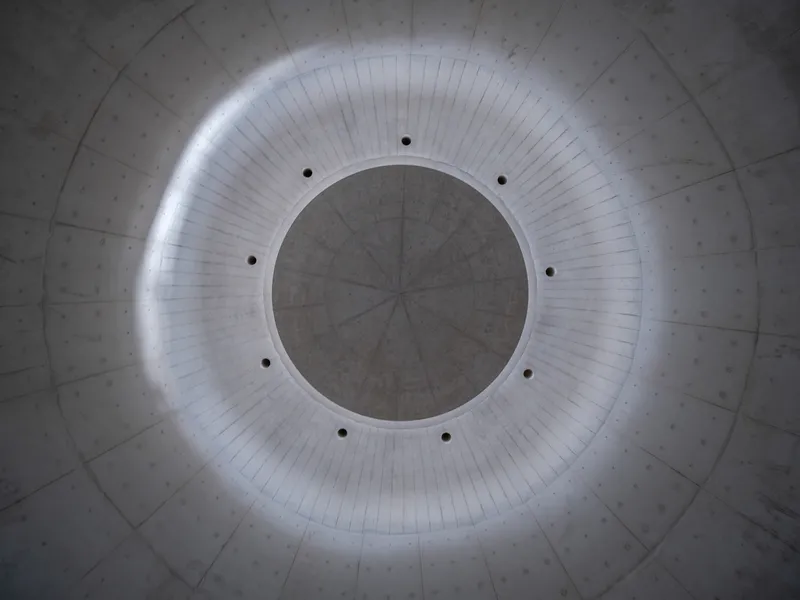
The upper music hall is the building's functional and emotional core. Forty-eight polished concrete seats surround a sunken stage on two levels, creating a tight, enveloping relationship between performer and listener. The circular plan ensures that no audience member is significantly farther from the sound source than any other, a practical consequence of the acoustic geometry rather than a purely formal choice.
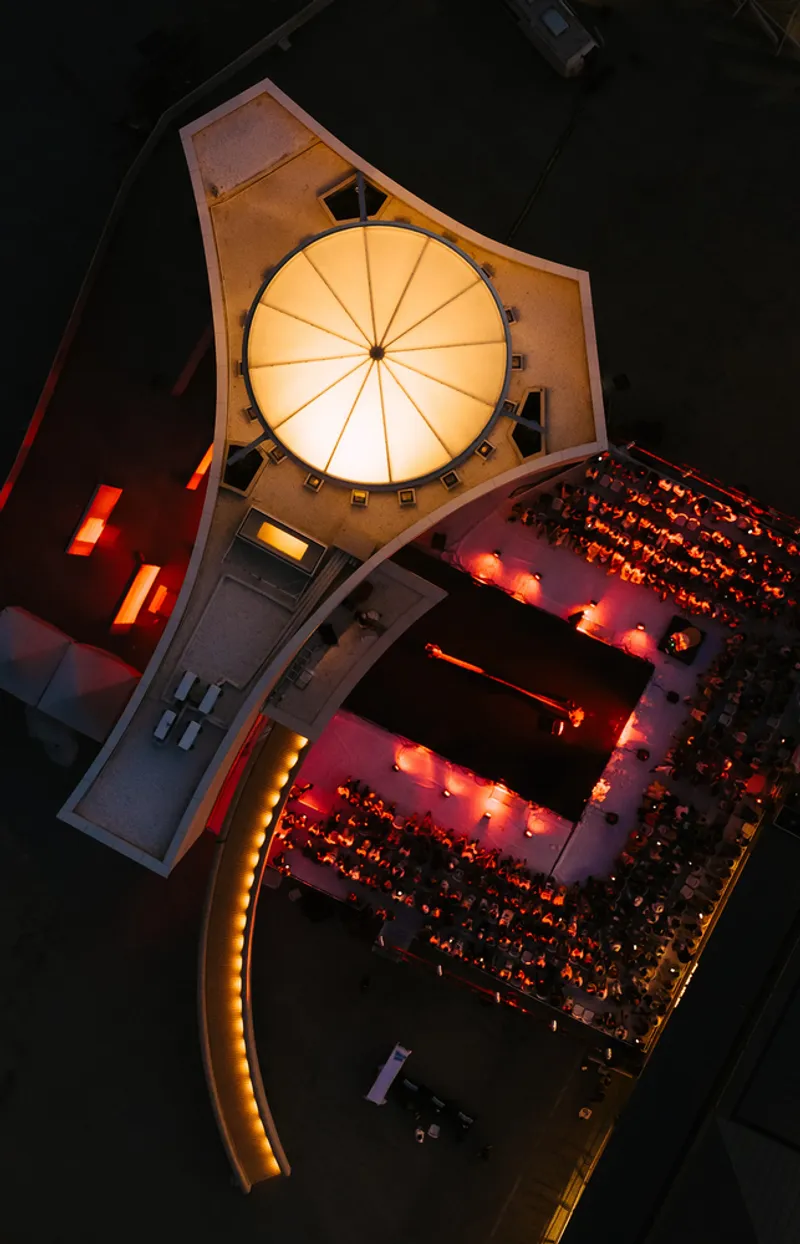
Above, the retractable circular pneumatic roof can project up to 4.9 meters when fully opened, converting the hall into an open-air theatre. In the night photograph with the audience seated under artificial light, you can see the radial ceiling pattern and the warm glow that the concealed perimeter lighting casts against the concrete dome. When the roof retracts and the sky enters the room, the acoustic character shifts entirely. The building becomes a funnel for weather, light, and ambient sound, collapsing the boundary between concert and environment.
Nine brass sound transmission tubes, embedded within the seating structure, carry music from this upper hall down to the meditation rotunda below. It is a deliberately analog technology in an era of digital sound distribution, and it gives the lower space a character that speakers could never replicate: music arrives softened, diffused, slightly delayed, as though heard through the walls of the building itself.
The Meditation Rotunda Below

Nine meters high and shaped by the same concave walls that define the exterior, the lower rotunda is a space of enforced stillness. Polished concrete seats arranged along the perimeter resemble lounge chairs, inviting visitors to recline rather than sit upright. Natural light filters through the narrow gaps between the curved shear walls, creating slow-moving lines of illumination that track the sun's arc through the day.
The corridor that frames a distant landscape view at dusk captures the rotunda's essential quality: a controlled aperture onto something vast. Whether that something is the sea horizon visible through the eastern facade's large view window, or the music descending from above, the rotunda positions the visitor as a receiver rather than a participant. You do not perform here. You absorb.
Rooftop and the Sea

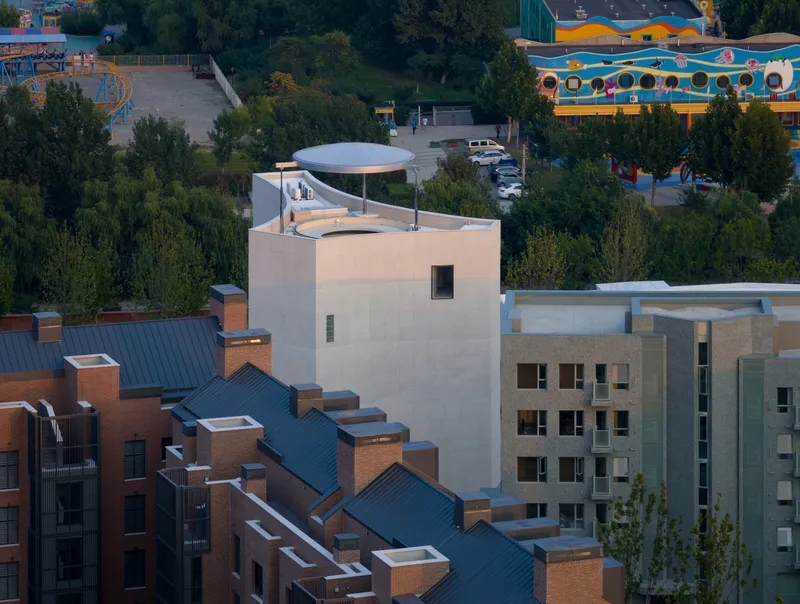
The rooftop terrace, with its curved metal canopy on slender posts, offers a panoramic view of the sea that none of the interior spaces fully deliver. It functions as a decompression zone: after the acoustic intensity of the music hall or the meditative quiet of the rotunda, visitors emerge into wind, light, and horizon. The canopy's disc shape, visible from the aerial shots at dusk, gives the building its distinctive silhouette against the residential skyline.
Placing this outdoor moment at the building's summit completes the vertical narrative. You enter at grade, ascend through a ramp, pass through compressed corridors, sit inside a concrete drum of calibrated sound, and then break free into open air and ocean. The sequence is cinematic in its pacing, and the payoff is genuine.
Why This Project Matters
Small performance venues tend to follow predictable typological scripts: a rectangular room, a stage at one end, absorption panels on the walls. The Chapel of Music rejects that script by making the section, not the plan, the primary organizational tool. Sound moves vertically through brass tubes. Light enters through gaps in shear walls and a retractable pneumatic roof. The audience surrounds the performer on two levels. Each of these moves carries real acoustic and spatial consequences, and together they produce a building that feels genuinely invented rather than assembled from precedent.
For Vector Architects, this fourth Aranya project also marks a significant shift in ambition. The earlier coastal buildings could rely on the drama of the sea as a collaborator. Placing a building in the middle of a busy community plaza demands a different kind of conviction: the architecture must generate its own atmosphere, independent of landscape. The Chapel of Music does exactly that, turning 455 square meters of concrete, brass, and teakwood into a self-contained acoustic landscape that earns its place at the center of daily life.
Chapel of Music by Vector Architects. Located in Aranya, Beidaihe New District, Qinhuangdao, Hebei, China. 455 square meters. Completed 2023. Photography by Shengliang Su, Arch-Exist, Hao Chen, and Zaiye Studio.
About the Studio
Share Your Own Work on uni.xyz
If projects like this are the kind of work you want to make, uni.xyz is a place to publish your own, find collaborators, and enter design competitions.


Popular Articles
Popular articles from the community


Co-Life: Senior Housing Design That Reconnects Older Adults With the City
Co-Life reimagines senior housing design through healing gardens, shared streets, workshops, and a sustainable community across generations.

Lunar Spiral: Space Architecture Shaped by the Mathematics of the Universe
Lunar Spiral reimagines space architecture through Fibonacci geometry, lunar regolith, levitating habitats, and self-sustaining Moon living.

The Musturak Paradise: Senior Living Architecture for a Connected Future in Temara, Morocco
The Musturak Paradise reimagines senior living architecture in Temara via private homes, social spaces, culture, community, and shared care.

Co-life: Sustainable Architecture for Age-Friendly Community Living
Co-life reimagines sustainable architecture for seniors through courtyards, rammed earth, shared gardens, and spaces designed for belonging.

Similar Reads
You might also enjoy these articles


Hodi-Mandai Geram
Project Function: Preservation and revitalization of the Intangible heritage and socio-spatial identity of the Hodi by Housing, Cultural Memory Center, Sacred Grove, landscape, local tourism economy


Olio Towers: A Mid-Rise for Performers That Fuses Housing, Rehearsal, and Stage
Located blocks from Houston's Theater District, this modular tower stacks living units around a central performance atrium.

Oasis: Modular Green Housing Carved into Dhaka's Urban Fabric
A shortlisted Plugin Housing entry reclaims unauthorized settlements in Dhaka with stepped concrete volumes, green roofs, and ventilation-driven design.

Black Hole: A Floating Megastructure for the Post-Physical Era
Emiliano Mazzarotto envisions a spherical, self-scaling arena where e-sports, digital hotels, and holographic stadiums replace traditional public space.

Explore Chapel Competitions
Discover active competitions in this discipline

Challenge to reimagine the Iron Throne

Photograph architecture without architects

Illustrate the lost glory of Angkor Wat - Render Challenge

Design challenge to reuse E-waste
Comments (0)
Please login or sign up to add comments
No comments yet. Be the first to comment!