

Flying Shop
The brief is to design a retail store that redefines the traditional market prototype in today’s changing times. This proposal consists of an airship that hosts a shop inside. The buying experience becomes unique: buying while flying above in the sky.

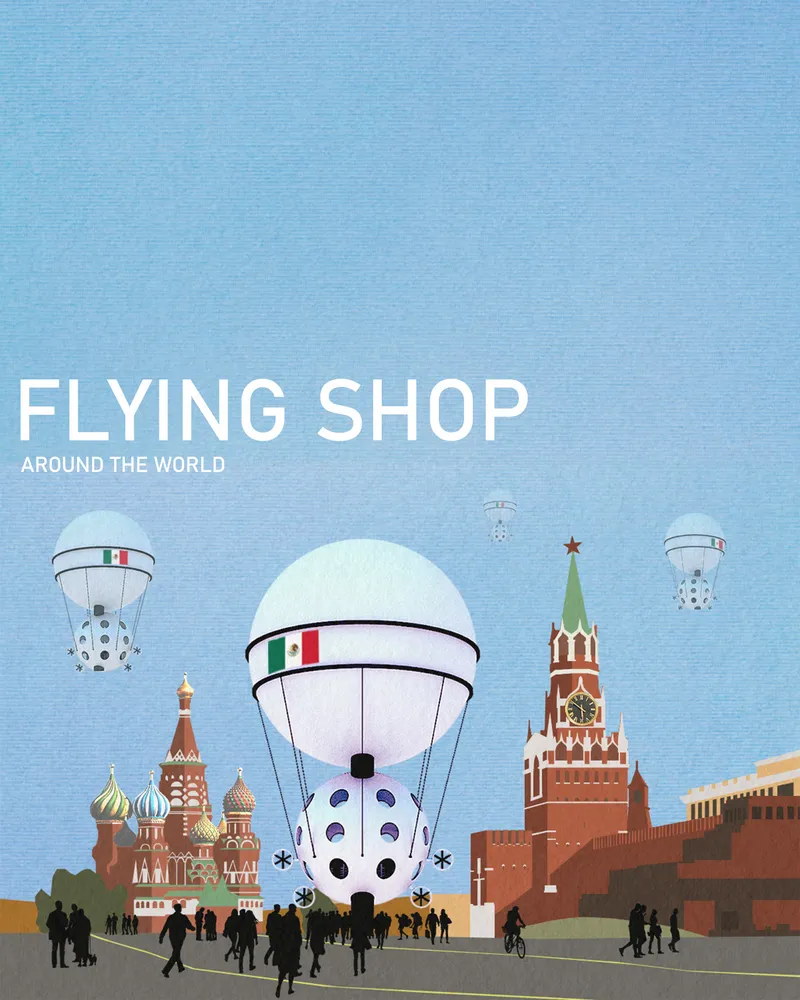 Retail of Tomorrow Cover Board
FAQ'S
1. What was the concept behind the project?
The air balloons, airships and other flying machines that catch the human senses when in flight.
2. What was the intent behind the organization of elements across various levels (Architectural, site, urban?
The sphere is a form that can be used for aerodynamic purposes, it's also flexible when making the space distribution for the interiors. The commitment of this concept is to minimize the surface needed, so it does not occupy a piece of land permanently like most of the buildings. Intended not to be part of a city, but the world instead.
3. How was the programme condensed into final?
From the beginning, it was stablished that 70% of the surface would be assigned to a commercial purpose, the other 30% for storage, crew and machine room. The learning process of this design made it clear that a sphere form has a tremendous flexibility.
4. How was a specific objective attempted to be met?
The main topic is "The future of retail". How to compete with e-commerce? It's well known that the "buying experience" must be unique if there's to be a stand against online shopping. The pandemics, the climate change and economic recessions are unstable factors that cannot be totally controlled even if taking the necessary measures. The focus always was the "buying experience". Nevertheless, because it is an airship, it works mostly like an airplane: the ventilation system is the very same: clean air, purified constantly so diseases can be prevented.
5. What is the expansion plan of the project?
A simple answer: building more units. Because it is airship and is about to fly in the sky, the form must remain the same for aerodynamic reasons.
6. How will the project transform with the passing time?
Very few. Very little has changed since the human started to fly. Flying is an unique experience, enjoyed by many. The transformation, perhaps, will be found in the development of new technologies, the increase of a cultural level worldwide, and the need of leisure activities for all humankind.


Popular Articles
Popular articles from the community


LT2A and OPEN Architectes Thread a Brick and Glass High School Through a Wooded Belgian Campus
In Braine-l'Alleud, a 3,000 m² wing for Collège Cardinal Mercier pairs pale brick with a glazed colonnade, deferring to a small chapel and a dense wood.

graciastudio Turns a Viewless Tijuana Lot Inward Around a Courtyard of Concrete, Timber and Trees
In Tijuana, Jorge Gracia's GA2 House stacks a timber-clad private floor over exposed concrete and replaces a missing view with a planted interior patio.

David Ortega Stacks a Two-Story Mexico City Penthouse Around a Steel Stair and a Pergola-Shaded Roof Terrace
In Colonia Roma, a 300 m² penthouse uses oak joinery, a planted steel stair and a slatted roof pergola to make a new-build apartment feel like a house.

The Amber Palace Opera: A Geological Fiction Surfaces on Tallinn's Baltic Waterfront
Pierre Brillard reimagines a Baltic legend as a public landscape, opera house, and waterfront promenade rooted in Tallinn's coastal identity.

Similar Reads
You might also enjoy these articles
Yenisei Monitoring Center: A Sun-and-Moon Sphere Anchors a Research Campus on Siberia's Great River
In Krasnoyarsk, shifting square blocks, a glazed central sphere and descending window rhythms turn river science into a public spectacle on the Yenisei.
Andretta Artist's Village: A Node-Based Masterplan That Lets the Hills Write the Plan
A cultural landscape strategy for Palampur's artist colony threads studios, residences and stages along a porous spine shaped by the Dhauladhar terrain.
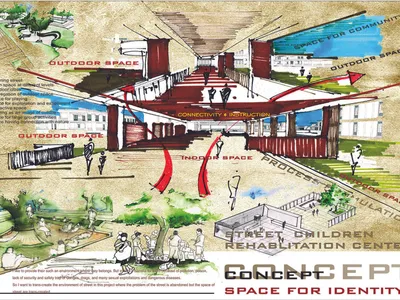
Street Children Rehabilitation Center: A Brick Campus That Eases Children From Street to Safety
A low-rise courtyard campus where learning streets, uthans and shaded verandahs stage a gradual passage from street into protective, family-scale life.
The NEON Culture: A Field of Pavilions Built for the 24-Hour City
Smaran Alva spreads galleries, stages, clubs and markets across a varied site, treating light, sound and ramped movement as the real building materials.


Comments (0)
Please login or sign up to add comments
No comments yet. Be the first to comment!