
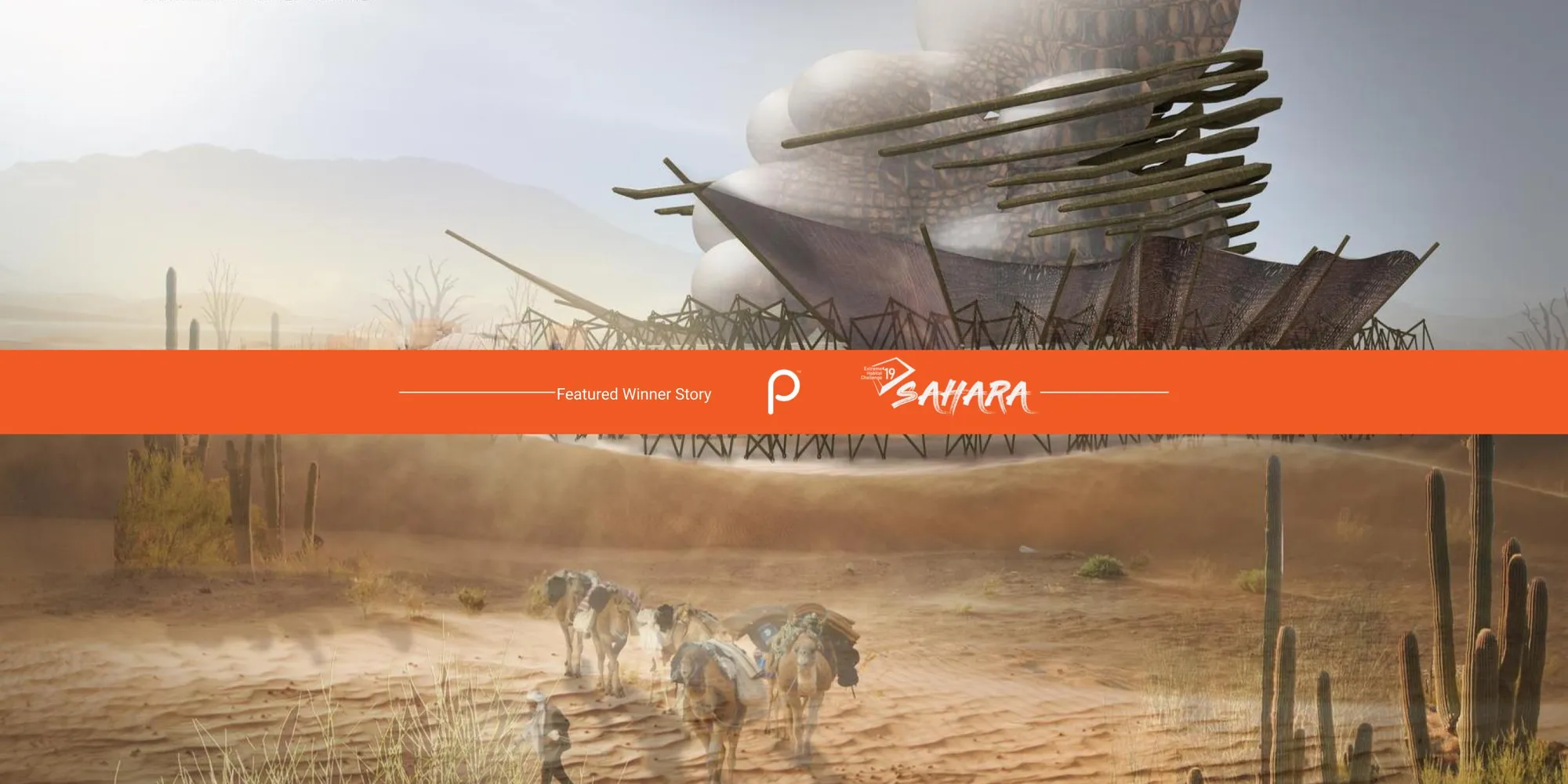
This is how Sahara can be inhabited via the hyperloop of the future connecting New York and Mumbai.
Making extreme habitats possible


The competition
The Extreme Habitat Challenge (EHC) is one of the world’s most coveted competitions for habitat design. It recognizes exceptional ideas that redefine habitat design through the implementation of innovative ideas, techniques, construction, visual, programmatic and futuristic organizations through architecture as a tool. EHC embarks itself on technological and engineering innovations which are about to go big and sets architecture free to innovate more in these uncharted directions. It is a one of its kind platform that promotes the relationship between the habitat + technology + planet.
The jury for the competition consisted of esteemed designers, professionals and academicians from around the world. The Lead Jurors for the competitions were as follows:

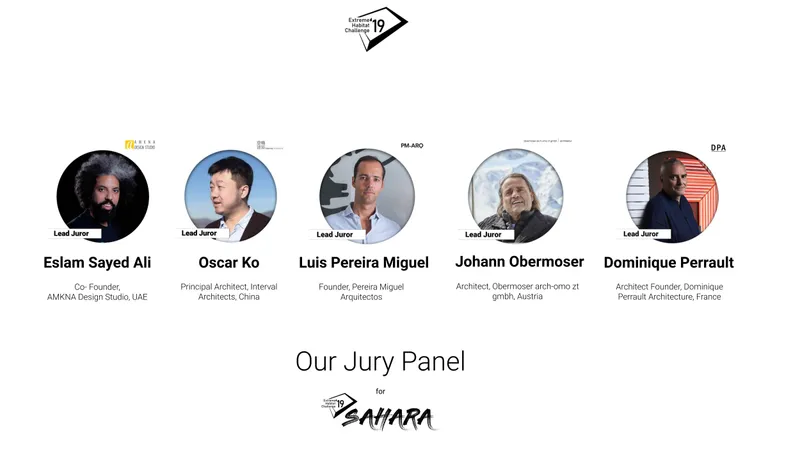
Eslam Sayed Ali, Co-Founder, AMKNA, UAE | Oscar Ko, Founder, Interval Architects, Shanghai China | Luis Pereira Miguel, Founder, Pereira Miguel Arquitectos, Portugal | Johann Obermoser, Founder, obermoser arch-omo zt gmbh architecture, Innsbruck, Austria | Dominique Perrault, Founder, Dominique Perrault Architecture, Paris, France
Here are the best of competition projects as follows:
Winning project: WEAVING WATER
By: Shuchuan Yang, Jiani Li, Jiayan Shao
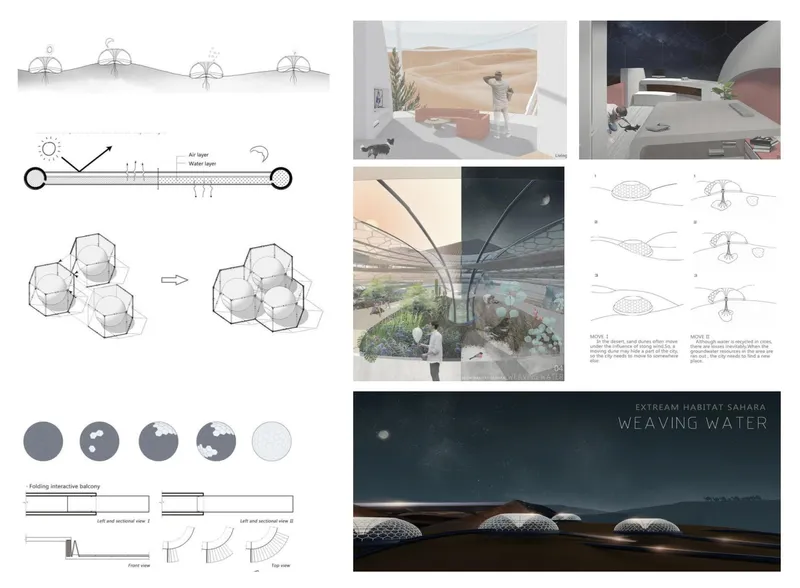
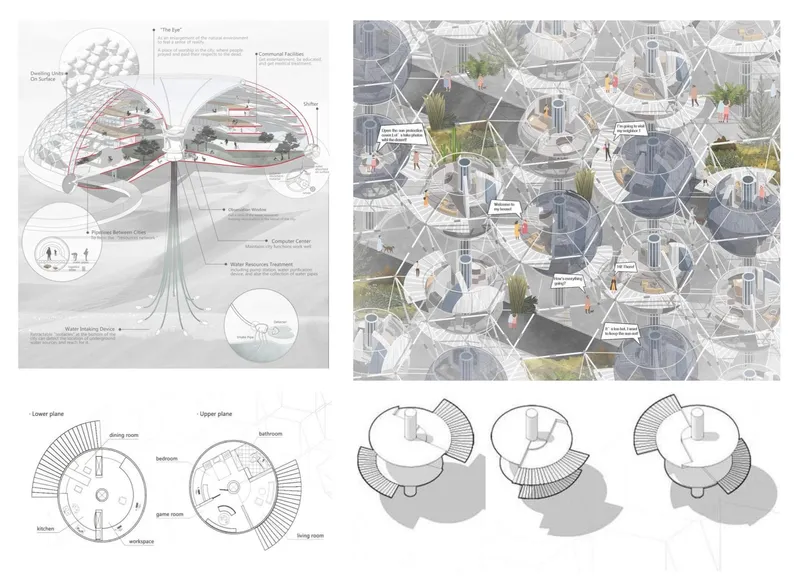
Description: The final habitat consists of several prototype cities and resource sharing pipelines. The prototype city is a giant water intake and catchment itself. The residential area is distributed on the surface of the spherical city. The sprawl is based on the concept of "resource networks". As the original urban population grew, resources (mainly the water) became scarce, so the "pioneer squad" split up in search of new suitable sites. "Pioneer team" finds a suitable area and then settles down. In this process, the original city sends resources to the "pioneer team" through pipelines to ensure its normal operation before it settles down. After settling down, this newly born sub-city can also be connected to the original mother city through pipelines. Then the mother and child cities develop and expand, more sub-cities are born, then a "resource network" connected by pipelines gradually formed in the desert. Just as an old Chinese saying goes, "if one side is in trouble, all sides help", people in the desert help each other and develop together.
The prototype city is a giant water intake and catchment itself. Retractable "tentacles" at the bottom of the city can detect the location of underground water sources and reach for it. The surface of the city is made of special water-collecting material. The precipitation can be retained to the greatest extent and collected into the water collecting device in the outermost circle. The core of the city is a water purification device, which purifies the collected rainwater, groundwater and domestic and production sewage, and pressurizes them to be transported to the top through the huge structure (including pipes) in the centre of the city, and then to hexagonal pipe network to each water-using unit.
Jury Comments: "The visionary proposal shows a grounded, accurate environmental analysis of the Saharan context and its topics.
The design appropriately generates visionary responses to key‐problematics as basic resources supply, shelter and a conscious energetic self‐sustenance, unavoidable themes for thinking about human settlements in extreme contexts. Moreover, it creatively answers to the requirements of an embryonal, expandable, nomadic settlement.
The functional mixture of living, working and recreational areas unveil visionary yet feasible solutions; the green core replies to the human longing for the nature element. Dwelling‐units display flexible applications and interactions with public and social spaces." - Johann Obermoser.
-------------------------
Honourable Mention: SAHARA FORTOPIA
By: Zixuan Lin, Yue Jia & Jiageng Chen
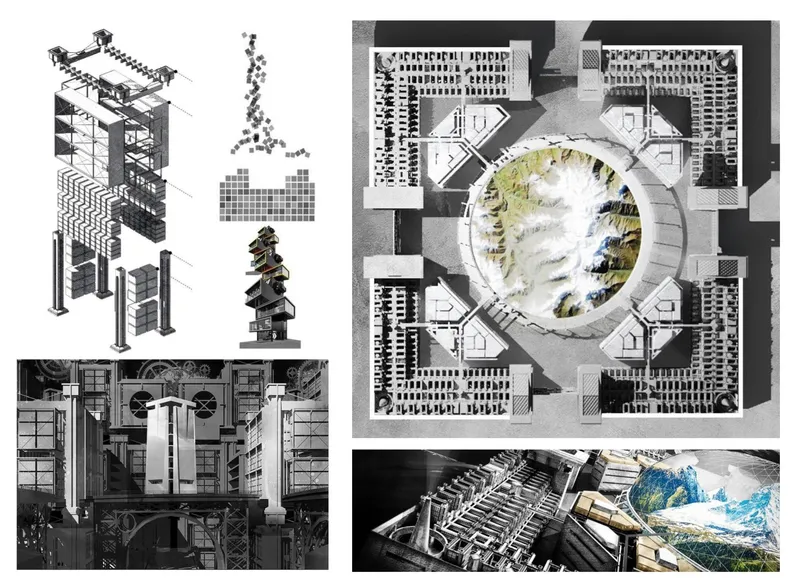

Description: Sahara Fortopia is a fort to protect people from harsh climate conditions and a utopia of the natural environment as an oasis in the desert. The main idea is to combine the course of Industrial modular habitat construction and the import of controllable natural environment, eventually creating a hugely complex world.
Talking about the population scaling strategy with the method of industrial modular, the first batch of dwelling units (including living modules, activity centres and guardrooms) can be transported to the site and assembled quickly. Living modules are designed to accommodate different living conditions from solitude to family of four to five, congruous with adequate population. So the residential zone in one prototype consists of a certain proportion of different modules, suitable for a stable society of 1000.
The architectural concept concentrates on the settlement and regular square shape instead of point block and tower buildings which is not suitable in the tropical desert climate in the Sahara and is also hard to construct because of the instability of foundation and also to the disadvantage of energy conservation. The design of a symmetry plan make construction and assembling much easier, facilitate the organization of transportation inside the habitat as well.
--------------------------------
Honourable Mention: NOMADIC NEST OF SAHARA
By: Jiang Peiwei
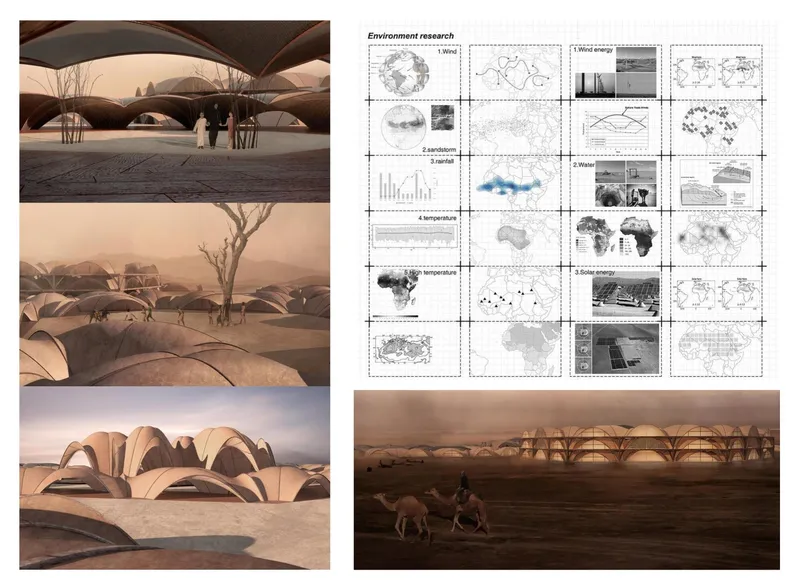
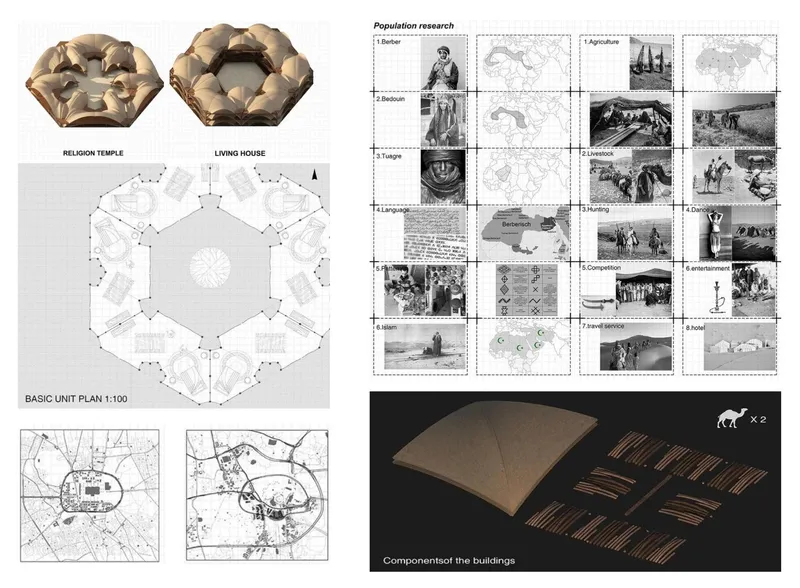
Description: The design is intended to find a construction that is based on the local materials and adapted to the desert living environment through the study of Saharan traditional tectonic and modern temporary construction technology. And also with reference to modern structures and materials, finding the current and future desert living patterns.
-----------------------
Honourable Mention: SANDCRETE CITY
By: Terrence Thackeray & Alexi Constantinou

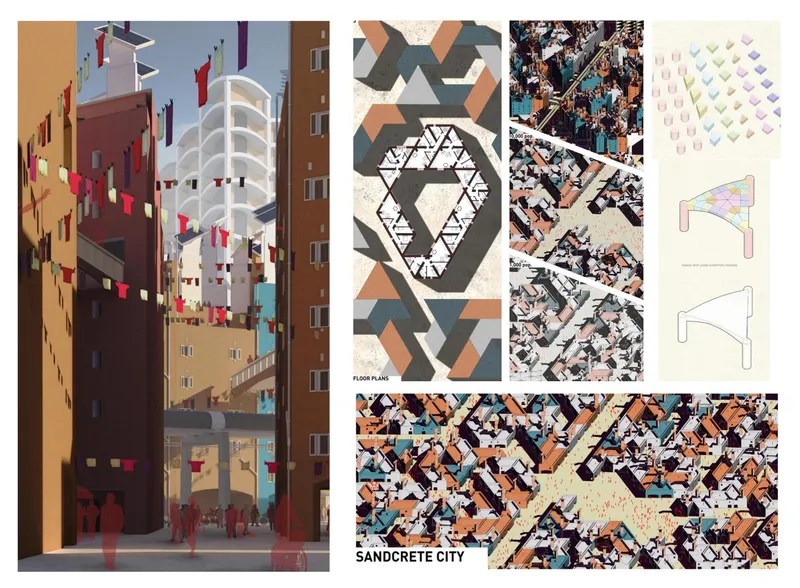
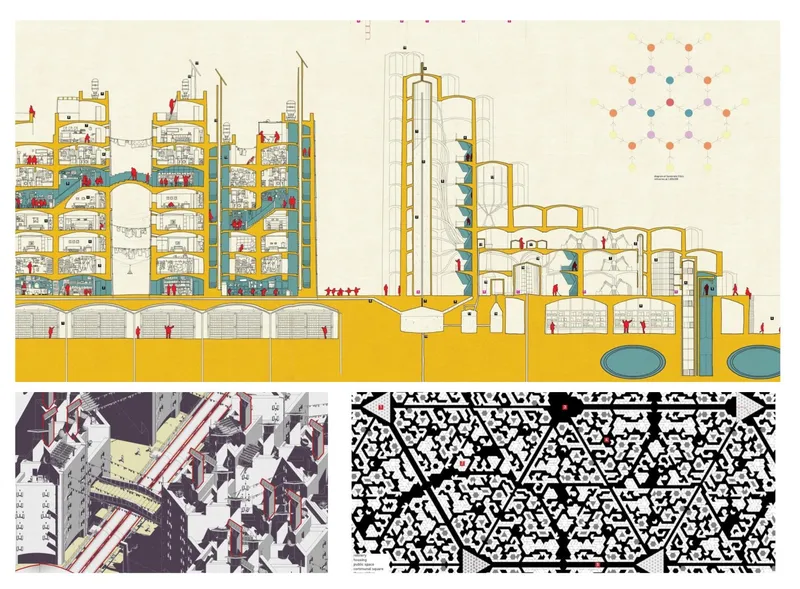

Description: The construction of the world's first Sandcrete City is a response to the Global Sand Crisis currently sweeping the construction industry. The project explores the potential of constructing a self-sustaining city using only natural materials found in the Mauritanian desert and aims to be a catalyst for a more innovative and responsible future.
All three elements have been integrated in a manner that minimizes walking distances and exposure to direct sunlight. All dwellings within a neighbourhood are designed around each refinery and are no more than 200 metres away from it; which most of the journey can be achieved in shade. The narrow streets and internal communal areas weave around dwellings and provide open spaces that serve commercial units and public-funded spaces such as schools. Playspaces have also been provided within the urban fabric of the city, however, the endless narrow streets and courtyards provide the space required for children and other recreational activities.
To avoid extreme temperatures and water waste, the cites farming is entirely underground and takes advantage
of aquaponic systems along with low energy lighting methods for growing plants. The low energy lighting system creates underground 'pink houses, whereby we give plants only the wavelengths of light they need the most which are blue and red. Using LEDs not only save energy but also result in a cooler internal environment, allowing you to place them close to the plants, which can be stacked. Water is obtained from the natural underground reserves located 10-25metres underground.
People’s Choice Award: MIGRATING BEHEMOTHS
By: Yuqian Li & Zhiyan Cai

Description: The vision includes the creation of an ancient behemoth in which a building is designed that can move around and, satisfying the needs for desert survival and provide a new lifestyle of a migrating city.
People’s Choice Award: HEXAGON CITY
By: Pieter Scholten
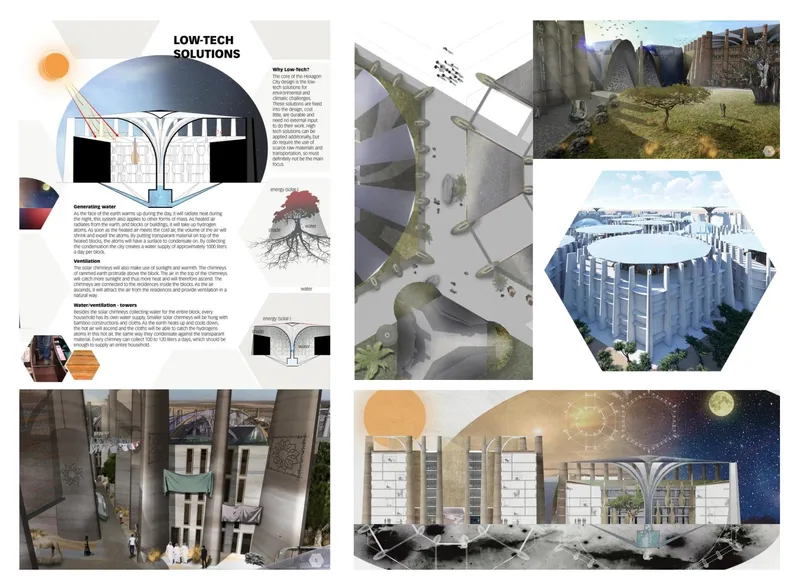
Description: Hexagon City challenges the norm by using materials at hand at the building site, by making optimal use of the land and by applying low-tech solutions to supply the city with durable energy, water, shade and cooling.
The city was designed with low-tech solutions for providing water, cooling, energy and food production. The hexagon grid is able to expand all ways and had an optimum usage of site area.
The high-tech options are considered in addition so this was not a matter of design for the city but is rather a matter of implementation. Assumptions were made considering things like the sewerage which would be a mandatory element of the city along with considering general ideas of a smart city.
Discover the full results here: https://uni.xyz/competitions/extreme-habitat-challenge-2019-sahara/entries
Discover the design brief here: https://uni.xyz/competitions/extreme-habitat-challenge-2019-sahara/info/about
Follow us on social media: Facebook | Instagram | LinkedIn | Twitter | Youtube
Discover other design competitions to participate here: https://uni.xyz/competitions




Popular Articles
Popular articles from the community


The Musturak Paradise: Senior Living Architecture for a Connected Future in Temara, Morocco
The Musturak Paradise reimagines senior living architecture in Temara via private homes, social spaces, culture, community, and shared care.

Co-Life: Senior Housing Design That Reconnects Older Adults With the City
Co-Life reimagines senior housing design through healing gardens, shared streets, workshops, and a sustainable community across generations.

Play: Fragments of Their World
Familiar architecture becomes modular playground design, creating safe spaces where displaced children can learn, connect, imagine and play.

Hill & Cross Opera: Sculptural Opera House Architecture Shaped by Tallinn’s Landscape and Identity
Hill & Cross Opera reimagines opera house architecture in Tallinn through its sculptural hill, civic plaza, glass wave and a luminous cross.

Similar Reads
You might also enjoy these articles

Lunar Spiral: Space Architecture Shaped by the Mathematics of the Universe
Lunar Spiral reimagines space architecture through Fibonacci geometry, lunar regolith, levitating habitats, and self-sustaining Moon living.
The Main Dream: Modular Architecture for Play, Learning, and Community
A modular playground turns recycled plastic into adaptable spaces where refugee children can play, build, learn, and reconnect.
Play: Fragments of Their World
Familiar architecture becomes modular playground design, creating safe spaces where displaced children can learn, connect, imagine and play.

Wadi Rum Observatory: Desert Architecture Designed for the Night Sky
Wadi Rum Observatory turns desert architecture into a quiet instrument for astronomy, hiding research spaces under Jordan's starlit terrain.

Comments (0)
Please login or sign up to add comments
No comments yet. Be the first to comment!