
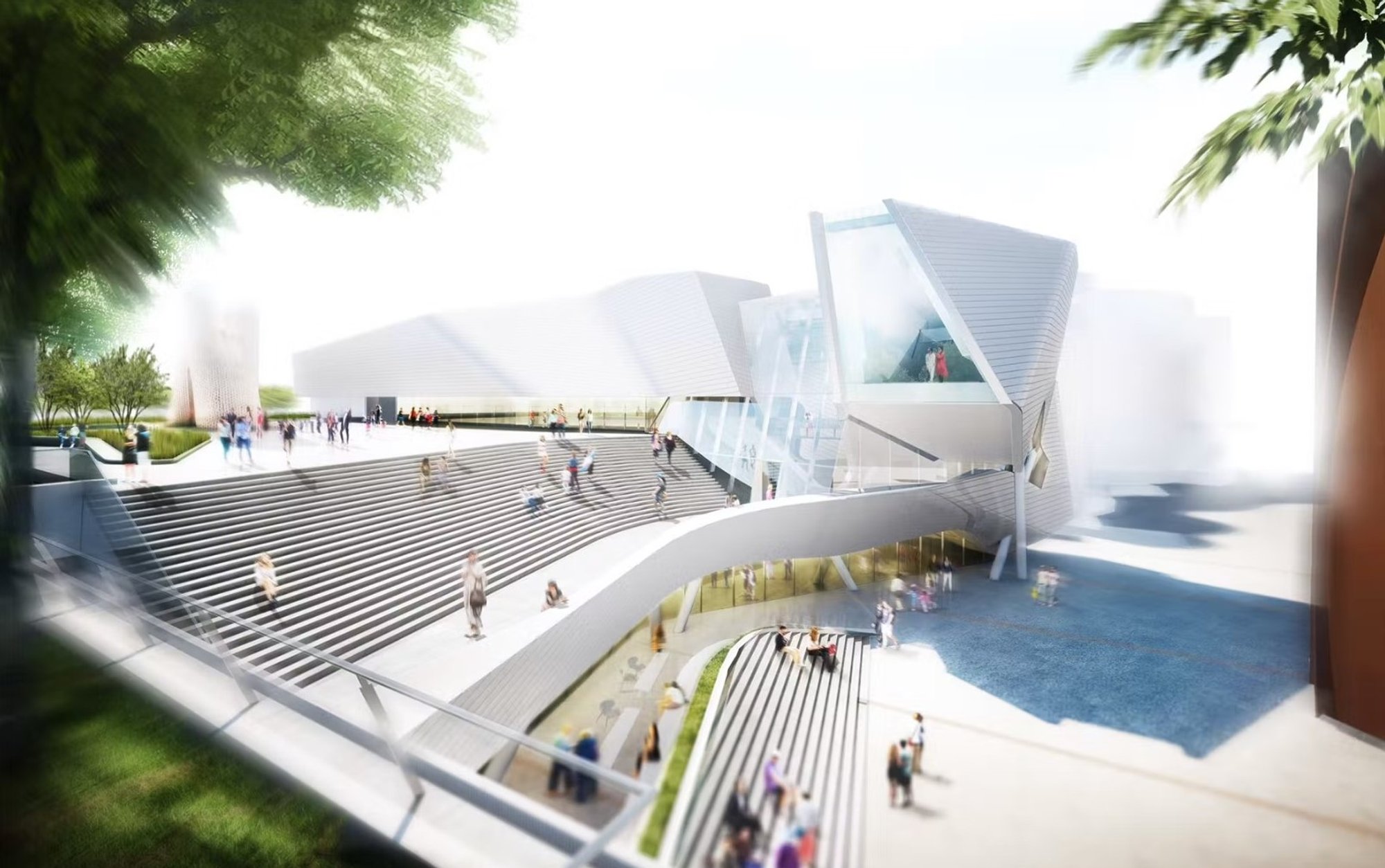
Morphosis' Orange County Museum of Art is a towering building among giants.
The museum is one of the only human-scaled buildings in the area, and its size allows for a more intimate experience with the art inside.

Costa Mesa is one of many cities in Orange County, California that was designed with the automobile in mind. In 1967, the Segerstrom family took a lima bean field near the San Diego Freeway and transformed it into South Coast Plaza. Today, it is the largest mall in California and the fourth largest in the nation. With over 2.8 million square feet of interior space and 250 boutiques, it has set the dimensions for everything that surrounds its oceanic parking lot.
Even though it's right across the street, the Segerstrom Center for the Arts can be easily overlooked by the 22 million visitors the mall receives annually. To make up for this perceptual distance, the Segerstroms developed the 14-acre cultural campus as an assortment of larger-than-life performance venues bearing the family name. The only unprogrammed thing in the area is a large grassy area on its eastern side.
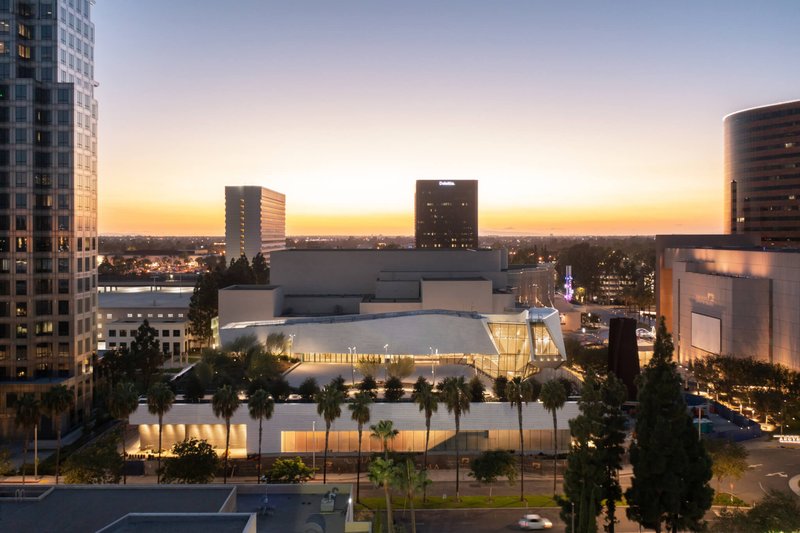
When Morphosis entered the design competition for the Orange County Museum of Art (OCMA), they did so with the intention of bettering the venue's potential as an open-air expanse. The OCMA is a $93 million dollar museum that holds modern and contemporary art. “When we designed the museum, we kept the community in mind by giving them about 75 per cent of the free space while still including a 53,000-square-foot museum,” Thom Mayne, the firm’s founder and the design director for OCMA, explained. He was sitting on the 10,000-square-foot upper plaza gazing north toward Connector, the towerlike steel sculpture by artist Richard Serra that has long been a landmark for Segerstrom Center. For the next ten years, the public will have free access to the museum's upper plaza via a staircase from the sidewalk. The upper plaza can serve as an outdoor gallery space or seating for major events, thanks to a grand public stair facing the lower plaza.
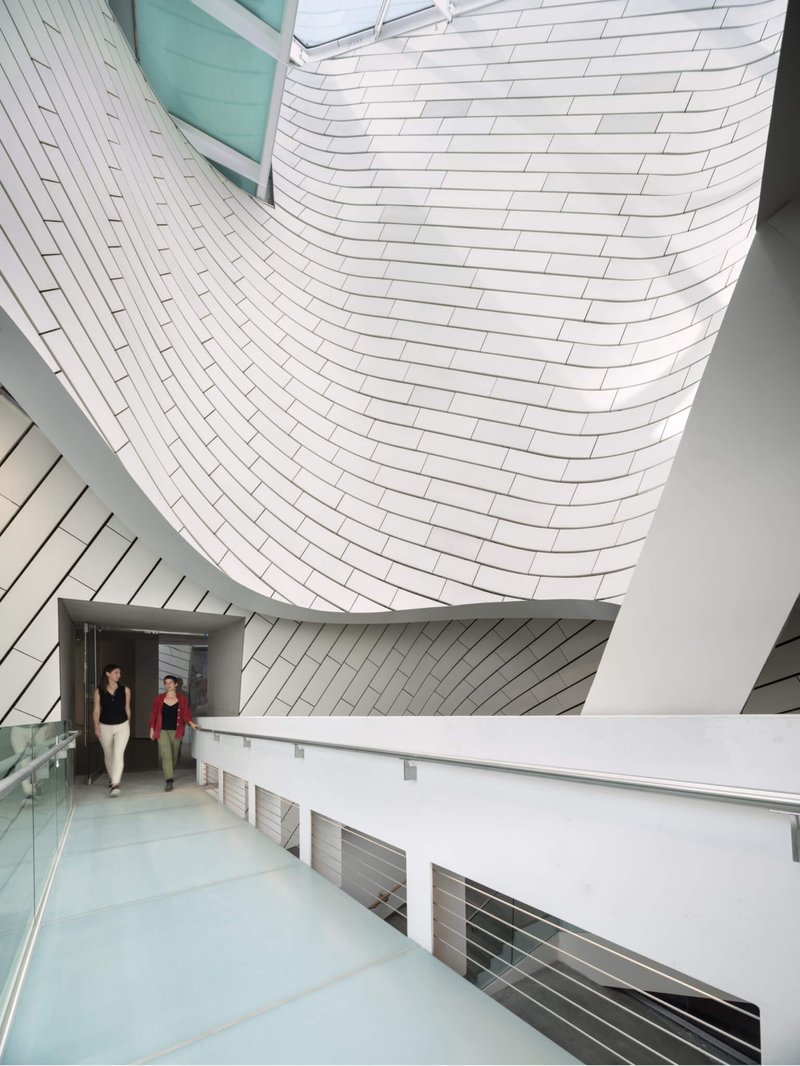 The museum’s curvy surface is clad in terra-cotta, both outside and in the atrium. (Mike Kelley)
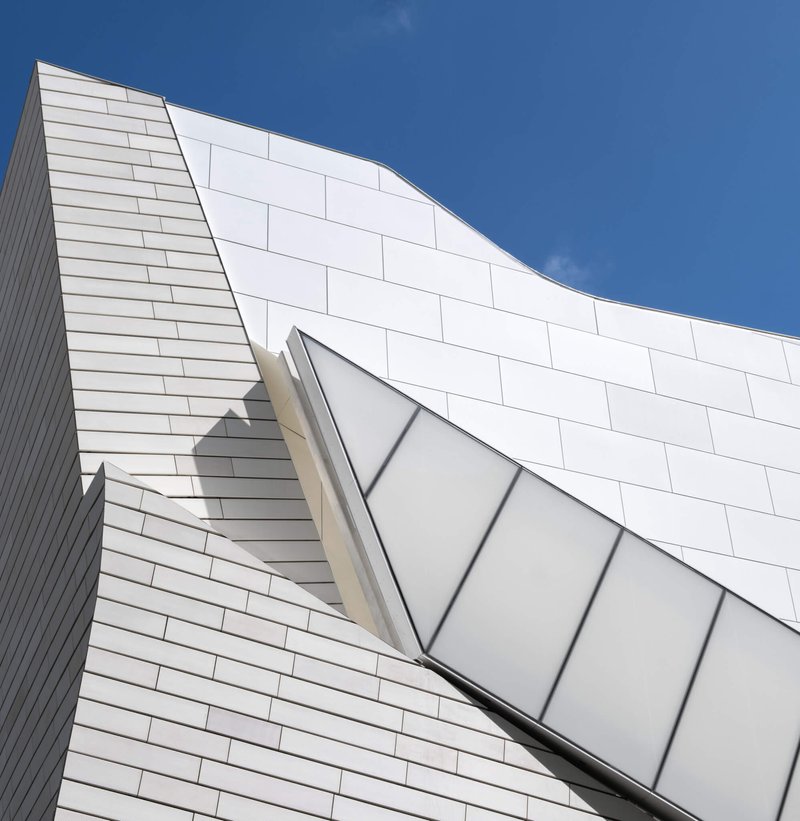 (Mike Kelley)
The plaza is a hidden gem in the midst of tall buildings and busy streets. Mayne argues that it is more like a piazza, or an Italian public square, which encourages opportunities for chance encounters and surprises. The plaza is framed by mature native Palo Brea and live oak trees on one side and a field of white terra-cotta tiles on the other, adding to its charm and making it an unexpectedly intimate respite from the city bustle. The sculpture by New York-based artist Sanford Biggers, titled Of many drinks of water... (2022), is a massive, metal sequin sculpture that resembles a reclining figure on one side. The other side of the sculpture provides plenty of seating for visitors, so they can relax and enjoy the view.
From nearly every angle, OCMA is much more modest than what pictures show. The facade slopes away from the ground plaza, resembling a canyon that's been carved out by years of flowing water. There's also a public stair on the ground plaza that offers additional seating, and it's aligned with the upper plaza. Plus, there's plenty of bench seating on the other side that's shaded. The street-facing elevation is mostly glass, and it has murals by Sarah Cain and Alicia McCarthy. The remaining two sides are more understated. The same intricately designed terra-cotta tiles that welcome visitors as they walk into the upper plaza can also be seen from the front of the building, stretching across the main atrium. Brandon Welling, Morphosis's partner-in-charge, says that terra-cotta was the best material to use for the exterior of the museum because of its durability and the ease with which it could be crafted to reflect the artistry within the museum.
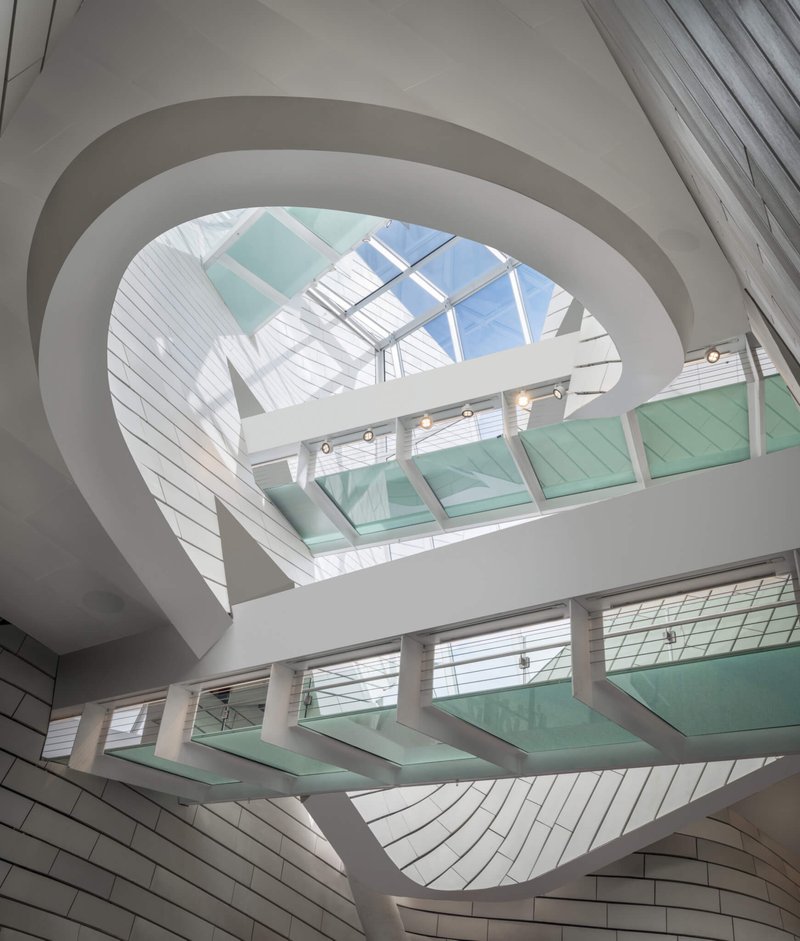 Glass and steel bridges cross through the curvy atrium. (Mike Kelley)
The grand lobby atrium's complex geometry is broken up by two catwalks, making the museum look more like a labyrinth than a casual stroll through the exhibitions would suggest. The largest exhibition spaces are on the ground floor, where OCMA director Heidi Zuckerman oversaw even its smallest details. “It was important for all monitors, outlets, and other building necessities to be removed from sight so that the art could be appreciated without distraction,” Zuckerman explained while gesturing at the artworks like figures in a composition. A hidden staircase leads inward to a narrow, mezzanine gallery with a ribbon window at a curiously low height. Zuckerman explained that many of the internal details were implemented for local schoolchildren on field trips to explore and develop their own relationships with contemporary art. With the same desire to shape young minds, the education center on the top floor is a small, cloistered room with an artfully exposed ceiling that might inspire curiosity about architecture itself.
“The way it contrasts yet complements everything else in Segerstrom Center,” Mayne said while looking across the upper plaza as caterers prepared for an upcoming event, “makes OCMA feel like the last piece of a puzzle.”
Shane Reiner-Roth is an acclaimed lecturer at the University of Southern Cal
References (2)



Popular Articles
Popular articles from the community


Inverted Architecture Installation by Studio Link-Arc: Exploring the Intersection of Architecture and Living Organisms
Inverted Architecture Installation by Studio Link-Arc blends mycelium, sustainability, inverted design, ecological cycles, and urban adaptive architecture in Shenzhen.
On the Brooks House by Monsoon Collective – A Contemporary Kerala Home Rooted in Tradition
Kerala home blending tradition and modernity with water-inspired design, brick architecture, courtyard planning, and sustainable rainwater harvesting strategies.
An Miên Lumière Cafe by xưởng xép, Ho Chi Minh City, Vietnam
An industrial-inspired café where layered steel and warm light create a dynamic, immersive environment shaped by reflection, depth, and perception.
Treehouse Apartment: A Warm Timber Interior Blending Craft, Play, and Contemporary Living
Warm timber apartment with integrated treehouse, combining natural materials, craftsmanship, and playful design to create a flexible, family-oriented living environment.


Similar Reads
You might also enjoy these articles
Scientific and Educational Monitoring Center of the Yenisei, Krasnoyarsk
Architecture as an instrument for ecological research, education, and environmental awareness along Russia’s largest river.
Development of Andretta Artist’s Village, Palampur, Himachal Pradesh, India
Reimagining Andretta as a living cultural landscape where art, architecture, and community converge to shape a global creative village.

The NEON Culture: Experiential Architecture Shaping Contemporary Urban Life
Exploring how experiential architecture responds to accelerated lifestyles through immersive spaces, adaptive programs, and sensory-driven urban design.

Narwall: Autonomous Offshore Architecture for Extreme Environments
A visionary model of sustainable offshore architecture, Narwall redefines public life, energy autonomy, and resilience in extreme Arctic waters.


Explore Architecture Competitions
Discover active competitions in this discipline




The International Standard for Design Portfolios


The Global Benchmark for Architecture Dissertation Awards


The Global Benchmark for Graduation Excellence


Challenge to design an urban locus of culture and heritage
Comments (0)
Please login or sign up to add comments
No comments yet. Be the first to comment!