

Swamp capsule camp
Wetland sustainable education camp

Key words| campers, sustainability, nomads, coming home, units, prefabrication
While researching the site, the first thing I came across was the Tame Valley Wetland organization. Amongst other things they did to preserve the wetland, they also took on a project to educate the children by organizing camps. It is a good way to transfer knowledge, which children will later transfer to their parents, raising awareness of the importance of wetlands. So in the light of that discovery I decided to make a sustainable children's education camp.
The project started off with the idea of a disappearing camp where the people would either assemble the camp houses and disassemble them on site and clean off everything before they leave, so the site would be left intact. There was even an idea about walking houses, aiming to include a larger part of the area in the project, but in the end I decided that movable structures would be reserved for rangers of the camp.
The feeling I wanted to create was the feeling of coming home.
Imagine when you were younger in the countryside, or a mountain home your grandparents owned. Every day you would take short field trips and wander off into the forest, or try to reach the horizon over the vast fields and meadows. But soon enough your short field trip became very long and you couldn’t see the houses or the roofs and smoke coming from the chimneys. The sun is setting and there is only an endless line of fields you have to travel to come home. Darkness is starting to swallow the fields around you, until even the horizon disappears from view, but we follow north. Slowly you can see the first light come into view. The smell of the meal cooking by the fire. You have reached your home and you are safe, cradled by the lights and warmth around you.
I wanted to recreate that feeling, considering that the site is a big meadow/ field with only nature and wetlands surrounding it. So I started by creating diagrams of how the camp houses would be placed. First attempt was dividing the location in concentric circles. The architecture is supposed to slowly appear into view and the concentric circles around the center of the location are filled gradually. The center of the location is a place for gathering where the campfire is placed. The rest of the circles were reserved for arranging the camp houses and in such a way that the density of the houses was the biggest around the center. The further from the center you go the smaller the density. In the end the layout of the houses resembles that of a mountain village.The more you go into nature the less you disturb it, the further you go from the campfire the more you come to be one with nature.
As the camp spreads and more campers come, the location of phase 2 begins to form as a natural continuation of phase 1. To minimize the human influence on nature, the project on the preserved part of the location only consists of different wooden trails and platforms for placing the tents if people wanted to camp in the wetland. The urban layout of the project resembles that of phase 1 and is based on the same idea of one central platform that represents a hangout spot (campfire). From that central platform a lot of smaller ones develop forming a camping spot and smaller meeting sites where campers can also perform different activities.
Another aspect of the project that emerged from the very nature of camping sites is its unpredictable character. The way the users kind of divert from the original purpose of the site and its objects. It’s like any architecture, merely a black box waiting to reach its full potential. In a way the project tried to predict many ways in which the campers can make use of the space around them. Starting from the way they try to make use of the surrounding trees to set up their camps, to the way they can turn every meadow in a sports court, taking out their folding chairs, using tree logs as benches, tying wires to left out tree boles to dry their clothes… Camping is a special concept in the way that it doesn’t try to conquer the surrounding nature and maximize its utilization. It is special in a way that it lets people merge with nature and exist in the most sustainable way, taking us back to our nomadic origins.
The camp is based on sustainable principles. First of all camp houses are prefabricated, which makes them easily transportable and leaves 0 production waste on the site. That being said if one day people decide to empty the site they can use the camp houses for something else.
After researching reed characteristics, we realized they can be used for recycling of organic waste, so reed beds were placed in certain places to enable a complete usage of waste. And since the climate in England is known for abundant rain showers, the project also includes a rainwater collecting system.

Popular Articles
Popular articles from the community


Faces of the Soviet Avant-Garde: Turning Moscow's Street Names into an Open-Air Museum
A network of sculptural installations across a Moscow residential district transforms forgotten architect names into spatial encounters with cultural memor
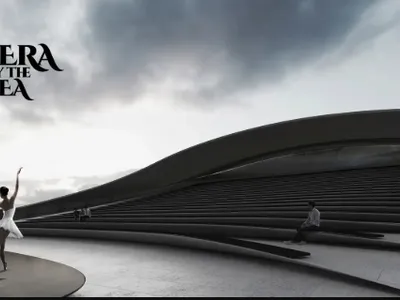
Opera by the Sea Estonia: Three Shells Dissolving Architecture into Tallinn's Coastline
A winning opera house proposal replaces monumental form with interconnected shells that blur the boundary between building, park and Baltic Sea.

Manzana Morphosis: Stretching Barcelona's Grid into a Living Landscape for 2050
A radical reworking of the Eixample manzana turns density into a tool for generous public space, vertical ecology, and environmental performance.

The Amber Palace Opera: A Geological Fiction Surfaces on Tallinn's Baltic Waterfront
Pierre Brillard reimagines a Baltic legend as a public landscape, opera house, and waterfront promenade rooted in Tallinn's coastal identity.

Similar Reads
You might also enjoy these articles
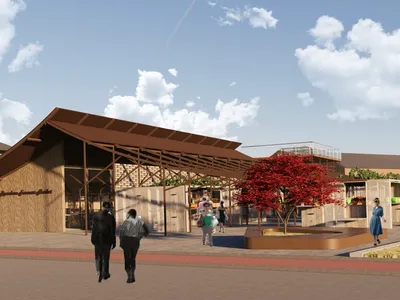
The Rhythm of Seasons
A Farmers' Market Connecting Nature and the City

More Than a Building-Designing a Living System
More Than a Building-Designing a Living System
Base Beyond
DESERT COMPOUND ARID: TOURISM OF ABSENCE AND ABUNDANCE

Explore Campus Competitions
Discover active competitions in this discipline


Challenge to reimagine the Iron Throne

Photograph architecture without architects

Illustrate the lost glory of Angkor Wat - Render Challenge

Design challenge to reuse E-waste
Comments (0)
Please login or sign up to add comments
No comments yet. Be the first to comment!