

The Tim Story: A Foldable Seat That Hooks Onto Metro Rails and Rethinks Transit Comfort
A portable elastic fabric seat system that collapses smaller than a water bottle and supports up to 115 kg on any overhead rail.

Every weekday, millions of commuters board a bus or metro and immediately face the same quiet calculation: stand for forty minutes, lean awkwardly against a pole, or wedge into a gap that barely qualifies as space. The infrastructure works, the route works, the schedule works, but the body does not. The Tim Story starts from this exact friction point and proposes something disarmingly simple: a foldable seat you carry in your bag, hook onto an overhead rail, and use however the crowd allows. It collapses to 44.7 × 3.6 × 5 cm, smaller than a standard water bottle, yet holds up to 115 kg.
Designed by Abhishek Rana, the project received an Honorable Mention in the @ease competition. Rather than proposing a system-wide retrofit of transit vehicles, Rana shifts the agency to the commuter. The result is a product-scale intervention with architectural ambition: it reframes public transit not as infrastructure to endure but as a shared spatial experience that can be improved through lightweight, human-centered design.
Mapping the Problem Through Tim's Commute
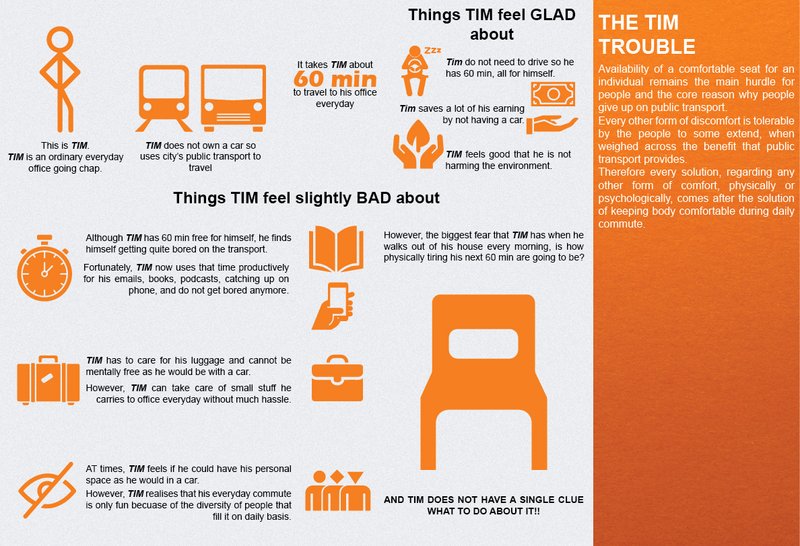
Rana builds his case with a narrative device: Tim, the everyday office-goer whose commute quality determines the tone of his entire day. The opening infographic diagrams the stakes clearly. Public transport saves money, reduces environmental impact, and frees time for reading or rest, but research cited in the project identifies the single biggest deterrent to ridership as the unavailability of a comfortable seat. The diagram connects these dots with orange iconography that traces the commuter's decision tree, from departure to arrival, marking each pain point where physical discomfort erodes the practical benefits of mass transit.
Four Crowding Scenarios, One Adaptive Device
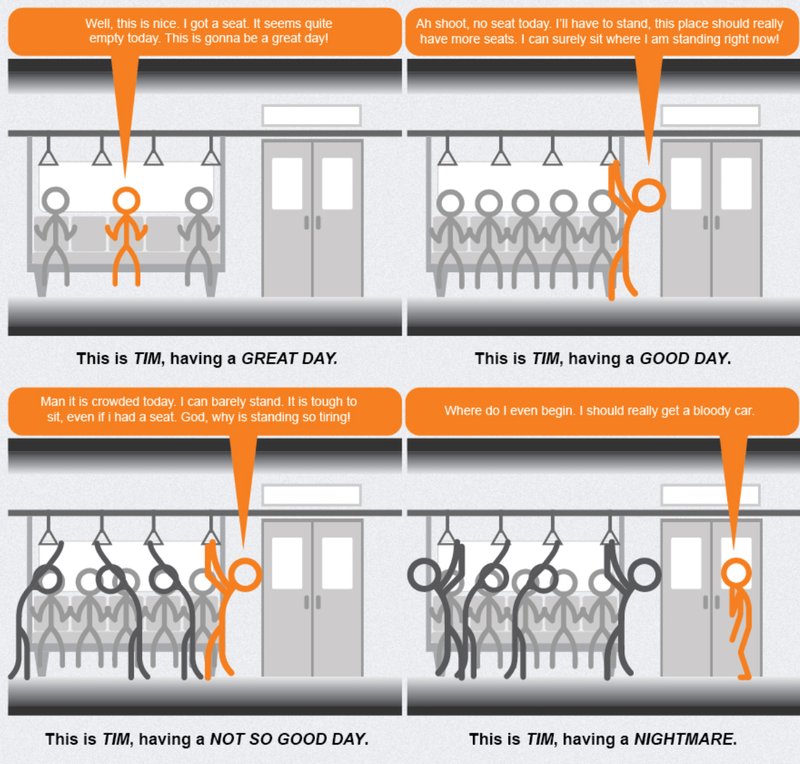
The strongest conceptual move in the project is the acknowledgment that transit conditions are not static. A morning metro at 7:15 is a different spatial reality than the same car at 8:45. Rana's four sequential diagrams illustrate this range: from a relatively empty carriage where the device deploys as a full suspended seat, to a moderately crowded scenario where it serves as a leaning backrest, to a packed rush-hour crush where it functions simply as a stabilizing support handle. The product does not insist on one mode of comfort. It adapts, and that adaptability is what makes the concept viable across real-world conditions rather than idealized ones.
Elastic Fabric, Aluminum Frame, and a Three-Step Deployment
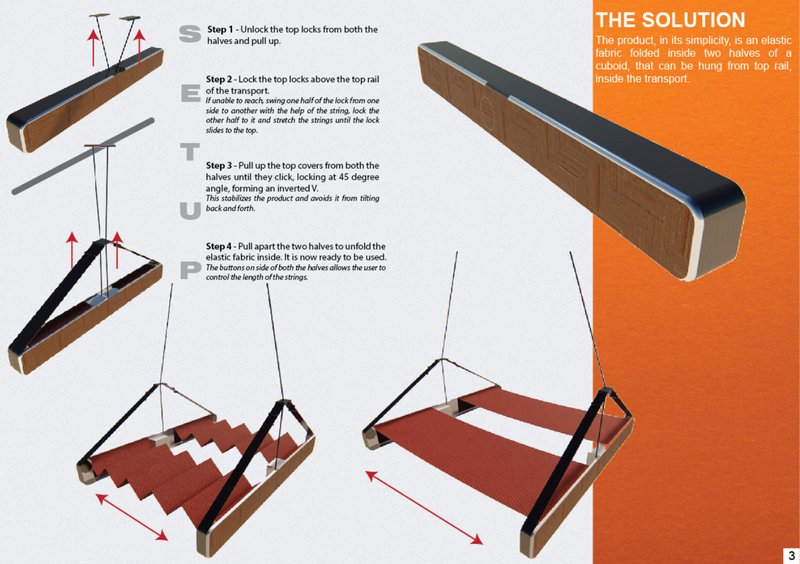
The exploded axonometric drawing reveals the mechanism clearly. A lightweight aluminum frame houses an elastic fabric panel that extends once the device is unfolded and hooked onto the rail. The deployment sequence is three steps: unlock and hook, extend the fabric, sit or lean. No tools, no complicated assembly, no modifications to the transit vehicle itself. The rail-hooking detail is worth noting because it works with existing infrastructure. Rana avoids the trap of designing a product that requires a redesigned bus or metro to function. The overhead rail already exists in nearly every urban transit system worldwide.
Dimensions Built for Daily Carry and Diverse Bodies
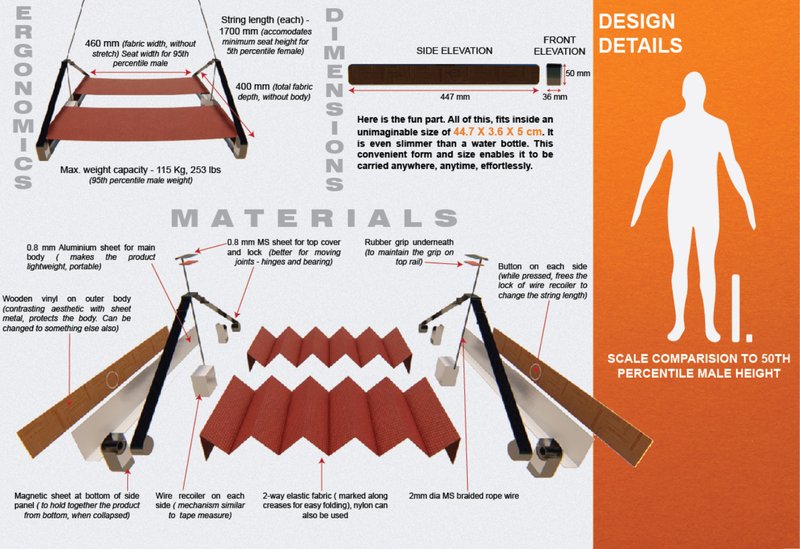
The technical drawing pins down the ergonomic decisions. At 44.7 × 3.6 × 5 cm when folded, the device slips into a backpack side pocket or a tote bag without adding meaningful bulk. The 115 kg weight capacity covers a wide demographic range, and the human-scale figure in the drawing shows the seated posture with the fabric panel supporting the user at a natural hip height relative to the overhead rail. Material choices, lightweight aluminum for the structural members and elastic fabric for the seating surface, strike a balance between durability and portability that would be difficult to achieve with heavier engineering plastics or rigid textile systems.
Why This Project Matters
The Tim Story operates at the intersection of product design and urban thinking, and that is precisely where it finds its strength. It does not require municipal budgets, fleet overhauls, or new rolling stock. It asks a different question: what if the commuter could carry their own comfort, the way they carry a phone or an umbrella? By decentralizing the solution, Rana sidesteps the bureaucratic inertia that stalls most transit improvement proposals while directly addressing the comfort gap that discourages ridership.
More broadly, the project is a case study in how architectural thinking scales down without losing relevance. The goal is the same as any good piece of urban design: make the shared environment more livable so that people actually choose to use it. If more commuters ride public transit because standing no longer means suffering, the downstream effects on car dependency, emissions, and urban congestion are real. Rana's Honorable Mention in the @ease competition is well earned. The proposal is compact in form and expansive in implication.
View the Full Project
About the Designers
Designer: Abhishek Rana
Enter a Design Competition on uni.xyz
uni.xyz runs architecture and design competitions year-round that reward proposals with spatial conviction and real site intelligence.
Project credits: The Tim Story by Abhishek Rana @ease (uni.xyz).




Popular Articles
Popular articles from the community

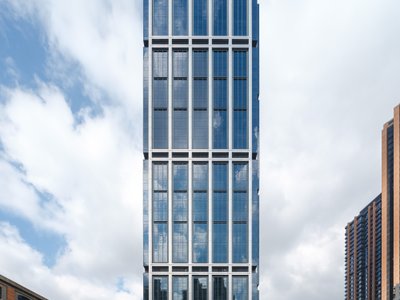
Foster + Partners Wraps a 200-Meter Shanghai Tower in Stainless Steel and Industrial Memory
The Suhe Centre Office Tower anchors a regenerated waterfront district in Shanghai with an all-steel structure that nods to local warehouse heritage.
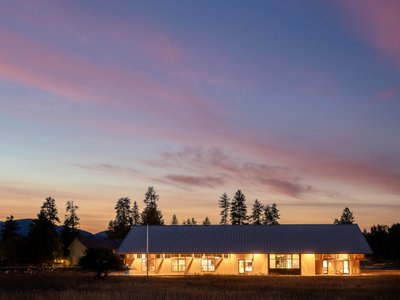
Johnston Architects Reimagines the Methow Valley Hay Barn as a Small-Town Library in Winthrop
A 7,300-square-foot timber library channels the region's agrarian vernacular to serve a rural Washington community of 400 year-round residents.
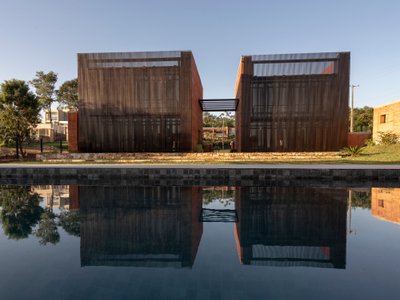
BAUEN Builds Two Rammed Earth Volumes in Paraguay Inspired by the Ovenbird's Nest
In San Bernardino, a house of compacted earth channels the instinct of a constructive bird to shelter life from the Paraguayan summer.
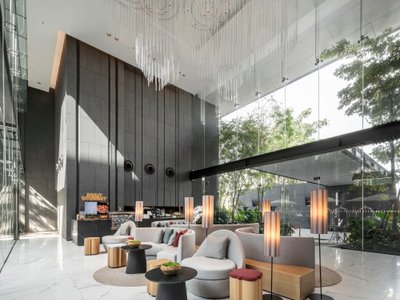
IDIN Architects Wraps a Hua Hin Hotel Around a Private Courtyard to Escape the City
Dusit D2 Hua Hin turns an urban infill site in Thailand's family vacation heartland into a self-contained resort through courtyard planning.

Similar Reads
You might also enjoy these articles

Of Water & Spirit: Reimagining an Offshore Oil Rig Through Adaptive Reuse Architecture
Transforming an abandoned offshore oil rig into a museum of water, memory, and renewal through adaptive reuse architecture.
Cyber Oyster: A Visionary Adaptive Reuse Architecture Project Transforming Abandoned Oil Rigs Through Oyster Bionics
An adaptive reuse architecture concept transforming abandoned offshore oil platforms into self-healing marine ecosystems inspired by oyster bionics.
La Macchina Adriatica by Adriana Jul Camargo
An adaptive reuse architecture project transforming abandoned Adriatic oil rigs into a floating museum, research hub, and living sea observatory.
Mechanism of Memories: Adaptive Architecture Reimagines Offshore Structures as Living Cultural Machines
Floating adaptive architecture transforms abandoned offshore structures into cultural spaces that preserve memory, habitation, and human connection.

Explore Industrial Building Competitions
Discover active competitions in this discipline




The Global Benchmark for Architecture Dissertation Awards

Design challenge to equip cities with modern furniture


Packaging challenge - Design meets sustainability
Comments (0)
Please login or sign up to add comments
No comments yet. Be the first to comment!