
Sanuki Daisuke Architects Carve a Vertical Garden Through a Vietnamese Tube House in Vung Tau
A staggered section and ten-meter tree turn one of southern Vietnam's narrow nhà ống plots into a breeze-cooled, light-filled home.


Vietnam's nhà ống, or tube house, is one of the most constrained residential typologies in Southeast Asia: a slot of land four to eight meters wide and up to twenty meters deep, walled in on three sides by neighbors. Only the front face breathes. For decades, architects have tried to mitigate the darkness and dead air that result, usually by punching a courtyard somewhere in the middle and calling it a day. Sanuki Daisuke Architects takes a more radical position in Vung Tau, a coastal city in southern Vietnam. Rather than inserting a void into a solid mass, the firm treats the entire section as a void and then selectively inserts solid, private rooms into it.
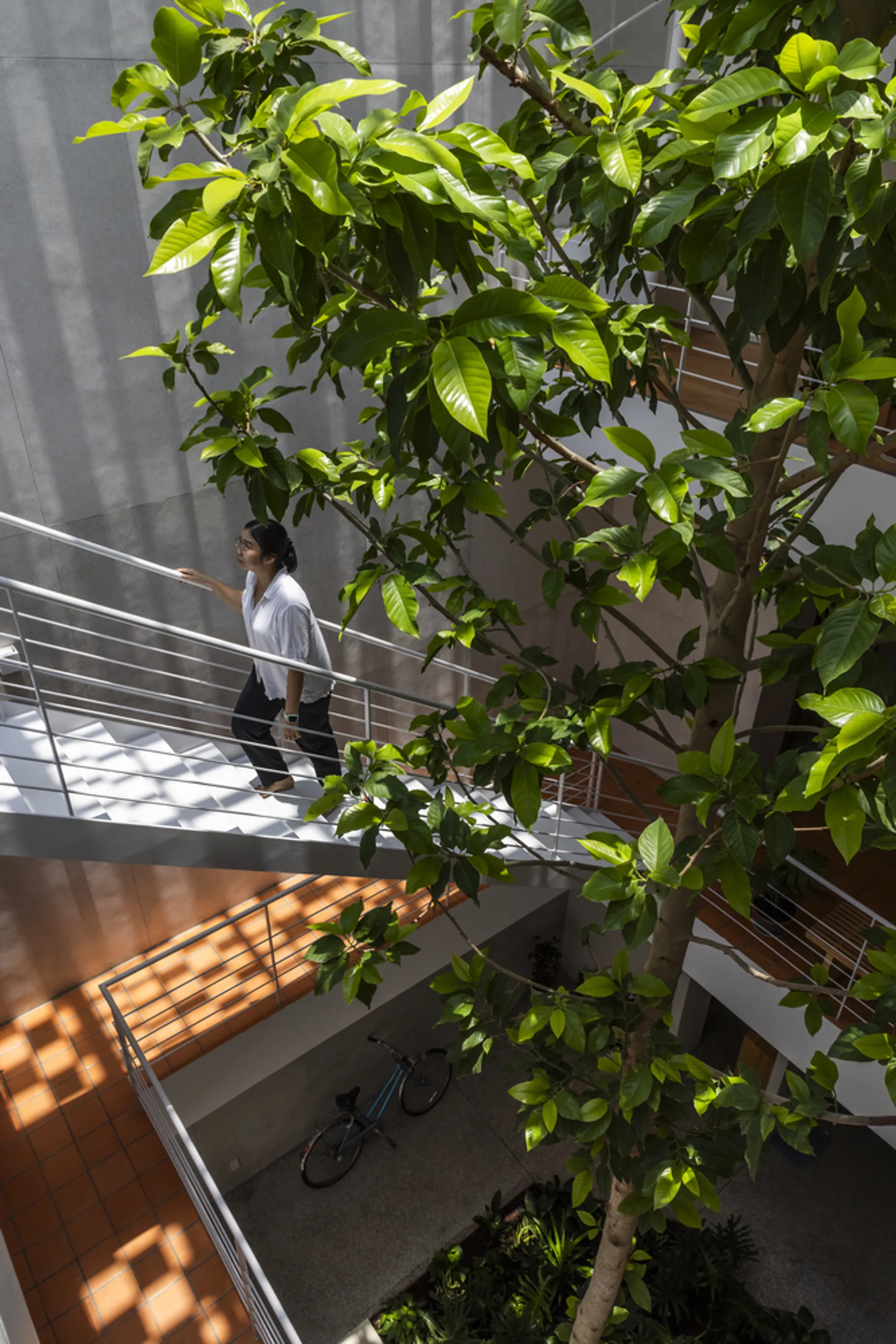
The result is a house that reads less like a building and more like a scaffold for living plants, circulating air, and filtered light. A ten-meter White Champak tree rises through the center of the plan. Staggered floor slabs from the second level upward create overlapping half-levels connected by bridges and open staircases, so that ocean breezes entering the west facade can travel vertically through a full-height atrium and exit at the roof. It is a convincing argument that the tube house does not need to be a tunnel.
A Facade That Breathes

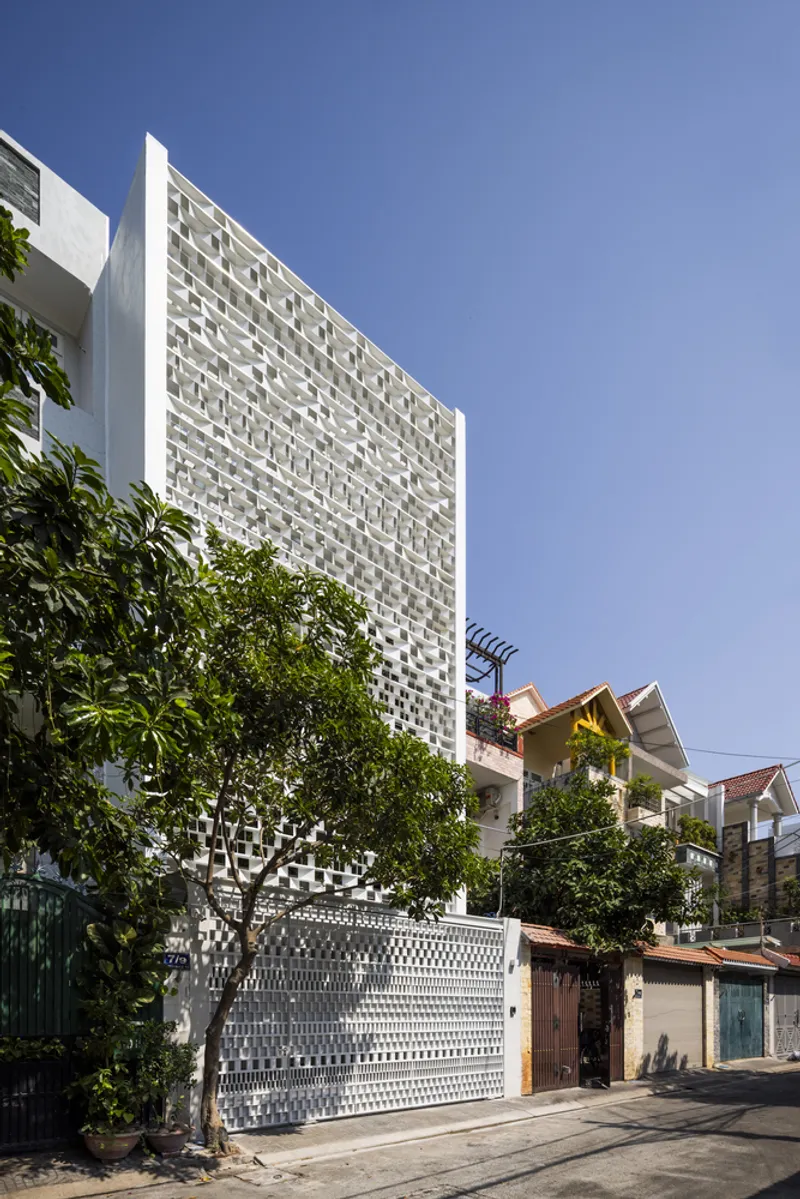

The west-facing front elevation is the house's most exposed surface, catching the full force of tropical afternoon sun. Sanuki Daisuke wraps it in a system of light steel shades composed of angled panels that overlap and shift in density. From the street, the facade reads as a luminous white screen rising above the neighborhood's low-rise terra-cotta roofs. Up close, the geometry becomes legible: a tessellated pattern of triangular and diamond-shaped voids that modulate sunlight rather than block it.
The screen does double duty. It prevents direct solar gain on what would otherwise be an unbearable western wall, and it turns the interior into a constantly shifting field of checkered light. Shadows rotate with the sun, so the atmosphere of every room changes hour by hour. It is a passive strategy with an expressive payoff.


Detailing matters here. The precast concrete screen elements maintain consistent structural depth while varying their aperture density from bottom to top. At the lower levels, where privacy is needed, the pattern is tighter. Higher up, it opens out, allowing the tree canopy and planted terraces to be glimpsed from the street. At dusk the relationship inverts: interior lighting turns the entire facade into a glowing lantern, broadcasting the vertical garden to the neighborhood.
The Atrium as Infrastructure

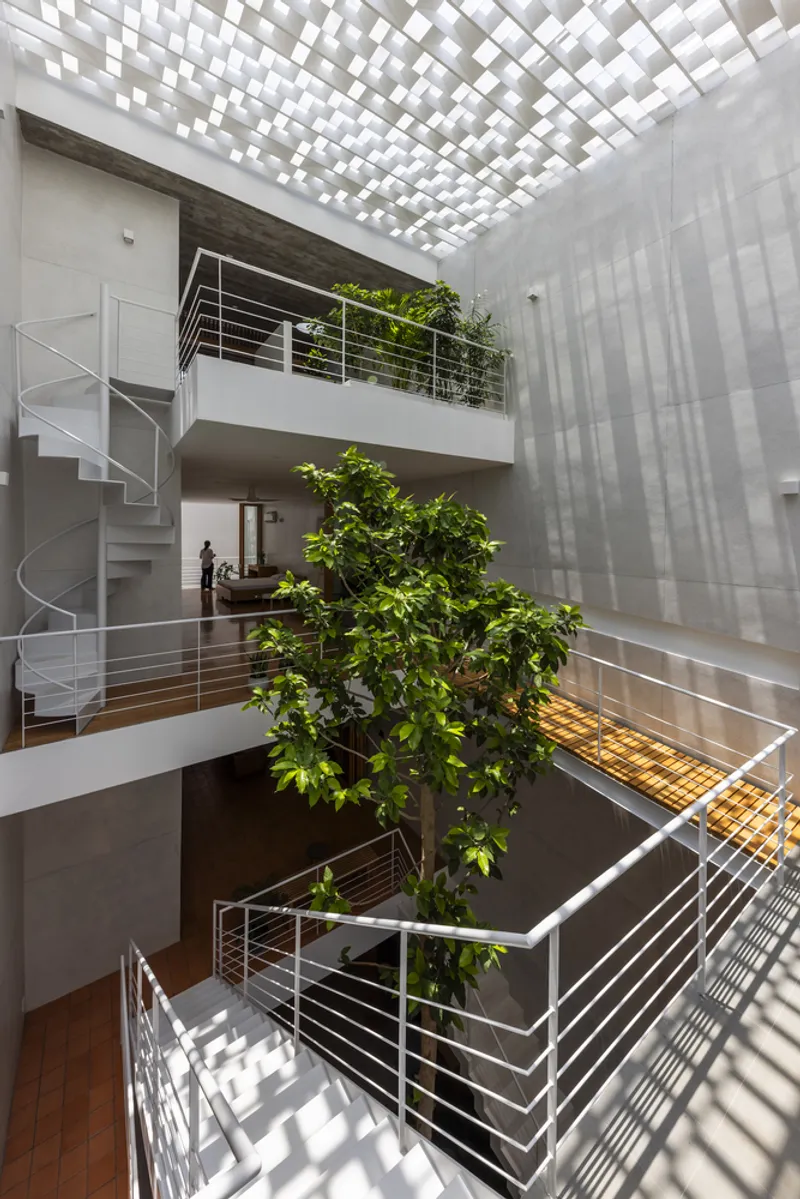

The central atrium is not decorative. It is the house's primary piece of environmental infrastructure. Extending from the ground floor to the roof, the void channels ocean breezes upward through the stack effect, pulling cooled air from the planted ground level and exhausting warm air at the top. A secondary atrium at the rear reinforces the cross-ventilation loop, so that even on the hottest days the house can function without mechanical cooling for extended periods.
What makes this atrium exceptional is that the ten-meter Champak tree grows through its full height, turning a climate device into a spatial event. From any level, you look across to the tree's trunk or into its canopy. Bridges and spiral stairs orbit the tree like a vertical trail, making the act of moving between floors feel closer to navigating a garden than climbing a staircase.
Staggered Slabs and Open Connections
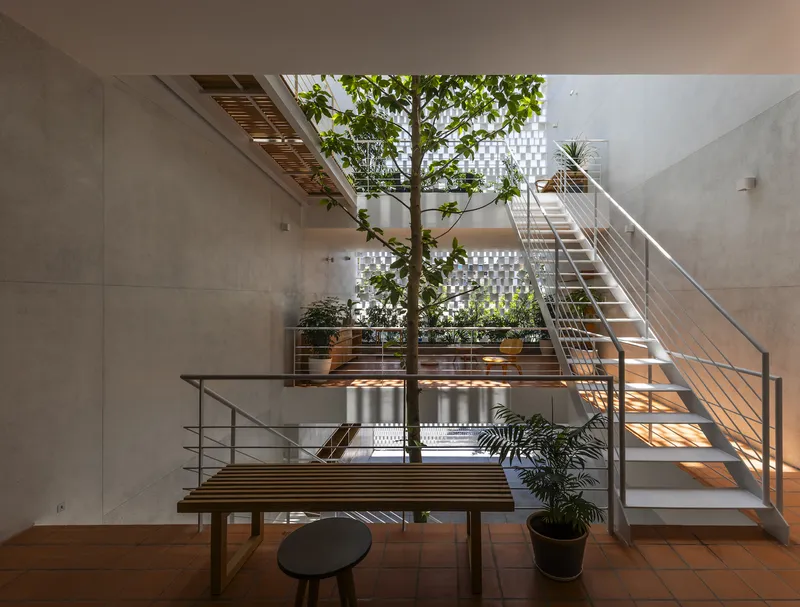


From the second floor upward, the floor plates are staggered in section. Instead of full-width slabs at uniform heights, overlapping half-levels create a cascade of terraces, bridges, and double-height pockets. The effect is that no two adjacent spaces share the same ceiling height, and sightlines extend diagonally through the section rather than stopping at flat ceilings. This is the move that transforms the tube house from a stack of rooms into a continuous spatial experience.
The ground floor, by contrast, is deliberately conventional: a solid base of enclosed private rooms and children's play areas that provide acoustic and visual separation from the street. It is a sensible trade. The bottom of the house is quiet and grounded; everything above it is open, airy, and interconnected.
Filtered Light and Interior Landscapes


The checkerboard ceiling screens that appear at multiple levels are among the project's most photogenic elements, but they serve a precise environmental purpose. Each perforated panel admits sunlight in discrete patches, reducing glare while maintaining high ambient brightness. Potted plants and raised beds on every level intercept this dappled light, creating micro-landscapes that soften the concrete and steel palette.


The planting strategy extends beyond the central tree. Raised beds line the atrium edges, greenery spills from stair landings, and a pixelated blue-and-white tile wall at one courtyard level adds a ceramic warmth that complements the lush foliage. The cumulative effect is that the house does not contain a garden; it is a garden, with rooms tucked into it.
Living Rooms That Dissolve Their Walls

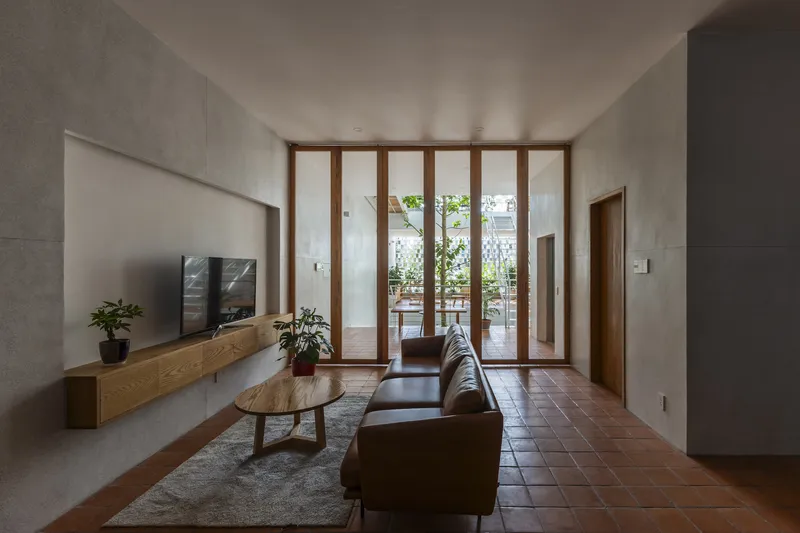

Communal living spaces on the second through fourth floors are defined by movable partitions: large timber-framed sliding and folding glass doors that, when open, erase the boundary between room and terrace. Terra-cotta floor tiles run continuously from interior to exterior, reinforcing the sense that inside and outside are the same surface. Concrete walls provide thermal mass and acoustic separation where needed, but the dominant experience is one of openness.
The material palette is restrained: polished concrete, timber, terra-cotta, and steel. There are no applied finishes competing for attention, which lets the play of natural light do the expressive work. It is a disciplined choice that ages well in a tropical climate.
Private Rooms and Rooftop Retreats


Bedrooms are conceived as enclosed pods within the open framework. Timber ceiling panels and slatted screens differentiate these rooms from the concrete communal zones, signaling a shift in register. Built-in planters bring greenery into even the most private spaces, and circular skylights punch through the roof to deliver direct light without compromising enclosure. The rooms feel calm and protected, a necessary counterpoint to the transparency of everything else.


At the rooftop, the checkerboard screen reappears as a freestanding wall that filters sunlight onto planted beds and a tiled terrace. It is a generous outdoor room that extends the vertical garden to its logical conclusion: a domestic landscape stacked five levels high, each one open to the sky.
After Dark
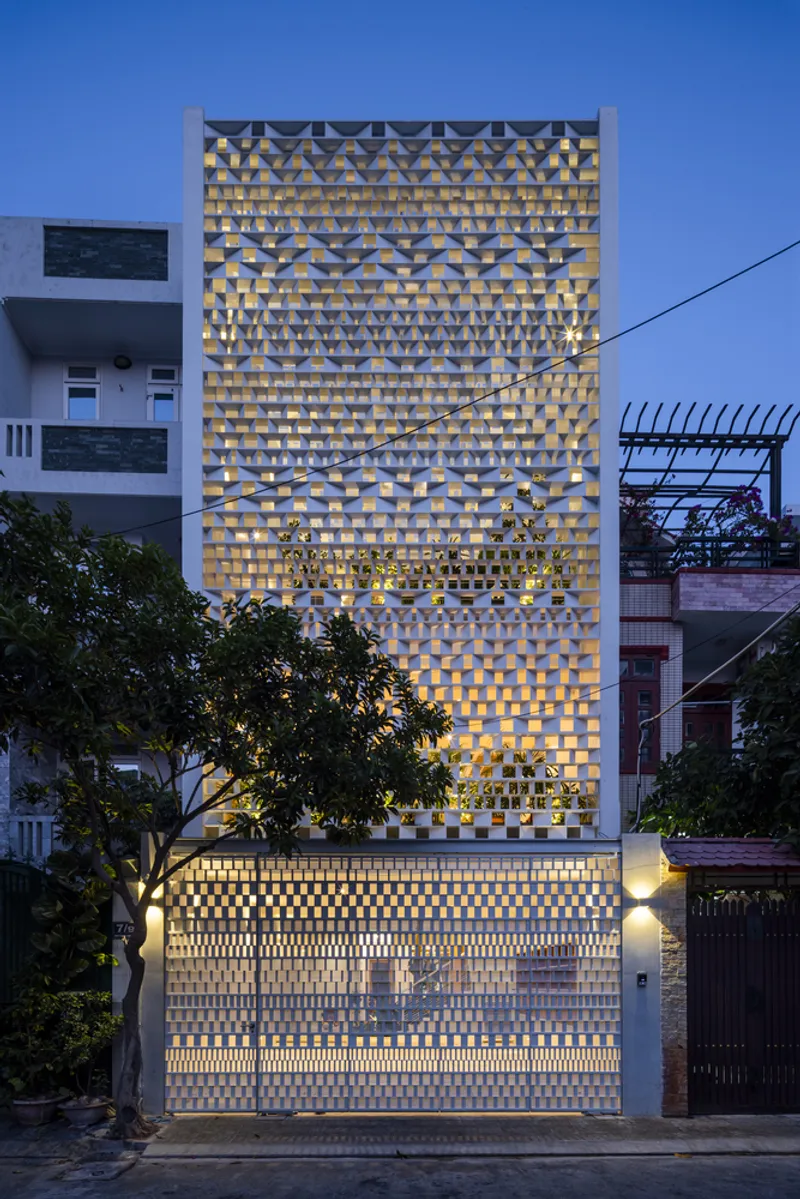
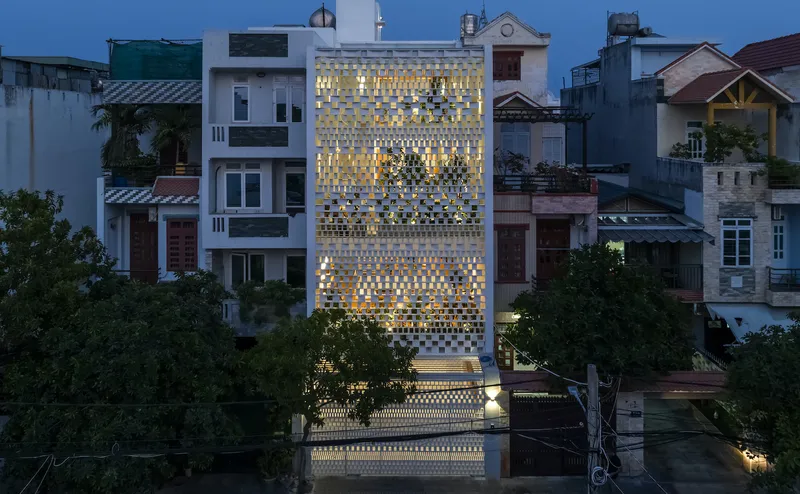

At twilight the house undergoes a complete inversion. Interior lighting turns the perforated facade into a glowing grid, its geometric pattern broadcasting warmth into the neighborhood. Aerial views reveal the tower rising between low-rise rooftops like a lantern planted in a field of tiles. It is an unsubtle but effective demonstration of how a single facade strategy can produce two entirely different identities over the course of a day.
Plans and Drawings
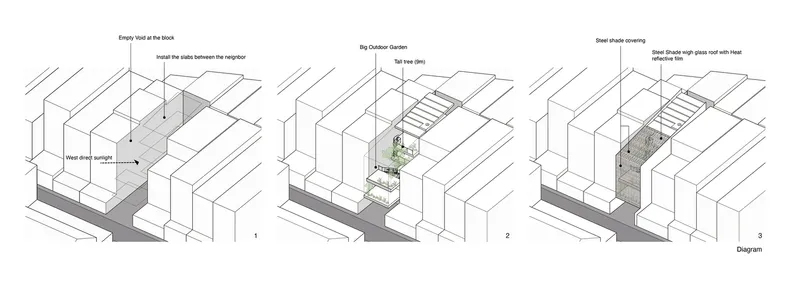
The axonometric sequence lays bare the project's generative logic. Start with a solid extrusion on the narrow plot, subtract the front yard void and rear atrium, then stagger the remaining floor slabs to create interlocking half-levels. The rooftop void completes the stack. Read in sequence, the diagrams make a persuasive case that the design is not arbitrary but systematic: each subtraction serves ventilation, light, or spatial connection.
Why This Project Matters
Tube houses are not going away. Vietnam's cities continue to grow on narrow, deep lots, and the economic logic of the nhà ống remains sound. What Sanuki Daisuke demonstrates here is that the typology's limitations are not fixed. By treating the section as the primary design tool, staggering slabs, and committing to a full-height planted atrium, the firm extracts daylight, airflow, and spatial richness from a plot that conventional practice would fill solid.
The Vung Tau House also makes a quiet argument about replicability. The steel shading system, precast concrete screen, and staggered slab strategy are all achievable with common construction techniques. Nothing here requires exotic materials or extraordinary budgets. That pragmatism, combined with a genuinely inventive section, is what elevates this project from a well-designed home to a credible prototype for a different kind of dense tropical housing.
Vung Tau House by Sanuki Daisuke Architects, Vung Tau, Vietnam, 2024. Photography by Hiroyuki Oki.
About the Studio
Share Your Own Work on uni.xyz
If projects like this are the kind of work you want to make, uni.xyz is a place to publish your own, find collaborators, and enter design competitions.




Popular Articles
Popular articles from the community


Riyadh For All: Intergenerational Urban Design for Active Aging in Rabat
Riyadh For All reimagines urban design in Rabat with intergenerational co-living, adaptive courtyards, and Moroccan cultural exchange today.

The Musturak Paradise: Senior Living Architecture for a Connected Future in Temara, Morocco
The Musturak Paradise reimagines senior living architecture in Temara via private homes, social spaces, culture, community, and shared care.

Co-Life: Senior Housing Design That Reconnects Older Adults With the City
Co-Life reimagines senior housing design through healing gardens, shared streets, workshops, and a sustainable community across generations.

AL-JANNAH: Sustainable Architecture and Permaculture for Afghan Widows
AL-JANNAH uses sustainable architecture and permaculture to create resilient oasis of housing, learning, work and renewal for Afghan widows.


Similar Reads
You might also enjoy these articles


Hodi-Mandai Geram
Project Function: Preservation and revitalization of the Intangible heritage and socio-spatial identity of the Hodi by Housing, Cultural Memory Center, Sacred Grove, landscape, local tourism economy


Olio Towers: A Mid-Rise for Performers That Fuses Housing, Rehearsal, and Stage
Located blocks from Houston's Theater District, this modular tower stacks living units around a central performance atrium.

Oasis: Modular Green Housing Carved into Dhaka's Urban Fabric
A shortlisted Plugin Housing entry reclaims unauthorized settlements in Dhaka with stepped concrete volumes, green roofs, and ventilation-driven design.

Black Hole: A Floating Megastructure for the Post-Physical Era
Emiliano Mazzarotto envisions a spherical, self-scaling arena where e-sports, digital hotels, and holographic stadiums replace traditional public space.


Explore Architecture Competitions
Discover active competitions in this discipline



Challenge to reimagine the Iron Throne


Photograph architecture without architects


Illustrate the lost glory of Angkor Wat - Render Challenge


Design challenge to reuse E-waste
Comments (0)
Please login or sign up to add comments
No comments yet. Be the first to comment!