
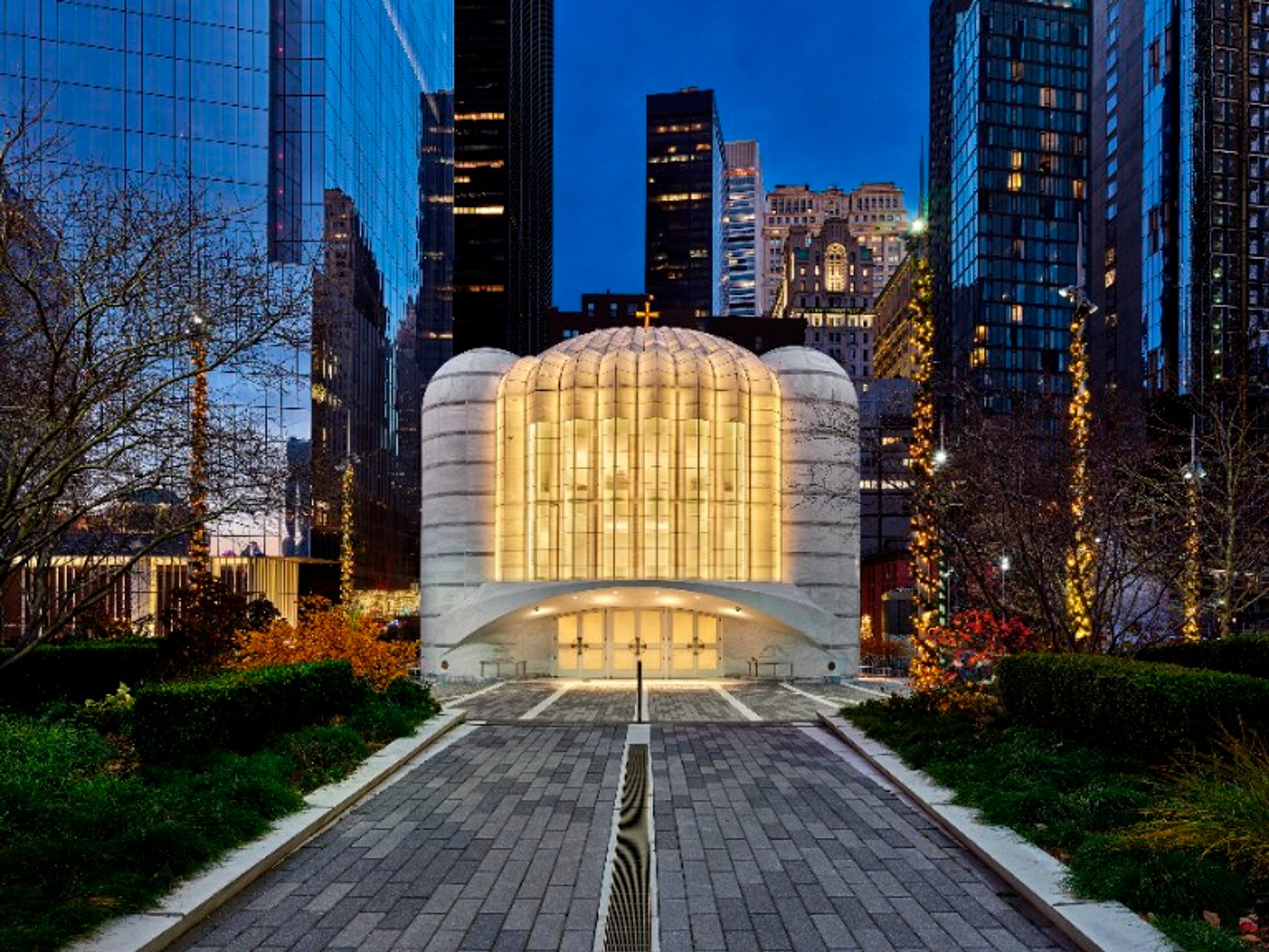
World Trade Center Church Designed by Santiago Calatrava Now Open in New York
Famous architect's stunning design honors victims of 9/11 terrorist attacks

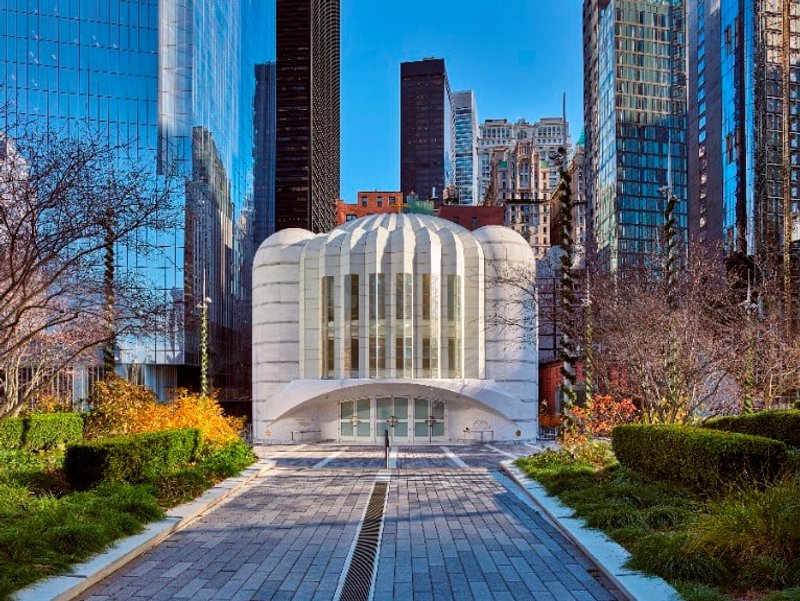
Renowned architect Santiago Calatrava celebrated the opening of the St Nicholas Greek Orthodox Church and National Shrine in New York City at the World Trade Center site. The Church, which was the only religious structure destroyed on 9/11, has now been transformed into a National Shrine. This project marks Calatrava's first-ever religious institution design.
Calatrava was responsible for redesigning the building from scratch, ensuring that it not only adhered to traditional Greek Orthodox liturgy but also honoured the Church's connection to the World Trade Center Memorial site. The St. Nicholas Church is the second completed structure at the World Trade Center campus to be designed by Santiago Calatrava, following the World Trade Center Transportation Hub.
“To see the St. Nicholas Greek Orthodox Church and National Shrine finally open is emblematic of Lower Manhattan’s storied future and defining past,” said Santiago Calatrava, Architect of the newly rebuilt St. Nicholas Greek Orthodox Church and National Shrine. “I hope to see this structure serve its purpose as a sanctuary for worship but also as a place for reflection on what the city endured and how it is moving forward. Architecture can have an intrinsic symbolic value, which is not written or expressed in a specific way but in an abstract and synthetic manner, sending a message and thus leaving a lasting legacy. Thank you to the Port Authority of New York and New Jersey, the Greek Orthodox Archdiocese of America, the Friends of St. Nicholas and the WTC Memorial Museum for their fervent support throughout the course of reconstruction and for believing in my architectural vision.”
 St. Nicholas Greek Orthodox Church and National Shrine Angle from the Narthax into the Nave - Photo © Alan Karchmer for Santiago Calatrava.
Santiago Calatrava's design for St. Nicholas Church was heavily influenced by Byzantine architecture and landmarks, specifically a mosaic in Hagia Sophia depicting the Virgin Mary as the "Throne of Wisdom." In a series of watercolours, Calatrava illustrates the transformation from the Hagia Sophia mosaic to the facade of St. Nicholas. The dome, which was inspired by the Hagia Sophia, features 40 windows and 40 "ribs" - the same number of ribs in Saint Nicholas, which can be seen from both the interior and the external division of the roof. The dome also features 20 prophets whose images are alternated between the dome ribs. The architectural elements incorporated into the structure were based on a thorough study of the relationship between Byzantine architecture and numbers.
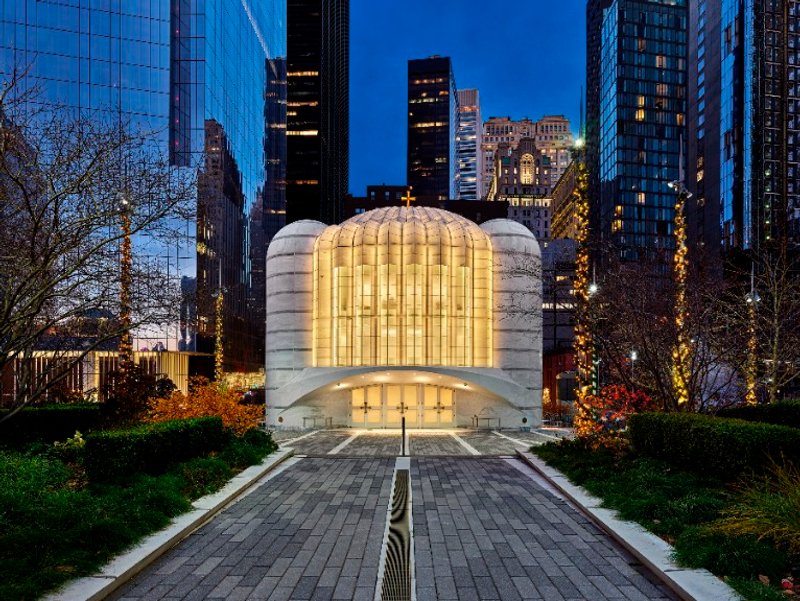 St. Nicholas Greek Orthodox Church and National Shrine Angle from the Narthax into the Nave - Photo © Alan Karchmer for Santiago Calatrava.
The St. Nicholas Greek Orthodox Church and National Shrine is a beautiful architectural masterpiece that was designed by Santiago Calatrava. The exterior of the church is made entirely of Pentelic marble, which is a nod to the Parthenon in Athens. The dome of the church is made of thin stone and glass laminated panels that are illuminated from behind, creating an incandescent aura that makes the entire church appear to glow from within. This gives the impression of the church being a beacon of hope in the night. The exterior of the church comprises of four solid stone-clad towers that ultimately form a square shape and host the dome-like building. The corner towers and two west-facing towers are clad in alternating large and small horizontal bands of white and grey marble, reminiscent of the Church of the Holy Savior in Chora, Turkey.
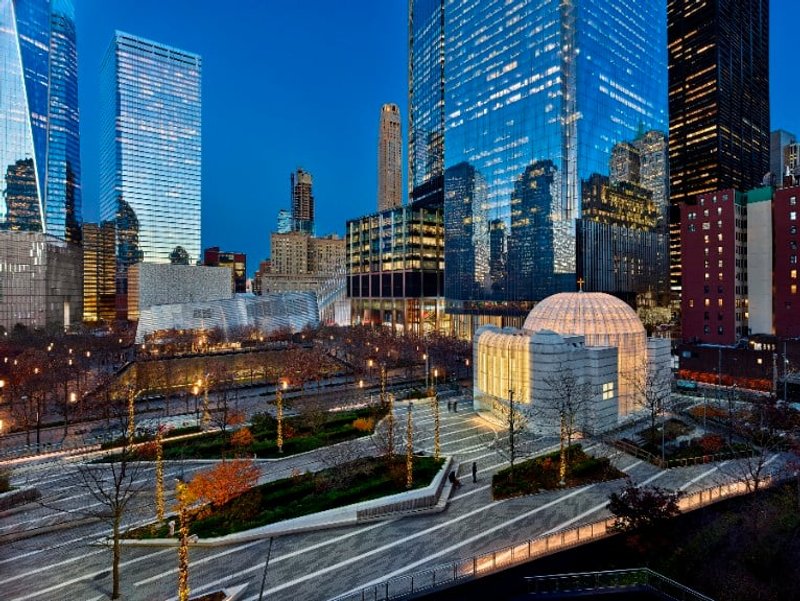
The St. Nicholas Greek Orthodox Church and National Shrine is the latest addition to the World Trade Center Campus, joining the WTC Transportation Hub – commonly known as “the Oculus” which opened to the public in 2016. The Oculus, which was envisioned by Santiago Calatrava to symbolize a dove released from a child’s hand, is situated at an angle in contrast to neighbouring buildings and even the entire grid of the city, thereby allowing the light to shine directly overhead. The downtown architectural landmark has become one of the most photographed structures ever and is responsible for bringing in tourists and helping re-energize the lower Manhattan area.
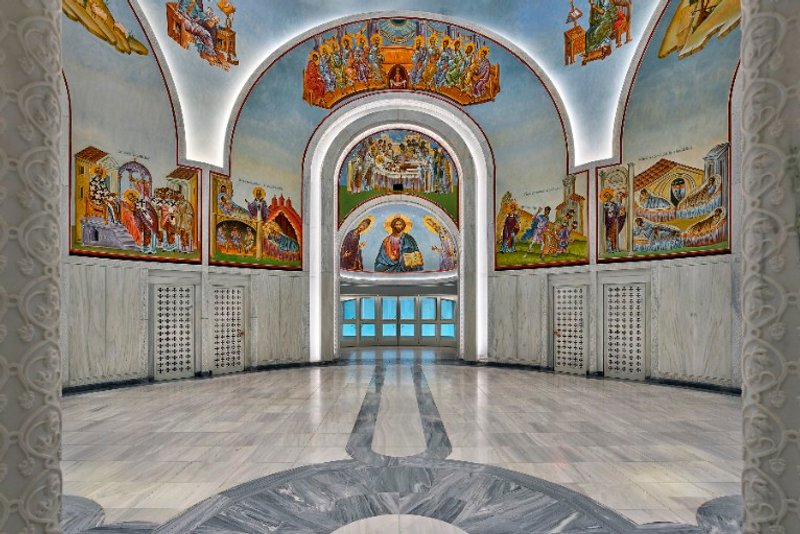 Orthodox Church and National Shrine Angle from the Narthax into the Nave - Photo © Alan Karchmer for Santiago Calatrava.
The church stands tall at a height of 25 feet above street level, towering above the World Trade Center Memorial oak trees. Its stone exterior gives it a strong and fitting presence as the only non-secular building on the rebuilt site. It serves as a symbol of hope and rebirth for both the congregation and the city, as it welcomes millions of visitors to the World Trade Center campus.
Visitors can access the church through a low archway on the west side, leading to an open plaza. The west façade features round stair towers, guiding visitors to the entrance. The second and third floors of the building, located west of the dome, house the Community rooms. These spaces include two small offices with windows that offer views of the Memorial and Liberty Park. Additionally, there is a large Meeting Room that is open to the local community for meetings and other events. These spaces play a vital role in the church's mission to foster an open and welcoming relationship with the World Trade Center Memorial site and the community of Lower Manhattan.
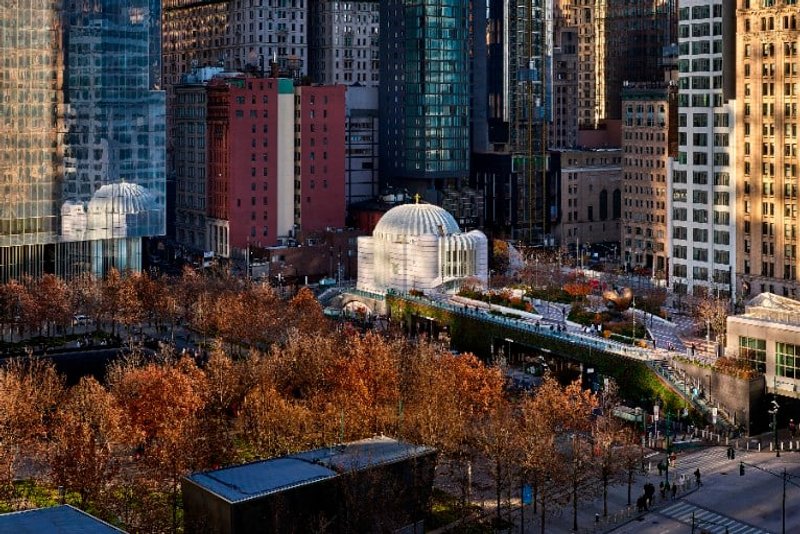 Orthodox Church and National Shrine Angle from the Narthax into the Nave - Photo © Alan Karchmer for Santiago Calatrava.
The St. Nicholas Greek Orthodox Church and National Shrine is the final addition to the World Trade Center Campus designed by Santiago Calatrava, joining the already iconic "Oculus" transportation hub which opened to the public in 2016. The Oculus, which was designed to symbolize a dove being released from a child's hand, stands at an angle in contrast to the surrounding buildings and the city's grid, allowing light to shine directly overhead. This downtown architectural masterpiece has become one of the most photographed structures in the world, attracting tourists and helping to revitalize the lower Manhattan area.
Cover photo: St. Nicholas Greek Orthodox Church and National Shrine Angle from the Narthax into the Nave - Photo © Alan Karchmer for Santiago Calatrava.
References (1)



Popular Articles
Popular articles from the community

On the Brooks House by Monsoon Collective – A Contemporary Kerala Home Rooted in Tradition
Kerala home blending tradition and modernity with water-inspired design, brick architecture, courtyard planning, and sustainable rainwater harvesting strategies.
Inverted Architecture Installation by Studio Link-Arc: Exploring the Intersection of Architecture and Living Organisms
Inverted Architecture Installation by Studio Link-Arc blends mycelium, sustainability, inverted design, ecological cycles, and urban adaptive architecture in Shenzhen.
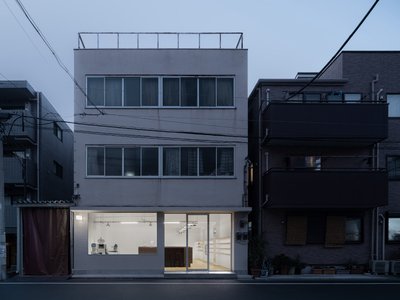
Atelier Macri Concept Store Interior Design by CASE-REAL
Atelier Macri store features a "ko" counter, walnut wood details, cork displays, blending retail, gallery, and seamless customer experiences.
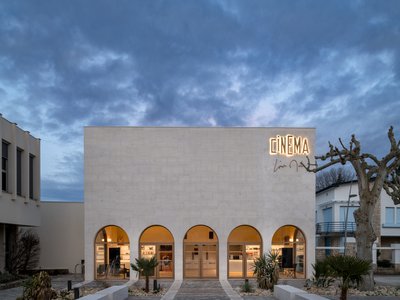
Louis Malle Cinema: A Limestone Cultural Landmark Revitalizing Community Life in Prayssac
Limestone cinema extension with public forecourt, blending heritage and modern design to create flexible cultural spaces and strengthen community interaction.
Similar Reads
You might also enjoy these articles
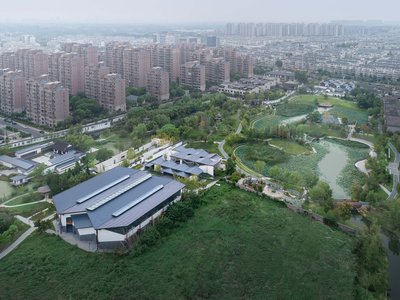
Zhuxi Wonderland: Reimagining Traditional Chinese Gardens by Doarchi Architects
Zhuxi Wonderland by Doarchi Architects reinterprets traditional Yangzhou gardens, integrating courtyards, pavilions, and tea houses in modern cultural design.
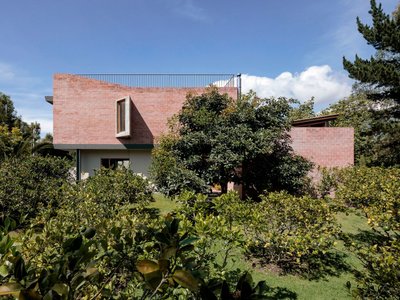
Doble Soga House: A Contemporary Brick Residence Rooted in Landscape in Quito, Ecuador
Brick house in Quito integrating nature, flexible living spaces, exposed materials, and rooftop terrace, creating warm contemporary architecture for modern family life.
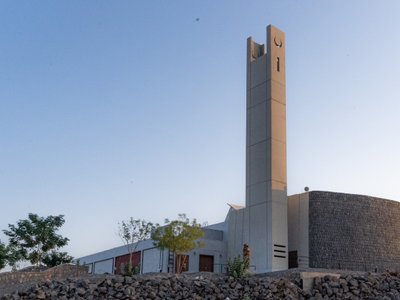
Al Gharra Mosque in Medina Redefining Contemporary Islamic Architecture
Minimalist Medina mosque using concrete, light, and landscape to reinterpret Islamic worship spaces through symbolic spiritual transitions and contemporary architecture.
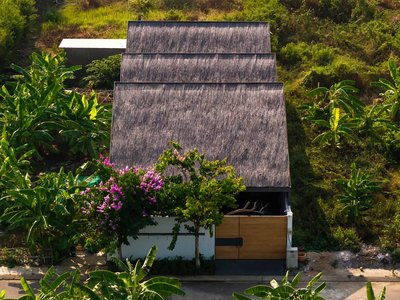
Viczonecode Villa by DDconcept – Tropical Family Living in Ho Chi Minh City
Tropical family villa in Ho Chi Minh City featuring courtyards, skylights, natural ventilation, elevated flooring, and seamless indoor–outdoor living surrounded by greenery.

Explore Architecture Competitions
Discover active competitions in this discipline




The International Standard for Design Portfolios


The Global Benchmark for Architecture Dissertation Awards


The Global Benchmark for Graduation Excellence

Design Challenge - Contemporary interpretation of a religious complex
Comments (0)
Please login or sign up to add comments
No comments yet. Be the first to comment!