
Rebirth of Compound
Post pandemic township design
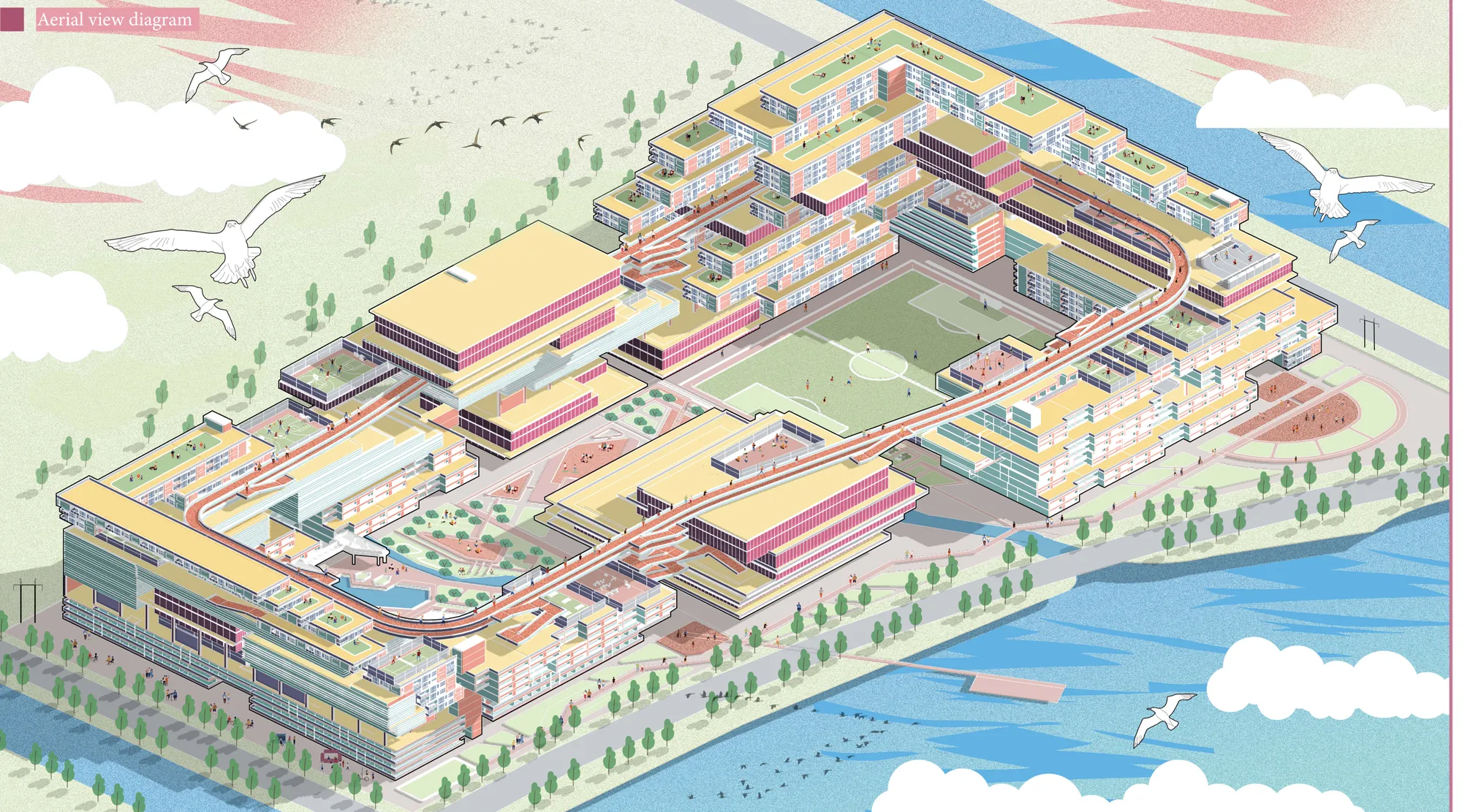
The inspiration of this design comes from the problems existing in real life.The outbreak of the new crown has brought a huge impact on our lives, exposing many problems in the community in isolation.For example: 1. The community needs to form relatively closed units for isolation.2. It's too crowded for internal contagion.3. Insufficient material support in the unit.4. The poor sense of belonging of residents does not mean that they actively participate in epidemic prevention.These issues, if addressed effectively, could lead to new patterns of habitation during the epidemic.We chose Shenzhen, China, which has a large population, and analyzed the previous living mode in China, and found that China experienced the residential mode of compound after the founding of the People's Republic of China.We found that the advantages of the compound (mixed function, high density but not crowded, strong neighborhood relationships) were very much in line with our expectations in terms of adapting to quarantine and post-epidemic life.However, the courtyard model has its disadvantages (too closed, lack of playing fields), which we need to remove in the process of renovation.Therefore, we made use of the compound model's functional mix, easy closure and strong neighborhood relationship, and improved the shortcoming of lack of exercise, thus forming our new compound model.
Our scheme draws on the form characteristics of the courtyard model in shape, and makes a large enclosed building form in the plot, and mixes the residential, office, medical, entertainment and commercial layout according to the proportion requirements.
Mixed main functions are divided into residential function, industrial function, supporting function.Residential function as the main function of the community, including dormitory, all kinds of quality apartment and other different types;As the focus of functional mixed community, industrial function includes office, business, hotel, leisure and entertainment, creative culture, etc.The supporting functions are mainly for the internal use of the community, including community services, medical treatment, culture and sports, etc.
In order to combine peacetime and wartime in the post-epidemic era, we put forward the concept of sunshine shared space.This space can be connected to form a large public space during the non-epidemic period, and can be separated to form an independent space for use during the epidemic period.To prevent the spread of the virus at the same time, to ensure people's outdoor activities and exercise.
We found that the lack of physical activity during home isolation during the epidemic was extremely detrimental to people's physical and mental health.Therefore, we put forward the concept of maximizing the movement space in the courtyard mode.By classifying and analyzing the five functions that must exist, the possible and necessary motion types are extracted, and the motion space is arranged according to the rules of points, lines and planes.However, we did not set all the space as sports space. In the north side of the base, considering the demand of static movement, we combined with the water features to create a viewing and rest space for use.
Through this design, we have well responded to the concept of "density does not equal crowded". It can be seen that the building density of our compound is relatively high, but due to reasonable organization, there are many opening Spaces, which are not crowded.It also reflects on the life style of people in the post-epidemic era, which provides a new attempt and possibility for future human settlement.



Popular Articles
Popular articles from the community

Pangolin Can Help Mining: Biomimicry Architecture for an Asteroid Mining Habitat
Pangolin Can Help Mining explores biomimicry architecture through a modular 3D-printed habitat designed for asteroid mining and future life.

EW PARK: Sustainable Architecture Reimagines the Future of Urban Parking
EW PARK reimagines city parking as a modular wooden tower combining automation, solar energy, electric mobility, and adaptable urban design.
A Reinforced Cocoon: Vernacular Architecture for Security, Healing and Community in Qandahar
A Reinforced Cocoon reimagines Afghan vernacular architecture as secure community space for widowed women, families, healing and resilience.

Co-Life: Senior Housing Design That Reconnects Older Adults With the City
Co-Life reimagines senior housing design through healing gardens, shared streets, workshops, and a sustainable community across generations.

Similar Reads
You might also enjoy these articles

The Rhythm of Seasons
A Farmers' Market Connecting Nature and the City


More Than a Building-Designing a Living System
More Than a Building-Designing a Living System
Base Beyond
DESERT COMPOUND ARID: TOURISM OF ABSENCE AND ABUNDANCE





Comments (0)
Please login or sign up to add comments
No comments yet. Be the first to comment!