

1-1 Architects Flip a Suburban House Upside Down to Find Daylight in Anjo, Japan
A 71-square-meter timber house in a rural Japanese settlement inverts floor conventions to let residents live fluidly between two open rooms.


Suburban Japan keeps building itself into a corner. As older farmhouse lots get subdivided, new houses crowd property lines, and ground-floor rooms sit in shadow. House TN by 1-1 Architects confronts that condition head-on: rather than retreating from it, the design reverses the typical section, pulling the second floor back from its edges to create a bright, permeable volume floating above a deliberately enclosed ground level. The result is a 71-square-meter house in Anjo that feels twice its size and costs no more than a spec-built home.
Led by Yuki Kamiya, Yui Goto, and Kazuya Shibata, the team recognized that the site, a central parcel carved from a large single-story farmhouse lot, was hemmed in on both sides by newer houses built to the boundary. Pushing the ground floor back would have created a courtyard nobody wanted to sit in. Instead, the architects set back the upper volume in a podium-like configuration, wrapping it with continuous openings that catch light well above the neighboring rooflines. The house becomes two distinct one-room environments: a concrete-floored ground level for cooking, eating, and gathering, and a timber-slatted upper realm for rest, play, and open air. Residents choose where to be based on time of day, season, or mood, rather than the fixed labels of conventional room planning.
Corrugated Metal and the Suburban Edge

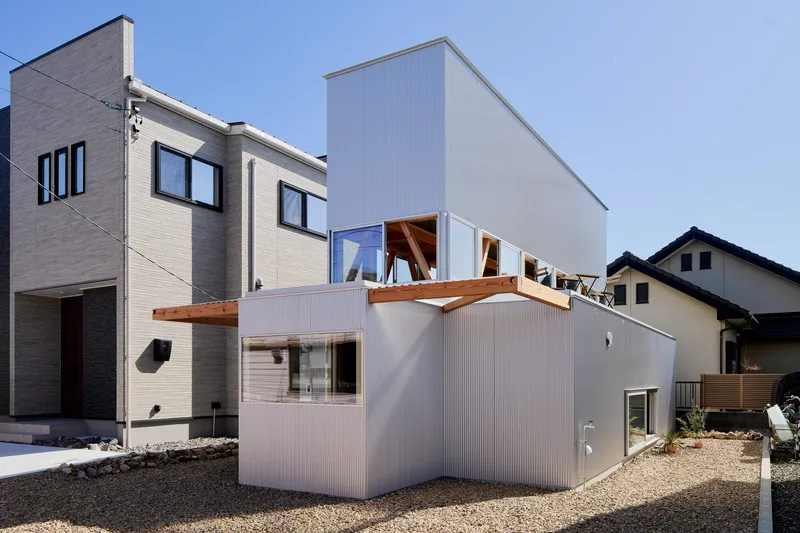
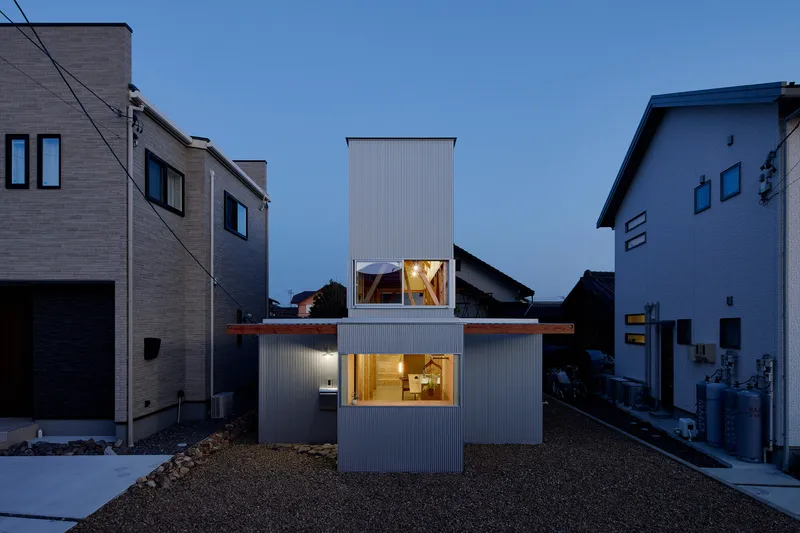
White corrugated metal cladding wraps the house in a material that reads as both industrial and domestic, a deliberate refusal to mimic the tile-clad neighbors. The cantilevered upper volume projects over a gravel yard, creating a sheltered threshold between interior and exterior without the formality of a porch. Seen from the street, the house announces its structural logic: the setback second floor and the exposed diagonal bracing below make the building legible as a section, even from the outside.
Gravel replaces lawn. The choice is practical (drainage, maintenance, budget) but also honest. On a lot this tight, a planted garden would be an affectation. The gravel courtyard instead becomes a kind of shared breathing room between the house and its immediate neighbors, its openness amplifying the sense of space that the podium configuration generates above.
The Ground Floor: Concrete, Timber, and Deep Shadow


At ground level, polished concrete meets exposed timber posts and the underside of the 2×4 louver slab, which doubles as ceiling finish. The kitchen and dining area run along the longer axis, framed by columns that mark structural bays without closing off sight lines. At dusk, pendant lights glow against the rhythmic overhead slats, turning what could feel like a basement into something closer to a lantern.
Low windows at the perimeter pull in views of the courtyard and the neighbors' ground planes, grounding the interior in its context rather than pretending the context doesn't exist. A small entrance corner with wall-mounted sink and timber shelving keeps utility functions visible and accessible, reinforcing the ethos of living within a single open environment rather than retreating behind doors.
A Slatted Ceiling That Is Also a Floor


The most inventive move in House TN is structural. The second-floor slab is composed entirely of 2×4 timber louvers that serve simultaneously as the upper floor's walking surface, the ground floor's finished ceiling, and the horizontal diaphragm providing the building's rigidity. This triple duty eliminates the need for a separate ceiling layer, a separate subfloor, and conventional plywood bracing. The budget savings are real; the spatial effect is even better.
Light slips through the gaps between louvers, casting striped shadow patterns across the concrete below. Turquoise-painted accents appear on select slats, a small chromatic surprise that prevents the all-timber palette from becoming monotonous. The effect changes throughout the day as sunlight shifts angle, turning the ceiling into a slow-moving sundial.
The Upper Realm: Diagonal Bracing and Open Air
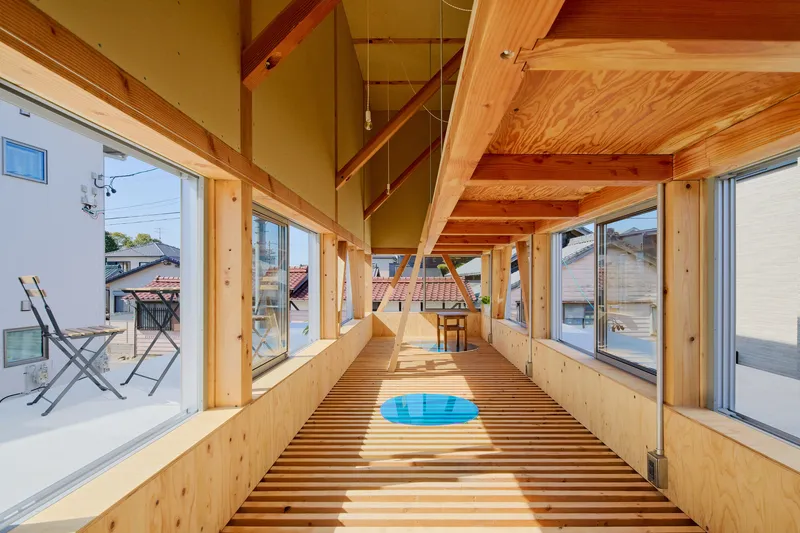
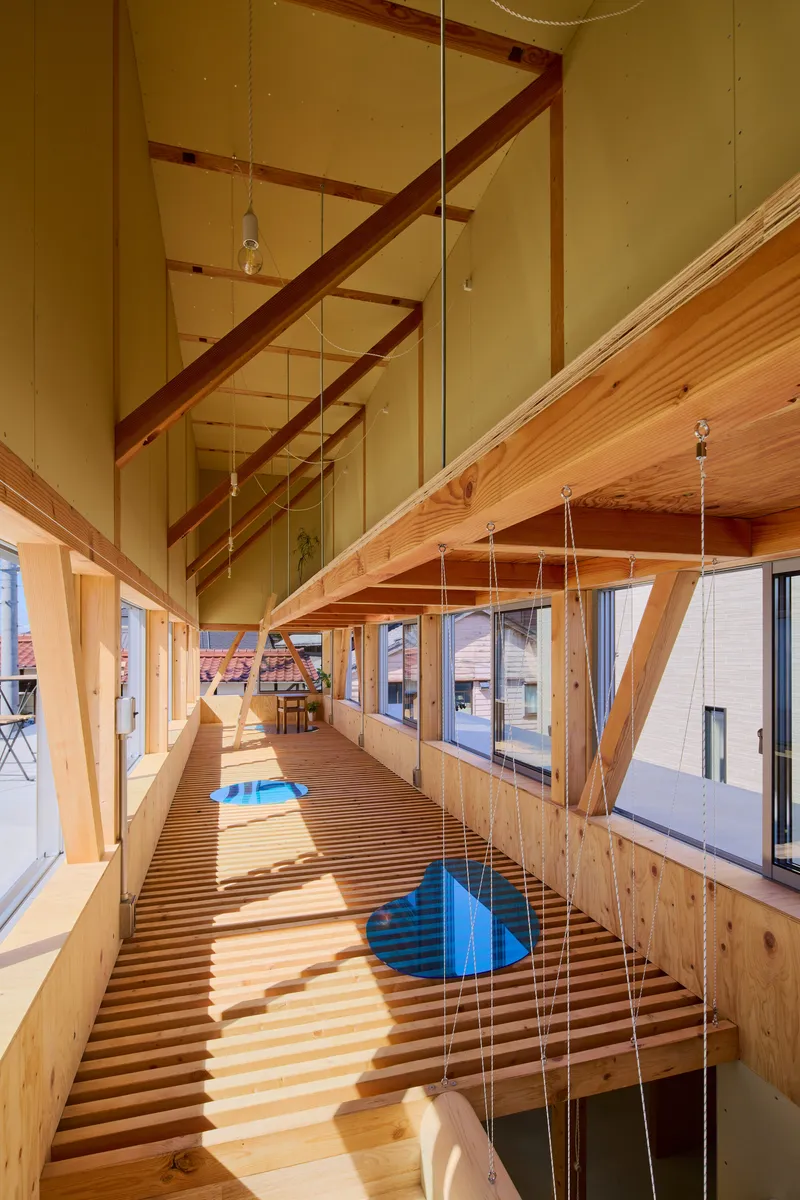

Upstairs, the slatted floor and exposed diagonal beams create a corridor-like space that is part room, part veranda. Sunlight enters through continuous glazing on both sides and cuts through the louver floor, linking the two levels visually and thermally. The diagonal bracing is not hidden; it crosses the vaulted ceiling in long sweeping lines that give the narrow plan a sense of directionality and movement.
Walking on the louver floor means constantly seeing the ground level through your feet. It is a disconcerting sensation at first, then a liberating one: the house doesn't have two separate stories so much as two overlapping atmospheres. Sound, light, and temperature migrate between them freely. Privacy is sacrificed, but in a 71-square-meter house, the illusion of privacy would be just that.
Terrace as Second Living Room


The setback that generates daylight for the second floor also creates a generous rooftop terrace, enclosed by corrugated metal walls that shield it from the street. Sliding glass doors dissolve the boundary between inside and out. A pair of folding chairs is all the furniture needed; the space is defined by its sky exposure rather than by objects.
At dusk, the terrace and the glazed timber interior behind it merge into a single illuminated volume visible from the street. The house gives something back to the neighborhood at this hour: a warm, legible presence among the opaque facades on either side.
The Void Between: Spatial Permeability in the Townscape


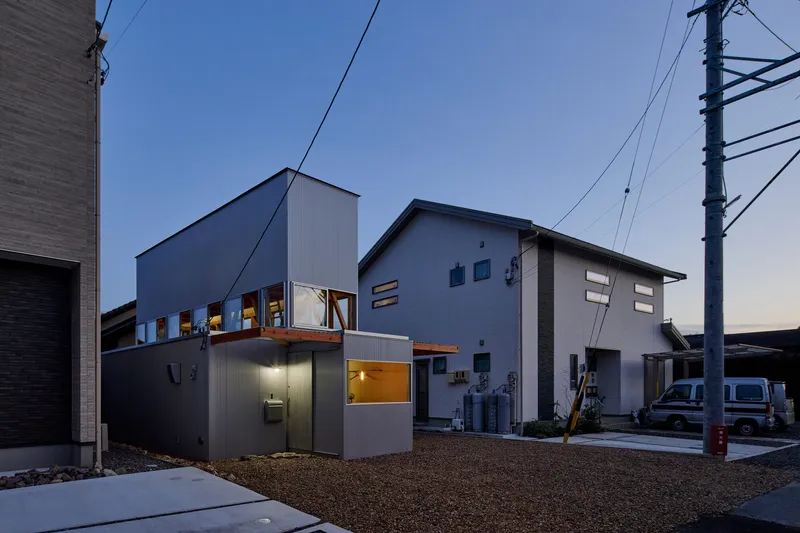
From the street, the most striking element is not the house itself but the void it creates at the height of its neighbors' eaves. The cantilevered deck, the angled window openings, and the visible diagonal bracing all occupy a zone that in a conventional house would be solid wall or empty air. Here it reads as inhabited threshold, an in-between layer that introduces porosity into a streetscape of closed volumes.
Overhead power lines, neighboring tile roofs, and the messiness of a real suburban block are visible in every exterior shot. 1-1 Architects did not attempt to erase this context. The white corrugated shell simply holds its position within it, clear about what it is and confident that a small house can reshape the air around it without dominating anything.
Thresholds and Color Details
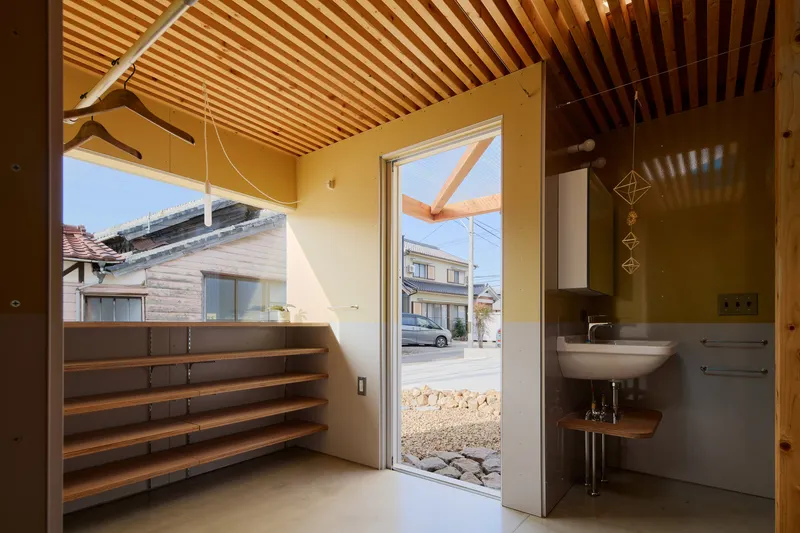
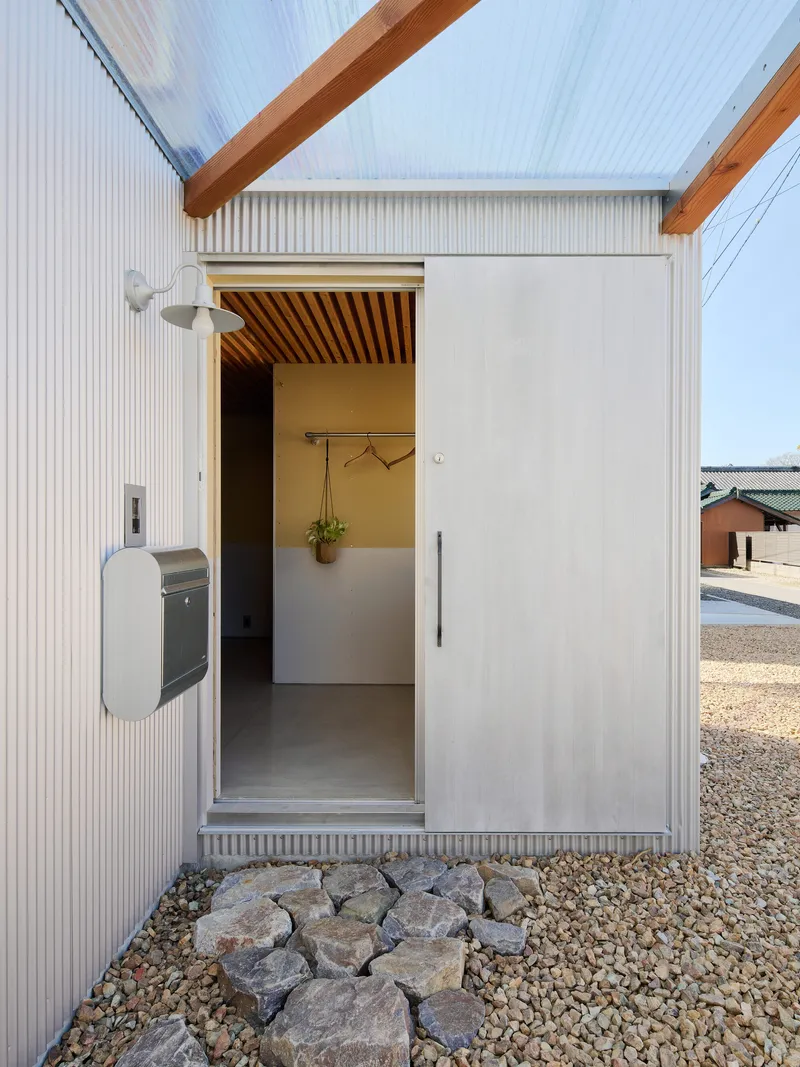

Entry into the house happens at the gravel edge, through a corrugated-metal-framed opening that frames the mailbox, a stone border, and the sky in a single view. Inside, a timber shelf wall and wall-mounted sink serve as mudroom, storage, and workspace simultaneously. There is no vestibule, no transition zone. You step from the suburban street directly into the life of the house.
Color is used surgically: a turquoise stripe on a ceiling slat, a yellow-walled doorway, a blue-painted soffit. These small interventions keep the timber-and-concrete palette from falling into the trap of false neutrality. Each color marks a specific condition: a change of ceiling height, a shift in program, a moment where structure changes direction.
Internal Aperture and the Circular Opening


A circular opening cut through the suspended timber platform connects the upper and lower levels with the directness of a ship's hatch. Afternoon sunlight pours through it, illuminating the lower room in a cone of warm light. The opening is too large to ignore and too small to walk through, functioning as a visual link and a ventilation channel rather than a conventional stairwell.
Elsewhere, slatted screens cast striped shadows on white walls and plywood doors, reinforcing the rhythm of the 2×4 louver system as a governing motif. The entire house reads as a single structural idea explored at every scale, from the diaphragm slab to the interior partitions to the shadow patterns on the floor.
Plans and Drawings


The ground floor plan reveals the building's simple rectangular footprint, with two parking bays flanking a central living space and planted beds at the perimeter. The upper-level plan and elevation show how the narrow volume terminates in terraces at each end, giving the second floor access to sky on three sides. The section is the most revealing drawing: it shows the split-level relationship between the two one-room environments, the circular aperture punching through the louver slab, and the diagonal bracing that makes the cantilever possible.
What the drawings make clear is how compact the actual built volume is. At 71 square meters, the house barely exceeds the footprint of a large studio apartment. The section is doing all the heavy lifting: by stacking two differently conditioned environments and linking them through the permeable slab, the architects multiply the experiential area far beyond the measured one.
Why This Project Matters
House TN is a convincing argument that suburban Japan's least promising sites can still produce architecture worth paying attention to. The constraints here are severe: a sandwiched lot, tight budget, oppressive proximity to neighbors, and the regulatory fog of an urbanization control area. Rather than treating those constraints as problems to be designed around, 1-1 Architects treated them as the project's raw material. The inverted section, the multi-purpose slab, and the refusal to create predetermined rooms all emerge directly from the difficulty of the site.
More broadly, the house challenges the assumption that spec-level budgets must produce spec-level architecture. By collapsing structure, finish, and spatial identity into a single timber louver system, the design achieves material economy without material poverty. It suggests a replicable tactic for the thousands of subdivided lots across Japanese suburbs where older farmhouses are giving way to developer-built boxes. If a 71-square-meter house on a leftover parcel can feel this generous, the problem was never the parcel.
House TN by 1-1 Architects (Yuki Kamiya, Yui Goto, Kazuya Shibata). Anjo, Japan. 71 m². Completed 2024. Photography by Takashi Uemura.
About the Studio
1-1 Architects
Official website of 1-1 Architects, one of the studios behind this project.
1-1arch.comShare Your Own Work on uni.xyz
If projects like this are the kind of work you want to make, uni.xyz is a place to publish your own, find collaborators, and enter design competitions.


Popular Articles
Popular articles from the community


The Amber Palace Opera: A Geological Fiction Surfaces on Tallinn's Baltic Waterfront
Pierre Brillard reimagines a Baltic legend as a public landscape, opera house, and waterfront promenade rooted in Tallinn's coastal identity.

Manzana Morphosis: Stretching Barcelona's Grid into a Living Landscape for 2050
A radical reworking of the Eixample manzana turns density into a tool for generous public space, vertical ecology, and environmental performance.

Cloaked Colonization: A Mobile Underwater Habitat That Moves Like a Fish
Micah Abaya's shortlisted EHC Pacific entry reimagines ocean settlement as a dispersed network of self-sustaining architectural organisms.

Extended Shell: Retrofitting Kolkata's Balconies as Living Urban Thresholds
A modular retrofit system recovers the social and environmental intelligence of Kolkata's historic verandas for contemporary Park Street residents.

Similar Reads
You might also enjoy these articles

Bao Huynh Watercolor Atelier: A Serene Art Retreat in Hội An
Bao Huynh Watercolor Atelier in Hội An blends multifunctional art spaces, sustainable design, local materials, and family-friendly living in a serene environment.

Atelier Macri Concept Store Interior Design by CASE-REAL
Atelier Macri store features a "ko" counter, walnut wood details, cork displays, blending retail, gallery, and seamless customer experiences.

Manuel Vargas Izquierdo Stadium and High-Performance Sports Center: Architectural Excellence in Jalpa de Méndez
The Manuel Vargas Izquierdo Stadium blends sustainable design, inclusive sports facilities, and cultural-inspired architecture, revitalizing Jalpa de Méndez’s public spaces.

KAKR Buluh Awar Hall: Revitalizing Community and Ecology Through Bamboo Architecture
Community built bamboo hall revitalizes Buluh Awar village, empowering youth, restoring ecology, celebrating vernacular craftsmanship through sustainable architecture and culture.


Comments (0)
Please login or sign up to add comments
No comments yet. Be the first to comment!