

113 Three Mills Lisbon Restaurant – Adaptive Reuse in Mouraria by José Adrião Arquitetos
Historic Mouraria mill reborn as 113 Three Mills Lisbon restaurant, a compact pre-Pombaline renovation by José Adrião Arquitetos into hospitality.


The 102 m² 113 Three Mills Lisbon Restaurant by José Adrião Arquitetos transforms a layered pre-Pombaline corner building in Mouraria into an intimate dining venue that folds local history, archaeology, and urban texture into a contemporary hospitality setting. Completed in 2022 under the direction of José Adrião, the rehabilitation reclaims the site’s commercial legacy while revealing traces of the flour-milling past that gave Beco dos Três Engenhos—Alley of the Three Mills—its name. What was once a workshop, and before that a tavern, now reopens as a street-connected restaurant that treats memory as a design material.

Urban and Historical Context in Mouraria
Set at the intersection of Rua Marques de Ponte de Lima and Beco dos Três Engenhos, the 113 Three Mills Lisbon Restaurant sits within Lisbon’s Mouraria district, one of the city’s most culturally layered neighborhoods. The existing structure predates the Pombaline reconstruction era and grew over time from an irregular patio condition, resulting in a distinctive trapezoidal footprint. That accretive geometry—evidence of informal urban growth—became both a constraint and an opportunity, encouraging a spatial strategy that works with angles, thicknesses, and residual volumes rather than erasing them.


Archaeological Discovery and Naming
During rehabilitation, archaeological investigation in the basement uncovered milling elements tied to historical flour production. These finds confirmed the toponymic origins of the alley and anchor the project narrative: the restaurant does not merely occupy a site; it reactivates the memory of the Three Mills. By acknowledging these remains, the design deepens visitor connection to place and extends the project’s storytelling power for cultural tourism, search discoverability, and local identity.

From Mill to Tavern to Workshop to Restaurant
Few Lisbon interiors carry such a compact record of economic reuse. After its milling phase, the building operated as a tavern and later as a workshop. The current intervention leverages the last valid commercial license (tavern) to streamline regulatory conversion, a pragmatic move that allowed resources to focus on spatial quality. Framing this lineage within the 113 Three Mills Lisbon Restaurant narrative supports SEO relevance across searches for historic Lisbon taverns, adaptive reuse projects, and Mouraria dining.

Adaptive Reuse Strategy
Rather than impose a new image, the project stabilizes, extends, and clarifies the existing structure. The rehabilitation consolidates original masonry and concrete layers, strategically extends the upper floor, and introduces a covered outdoor terrace that acts as climatic buffer and social spillover. Service cores—restrooms, storage, and back-of-house—are tucked into the new upper-level buildout so that guest areas remain open to the street and surrounding elevations. This light-touch yet surgical approach preserves historical legibility while meeting contemporary restaurant standards.

Spatial Organization
The ground floor of the 113 Three Mills Lisbon Restaurant houses the kitchen and a street-linked lounge that opens directly to the public realm, encouraging casual entry from Mouraria’s narrow pedestrian flows. Above, the extended upper level gathers dining under cover while pushing out toward the terrace, where large open apertures—deliberately left without casements—capture cropped views of neighboring façades. These framed fragments stitch the restaurant to the urban fabric and create a cinematic dining experience shaped by Lisbon’s shifting daylight.

Material Expression and Preservation
Interior surfaces reveal the layered material history of the building—masonry, concrete, and constructed thicknesses—rather than masking them behind new finishes. Select new work is purposefully minimal, allowing the tactile contrast between old substrate and precise insertions to carry the architectural dialogue. The result is an atmosphere that feels both raw and refined: heritage texture held in tension with contemporary hospitality needs. For design researchers and travelers searching “113 Three Mills Lisbon Restaurant architecture,” this material candor becomes a distinctive draw.
Terrace Framing and Urban Dialogue
One of the project’s most memorable gestures is the terrace level, where broad openings without glazing planes act as viewfinders. Dining becomes a visual exchange with adjacent buildings; stucco, tile, and weathered surfaces across the lane enter the composition as living elevations. Lisbon’s air, sound, and seasonal light animate the space, softening the boundary between adaptive reuse interior and exterior urban room.
Small Footprint, Strong Identity
At just 102 m², the 113 Three Mills Lisbon Restaurant demonstrates how compact heritage properties can be reactivated for contemporary use without sacrificing character. By combining archaeological storytelling, regulatory pragmatism, and spatial restraint, José Adrião Arquitetos delivers a destination that reads simultaneously local and current—qualities that support strong organic search performance across architecture, travel, food, and Lisbon heritage keywords.

The 113 Three Mills Lisbon Restaurant is a study in how careful rehabilitation can turn a layered pre-Pombaline remnant into a culturally resonant dining experience. History discovered in the basement informs naming and narrative; modest extensions unlock usable area; open terrace frames the neighborhood; and material honesty grounds the whole in Mouraria’s urban grain. For visitors, designers, and researchers alike, it offers a concise lesson in adaptive reuse rooted in place.

All the photographs are works of Hugo Santos Silva


Popular Articles
Popular articles from the community


longwave studio Reorganizes a 112 m² Tainan Apartment Around the Daily Routines of a Family and Two Cats
In Tainan, Taiwan, birch plywood, rust-red furniture and a freestanding plaster wall link arrival, storage, work and family life in one apartment.

David Ortega Stacks a Two-Story Mexico City Penthouse Around a Steel Stair and a Pergola-Shaded Roof Terrace
In Colonia Roma, a 300 m² penthouse uses oak joinery, a planted steel stair and a slatted roof pergola to make a new-build apartment feel like a house.

Cube Design Draws an Ecological Corridor Between Two Shenzhen Hills with the Nankai Building
Beside Shenzhen's container docks, the Nankai Building pairs stacked balconies with a climbing green screen to connect two hillsides across its height.

Jaramillo Van Sluys Arquitectura and Urbanismo Turn a Demolished Registry Lot in Quito into an Orchard Plaza
In Quito's Centro Histórico, a 2,800 m² plaza exposes the San Agustín convent wall and redraws its lost Augustinian orchard in volcanic stone.

Similar Reads
You might also enjoy these articles

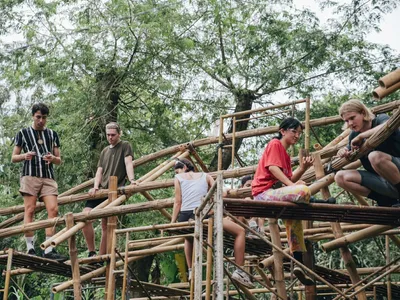
Bamboo Housing Challenge 2026: Design Affordable, Sustainable Homes Using Bamboo
An international design competition by Bamboo U and IBUKU inviting architects and designers to reimagine affordable housing using bamboo — with the winning design built full-scale in Bali.

Computational Design & Education: Beegraphy Design Awards Introduces 7th Category (Featuring Jiyun's Innovative Approach)
Dive into Beegraphy’s 7th Design Awards category, where computational design meets education to create immersive, interactive learning tools, inspired by Jiyun’s work.

From Parametric Lighting to Urban Furniture: Join the 2nd Workshop in Beegraphy’s Computational Design Series
Dive into Cutting-Edge Design Techniques and Practical Applications with Industry Experts

Last Call: Unleash Your Architectural Genius in SHAK's Kindergarten Design Competition
Urgent call for architects to join SHAK's kindergarten design competition before the looming deadline

Explore Architecture Competitions
Discover active competitions in this discipline

Challenge to reimagine the Iron Throne

Photograph architecture without architects

Illustrate the lost glory of Angkor Wat - Render Challenge

Design challenge to reuse E-waste
Comments (0)
Please login or sign up to add comments
No comments yet. Be the first to comment!