
7th Hue Architecture Collective Filters Kerala's Light Through a Compact Brick and Timber Home
At just over 2,000 square feet, The Tiny House in Kerala reimagines compact tropical living through courtyards, perforated screens, and layered volumes.


There is a recurring temptation in residential architecture to equate generosity with size. The Tiny House, designed by 7th Hue Architecture Collective under lead architect Ar. Shyamraj Chandroth, pushes back on that equation with discipline and conviction. Sitting on a modest plot in Kerala between neighboring houses, this 2,023-square-foot home treats constraint not as a limitation but as the very engine of its design intelligence. The result is a house that feels far larger than it measures, and far more connected to its tropical climate than many homes twice its footprint.
What makes the project genuinely compelling is its material and spatial layering. Rather than retreating behind blank walls for privacy, the house uses perforated red brick screens, timber slat partitions, and interior courtyards to negotiate between openness and enclosure. Every surface mediates: light is filtered, air is channeled, views are framed rather than blocked. It is a house designed not around rooms but around thresholds, and that distinction changes everything about how it performs.
A Street Facade Built from Pattern and Restraint
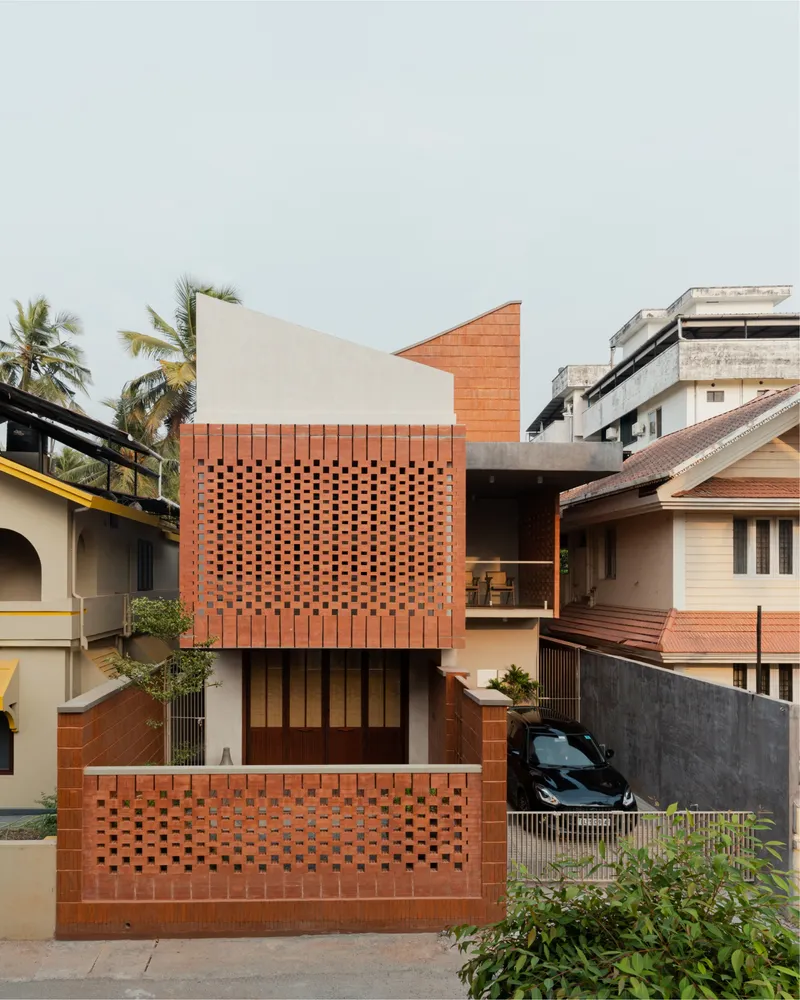
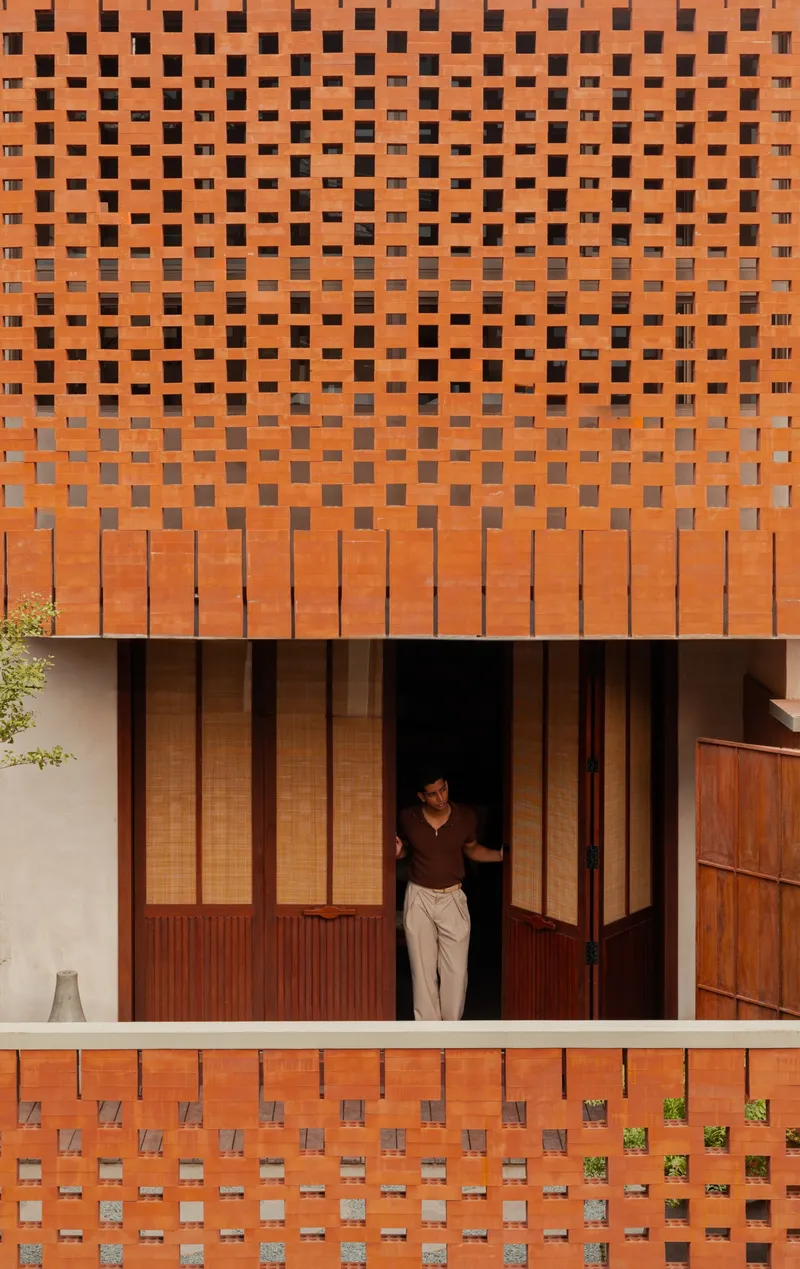

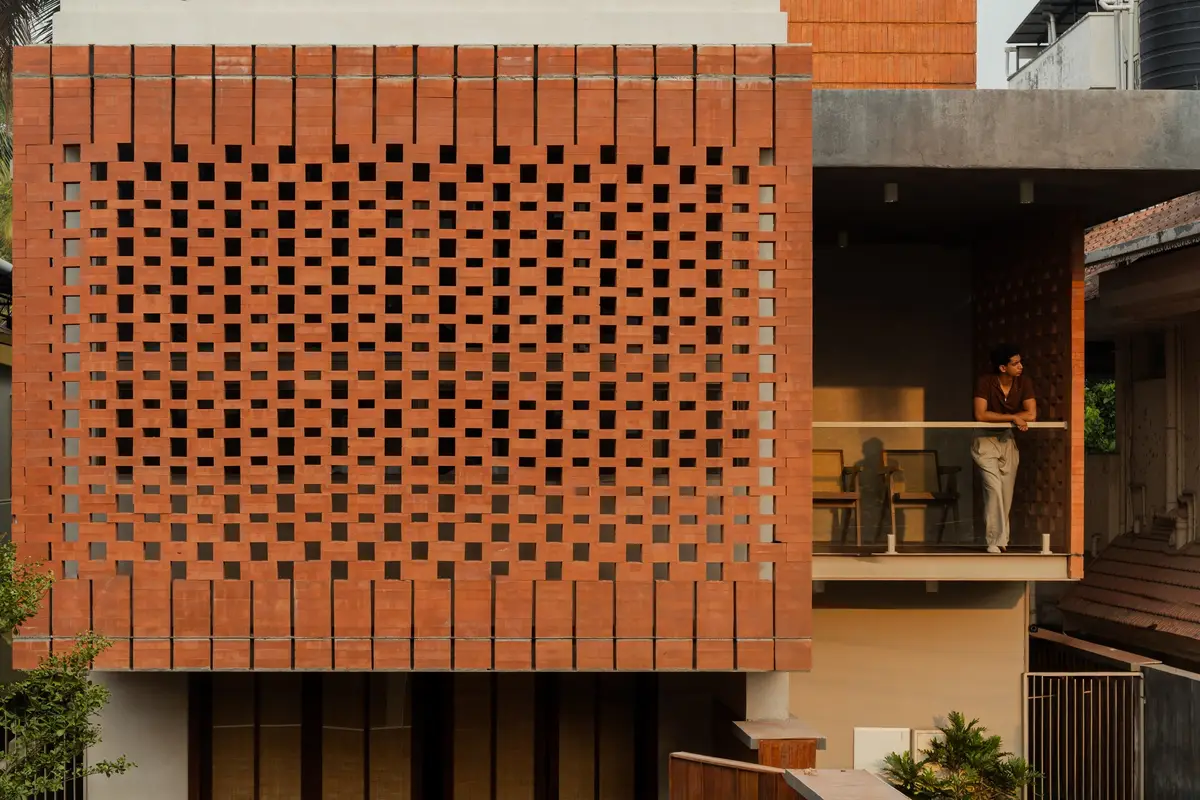
From the street, the house reads as a composed dialogue between white stucco volumes and panels of perforated red brick. The brick is laid in a chequered bond that turns what could be a flat boundary wall into a lantern: porous, textured, and alive with shifting shadow. A recessed timber doorway punches through the brick screen at ground level, signaling entry without fanfare. The proportions are tight, the palette is deliberate, and the overall effect is one of quiet authority within a dense urban fabric.
The facade does not compete with its neighbors so much as quietly outperform them. Where adjacent houses lean on conventional plastered walls and metal gates, The Tiny House uses its brick screen as both privacy device and public gesture. Stand at street level and you catch glimpses of life behind the lattice: a figure on the balcony, warm light spilling through the perforations at dusk. It is generous architecture for a compact lot.
Courtyards as the Spatial Core


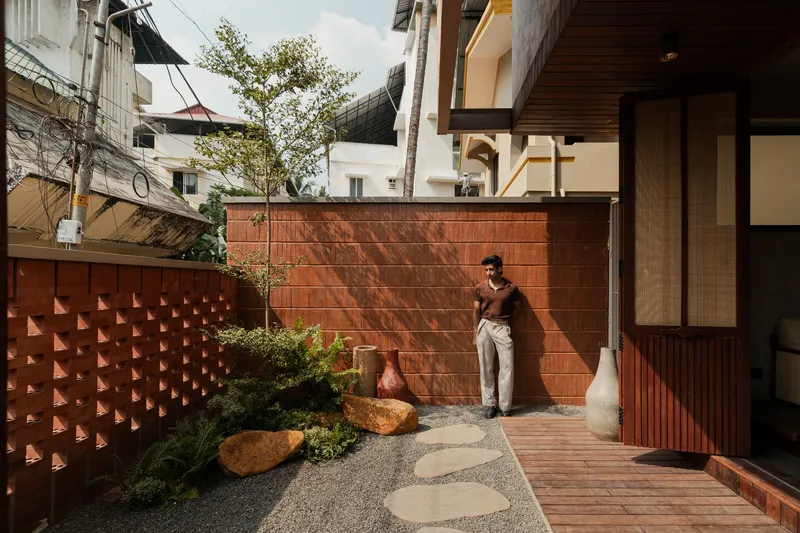
The house organizes itself around interior courtyards that pull light and air deep into the plan. One courtyard, floored in loose gravel with stepping stones and potted plants, sits at the junction between living spaces and acts as the house's lungs. Glass doors fold back to dissolve the boundary between inside and out. A second garden court, flanked by red terracotta tile walls and planted with a single tree among boulders, introduces a rougher, more elemental quality.
These courtyards are not decorative. In a Kerala climate where heat and humidity are constants, they establish the cross-ventilation strategy that makes the house habitable without relying entirely on mechanical cooling. They also solve the density problem: on a narrow lot, you cannot get natural light from the sides, so you pull it in from above and through the middle. The courtyards are the oldest tropical strategy in the book, executed here with real precision.
Timber, Cane, and the Warmth of Interior Surfaces
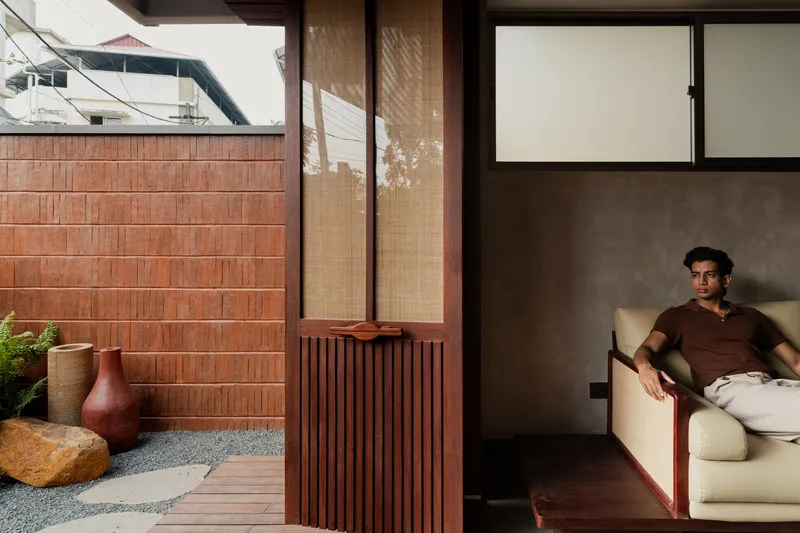


Inside, the material palette shifts from the mineral tones of brick and concrete to the warmth of timber and cane. Slatted timber partitions separate the lounge from the courtyard, allowing air and diffused light to pass through while defining distinct zones. A timber-slatted ceiling panel runs above the living and dining area, softening the exposed concrete soffit overhead and introducing a horizontal rhythm that stretches the perceived length of the space.
Vertical timber slat panels frame the glass doors in the dining area, casting fine parallel shadows across the floor as daylight tracks through the day. The effect is cinematic without being theatrical. These are working elements: they control glare, they provide partial visual screening, and they give every room a changing character from morning to evening. The architects have clearly studied how Kerala's strong equatorial light behaves, and the house is tuned to that behavior.
Living and Dining Under a Concrete Canopy
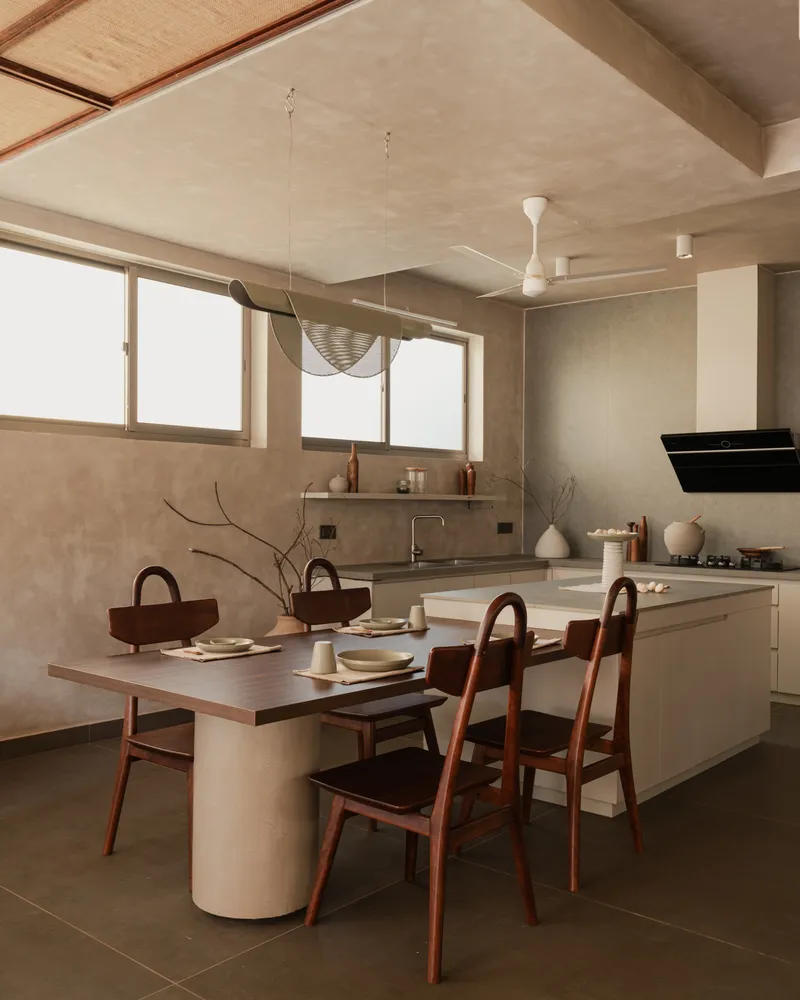

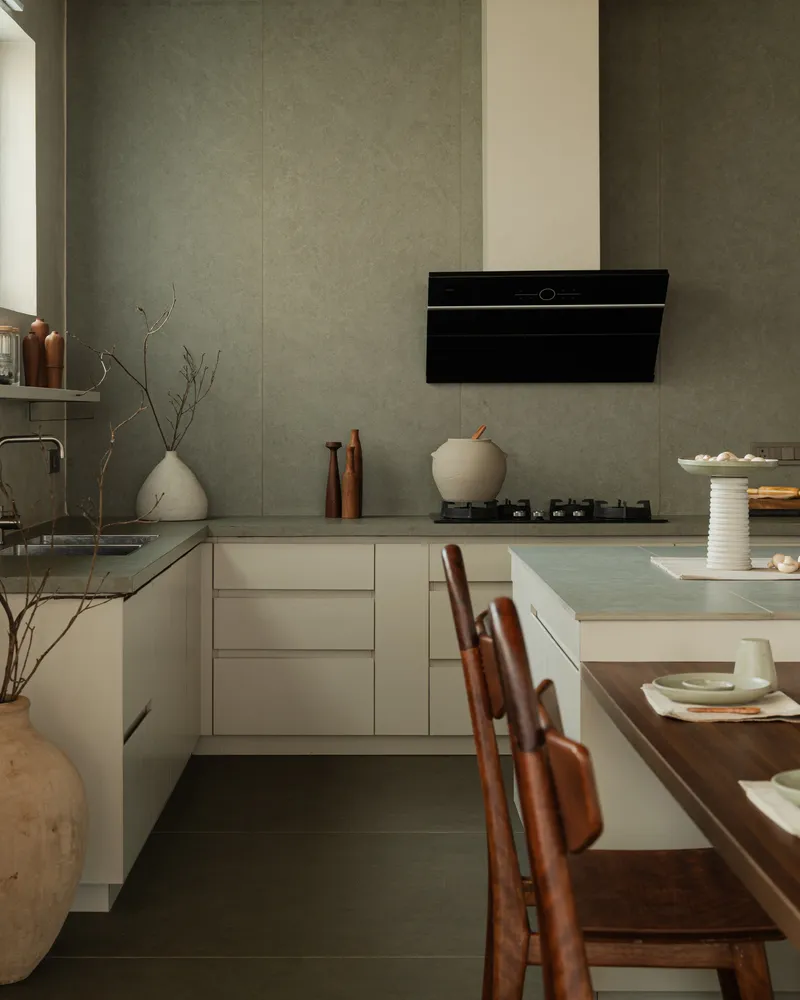
The open kitchen and dining area anchors the ground floor's social life. A cylindrical plaster table base gives the dining surface a sculptural solidity, while sliding frosted glass windows filter light without sacrificing privacy. The kitchen itself is restrained: pale cabinetry, textured wall panels, and a black range hood that adds a single note of contrast. There is nothing excessive here, but nothing is missing either.
A wire pendant light hangs above the dining table, where ceramic vessels and curved timber baskets speak to a lived-in quality that architectural photography rarely captures. The house is clearly inhabited and cared for, which makes the spatial claims more convincing. Compact kitchens often feel like afterthoughts in ambitious residential projects. Here, it is integrated into the larger spatial narrative without being compromised.
Bedrooms Washed in Filtered Light


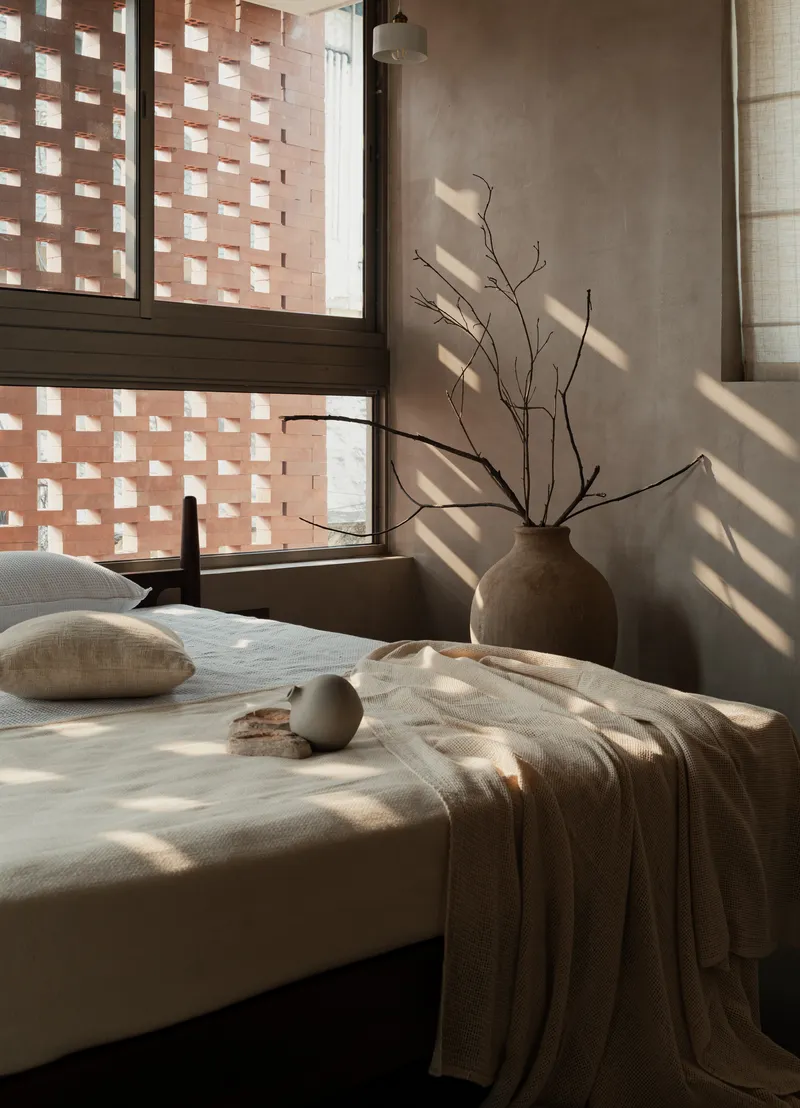
The bedrooms are where the perforated brick screens deliver their most poetic effect. In one room, a full wall of chequered terracotta brick filters strong daylight into dappled patterns that wash across the polished concrete floor and onto the bed. The effect changes by the hour, turning a simple sleeping space into something genuinely atmospheric. A high clerestory window in another bedroom introduces a softer, more diffused wash of light above a timber and cane headboard.


A workspace tucked into one bedroom corner places a writing desk beneath a translucent fabric roman shade, proof that compact living does not have to mean eliminating the secondary spaces that make a house functional for daily life. Elsewhere, a tall recessed window niche frames a figure looking out, the cream-toned plaster walls amplifying the available light. These are small rooms that never feel cramped because the light strategy is so carefully considered.
Stairwell and Circulation as Designed Events
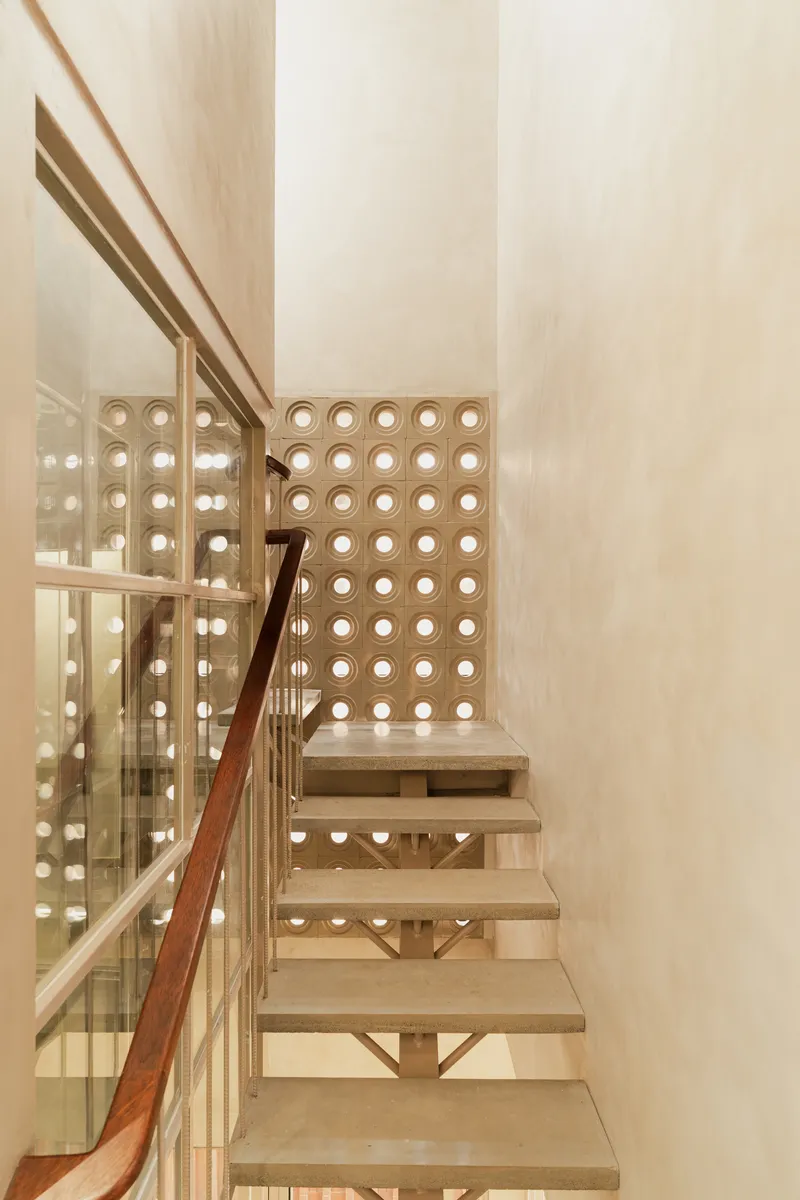


In a house this size, circulation eats into usable floor area. The architects have responded by making the stairwell an event in itself. A timber staircase with a glass balustrade rises through a skylit shaft, with a circular perforated screen wall turning the vertical passage into a play of light and shadow. It is both functional connector and spatial spectacle.
Pivoting timber screens with black metal frames appear at key transitions, allowing rooms to be opened or closed as needed. On the deck, a timber lounge chair sits beneath an exposed concrete soffit, facing the perforated brick wall. It is the kind of space that exists only because the architects thought about the experience of moving through the house, not just the rooms at either end of the journey.
The Courtyard Screen as Landscape Element
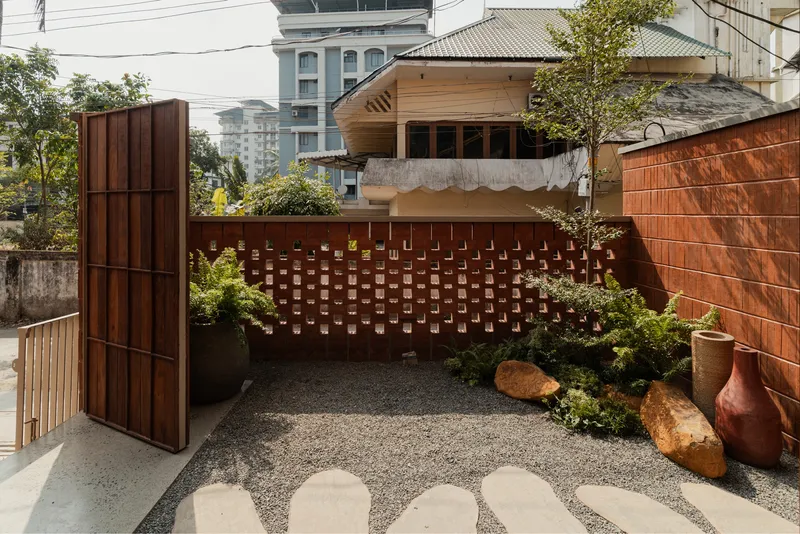
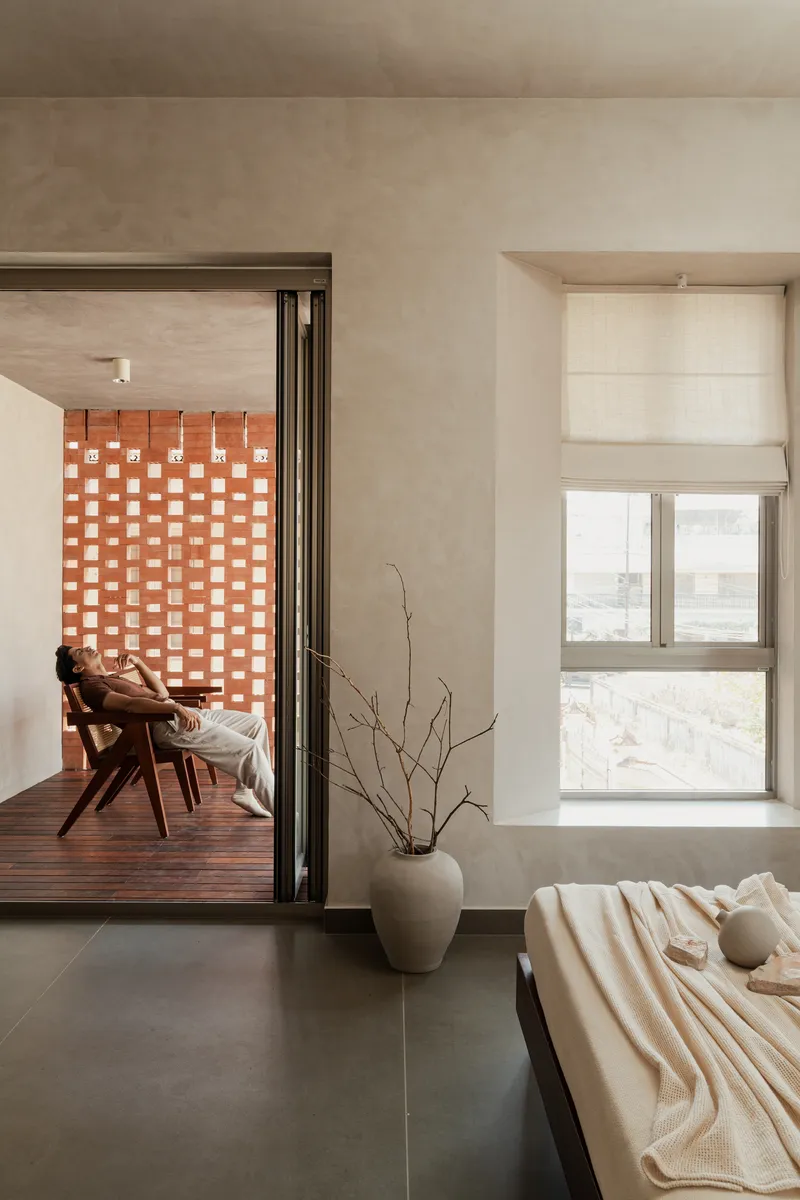
One of the project's strongest compositions places a perforated terracotta screen wall at the rear of a courtyard garden, flanked by timber cladding and planters. The screen reads as both architecture and landscape boundary, dissolving the distinction between wall and garden. From the bedroom, folding glass doors open onto a timber deck that terminates at the brick screen, creating a layered sequence: interior, deck, screen, sky. It is a telescoping depth that makes the house feel much deeper than its actual dimensions.
Plans and Drawings
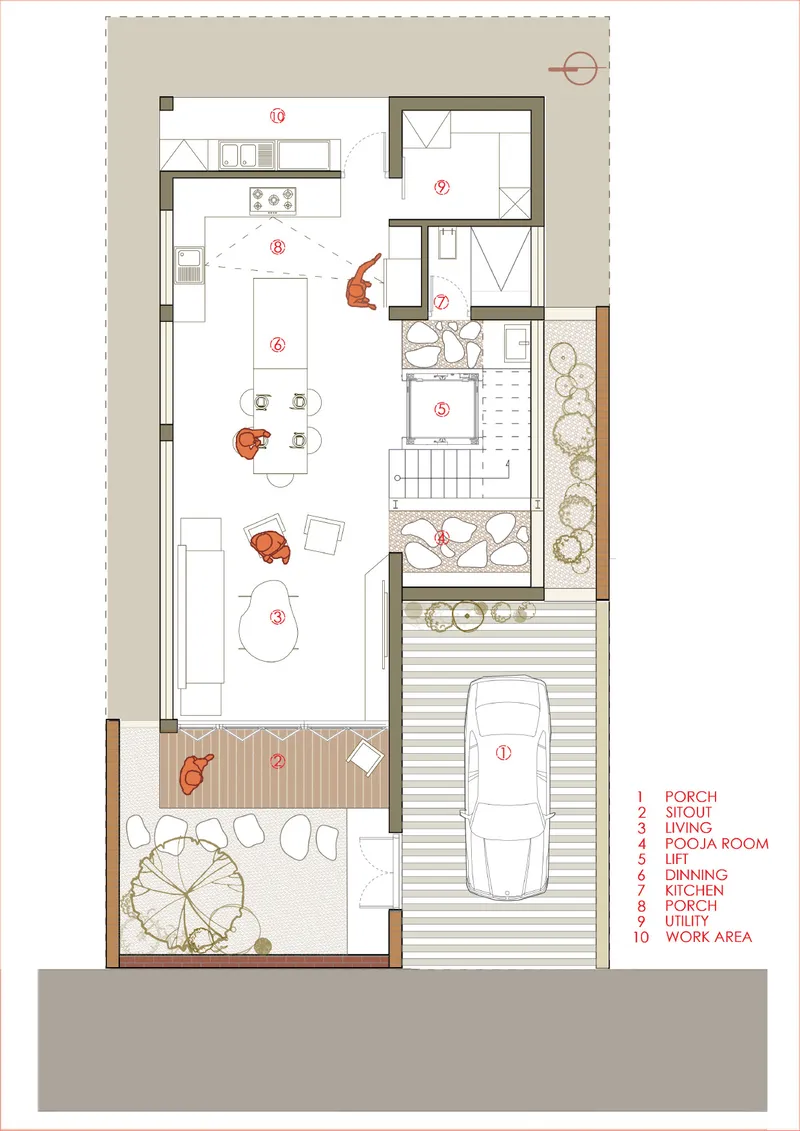

The floor plans reveal the organizational logic that the photographs only hint at. The ground level places open living areas, kitchen, and a timber deck terrace around the central courtyard, maximizing cross-ventilation and natural light penetration. The upper level arranges bedrooms with ensuite bathrooms along the perimeter, with covered parking tucked below. The compact footprint is legible in plan, but so is the spatial generosity that the courtyard strategy produces. Every square foot is accounted for, nothing is wasted, and the circulation is tight without being mean.
Why This Project Matters
The Tiny House matters because it demonstrates, with real clarity, that the environmental and spatial ambitions of tropical modernism are not reserved for large villas on generous plots. On a constrained urban lot with neighbors pressing in from both sides, 7th Hue Architecture Collective has delivered a house that breathes, glows, and connects its inhabitants to the rhythms of Kerala's climate. The perforated brick screens are not stylistic affectation; they are a working environmental system that manages light, air, and privacy simultaneously.
At a moment when compact housing in India too often defaults to sealed, air-conditioned boxes, this project offers a counter-argument rooted in material intelligence and spatial discipline. The courtyards, the layered screens, the timber partitions: these are not expensive moves, but they require conviction and careful coordination. Ar. Shyamraj Chandroth and his team have shown that small houses can carry big ideas, and that economy of means and richness of experience are not in opposition. That lesson extends well beyond Kerala.
The Tiny House, designed by 7th Hue Architecture Collective, led by Ar. Shyamraj Chandroth. Located in Kerala, India. 2,023 square feet. Completed in 2024. Photography by Marc Frames.
About the Studio
7th Hue Architecture Collective
Share Your Own Work on uni.xyz
If projects like this are the kind of work you want to make, uni.xyz is a place to publish your own, find collaborators, and enter design competitions.


Popular Articles
Popular articles from the community


Cube Design Draws an Ecological Corridor Between Two Shenzhen Hills with the Nankai Building
Beside Shenzhen's container docks, the Nankai Building pairs stacked balconies with a climbing green screen to connect two hillsides across its height.

ETEH Reworks the Shared Spaces of São Domingos School in Brazil Around Timber, Color and Hanging Plants
At São Domingos School in Brazil, 436 m² of hall, refectory and library are recast with timber joinery, a yellow and blue code and trailing greenery.

David Ortega Stacks a Two-Story Mexico City Penthouse Around a Steel Stair and a Pergola-Shaded Roof Terrace
In Colonia Roma, a 300 m² penthouse uses oak joinery, a planted steel stair and a slatted roof pergola to make a new-build apartment feel like a house.


Manzana Morphosis: Stretching Barcelona's Grid into a Living Landscape for 2050
A radical reworking of the Eixample manzana turns density into a tool for generous public space, vertical ecology, and environmental performance.

Similar Reads
You might also enjoy these articles

LAVA Architecten Gives Vocational Education a Sawtooth-Roofed Face on a Mechelen School Campus
In Mechelen, Belgium, a 2,053 m² STEM school on a 6×6 m grid turns workshops and classrooms into rooms that can be rearranged as teaching changes.

KEMA Studio Turns a Derelict Marvila Attic into a 60 m² Lighthouse Apartment Above Lisbon
In Lisbon's Marvila district, a rebuilt roof, four skylights and two plywood volumes turn an unlivable attic into a bright home facing the Tagus.

Pixel Gardens: One Repeated Module Stacked Into a Terraced Social Housing Tower for Famagusta
Salem Bader's shortlisted housing tower builds a vertical neighbourhood from one repeated module, offsetting units to carve terraces, light and air.

Bao Huynh Watercolor Atelier: A Serene Art Retreat in Hội An
Bao Huynh Watercolor Atelier in Hội An blends multifunctional art spaces, sustainable design, local materials, and family-friendly living in a serene environment.

Explore Tiny House Competitions
Discover active competitions in this discipline

Challenge to design mud housing for contemporary communities

Challenge to reimagine the Iron Throne

Photograph architecture without architects

Illustrate the lost glory of Angkor Wat - Render Challenge
Comments (0)
Please login or sign up to add comments
No comments yet. Be the first to comment!