

A Better Space for Children: Turning a Historic Palace Attic into a Healing Playground
Inside the Negarestan Palace, colorful polypropylene frames and soft flooring transform forgotten attic spaces into sanctuaries for vulnerable children.


Forgotten attic rooms, with their sloped ceilings and exposed timber frames, are rarely considered spaces for children. They are leftover architecture, neglected by default. But within the historic Negarestan Palace, a series of these overlooked roof cavities has been reimagined as vibrant, soft-floored playrooms where children affected by labor exploitation can gather, heal, and simply be kids. The project treats the attic not as residual space but as a found vessel, one whose raw structural character becomes part of the therapeutic experience.
Majid Amero's A Better Space, a shortlisted entry in the International Product Design Awards 2019, sits at the intersection of adaptive reuse and social architecture. Sited within the Negarestan Palace, the project reclaims underutilized heritage architecture and redirects it toward one of the most urgent humanitarian challenges of our time: child labor. Rather than constructing new, Amero works with what already exists, preserving cultural fabric while giving it renewed purpose as a child-centered environment.
Color as Structure: Bent Frames That Invite Play
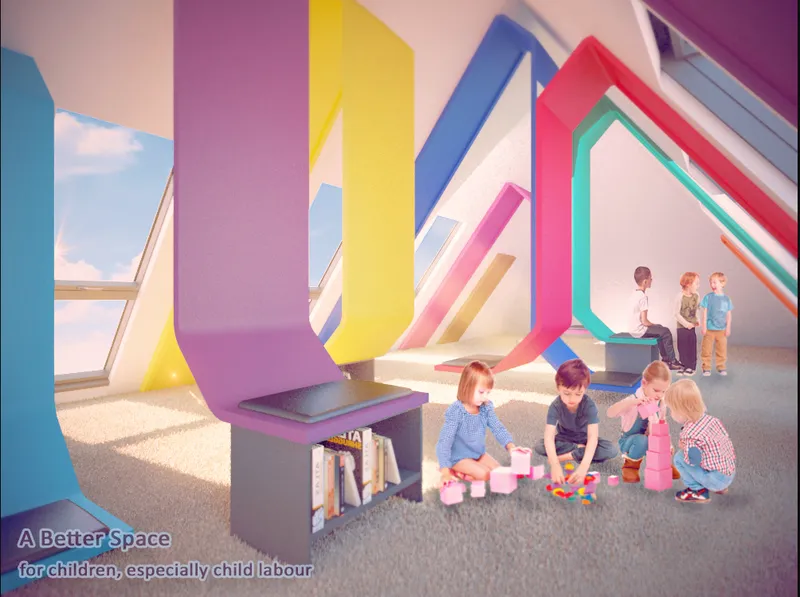
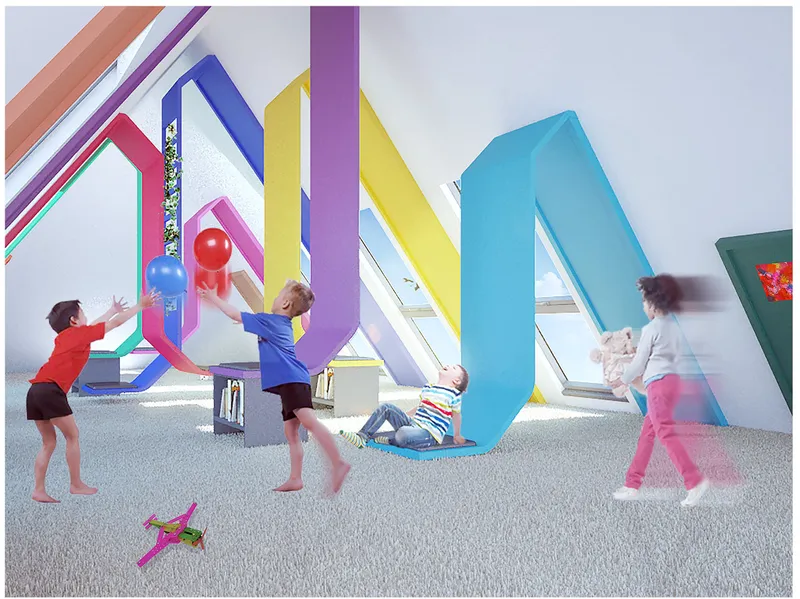
The interior photographs reveal an immediately legible strategy: brightly painted bent frames arc through the sloped attic volumes, their candy-colored profiles contrasting against the muted timber of the existing roof. These are not decorative additions layered onto a neutral backdrop. They actively reshape how children perceive and move through the space. The curves echo playful geometries, guiding the eye upward toward skylights that flood the rooms with afternoon light. Children are shown playing on carpeted floors, tossing balloons, occupying the space with the kind of unstructured freedom that is precisely the point.
The material choice matters here. Polypropylene decor elements ensure the installations are both safe for active play and environmentally sustainable. Soft flooring beneath the frames absorbs impact, protecting children during the kind of physical spontaneity that healthy development demands. Every surface decision, from the yielding floor to the rounded frame profiles, reflects a design ethos where safety is not an afterthought but the generative logic of the entire scheme.
Reading the Bones: Exposed Timber and the Palace's Latent Potential
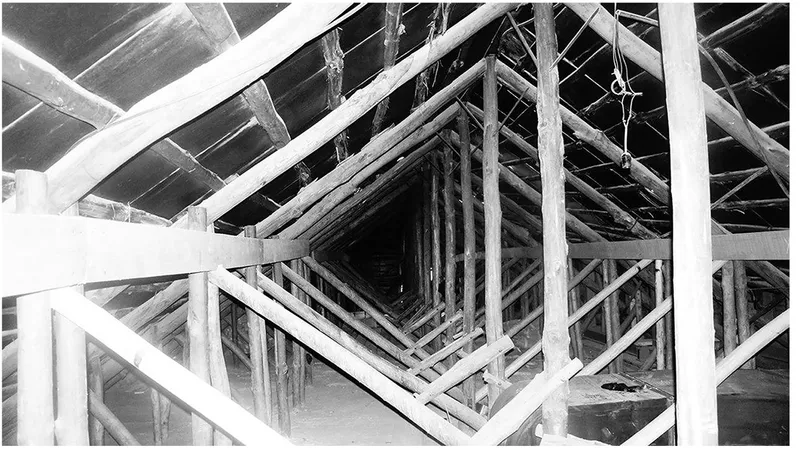
An upward photograph of the unfinished attic space strips the project back to its raw starting condition: exposed timber roof framing, diagonal bracing, and the skeletal geometry of a palace built for a different era. Seeing this image alongside the finished playrooms makes the transformation visceral. The existing structure is not concealed or clad over. Instead, it remains visible, its rhythm of rafters and purlins forming a spatial backdrop that lends warmth and textural depth. The decision to leave this structure legible is both pragmatic and poetic. It reduces material intervention while allowing children to inhabit a space that carries historical weight, even if they experience it simply as a room with interesting wooden ribs overhead.
Assembly Logic: How the Parts Come Together
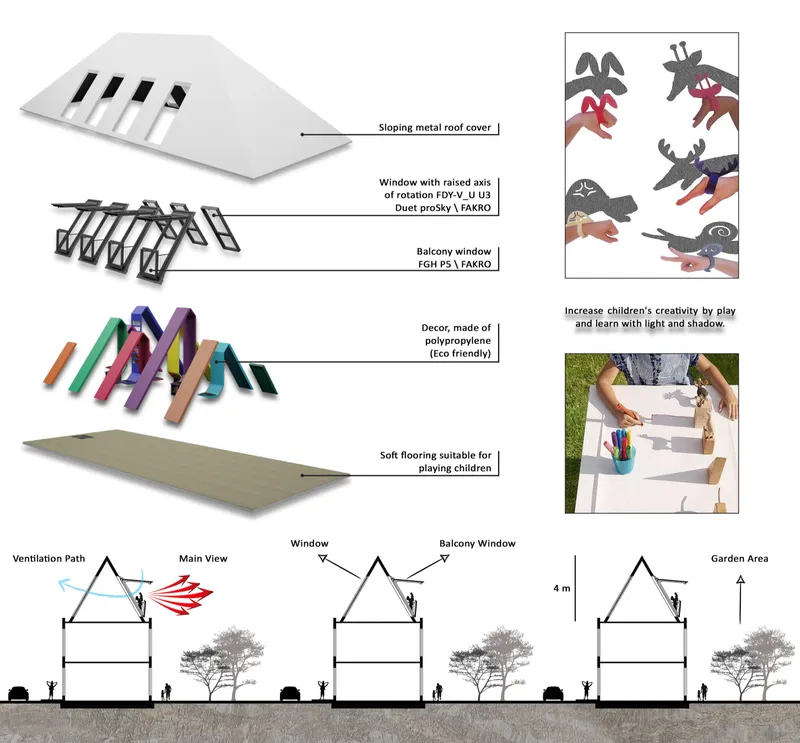
The exploded axonometric diagram dissects the project into its constituent layers: roof assembly at the top, window types mediating between interior and exterior, the colorful interior decor modules, soft flooring systems, and cross sections populated with child-scaled figures. What becomes clear is the modular logic driving the design. Each layer can be adapted, reconfigured, or replaced independently, which gives the project a scalable quality. A different palace room, a different attic, or even an entirely different heritage building could receive a version of this intervention without wholesale redesign.
The cross sections are particularly telling. They show how window placement has been calibrated to admit light deep into the sloped volumes, and how the interaction between light and the colored frames generates shadow play on interior surfaces. For children, this translates into an environment that shifts throughout the day, offering new visual stimuli without electronic mediation. The diagram positions A Better Space not as a singular installation but as a replicable system, a toolkit for converting neglected architecture into child-focused sanctuaries.
Architecture as Therapeutic Intervention
The project is explicit about its audience: children subjected to labor exploitation, who often face stunted emotional development and limited opportunities for socialization. Conventional responses to child labor tend to focus on policy, enforcement, or economic support. A Better Space operates in a different register, arguing that the built environment itself can be a form of care. By offering spaces for unstructured play, creative experimentation, and social interaction across backgrounds, the design addresses psychological needs that policy alone cannot reach. The bright colors, the tactile flooring, the shifting light: these are not aesthetic luxuries but deliberate architectural tools aimed at restoring a sense of safety and belonging.
Why This Project Matters
A Better Space succeeds because it refuses the false choice between heritage preservation and social utility. The Negarestan Palace is not frozen as a monument; it is activated as a living resource. The project demonstrates that adaptive reuse need not be limited to restaurants, galleries, or co-working spaces. Heritage buildings can serve populations that architecture has historically overlooked, including the most vulnerable children in a city. By working within existing structures rather than building new, the approach is inherently more sustainable and more culturally grounded.
For architects and designers watching the growing conversation around socially responsive practice, Amero's work offers a concrete proposition. It shows that empathy in architecture is not about grand gestures or expensive materials. It is about reading an existing condition clearly, understanding who needs the space most, and intervening with precision: the right colors, the right softness underfoot, the right amount of daylight at the right time of day. That kind of specificity, directed toward children who have been denied the most basic spatial dignity, is what gives A Better Space its quiet power.
View the Full Project
About the Designers
Designer: Majid Amero
Enter a Design Competition on uni.xyz
uni.xyz runs architecture and design competitions year-round that reward proposals with spatial conviction and real site intelligence.
Project credits: A Better Space by Majid Amero International Product Design Awards 2019 (uni.xyz).


Popular Articles
Popular articles from the community

Opera by the Sea Estonia: Three Shells Dissolving Architecture into Tallinn's Coastline
A winning opera house proposal replaces monumental form with interconnected shells that blur the boundary between building, park and Baltic Sea.

The Amber Palace Opera: A Geological Fiction Surfaces on Tallinn's Baltic Waterfront
Pierre Brillard reimagines a Baltic legend as a public landscape, opera house, and waterfront promenade rooted in Tallinn's coastal identity.

Manzana Morphosis: Stretching Barcelona's Grid into a Living Landscape for 2050
A radical reworking of the Eixample manzana turns density into a tool for generous public space, vertical ecology, and environmental performance.

Opera on the Sea: Driftwood Logic Shapes a Timber Opera House on Estonia's Coast
Trevor Orgill's opera house translates the entangled drift of floating timber into a civic building where wood, water, and music converge.

Similar Reads
You might also enjoy these articles

Play: Fragments of Their World: Remembered Architecture Rebuilt as a Modular Playground for Refugee Camps
Tom Gardner abstracts domes, arches and towers from the homelands of displaced families into a kit of child-scaled play parts for camp settlements.
REBIRTH: A Circular Settlement Where Afghan Widows and Their Children Rebuild Life Together
A shortlisted Resile entry turns the circle into a protective ring of timber and brick, gathering homes, classrooms and gardens around a shared landscape.
The Main Dream: A Recycled Plastic Kit That Lets Refugee Children Build Their Own Playground
Thirty-centimetre interlocking cubes that connect on three axes turn play into construction, letting children author the spaces they occupy.

Lunar Spiral: A Fibonacci-Driven Moon Settlement Rising from Shackleton Crater
Golden-spiral geometry organises buried infrastructure and orbiting habitable spheres into a lunar base designed to grow as life on the Moon expands.

Explore Youth Architecture Competitions
Discover active competitions in this discipline

Challenge to design luxury tourism on rails

VR headsets Storefront design competition

Designing a staircase for a client
Comments (0)
Please login or sign up to add comments
No comments yet. Be the first to comment!