
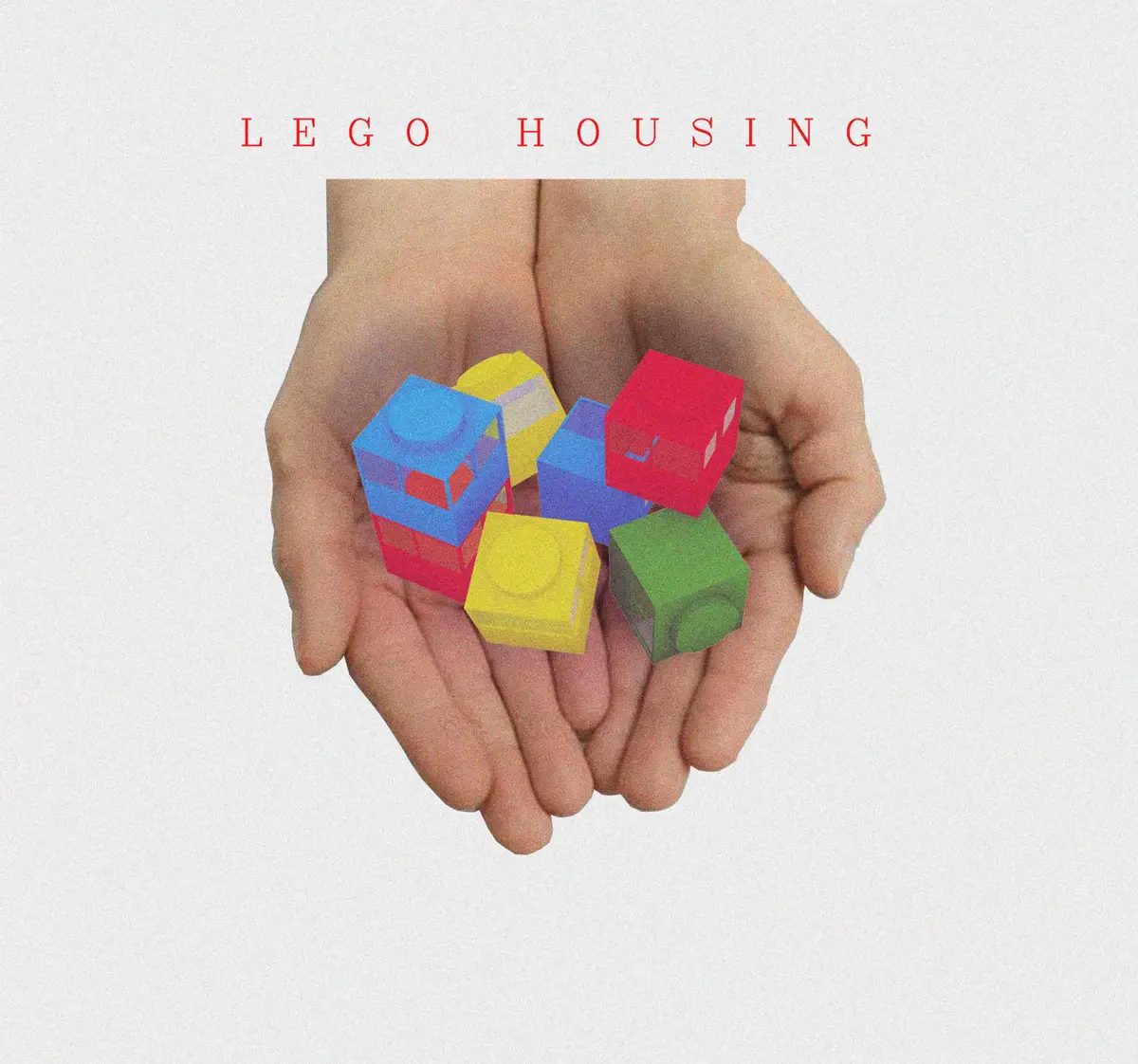
A building block in your pocket
order yourself a house

Cities have struggled in the last years with the issue of a correct densification process, in order to balance the high demand of urban housing, including for young people, professionals, or people with a poor social background. Every city, either big or small, is facing the need to rethink the way they approach the housing programme, because there is a fundamental change even in the way we live. We can order pretty much anything, we rely more on public transport than our own personal car, we leave our apartments to go to work and interact with our friends, and unless it is a cultural trait, we reject the idea of multi-generational homes. Our “house” becomes more and more a space in which we sleep and get ready for the day.
With this in mind, we thought of how we can approach the idea of a “pocket home” as literally as possible. What if you could take out the phone from your pocket, download an app, and order yourself a living module? You could even take it apart and assemble much like children’s building blocks. The process would be quick and simple: you apply for the programme, you get creative with your space, choosing how many modules you want and their configuration, allowing you a high degree of customization, place an order, and in a few weeks, you can just move in.
The modules strive to be as simple and ecological as possible. Given the fact that the proposed project is meant to be temporary, we have to think about how to build without making a powerful impact on the site. Even more important than this, we have to consider this as a pilot-project that can be applied to every city, big or small, blend in its surroundings and help resolve this housing crisis. The
structural body of the module can be made either of wood, or metal, whichever is easier to source locally, insulated with cellulose fiber, or even flax, depending on the area. The interiors would be made out of plywood, to give a warm, welcoming feeling, with sliding doors to save as much space as possible, and foldable furniture that can serve multiple purposes made generally out of cardboard. Basically, the module, as well as the furniture is ready-made, installed on site, out of recycled materials that can be sourced even in the city, and then reused when the temporary accommodation is taken apart. On the exterior, the modules would be wrapped in several layers of cardboard, to strengthen the insulation and its structural capacity, then covered with a waterproof membrane, and finished with a color of your choosing.
In the city, on site, we chose not to make a separate structure meant to hold the modules in place, instead they are stacked over each other, latched on structural springs, to help with the overall stability and earthquake resistance. On the ground floor, we placed a small, public area of 22 sqm, as a reception / staff office, together with an elevator and a stair to facilitate the upper floors.

Popular Articles
Popular articles from the community


Juan García Correa, John González and Claudia Rueda Sink a Circular Amphitheater into a Manizales Engineering Building
On the La Nubia campus in Manizales, Colombia, the S1 Building folds labs and offices into a hillside of ramped lawns that double as a campus route.

David Ortega Stacks a Two-Story Mexico City Penthouse Around a Steel Stair and a Pergola-Shaded Roof Terrace
In Colonia Roma, a 300 m² penthouse uses oak joinery, a planted steel stair and a slatted roof pergola to make a new-build apartment feel like a house.


Aquadapt: An Underwater Habitat That Rewrites Its Rooms by the Hour
Curved modules ring the seabed while one shell shifts from breakfast room to cinema, farm and football pitch as residents' needs change.

Singing Woman: An Opera House That Performs Before the Curtain Rises
Ovidiu Cristian Pavel's conceptual opera house translates Estonia's choral identity into a sculpted waterfront landmark facing the Baltic Sea.

Similar Reads
You might also enjoy these articles

The Rhythm of Seasons
A Farmers' Market Connecting Nature and the City


More Than a Building-Designing a Living System
More Than a Building-Designing a Living System
Base Beyond
DESERT COMPOUND ARID: TOURISM OF ABSENCE AND ABUNDANCE

Explore Residential Building Competitions
Discover active competitions in this discipline


Comments (0)
Please login or sign up to add comments
No comments yet. Be the first to comment!