

LIFE Architects Turns a Sharp Wedge of Land in Seoul into a Ten-Story Office Tower
A-Building in Seongdong-gu transforms an acute-angled plot into 356 square meters of vertically stacked workspace wrapped in laminated ceramic.


Acute-angled plots are the leftovers of urban planning, the slivers that remain after roads, rail corridors, and property boundaries have had their say. Most developers avoid them. LIFE Architects, led by Jeeyoung Han and Sooyong Hwang, took one such triangular remnant in Seoul's Seongdong-gu district and drove a ten-story office building straight through it. Completed in 2021, A-Building occupies just 356 square meters of total floor area, one basement level below and ten floors above grade, yet manages to feel neither cramped nor apologetic about its geometry.
What makes the project genuinely interesting is the refusal to disguise the site's constraints. The acute angle of the plot is not hidden behind a rectangular wrapper or softened into a curve. It is amplified, projected upward through the facade, and turned into the building's primary formal identity. The sharp prow that results is both a structural assertion and a piece of urban wayfinding, marking the corner where pedestrian and vehicular paths converge. It is architecture that takes a liability and reframes it as a thesis.
Reading the Geometry from the Street
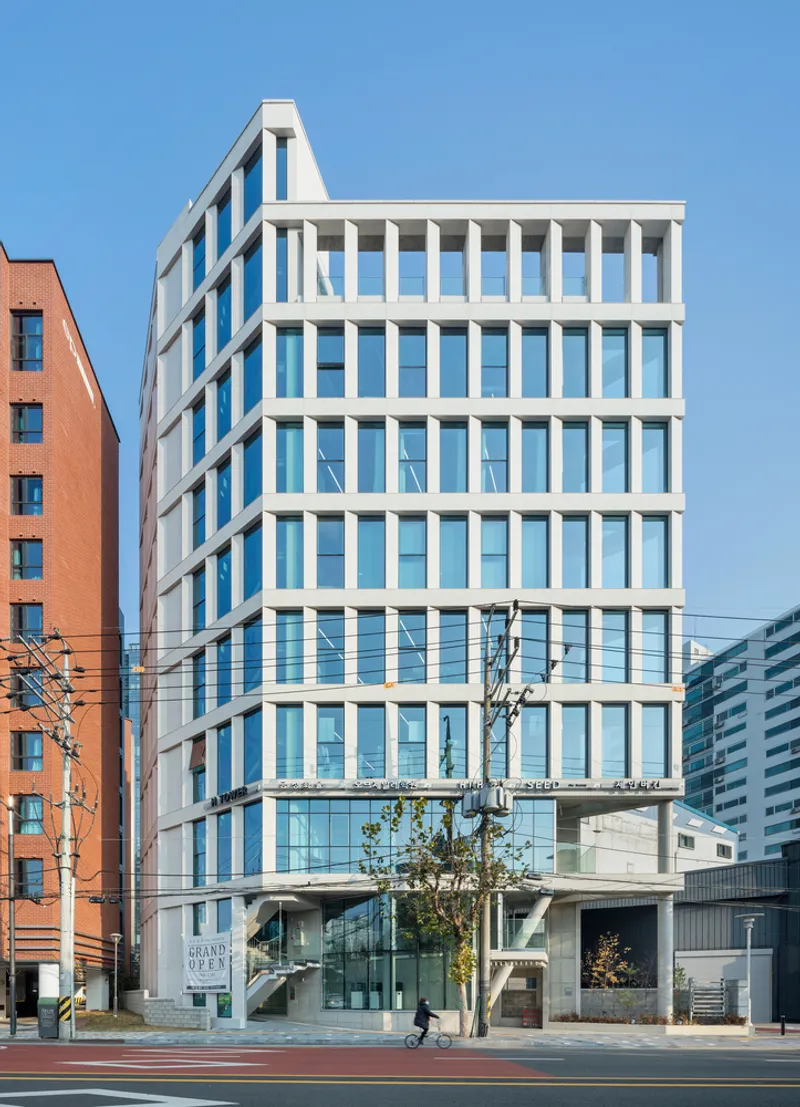
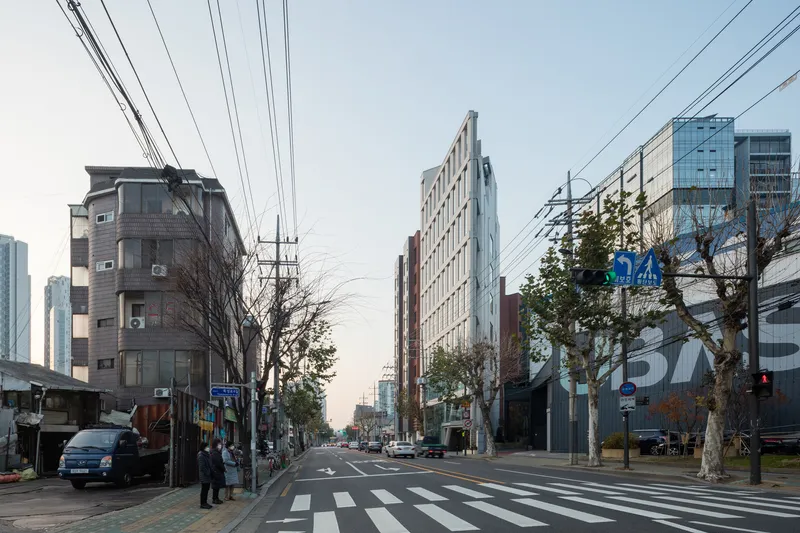
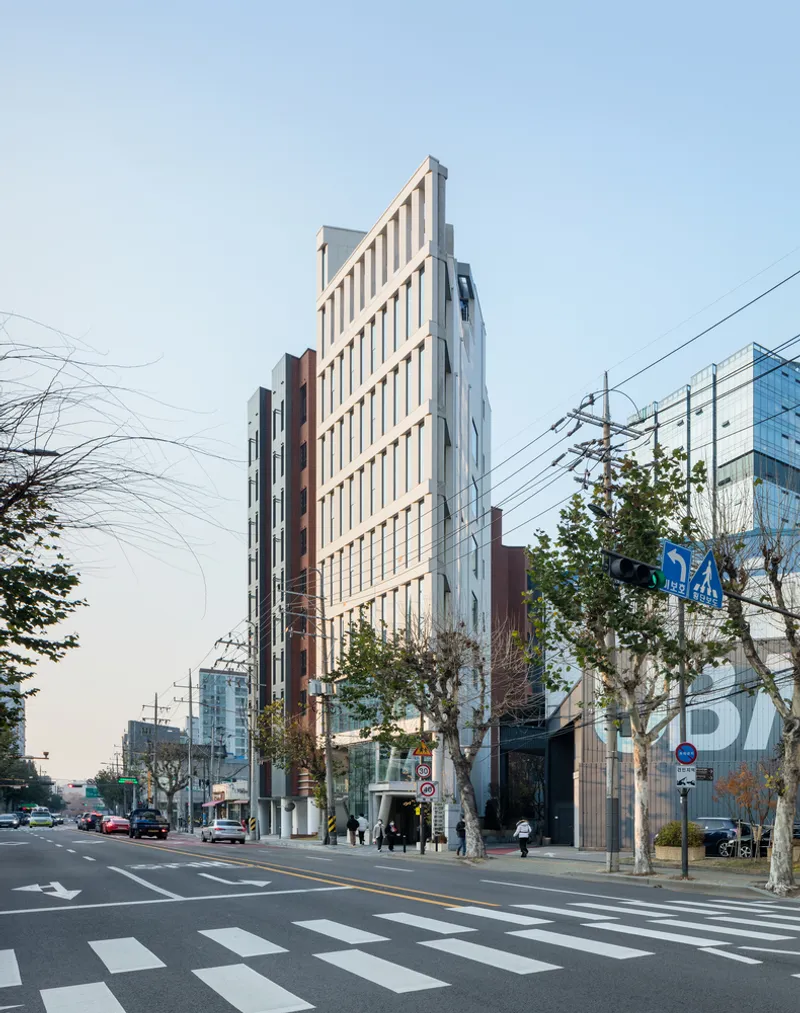
At street level A-Building reads differently depending on your angle of approach. From the broader road it presents a slender, vertical composition of white sunshade fins and glazing bands, almost textile in its layering. Walk toward the acute corner and the building narrows dramatically, its facade planes converging into a knife-edge that seems to slice the block apart. At dusk the white cladding catches ambient light from power lines, street lamps, and passing headlights, giving the tower a presence that far exceeds its modest footprint.
Bare winter trees and overhead wires lend the surrounding streetscape a graphic quality that complements the building's own linearity. The architects clearly understood that this would not be experienced in isolation but rather within the dense visual noise of a Seoul neighborhood, and they calibrated the facade's rhythm to hold its own without shouting.
A Facade That Earns Its Complexity
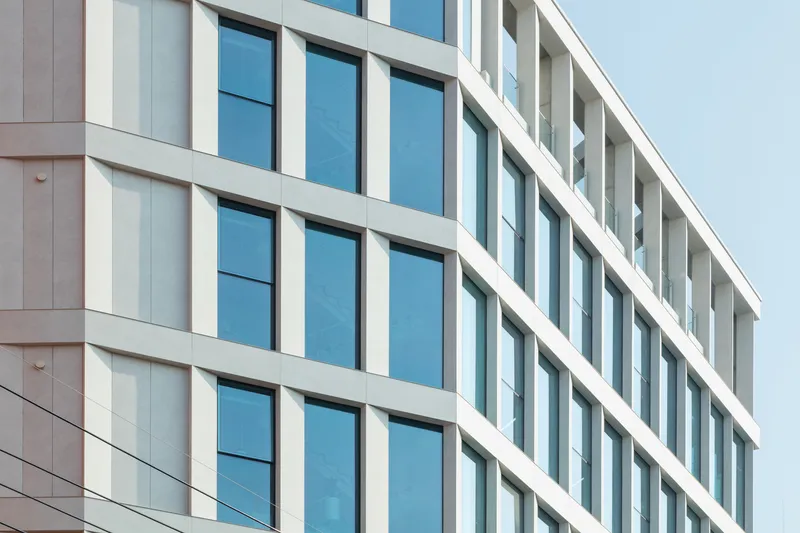
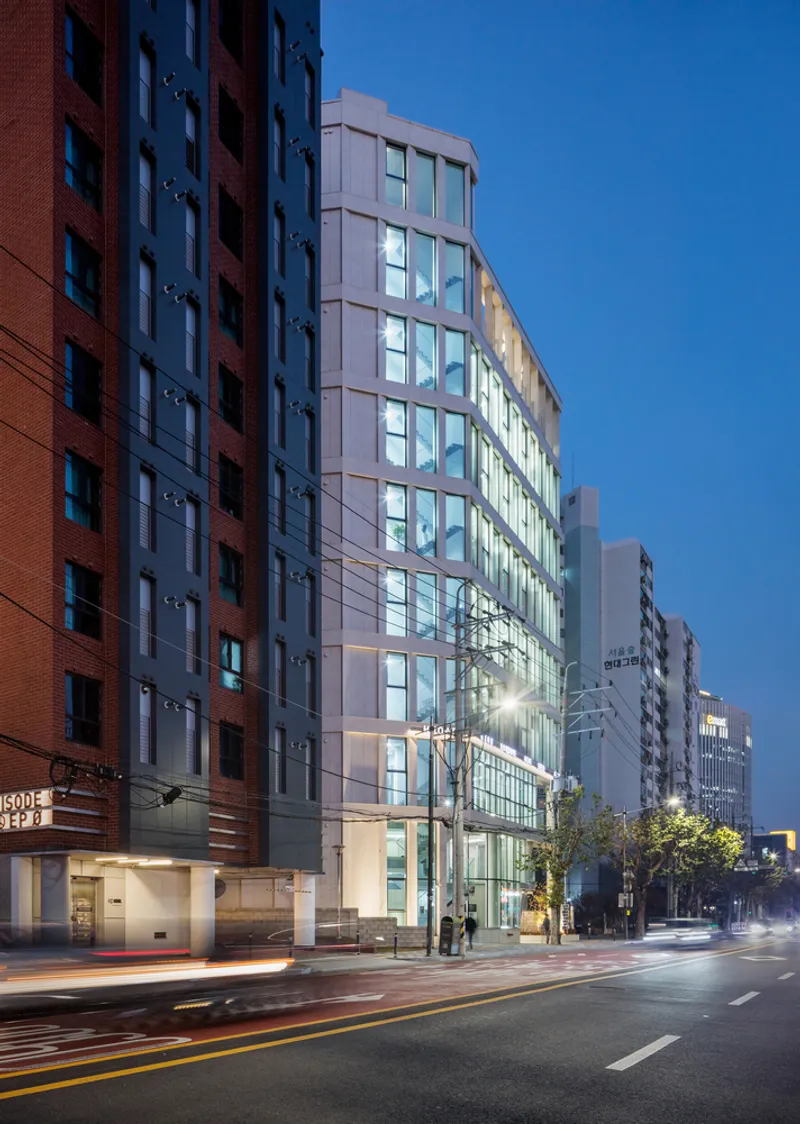
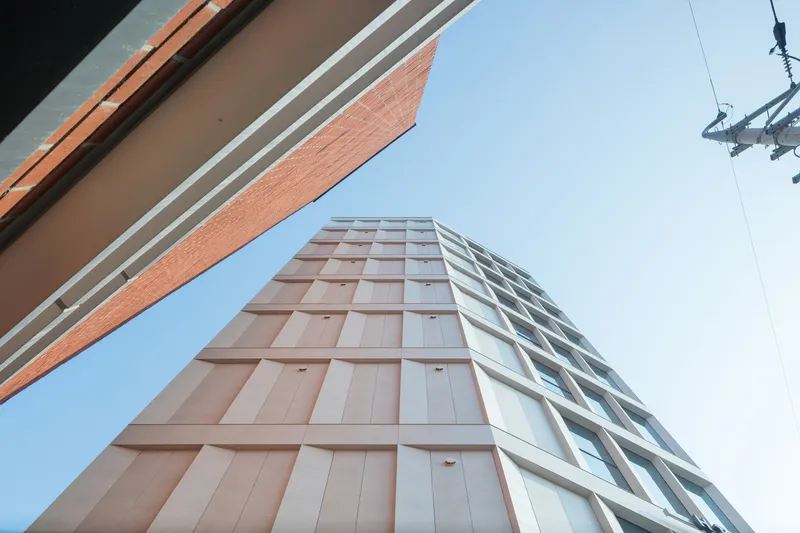
The cladding system deserves close attention. Laminated ceramic tiles create a seamless, matte skin that avoids the slickness of curtain-wall glass and the heaviness of stone. Horizontal mullions break the elevation into manageable registers while vertical bands of glazing and solid panels alternate in a rhythm that shifts subtly from floor to floor. The result is a facade with genuine depth: shadows travel across it as the sun moves, and the building never looks the same twice in a single afternoon.
Viewed from below, the tower reveals panels in a warm pink tone that softens the otherwise monochromatic palette. Ribbon windows wrap continuously around corners, reinforcing the diagonal geometry rather than defaulting to orthogonal openings. Prefabricated cladding panels keep the execution tight and the joints clean, a level of precision that matters enormously on a building this narrow, where any misalignment would be immediately visible.
Ground Floor: Porous Threshold
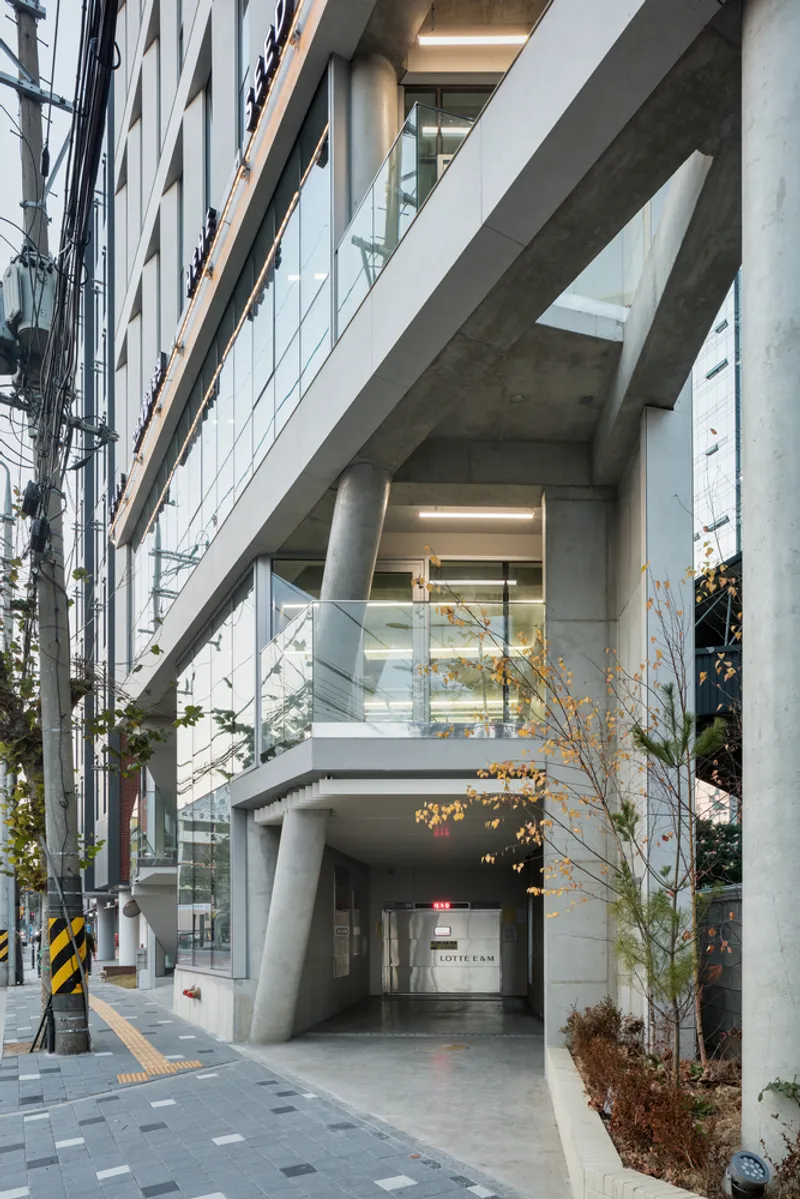
The ground level is handled with care. Angled concrete columns lift the main volume off the street, creating a glass passage beneath the cantilevered mass that functions as both entrance and covered public edge. The gesture recalls pilotis but with a sharper, more site-specific logic: the columns splay to follow the plot's diagonal, making the structural grid legible from the sidewalk.
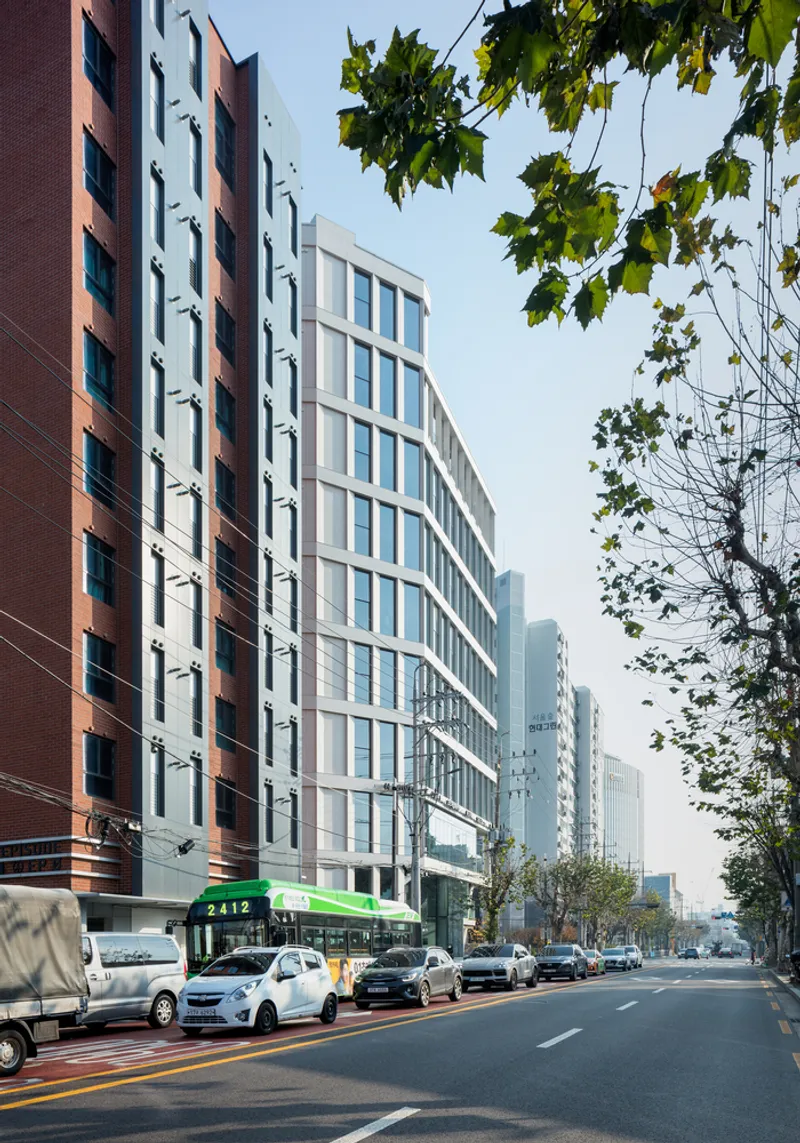
Along the tree-lined street the building's curved secondary facade softens what could have been an abrupt boundary between private interior and public realm. Overhanging foliage from mature street trees filters light onto the white surfaces, and parked cars nestle casually against the base. It reads less like a corporate office and more like an active piece of neighborhood infrastructure. The first floor currently serves as a fashion showroom and pop-up event venue, a programmatic flexibility that suits the transparency of the ground plane.
Interior Circulation as Spatial Event
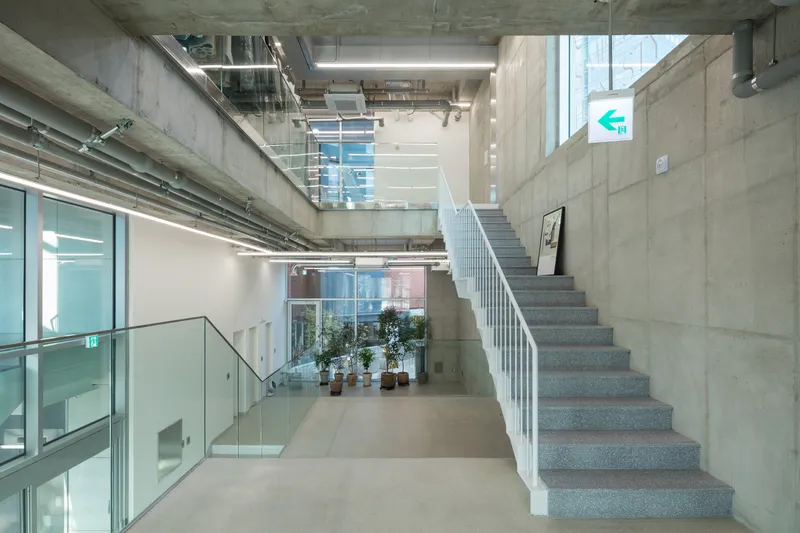
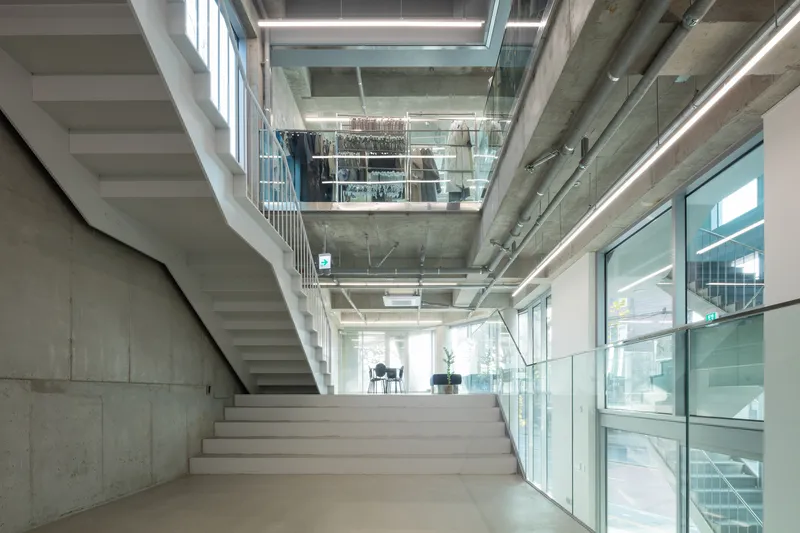
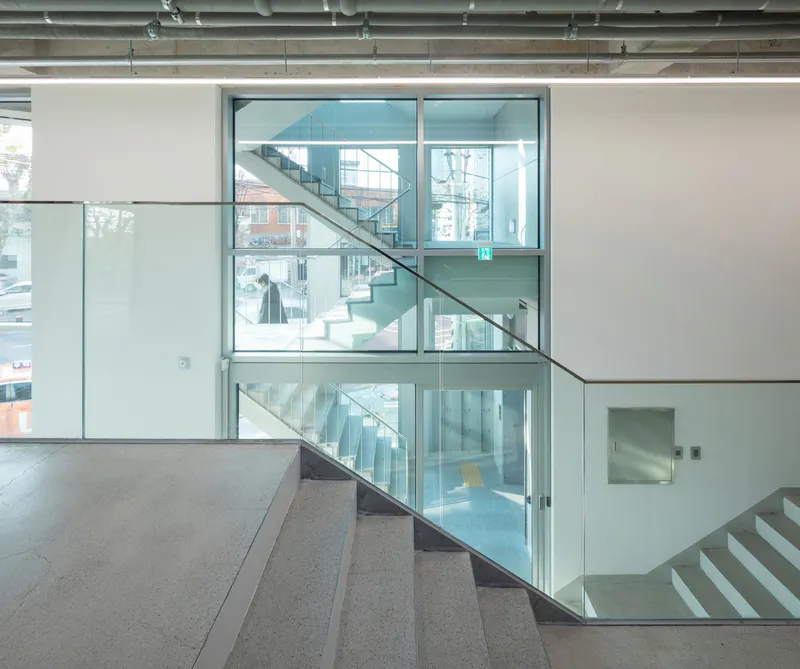
Staircases in narrow buildings often feel like afterthoughts, shoved into leftover corners. Here they are given architectural weight. A terrazzo-and-white staircase threads through a multi-story atrium, its glass balustrades allowing light to pass laterally between floors. The exposed concrete walls and ceiling are left unfinished, providing a textural counterpoint to the polished stair treads and white metal railings.
At certain landings a glass-walled bridge connects the stair core to adjacent floor plates, turning a vertical commute into a moment of spatial awareness. You see up, down, and across simultaneously. The architects suspended portions of the staircase using tension rods rather than conventional supports, which keeps the circulation zone visually open and structurally honest. It is a small detail that communicates a larger ambition: nothing in this building is merely functional.
Working Inside the Wedge
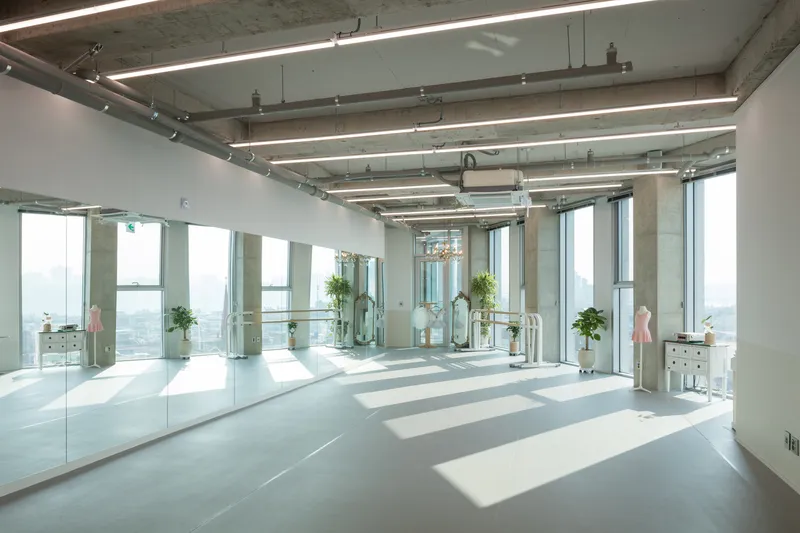
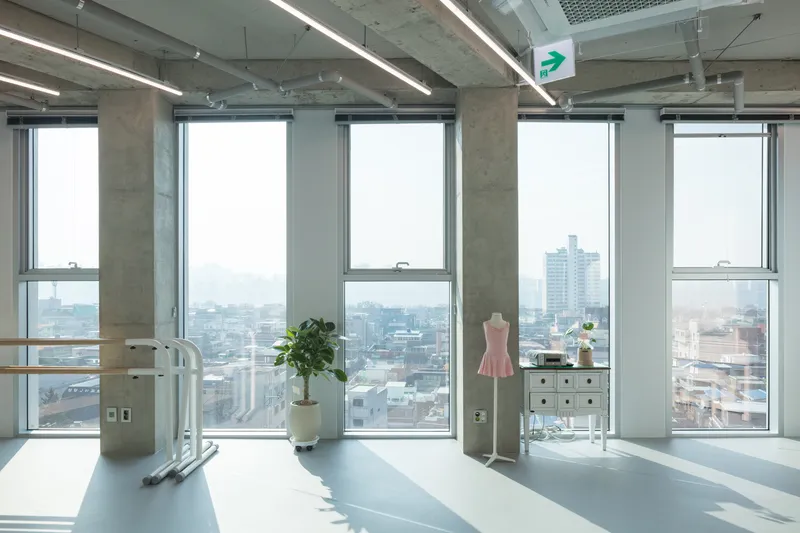
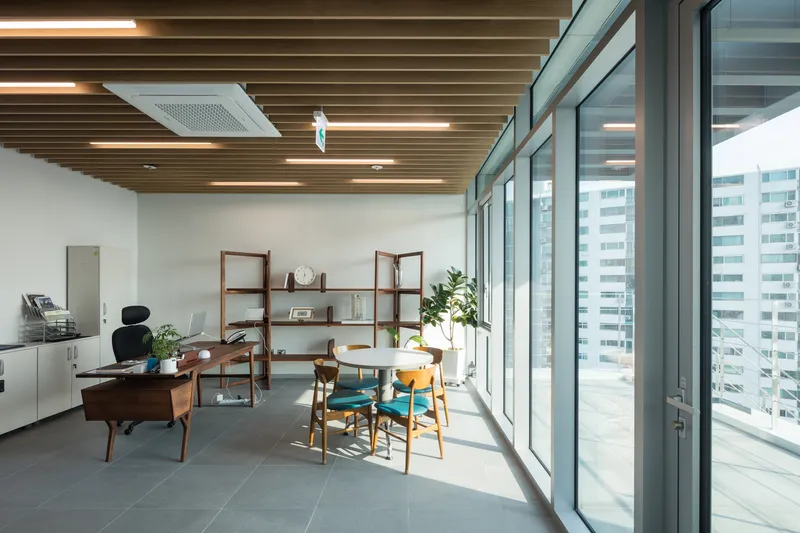
The office floors demonstrate that acute geometry does not have to produce awkward rooms. Open studio spaces stretch toward floor-to-ceiling windows, and the exposed concrete ceilings keep overhead heights generous. Linear suspended lights follow the long axis of each floor plate, reinforcing directionality and drawing the eye toward the glazed perimeter where Seoul's hazy skyline sits at the edge of every workstation.
One upper floor features a wood-slat ceiling and access to an outdoor terrace, a welcome shift in materiality that breaks the concrete-and-glass palette. Midcentury furnishings and afternoon light filtering through full-height glazing give the space a warmth that photographs of exposed-concrete buildings rarely convey. A dress form near one window hints at the fashion tenants who occupy several floors, grounding the architecture in the daily life of its users.
Thresholds, Lobbies, and the In-Between
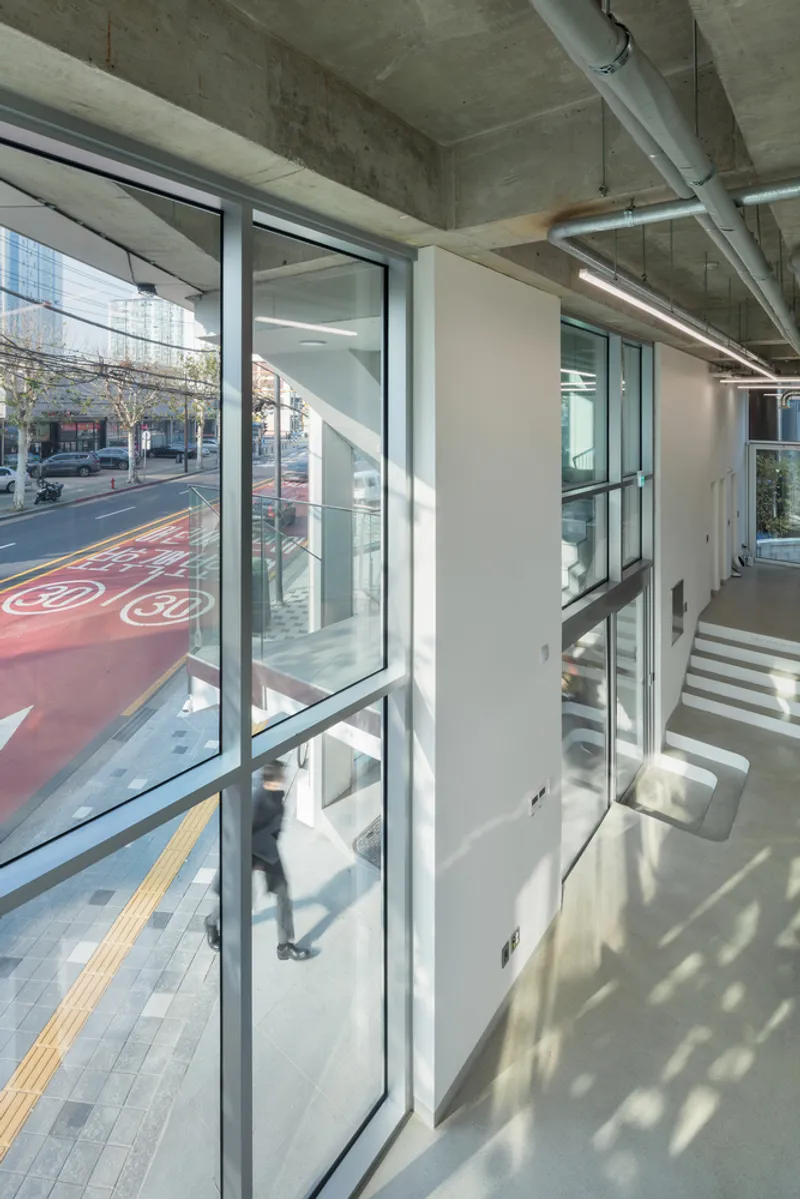
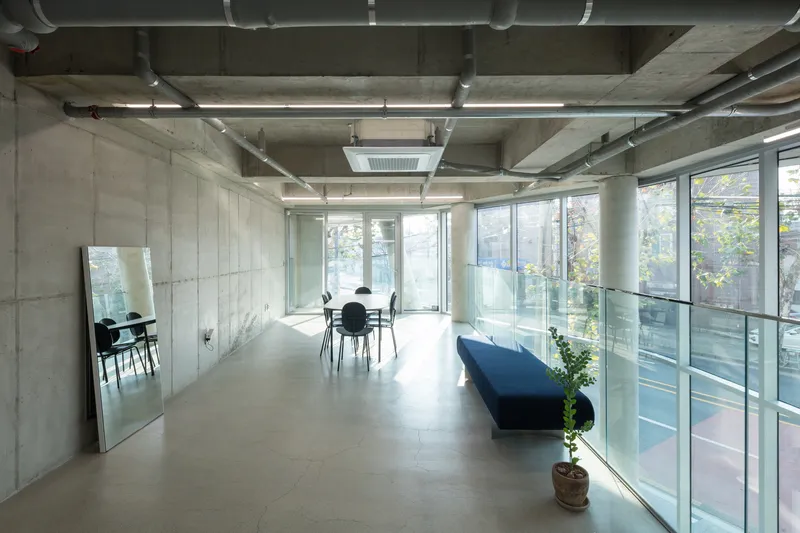

The lobby spaces reveal a building designed for decompression between the density of the street and the focus of the workspace. Full-height glazing floods the ground-floor lobby with morning sunlight, turning an otherwise utilitarian passage into a contemplative pause. Upstairs a minimalist landing pairs a concrete storage wall with a blue bench and glass balustrade overlooking street trees, the kind of incidental seating that encourages a conversation or a quiet coffee.
These transitional zones are where A-Building's spatial ambition becomes most legible. The architects treat every landing, corridor, and elevator lobby as an opportunity to frame a view or modulate light. The stairwell connecting levels through white walls and terrazzo flooring is not a service space; it is, arguably, the building's best room.
Upper Floors and Skyline
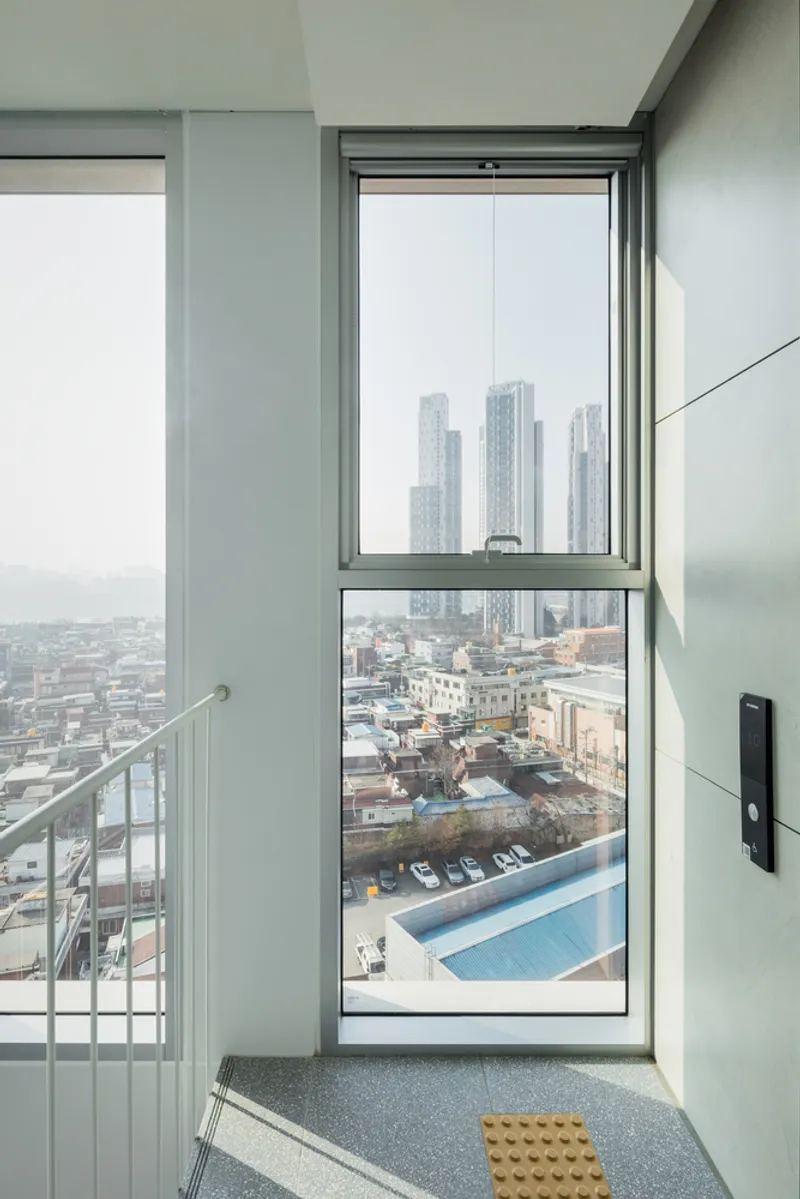
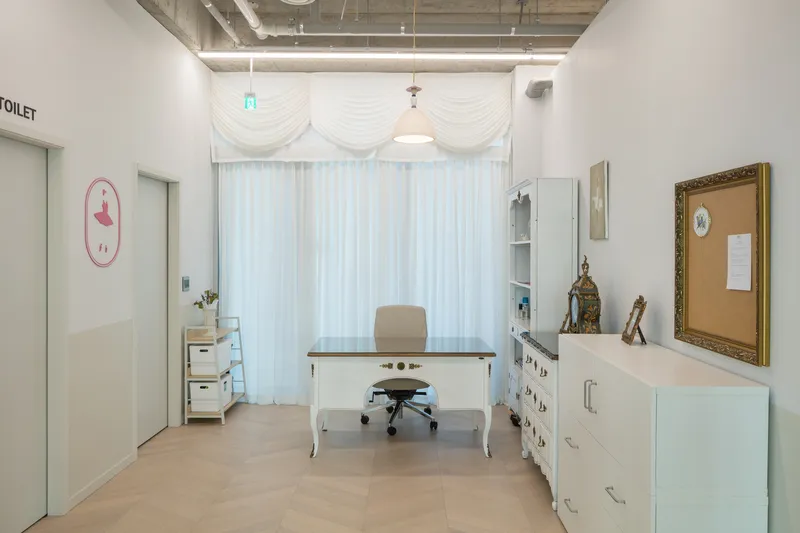
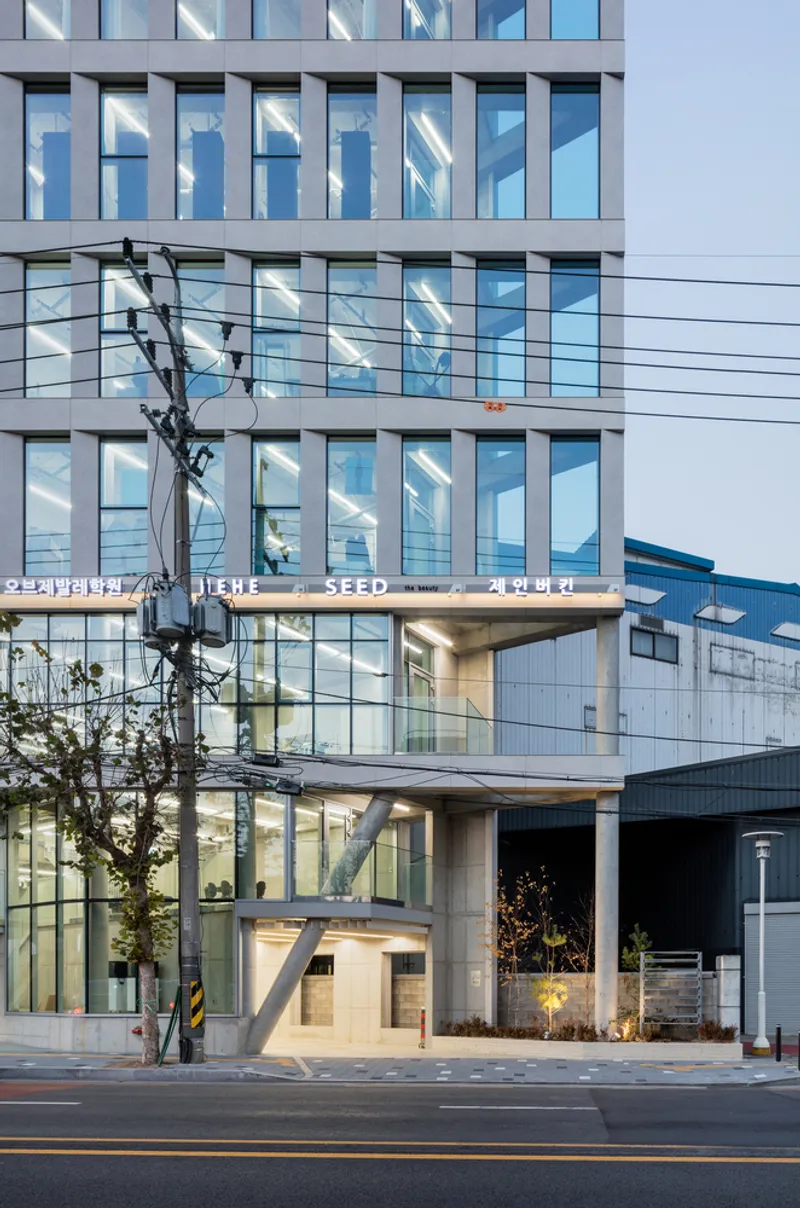
Near the top of the tower the views open up. An elevator lobby frames a rooftop pool against a backdrop of distant towers dissolving into Seoul's characteristic haze. Office interiors on upper floors trade the raw concrete palette for sheer curtains and softer lighting, a deliberate shift in atmosphere as one ascends. The facade's glass-and-metal-panel composition, visible from the street at dusk with the exposed concrete circulation core lit from within, confirms that the building performs as well at night as it does during the day.
The presence of a rooftop pool on a 356-square-meter office building is an unexpected programmatic move. It suggests that LIFE Architects and the client understood the building not just as workspace but as a vertical amenity, a place where the constraints of the plot are rewarded with sky, water, and horizon at the top.
Why This Project Matters
Cities are full of plots that nobody wants: too narrow, too angled, too compromised by adjacent infrastructure. A-Building proves that these sites are not problems to be solved but provocations to be embraced. By projecting the acute geometry of the land directly onto the facade, LIFE Architects produced a form that is both structurally logical and visually arresting. The laminated ceramic cladding, the suspended staircases, and the tension-rod structural details all follow from the site's geometry rather than fighting it.
More broadly, the project is an argument for density without banality. Ten stories on a tiny plot could easily have produced a forgettable extrusion. Instead, every floor plate is considered, every threshold is designed, and the building gives back to the street through its transparent ground level and its dynamic, light-responsive skin. For architects working on constrained urban sites anywhere in the world, A-Building is a reference worth studying closely.
A-Building by LIFE Architects (Jeeyoung Han, Sooyong Hwang). Seongdong-gu, Seoul, South Korea. 356 m². Completed 2021. Photography by Kyungsub Shin.
About the Studio
Share Your Own Work on uni.xyz
If projects like this are the kind of work you want to make, uni.xyz is a place to publish your own, find collaborators, and enter design competitions.


Popular Articles
Popular articles from the community


Cube Design Draws an Ecological Corridor Between Two Shenzhen Hills with the Nankai Building
Beside Shenzhen's container docks, the Nankai Building pairs stacked balconies with a climbing green screen to connect two hillsides across its height.

Jaramillo Van Sluys Arquitectura and Urbanismo Turn a Demolished Registry Lot in Quito into an Orchard Plaza
In Quito's Centro Histórico, a 2,800 m² plaza exposes the San Agustín convent wall and redraws its lost Augustinian orchard in volcanic stone.

Architekt Andreas Gruber Scatters 23 Dark Timber Chalets Across a South Tyrolean Forest Edge
In Molini di Tures, Amonti Chalets breaks a resort into a hamlet of gabled timber houses, with parking, storage and services pushed into the slope.

Juan García Correa, John González and Claudia Rueda Sink a Circular Amphitheater into a Manizales Engineering Building
On the La Nubia campus in Manizales, Colombia, the S1 Building folds labs and offices into a hillside of ramped lawns that double as a campus route.

Similar Reads
You might also enjoy these articles


Hodi-Mandai Geram
Project Function: Preservation and revitalization of the Intangible heritage and socio-spatial identity of the Hodi by Housing, Cultural Memory Center, Sacred Grove, landscape, local tourism economy


Olio Towers: A Mid-Rise for Performers That Fuses Housing, Rehearsal, and Stage
Located blocks from Houston's Theater District, this modular tower stacks living units around a central performance atrium.

Oasis: Modular Green Housing Carved into Dhaka's Urban Fabric
A shortlisted Plugin Housing entry reclaims unauthorized settlements in Dhaka with stepped concrete volumes, green roofs, and ventilation-driven design.

Black Hole: A Floating Megastructure for the Post-Physical Era
Emiliano Mazzarotto envisions a spherical, self-scaling arena where e-sports, digital hotels, and holographic stadiums replace traditional public space.

Explore Building Design Competitions
Discover active competitions in this discipline

Challenge to reimagine the Iron Throne

Photograph architecture without architects

Illustrate the lost glory of Angkor Wat - Render Challenge

Design challenge to reuse E-waste
Comments (0)
Please login or sign up to add comments
No comments yet. Be the first to comment!