
a coffee bean
The Coffee Bean Pavilion

Coffee is a daily dose of joy, peace, excitement and indeed a necessity for millions of people across the globe. It helps make one feel more awake and lively. The Coffee Bean Pavilion - takes its inspiration from a simple coffee bean to generate a surge of emotions in the user. The simple connection of the user with the coffee bean helps the pavilion to achieve an environment that generates liveliness and stimulates energy.
The major driving concepts of the coffee pavilion were to establish a connection with the user while achieving a sustainable design that could be achieved parametrically which would in turn allow for an efficient modular replication.
Simplicity of the design and repetition of the units makes it possible to have an easy, efficient and fast construction enabling it to be modular and made at different sites. For the ease of visual understanding the site chosen is the rooftop of ‘The Heights Building’ of BIG architects located in the USA. Coffee for Americans is a hot and classic beverage, thus making the location of the site an appealing place for the set up of the coffee pavilion. The Heights Building opens as a cascade of green terraces fanning from a central axis, addressing the academic needs of Arlington’s two county-wide school programs while forming a vertical community within its dense urban context.
Coffee here lays the ground for offering a sense of connectivity with the pavilion, as the design offers a sense of familiarity with the shape of a coffee bean and one’s experience after its consumption.
The primary material used for the design is terracotta which is a highly eco-sustainable material and steel rebars are added for support. Terracotta is an easily manufactured material which also makes it easily available in the local market. In addition to it, factors such as fairly easy resistance to heat and climate, its high strength and durability makes it an appropriate choice of material for the pavilion. The sense of contrast that the materiality of the pavilion brings, in terms of the surrounding context and design is a direct interpretation and analogy of how the use of terracotta for a design of parametricism placed in an absolute urban setting is being depicted through the mix of contemporary and local vernacular.
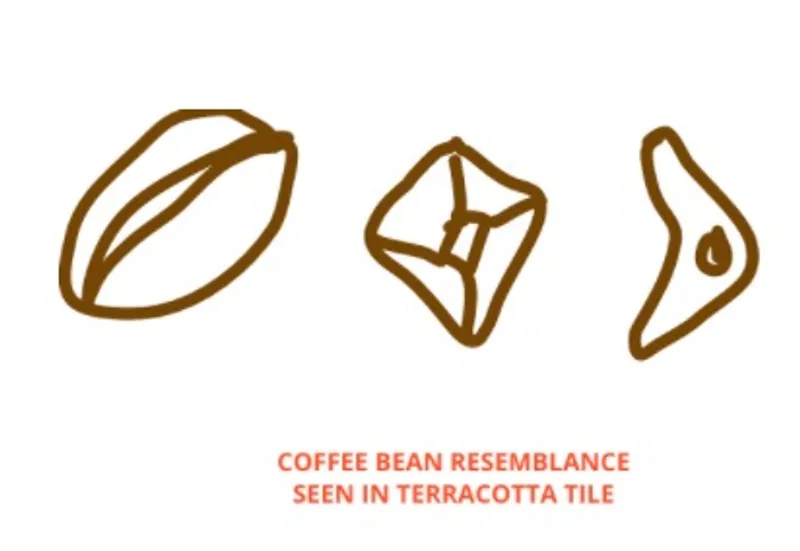
While the skin is made out of terracotta the skeletal framework of horizontal and vertical reinforcement bars are made out of steel. They are welded together. Terracotta tiles in the first column are horizontally slided on the steel rods. These tiles can be rotated along the rod allowing user engagement with the pavilion. Alternate layers of terracotta tiles are treated differently. The tiles in the second column are cladded onto the vertical steel bars, with the use of screws. Each terracotta tile has a cavity resembling a coffee bean that repeats itself to achieve parametricism and is uniquely made with varied sizes of the cavity. The cavity’s size changes from top to bottom of the pavilion. The aim was to achieve lesser sunlight infiltration from the top and more cross ventilation thus, resulting in the lower panels having a bigger cavity/hole and a gradually decreasing size of the cavity as it goes to the top. Light enters the pavilion through these openings keeping the inside lit and energised. Coffee aims at awakening the senses resulting in an increase in one’s work productivity. This is precisely what the pavilion offers via its openings and coffee bean like form. The warmth that the pavilion offers through the earthy color tone of terracotta tiles drives in a sense of similarity with the color of coffee, further familiarizing the user’s visual perception of the pavilion.
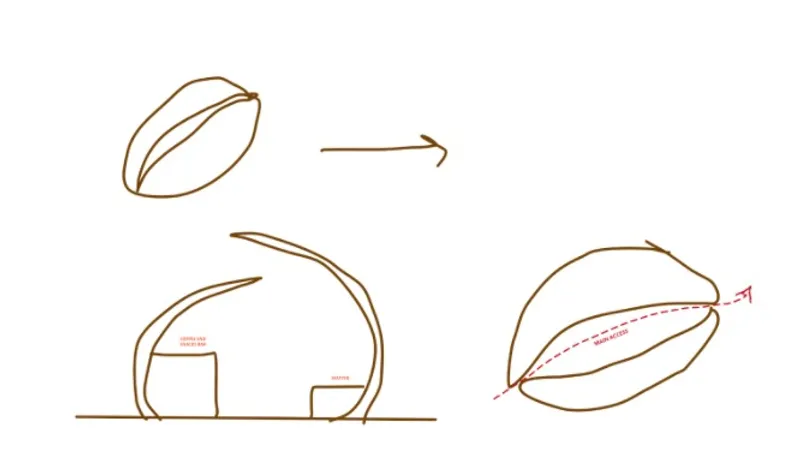
The pavilion offers a multitude of activities. In addition to acting as a meeting, relaxing point there's also a coffee bar present with an eatery joint connected. It makes it an actively social interactive zone while offering a comfortable environment for the user to enjoy the activities emphasizing on the proposition of placemaking as a brewing concept. In all, the pavilion acts as a visually attractive meeting point to a variety of users that provokes connectivity and social engagement.

Popular Articles
Popular articles from the community


Play: Fragments of Their World
Familiar architecture becomes modular playground design, creating safe spaces where displaced children can learn, connect, imagine and play.

Co-life: Sustainable Architecture for Age-Friendly Community Living
Co-life reimagines sustainable architecture for seniors through courtyards, rammed earth, shared gardens, and spaces designed for belonging.

Co-Life: Senior Housing Design That Reconnects Older Adults With the City
Co-Life reimagines senior housing design through healing gardens, shared streets, workshops, and a sustainable community across generations.

The Ocean Hive: Sustainable Architecture for a Self-Sufficient Civilization at Sea
The Ocean Hive imagines sustainable architecture at sea, where modular habitats, algae, wave power and ocean waste sustain a growing colony.

Similar Reads
You might also enjoy these articles

Bao Huynh Watercolor Atelier: A Serene Art Retreat in Hội An
Bao Huynh Watercolor Atelier in Hội An blends multifunctional art spaces, sustainable design, local materials, and family-friendly living in a serene environment.

Atelier Macri Concept Store Interior Design by CASE-REAL
Atelier Macri store features a "ko" counter, walnut wood details, cork displays, blending retail, gallery, and seamless customer experiences.

Manuel Vargas Izquierdo Stadium and High-Performance Sports Center: Architectural Excellence in Jalpa de Méndez
The Manuel Vargas Izquierdo Stadium blends sustainable design, inclusive sports facilities, and cultural-inspired architecture, revitalizing Jalpa de Méndez’s public spaces.

KAKR Buluh Awar Hall: Revitalizing Community and Ecology Through Bamboo Architecture
Community built bamboo hall revitalizes Buluh Awar village, empowering youth, restoring ecology, celebrating vernacular craftsmanship through sustainable architecture and culture.

Comments (0)
Please login or sign up to add comments
No comments yet. Be the first to comment!