

A Form for the Future of a Historic City: Climate Logic Meets Childhood in Yazd
A daycare complex in Iran's desert heart reinterprets windcatchers, courtyards, and double-shell walls as performance-driven systems for young learners.


Six meters below the desert floor, the earth holds a near-constant temperature year-round. Hot air captured by rooftop windcatchers descends through geothermal channels at that depth, sheds its heat, and rises into classrooms where children play among modular furniture and colored blocks. It is a cooling system that predates mechanical HVAC by centuries, retuned here with computational fluid dynamics and seasonal valve controls for a contemporary daycare complex in Yazd, one of Iran's oldest continuously inhabited cities.
Designed by Fatemeh Aghasi, A Form for the Future of a Historic City received the Institutional Excellence Award in the Form Follows Climate 2020 competition. Situated in Yazd's central desert region, where extreme summer heat, low humidity, and dramatic diurnal temperature swings have shaped a rich vernacular of thick walls, subterranean spaces, and windcatchers, the project refuses to treat these elements as stylistic motifs. Instead, it rebuilds them as performance-driven systems calibrated with contemporary environmental analysis, proposing educational architecture as a testing ground for sustainable urban futures in historic contexts.
Clustered Volumes Around a Climatic Heart
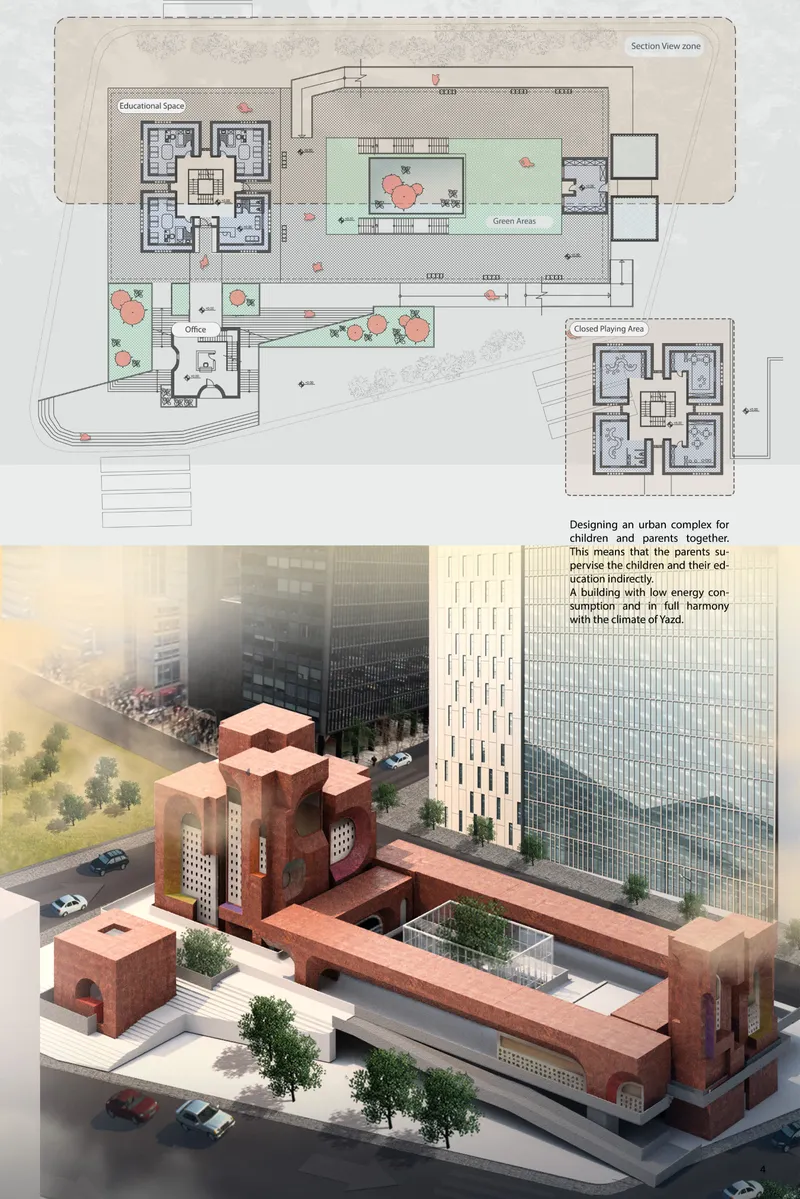
The site plan reveals a cluster of red brick volumes organized around a central courtyard dense with trees. The building is oriented along a north-south axis, a decision informed by CFD analysis to optimize solar exposure control and harness prevailing wind patterns. Educational spaces sit primarily on the southern side, where passive environmental strategies can best moderate conditions. The courtyard itself is not ornamental; it functions as both the social and climatic core of the complex, with vegetation strategically placed along airflow routes to humidify Yazd's characteristically dry desert air before it enters interior spaces.
Inspired by the traditional Yazd courtyard, this central yard can be partially opened or enclosed depending on seasonal demands. In summer, plants cool and moisturize incoming air. In winter, reduced openings limit heat loss. The result is an adaptive spatial mechanism that regulates comfort without relying on conventional energy systems.
Interiors Shaped by Texture, Color, and Play

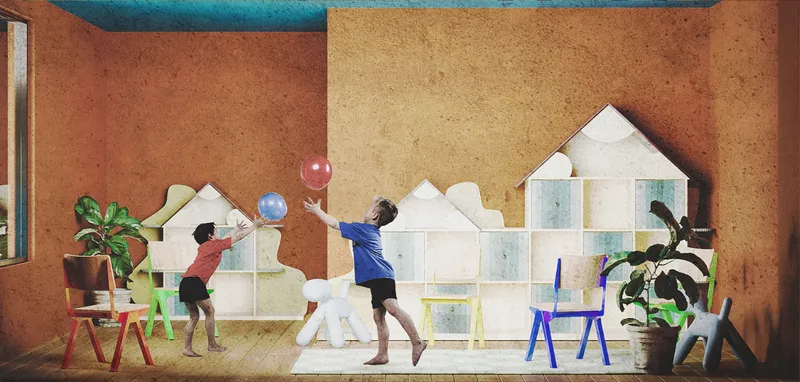
Step inside and the architectural rigor softens into a world scaled for children. Textured orange walls recall the earthen tones of Yazd's historic fabric, while white modular blocks, colorful chairs, and turquoise ceilings create playful environments that invite exploration. The spatial quality here is deliberate: these are not decorated rooms but carefully considered enclosures where material warmth and color serve developmental as well as climatic purposes. The thick, double-shell walls visible in the background are not just aesthetic; they act as thermal buffers, significantly reducing heat transfer during peak summer months while retaining warmth in winter.
There is a quiet confidence in how the project lets its young occupants interact with architecture that is simultaneously rooted in ancient desert intelligence and designed for their immediate, tactile world. The classrooms function because the building envelope does its job invisibly, keeping interiors comfortable through layered construction methods calibrated with modern environmental tools.
Windcatchers Retuned: Seasonal Ventilation in Section
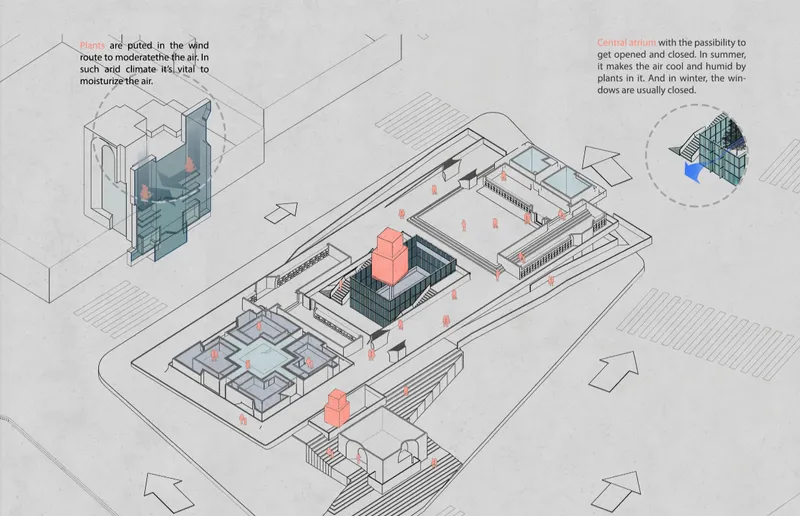
The axonometric drawing makes the ventilation logic legible. Both four-sided and two-sided windcatchers rise from the complex, capturing wind from the north and south and directing it into underground geothermal channels approximately six meters below grade. At that depth, earth temperatures remain relatively stable throughout the year. Hot air passing through these channels cools naturally before being distributed into the building's interior. In winter, valves above the educational spaces close to prevent cold air infiltration, reducing airflow to a single windcatcher. Earth-warmed air is then circulated with controlled mechanical assistance, maintaining thermal comfort without conventional heating.
What distinguishes this from a historical recreation is the precision of the switching logic. The windcatcher is not a frozen symbol; it is a seasonally adaptive device whose performance is verified through computational analysis. The annotated drawing communicates this clearly, showing how each tower connects to the underground network and how airflow direction shifts between summer and winter modes.
Multi-Level Sections That Breathe

The building section cuts through multiple levels to reveal how courtyards, glazed atrium areas, and enclosed classrooms interlock. What reads in plan as a compact cluster unfolds in section as a varied landscape of heights, light conditions, and air movement paths. Glazed atria admit daylight deep into the plan while courtyards punctuate the mass, ensuring that no interior space is far from natural ventilation or visual connection to the sky. The section also exposes the vertical logic of the passive systems: air enters at the roof, descends through geothermal channels, and re-emerges at occupied levels, making the building a continuous loop of thermal exchange.
Why This Project Matters
Designing within a historic city as layered as Yazd demands more than formal sensitivity. It demands operational intelligence. Aghasi's daycare complex demonstrates that vernacular strategies like windcatchers, thick double-shell walls, and central courtyards are not relics to be preserved behind glass but living systems that can be re-engineered for contemporary performance standards. The project's real contribution is methodological: it shows how computational analysis tools and traditional spatial logic can be fused without one subordinating the other.
For a building type often treated as generic, the daycare program here becomes an unlikely but compelling vehicle for this argument. Children learn in rooms cooled by air that has traveled through six meters of earth and been humidified by courtyard vegetation. They play under turquoise ceilings within walls that absorb and release heat on a diurnal cycle perfected over centuries. The architecture does not announce its sustainability; it simply works, drawing on the deep knowledge of the city it belongs to while preparing that city for a hotter, more uncertain future.
View the Full Project
About the Designers
Designer: Fatemeh Aghasi
Enter a Design Competition on uni.xyz
uni.xyz runs architecture and design competitions year-round that reward proposals with spatial conviction and real site intelligence.
Project credits: A Form for the Future of a Historic City by Fatemeh Aghasi Form Follows Climate 2020 (uni.xyz).




Popular Articles
Popular articles from the community


Hill & Cross Opera: Sculptural Opera House Architecture Shaped by Tallinn’s Landscape and Identity
Hill & Cross Opera reimagines opera house architecture in Tallinn through its sculptural hill, civic plaza, glass wave and a luminous cross.

Co-Life: Senior Housing Design That Reconnects Older Adults With the City
Co-Life reimagines senior housing design through healing gardens, shared streets, workshops, and a sustainable community across generations.

Riyadh For All: Intergenerational Urban Design for Active Aging in Rabat
Riyadh For All reimagines urban design in Rabat with intergenerational co-living, adaptive courtyards, and Moroccan cultural exchange today.

The Earth Pod: 3D Printed Homes for Resilient Refugee Communities
The Earth Pod reimagines refugee housing through 3D printed homes made from clay, combining resilience, self-sufficiency, and rapid shelter.
Similar Reads
You might also enjoy these articles
Sustainable Architecture Design: Embracing Nature and Modernity at Villa Solsidan
The article explores Villa Solsidan by AndrénFogelström, showcasing its sustainable architecture design and integration with the natural surroundings in Saltsjöbaden, Sweden.
Scientific and Educational Monitoring Center of the Yenisei, Krasnoyarsk
Architecture as an instrument for ecological research, education, and environmental awareness along Russia’s largest river.
Development of Andretta Artist’s Village, Palampur, Himachal Pradesh, India
Reimagining Andretta as a living cultural landscape where art, architecture, and community converge to shape a global creative village.
Street Children Rehabilitation Center: A Model of Social Architecture for Community Rehabilitation
An inclusive social architecture project that transforms streets into nurturing environments, restoring dignity, identity, and opportunity for vulnerable children.

Explore Persian Architecture Competitions
Discover active competitions in this discipline



Challenge to reimagine the Iron Throne


Photograph architecture without architects


Illustrate the lost glory of Angkor Wat - Render Challenge


Design challenge to reuse E-waste
Comments (0)
Please login or sign up to add comments
No comments yet. Be the first to comment!