
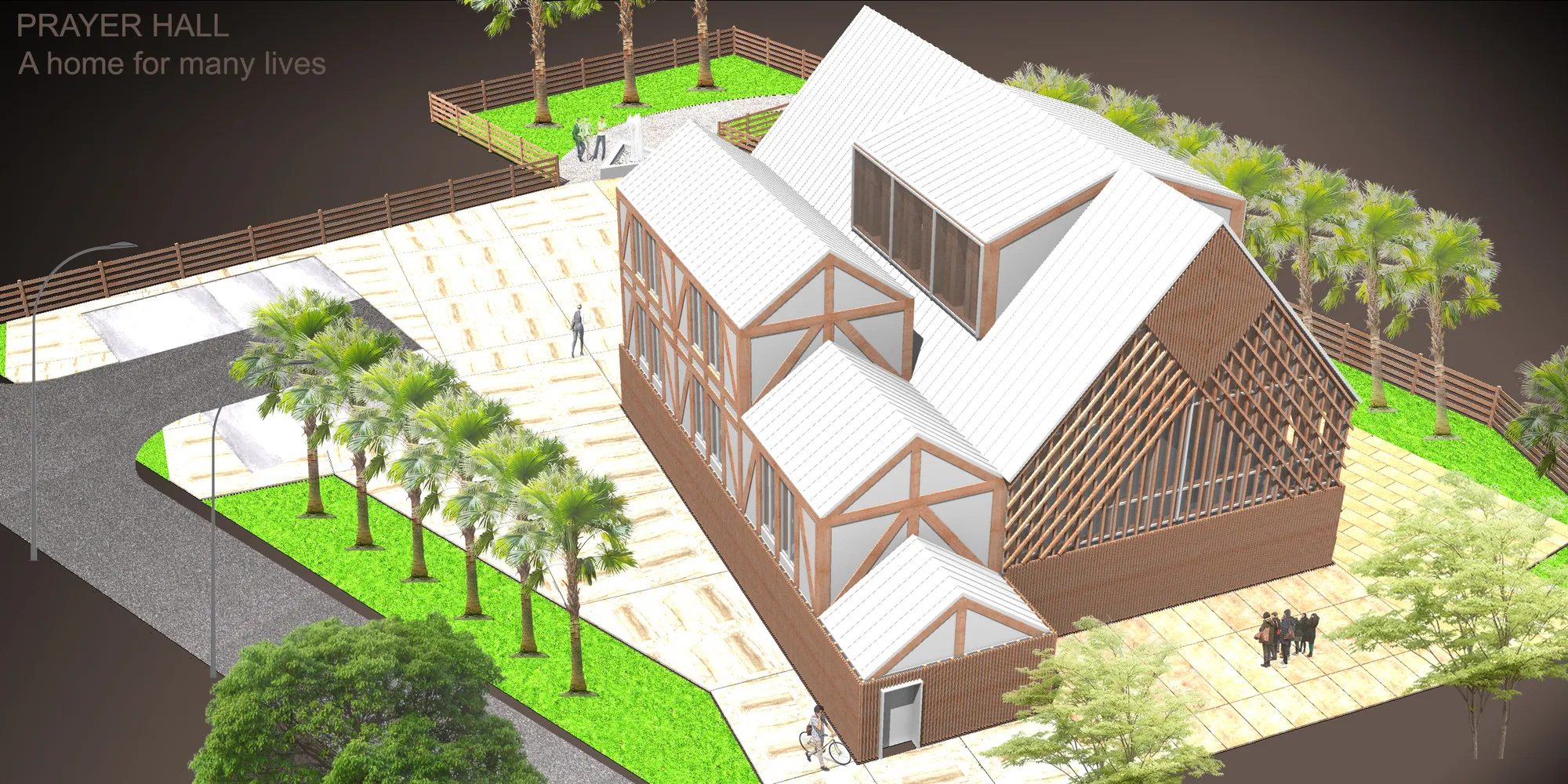
A home for many lives
PRAYER HALL

Starting with the design of the prayer room for the Congregate Religious Building Competition, I first tried to look at HO CHI MINH CITY. The site is located west of the SONG SAI GON river that flows through the city. In its vicinity there is a beautiful space VINHOMES CENTRAL PARK. It offers a panorama of the water and impressive skyscrapers of the city's urban development.
However, the site of the competition is in a slightly different neighborhood. It is a space with great potential. Directly on NGUEN HUU CANH Road. It is a large place in the urban tissue with a specific shape, opening in two directions. This gives rise to great design possibilities. The general definition comes from adjacent buildings that fall into two functional categories. In the south there is a large residential complex with additional services included in one block. It is called THE MANOR 1. From the west and north, it is surrounded by residential and hotel buildings. You reach these buildings through picturesque streets with access to various functions. This creates excellent conditions for the creation of architecture focused on thinking about the community. The goal is to create a space conducive to contemplation and tranquility. Rest after the hardships of everyday life and being cut off from the hustle and bustle of the city will be a priority here. Only such conditions can help direct the minds of visitors towards spiritual flourishing.
The religious structure of the city is dominated by non-believers. The second place is taken by Catholics and the third by Buddhists. Together with other denominations, they make up about 20% of the population. In order to facilitate the use of the designed building, its main function is presented as a high room where meditation sessions and calming exercises are to take place. The main spatial aspect is the structure that lifts and opens the roof in the central part. Through the created windows above the heads of the people gathered in the Prayer Main Hall, light will seep from above. The façades, which are two pediments of the main body, are glazed. On their surface there are openworks obscuring the view of the surrounding high neighbourhood. Courses and mini-lectures for adults and children can be organized in the entrance area. In the transitional part there are rooms for changing shoes and clothes for the comfort of using the main hall.
Nevertheless, the contemplative space itself would not sufficiently fulfill the function of the created place. In order to maximize the possibilities of users, a library room is being designed. There are comfortable seats for reading books from the book collection collected here. From this space you can also draw inspiration from people exercising in the main space or contemplate a square surrounded by trees visible behind the glass facade.
The second, smaller part of the complex is occupied by a building directly adjacent to Prayer Main Hall. There is a vertical communication in it, specially separated from the place of assembly. It provides access to toilets directly from inside the main hall or from outside the facility. On the ground floor there is also a room for the meeting leader in case he needs special equipment or preparation space. On the floor above, there is a mini-office for discussions on matters related to the operation of the facility. There you also go to the library, creating a sense of exclusivity and access to special knowledge. On the top floor, you can use the cafeteria equipment to drink a cup of warm tea or coffee with a person you may have met during meditation classes.
The location of the building on the plot results from its spatial values. A smaller block with an entrance located directly from the main road is to invite and suggest the intimacy of the whole. From the pedestrian route at the eastern border of the plot, we enter the space next to the building or through the gate made of trees. If we do not use the first entrance, the floors of the squares direct us deeper into the complex. For those arriving by car, parking is available. It does not interfere with the direct proximity to Congregate Religious Buildings. They are hidden behind curtains of trees surrounding them on three sides. This creates a kind of sanctuary of peace surrounded by nature. In the western part of the plot, spatially connected with the center of the site by a fountain, there is a walking alley. Contact with the roaring water and the proximity of trees is supposed to put you in a positive mood and help you open up to a new atmosphere of the place.
The design of both buildings is inspired by the local architecture of Vietnam. It draws its spatial relationships from 'Traditional Tube House'. The dominant material here is wood. This is especially the case with the truss of the main building. The exposition of this structure in the Prayer Main Hall space is to indicate its special character. The structure on which the roof rests, going downwards, reduces its form. This is a special procedure, intended to point to the uniqueness of the shaped space. Wood also indicates the object's connection with nature. The visible grain pattern of the beams shows what is usually hidden under the bark of the tree. The use of this material is also to help the object breathe and maintain a healthy climate inside. On the outside, the non-wooden elements are white in color to indicate the abstract function of the complex. It is also the color that absorbs the sun's rays the least. Wooden openwork decorating the glass pediments of the main building constitute a visual barrier. They also provide shading of the interior of the object, while penetrating the center of the reflected light.



Popular Articles
Popular articles from the community


Lunar Spiral: Space Architecture Shaped by the Mathematics of the Universe
Lunar Spiral reimagines space architecture through Fibonacci geometry, lunar regolith, levitating habitats, and self-sustaining Moon living.

Co-Life: Senior Housing Design That Reconnects Older Adults With the City
Co-Life reimagines senior housing design through healing gardens, shared streets, workshops, and a sustainable community across generations.

The Earth Pod: 3D Printed Homes for Resilient Refugee Communities
The Earth Pod reimagines refugee housing through 3D printed homes made from clay, combining resilience, self-sufficiency, and rapid shelter.

Riyadh For All: Intergenerational Urban Design for Active Aging in Rabat
Riyadh For All reimagines urban design in Rabat with intergenerational co-living, adaptive courtyards, and Moroccan cultural exchange today.

Similar Reads
You might also enjoy these articles

Day and Night Park: A Time-Based Urban Newsstand in Beijing
A temporary urban newsstand in Beijing blending travel, light, and reading through poetic colors, compact form, and community-focused design.

Modernist Patio Renovation in El Masnou, Barcelona by Oliver Segura Arquitectura + Cebrià Arquitectura
Modernist patio renovation blending tradition and innovation with a movable pool, leveled floors, and Catalan materials in El Masnou.

Alto Residencial Coop: Cooperative Housing Development in Santiago de Compostela by Carbajo Barrios Arquitectos
A linear cooperative housing complex blending white volumes and perforated metal façades, enhancing community living, natural light, privacy, and urban integration.
Vil Genis School by BPA ARCHITECTURE – Massy, France
Vil Genis School in Massy, France, features sustainable design, south-facing classrooms, community integration, accessible spaces, and modern educational architecture.

Explore Architecture Competitions
Discover active competitions in this discipline




Challenge to reimagine the Iron Throne


Photograph architecture without architects


Illustrate the lost glory of Angkor Wat - Render Challenge


Design challenge to reuse E-waste
Comments (0)
Please login or sign up to add comments
No comments yet. Be the first to comment!