

A Perennial Role
An essay on the perennial role of architecture concerning security.

Security in society has always been vital. Security was one of the factors for the creation of prehistoric communities. This primordial expression of the phrase “strength in numbers” has gifted us with the civilization that we enjoy today. These days, security is still a paramount priority. In my opinion, security is an irrevocable need of our species and our society. A society without security cannot and will not be able to reach for higher aspirations. Security is a physiological need, and as such, having it presents us with the proper foundation to reach those higher aspirations (by Maslow’s Hierarchy of Needs).
Architecture has always played an integral role in protecting individuals and communities. Inventions like fences, barbed gates, and watchtowers, have been ever-present in our society (albeit in different forms, utilizing different materials). These inventions were first used by our ancestors as defenses from wild animals or others who wished to raid their early settlements. These rudimentary forms of security were effective for the era. These days, we rely on the same base principles albeit use materials more apt to the current times. Nonetheless, architecture will have a perennial role in security for as long as our society exists, whatever form that may be. It is, after all, architecture, that helps aid us in our want and need to protect what is valuable to us.
With the ever-evolving landscape of society, security has both changed drastically and stood still. It has stood still in the sense that security has no new goal. Its goal is simply to secure valuables in whatever form that may be. The way that it has changed, however, is the fact that the word valuables has increased in the definition. In the primordial society, the term valuable was used to encompass food, shelter, clothing, rudimentary tools, etc. The term was used to encompass the base physiological and safety necessities of the times. These days, that definition includes information, habits, patterns, preferences, etc. Essentially, the term valuables have evolved from physiological and safety needs to cognitive needs (to put it simply). Our security needs have advanced as our society has advanced. Nowadays, we give a great deal to a holistic approach to security. Meaning we give as much protection to our house as we do to our smart devices, both physically (meaning preventing the loss of the phone) and cognitively (simply put, preventing the loss or breach of information on our devices). Additionally, that translates to increasing the percentage space of security facilities. By this I mean, modern-day buildings and infrastructure have included more spaces for the holistic security that I have described. We put as much care and attention to violent threats as we do with cyber threats and breaches. For example, a typical office building would want to guard its perimeter and facilities as much as it does its server room and data centers. The evolution of society also demanded the evolution of security parameters. As society evolved, so did our security needs. In architecture, that translates to a renewed focus on holistic security. If, hypothetically, security spaces before comprised only 5% of the total space, nowadays, we have an immense need to increase that to perhaps 10-15%, maybe even more. This new relationship and dynamics we find ourselves in are all in the interest of servicing the new needs of society, vis-à-vis, the new security dynamics of the age.
The new security dynamics of this age include increased security (both in the physical and digital realm). There is a myriad of new technologies that help keep both realms safe from intrusion and breaches. For example, there aren’t a lot of places where you could elude CCTVs these days. An even better example of the new security dynamics is the CCTV system in Singapore. Singapore personifies my earlier statement (not a lot of places to hide from CCTVs) and proves its validity. The CCTV system in Singapore encompasses nearly the entire country. It’s so effective that Singapore’s Minister for Home Affairs and Minister for Law, K. Shanmugam has called their CCTV system “a game-changer” because of its aid in solving 4900 police cases (as of December 2020). In addition, some studies have proven that while there may be some flaws in CCTV technology, the mere presence and prevalence of these devices in an area helps prevent crime. The psychological impact of such devices creates an additional bubble of security that helps fulfill the technology’s function to a greater degree. While the pros greatly outweigh the cons, not everyone feels the same about CCTV technology. Some view it as an invasion of privacy more than a tool for protection while others question the prevention aspect of its presence. Doubts aside, there’s a plethora of concrete proof that CCTVs work in our favor. In my opinion, there will be some technologies developed in the future that may be more intrusive than the simple CCTVs we know today (i.e., development of x-ray cameras, active tracking, etc.). From a macro point of view, CCTVs are just one of the more prevalent surveillance systems present to provide security to our society, but it is not the only one active. There have been hypothetical studies about the validity of utilizing AI to help combat the security problem (both in the physical and digital realms).
Future talks aside, the architecture profession melds with this issue in a few ways. Chief among them is the ability to create infrastructure for all these functions. As I’ve stated earlier, if the increase in security measures and technologies becomes more prevalent, I believe we could see a rise in the infrastructure dedicated to housing it. If there are more CCTVs in an area, then the likelihood of having a place for it (a command center, response center, what have you) increases drastically. We cannot have these technologies present without a proper system and more importantly without proper infrastructure. We can expect, therefore, that if security technology advances, the space allotted for it will increase as well. This begs the question, what typology would have to sacrifice to make way for this infrastructure? The urban realm is getting crowded as it is, what space/s would make the sacrifice to ensure that the security infrastructure gets built? The answer to the questions is unfortunately a discussion for another time but there are certain leeway and compromises we can make to ensure that there will be some space for this necessity. Instead of drastically increasing the sheer volume of single-use security infrastructure, we should focus on integrating security infrastructure in modern buildings. Maybe a mixed-use office space could house (to a certain degree) a command and response center for the neighborhood, or perhaps we can plan slightly bigger spaces for police stations and headquarters to ensure that our law enforcement has the appropriate space to conduct their work properly. This is just conjecture, of course, but these are very real questions and design considerations that will require answers in the future.
In conclusion, architecture will always play a role in the development of society in all aspects. Security infrastructure is just one of those aspects that our profession has influence over. In my opinion, the future of architecture is holistic. The fact that we can ask these questions (“how would architecture and design tie into security concerns?”, “how do surveillance systems affect societal growth?”, etc.) is concrete proof that we are leaning towards holistic design. The future of security systems and designs is a world that has successfully integrated both realms into one defense system. That would mean we have the same everyday capacity to protect our physical property while also protecting our digital property. I think that security architecture wouldn’t look too different than how it does now. In the future, I like to imagine that we have better versions of our current technology. CCTVs become more advanced, we would have X-ray screens that we can walkthrough, security turnstiles that have designs preventing people from jumping over them, etc. Again, I think we’d have more advanced technology, but I doubt that the aesthetic or dynamic of our future (or near future) security technology would be alienating.
In the end, all these technologies and ideas for security have evolved a great deal through time. Whether the perception is good or bad, I think we can agree that these technologies serve society a great purpose. It is because of the security we enjoy today that we can achieve greater heights as a civilization. With our physiological and safety needs met, I do not doubt that we can grow even greater as a civilization.
References (6)



Popular Articles
Popular articles from the community


The Musturak Paradise: Senior Living Architecture for a Connected Future in Temara, Morocco
The Musturak Paradise reimagines senior living architecture in Temara via private homes, social spaces, culture, community, and shared care.

Hill & Cross Opera: Sculptural Opera House Architecture Shaped by Tallinn’s Landscape and Identity
Hill & Cross Opera reimagines opera house architecture in Tallinn through its sculptural hill, civic plaza, glass wave and a luminous cross.

Co-Life: Senior Housing Design That Reconnects Older Adults With the City
Co-Life reimagines senior housing design through healing gardens, shared streets, workshops, and a sustainable community across generations.

The Ocean Hive: Sustainable Architecture for a Self-Sufficient Civilization at Sea
The Ocean Hive imagines sustainable architecture at sea, where modular habitats, algae, wave power and ocean waste sustain a growing colony.


Similar Reads
You might also enjoy these articles

Day and Night Park: A Time-Based Urban Newsstand in Beijing
A temporary urban newsstand in Beijing blending travel, light, and reading through poetic colors, compact form, and community-focused design.

Modernist Patio Renovation in El Masnou, Barcelona by Oliver Segura Arquitectura + Cebrià Arquitectura
Modernist patio renovation blending tradition and innovation with a movable pool, leveled floors, and Catalan materials in El Masnou.
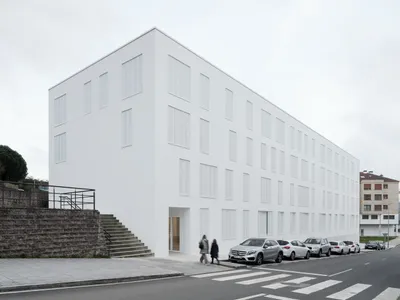
Alto Residencial Coop: Cooperative Housing Development in Santiago de Compostela by Carbajo Barrios Arquitectos
A linear cooperative housing complex blending white volumes and perforated metal façades, enhancing community living, natural light, privacy, and urban integration.
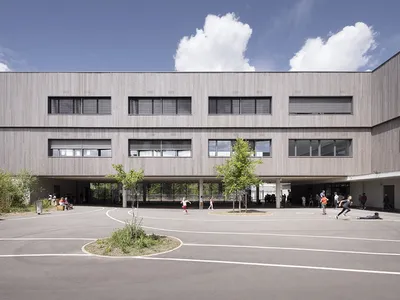
Vil Genis School by BPA ARCHITECTURE – Massy, France
Vil Genis School in Massy, France, features sustainable design, south-facing classrooms, community integration, accessible spaces, and modern educational architecture.


Comments (0)
Please login or sign up to add comments
No comments yet. Be the first to comment!