

'CORAL'ization: Turning Abandoned Offshore Oil Rigs into Islands Grown from Coral
A runner-up at Proximity Island 2019 that wraps a decommissioned oil rig in recycled frames and lets coral slowly grow it into an inhabitable island.


What if the most sustainable thing to do with an oil rig is to leave it standing and let the sea finish the job? 'CORAL'ization starts from that provocation. Instead of paying to dismantle an obsolete offshore platform, the project treats its steel skeleton as a seed. Recycled metal frames go in above and below the waterline, coral is cultivated across them, and over several decades the industrial structure disappears beneath layers of reef and coral limestone until what remains reads less like a building and more like a geological formation of caves, cliffs and islands.
The proposal by Daria Verkeenko was named a runner-up in Proximity Island 2019. Its site is the isolated marine territory where rigs are typically left behind once extraction ends, structures that have long stood for pollution and environmental damage. Verkeenko reverses that reading. The rig becomes an armature for marine biodiversity, and architecture becomes something that is grown, harvested and remade in place rather than imported and fixed.
Two Rock Towers on Industrial Stilts
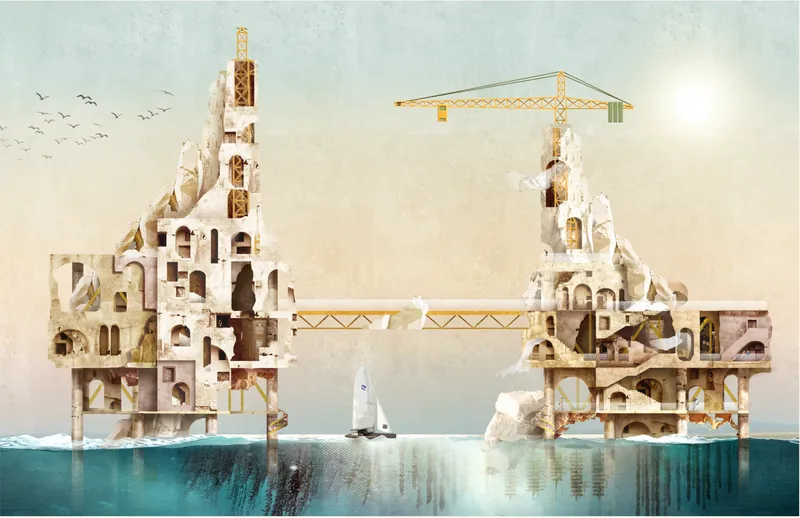
The elevation sets the tone with deliberate ambiguity. Two perforated, rock-like masses sit on stilts and are linked by a bridge, while a crane still hovers nearby, a reminder that the platform's working past has not been erased, only overgrown. A sailboat and a flock of birds under a low sun signal the new constituency: not tankers and crews, but wildlife and visitors. The image works because it refuses to show a finished building. It shows a structure mid-transformation, which is exactly what the project argues architecture should be.
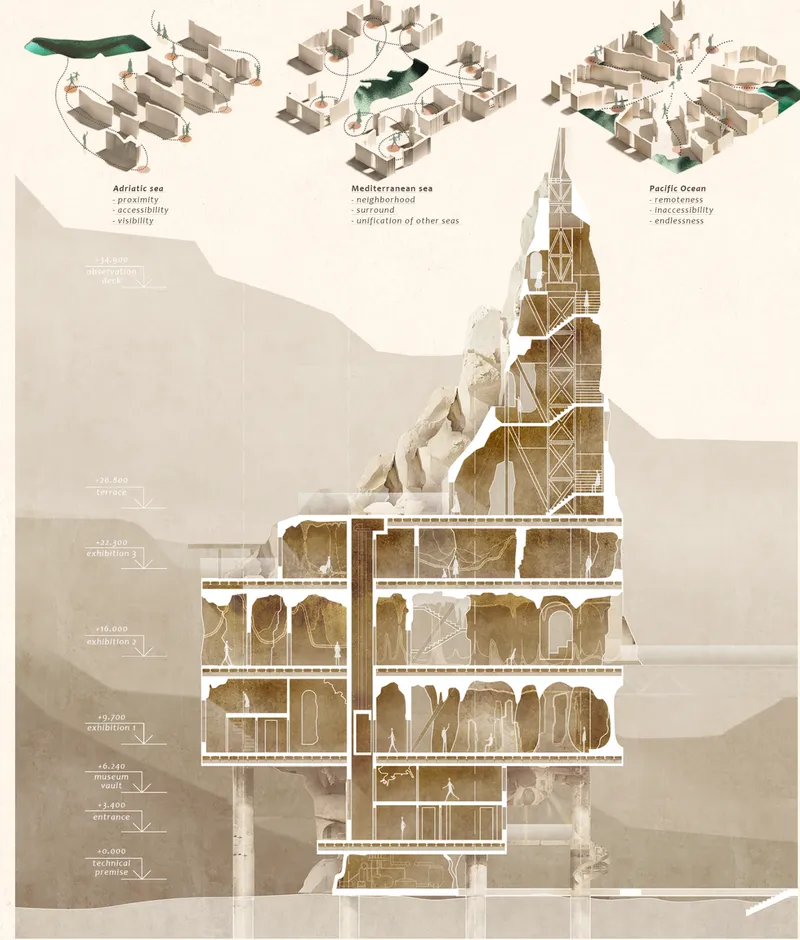
The section reveals the logic underneath the rough skin. Stacked levels sit around a central shaft, with a stair frame threading vertically through the mass, all held on the original piers. The small maze diagrams above hint at how circulation is meant to feel: not a clean sequence of floors but a wandering path through hollows, closer to exploring a cave than climbing a tower. The rig's rational grid survives as structure, while the experience of moving through it becomes organic.
Walkways Laid Over a Cultivated Sea Floor
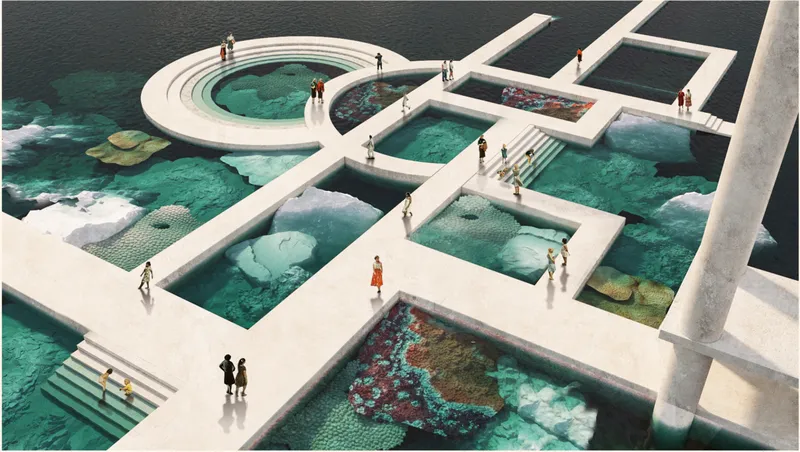
From above, the platform resolves into a field of turquoise pools crossed by thin white walkways and stairs. Visitors stroll between basins of coral, which turns the cultivation process itself into the landscape. This is the project's quiet strength: the reef is not hidden behind a façade or confined to a lab. The growing ecosystem is the ground plane, and people move across it the way they might walk the edges of a tidal flat.
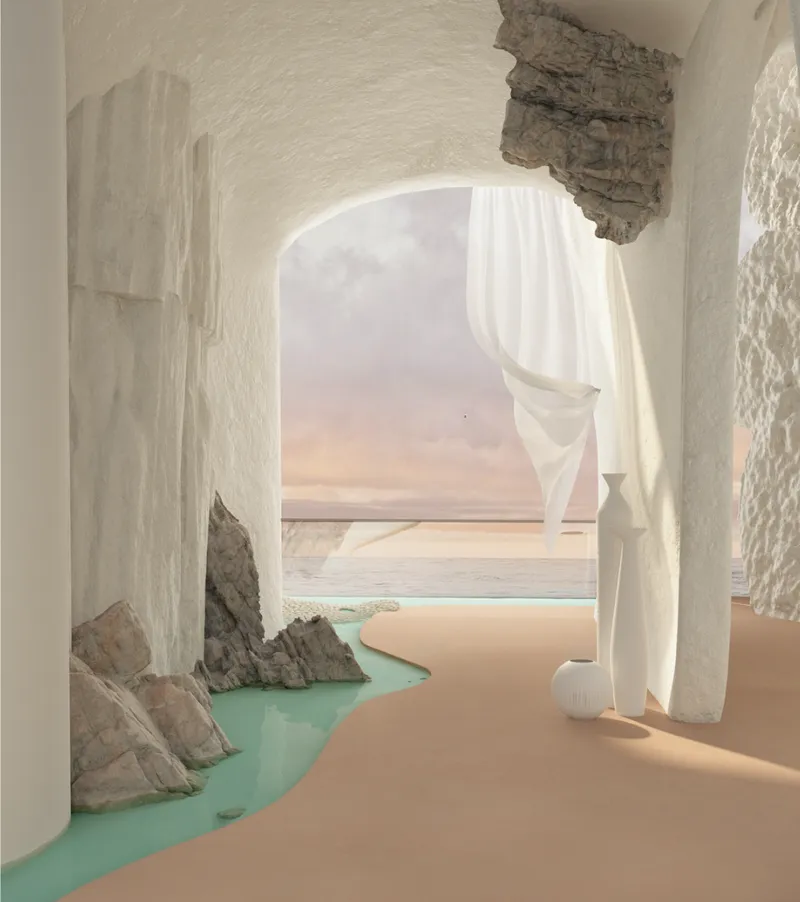
Inside, the cave metaphor becomes literal. A plastered corridor carries a turquoise water channel alongside rock outcrops, with a sheer curtain softening the opening to a pink dusk sea. Water runs through the architecture rather than around it, and the transition between interior and ocean is handled with fabric and light rather than heavy enclosure. It is a convincing image of what living inside a coral formation might actually feel like.
Coral as Both Habitat and Building Material
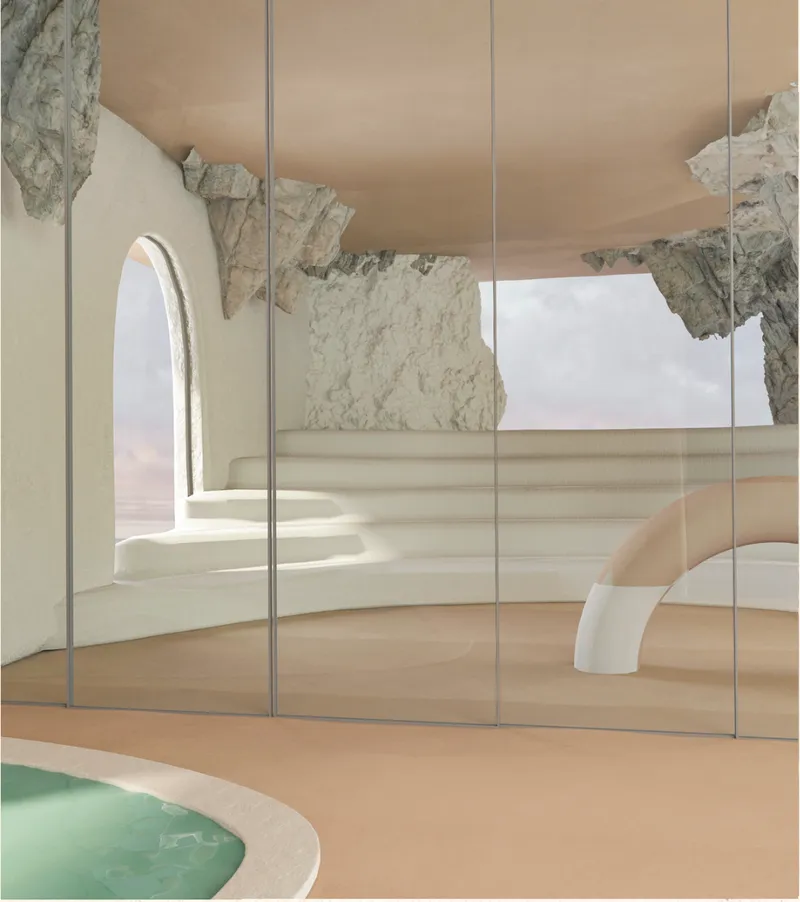
The research core of the proposal is material. Verkeenko identifies three coral-based materials, built around coral limestone and processed dead coral, and integrates them into the envelope, interiors and spatial structures of the platform. The result is a closed loop: the site gradually produces the material required for its own expansion. The curved plaster room, with stepped seating, an arched window and a round turquoise pool seen through floor-to-ceiling glass, shows how soft and continuous these surfaces can become when walls, floors and furniture are shaped from the same substance.
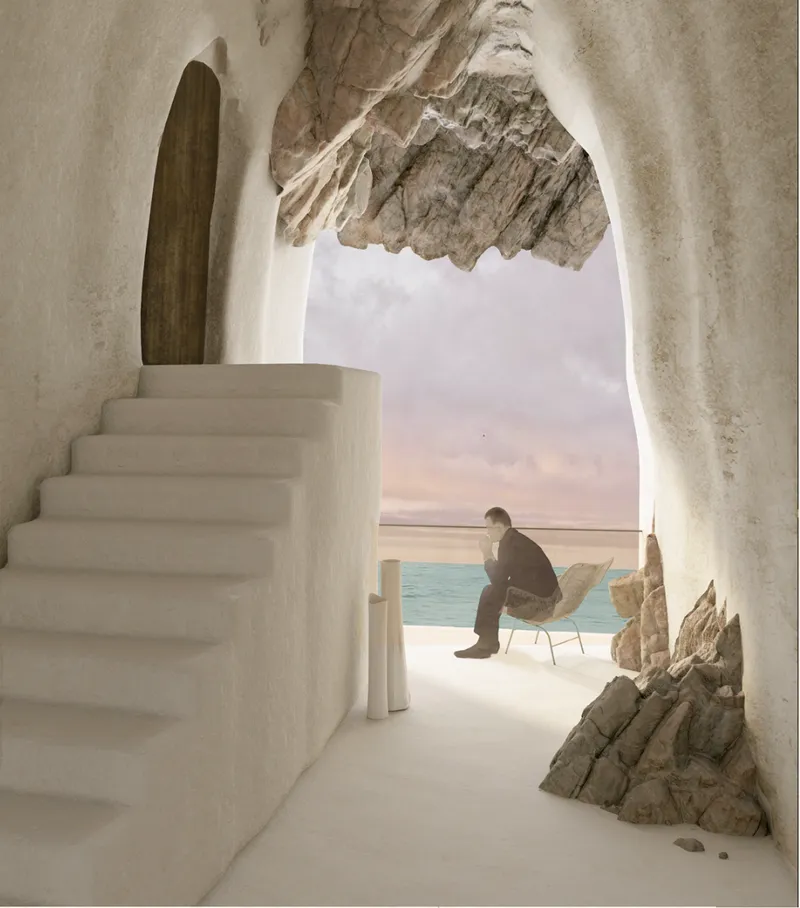
The white staircase rising beside a rock-framed arch makes the same point at a more intimate scale. A seated figure looks out to sea from a threshold that seems carved rather than assembled. The rough outcrop and the smooth plaster belong to one material family, so the line between what grew and what was built starts to blur, which is precisely the ambiguity the project is chasing.
Domestic Life Carved into the Reef
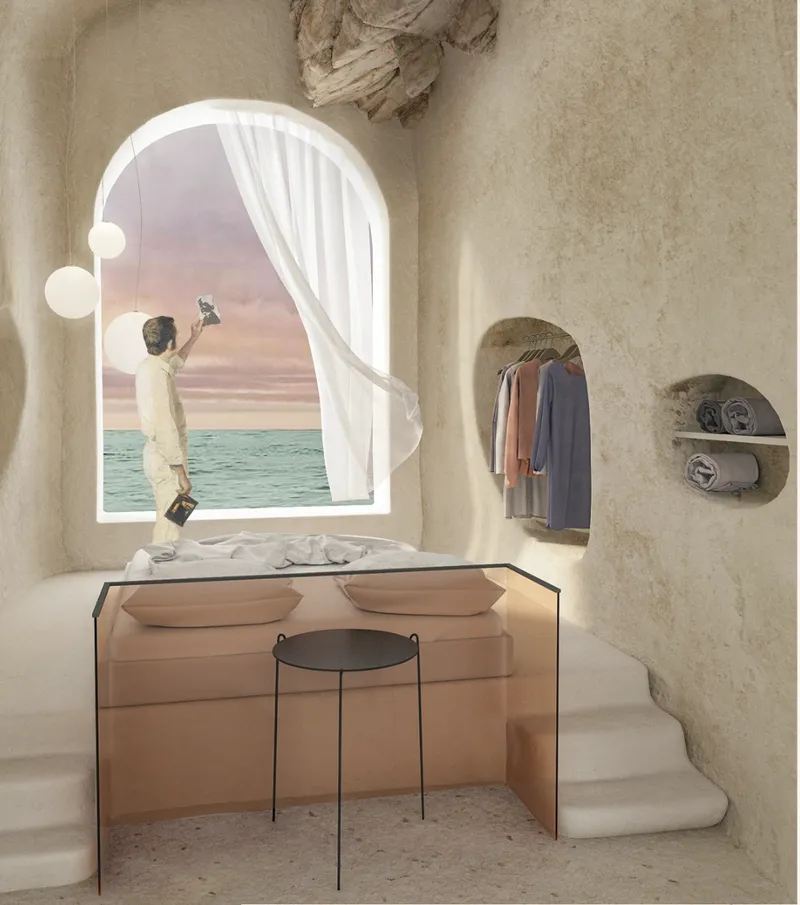
The bedroom rendering pushes the idea into everyday inhabitation. A carved plaster room opens through an arched sea window, a curtain billows in the breeze, and the bed sits inside an amber glass enclosure. The glass is a smart counterpoint: against the mineral, cave-like shell, it introduces a crisp, lightweight layer of privacy without breaking the sense of being inside the rock. This is where the proposal earns its claim of being inhabitable rather than merely ecological.
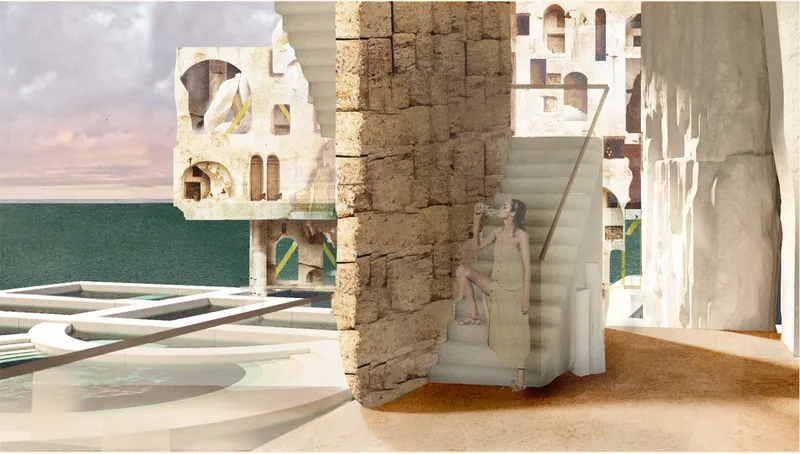
The final image settles into calm. A woman drinks on a stone staircase beside rough masonry, with a pool and the sea beyond at dusk. Nothing here references oil, extraction or industry. That absence is the point. The renderings narrate an ending in which the rig has fully dissolved into a place, and the project's success rests on how plausible that quiet ending feels.
Why This Project Matters
Decommissioning offshore infrastructure is expensive and environmentally disruptive, and most proposals for reuse simply swap one programme for another inside the same steel shell. 'CORAL'ization goes further by questioning permanence itself. It treats the rig as a starting condition, accepts that the architecture will take decades to arrive, and lets ecological growth determine the spatial outcome. That is a genuinely different model of authorship, one where the designer sets up conditions and the reef does much of the building.
The proposal leaves open questions about growth rates, structural loading and how coral harvesting is balanced against reef health, and those are worth pressing on. But as a competition entry, it lands a clear argument with real atmosphere: industrial remnants can become regenerative ground, and buildings can be cultivated from the sites they occupy. For a generation of designers inheriting the infrastructure of the fossil fuel era, that is a useful idea to have on the table.
View the Full Project
About the Designers
Designer: Daria Verkeenko
Enter a Design Competition on uni.xyz
uni.xyz runs architecture and design competitions year-round that reward proposals with spatial conviction and real site intelligence.
Project credits: CORAL’ization by Daria Verkeenko Proximity Island 2019 (uni.xyz).


Popular Articles
Popular articles from the community


Cloaked Colonization: A Mobile Underwater Habitat That Moves Like a Fish
Micah Abaya's shortlisted EHC Pacific entry reimagines ocean settlement as a dispersed network of self-sustaining architectural organisms.

Manzana Morphosis: Stretching Barcelona's Grid into a Living Landscape for 2050
A radical reworking of the Eixample manzana turns density into a tool for generous public space, vertical ecology, and environmental performance.
Opera by the Sea Estonia: Three Shells Dissolving Architecture into Tallinn's Coastline
A winning opera house proposal replaces monumental form with interconnected shells that blur the boundary between building, park and Baltic Sea.

Singing Woman: An Opera House That Performs Before the Curtain Rises
Ovidiu Cristian Pavel's conceptual opera house translates Estonia's choral identity into a sculpted waterfront landmark facing the Baltic Sea.

Similar Reads
You might also enjoy these articles

Healing Façade: A Modular Chapel System That Restores Ethiopia's Sacred Forests
Winner of the Eco-Chapel competition, this circular timber façade collects water from air to rebuild soil and reforest degraded Ethiopian landscapes.
Kaffeebühnen: Where Coffee Shop Architecture Becomes a Civic Stage in Vienna
A linear sequence of timber boxes, transparent shells, and open yards turns the Viennese café tradition into a public performance space.
Eco Chapel: A Modular Forest Pavilion That Grows Like the Landscape It Protects
Hexagonal timber modules weave through existing trees, turning a chapel into a living system for prayer, education, and reforestation.


Urban Forest: A Vertical Ecosystem for 5,000 Workers in Singapore's Changi Business Park
Radially stacked pods and layered green decks turn a 7-acre plot into 47 acres of ecological workspace projected for 2040.

Explore Conceptual Architecture Competitions
Discover active competitions in this discipline

Design challenge to reuse E-waste

Packaging challenge - Design meets sustainability
Comments (0)
Please login or sign up to add comments
No comments yet. Be the first to comment!