
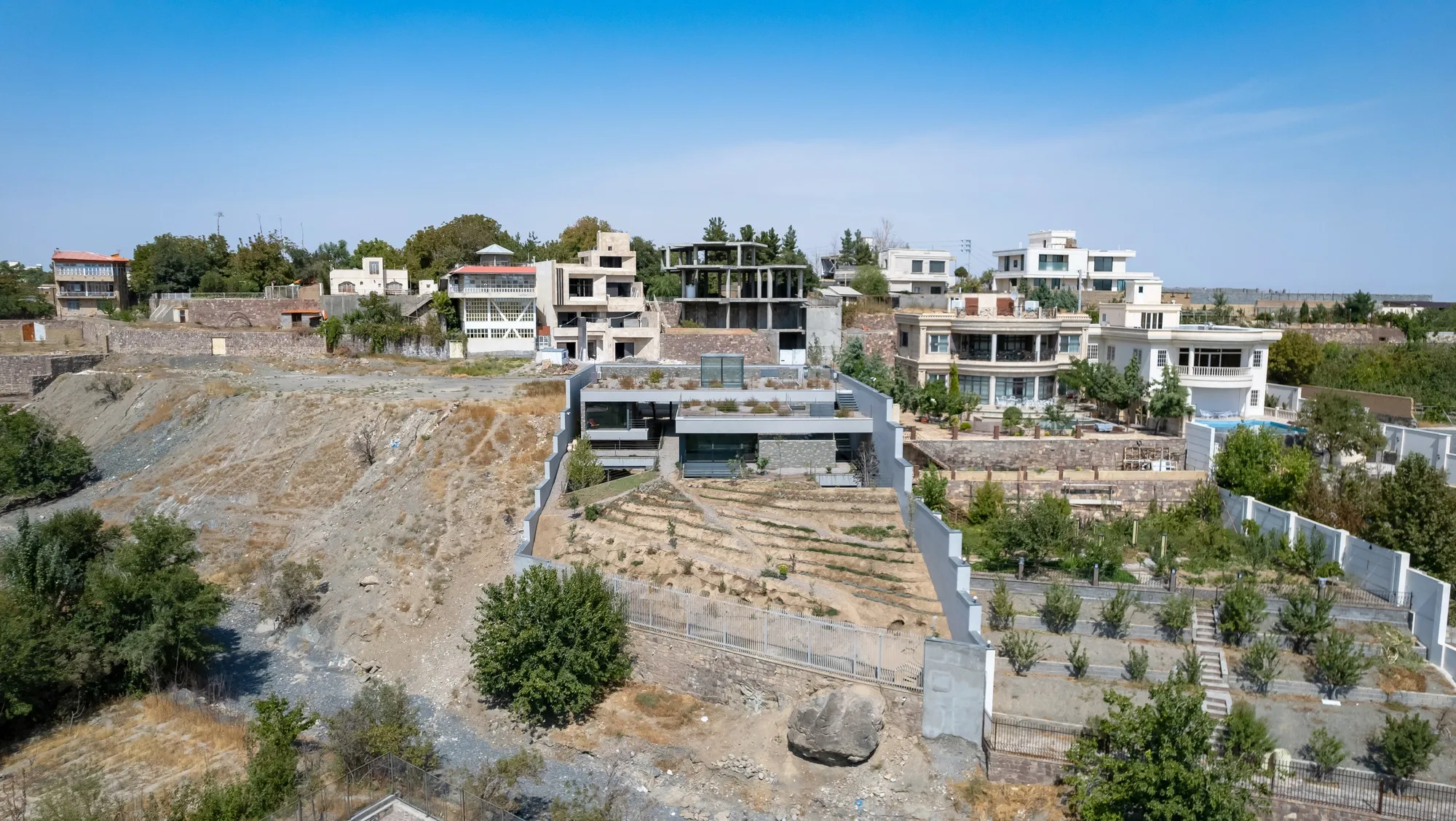
ABAR Office Carves a Weekend Villa into a Steep Hillside Adjacent to a Seasonal River in Shandiz
Kand-Kaav Villa steps down a terraced slope in northeastern Iran, using stone, microcement, and wood to blur the line between architecture and terrain.


Shandiz sits in the foothills south of Mashhad, a landscape of orchards and seasonal rivers increasingly consumed by relentless villa development. When ABAR Office, led by architect Javad Khodaee, was brought onto the Kand-Kaav project, a full set of plans already existed but had failed to satisfy the client's needs. The redesign, which stretched from 2018 to 2024, produced something far more considered: a 690 square meter weekend residence on a 1,306 square meter plot that steps down the slope rather than sitting on top of it, keeping the built mass subordinate to topography and oriented against the prevailing winds.
What makes this project genuinely compelling is the refusal to treat a weekend villa as a simple retreat box. Kand-Kaav operates more like a small settlement, its circulation organized as a network of alleys and corridors threaded among enclosed rooms, sometimes merging visually or spatially with open and semi-open areas. Stairs are not afterthoughts but the primary organizing elements, creating an intertwined movement structure that turns every transition between levels into an act of discovery. The result won first place in the single residential category at the 2024 Memar Award, Iran's most prominent architecture prize, and it earned the recognition honestly.
Terrain as Co-Author

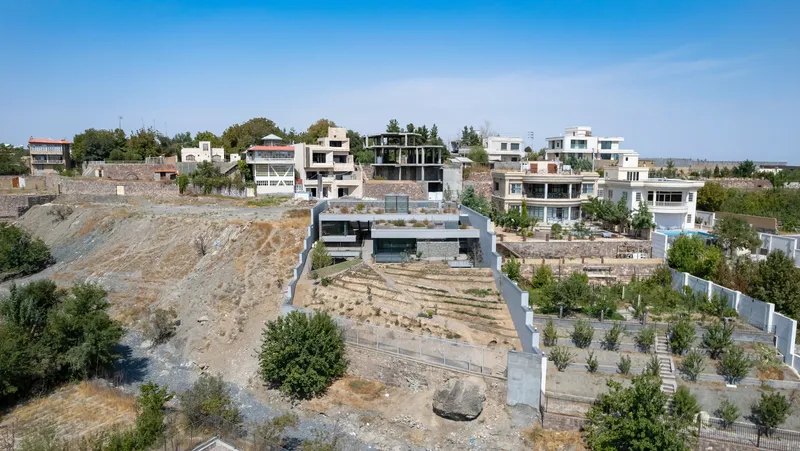
From the air, Kand-Kaav reads less as a house and more as a geological formation that happens to glow from within. Two stories above ground plus a basement level step down the steep grade, and the flat roofed volumes stagger in plan so that no single mass dominates the hillside profile. The terracing below, planted with a mix of carefully selected species and areas left to develop naturally, extends the architectural logic into the landscape without forcing symmetry or manicured precision.
Positioning the mass contrary to the disturbing wind direction is a quiet but effective passive strategy. It lets the building shield its own courtyards, creating sheltered microclimates where the boundary between interior and exterior dissolves into what ABAR Office describes as "in-betweens." Adjacent to a seasonal river, the site is dynamic by nature, and the architecture mirrors that dynamism by offering multiple spatial conditions: intimate enclosure for a family evening, generous open zones for large gatherings, and tucked-away corners for solitude.
Material Restraint Against a Rugged Landscape
The material palette is deliberately limited to stone, microcement, and wood. Stone connects the building to the terrain it occupies. Microcement, supplied by Daha Beton Zist, provides smooth, continuous surfaces that contrast with the rough hillside without competing for attention. Wood, fabricated by Babaee Wood Industries, introduces warmth at the scale of touch: furniture, thresholds, interior linings. The spiral staircase, manufactured by Spiral Azmayesh, introduces a vertical event within the otherwise horizontal logic of the stepping volumes.
Structural engineering by Hooman Movahed Aval had to reconcile the ambition of open, flowing spaces with the reality of building on a significant slope next to a watercourse. The result is a structure that feels grounded and substantial without being heavy. Metal detailing by Mahdi Behtash and glazing by Altus and Imeni Shargh contribute to the precision of the envelope, ensuring that the generous openings visible in the aerial views do not compromise the sense of shelter.
Circulation as Spatial Experience
The most distinctive aspect of the plan is how ABAR Office treats movement. Rather than organizing rooms along a corridor, the architects created a system of paths that behave like the narrow alleys of a traditional Iranian town: they compress, expand, reveal courtyards unexpectedly, and occasionally dissolve into open air. The stairs are not simple connectors between floors but spatial events that reorganize one's relationship to the slope, the sky, and adjacent rooms at each landing.
This approach serves the villa's need for programmatic flexibility. A weekend house must accommodate radically different moods: a couple arriving alone on a Friday evening has different spatial needs than a holiday gathering of extended family. By distributing collective spaces generously and separating them clearly from private zones, yet linking everything through this labyrinthine circulation, Kand-Kaav allows the house to feel occupied at every scale of use.
Why This Project Matters
In a region where villa construction often means dropping a prefabricated spatial formula onto a hillside and calling it a retreat, Kand-Kaav demonstrates that engaging seriously with topography, climate, and the rhythms of domestic life produces architecture that is both more functional and more emotionally resonant. The six-year design period is not a sign of indecision but of genuine iteration, a willingness to discard a complete set of plans and start over when the architecture was not meeting its purpose.
The Memar Award jury recognized what the aerial views make visible: a building that belongs to its site so thoroughly that removing it would feel like an excavation rather than a demolition. ABAR Office's achievement here is in proving that restraint in material, sensitivity to slope, and complexity in spatial sequence can coexist in a weekend villa without pretension. It is a model for how to build in Iran's increasingly developed foothill landscapes without erasing the qualities that make people want to be there in the first place.
Kand-Kaav Villa by ABAR Office (Javad Khodaee). Shandiz, Khurasan Razavi, Iran. 690 m², completed 2024. Photography by Diman Studio.
About the Studio
Share Your Own Work on uni.xyz
If projects like this are the kind of work you want to make, uni.xyz is a place to publish your own, find collaborators, and enter design competitions.



Popular Articles
Popular articles from the community


The Musturak Paradise: Senior Living Architecture for a Connected Future in Temara, Morocco
The Musturak Paradise reimagines senior living architecture in Temara via private homes, social spaces, culture, community, and shared care.

Hill & Cross Opera: Sculptural Opera House Architecture Shaped by Tallinn’s Landscape and Identity
Hill & Cross Opera reimagines opera house architecture in Tallinn through its sculptural hill, civic plaza, glass wave and a luminous cross.

AL-JANNAH: Sustainable Architecture and Permaculture for Afghan Widows
AL-JANNAH uses sustainable architecture and permaculture to create resilient oasis of housing, learning, work and renewal for Afghan widows.

Conexión: Biophilic Design Reimagines High-Rise Living in Hong Kong
Conexión reimagines high-rise living in Hong Kong through biophilic design, green facades, shared spaces, daylight, water and nature within.


Similar Reads
You might also enjoy these articles

Bao Huynh Watercolor Atelier: A Serene Art Retreat in Hội An
Bao Huynh Watercolor Atelier in Hội An blends multifunctional art spaces, sustainable design, local materials, and family-friendly living in a serene environment.

Atelier Macri Concept Store Interior Design by CASE-REAL
Atelier Macri store features a "ko" counter, walnut wood details, cork displays, blending retail, gallery, and seamless customer experiences.

Manuel Vargas Izquierdo Stadium and High-Performance Sports Center: Architectural Excellence in Jalpa de Méndez
The Manuel Vargas Izquierdo Stadium blends sustainable design, inclusive sports facilities, and cultural-inspired architecture, revitalizing Jalpa de Méndez’s public spaces.

KAKR Buluh Awar Hall: Revitalizing Community and Ecology Through Bamboo Architecture
Community built bamboo hall revitalizes Buluh Awar village, empowering youth, restoring ecology, celebrating vernacular craftsmanship through sustainable architecture and culture.



Comments (0)
Please login or sign up to add comments
No comments yet. Be the first to comment!