
ACL Architects Carve Light and Air into a Narrow Alley House in Vietnam's Mekong Delta
Uyen House in My Tho stacks four levels around a central atrium, turning a constrained urban lot into a generous vertical garden.


In My Tho, a river city in Vietnam's Mekong Delta, the typical residential alley is too narrow for a car. It is the kind of site that tempts architects toward defensive design: windowless party walls, a single slot of sky, rooms stacked like boxes. ACL Architects, led by Le Van Tan, took the opposite approach with Uyen House. Rather than sealing the 350-square-meter section off from its neighbors, the team organized the entire house around a central void, an atrium that pulls daylight deep into the plan and lets tropical air move vertically through every floor.
The project is a filial gesture: a son commissioning a home for his parents. That brief, rooted in care and longevity, shows up in material choices that age well, in spatial sequences that favor slow circulation over efficiency, and in planted terraces that grow more lush with each monsoon season. Uyen House is not trying to be a landmark on the street. Its narrow facade barely announces itself above the roofline. The real architecture is internal, and it rewards the climb.
A Facade That Barely Whispers
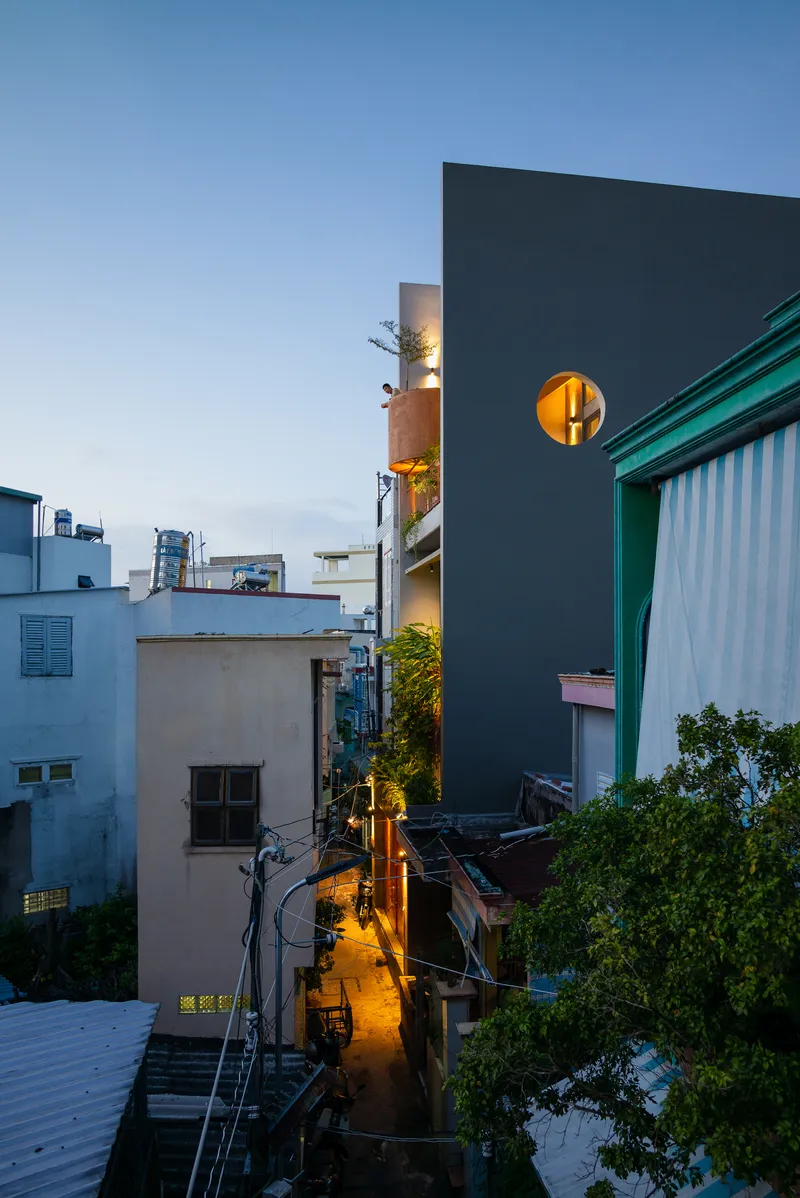

From the alley, Uyen House presents almost nothing: a slender elevation, a circular porthole window punched through the upper mass, and a roofline that arches gently above the adjacent houses. The restraint is deliberate. In a dense urban fabric where every centimeter of frontage is contested, ACL Architects chose to withhold spectacle, letting the porthole serve as the single identifying mark. At dusk, the circle glows like a lantern, hinting at the layered interior behind it.
The arched roof profile, visible in the evening silhouette, softens the box and nods to the vernacular barrel vaults found across southern Vietnam. It also performs a climatic role, lifting the ceiling plane at the center to encourage hot air to rise and escape through upper openings.
The Atrium as Engine
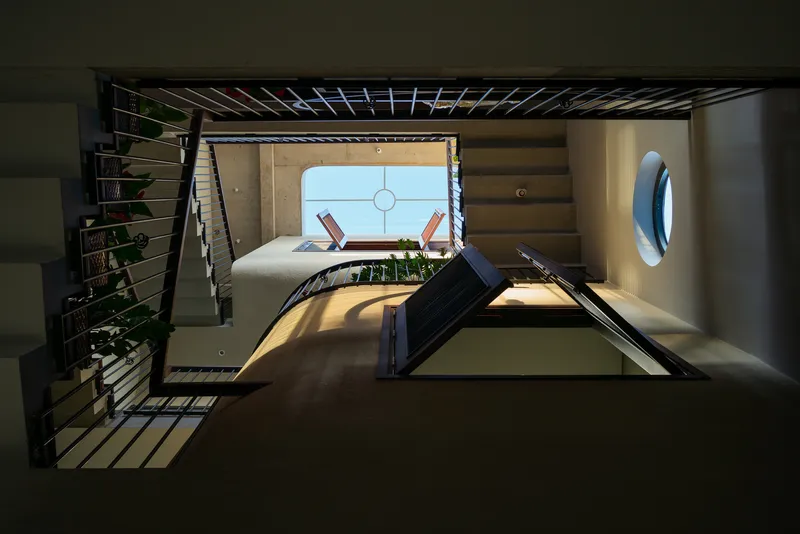


The central atrium is the project's most consequential move. Looking straight up from the ground floor, you read the full section: crossing bridges at different levels, planted balconies spilling ferns and vines, and circular skylights capping the void above. The space operates as both a light well and a ventilation chimney. Warm air rises through the open stairwell and exits at the roof, pulling cooler air in at the base. It is a passive cooling strategy dressed up as spatial drama.
The bridges are not purely functional connectors. They create overlapping sightlines between floors, allowing the parents to see and hear activity throughout the house without leaving their room. In a building commissioned as an act of devotion, this visual connectivity carries emotional weight. The atrium keeps the family within earshot of one another, even across four levels.
Timber, Concrete, and the Color of Earth
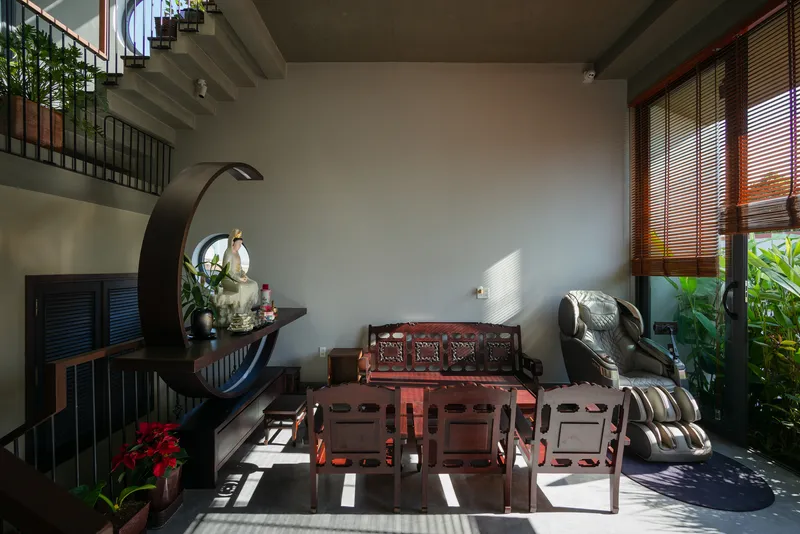
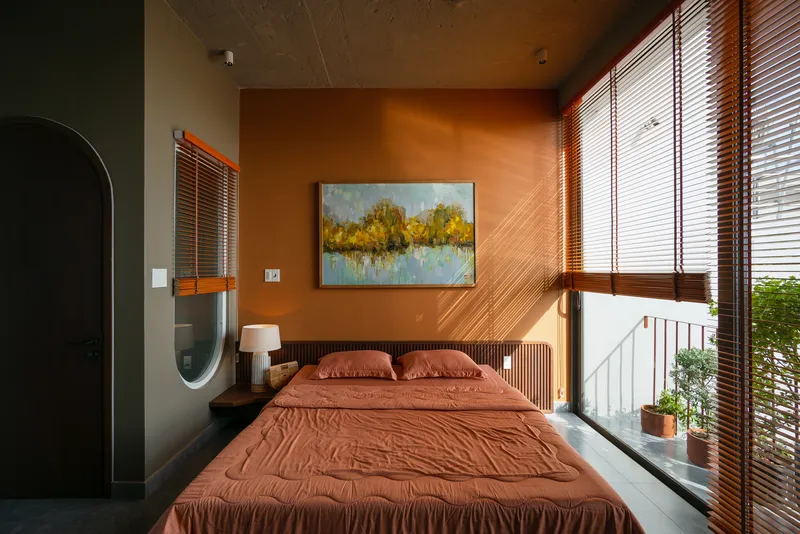

ACL Architects build the palette from three materials: exposed concrete for the structural frame and ceilings, timber for shutters, furniture, and stair treads, and terracotta-toned finishes for the bedroom walls. The concrete is left raw, with board-formed textures visible on the soffits. It reads as honest rather than brutal, partly because the timber elements warm every room they touch. Horizontal wood blinds filter the southern light into soft bars across the living spaces.
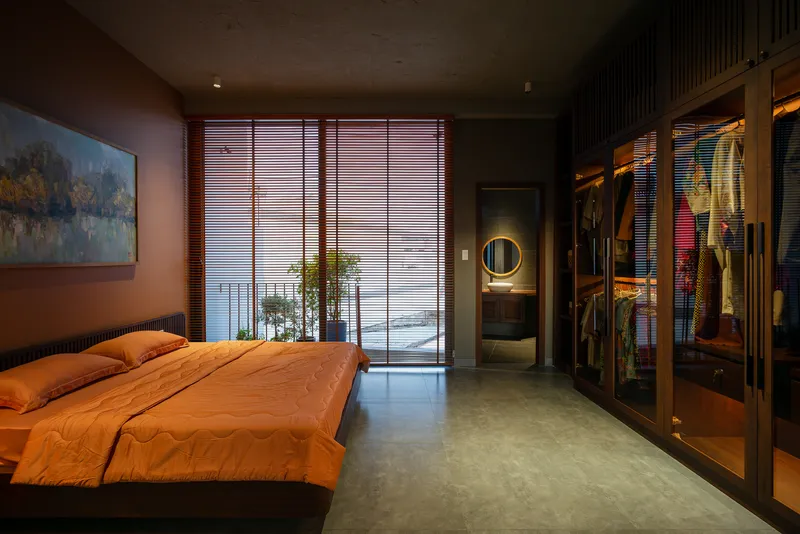
The terracotta walls in the bedrooms deserve attention. They shift the atmosphere from the communal openness of the lower floors to something quieter and more enclosed. Combined with the low exposed concrete ceilings, these rooms feel sheltered, almost cave-like, a deliberate contrast to the airy atrium just outside the door.
A Staircase as Spatial Spine

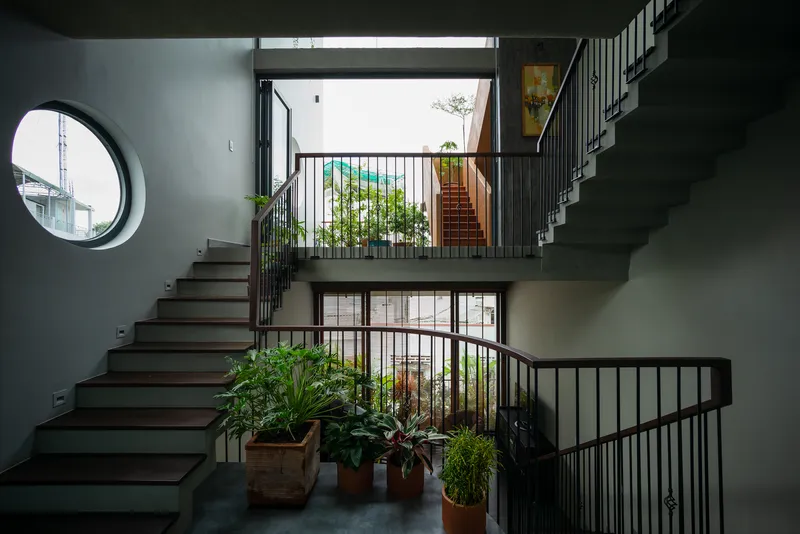
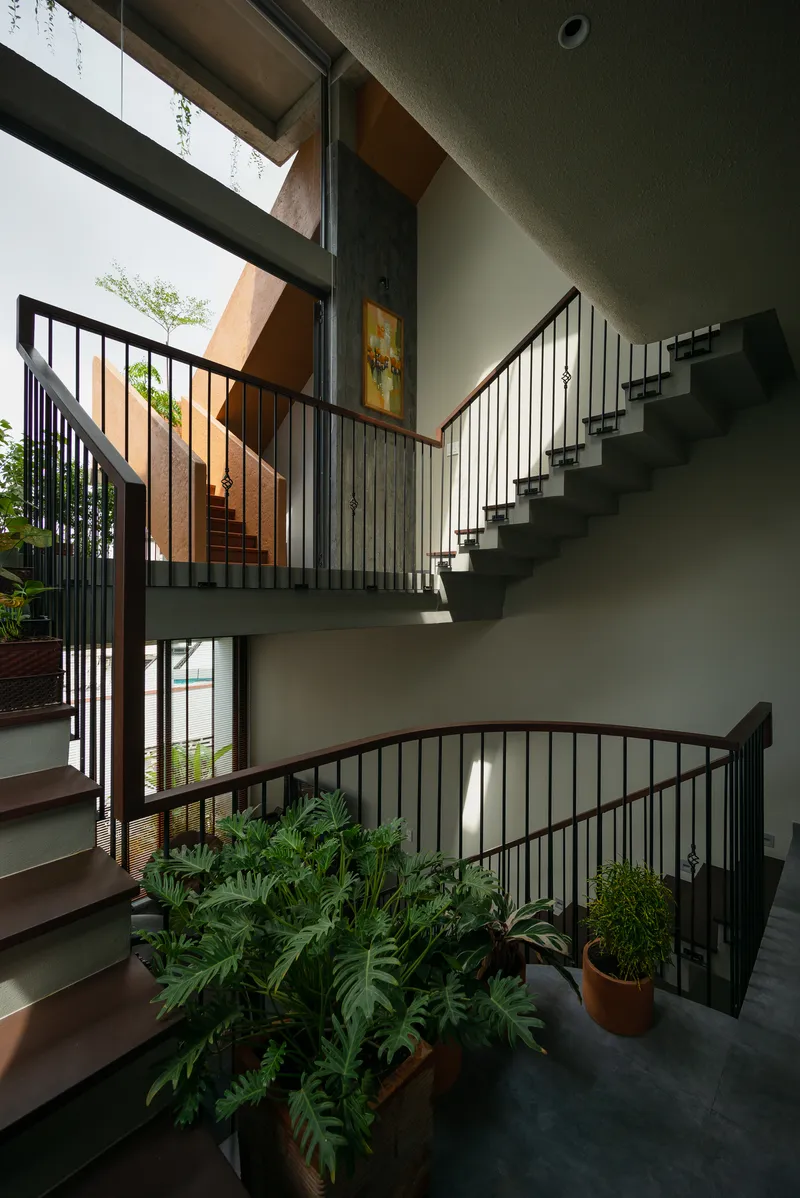
On a site this narrow, the stair cannot be tucked away. It becomes the primary spatial experience of the house. ACL Architects treat it accordingly: curved concrete treads, black steel balustrades with a clean profile, and timber handrails that feel warm in the hand. The staircase zigzags through the section, pausing at landings lined with potted ferns and open to the atrium. Each landing is less a corridor than a small garden.
Clerestory glazing and skylights wash the stairwell with natural light even on overcast days. The effect is that ascending feels like moving toward the sun. By the time you reach the rooftop terraces, you have passed through a complete gradient of light, from the sheltered ground floor to the open sky.
Living with Plants at Every Level


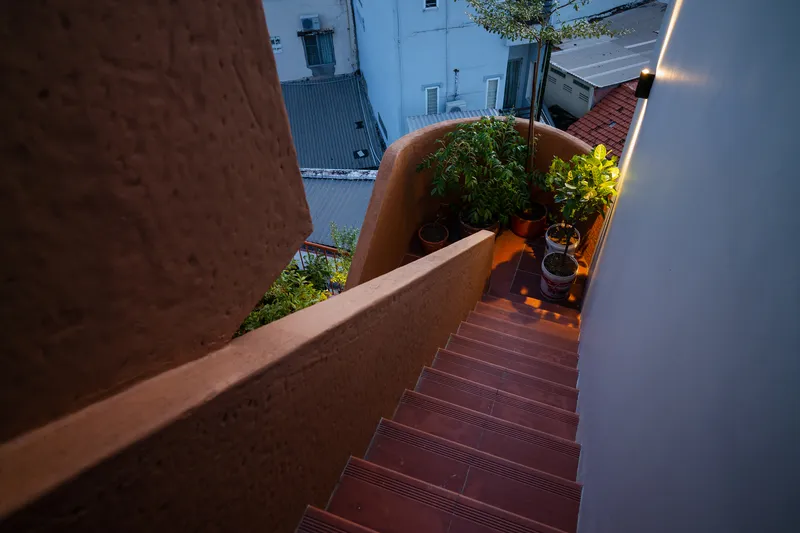
Vegetation is not decoration here; it is infrastructure. Planted terraces appear at every floor, visible through glass doors from the bedrooms and through open balustrades from the stairwell. The rooftop stair, finished in textured red tile treads, descends between raised planting beds that will eventually canopy the uppermost outdoor space. These green pockets moderate the microclimate, shading concrete surfaces that would otherwise absorb and radiate heat.
The planting strategy also serves the parents for whom the house was built. Gardening becomes an activity distributed vertically through the building, not confined to a backyard. Each terrace is accessible, intimate in scale, and oriented to catch morning or evening light depending on the level.
Nighttime Reveals the Section
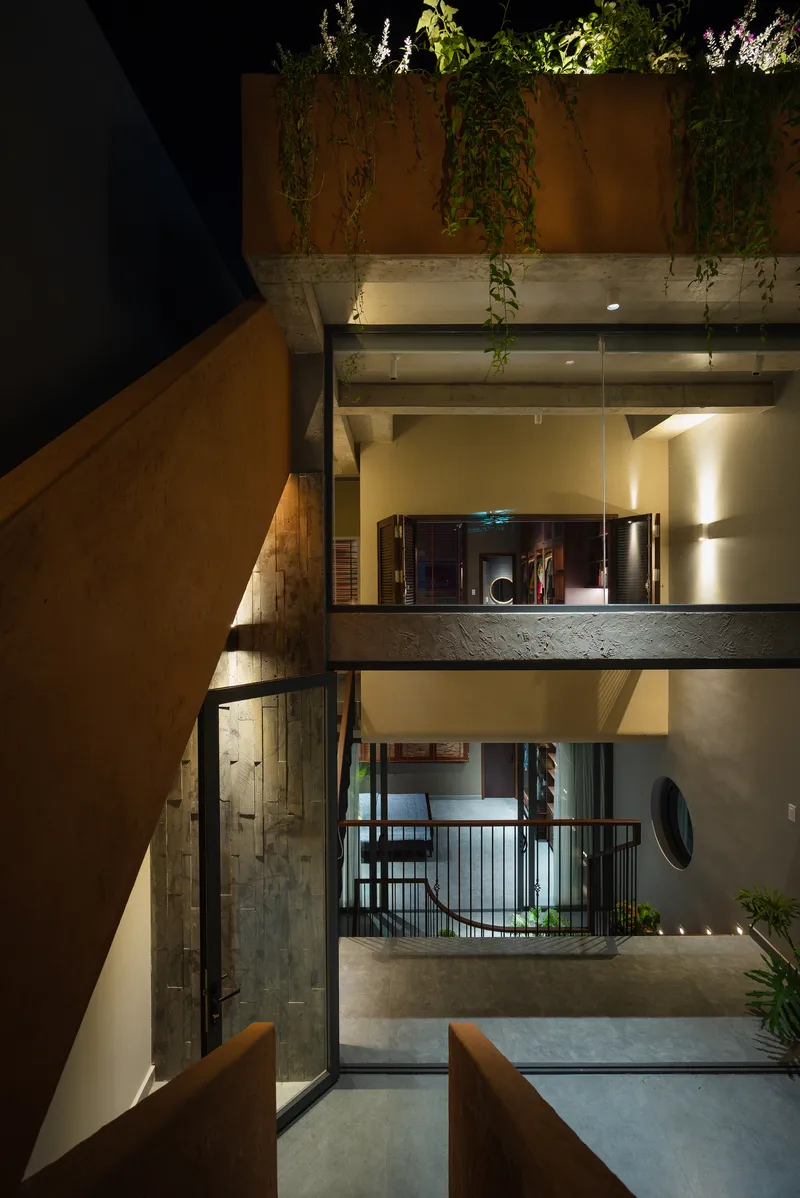
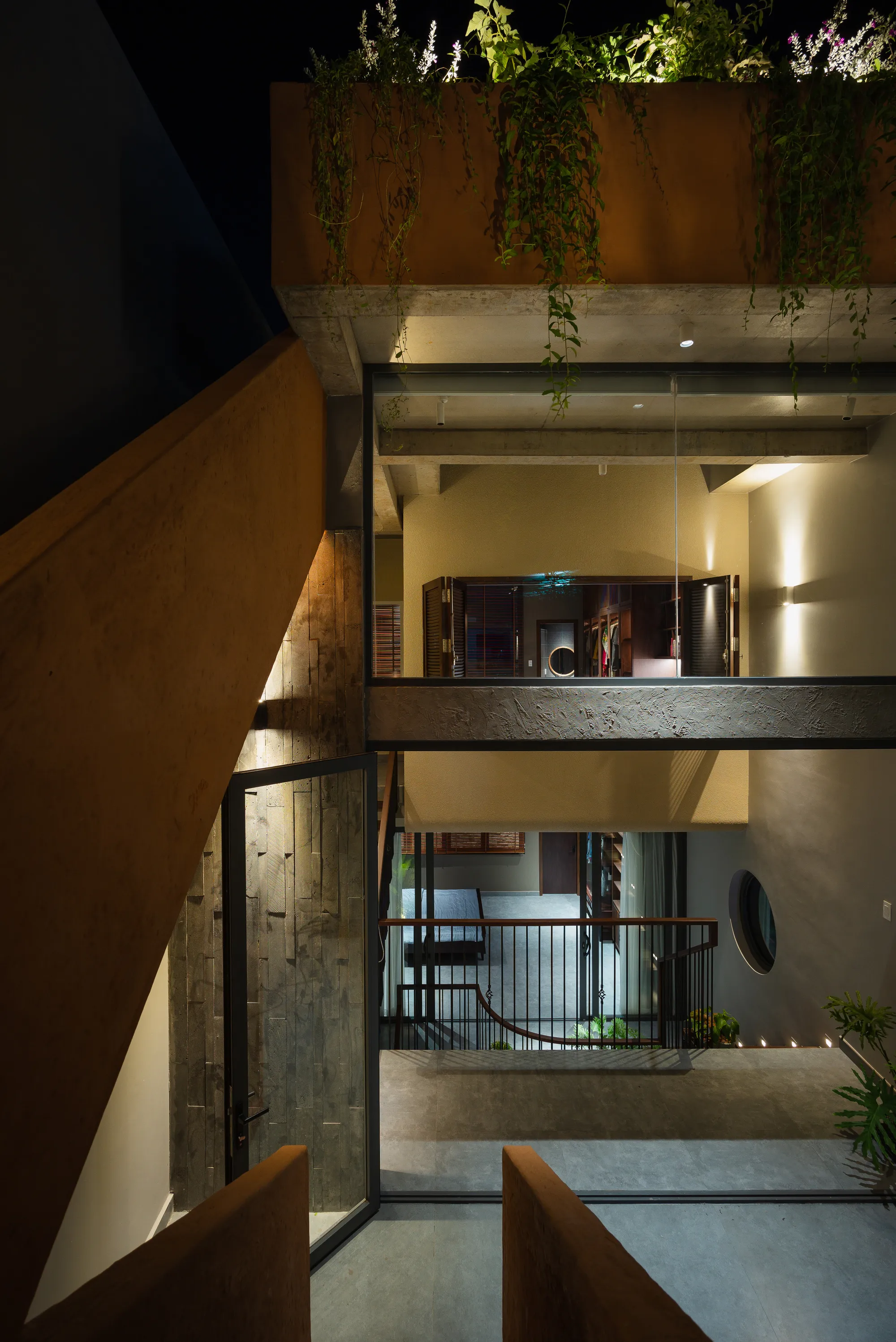
After dark, the house inverts. Interior lighting turns the atrium into a glowing vertical garden visible from multiple vantage points. Cascading vegetation catches the warm light, and the concrete balconies read as horizontal shelves stacked in silhouette. The nighttime view through the courtyard is the clearest expression of the section: you can count all four levels at a glance, each one slightly different in character.
The bedrooms at this hour retreat behind their wood blinds, the terracotta walls absorbing the amber glow of interior fixtures. There is a quiet domesticity to these rooms that photographs well but surely lives even better.
Plans and Drawings


The drawings confirm what the photographs suggest: a slender rectangular footprint, no more than a few meters wide, stretched deep into the block. The ground floor plan shows the living spaces and kitchen arranged along one side of the courtyard, with a light portal connecting the front of the house to the green zone at the rear. Upper floors shift the program to bedrooms and lobbies, each floor pulling back slightly to create the planted terraces. The section drawing is the most revealing: the zigzagging staircase, the arched roof, and the full height of the atrium are all legible in a single cut. ACL Architects have included photographic insets in their presentation drawings, a gesture that ties the abstract plan back to lived experience.
Why This Project Matters
Uyen House is a reminder that constraint is not the enemy of generosity. The narrow alley site, the modest budget implied by the material palette, and the straightforward brief could have produced a forgettable tube house. Instead, ACL Architects leveraged the vertical dimension to create a home that breathes, that changes mood from floor to floor, and that grows greener with time. The central atrium is the key decision: it sacrifices floor area for light, air, and visual connection, and the trade-off pays dividends on every level.
There is also something worth noting about the commission itself. A son building a house for his parents is a common narrative in Vietnamese culture, but the architecture here does more than fulfill an obligation. It anticipates how two people will age in a tropical city: with gardens within reach, with rooms that stay cool without mechanical systems working overtime, and with sightlines that keep them connected to the rest of the household. That is not sentiment. That is good design.
Uyen House by ACL Architects (lead architect: Le Van Tan), Thành phố Mỹ Tho, Vietnam. 350 m², completed 2022. Photography by Quang Tran.
About the Studio
Share Your Own Work on uni.xyz
If projects like this are the kind of work you want to make, uni.xyz is a place to publish your own, find collaborators, and enter design competitions.




Popular Articles
Popular articles from the community


The Earth Pod: 3D Printed Homes for Resilient Refugee Communities
The Earth Pod reimagines refugee housing through 3D printed homes made from clay, combining resilience, self-sufficiency, and rapid shelter.

The Ocean Hive: Sustainable Architecture for a Self-Sufficient Civilization at Sea
The Ocean Hive imagines sustainable architecture at sea, where modular habitats, algae, wave power and ocean waste sustain a growing colony.
EW PARK: Sustainable Architecture Reimagines the Future of Urban Parking
EW PARK reimagines city parking as a modular wooden tower combining automation, solar energy, electric mobility, and adaptable urban design.

Hill & Cross Opera: Sculptural Opera House Architecture Shaped by Tallinn’s Landscape and Identity
Hill & Cross Opera reimagines opera house architecture in Tallinn through its sculptural hill, civic plaza, glass wave and a luminous cross.


Similar Reads
You might also enjoy these articles

Bao Huynh Watercolor Atelier: A Serene Art Retreat in Hội An
Bao Huynh Watercolor Atelier in Hội An blends multifunctional art spaces, sustainable design, local materials, and family-friendly living in a serene environment.

Atelier Macri Concept Store Interior Design by CASE-REAL
Atelier Macri store features a "ko" counter, walnut wood details, cork displays, blending retail, gallery, and seamless customer experiences.

Manuel Vargas Izquierdo Stadium and High-Performance Sports Center: Architectural Excellence in Jalpa de Méndez
The Manuel Vargas Izquierdo Stadium blends sustainable design, inclusive sports facilities, and cultural-inspired architecture, revitalizing Jalpa de Méndez’s public spaces.

KAKR Buluh Awar Hall: Revitalizing Community and Ecology Through Bamboo Architecture
Community built bamboo hall revitalizes Buluh Awar village, empowering youth, restoring ecology, celebrating vernacular craftsmanship through sustainable architecture and culture.

Explore Residential Building Competitions
Discover active competitions in this discipline


Challenge to design mud housing for contemporary communities


Challenge to reimagine the Iron Throne


Photograph architecture without architects


Illustrate the lost glory of Angkor Wat - Render Challenge
Comments (0)
Please login or sign up to add comments
No comments yet. Be the first to comment!