

Homeless Vocational Training Center: Modular Reuse as a Tool for Social Reintegration
An abandoned building in a fractured Taiwanese city becomes a rotatable, crane-assembled training hub that turns homeless residents into skilled workers.


A highway carves through a city, and the fallout is measured in people. On one side, tech parks and new residential enclaves; on the other, displaced workers, rising rents, and a growing population with nowhere to sleep. The Homeless Vocational Training Center refuses to treat that population as a problem to manage. Instead, it reclaims an abandoned building on the fault line between these two halves and converts it into a modular facility where homeless individuals train for jobs as chefs, nurses, managers, and security officers. The architecture is not decorative. It is operational: lightweight, rotatable wall panels replace demolished interior and exterior walls, creating a structure that can be assembled, disassembled, and scaled by crane.
The project was designed by 孝霖 呂 in collaboration with X ECG and published on uni.xyz. Set in a Taiwanese urban context near a Science and Technology Park, it targets the socio-economic tension zone created by a new traffic arterial that split an existing urban fabric, displacing workers and amplifying income inequality. Rather than demolish the derelict structure or build from scratch, the designers chose adaptive reuse with a modular prefabrication system that complies with Taiwan's standard material regulations.
Red Frames and White Skin: A Street Presence That Signals Institutional Confidence

From the street, the building reads as an institutional presence without the coldness that label usually implies. The white facade is interrupted by exposed red structural frames that reveal the building's skeleton, a deliberate honesty about the adaptive reuse at play. Parked cars along the curb, sidewalk activity, and the multi-story scale place the center firmly in an everyday urban context. It does not hide behind corporate landscaping or fortress walls. The ground-level openness suggests accessibility, while the upper floors signal density of program: housing, training rooms, dining, services. The red steel is not ornamental; it marks the structural logic that allows the modular panels to plug in and rotate.
Timber Walls and Black Steel: Interiors Built for Dignity, Not Austerity

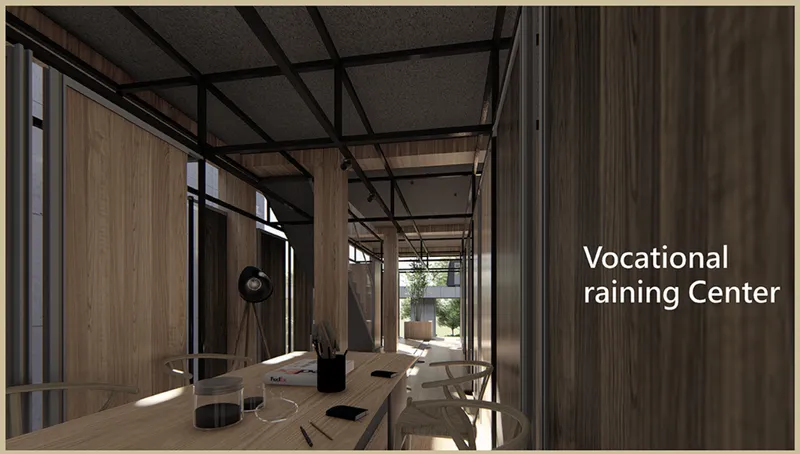
The interior hallway reveals the material strategy at its most effective. Timber-clad walls bring warmth to what could easily feel clinical, while exposed black steel ceiling beams carry the structural load visually and literally. Sunlight enters through angled openings, hitting the staircase and creating a sense of directed movement rather than institutional corridor monotony. There is nothing punitive about these surfaces. The timber reads as considered, not cheap; the steel reads as honest, not harsh.
The open workspace continues this language. Timber partitions subdivide the floor without sealing it off, maintaining sightlines through glazed sections to the desk areas beyond. The black steel frame is omnipresent, functioning as both ceiling grid and organizational logic for the modular components. These partitions are the core innovation: prefabricated panels designed for quick on-site assembly that create dynamic zones adjustable to ventilation needs, lighting conditions, and the shifting occupancy patterns of a population in transition.
Dining and Sleeping Under Exposed Trusses: Program as Community Infrastructure


The dining area is where the center's micro-community logic becomes most legible. Timber columns and pendant lights filter afternoon sun across shared tables, creating conditions closer to a cooperative restaurant than a soup kitchen. The exposed black steel framing overhead maintains the building's material consistency while allowing the ceiling plane to breathe. This is a space designed for communal meals prepared by trainees working in culinary roles, one of several vocational tracks that anchor the program.
The bedrooms complete the spectrum from public to private. A timber-clad wardrobe anchors one wall while exposed steel trusses span the ceiling, and a glass opening connects the room to an exterior terrace. These are not bunks in a shelter; they are rooms with territory, natural light, and the psychological weight of a personal threshold between inside and outside. The center provides temporary housing, but the design invests that temporariness with spatial qualities that reinforce a resident's sense of individual worth.
Assembly Logic: Axonometric Evidence of a Replicable System

The axonometric diagrams lay bare the assembly sequence and dimensional logic. Modular partition components are shown broken out, with clear annotations indicating how each panel connects, rotates, and locks into the existing structural frame. Floor plans demonstrate how the same component set generates different programmatic conditions: training rooms, bedrooms, bathrooms, dining. The system is designed for crane-based installation, meaning a single building can be reconfigured without specialized labor or lengthy construction timelines. This is where the project's ambition moves beyond a single site. If the modular system genuinely follows Taiwan's standard material regulations, as the designers claim, the center becomes a prototype rather than a one-off.
Why This Project Matters
Most adaptive reuse projects celebrate the building they save. The Homeless Vocational Training Center is more interested in the people it serves. By locating the intervention on the fracture line of an urban divide, near transport corridors and employment hubs, the designers position the center as a spatial bridge between communities that a highway separated. The programmatic ambition is significant: rather than warehousing homeless individuals, the building structures a path from arrival to skill acquisition to employment, distributing roles like chef, nurse, and manager among trainees who operate the facility itself.
The modular system is the project's strongest architectural proposition. Rotatable, prefabricated panels that comply with local material standards and install by crane suggest a genuinely scalable intervention. If cities across Taiwan and beyond face the same pattern of infrastructural disruption, displacement, and homelessness, a replicable kit of parts matters more than a singular architectural gesture. 孝霖 呂 and X ECG have proposed something that treats architecture not as monument but as mechanism: a system for reassembling fractured lives within a reassembled building.
View the Full Project
About the Designers
Enter a Design Competition on uni.xyz
uni.xyz runs architecture and design competitions year-round that reward proposals with spatial conviction and real site intelligence.
Project credits: Homeless Vocational Training Center by 孝霖 呂, X ECG.


Popular Articles
Popular articles from the community


graciastudio Turns a Viewless Tijuana Lot Inward Around a Courtyard of Concrete, Timber and Trees
In Tijuana, Jorge Gracia's GA2 House stacks a timber-clad private floor over exposed concrete and replaces a missing view with a planted interior patio.


Opera on the Sea: Driftwood Logic Shapes a Timber Opera House on Estonia's Coast
Trevor Orgill's opera house translates the entangled drift of floating timber into a civic building where wood, water, and music converge.

Singing Woman: An Opera House That Performs Before the Curtain Rises
Ovidiu Cristian Pavel's conceptual opera house translates Estonia's choral identity into a sculpted waterfront landmark facing the Baltic Sea.

Aquadapt: An Underwater Habitat That Rewrites Its Rooms by the Hour
Curved modules ring the seabed while one shell shifts from breakfast room to cinema, farm and football pitch as residents' needs change.

Similar Reads
You might also enjoy these articles

Cube Design Draws an Ecological Corridor Between Two Shenzhen Hills with the Nankai Building
Beside Shenzhen's container docks, the Nankai Building pairs stacked balconies with a climbing green screen to connect two hillsides across its height.

Praksis A and Studio Sted Bend a Red Timber Cabin Across the Granite of Norway's Southern Coast
On the southern Norwegian coast, a 105 m² cabin follows the rock on slender posts, pairing red cladding outside with pine, brick and plywood within.

David Ortega Stacks a Two-Story Mexico City Penthouse Around a Steel Stair and a Pergola-Shaded Roof Terrace
In Colonia Roma, a 300 m² penthouse uses oak joinery, a planted steel stair and a slatted roof pergola to make a new-build apartment feel like a house.

PARALELA and LB2 Thread a Public Walkway Through the Base of a Las Condes Residential Tower
In Las Condes, Santiago, the Hamlet Building gives its fenceless ground floor to a 70-metre wooded passage linking two streets and the metro.

Explore Adaptive Reuse Competitions
Discover active competitions in this discipline

Challenge to design luxury tourism on rails

VR headsets Storefront design competition

Designing a staircase for a client
Comments (0)
Please login or sign up to add comments
No comments yet. Be the first to comment!