

Meyer-Grohbrügge Designs a Beijing Restaurant That Doubles as a Flower Studio by Day
Nine petal-shaped tables orbit a central fountain inside a hotel atrium in Beijing's Chaoyang district, shifting from florist to fine dining.


A restaurant that only exists at night is already a compelling proposition. LING LONG, designed by Berlin-based Meyer-Grohbrügge on the third floor of Beijing's BEI Zhaolong Hotel, takes the idea further: when diners leave, the space transforms into a working flower studio. The same furniture, the same fountain, the same room, but a completely different program. It is a genuinely radical form of spatial economy, executed with the kind of material confidence that makes it look effortless.
Johanna Meyer-Grohbrügge and her team, including Frank Wang, Miao Zhou, and Sophia Frommel, organized 240 square meters around a single central element: a flower fountain that supplies water for freshly cut arrangements during the day and serves as a sculptural anchor for fine dining at night. Nine petal-shaped pink tables ring this core, their spacing choreographed to shift between the tight efficiency of a workshop and the generous breathing room of a modern Chinese restaurant. The ceiling, a radial fabric canopy, gathers everything beneath a soft geometry that reads as both tent and bloom.
A Radial Room
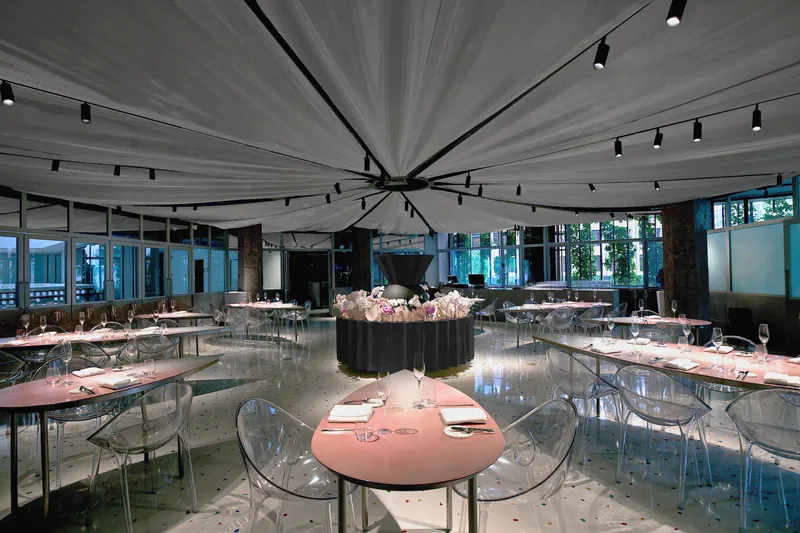
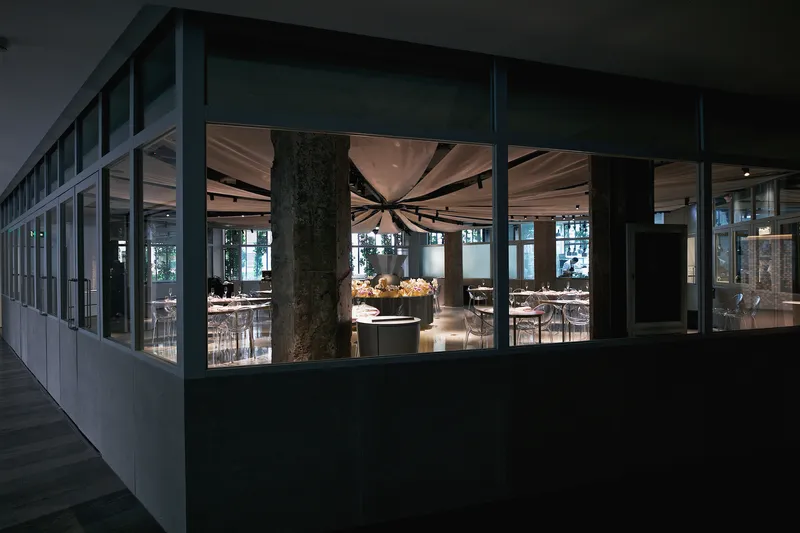
The dining room is organized as a centripetal composition. Every element radiates outward from the fountain: the draped fabric of the ceiling, the arrangement of the tables, and the zoning of the floor itself. An outer ring functions as lounge and circulation, while the inner orbit belongs to the diners. Seen from outside at dusk through the glazed facade, the room reads as a glowing lantern set within the hotel atrium, the radial canopy compressing interior light into a warm, focused glow.
The geometry is hexagonal, not circular, which gives the plan a specificity that a pure rotational scheme would lack. Corners become opportunities for serving stations and side rooms, while the faceted perimeter keeps the space from feeling like a banquet hall. It is a room with clear directionality despite its radial logic.
Petal Tables and Transparent Chairs
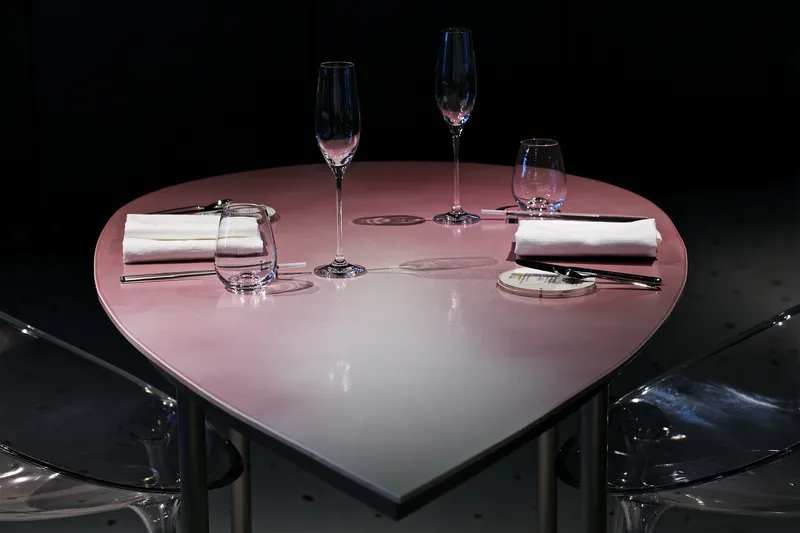
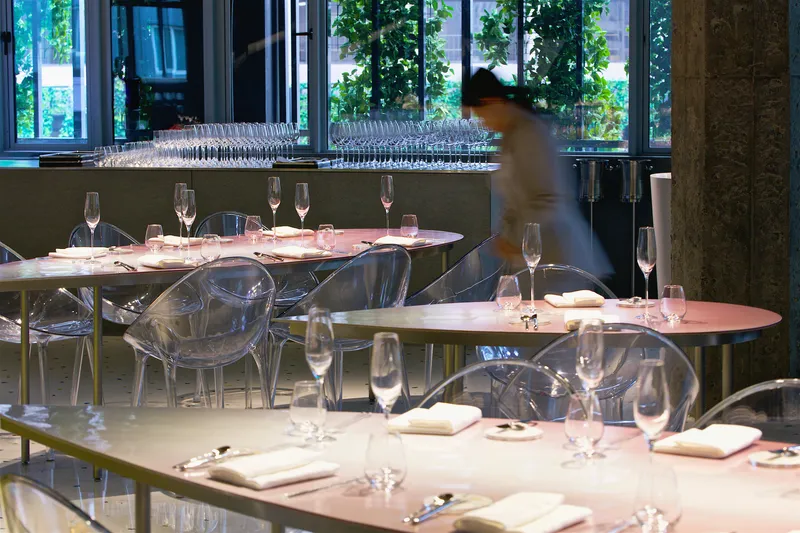
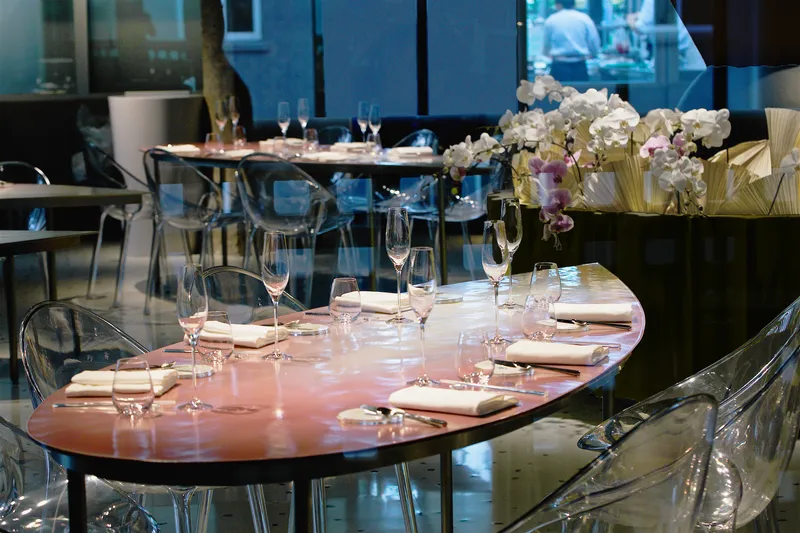
The furniture carries almost all of the design's identity. Each table is a glossy pink lacquered form shaped like an irregular petal or, in at least one case, a heart. They are not identical but share a family resemblance, their curved edges ensuring that no two seatings feel the same. Against these opaque, saturated surfaces, transparent acrylic chairs almost disappear, giving the room a floating quality where tabletops seem to hover.
The color choice is deliberate and unironic. Pink here functions less as a fashion statement and more as a chromatic link between the two programs: it reads equally well against floral arrangements and fine tableware. Orchids, wine glasses, crystal dishes, and pink menu cards compose small still lifes on each surface, every reflection doubled in the lacquer below.
Dining in Motion
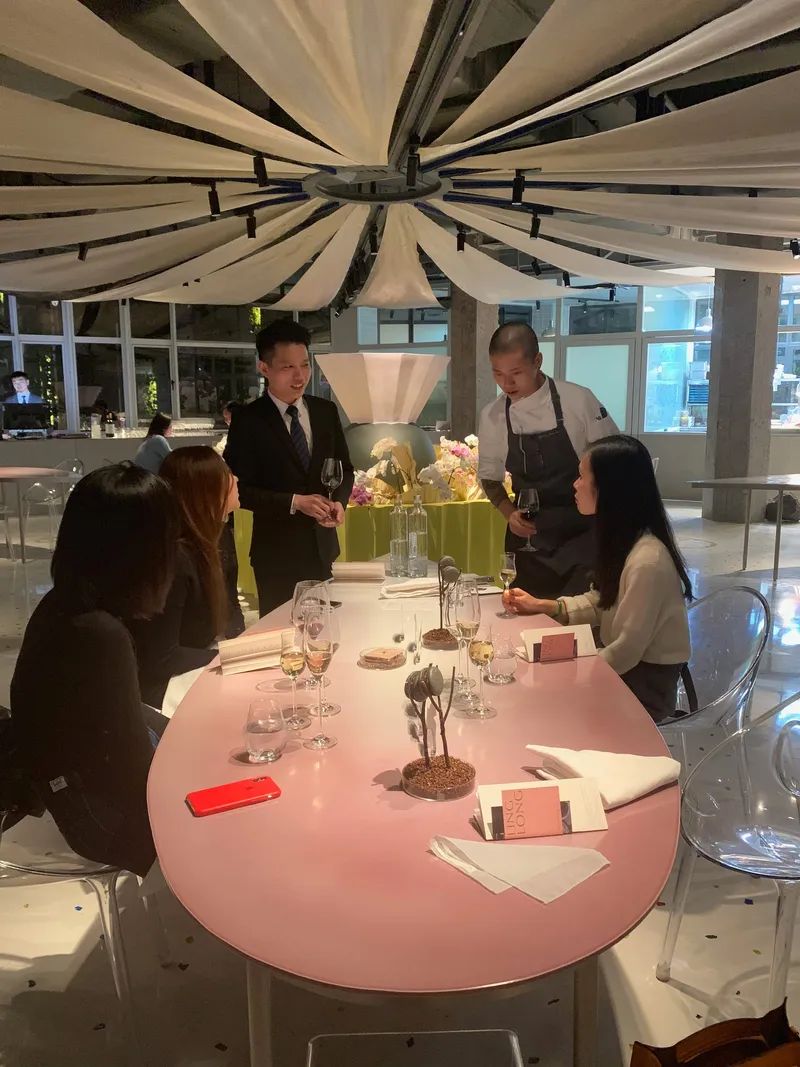

The photographs capture a space that feels inhabited rather than styled. Blurred figures move between tables; diners cluster around the petal forms; staff circulate through the outer ring. The fabric ceiling softens acoustics and light alike, creating an atmosphere closer to a salon than a conventional restaurant interior. Track lighting picks out individual tables without flooding the room, allowing the canopy's folds to remain legible overhead.
Place settings are composed with the same attention as the architecture. Wine glasses catch reflections from the glossy table surface. Crystal dishes sit alongside simple flatware. The overall effect is precise but not rigid, a calibration between formality and warmth that suits modern Chinese fine dining.
Open Kitchen as Spectacle
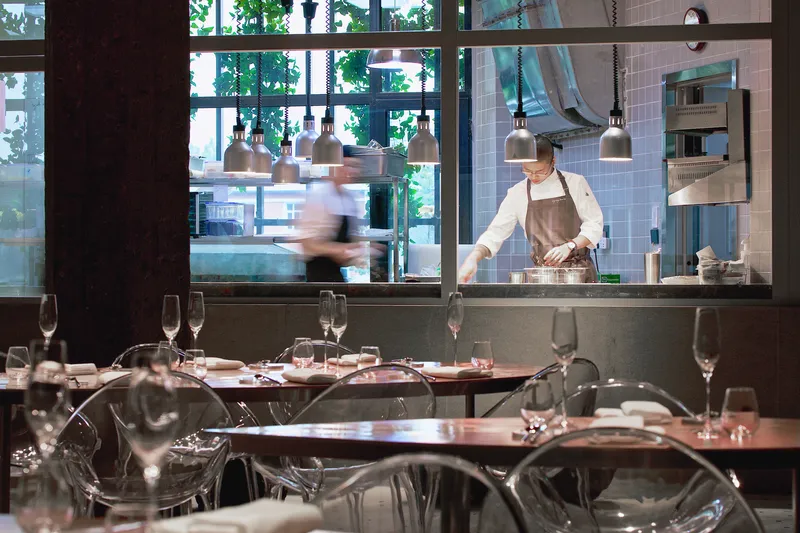
One edge of the room opens to the kitchen, visible through the same transparent acrylic vocabulary that defines the seating. A chef working behind a counter becomes part of the room's visual field, not sequestered but framed. The decision to leave this boundary porous reinforces the project's broader argument: this is a space defined by its activities, not its walls. When those activities change, the architecture adapts.
Plans and Drawings
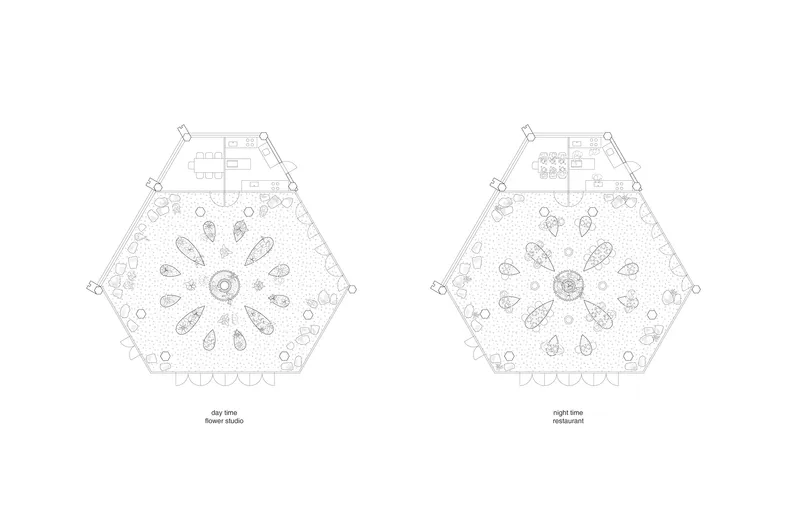
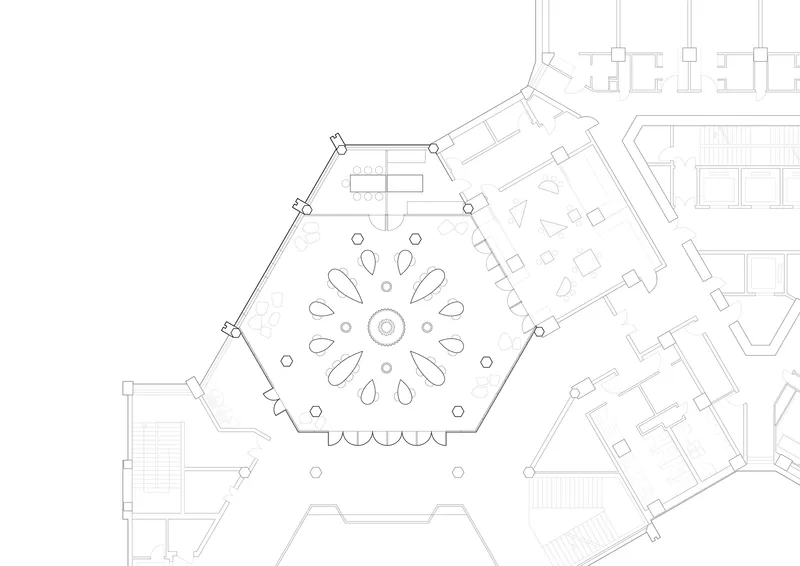
The plan drawings reveal the project's dual logic with remarkable clarity. Two floor plans compare day and night configurations: during the day, tables compress toward the center, tightly packed for the efficient workflow of flower arrangement from preparation to finished product. At night, they spread outward, opening gaps for circulation and creating the spatial generosity expected of fine dining. The hexagonal perimeter and adjacent angular rooms become legible only in plan, where the radial seating pattern locks into a larger hotel floor plate.
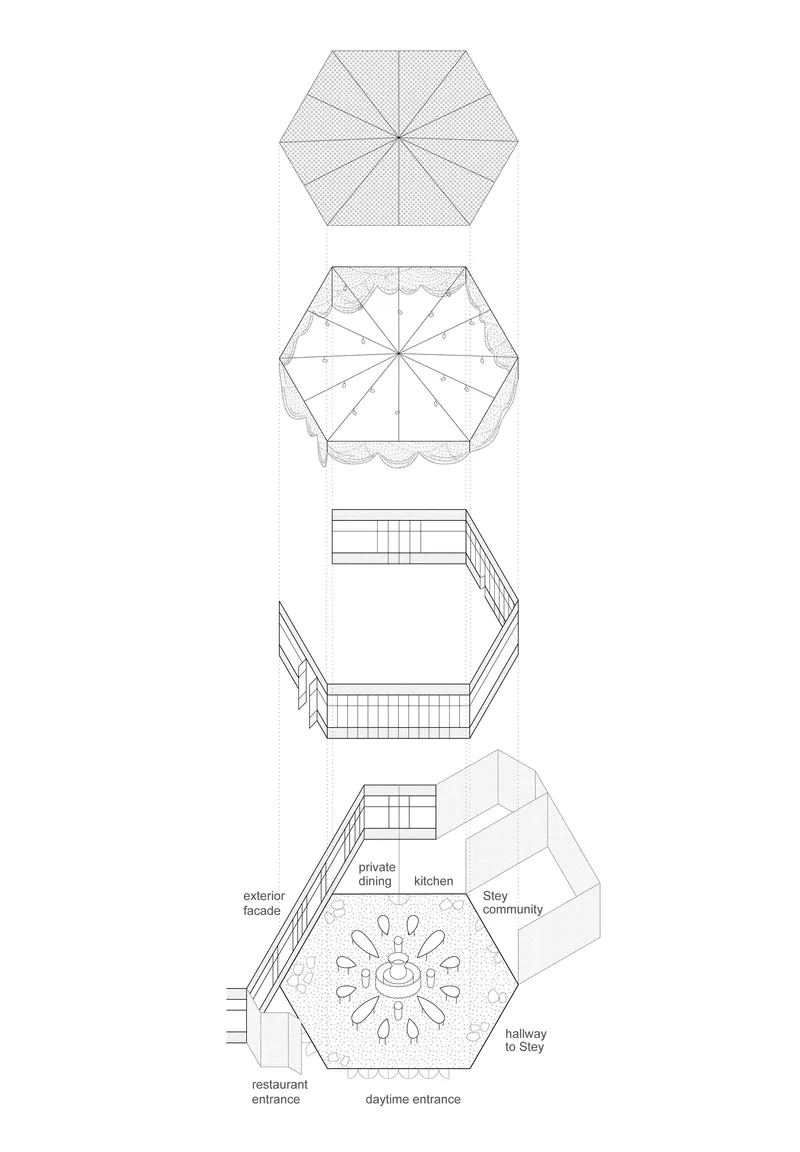
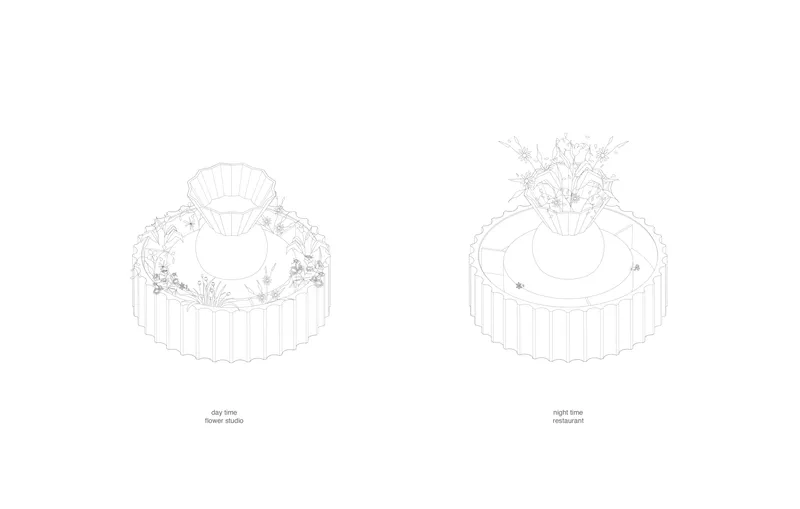
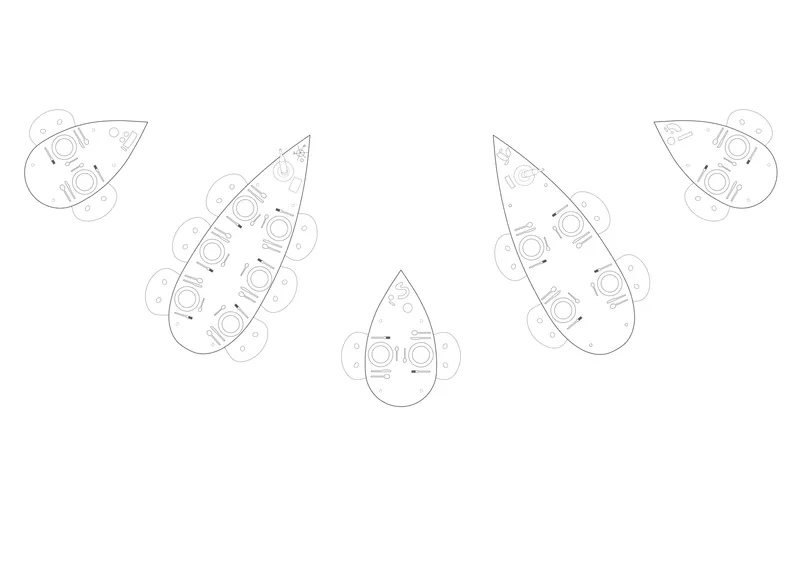
The exploded axonometric isolates four vertical layers of the hexagonal pavilion, from floor surface through furniture to the fabric canopy above. Meanwhile, isometric studies of the central planter installations show their scalloped edges in both day and night modes, treating the fountain not as decoration but as infrastructure. A series of rocket-shaped diagrams at varying scales appears to study the relationship between the central volume and its circular satellite elements, hinting at a design process rooted in typological play.
Why This Project Matters
LING LONG is a small project, just 240 square meters on a hotel's third floor, but it poses a question that scales well beyond its footprint: what happens when architecture is designed not for a single program but for two fundamentally different ones occupying the same space at different hours? The answer here is not a generic flexible room with movable partitions. It is a highly specific interior where the furniture, the fountain, and the ceiling are all calibrated to serve both modes. The architecture does not recede into neutrality; it commits to a strong formal identity that accommodates change.
For a profession that often treats restaurants as exercises in mood-boarding, Meyer-Grohbrügge's approach is refreshingly systemic. The petal tables are not styling. They are organizational devices whose shapes determine workflow paths, seating density, and spatial character. The pink lacquer is not decoration. It is a surface strategy that unifies two programs under a single chromatic regime. LING LONG suggests that the most effective interiors are the ones where every element works at least twice.
LING LONG Restaurant by Meyer-Grohbrügge. Beijing, China. 240 m². Completed 2020. Photography by Meyer-Grohbrügge.
About the Studio
Share Your Own Work on uni.xyz
If projects like this are the kind of work you want to make, uni.xyz is a place to publish your own, find collaborators, and enter design competitions.


Popular Articles
Popular articles from the community


Cloaked Colonization: A Mobile Underwater Habitat That Moves Like a Fish
Micah Abaya's shortlisted EHC Pacific entry reimagines ocean settlement as a dispersed network of self-sustaining architectural organisms.
Temporary Home for Dogs: A Reversed Zoo Rethinks Animal Shelter Architecture
In Bucharest, a sinuous corridor and freed landscape flip the logic of containment, designing a shelter that works to make itself unnecessary.

Opera by the Sea Estonia: Three Shells Dissolving Architecture into Tallinn's Coastline
A winning opera house proposal replaces monumental form with interconnected shells that blur the boundary between building, park and Baltic Sea.

Extended Shell: Retrofitting Kolkata's Balconies as Living Urban Thresholds
A modular retrofit system recovers the social and environmental intelligence of Kolkata's historic verandas for contemporary Park Street residents.

Similar Reads
You might also enjoy these articles

Pixel Gardens: One Repeated Module Stacked Into a Terraced Social Housing Tower for Famagusta
Salem Bader's shortlisted housing tower builds a vertical neighbourhood from one repeated module, offsetting units to carve terraces, light and air.

Bao Huynh Watercolor Atelier: A Serene Art Retreat in Hội An
Bao Huynh Watercolor Atelier in Hội An blends multifunctional art spaces, sustainable design, local materials, and family-friendly living in a serene environment.

Atelier Macri Concept Store Interior Design by CASE-REAL
Atelier Macri store features a "ko" counter, walnut wood details, cork displays, blending retail, gallery, and seamless customer experiences.

Manuel Vargas Izquierdo Stadium and High-Performance Sports Center: Architectural Excellence in Jalpa de Méndez
The Manuel Vargas Izquierdo Stadium blends sustainable design, inclusive sports facilities, and cultural-inspired architecture, revitalizing Jalpa de Méndez’s public spaces.

Comments (0)
Please login or sign up to add comments
No comments yet. Be the first to comment!