

Adaptive Reuse Architecture Reimagines Offshore Oil Rigs into Cultural and Research Islands
Transforming abandoned oil rigs into adaptive reuse architecture for ocean research, cultural exchange, and sustainable offshore living.


PROXIMITY ISLAND – Museum & Research Hub
Shortlisted Entry of Proximity Island 2019 Project by Alicia Davis and Matthias Hauss
In an era where architecture increasingly confronts environmental responsibility and spatial reinvention, PROXIMITY ISLAND - museum & research hub proposes a visionary model for adaptive reuse architecture in offshore environments. The project transforms decommissioned oil rigs into interconnected cultural and research hubs floating within the open sea, redefining industrial infrastructure as a catalyst for education, creativity, and ecological awareness.
Designed by Alicia Davis and Matthias Hauss, this shortlisted entry for Proximity Island 2019 explores how obsolete offshore platforms can evolve into sustainable architectural ecosystems. Rather than demolishing the existing structures, the proposal preserves the oil rigs and strategically expands them through additional decks and spatial interventions that establish a more humane and accessible environment.
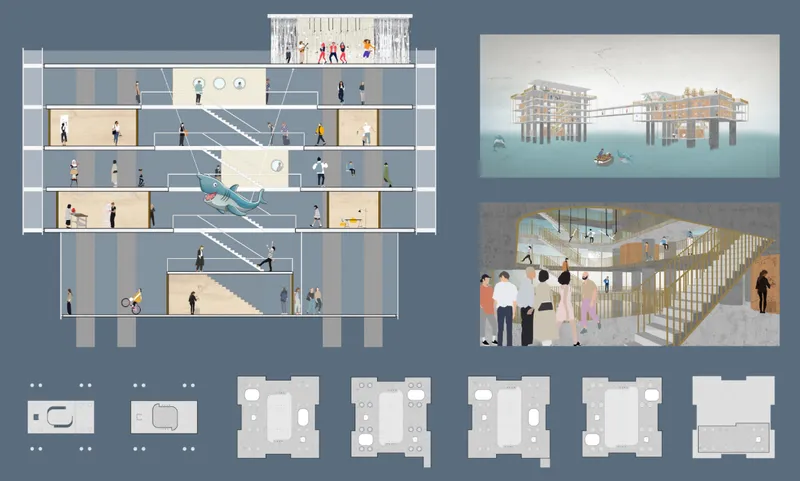
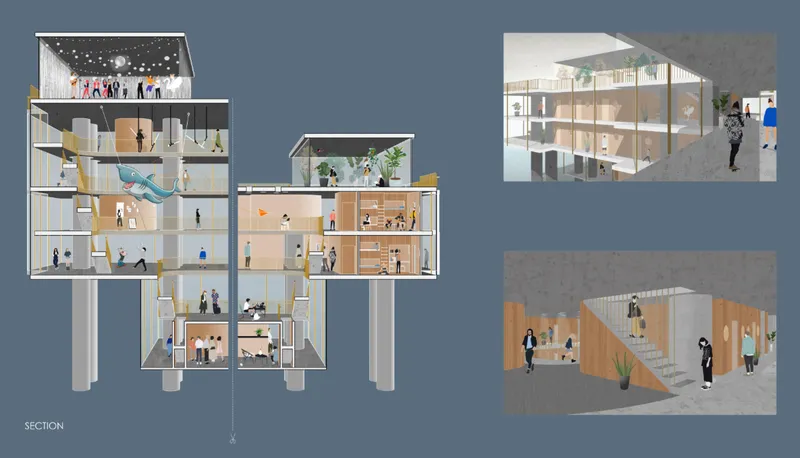
The project consists of two distinct yet interconnected islands. One rig accommodates the Museum of Open Waters, while the second functions as a research and residential hub for students, artists, researchers, and visiting guests. Together, they establish a floating architectural community dedicated to learning, exploration, and interaction with the oceanic environment.
Adaptive Reuse Architecture in the Middle of the Ocean
At the core of the project lies the idea of architectural preservation through transformation. Instead of viewing oil rigs as obsolete industrial remnants, the proposal recognizes their structural resilience and spatial potential. The original framework of the rigs remains largely intact, minimizing material waste while embracing a sustainable adaptive reuse strategy.
This approach positions offshore infrastructure as an architectural typology capable of supporting future cultural and scientific programs. Massive concrete platforms become foundations for public interaction, ecological observation, temporary living, and creative production.
The intervention demonstrates how adaptive reuse architecture can extend beyond urban warehouses or industrial factories and enter extreme marine conditions where architecture must negotiate isolation, climate, and environmental exposure.
Museum of Open Waters
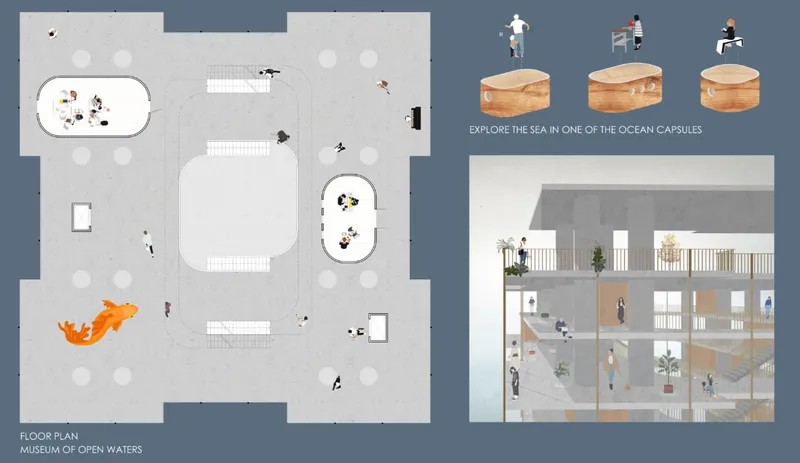
The first island, known as the Museum of Open Waters, serves as a public and educational destination where visitors engage directly with marine ecosystems and offshore environments.
Visitors arrive by boat onto the lower platform and gradually ascend through an open vertical circulation system organized around a central courtyard. The architecture encourages continuous visual interaction with the sea through layered balconies, panoramic openings, and framed views toward the horizon.
Inside the museum, a series of immersive “ocean capsules” allows visitors to explore various dimensions of marine life and oceanic research. These exhibition spaces function as interactive environments that combine education, reflection, and sensory experience.
The open rooftop platform transforms into a multifunctional event space overlooking the surrounding waters. This elevated public area creates opportunities for gatherings, performances, lectures, and collective experiences in the middle of the ocean.
Architecturally, the museum balances monumentality with openness. Heavy structural elements inherited from the oil rig contrast with warm wooden interventions, transparent circulation routes, and natural lighting strategies that soften the industrial atmosphere.
Research Hub and Creative Residency
The second platform functions as a research and residential island dedicated to long-term occupation and creative collaboration.
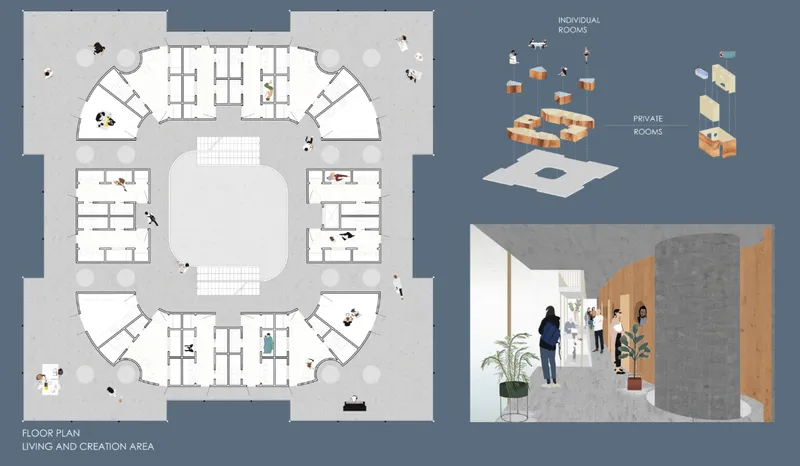
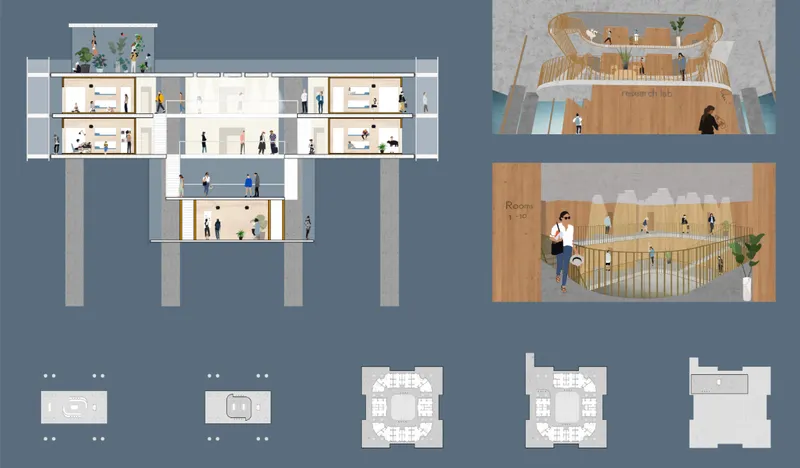
This offshore hub accommodates students, scientists, artists, researchers, and cultural practitioners through a combination of living units, collaborative studios, and quiet workspaces. The project proposes 23 residential dormitories arranged around shared circulation spaces and interior courtyards.
Unlike conventional isolated research facilities, the spatial organization promotes interaction and interdisciplinary exchange. Shared terraces, open corridors, bridges, and communal workspaces create opportunities for spontaneous encounters between residents.
The upper levels incorporate flexible working environments that support focused research as well as collaborative production. Above the residential spaces, an indoor garden introduces vegetation into the offshore structure, creating moments of calm and environmental relief within the dense architectural framework.
The bridge connecting both islands acts not only as circulation infrastructure but also as a symbolic link between public exploration and scientific investigation.
Humanizing Offshore Infrastructure
One of the project’s strongest architectural achievements lies in its ability to humanize large-scale industrial infrastructure.
Oil rigs are typically perceived as inaccessible and mechanical environments dominated by engineering efficiency. Proximity Island reinterprets these spaces through architecture that prioritizes movement, openness, and social interaction.
Curved circulation paths soften the rigid geometry of the original structure, while central voids introduce daylight deep into the building mass. Large staircases surrounding interior courtyards encourage visual connectivity between floors and transform circulation into a spatial experience rather than a purely functional necessity.
The project carefully choreographs the visitor journey through changing perspectives of the ocean. At times, the sea appears framed through circular portholes. In other moments, expansive views open dramatically along exterior walkways and terraces.
This constant dialogue between architecture and landscape reinforces the emotional and atmospheric qualities of the project.
Sustainable Offshore Architecture
Beyond its spatial and cultural ambitions, Proximity Island also proposes a sustainable future for offshore architecture.
The reuse of existing oil rig infrastructure significantly reduces demolition waste and material consumption. The proposal further suggests the integration of renewable energy systems such as solar and wind power, enabling the islands to operate independently within harsh marine conditions.
The project demonstrates how architecture can extend the lifecycle of industrial structures while responding to environmental concerns and emerging cultural needs.
Rather than allowing offshore rigs to become abandoned relics, the proposal reimagines them as productive and educational environments capable of supporting future generations.
Architecture Between Isolation and Connection
A defining quality of the project is its exploration of isolation as an architectural condition. Situated within the vast openness of the sea, the islands create a unique balance between remoteness and community.
The surrounding ocean intensifies awareness of scale, atmosphere, and human presence. At the same time, the interconnected programs foster collaboration, creativity, and shared experience.
This duality transforms the oil rigs into more than repurposed structures. They become experimental architectural territories where education, ecology, research, and culture converge.
Reimagining the Future of Industrial Heritage
Proximity Island presents a compelling vision for the future of adaptive reuse architecture. By transforming decommissioned oil rigs into floating cultural and research environments, the project expands the possibilities of sustainable architectural practice beyond terrestrial boundaries.
Through careful preservation, spatial innovation, and ecological awareness, Alicia Davis and Matthias Hauss demonstrate how industrial infrastructure can evolve into meaningful public architecture.
The project ultimately challenges architects and urban thinkers to reconsider the hidden potential of abandoned structures and to imagine new forms of living, learning, and exploration within extreme environments.


Popular Articles
Popular articles from the community


Opera on the Sea: Driftwood Logic Shapes a Timber Opera House on Estonia's Coast
Trevor Orgill's opera house translates the entangled drift of floating timber into a civic building where wood, water, and music converge.

Singing Woman: Contemporary Architecture Inspired by Estonia’s Voice and the Sea
Singing Woman turns Estonia’s song culture into flowing opera house architecture, blending public life, landscape, sea, and national memory.
Cloaked Colonization: A Mobile Underwater Habitat That Moves Like a Fish
Micah Abaya's shortlisted EHC Pacific entry reimagines ocean settlement as a dispersed network of self-sustaining architectural organisms.
Manzana Morphosis: Stretching Barcelona's Grid into a Living Landscape for 2050
A radical reworking of the Eixample manzana turns density into a tool for generous public space, vertical ecology, and environmental performance.

Similar Reads
You might also enjoy these articles

Eco Chapel: A Green Architecture Pavilion Designed in Symbiosis with the Forest
Eco Chapel uses green architecture to weave prayer, learning and reuse into a forest pavilion shaped by modular hexagonal canopies for life.
Kaffeebühnen: Coffee Shop Architecture Designed as a Civic Stage Between Vienna’s City and Park
Kaffeebühnen turns coffee shop architecture into a civic stage, linking Vienna’s park edge, urban life, warm timber yards, and coffee craft.
Healing Façade: Sustainable Architecture for Reforestation, Community, and Sacred Ecology in Ethiopia
Healing Façade reimagines sustainable architecture as a living wall that restores soil, catches water and renews Ethiopia's forest churches.


Urban Forest: A Vertical Ecosystem for 5,000 Workers in Singapore's Changi Business Park
Radially stacked pods and layered green decks turn a 7-acre plot into 47 acres of ecological workspace projected for 2040.

Comments (0)
Please login or sign up to add comments
No comments yet. Be the first to comment!