
Aesop Hangzhou by atelier suasua: Bridging Local Materiality and Contemporary Retail Design
Aesop Hangzhou by atelier suasua bridges local stone, flowing water, and traditional craftsmanship, creating a calm, sensory retail space rooted in Hangzhou’s heritage.


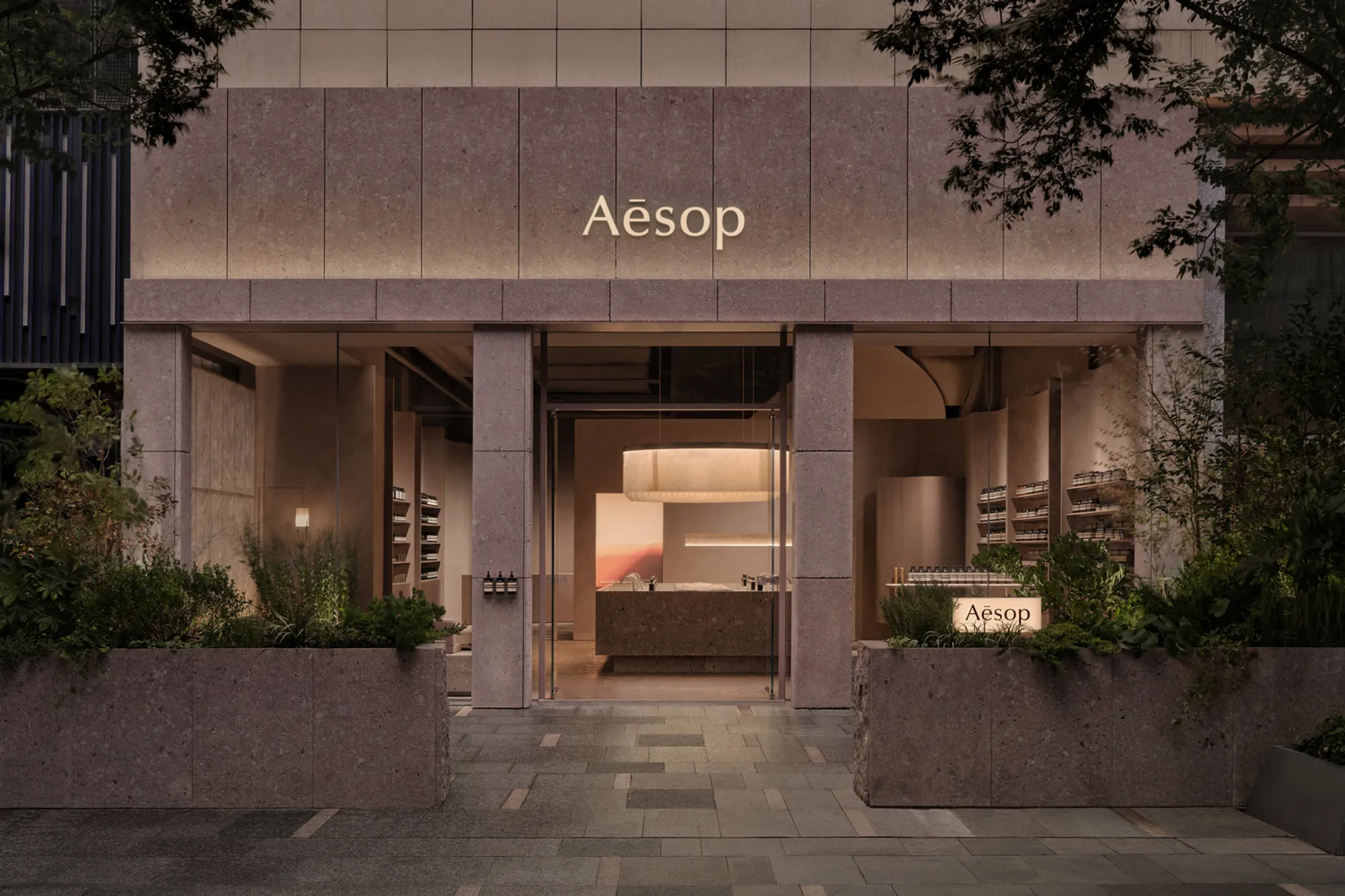
Located in Hangzhou, a city historically defined by waterways and stone bridges, Aesop Hangzhou by atelier suasua reinterprets local architectural memory through a refined contemporary retail interior. Completed in 2024, the 224-square-metre store transforms cultural symbolism, regional materials, and traditional craftsmanship into a spatial narrative that connects the global skincare brand with its immediate urban and historical context.
Interpreting the Bridge as Spatial Concept
Hangzhou’s identity has long been shaped by bridges, both physical and cultural. Historical records from the Qiantang County Records describe a dense urban fabric punctuated by bridges at every turn, while Marco Polo famously noted the presence of thousands of stone bridges throughout the city. Drawing from this legacy, atelier suasua adopts the bridge as a core architectural metaphor, representing connection, communication, and inclusivity.
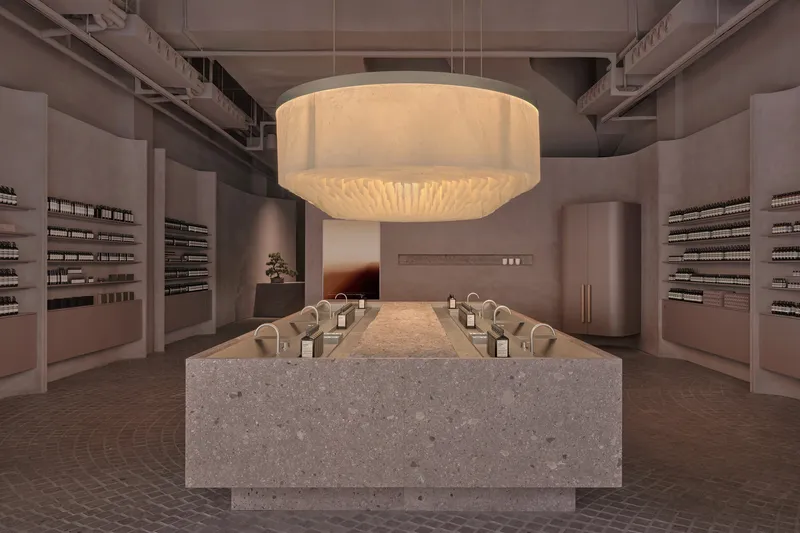
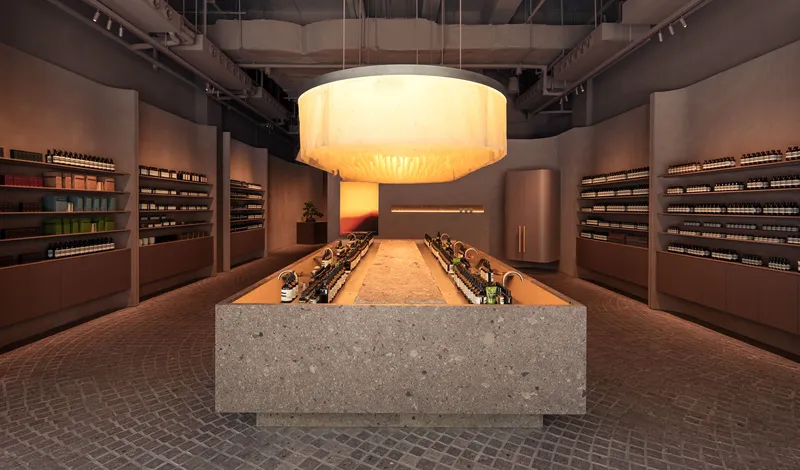
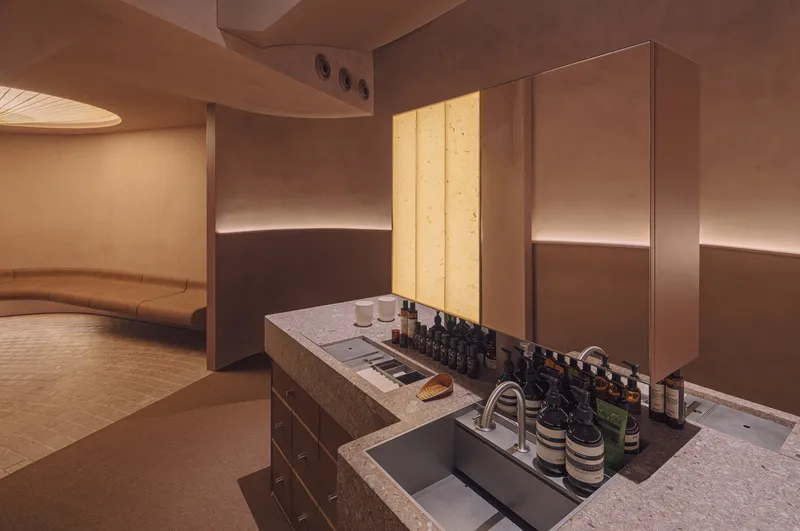
This idea materializes immediately upon entry. At the heart of the store lies a monumental central water sink, conceived as a symbolic bridge. Flowing water runs beneath rectangular stone slabs, encouraging visitors to pause, gather, or move across the space, mirroring the experience of crossing a bridge. This gesture anchors the interior as a place of encounter, aligning Aesop’s ritual-driven retail experience with Hangzhou’s historical spatial language.
Gaohu Stone and the Use of Local Materials
The project places strong emphasis on local material sourcing, echoing the construction logic of Hangzhou’s ancient bridges. Gaohu Stone, a regional material quarried in nearby Zhuji County since the Qing Dynasty, becomes the dominant architectural element. Known for its durability and subtle coloration, the stone has historically been used in bridges, roads, and temples across the region.
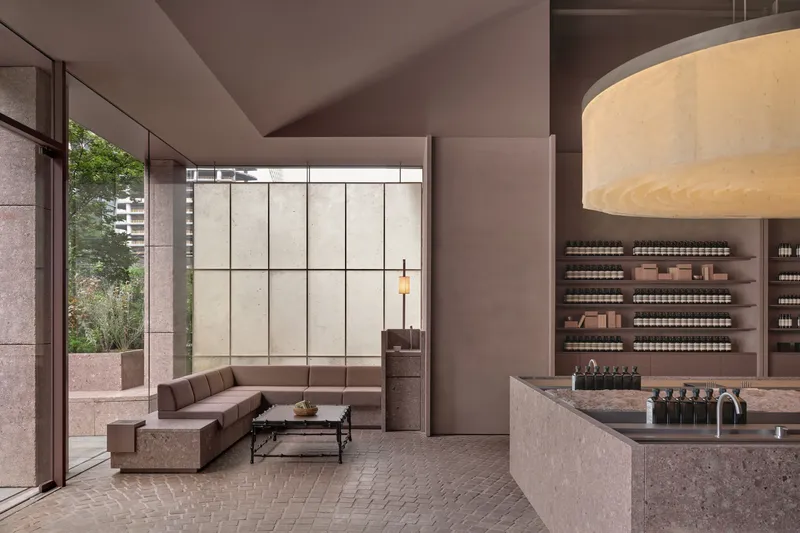
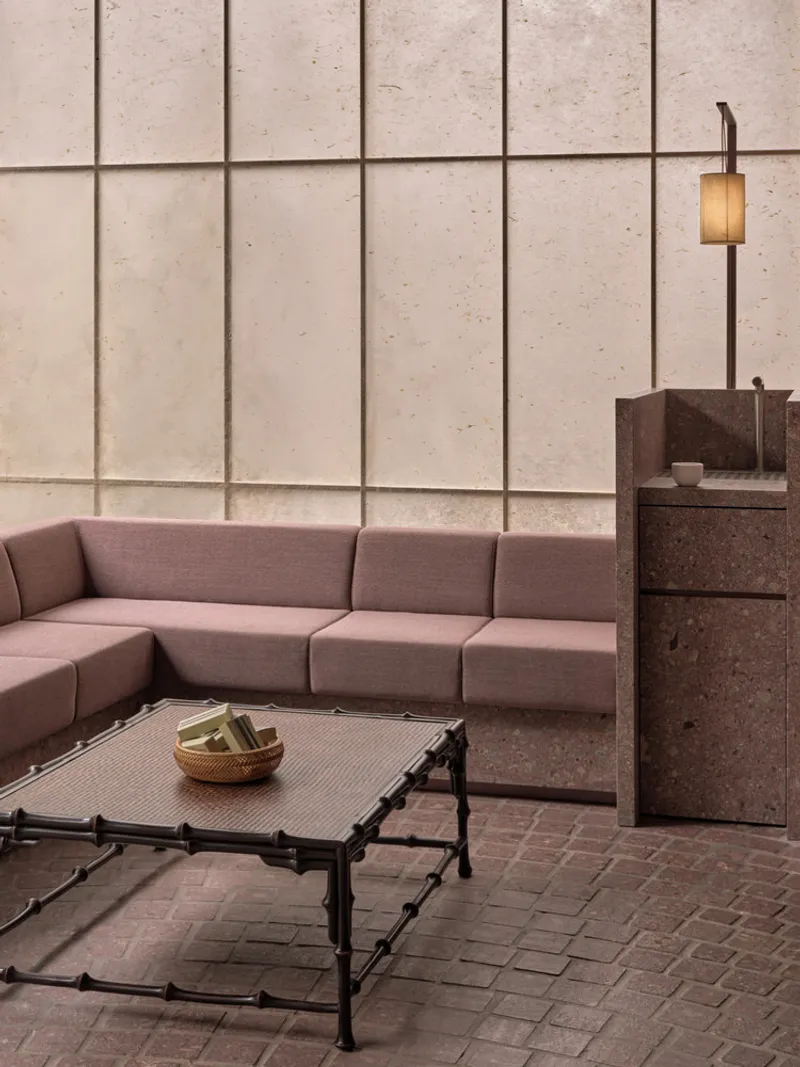
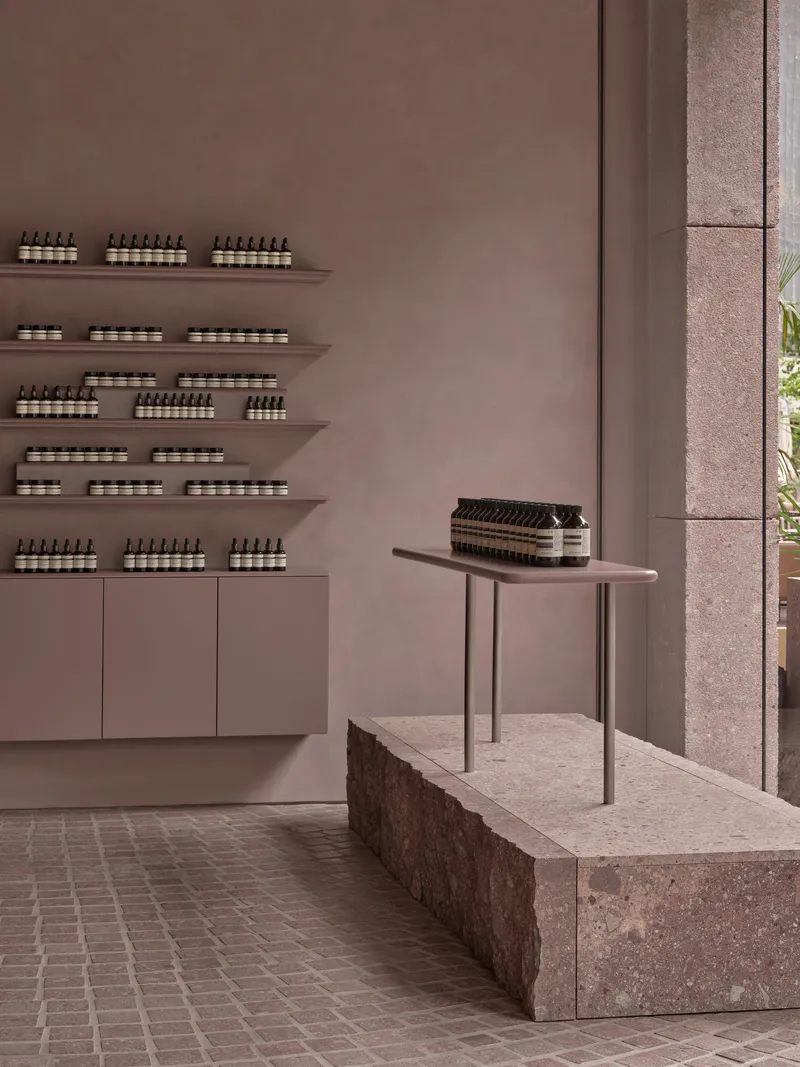
Atelier suasua explores Gaohu Stone through varied scales and finishes. Rough, raw-cut stone forms the colonnade and central sink, retaining the expressive texture of its extraction. Large polished slabs highlight the stone’s internal grain and are used in outdoor seating and garden elements, while small hammered stone tiles, measuring approximately 10 centimetres square, pave the interior floor. Laid in flowing patterns reminiscent of water ripples, these stones introduce tactile richness and reinforce the project’s fluid spatial narrative.
Courtyard as Urban Refuge
Situated along a lively commercial street flanked by restaurants and outdoor stalls, the site is embedded in constant urban motion. In response, the design introduces a stone-defined courtyard that acts as a buffer between the street and the interior. Colonnades and curved stone benches shape the threshold, offering a moment of calm and rest before entering the store.
Native plant species populate the courtyard, with layered vegetation and climbing vines softening the stone surfaces. As daylight shifts and seasons change, the courtyard evolves quietly, creating a dynamic yet restrained landscape that contrasts with the surrounding urban intensity. This transition space sets the emotional tone for the interior experience, aligning with Aesop’s emphasis on sensory calm and introspection.
Interior Continuity and Spatial Flow
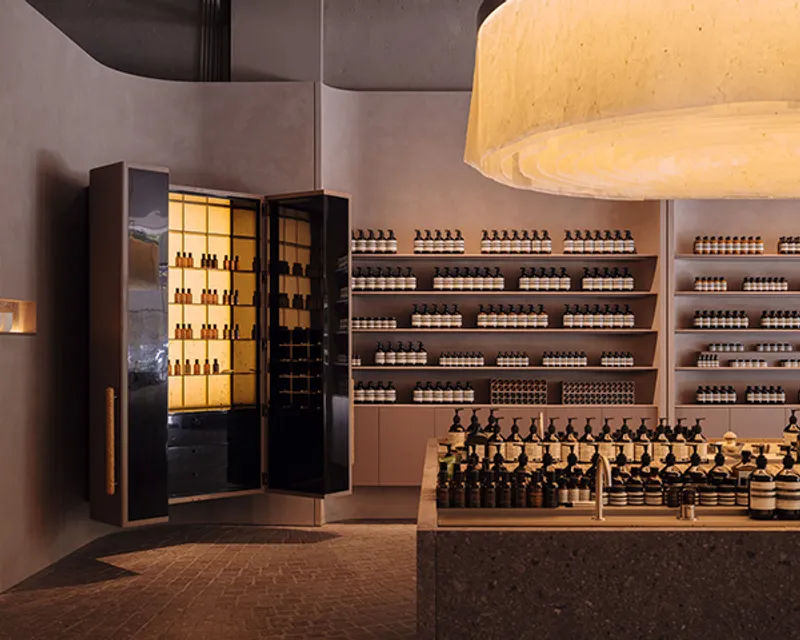
Inside, the store unfolds around the central sink beneath a generous six-metre-high volume, preserved by removing suspended ceilings and retaining the building’s original structure. The material palette remains intentionally restrained, with shelving, walls, and finishes harmonizing with the tones of Gaohu Stone.
A pre-existing spiral staircase was retained and reimagined as a key spatial feature. Its curved wall defines private en-suite sink areas while guiding visitors deeper into the store. Curved geometries recur throughout the project, linking exterior and interior spaces and reinforcing a sense of continuity. From the outdoor flowerbeds to interior partitions, these flowing lines echo the movement of water and subtly direct circulation.
Craftsmanship and Material Warmth
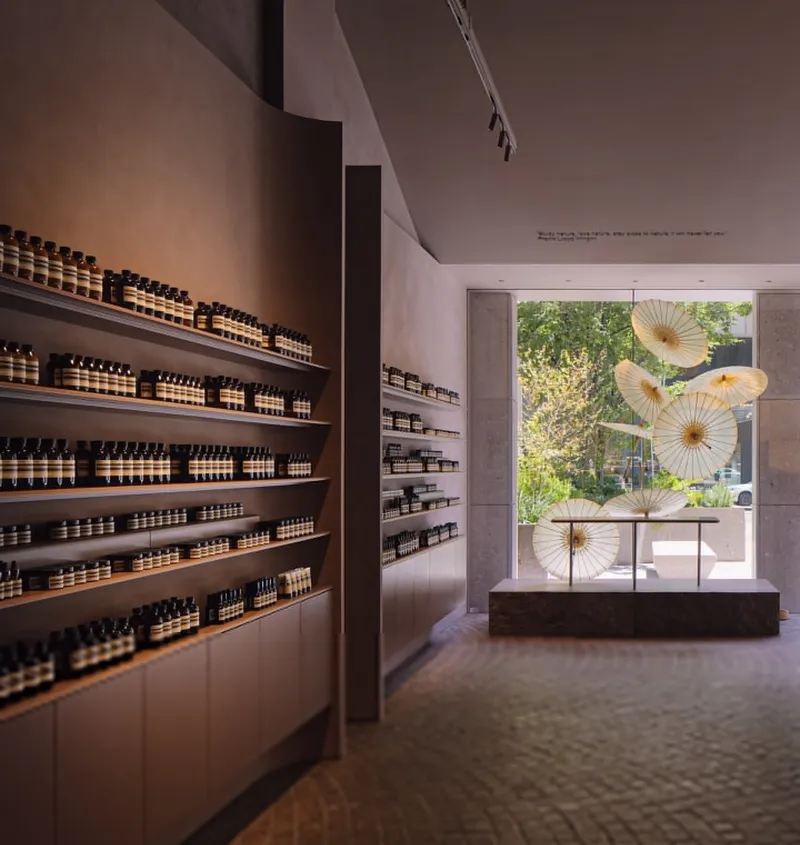
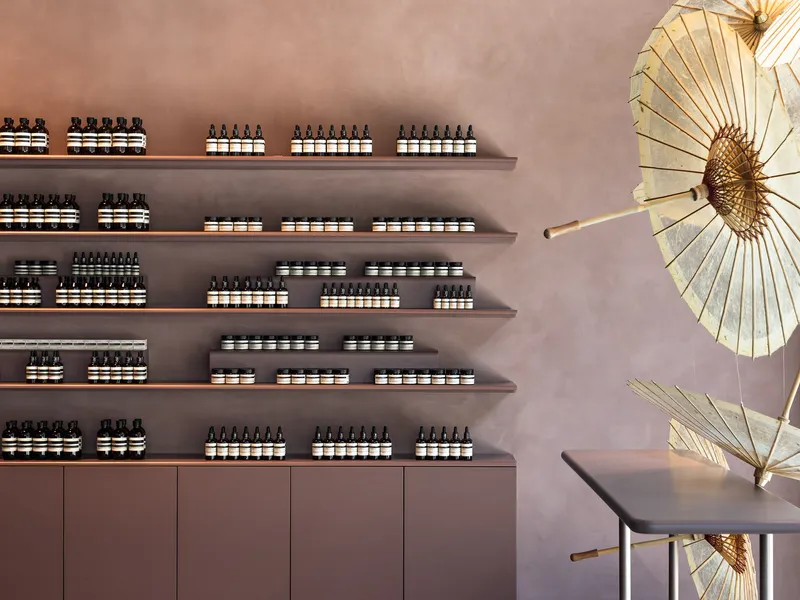
While stone establishes gravitas, traditional craftsmanship introduces warmth and intimacy. Hangzhou’s long history of artisanal production is celebrated through the integration of bamboo and oil-paper elements. Yuhang oil-paper umbrellas, a craft with over 250 years of history, play a central role in the lighting design.
Above the central sink, layers of oil paper form a sculptural chandelier, diffusing light softly throughout the space. Infused with locally sourced green tea leaves during the paper-making process, the material gains both cultural specificity and visual depth. Gentle airflow causes the paper layers to sway, evoking the rippling surface of Hangzhou’s lakes.
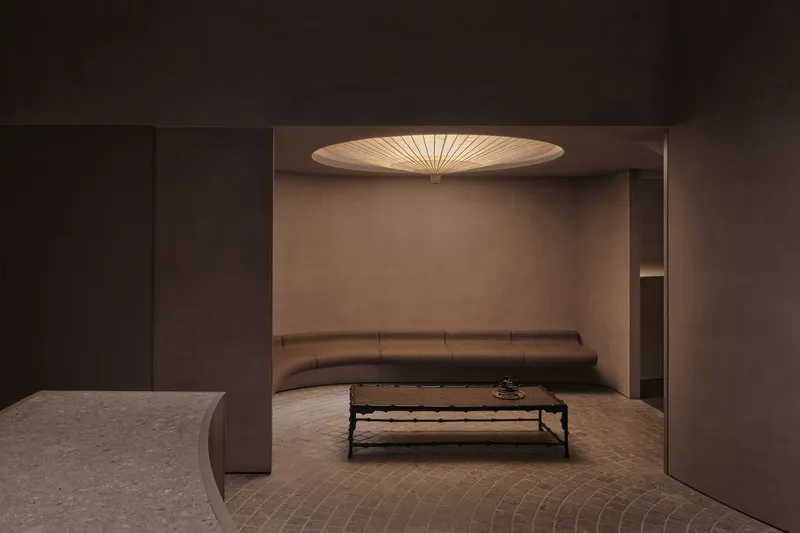
Deeper within the store, a two-metre-diameter oil-paper umbrella crafted by a local artisan has been transformed into a luminous installation, showcasing the structural beauty of hand-woven bamboo frames. Bamboo details extend to furniture, woven surfaces, and even the fragrance armoire handle, encouraging tactile engagement and reinforcing the human scale of the interior.
A Contemporary Retail Space Rooted in Place
Aesop Hangzhou exemplifies how context-driven retail architecture can transcend branding to create meaningful spatial experiences. By weaving together local stone, traditional craftsmanship, and a concept deeply rooted in Hangzhou’s urban history, atelier suasua delivers a store that feels both contemporary and timeless.
All photographs are works of Jonathan Leijonhufvud


Popular Articles
Popular articles from the community


The Ocean Hive: Sustainable Architecture for a Self-Sufficient Civilization at Sea
The Ocean Hive imagines sustainable architecture at sea, where modular habitats, algae, wave power and ocean waste sustain a growing colony.

Riyadh For All: Intergenerational Urban Design for Active Aging in Rabat
Riyadh For All reimagines urban design in Rabat with intergenerational co-living, adaptive courtyards, and Moroccan cultural exchange today.

Lunar Spiral: Space Architecture Shaped by the Mathematics of the Universe
Lunar Spiral reimagines space architecture through Fibonacci geometry, lunar regolith, levitating habitats, and self-sustaining Moon living.

Play: Fragments of Their World
Familiar architecture becomes modular playground design, creating safe spaces where displaced children can learn, connect, imagine and play.

Similar Reads
You might also enjoy these articles


Hodi-Mandai Geram
Project Function: Preservation and revitalization of the Intangible heritage and socio-spatial identity of the Hodi by Housing, Cultural Memory Center, Sacred Grove, landscape, local tourism economy


Olio Towers: A Mid-Rise for Performers That Fuses Housing, Rehearsal, and Stage
Located blocks from Houston's Theater District, this modular tower stacks living units around a central performance atrium.

Oasis: Modular Green Housing Carved into Dhaka's Urban Fabric
A shortlisted Plugin Housing entry reclaims unauthorized settlements in Dhaka with stepped concrete volumes, green roofs, and ventilation-driven design.

Black Hole: A Floating Megastructure for the Post-Physical Era
Emiliano Mazzarotto envisions a spherical, self-scaling arena where e-sports, digital hotels, and holographic stadiums replace traditional public space.

Explore Interior Design Competitions
Discover active competitions in this discipline


Challenge to design luxury tourism on rails


Challenge to reimagine the Iron Throne


Photograph architecture without architects


VR headsets Storefront design competition
Comments (0)
Please login or sign up to add comments
No comments yet. Be the first to comment!