
AFF architekten Extends a Cold War School in Berlin with a GDR-Inflected Concrete Addition
A bilingual German-Russian school in Karlshorst gets a compact new wing that refines East German building aesthetics into something quietly monumental.

Berlin's Karlshorst neighborhood carries a specific kind of historical weight. Once a center of Soviet military administration, the district retains traces of its GDR past in both its social fabric and its built environment. The Lew-Tolstoi-School, a bilingual German-Russian institution serving around 570 students, occupies one of those traces: a four-story standardized school block (the SK Berlin type) erected in the late 1960s. When AFF architekten was tasked with extending this complex, the question was not simply how to add square meters but how to negotiate a lineage of prefabricated building culture that most contemporary architects either ignore or caricature.
The answer is a compact three-story addition, completed in 2022, that reads as both continuation and correction. The extension picks up the story heights and circulation logic of the original building, connecting all floors between old and new, while introducing a material palette that deliberately echoes GDR prefab aesthetics in a more refined register. The result is 5,546 square meters of total floor area spread across the school extension, a new sports hall, and renovated sections of the existing block, all organized around courtyards that give the complex outdoor space it previously lacked.
A Facade That Remembers
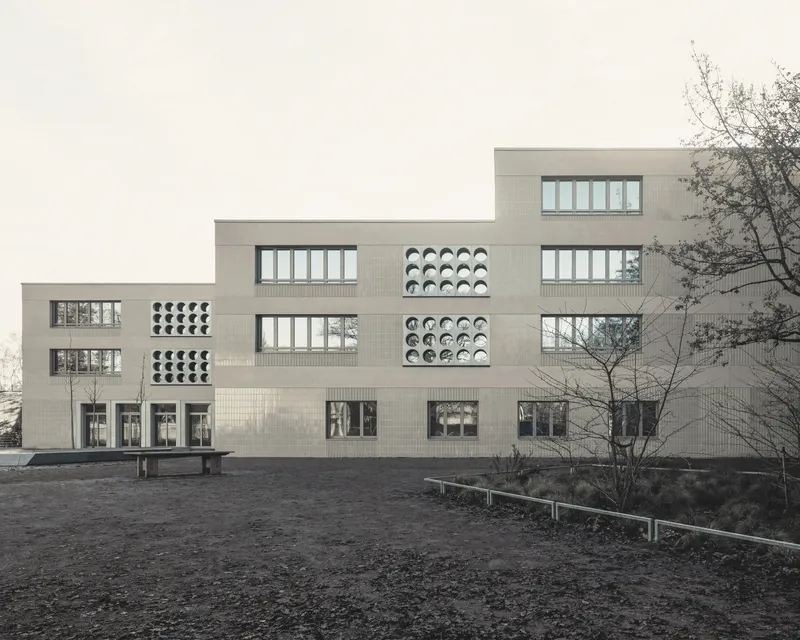
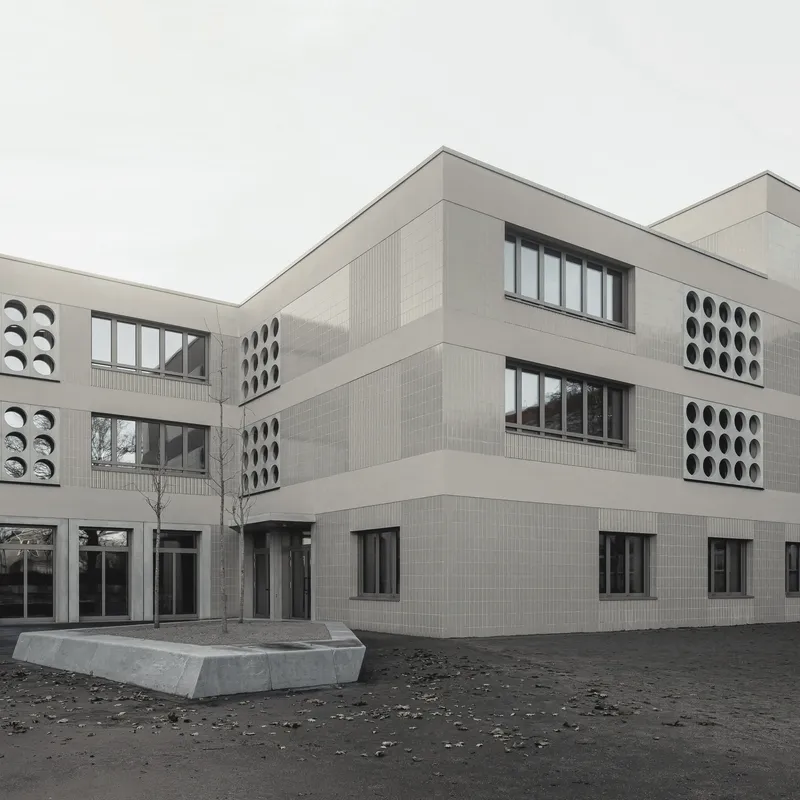

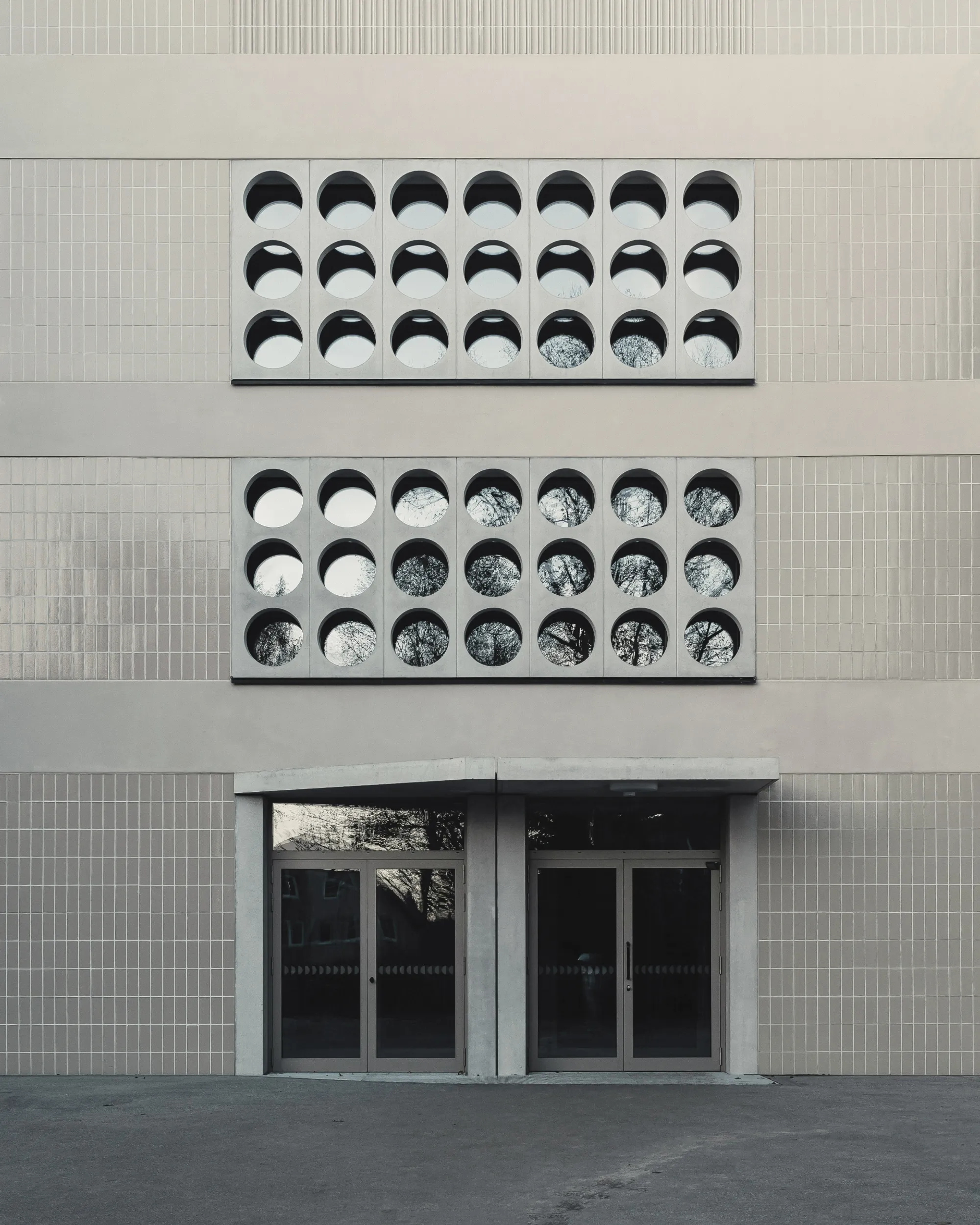
The most striking gesture is the facade, and it rewards close reading. AFF architekten constructs a monochrome surface that gains texture through material variation rather than color: glazed and profiled tiles alternate with matte mineral plaster, subdivided by large-format molded concrete elements and ribbon window sections. The circular perforations in the concrete panels are the signature move. They punctuate the pale surface with deep reveals that catch shadow and frame fragments of sky or branches, turning what could be a blunt institutional wall into something visually active.
The reference to GDR prefabrication is intentional but not nostalgic. These are not Plattenbau panels reproduced wholesale; they are abstracted, scaled, and detailed with a precision that the original system rarely achieved. The effect is of a building that knows where it comes from without being trapped there.
Circles as Leitmotif
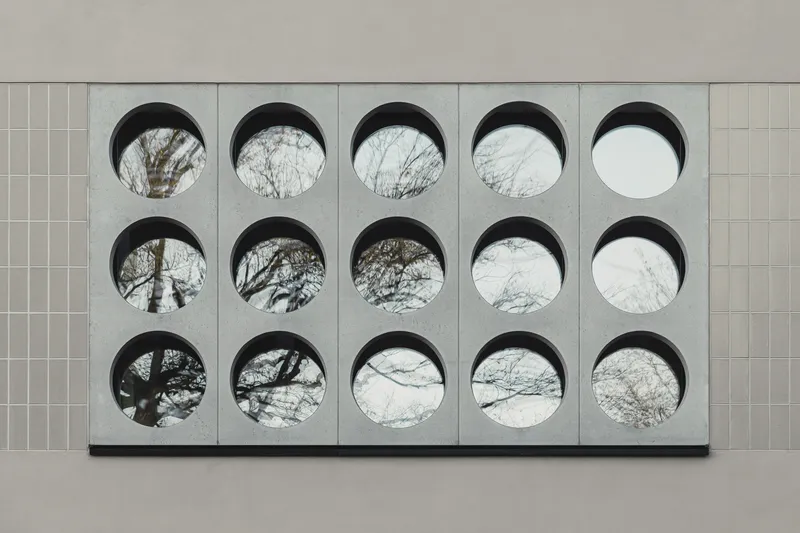

The circular openings deserve their own discussion because they do more than ornament. On the exterior, they operate as a screen: protecting floor-to-ceiling glazing behind perimeter concrete walls while allowing light and views to pass through. The depth of the reveals gives each circle its own shadow clock, changing character through the day and across seasons. Up close, they frame bare winter branches or sky with the precision of a viewfinder.
Inside, the motif reappears in rooms like the one visible in the second image, where green perforated wall panels and a grid of circular windows create an interior that feels both playful and controlled. Drum pendant lights echo the geometry overhead. It is a simple vocabulary, but AFF architekten deploys it with enough discipline to avoid the whimsy that circular forms often invite in school architecture.
Between the Buildings
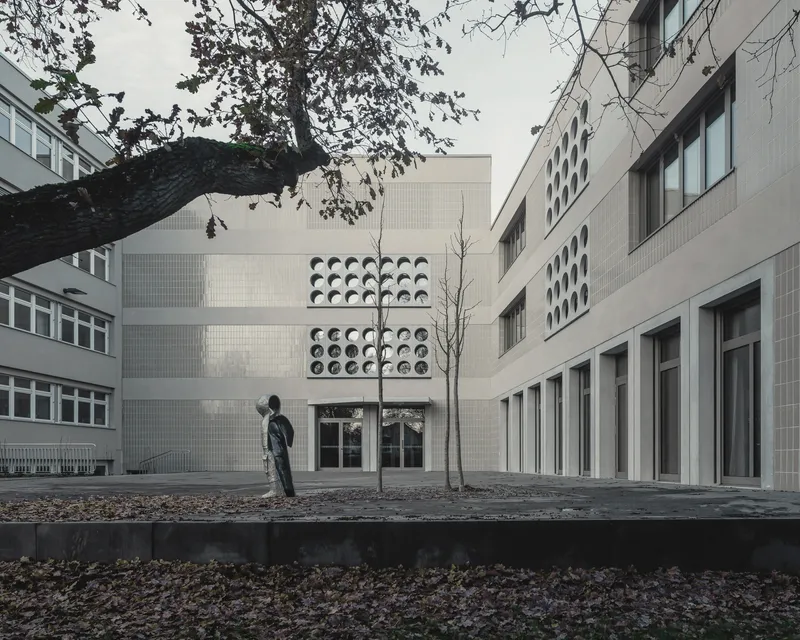

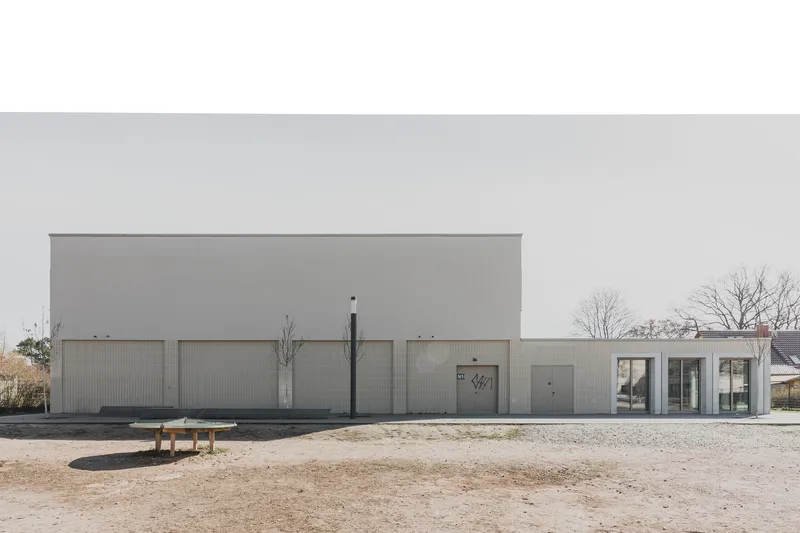
The site strategy is as considered as the facades. By placing the extension as an independent block, AFF architekten carves out usable outdoor space between the school buildings and the sports hall at the rear of the site. A small forecourt on the northeast side, between the existing building and the addition, creates a new address for the school. The courtyard views show this interstitial space functioning as a genuine threshold, not a leftover gap.
The street-facing elevation, clad in grey corrugated metal, adopts a notably quieter posture. A single bench on gravel beneath bare trees: this is a school that does not announce itself aggressively to its low-density residential surroundings. The restraint makes sense in Karlshorst, where small-scale residential buildings define the streetscape.
Corridors and Circulation
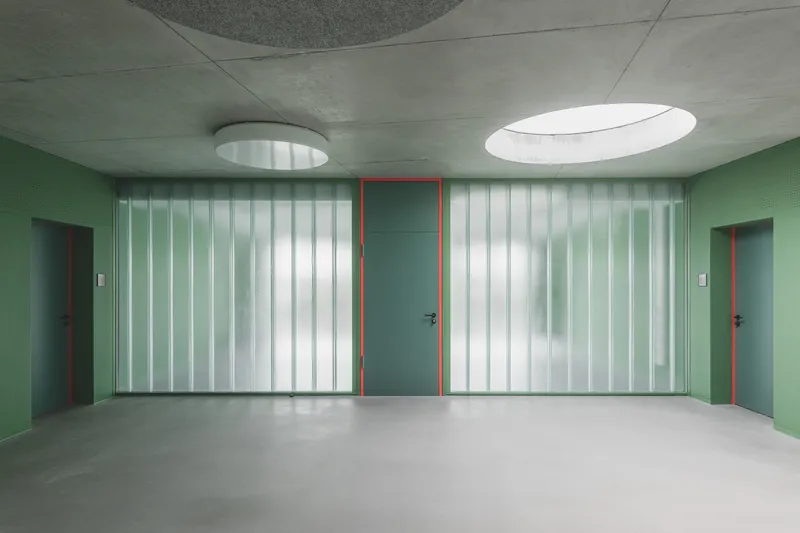
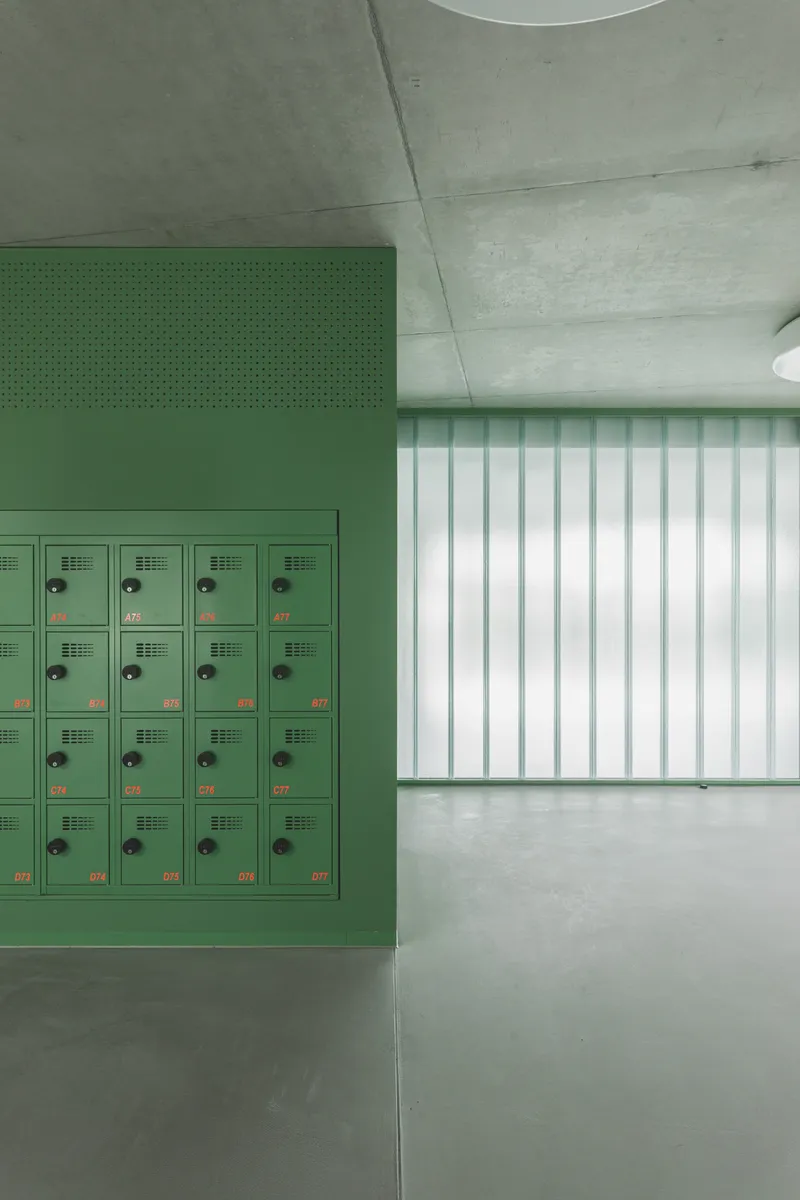
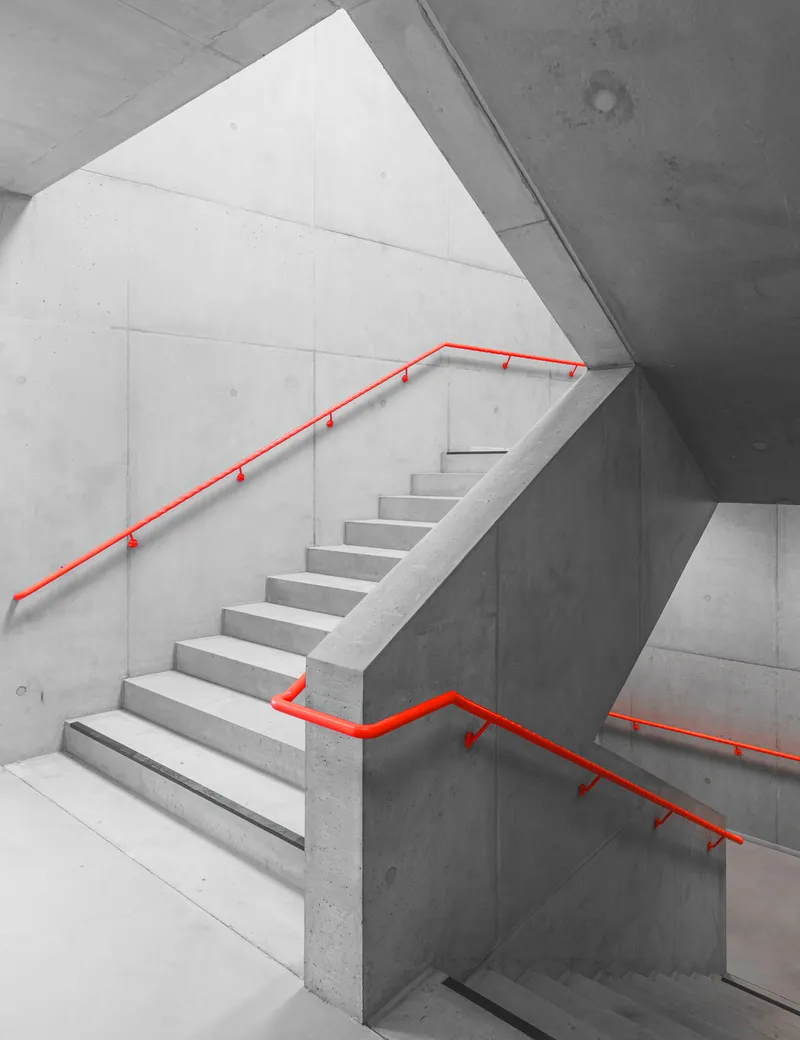
Connecting all floors of old and new buildings is not a trivial structural problem, and AFF architekten's solution of reusing the existing staircase to serve the extension is both pragmatic and elegant. It avoids duplicating vertical circulation and reinforces the reading of the complex as a single organism rather than an original plus an appendage.
The corridors themselves carry the material palette with consistency: exposed concrete ceilings, translucent vertical glass panels flanking doors in green and red, and green metal locker banks that read as furniture rather than institutional equipment. The stairwell, with its red metal handrails wrapping angular flights beneath a triangular skylight, is one of the most successful moments in the building. It manages to feel generous despite compact dimensions, pulling natural light deep into the plan.
The Sports Hall
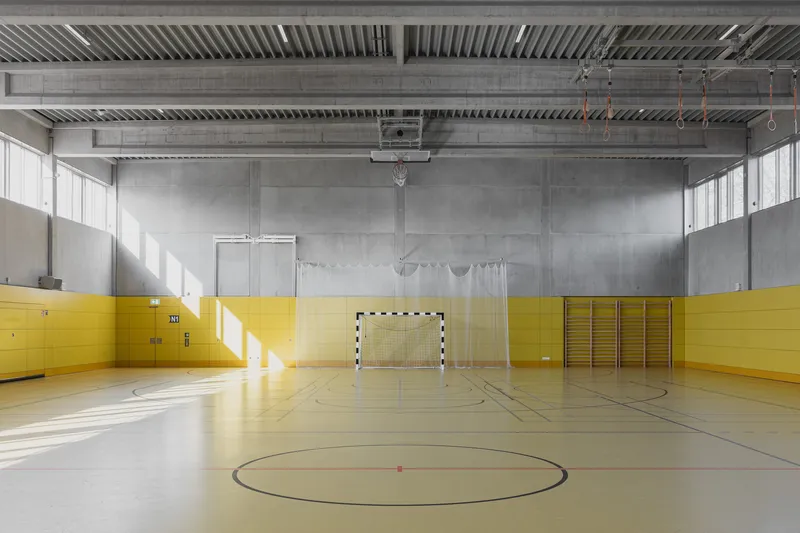
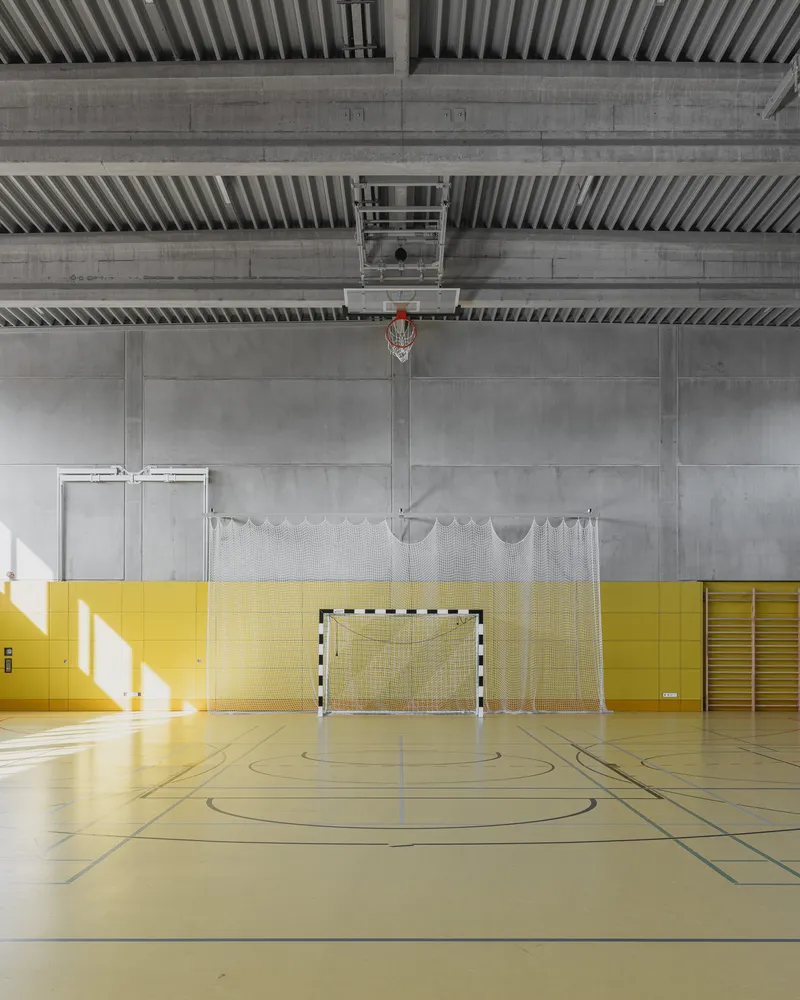
School gymnasiums are typically the least architecturally considered spaces in any educational complex, tolerated as necessary volumes. Here, AFF architekten treats the sports hall with the same attention given to the classrooms. Yellow wall padding provides the required impact protection while acting as a warm counterpoint to the exposed steel ceiling beams and concrete surfaces. High windows bring daylight in from above, avoiding the usual problem of glare at eye level.
The 1,609 square meters of the sports hall sit at the rear of the site, completing the courtyard arrangement. It is a functional volume that participates in the campus rather than sitting apart from it.
Plans and Drawings
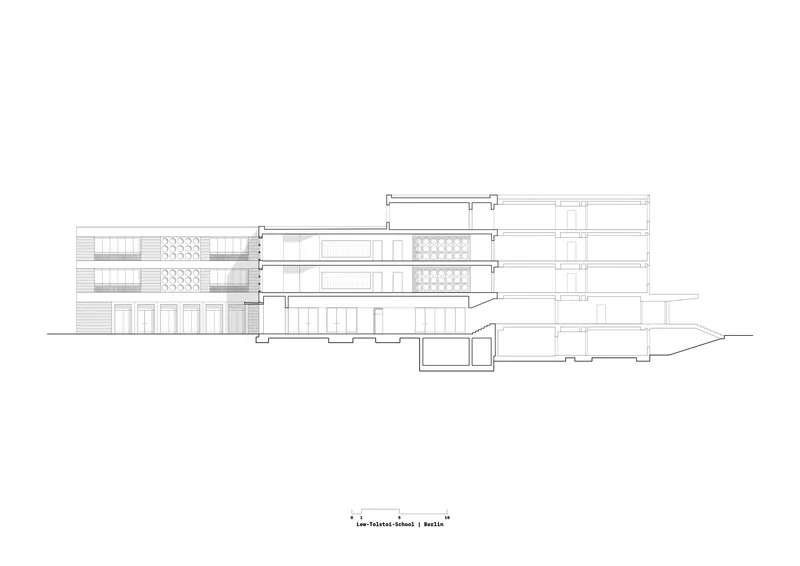
The section drawing reveals what the exterior conceals: the building steps down into underground levels, expanding the usable volume beyond what the compact three-story profile suggests from the street. The relationship between the extension and the existing building is legible here, with floor levels aligning to allow the seamless connection that the architects describe. The sports hall's taller volume reads clearly at the rear, its double-height space cutting a distinct profile against the lower classroom wings.
Why This Project Matters
School extensions in Berlin are a growth industry, driven by demographic pressure and decades of deferred maintenance. Most of them treat the existing building as a problem to be overcome or ignored. What makes the Lew-Tolstoi-School compelling is AFF architekten's decision to treat the GDR original as a genuine design partner, extracting from its standardized vocabulary a set of material and formal cues that inform the new work without constraining it. The circular perforations, the tile and plaster facade, the continuation of floor levels: these are not gestures of pastiche but of critical engagement with a building tradition that shaped much of eastern Berlin.
For a bilingual German-Russian school, the metaphor writes itself, but the architecture is smart enough not to lean on symbolism. The building works because its strategies are spatial and material rather than narrative. It creates usable outdoor space, connects old and new circulation efficiently, and produces a facade that genuinely rewards close looking. In a context where educational architecture often defaults to bright colors and ostentatious sustainability signaling, this is a building that trusts its own discipline.
Lew-Tolstoi-School by AFF architekten. Berlin, Germany. 5,546 m². Completed 2022. Photography by Hans-Christian Schink and Tjark Spille.
About the Studio
Share Your Own Work on uni.xyz
If projects like this are the kind of work you want to make, uni.xyz is a place to publish your own, find collaborators, and enter design competitions.




Popular Articles
Popular articles from the community

Hierarchy Towers: Sustainable Architecture for Vertical Co-Living in Singapore
Hierarchy Towers reimagines sustainable architecture through co-living, shared workplaces, green terraces, and new public life in Singapore.

Terra e Tuma Scatters Four Concrete Pavilions Through the Atlantic Forest in Mairiporã
A fragmented compound of music studio, art studio, chapel, and living quarters preserves every tree on a steep forested hillside near São Paulo.

The Memory of World: Skyscraper Architecture as a Vertical Exhibition of Human Civilization
A vertical museum in Hong Kong transforms skyscraper architecture into a journey through six eras of humanity, nature, memory, and progress.
Simplex Architecture Steps a Seoul Mid-Rise Tower to Negotiate Between Low-Rise Commerce and High-Rise Housing
In Seocho-dong, a gridded stone tower of terraces and sunken courtyards mediates between two radically different urban scales.


Similar Reads
You might also enjoy these articles
Loma House by Besonias Almeida Arquitectos: Modern Coastal Living in Costa Esmeralda
Loma House by Besonias Almeida Arquitectos is a modern coastal home in Costa Esmeralda, blending exposed concrete, wood, and natural dunes.
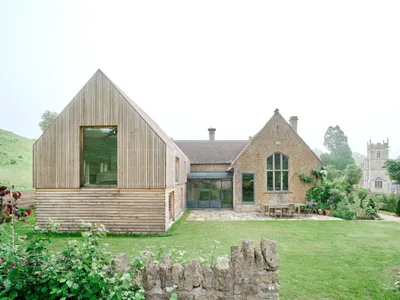
“Pitcombe’s Old School House Renovation by Bindloss Dawes: Blending Heritage and Contemporary Design”
Bindloss Dawes transformed Pitcombe’s 19th-century Somerset schoolhouse with a sustainable timber extension, blending historic charm, contemporary design, and panoramic countryside views.
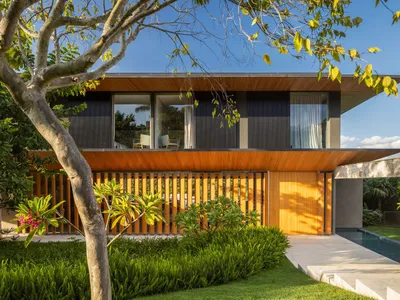
F3 Residence by Belluzzo Martinhão Arquitetos: Contemporary Luxury in São Paulo’s Countryside
F3 Residence in São Paulo blends contemporary design, natural materials, multigenerational living, hillside integration, expansive glass, infinity pool, and seamless indoor-outdoor flow.
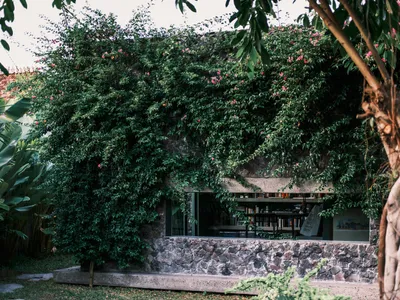
Private Villa in Ubud by BAMM ARCHITECTS: Contemporary Design Amidst Bali’s Jungle
Private Villa in Ubud blends contemporary design with tropical landscape, featuring open-air pavilion, stone and wood materials, suspended master bedroom, and jungle pool views.
Explore Landscape Design Competitions
Discover active competitions in this discipline




The Global Benchmark for Architecture Dissertation Awards


Challenge to design public laboratory
Comments (0)
Please login or sign up to add comments
No comments yet. Be the first to comment!