
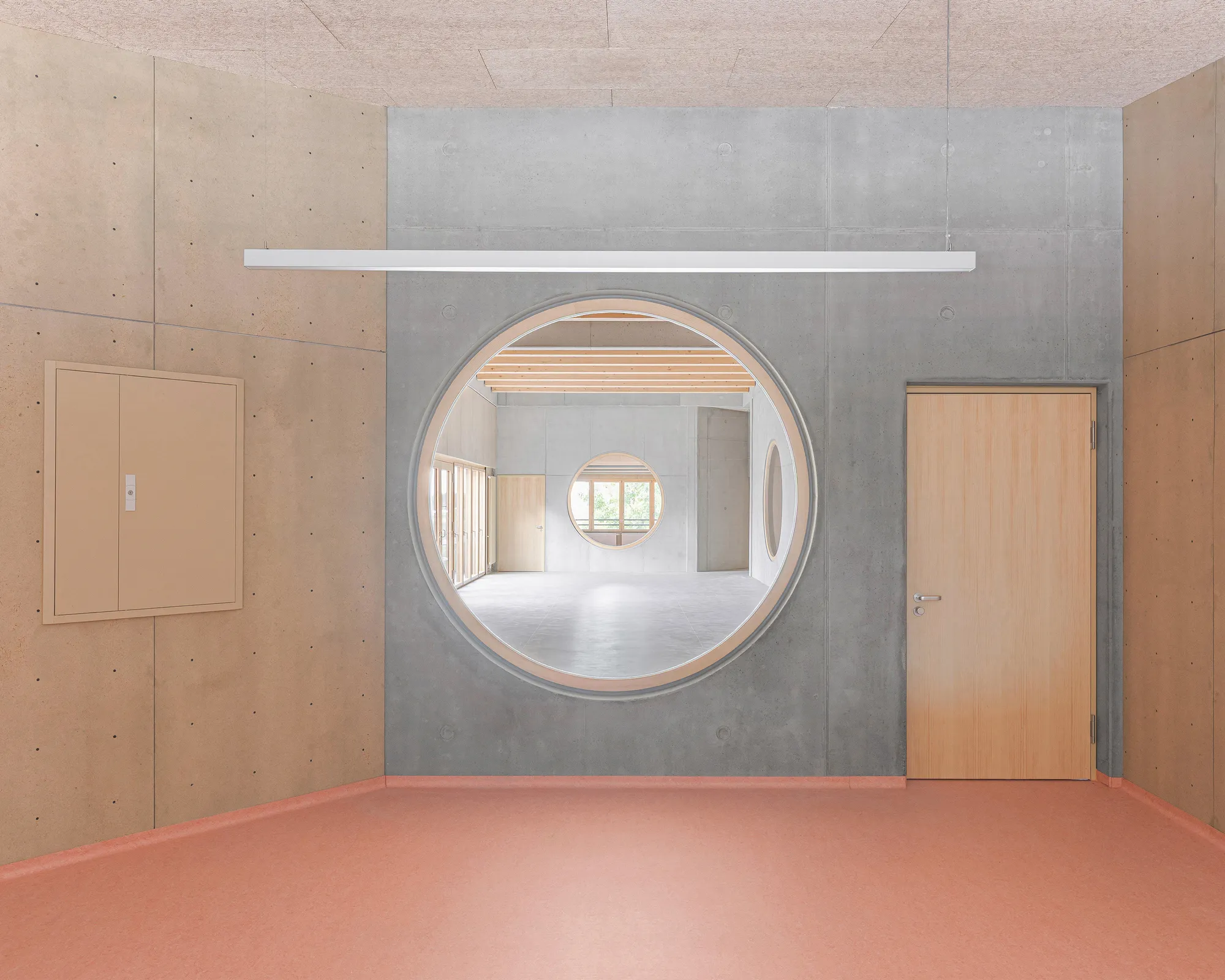
AFF architekten Turns a Former Military Barracks in Potsdam into a Primary School for 600 Children
A brick campus of clusters and circular portals reimagines a 1930s Red Army barracks site as a place of learning in north Potsdam.


Military barracks rarely suggest playfulness. The Krampnitz site in north Potsdam, erected between 1937 and 1939 to plans by Robert Kisch and occupied by the Red Army until 1991, is defined by rigid gabled volumes, robust brick walls, and a landscape of protected mature trees. AFF architekten had to thread a new three-stream primary school through this heritage-listed fabric without erasing its character or pretending it was never there. The result is an ensemble that houses 600 school children and 160 daycare children across a campus of renovated and newly built structures, unified by a restrained material palette and one deeply distinctive motif: the circle.
What makes the project genuinely interesting is the way it resolves a tension that defeats many school designs. Compartment pedagogy demands intimate, self-contained clusters, each with classrooms, group rooms, teacher stations, and after-school care. But a heritage site demands coherence at the urban scale. AFF architekten solve both problems at once by organizing six clusters around central forum spaces, linking them with glazed corridors and courtyards, and punching large circular openings through the concrete partition walls so that children constantly see into adjacent rooms. The school reads as a single organism at the site plan level and as a series of interconnected worlds at eye level.
Brick Continuity and the Barracks Memory
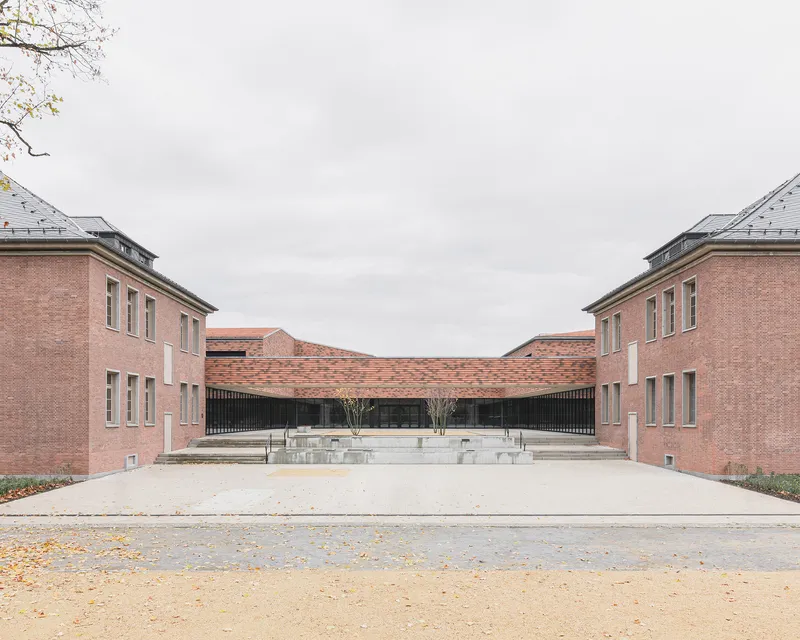

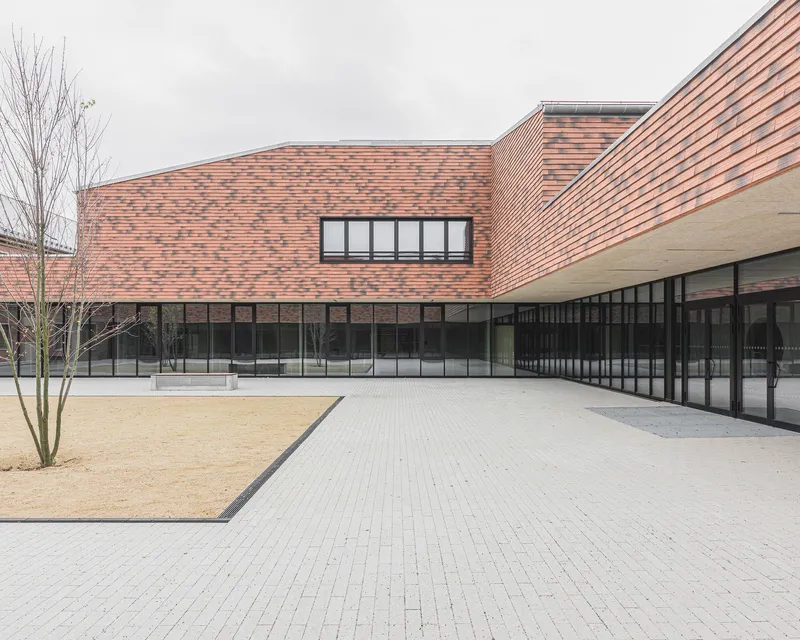
The new volumes adopt the gabled roof profile and brick cladding of their listed neighbors, but the translation is not slavish. The pink-red brick facades are crisper, the window proportions more generous, and the steel-framed glazing frankly modern. At the main entrance, tall glazed bays are flanked by orange benches that signal a welcoming threshold rather than a guard post. The choice to restore existing facades to their original appearance while building new walls in the same material family means you can walk the campus and sense the continuity without confusing old and new.
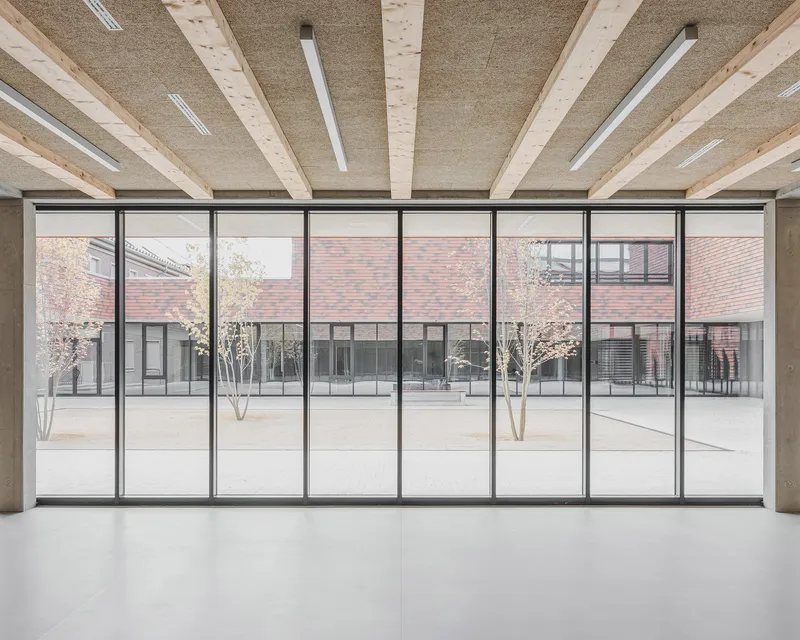
Courtyards play a critical role. Gravel surfaces, bare trees, and low planting beds occupy the spaces between wings, creating outdoor rooms that feel enclosed enough for younger children yet open enough to breathe. The glazed corridors that stitch volumes together turn these courtyards into visible landscapes from every circulation route, collapsing the boundary between inside and outside.
The Circle as Organizing Motif
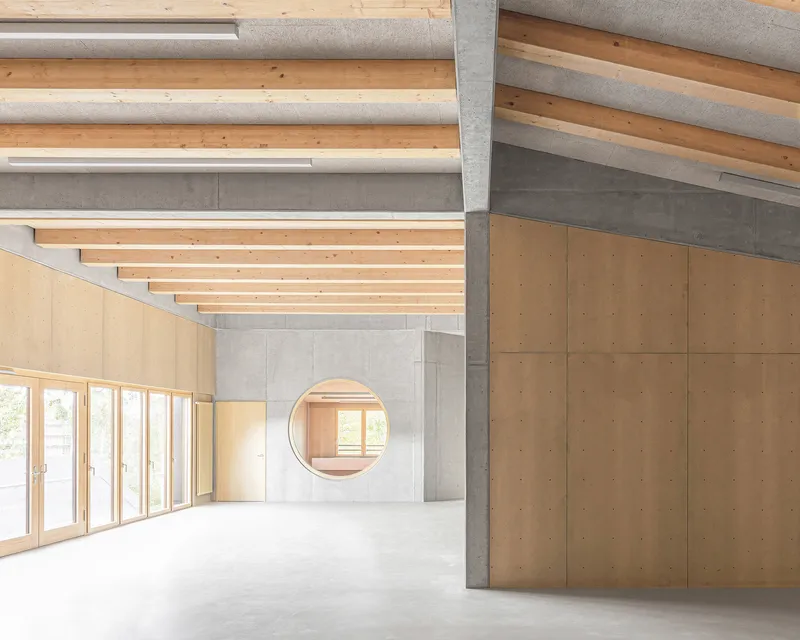
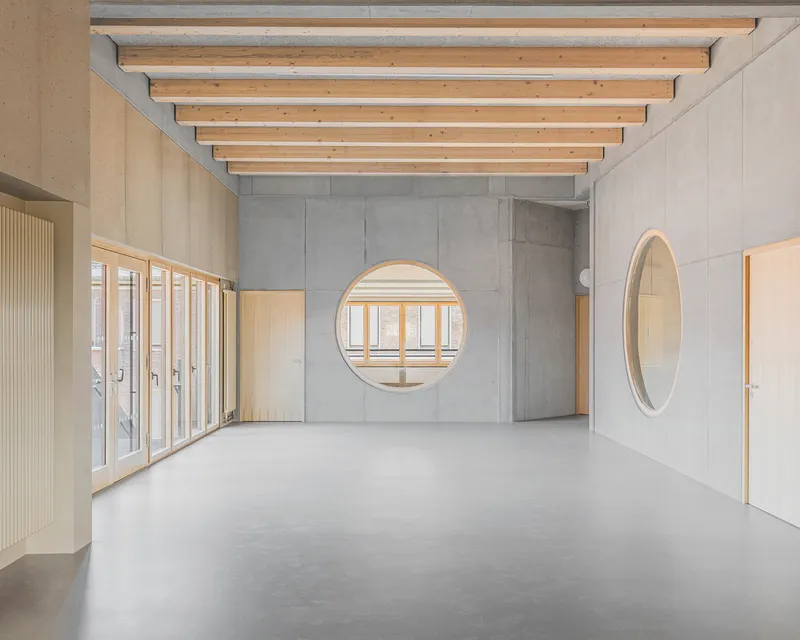

Walk through any cluster and you encounter them immediately: large circular openings cut through concrete walls, framed with timber reveals, sometimes nested in sequence so that you look through one portal and see another beyond it. These are not decorative. They are the mechanism by which AFF architekten make compartment pedagogy spatially legible. A teacher in a forum space can glance through a round window into a group room and beyond it into a classroom. Children moving between activities see their peers at work in adjacent spaces. The circle creates visual continuity without acoustic bleed, because the openings can be sized and positioned to manage sightlines precisely.
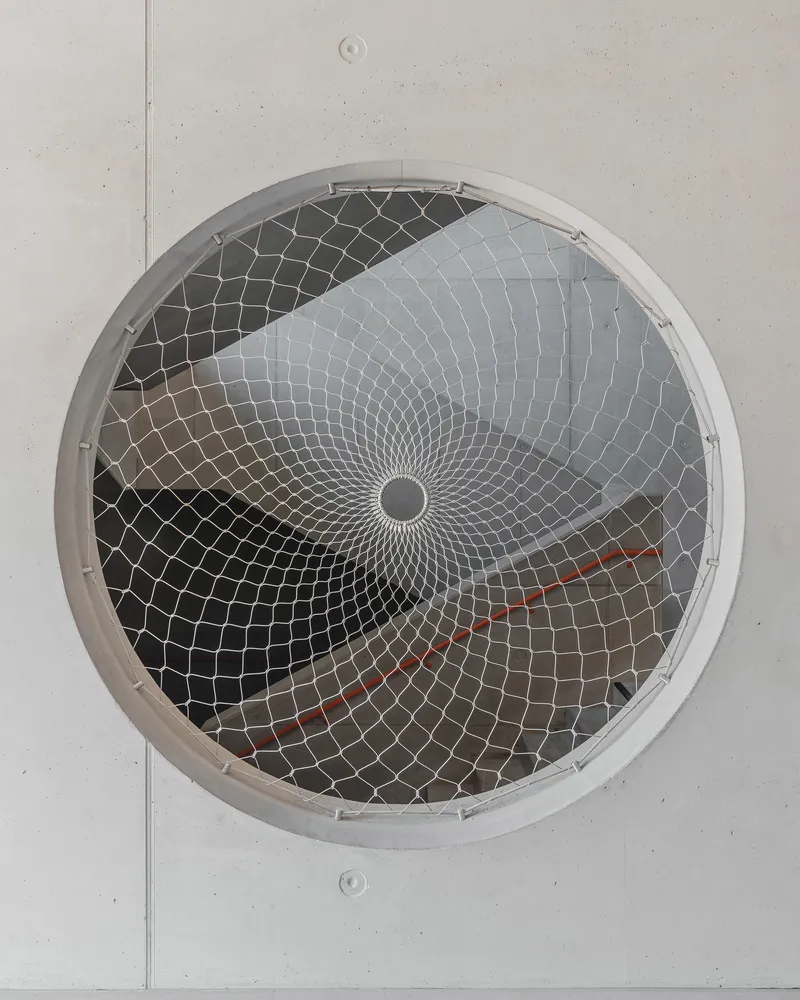
The motif recurs at every scale. Circular ceiling vents with spiraling metal mesh guards appear overhead. Decorative grilles in stairwells echo the geometry. Even the junction details where timber beams meet concrete walls feel softened by the prevalence of curves elsewhere. It is a remarkably disciplined formal decision: one shape, repeated with variation, giving a large and potentially institutional building a legible identity that even a six-year-old can recognize.
Material Honesty at Child Height
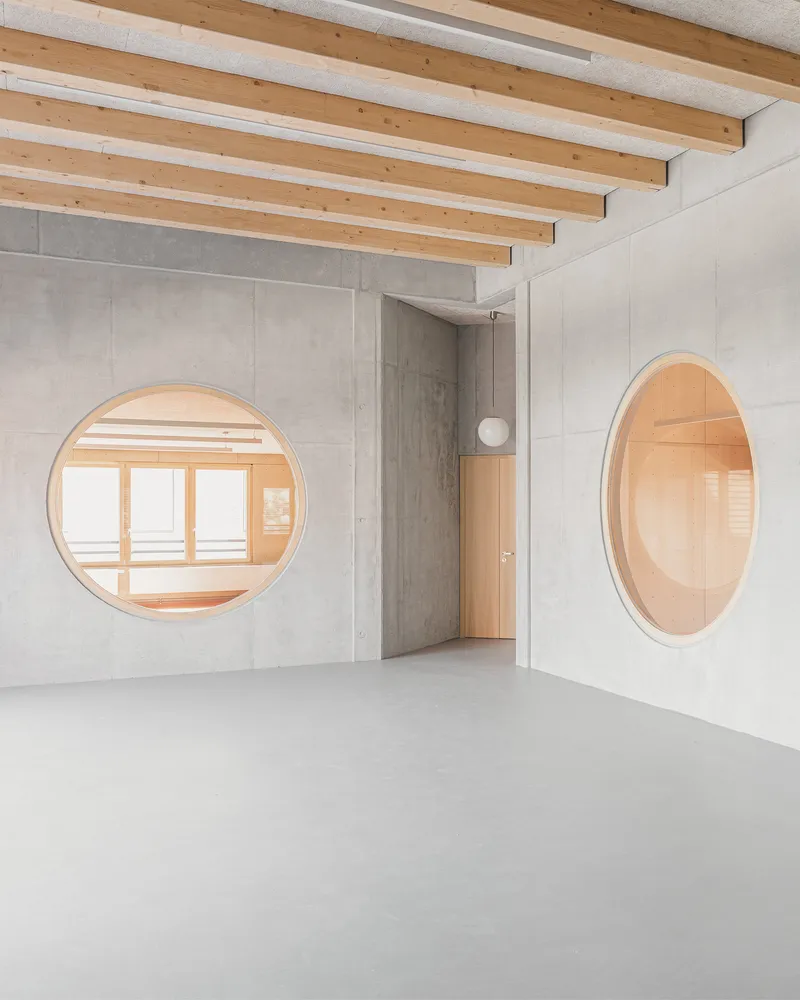


AFF architekten describe their approach as "material honesty," and the interiors bear this out. Concrete walls are left unclad. Timber ceiling beams and joists are exposed. Cement screed floors in circulation spaces shift to linoleum in classrooms, with a reddish tone that warms rooms where children spend the most time. Plywood panels line some wall segments, and timber doors provide tactile contrast to the cool grey concrete. Nothing is hidden behind plasterboard.
The risk with exposed materials in a primary school is that the space feels industrial or austere. Here, the warmth of the timber overhead and the color shifts in the flooring prevent that. The palette is robust enough to absorb years of daily use without looking worn, and calm enough that the rooms do not compete with the activity happening inside them. It is a long-term bet: these surfaces will age gracefully where painted finishes would not.
Courtyards, Terraces, and the Extended Classroom

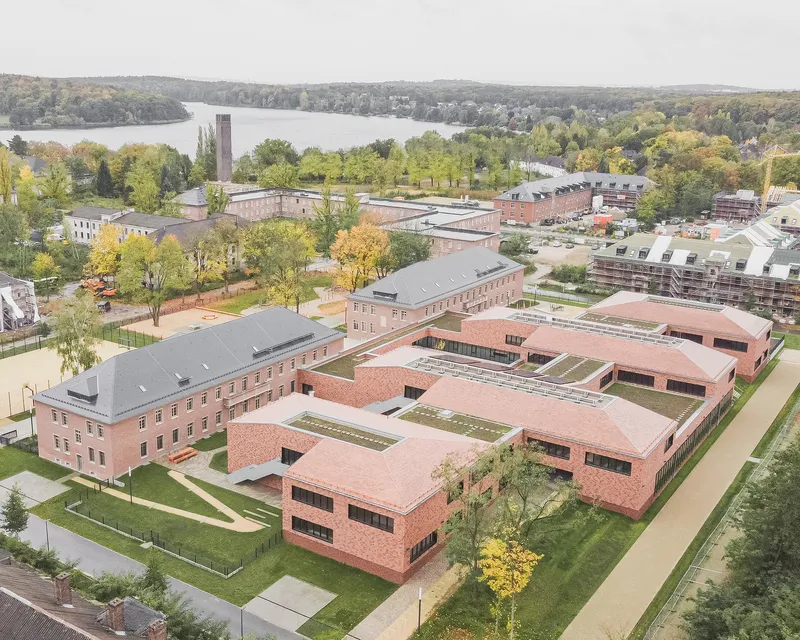
The aerial view reveals the full ambition of the site strategy. Green roof terraces cap the one- to two-story volumes, some extensively planted, others more intensively landscaped. The campus sits immediately adjacent to a future central park, and the learning terraces and differentiated open spaces extend the pedagogical concept outward. Movement, retreat, and informal interaction all have designated ground.
From inside the glazed gallery spaces, the courtyard views are framed by floor-to-ceiling steel mullions, turning the landscape into a kind of slow theater. The decision to keep building sections low, generally one to two stories, means that daylight reaches deep into every cluster and that no room is far from an exterior door. For a school serving 600 children, the campus manages to feel neither cramped nor sprawling.
The Gymnasium and Vertical Moments

The sports hall strips the material palette to its essentials: pale timber wall panels, an exposed concrete ceiling, and chrome climbing poles that descend from above. It is a generous, unadorned volume that does not try to be anything other than a place for physical activity. The restraint here is a quiet achievement; too many school gymnasia overshoot with color or signage.
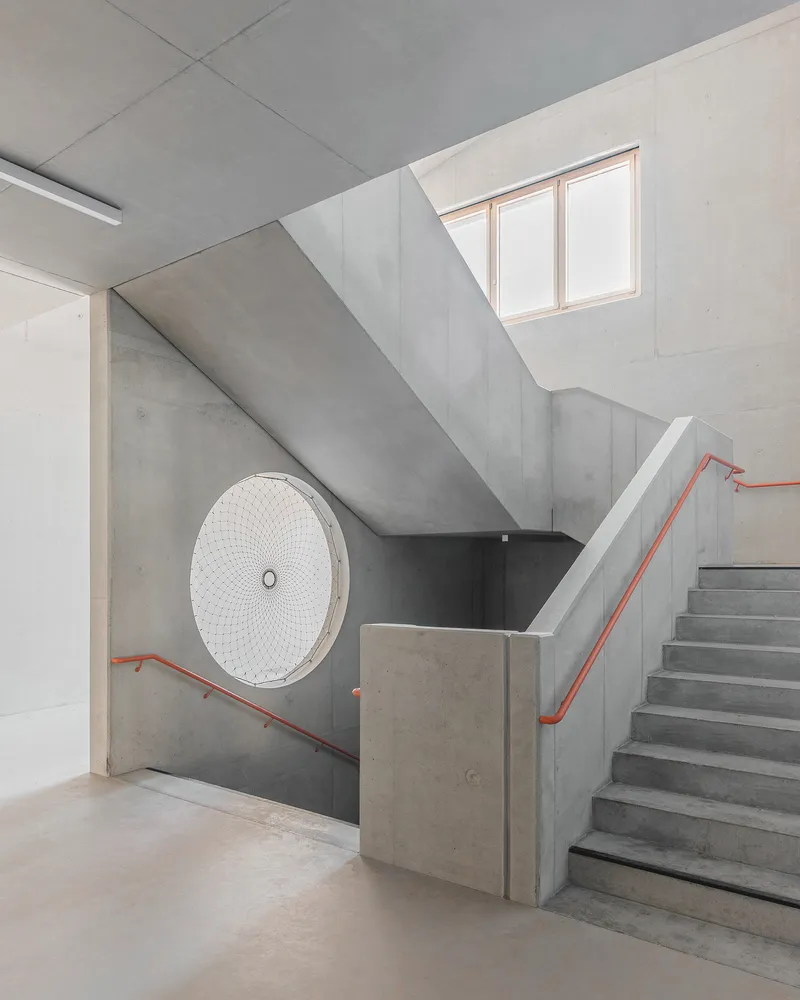
In the concrete stairwells, orange handrails provide a burst of color against grey walls as flights ascend toward skylights. A circular decorative grille at the top of one stair echoes the portal motif from the clusters, tying even the most utilitarian circulation space back to the building's formal language. These moments of care in the vertical transitions suggest that the architects understood how much time children spend on stairs and did not treat them as leftover space.
Plans and Drawings


The site plan reveals how the new construction negotiates the existing street grid and the heritage buildings it incorporates. Clusters are legible as distinct zones even in plan, their circular interior windows appearing as small voids in the partition walls. The roof plan shows the interplay of pitched volumes and courtyards, a pattern that reads from above as a village rather than a single institution. Sections confirm the low profile: the building steps down across the site, keeping the ridge lines modest and allowing the mature tree canopy to remain the dominant vertical element.
The elevation drawing is particularly telling. Two symmetrical wings with pitched roofs flank a lower central connector, a composition that rhymes with the barracks typology but reinterprets it through a contemporary lens. The connector's curved roof is the one formal departure from the gabled vocabulary, a gentle signal that something new is happening between the old walls.
Why This Project Matters
Schools on heritage sites often fall into one of two traps: they either mimic the old buildings so faithfully that the result feels like a theme park, or they assert their newness so aggressively that the historic context becomes a backdrop. AFF architekten avoid both by finding a formal language, the brick cladding, the gabled roofs, the restrained palette, that belongs to the site's history while deploying a spatial strategy, the circular portals, the cluster forums, the glazed corridors, that belongs entirely to contemporary pedagogy. The school does not look like a barracks. It looks like something that grew from the same soil.
The broader lesson is about durability, both material and institutional. By leaving structure and surfaces exposed, AFF architekten have created rooms that can absorb decades of use without cosmetic renovation cycles. By organizing clusters as self-contained units linked to shared outdoor spaces, they have given the school a framework flexible enough to accommodate shifts in class size, teaching method, or after-school programming. Krampnitz is proof that a school can be robust and gentle at the same time, a built organism that takes its cue from history without being trapped by it.
Primary School Krampnitz, designed by AFF architekten, is located in Potsdam, Germany. The project encompasses 15,077 m² and was completed in 2025. Photography by Tjark Spille.
About the Studio
AFF architekten
Share Your Own Work on uni.xyz
If projects like this are the kind of work you want to make, uni.xyz is a place to publish your own, find collaborators, and enter design competitions.




Popular Articles
Popular articles from the community


The Earth Pod: 3D Printed Homes for Resilient Refugee Communities
The Earth Pod reimagines refugee housing through 3D printed homes made from clay, combining resilience, self-sufficiency, and rapid shelter.

The Ocean Hive: Sustainable Architecture for a Self-Sufficient Civilization at Sea
The Ocean Hive imagines sustainable architecture at sea, where modular habitats, algae, wave power and ocean waste sustain a growing colony.

Co-Life: Senior Housing Design That Reconnects Older Adults With the City
Co-Life reimagines senior housing design through healing gardens, shared streets, workshops, and a sustainable community across generations.
EW PARK: Sustainable Architecture Reimagines the Future of Urban Parking
EW PARK reimagines city parking as a modular wooden tower combining automation, solar energy, electric mobility, and adaptable urban design.


Similar Reads
You might also enjoy these articles

Bao Huynh Watercolor Atelier: A Serene Art Retreat in Hội An
Bao Huynh Watercolor Atelier in Hội An blends multifunctional art spaces, sustainable design, local materials, and family-friendly living in a serene environment.

Atelier Macri Concept Store Interior Design by CASE-REAL
Atelier Macri store features a "ko" counter, walnut wood details, cork displays, blending retail, gallery, and seamless customer experiences.

Manuel Vargas Izquierdo Stadium and High-Performance Sports Center: Architectural Excellence in Jalpa de Méndez
The Manuel Vargas Izquierdo Stadium blends sustainable design, inclusive sports facilities, and cultural-inspired architecture, revitalizing Jalpa de Méndez’s public spaces.

KAKR Buluh Awar Hall: Revitalizing Community and Ecology Through Bamboo Architecture
Community built bamboo hall revitalizes Buluh Awar village, empowering youth, restoring ecology, celebrating vernacular craftsmanship through sustainable architecture and culture.





Comments (0)
Please login or sign up to add comments
No comments yet. Be the first to comment!