
Ageing in Place: Retrofitting Mumbai's Courtyard Neighbourhoods for Multi-Generational Care
Tejas Amrutkar threads lifts, ramps and distributed care units into existing Mumbai neighbourhoods so elders can grow old among familiar streets.


Most cities answer old age with relocation: a move to a gated facility on the periphery, away from the market, the neighbour on the landing and the street that once structured the day. Ageing in Place refuses that trade. Its argument is that the dense, walkable, socially layered neighbourhood Mumbai already has is the best care infrastructure available, provided architecture does the work of making it accessible. The project does not build a senior housing block. It adapts the city around the people who already live in it.
Developed by Tejas Amrutkar, the proposal starts from a demographic fact: Mumbai is steadily becoming a senior city, with rising life expectancy and a growing elderly population. Housing models built for nuclear families and short-term occupancy do not meet the physical, social and emotional needs of ageing residents. Amrutkar's response reimagines existing neighbourhoods as multi-generational continued care environments, where housing, healthcare, social space and public amenities operate as one connected urban system rather than as separate institutions.
A Red Volume and a Timber Stair Tower Slip Between Existing Tenements
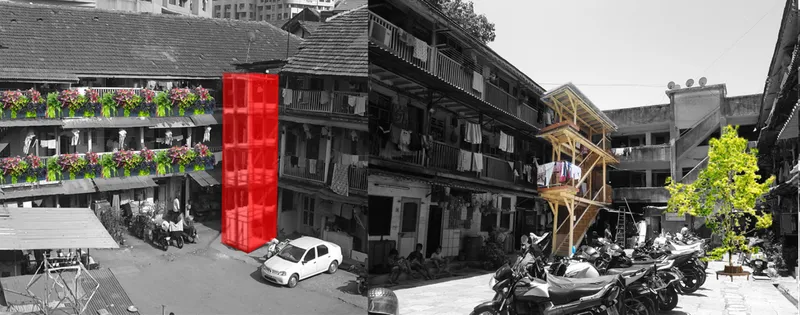
The paired courtyard views make the project's central decision legible at a glance. The tiled-roof tenement blocks stay; the motorbikes stay parked where they always are. What arrives is a red volume and a timber stair tower, set beside the existing buildings rather than replacing them. This is retrofitting as a deliberate position: barrier-free circulation through ramps, lifts and accessible staircases is added to the edge of what exists, so vertical and horizontal expansion can happen without disrupting daily life.
The contrast in colour and material is doing useful work. The red and the timber read clearly as new insertions, which supports the brief's emphasis on clear visual connections and intuitive wayfinding. For an older resident navigating a familiar but increasingly difficult courtyard, the lift core becomes a landmark, not a hidden service shaft.
The Courtyard as a Shared Room for Three Generations

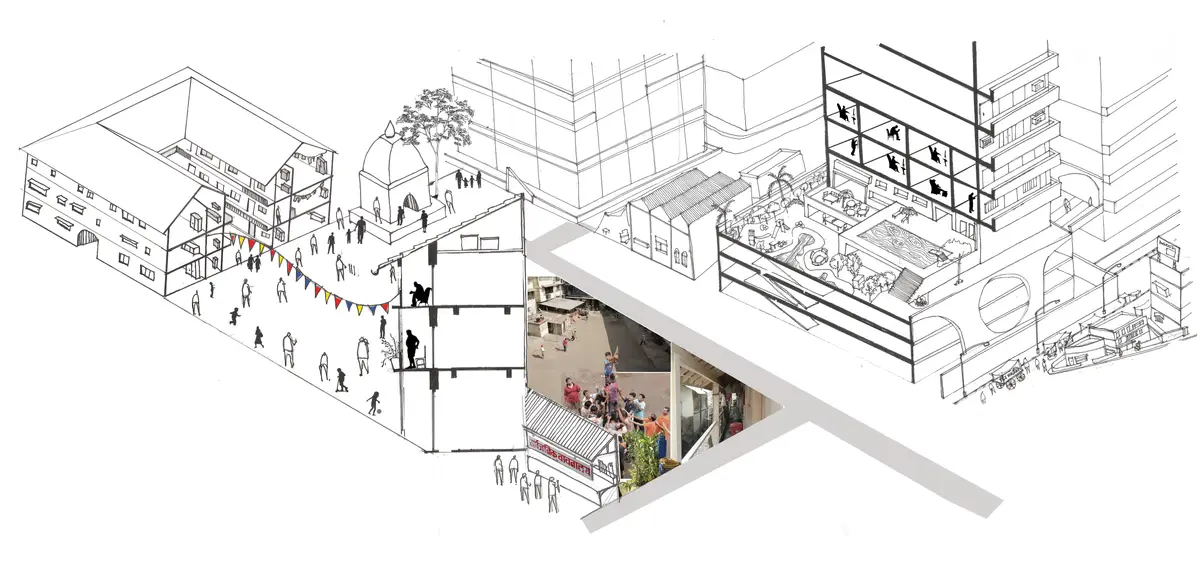
Seen from above, the courtyard reveals how much ordinary life the proposal is trying to protect. Flower-lined balconies, drying laundry and parked cars all remain in view, with the red tower inserted among them rather than dominating them. Amrutkar treats courtyards, shaded walkways, community platforms and semi-public terraces as spaces of informal exchange, where children, working adults and elderly residents cross paths through the course of an ordinary day.
That casual overlap is the point. Walking, resting, socialising and simply watching street life are framed here as health activities in their own right. The project keeps balconies shaded, edges planted and corridors open to natural ventilation, which responds to Mumbai's climate while keeping elders visually connected to the neighbourhood below. Care, in this reading, is partly a matter of sightlines.
A Red Route Line Ties the Kiosk, the Plan and the Region Together

The collage shifts scale deliberately: a sectional sketch, a ground floor plan, a street kiosk and a regional map, all connected by a single red route line against a skyline silhouette. It is the clearest expression of how the project distributes care. Small-scale healthcare units, assisted living support and community services are spread strategically through the fabric rather than concentrated in one institutional building, and the kiosk suggests how modest those touchpoints can be.
The red line also carries the proposal's urban logic. Mumbai's compact plots and high density are treated as conditions to work with, not against. Vertical additions, modular units and adaptable building systems allow a neighbourhood to change incrementally, which makes the model scalable from a single courtyard to a network of districts.
Why This Project Matters
Indian cities will need to house far more elderly residents in the coming decades, and the default answer of building new, isolated facilities carries a social cost that rarely appears in planning documents. Ageing in Place makes a persuasive case that the existing neighbourhood, with its markets, courtyards and informal networks, already holds most of what older residents need. Architecture's task is to remove the barriers: a lift where there were only stairs, a clinic within walking distance, a shaded terrace where conversation can happen.
What makes the proposal worth attention is its restraint. It does not demolish, and it does not segregate. By inserting legible, human-scaled elements into working tenement courtyards, Amrutkar reframes care architecture as an everyday presence in urban life instead of something hidden behind a boundary wall. It is a model that other dense cities facing the same demographic shift would do well to study.
View the Full Project
About the Designers
Designer: Tejas Amrutkar
Enter a Design Competition on uni.xyz
uni.xyz runs architecture and design competitions year-round that reward proposals with spatial conviction and real site intelligence.
Project credits: Ageing in Place by Tejas Amrutkar.


Popular Articles
Popular articles from the community


Cube Design Draws an Ecological Corridor Between Two Shenzhen Hills with the Nankai Building
Beside Shenzhen's container docks, the Nankai Building pairs stacked balconies with a climbing green screen to connect two hillsides across its height.

ETEH Reworks the Shared Spaces of São Domingos School in Brazil Around Timber, Color and Hanging Plants
At São Domingos School in Brazil, 436 m² of hall, refectory and library are recast with timber joinery, a yellow and blue code and trailing greenery.


Aquadapt: An Underwater Habitat That Rewrites Its Rooms by the Hour
Curved modules ring the seabed while one shell shifts from breakfast room to cinema, farm and football pitch as residents' needs change.

David Ortega Stacks a Two-Story Mexico City Penthouse Around a Steel Stair and a Pergola-Shaded Roof Terrace
In Colonia Roma, a 300 m² penthouse uses oak joinery, a planted steel stair and a slatted roof pergola to make a new-build apartment feel like a house.

Similar Reads
You might also enjoy these articles
Healing Façade: A Modular Chapel System That Restores Ethiopia's Sacred Forests
Winner of the Eco-Chapel competition, this circular timber façade collects water from air to rebuild soil and reforest degraded Ethiopian landscapes.
Kaffeebühnen: Where Coffee Shop Architecture Becomes a Civic Stage in Vienna
A linear sequence of timber boxes, transparent shells, and open yards turns the Viennese café tradition into a public performance space.
Eco Chapel: A Modular Forest Pavilion That Grows Like the Landscape It Protects
Hexagonal timber modules weave through existing trees, turning a chapel into a living system for prayer, education, and reforestation.


Urban Forest: A Vertical Ecosystem for 5,000 Workers in Singapore's Changi Business Park
Radially stacked pods and layered green decks turn a 7-acre plot into 47 acres of ecological workspace projected for 2040.

Explore Ageing-Well Design Competitions
Discover active competitions in this discipline

Challenge to reimagine the Iron Throne

Photograph architecture without architects

Illustrate the lost glory of Angkor Wat - Render Challenge

Design challenge to reuse E-waste
Comments (0)
Please login or sign up to add comments
No comments yet. Be the first to comment!