
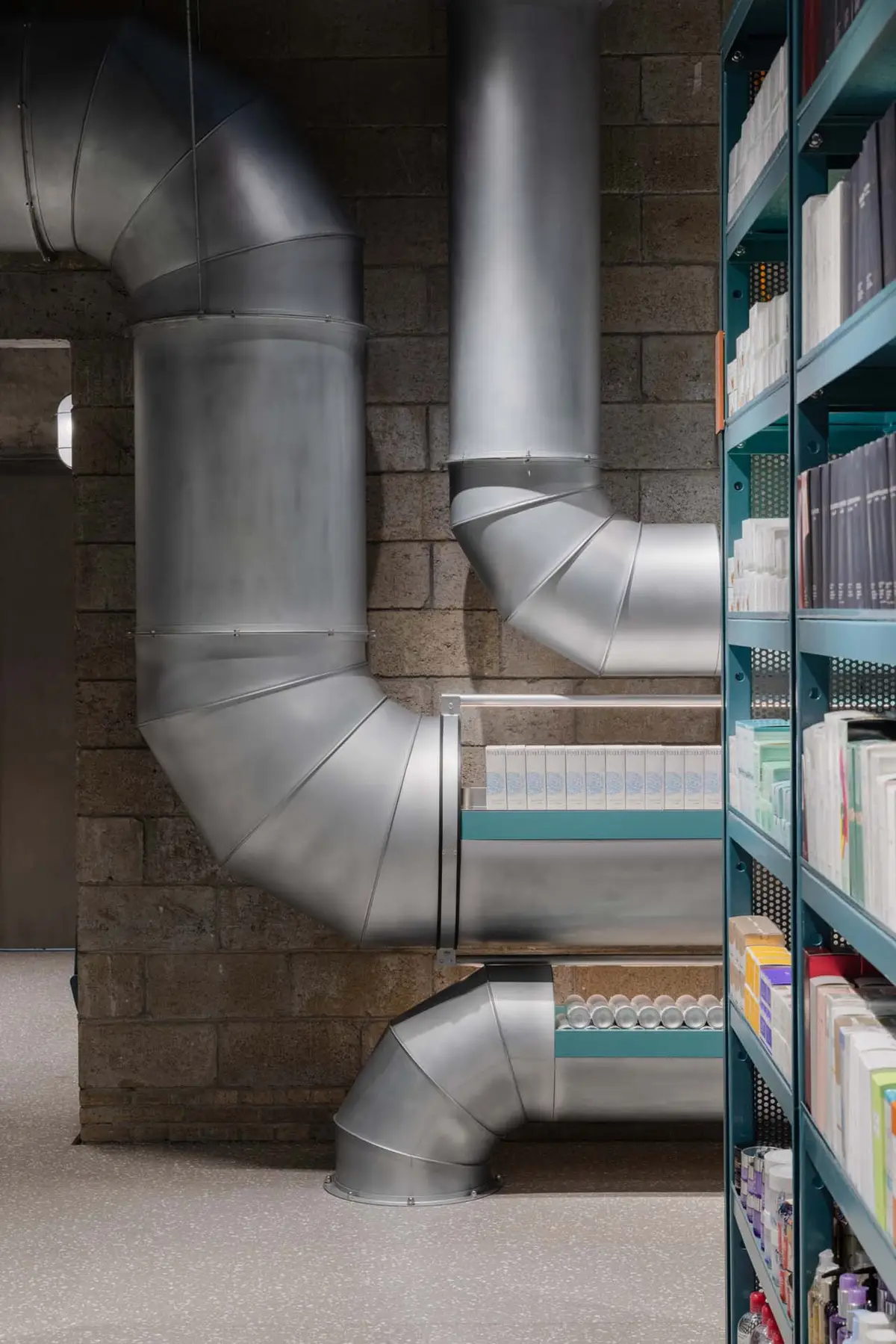
AIM Architecture Turns 75 Meters of Galvanized Pipe into a Beauty Retail Experience in Shenzhen
HARMAY's Shenzhen outpost channels the city's industrial DNA through a tunnel of steel pipes, terrazzo, and signature green shelving.


Shenzhen's identity is inseparable from construction. A fishing village turned megacity in under half a century, it has made the scaffold, the crane, and the exposed pipe into familiar urban furniture. For the 14th HARMAY store by AIM Architecture, that restless, unfinished energy becomes the entire design language: 485 square meters of retail stretched along a 75-meter-long corridor in Futian's Excellence INTOWN Shopping Centre, where galvanized steel pipes are not hidden behind ceiling tiles but elevated into the primary spatial material.
What makes this project worth studying is not the industrial aesthetic per se, which has become a reliable retail trope, but the degree to which the pipe network is made to do actual work. The tubes define the boundary of the space, morph into shelving and display furniture, mark the facade threshold, and culminate in a dense cluster at the cashier. It is a single system pushed through three sequential stages, and the result feels less like decoration and more like infrastructure that someone decided to leave switched on.
A Facade That Leaks Outward
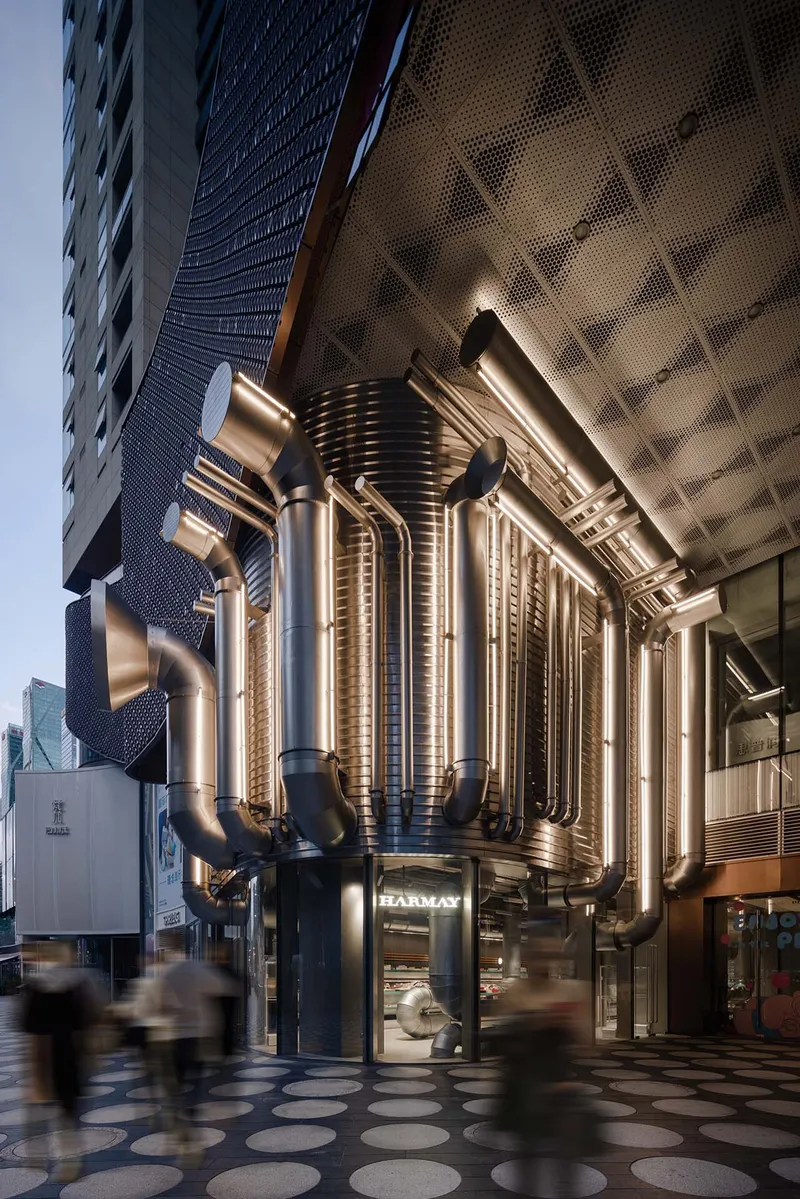

The storefront announces its logic immediately. A cylindrical stainless steel volume, sandblasted to a matte sheen, rises beside the entrance canopy while individual pipes extend past the facade line into the public concourse. The gesture is deliberate: the interior world refuses to stay inside. A circular floor pattern beneath the entry and a tiled canopy overhead frame the threshold, but the real invitation comes from the pipes themselves, which reach toward the passerby like exposed nerves.
This outward sprawl prevents the entrance from feeling like a typical shop door. Instead you are already inside the system before you cross the threshold, pulled along a trajectory that the pipes establish and never relinquish.
Three Stages of a 75-Meter Tunnel


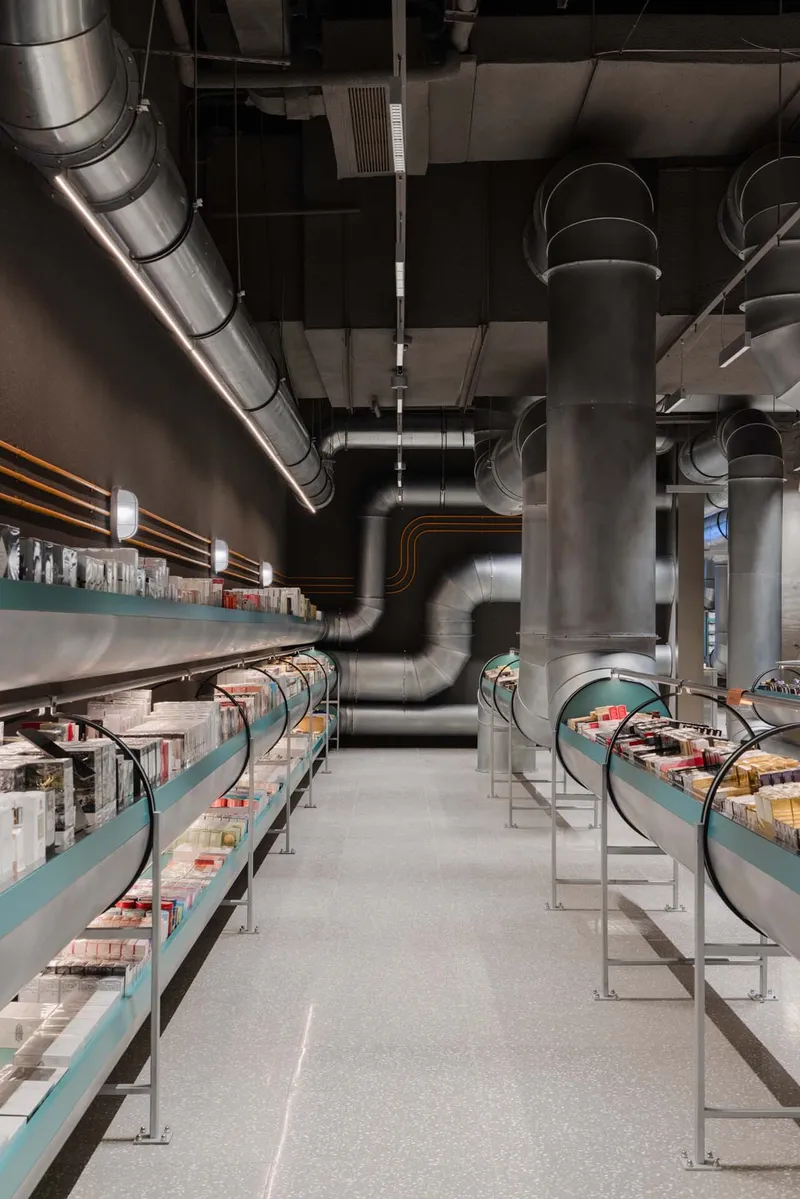
AIM Architecture organizes the deep, narrow plan into a three-act sequence. The first stage sees the galvanized pipes bending down from the ceiling and transforming into functional furniture: shelving units lined in HARMAY's signature teal green tone, product displays, and low counters. The pipes do not simply attach to these elements; they become them, curving smoothly from overhead routing into vertical supports and horizontal rails.
The middle section introduces mobile trolleys modeled on factory carts, reinforcing the warehouse reading. Hollow concrete block walls provide a raw, textured backdrop. The final stage compresses: pipes multiply, spacing tightens, and the corridor feeling intensifies until you reach the cashier, marked by a dense congregation of tubes. It is a crescendo built entirely from repetition.
Pipe as Object, Not Afterthought
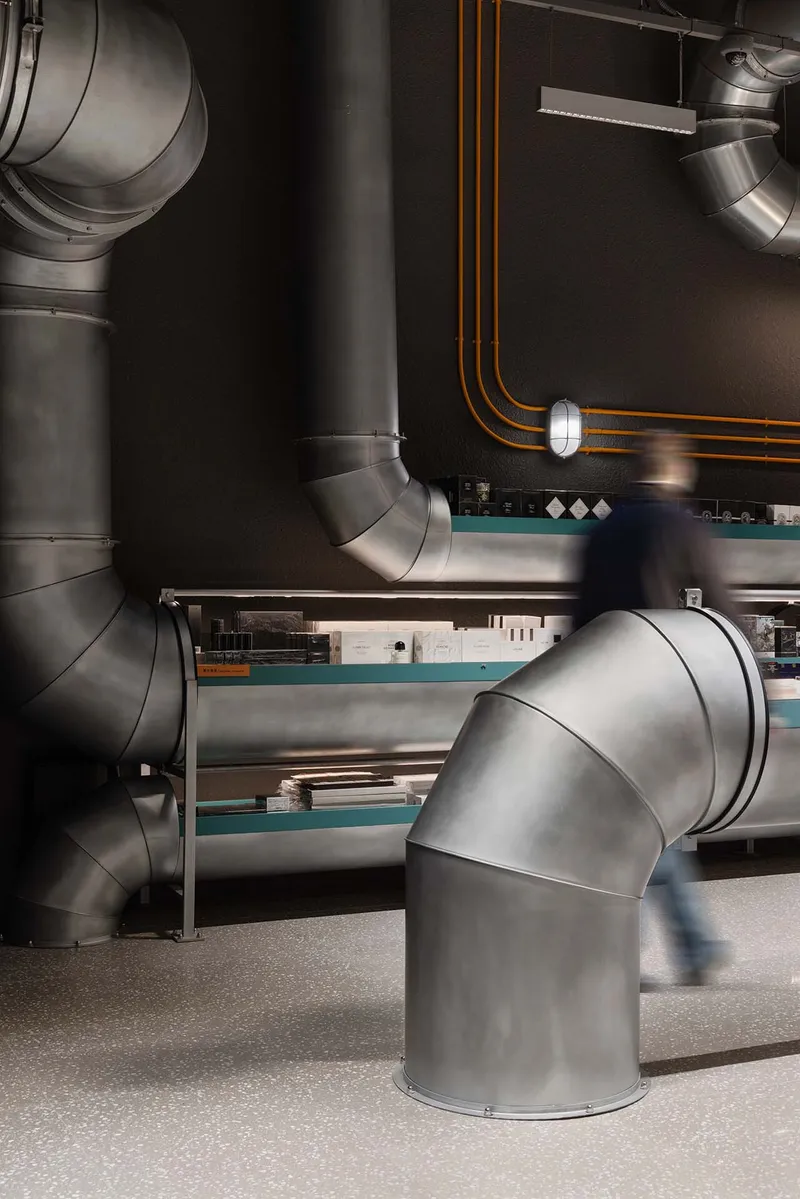


The elbow joints, T-connectors, and reducers that normally disappear above a suspended ceiling are here on full display, treated with the same compositional care that an architect might give to a column capital. Close views reveal how curves are choreographed: ducts cross the retail floor at ankle height, converge against a black-painted ceiling in tight bundles, and spiral up from the ground through shelving units. The detailing is precise enough that the pipes read as sculptural rather than messy.
This is the project's sharpest gamble. Industrial chic often relies on a controlled dose of roughness: a single exposed beam, a bit of visible concrete. Here, the entire overhead and perimeter surface is pipe. The risk of visual noise is high, but AIM keeps the palette disciplined: galvanized silver against teal green against raw concrete, with the occasional orange conduit as punctuation.
Material Honesty in Retail Drag
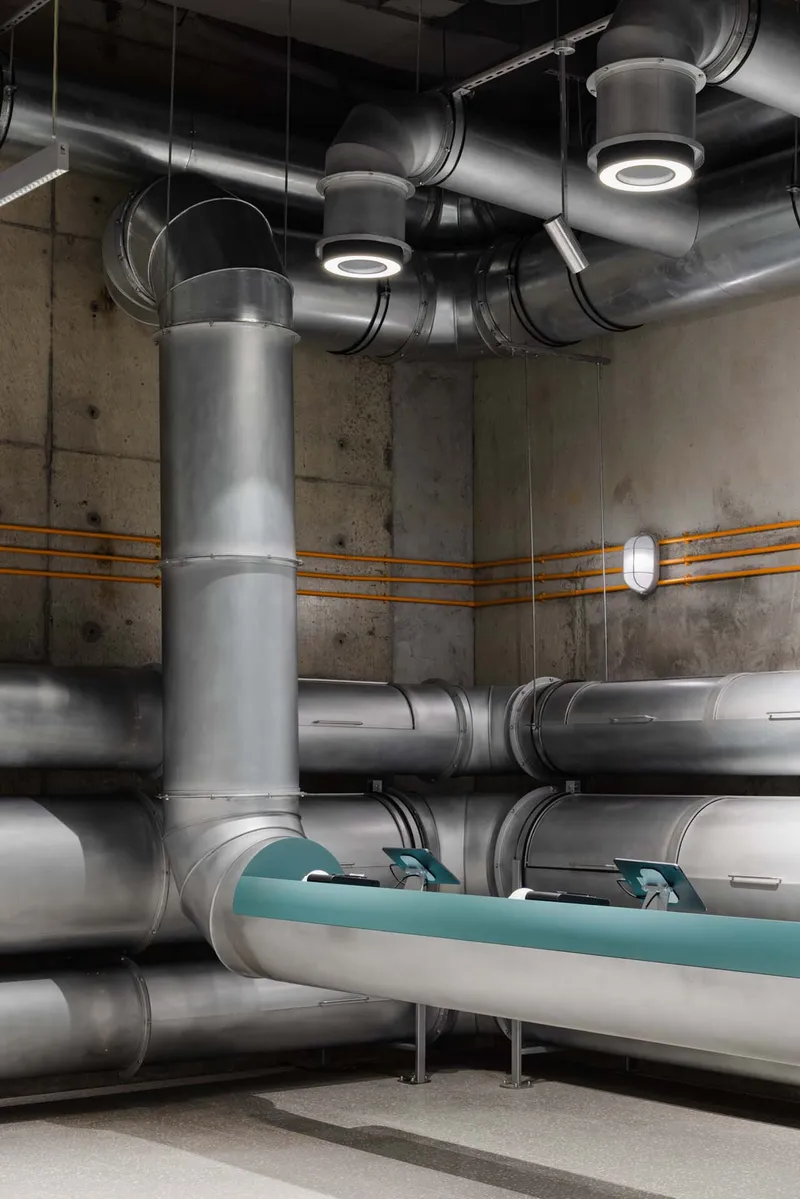


Look at the corner details: orange electrical conduits run openly alongside grey ventilation ducts against exposed concrete block. Stacked horizontal pipes emerge from the wall beside loaded shelves. Teal display units sprout duct elbows from the floor as if the building's guts grew retail appendages overnight. The material vocabulary is limited to galvanized steel, stainless steel, terrazzo, and hollow concrete block. Nothing is clad, nothing is plastered.
In a beauty retail context, where most competitors traffic in soft lighting and marble surfaces, this rawness is a calculated brand statement. HARMAY has built its identity around warehouse culture, the idea that cosmetics can be browsed and collected rather than presented on velvet. AIM's material choices literalize that ethos without turning it into a theme park.
Furniture and Display as Infrastructure


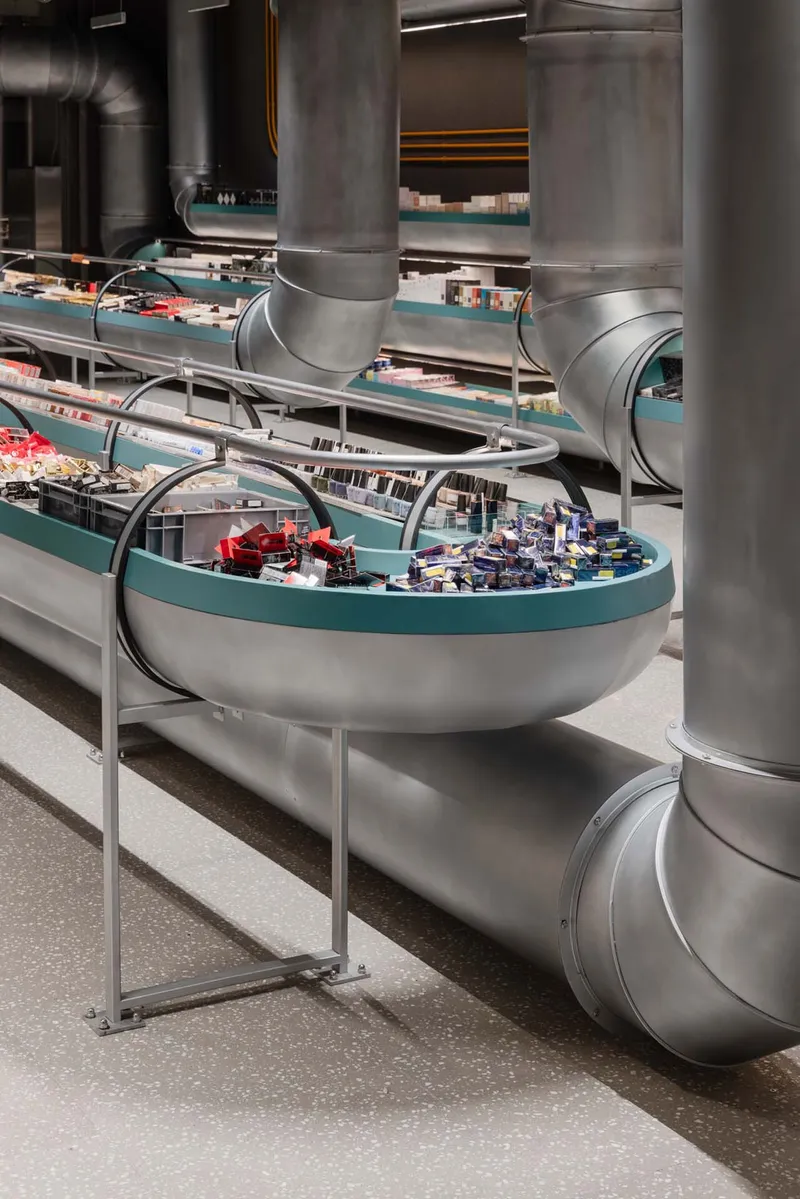
The shelving system deserves attention on its own terms. Green-toned units, inspired by the color of industrial factory racks, slot between and around the pipe network as if they arrived on the same truck. In some areas the pipes literally pass through the furniture, reinforcing the idea that everything belongs to one continuous system. A conveyor-belt-style product display in the middle zone pushes the factory metaphor further, turning the act of selecting a lipstick into something that feels almost logistical.
The cylindrical columns that punctuate the space are wrapped in the same duct material, erasing the usual distinction between structure and services. When every vertical element is a tube, the eye stops categorizing and starts moving, which is exactly what a retail plan wants.
The Tunnel Condition

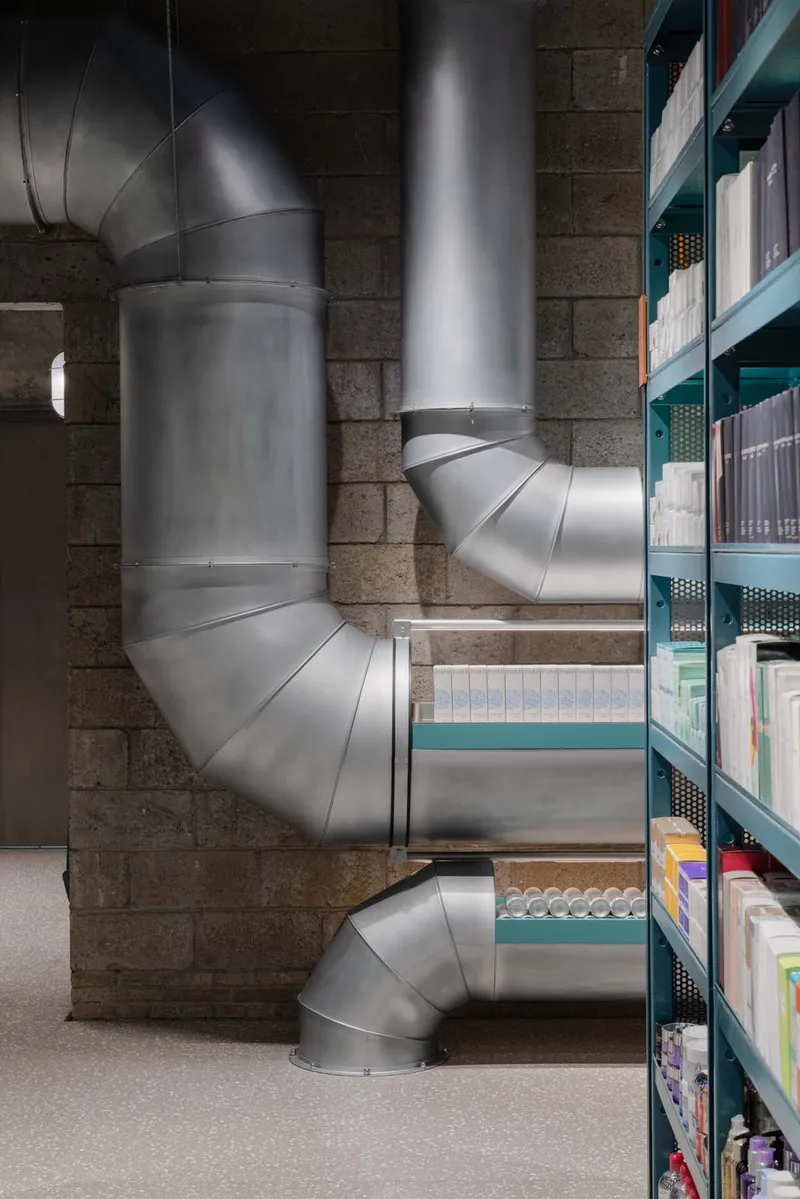
At 75 meters long but only a few meters wide, the store produces a genuine tunnel sensation. Vertical ducts rise beside shelves stocked with product, and the overhead pipes create a low, compressed ceiling plane that pushes you forward. Terrazzo flooring provides a smooth, continuous ground surface that contrasts with the complexity overhead, acting as a visual release valve.
This elongated plan could easily feel claustrophobic, but the three-stage sequencing introduces enough variation in density and furniture type to sustain interest. The space breathes in the middle before tightening again at the end. It is retail choreography executed through mechanical imagery.
Plans and Drawings



The section drawing makes the pipe routing explicit: ducts snake overhead and dive to floor level, filling what would normally be empty ceiling void with an active spatial layer. The floor plan reveals the pronounced linearity of the scheme, a single curving corridor with shelving arranged along both walls and a narrow circulation spine. The axonometric, perhaps the most revealing drawing, exposes a multi-level underground arrangement with curved tunnels and vertical shafts, suggesting that the tunnel condition is not just metaphorical but structurally embedded in the site's subterranean configuration.
Why This Project Matters
The HARMAY Shenzhen store is an argument for taking a single idea seriously. Where many retail interiors layer materials and moods to create variety, AIM Architecture commits to one system, the galvanized pipe, and wrings spatial, functional, and atmospheric range out of its repetition, accumulation, and transformation. That discipline is what separates the project from generic industrial styling. It is not borrowing an aesthetic; it is building with the logic that aesthetic implies.
It also offers a pointed reading of Shenzhen itself. In a city where construction never really stops, the work-in-progress condition is not nostalgia but daily reality. By framing a luxury beauty brand inside that permanent state of becoming, AIM suggests that unfinishedness can be its own form of refinement. For a city still writing its architectural identity, that is a generous and genuinely local proposition.
HARMAY Shenzhen Store by AIM Architecture. Located in Shenzhen, China. 485 m². Completed in 2022. Photography by Wen Studio and Bowen Gu.
About the Studio
Share Your Own Work on uni.xyz
If projects like this are the kind of work you want to make, uni.xyz is a place to publish your own, find collaborators, and enter design competitions.


Popular Articles
Popular articles from the community


The Ocean Hive: Sustainable Architecture for a Self-Sufficient Civilization at Sea
The Ocean Hive imagines sustainable architecture at sea, where modular habitats, algae, wave power and ocean waste sustain a growing colony.

Co-Life: Senior Housing Design That Reconnects Older Adults With the City
Co-Life reimagines senior housing design through healing gardens, shared streets, workshops, and a sustainable community across generations.

Co-life: Sustainable Architecture for Age-Friendly Community Living
Co-life reimagines sustainable architecture for seniors through courtyards, rammed earth, shared gardens, and spaces designed for belonging.

Little Red Riding Hood: Architectural Design as a Journey Through Fear, Light, and Storytelling
Little Red Riding Hood reimagines the fairy tale through architectural design shaped by fear, light, scale, memory, uncertainty, and choice.

Similar Reads
You might also enjoy these articles

Bao Huynh Watercolor Atelier: A Serene Art Retreat in Hội An
Bao Huynh Watercolor Atelier in Hội An blends multifunctional art spaces, sustainable design, local materials, and family-friendly living in a serene environment.

Atelier Macri Concept Store Interior Design by CASE-REAL
Atelier Macri store features a "ko" counter, walnut wood details, cork displays, blending retail, gallery, and seamless customer experiences.

Manuel Vargas Izquierdo Stadium and High-Performance Sports Center: Architectural Excellence in Jalpa de Méndez
The Manuel Vargas Izquierdo Stadium blends sustainable design, inclusive sports facilities, and cultural-inspired architecture, revitalizing Jalpa de Méndez’s public spaces.
KAKR Buluh Awar Hall: Revitalizing Community and Ecology Through Bamboo Architecture
Community built bamboo hall revitalizes Buluh Awar village, empowering youth, restoring ecology, celebrating vernacular craftsmanship through sustainable architecture and culture.

Explore Shopping Mall Competitions
Discover active competitions in this discipline

Challenge to design luxury tourism on rails

VR headsets Storefront design competition

Designing a staircase for a client
Comments (0)
Please login or sign up to add comments
No comments yet. Be the first to comment!