
Airport Reimagined Koh Phangan
Sustainable airport architecture redefines Koh Phangan with adaptive design, blending Thai tradition, flexibility, and future-ready travel systems.


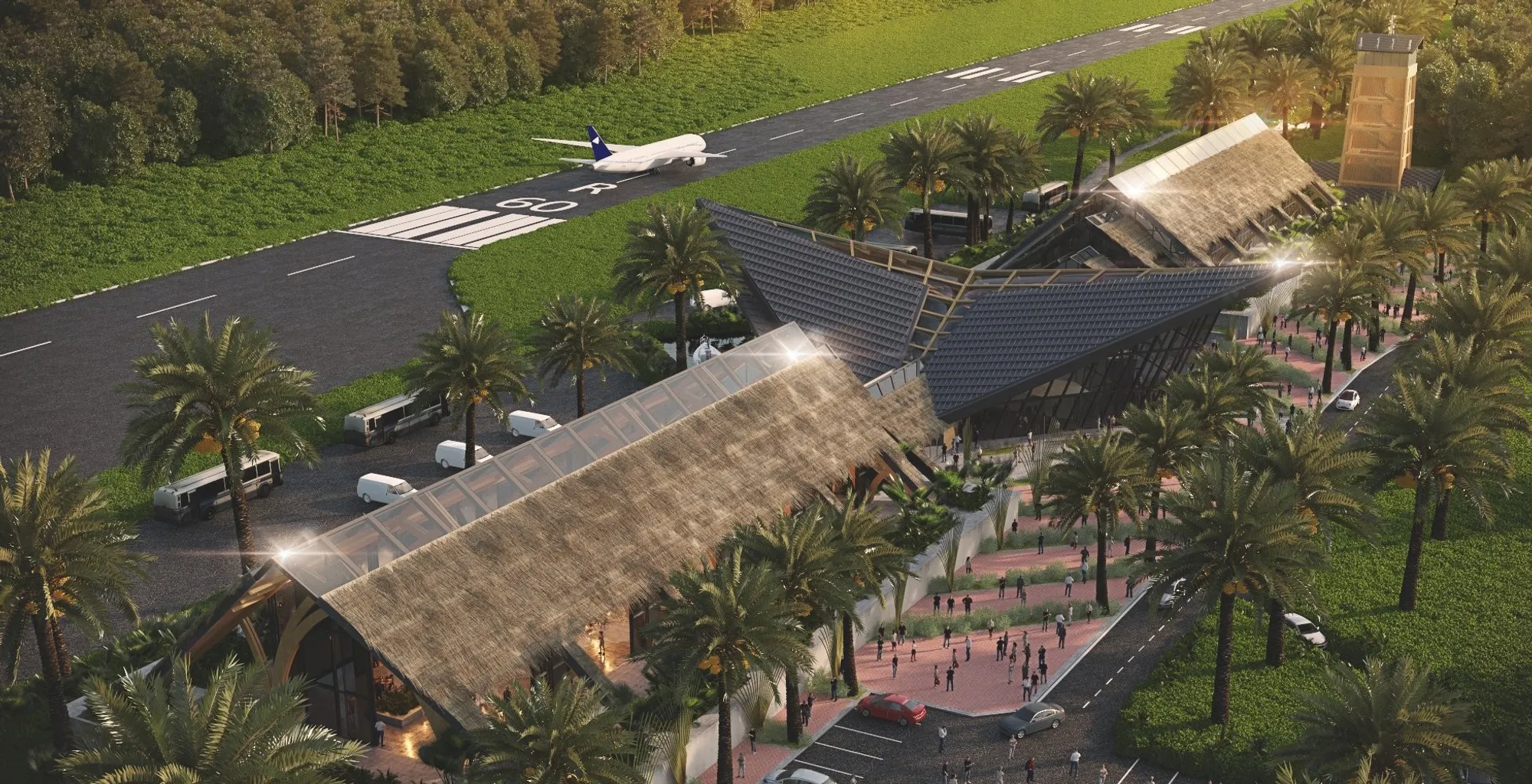
The project Airport Re-Imagined, Koh Phangan, designed by Joel Mbala-Nkanga, emerges as a compelling exploration of sustainable airport architecture that responds to both environmental sensitivity and evolving travel demands. Recognized as an Editor’s Choice entry in the First Window competition, the proposal positions itself at the intersection of cultural continuity, adaptive infrastructure, and future-oriented design thinking.
Context: Architecture Rooted in Place
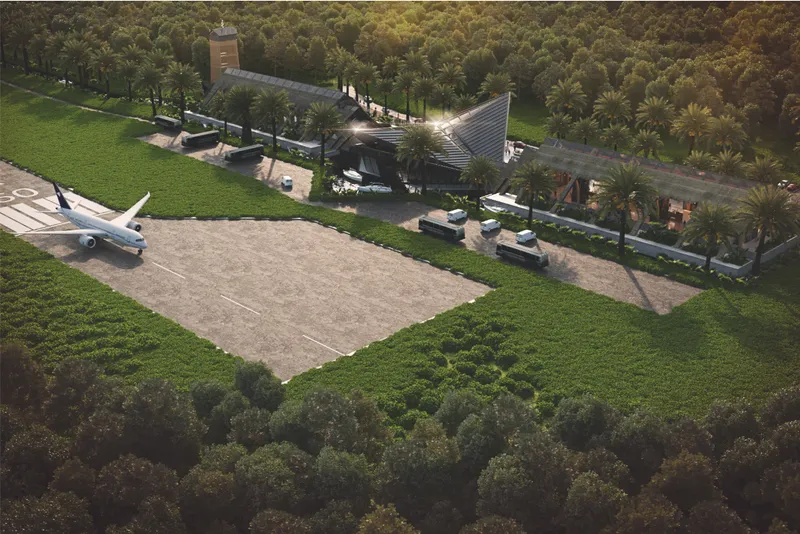
Located within the lush ecological landscape of Koh Phangan, the design engages deeply with its surroundings. Rather than imposing a conventional airport typology, the project draws inspiration from traditional Thai architecture, translating its materiality, roof forms, and spatial rhythm into a contemporary language.
The architecture reflects a balance between past, present, and future. Timber structures, layered roof systems, and open transitional spaces reinterpret vernacular strategies, ensuring that the airport feels embedded within its context rather than detached from it.
A New Typology: Flexible Airport Design
At the core of this proposal lies a radical rethinking of airport infrastructure. Unlike traditional terminals that operate at fixed capacities, this design introduces a flexible, expandable system capable of adapting to fluctuating passenger volumes.
The airport is conceived as a modular framework where spatial zones can expand or contract depending on operational demand. During peak travel periods, circulation areas, waiting zones, and processing spaces increase capacity. During off-peak times, the infrastructure contracts, optimizing energy use and operational efficiency.
This adaptability positions the project as a prototype for future-ready aviation infrastructure, where scalability becomes a fundamental design parameter.
Spatial Organization and User Experience
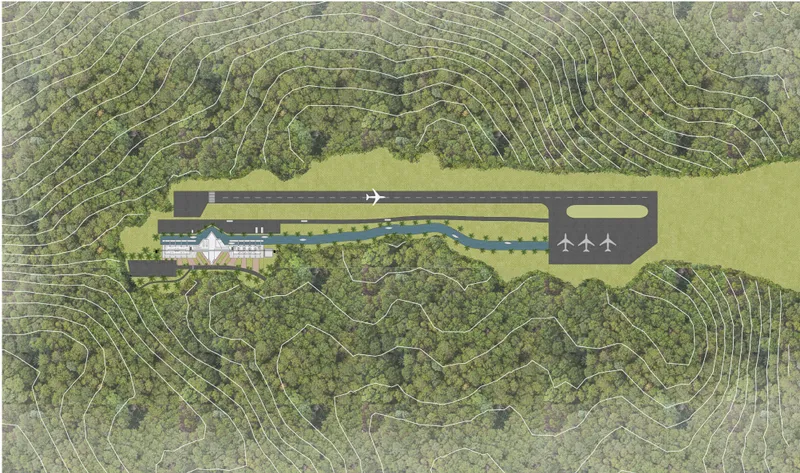
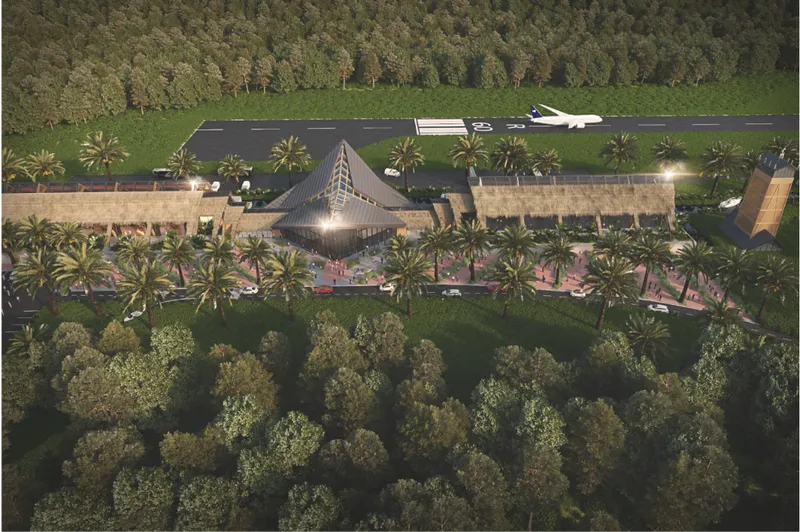
The spatial layout prioritizes clarity, fluidity, and user comfort. A central architectural volume anchors the project, acting as both a visual landmark and a functional hub. From this core, circulation pathways extend outward, connecting departure gates, arrival zones, and auxiliary facilities.
The integration of landscape is deliberate and continuous. Palm-lined pathways, water channels, and shaded courtyards blur the boundary between built and natural environments. This approach enhances the passenger experience by transforming the airport into a sequence of immersive spatial moments rather than a purely transactional space.
Multi-Modal Connectivity
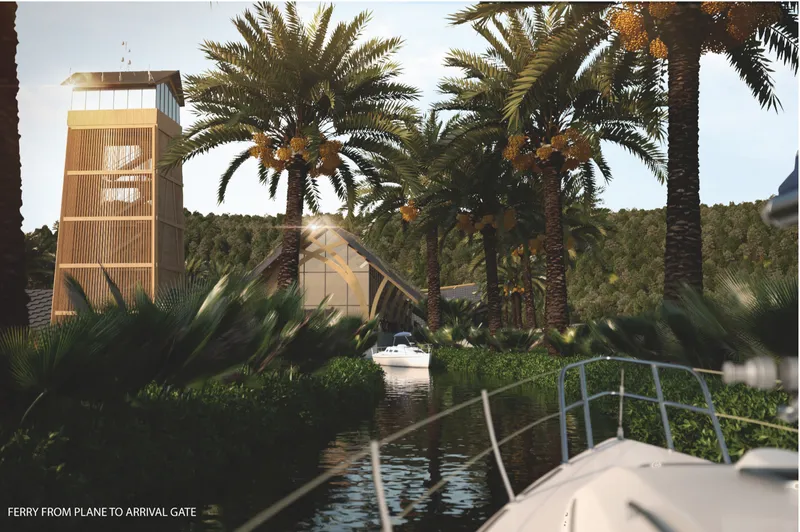
One of the defining features of the project is its integration of multiple transportation modes. Beyond conventional air travel, the design incorporates water-based mobility, allowing seamless transitions between planes, boats, and ground transportation.
A dedicated canal system connects arrival zones directly to ferry terminals, enabling a unique "plane-to-boat" experience. This strategy not only enhances connectivity across the island but also reinforces the project’s contextual relevance.
Environmental Strategy and Material Logic
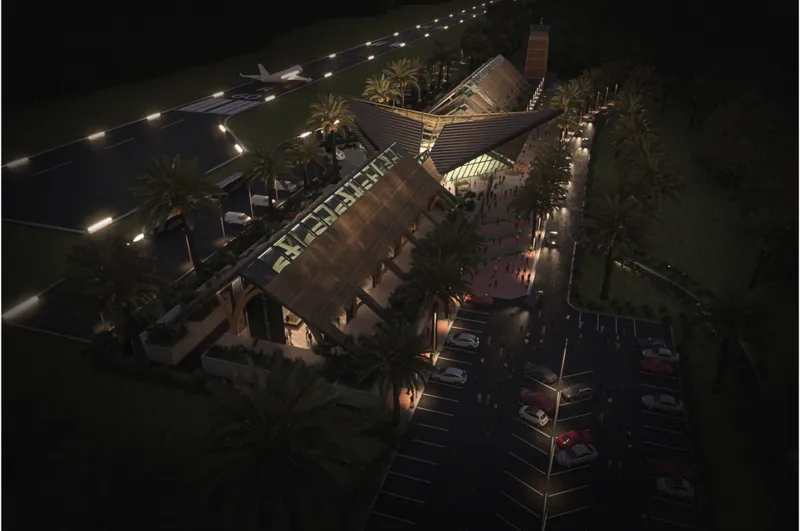
The project adopts a strong environmental stance, aligning with the principles of sustainable airport architecture. Passive design strategies such as natural ventilation, shaded roofs, and optimized orientation reduce reliance on mechanical systems.
Material selection further reinforces sustainability. Locally sourced timber, lightweight structural systems, and permeable surfaces minimize ecological impact while maintaining structural efficiency.
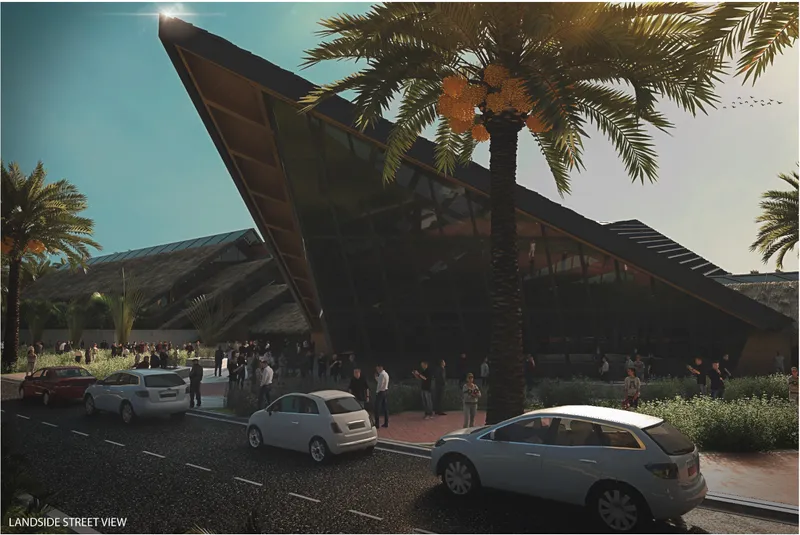
The expansive roof forms are not merely aesthetic gestures but performative elements that regulate sunlight, channel airflow, and provide shelter from tropical conditions.
Programmatic Zoning and Operational Clarity
The airport is organized into distinct zones: public areas, secure spaces, and administrative functions. This clear zoning ensures operational efficiency while maintaining intuitive navigation for users.
Diagrams reveal how these zones adapt dynamically, responding to varying passenger densities. The design supports both regular daily operations and peak capacity scenarios without compromising spatial quality or user comfort.
Architectural Expression: A Symbol for the Island
The formal expression of the airport is defined by angular roof geometries that converge toward a central apex. This creates a striking visual identity, positioning the airport as a symbolic gateway to Koh Phangan.
The control tower, elevated and visually distinct, acts as a vertical marker within the landscape. Together, these elements establish a strong architectural presence while remaining respectful of the surrounding environment.
Toward Future Airport Architecture
This project challenges conventional assumptions about airport design. By integrating flexibility, sustainability, and cultural sensitivity, it proposes a new paradigm for infrastructure in ecologically sensitive regions.
Rather than treating airports as isolated mega-structures, the design reimagines them as adaptable, context-driven systems that evolve over time. It demonstrates how sustainable airport architecture can move beyond efficiency metrics to create meaningful, human-centered experiences.
Airport Re-Imagined, Koh Phangan is not merely an infrastructural proposal but a forward-thinking vision for the future of travel. It aligns architectural innovation with environmental responsibility and cultural identity, offering a model that is both scalable and site-specific.
As global travel continues to evolve, projects like this highlight the importance of adaptability and sustainability in shaping the next generation of airport architecture.




Popular Articles
Popular articles from the community


Co-Life: Senior Housing Design That Reconnects Older Adults With the City
Co-Life reimagines senior housing design through healing gardens, shared streets, workshops, and a sustainable community across generations.

The Earth Pod: 3D Printed Homes for Resilient Refugee Communities
The Earth Pod reimagines refugee housing through 3D printed homes made from clay, combining resilience, self-sufficiency, and rapid shelter.

Play: Fragments of Their World
Familiar architecture becomes modular playground design, creating safe spaces where displaced children can learn, connect, imagine and play.

Lunar Spiral: Space Architecture Shaped by the Mathematics of the Universe
Lunar Spiral reimagines space architecture through Fibonacci geometry, lunar regolith, levitating habitats, and self-sustaining Moon living.

Similar Reads
You might also enjoy these articles

Eco Chapel: A Green Architecture Pavilion Designed in Symbiosis with the Forest
Eco Chapel uses green architecture to weave prayer, learning and reuse into a forest pavilion shaped by modular hexagonal canopies for life.
Kaffeebühnen: Coffee Shop Architecture Designed as a Civic Stage Between Vienna’s City and Park
Kaffeebühnen turns coffee shop architecture into a civic stage, linking Vienna’s park edge, urban life, warm timber yards, and coffee craft.
Healing Façade: Sustainable Architecture for Reforestation, Community, and Sacred Ecology in Ethiopia
Healing Façade reimagines sustainable architecture as a living wall that restores soil, catches water and renews Ethiopia's forest churches.


Urban Forest: A Vertical Ecosystem for 5,000 Workers in Singapore's Changi Business Park
Radially stacked pods and layered green decks turn a 7-acre plot into 47 acres of ecological workspace projected for 2040.


Comments (0)
Please login or sign up to add comments
No comments yet. Be the first to comment!