

SPEC Wraps a Century-Old Daifuku Tradition in a Minimalist Shell for Tokyo's Tomigaya District
A curved wood counter and hand-cut lace fabric connect artisan confectionery-making to the street in Shibuya's Yoyogi Park neighborhood


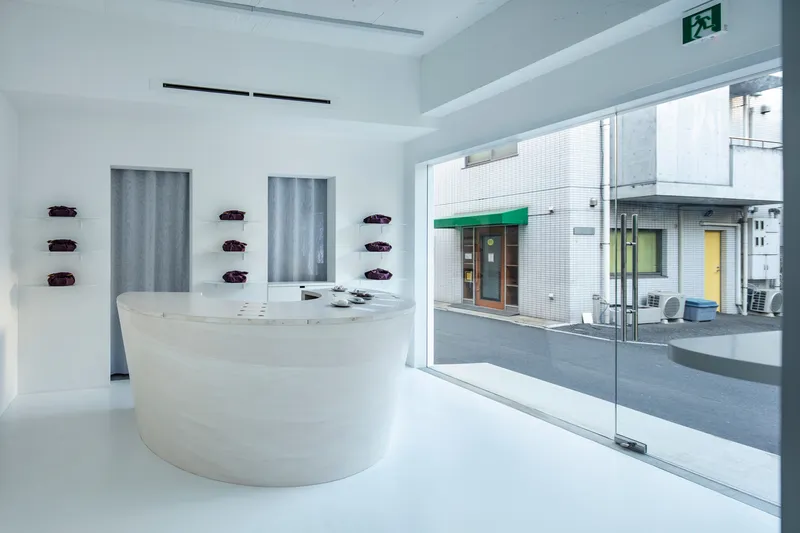
Walk past SPEC's Aito-Denkimochiten on a weeknight in Tomigaya and you catch glimpses of hands folding mochi through circular cuts in lace fabric stretched across the workshop window. The 2023 project occupies a tight urban plot one minute from Yoyogi Park Station, where a traditional Daifuku confectionery business dating back to Taisho-era methods in Fukushima Prefecture now produces and sells sweets under the same roof. SPEC built the entire retail experience around a single sculptural wood counter, an organic round form with exposed metal fittings that anchors the sales floor and frames the view back to the production space.
What matters here is the decision to strip everything away except the counter and the fabric screen. No signage clutter, no decorative gestures, no attempt to dress up the Daifuku with unnecessary packaging metaphors. The architects bet that centering the handcrafted confections in a minimalist white volume would do more to communicate their delicacy than any applied ornament. The bet paid off: the shop reads as a spatial extension of the product itself, both precise and warm, both refined and tactile.
The Counter as Spatial Anchor
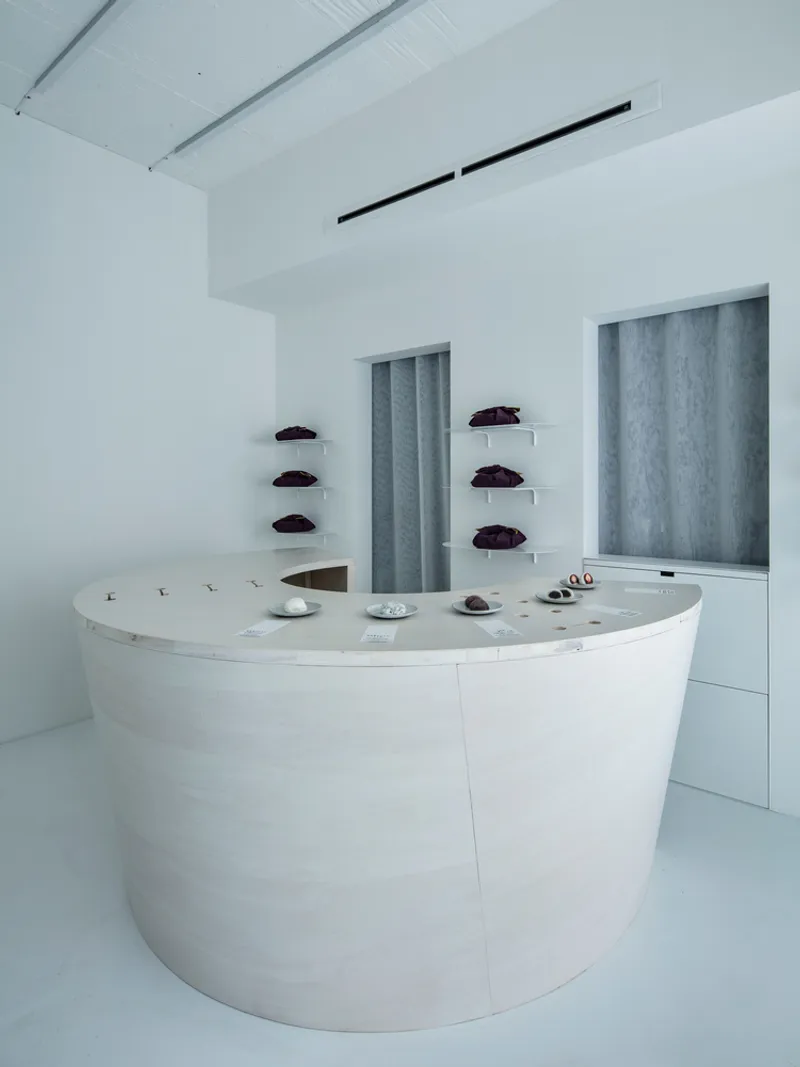
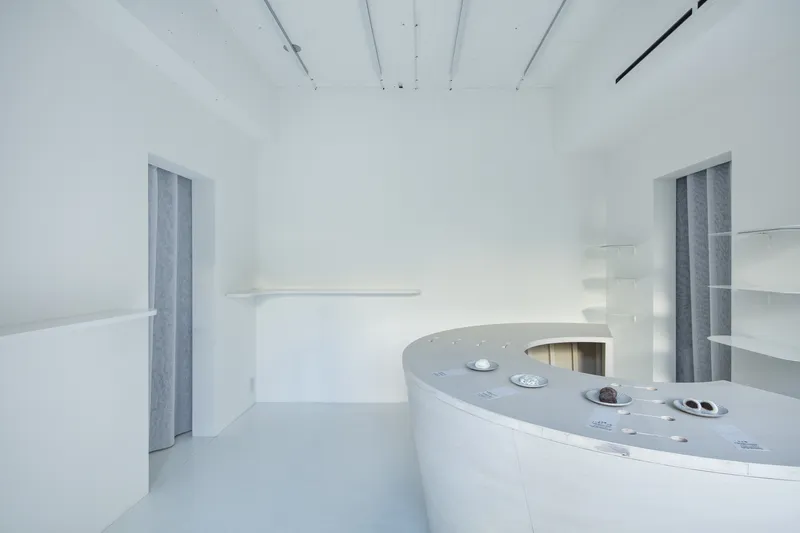
The counter is the project. Its curved form occupies the center of the sales floor, a freestanding wood volume with a soft white grain that contrasts against the exposed metal fittings left deliberately visible. SPEC chose not to hide the joinery or the hardware, instead treating the fittings as markers of human assembly, a parallel to the handwork visible in the wrapped Daifuku stacked on the counter's surface. The counter's footprint is small but its presence is outsized, organizing circulation and sightlines while also serving as the primary display surface.
Behind the counter, floating shelves hold additional product against a backdrop of grey lace fabric panels that separate the sales area from the workshop beyond. The fabric is not decorative filler. Its hand-cut circular openings function as framed vignettes, offering controlled sightlines to the artisans working behind the screen without fully exposing the production zone. The layering creates depth in a shallow plan, turning what could have been a simple partition into an active threshold.
Lace Fabric as Architectural Device

The grey lace fabric is doing double duty. Up close, the diagonal folds and layered panels create subtle depth and shadow, a texture that reads as handmade even though the installation is clearly deliberate and controlled. From the street, the fabric registers as a veil, soft enough to hint at activity inside the workshop but opaque enough to maintain privacy for the artisans. The circular cutouts break the plane of the fabric at strategic points, framing views of hands at work or finished trays of Daifuku waiting to be moved to the counter.
This move transforms the workshop from back-of-house space to visible performance. Customers standing at the counter are aware of the production happening a few meters away, but the fabric prevents the workshop from becoming a full-on display theater. The result is a calibrated transparency that respects both the artisans' need for working space and the customers' curiosity about process. It is a spatial strategy rooted in Japanese retail tradition, where partial concealment often does more to heighten interest than full exposure.
Street Presence in Shibuya's Urban Fabric
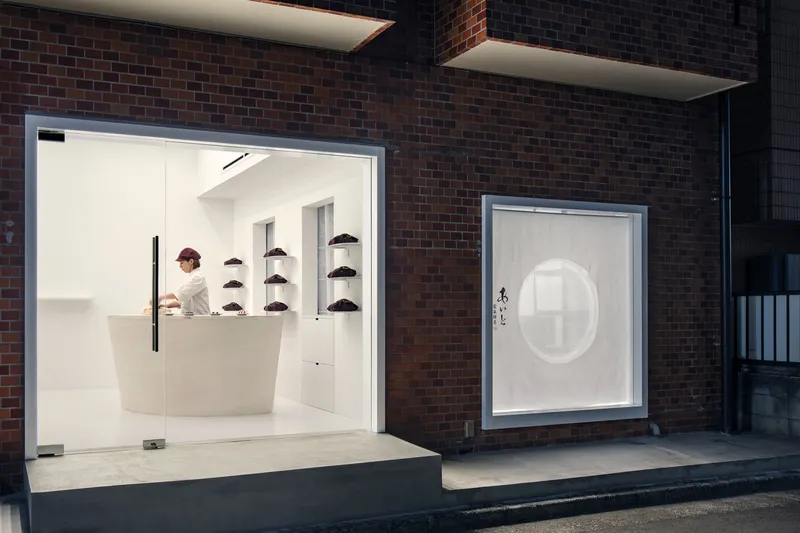
The shopfront is a single plane of glass set into a dark brick facade, the curved counter visible through the opening even when the shop is closed. At night, the interior illumination turns the storefront into a glowing vitrine, the white counter and grey fabric screen contrasting sharply against the surrounding masonry. The circular window punched into the brick facade above the shopfront aligns with the fabric's circular cutouts, creating a visual echo that ties the exterior and interior together.
This restrained street presence is a conscious rejection of the visual noise typical in Tokyo's commercial districts. No blade sign, no banner, no neon. The shop announces itself through materiality and light rather than graphic branding, a move that signals confidence in the product and the spatial experience. The tiled street and narrow lane context reinforce the shop's intimacy; this is a neighborhood destination, not a tourist-facing spectacle.
Why This Project Matters
Aito-Denkimochiten demonstrates that minimalism in retail architecture is not about emptiness but about focus. By reducing the spatial elements to a single counter, a fabric screen, and a glass shopfront, SPEC created a stage where the Daifuku and the artisans making them become the primary content. The architecture does not compete for attention; it frames and amplifies the existing cultural value embedded in the confectionery tradition. This is a fundamentally different approach from retail design that tries to overlay narrative through applied decoration or thematic gestures.
The project also shows how a small urban intervention can connect production and consumption without resorting to the open kitchen model that has become standard in contemporary food retail. The lace fabric threshold is a more nuanced device, offering controlled visibility that respects both the customer's desire to see process and the artisan's need for a functional workspace. In a city where every square meter counts, this calibrated transparency is a spatial strategy worth studying, applicable well beyond the confectionery typology.
Aito-Denkimochiten, designed by SPEC, Tomigaya, Shibuya City, Tokyo, Japan, completed 2023. Photography by kenta hasegawa.
About the Studio
Share Your Own Work on uni.xyz
If projects like this are the kind of work you want to make, uni.xyz is a place to publish your own, find collaborators, and enter design competitions.


Popular Articles
Popular articles from the community


longwave studio Reorganizes a 112 m² Tainan Apartment Around the Daily Routines of a Family and Two Cats
In Tainan, Taiwan, birch plywood, rust-red furniture and a freestanding plaster wall link arrival, storage, work and family life in one apartment.

Juan García Correa, John González and Claudia Rueda Sink a Circular Amphitheater into a Manizales Engineering Building
On the La Nubia campus in Manizales, Colombia, the S1 Building folds labs and offices into a hillside of ramped lawns that double as a campus route.

U.GA Architects Wraps an Oval Rooftop Pool in Curved Board-Formed Concrete on Busan's Jeollidan-gil
In Busan's Jeonpo-dong, a 454 m² mixed-use block stacks a neighborhood facility, guest rooms and an oval rooftop pool inside spiraling concrete walls.

Architekt Andreas Gruber Scatters 23 Dark Timber Chalets Across a South Tyrolean Forest Edge
In Molini di Tures, Amonti Chalets breaks a resort into a hamlet of gabled timber houses, with parking, storage and services pushed into the slope.

Similar Reads
You might also enjoy these articles


Hodi-Mandai Geram
Project Function: Preservation and revitalization of the Intangible heritage and socio-spatial identity of the Hodi by Housing, Cultural Memory Center, Sacred Grove, landscape, local tourism economy


Olio Towers: A Mid-Rise for Performers That Fuses Housing, Rehearsal, and Stage
Located blocks from Houston's Theater District, this modular tower stacks living units around a central performance atrium.

Oasis: Modular Green Housing Carved into Dhaka's Urban Fabric
A shortlisted Plugin Housing entry reclaims unauthorized settlements in Dhaka with stepped concrete volumes, green roofs, and ventilation-driven design.

Black Hole: A Floating Megastructure for the Post-Physical Era
Emiliano Mazzarotto envisions a spherical, self-scaling arena where e-sports, digital hotels, and holographic stadiums replace traditional public space.

Explore Architecture Competitions
Discover active competitions in this discipline

Challenge to reimagine the Iron Throne

Photograph architecture without architects

Illustrate the lost glory of Angkor Wat - Render Challenge

Design challenge to reuse E-waste
Comments (0)
Please login or sign up to add comments
No comments yet. Be the first to comment!