

AJC Architects Launches a 42-Meter Weathering Steel Lookout Over a Century-Old Sydney Quarry
Perched on the edge of Hornsby Quarry, a cantilevered viewing platform choreographs a procession from dense bushland to volcanic void.


For over a century, Hornsby Quarry sat inaccessible on Sydney's northern edge, a geological wound carved into a volcanic diatreme and left to flood and regenerate. Now part of a 60-hectare landscape-led regeneration effort, the site demanded an intervention that could mediate between deep geologic time and the immediacy of public experience. AJC Architects, working alongside Clouston Associates and Hornsby Shire Council, answered with The Southern Lookout: a 42-meter-long elevated viewing platform built from weathering steel, balanced on a tripod of angled columns, and cantilevered six meters over the quarry's edge.
What makes this project genuinely compelling is not the cantilever itself, though it is structurally impressive, but the choreography it stages. Visitors do not simply arrive at a view. They are drawn through a tightly framed sequence, passing beneath, within, and finally above the forest canopy before the quarry void and its flooded basin reveal themselves at the terminus. The platform borrows its aesthetic directly from the industrial operations that shaped the site, treating the quarry's utilitarian past as source material rather than something to suppress.
Arriving Through Industrial Portals


The entrance sequence sets the tone. Robust steel portals, flanked by gabion retaining walls packed with local stone, frame the approach with an unapologetic industrial weight. Corten panel walls close in on either side, directing the body forward while establishing a material language that references the quarry's operational history. There is nothing delicate about the gesture, and that is precisely the point.
The weathering steel is allowed to develop a deep, earthy patina over time, its surface shifting in color and texture with the seasons. Against the warm afternoon light, the handrail and wall panels register as geological layers in their own right. The material choice is not merely aesthetic; it eliminates the need for painted maintenance on a structure embedded in sensitive bushland and ensures that the platform ages alongside the regenerating landscape rather than against it.
A Procession Through the Canopy


The 42-meter linear platform rises along a steeply sloped site, and AJC Architects exploit the topography to create a procession that shifts from enclosure to exposure. At its start, the walkway is nestled among mature eucalyptus and pine, its steel frame slicing between branches. Views are deliberately contained, filtered by foliage and the narrowness of the grated steel floor. Visitors become aware of the falling terrain beneath their feet before they see where they are headed.
The grated mesh deck is critical to this experience. It provides a constant, slightly unsettling awareness of the slope dropping away below while keeping the visual focus directed forward along the platform's axis. The combination of transparency underfoot and opacity at eye level turns the walk itself into an event, not merely a means of reaching the view.
Structural Precision on a Sensitive Slope


The engineering achievement here is quietly radical. The entire platform is anchored into the embankment and balanced on four angled columns supported by a single central footing, achieving an 18-meter span and a 6-meter cantilever. The tripod-like column arrangement minimizes ground disturbance on a geologically and ecologically sensitive slope, touching the earth at as few points as possible while supporting the full weight of the heavy steel sections.
Viewed from below, the structural logic is legible. Diagonal cross bracing, heavy steel beams, and timber deck boards read as an honest assembly. Nothing is concealed. The industrial detailing communicates how forces travel through the structure, giving the lookout the directness of infrastructure rather than the ambiguity of a sculptural object. The underside of the bridge reveals translucent panels alongside the mesh decking, filtering light downward and reducing the platform's shadow footprint on the understory below.
The Cantilever and the Quarry Void


The sequence reaches its conclusion at the cantilevered terminus, where a glazed viewing box pushes out over the edge and the full quarry void opens up. The volcanic diatreme, the flooded basin, the vegetated rock walls, and the forested ridges beyond are all suddenly available in a single panoramic frame. After the tightly controlled procession, the release is visceral.
From a distance, the cantilevered box reads as a precise incision into the landscape, its weathered steel cladding blending with the tonal range of the surrounding bushland while its sharp geometry declares its artificiality. The glazed end wall maximizes transparency at the point of maximum drama, turning the structure into a frame for the geological spectacle it overlooks.
Landscape as Context, Not Backdrop

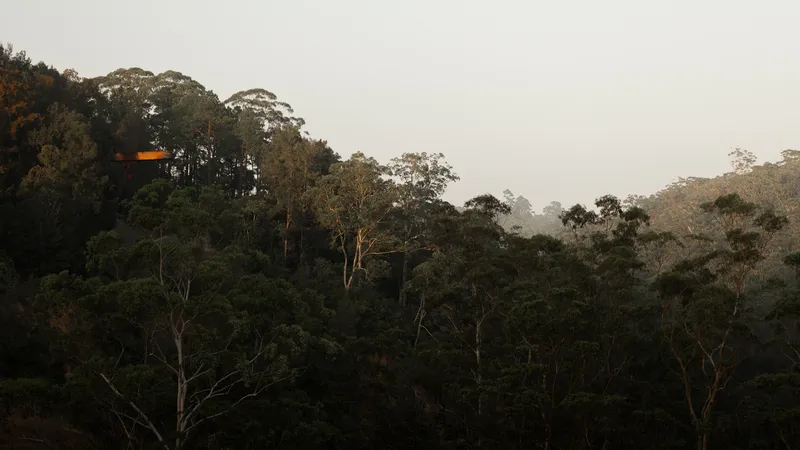
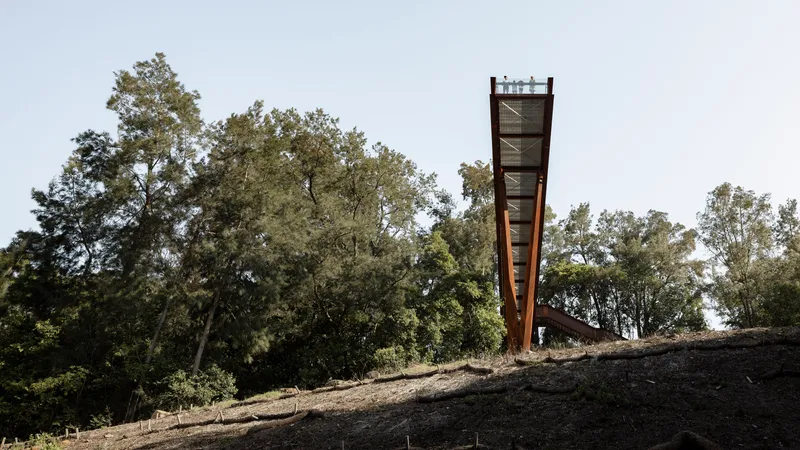
The quarry lake, with its still water reflecting vegetated rock walls and distant ridgelines, is the true subject of the project. The Southern Lookout exists to stage a confrontation with this landscape, not to compete with it. The decision to use weathering steel, gabion, and grated metal ensures that the platform recedes materially while asserting itself spatially. It is simultaneously robust and self-effacing.
Seen in misty morning light from across the valley, the lookout barely registers above the canopy, a thin horizontal line emerging from the trees. The observation tower at the opposite end marks a vertical accent that orients visitors from a distance, but the dominant reading remains one of landscape first, architecture second. For a site that was inaccessible for more than a hundred years, this restraint is the right call.
Structural Details Up Close

At the detail scale, The Southern Lookout rewards close attention. The connection between the weathering steel frame and the diagonal timber deck boards is handled with a precision that communicates care without preciousness. Bolted connections are exposed, weld lines visible. The translucent panels embedded in the bridge deck create unexpected moments of filtered light when viewed from below, animating the underside of the structure and softening what could otherwise read as a blunt piece of infrastructure.
Plans and Drawings


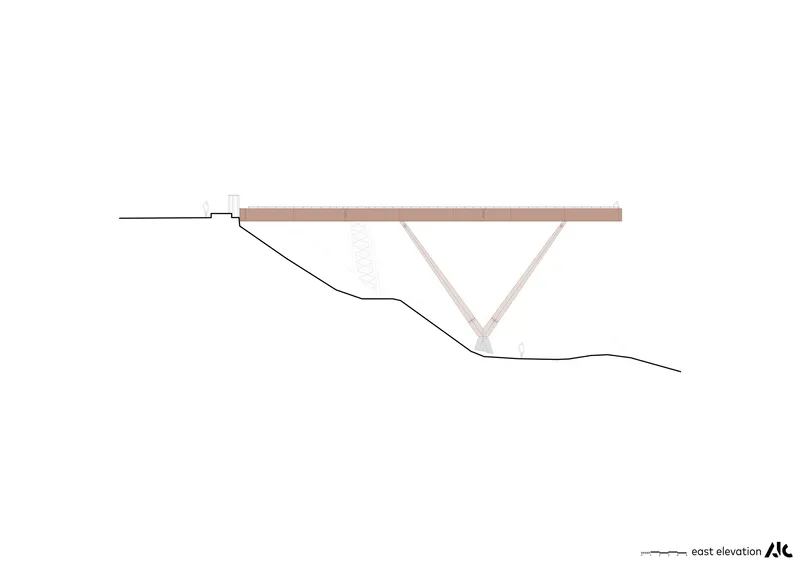
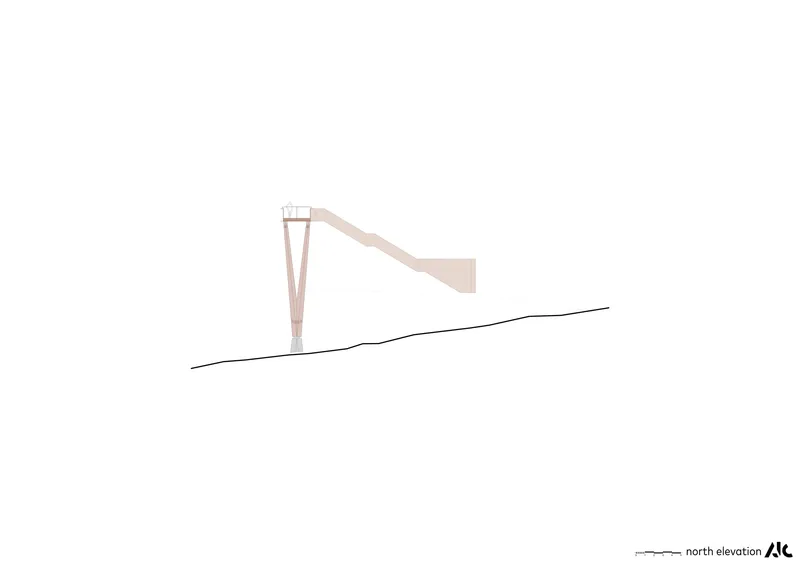
The site plan reveals how carefully the platform is threaded into the curved network of bushland paths and water bodies, connecting the larger trail system to the quarry edge without requiring extensive clearing. The elevation drawings make the structural logic explicit: the tall vertical tower anchors one end while the horizontal walkway extends outward, its angled support columns splaying to meet a single footing below. The west and east elevations show how the structure negotiates the steep terrain, rising from the slope on minimal points of contact. The north elevation captures the full drama of the cantilever, projecting the viewing platform out from a tapered vertical support into open air.
Why This Project Matters
Public lookout projects are easy to get wrong. They either overperform, turning into landmark objects that distract from the landscape they claim to celebrate, or underperform, reducing the experience to a guardrail and a sign. AJC Architects find a productive middle ground by treating the journey to the view as the primary design problem. The 42-meter sequence from gabion entrance to cantilevered terminus is a genuine spatial narrative, one that uses material, structure, and topography to build anticipation before delivering the payoff.
The project also sets a strong precedent for how architecture can participate in the regeneration of post-industrial landscapes. Rather than sanitizing the quarry's history with a polite timber deck, the platform embraces industrial materiality and structural honesty as a form of respect for the site's origins. The result is a piece of public infrastructure that is both legible and layered, engineered to touch the ground lightly while anchoring a place that was hidden from public life for more than a century firmly in the present.
The Southern Lookout by AJC Architects (lead architect: Lee Collard), in collaboration with Clouston Associates and Hornsby Shire Council. Located in Hornsby, Sydney, Australia. 200 m². Completed in 2026. Photography by Alexander Mayes.
About the Studio
Share Your Own Work on uni.xyz
If projects like this are the kind of work you want to make, uni.xyz is a place to publish your own, find collaborators, and enter design competitions.


Popular Articles
Popular articles from the community


graciastudio Turns a Viewless Tijuana Lot Inward Around a Courtyard of Concrete, Timber and Trees
In Tijuana, Jorge Gracia's GA2 House stacks a timber-clad private floor over exposed concrete and replaces a missing view with a planted interior patio.


Manzana Morphosis: Stretching Barcelona's Grid into a Living Landscape for 2050
A radical reworking of the Eixample manzana turns density into a tool for generous public space, vertical ecology, and environmental performance.

Opera on the Sea: Driftwood Logic Shapes a Timber Opera House on Estonia's Coast
Trevor Orgill's opera house translates the entangled drift of floating timber into a civic building where wood, water, and music converge.

Cube Design Draws an Ecological Corridor Between Two Shenzhen Hills with the Nankai Building
Beside Shenzhen's container docks, the Nankai Building pairs stacked balconies with a climbing green screen to connect two hillsides across its height.

Similar Reads
You might also enjoy these articles

LAVA Architecten Gives Vocational Education a Sawtooth-Roofed Face on a Mechelen School Campus
In Mechelen, Belgium, a 2,053 m² STEM school on a 6×6 m grid turns workshops and classrooms into rooms that can be rearranged as teaching changes.

KEMA Studio Turns a Derelict Marvila Attic into a 60 m² Lighthouse Apartment Above Lisbon
In Lisbon's Marvila district, a rebuilt roof, four skylights and two plywood volumes turn an unlivable attic into a bright home facing the Tagus.

Pixel Gardens: One Repeated Module Stacked Into a Terraced Social Housing Tower for Famagusta
Salem Bader's shortlisted housing tower builds a vertical neighbourhood from one repeated module, offsetting units to carve terraces, light and air.

Bao Huynh Watercolor Atelier: A Serene Art Retreat in Hội An
Bao Huynh Watercolor Atelier in Hội An blends multifunctional art spaces, sustainable design, local materials, and family-friendly living in a serene environment.

Explore Architecture Competitions
Discover active competitions in this discipline

Challenge to reimagine the Iron Throne

Photograph architecture without architects

Illustrate the lost glory of Angkor Wat - Render Challenge

Design challenge to reuse E-waste
Comments (0)
Please login or sign up to add comments
No comments yet. Be the first to comment!