
Al Rozana: A Community Campus Built on the Architecture of Collective Memory
A citadel reborn as a multi-sensory campus where vaulted arcades, fragrant planting, and folk song soundscapes reactivate shared cultural identity.


What if architecture could function less like a building and more like a song passed between generations? Al Rozana takes its name from a traditional ship and an iconic folk song, both symbols of unity, trade, and historical endurance, and translates that lineage into built form. The result is a community campus designed to engage all five senses: sight through vernacular visual motifs, sound through local song soundscapes, smell through fragrant planting, touch through textured stone surfaces, and spatial awareness through the rhythms of vaulted arcades and open courtyards. Rather than preserving heritage behind glass, the project embeds it into the rituals of daily life.
Designed by Tuqa Albaddad and Waed Jibreel, Al Rozana was shortlisted in the Memory competition on uni.xyz. The proposal centers on the adaptive reuse of a surviving citadel structure, transforming it into a governmental building while wrapping it in a new orthogonal grid that supports commercial zones, healthcare facilities, recreational spaces, and cultural programming. It is, in the designers' framing, a living archive: architecture that captures camaraderie, cultural identity, and resilience in its very walls.
A Citadel at the Heart, a Grid as its Pulse
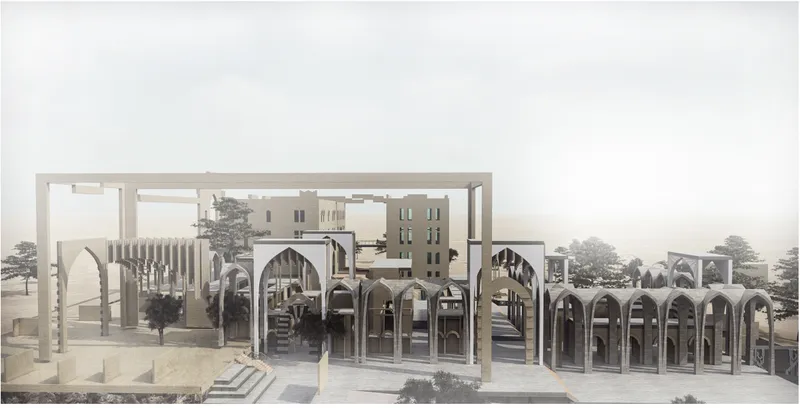
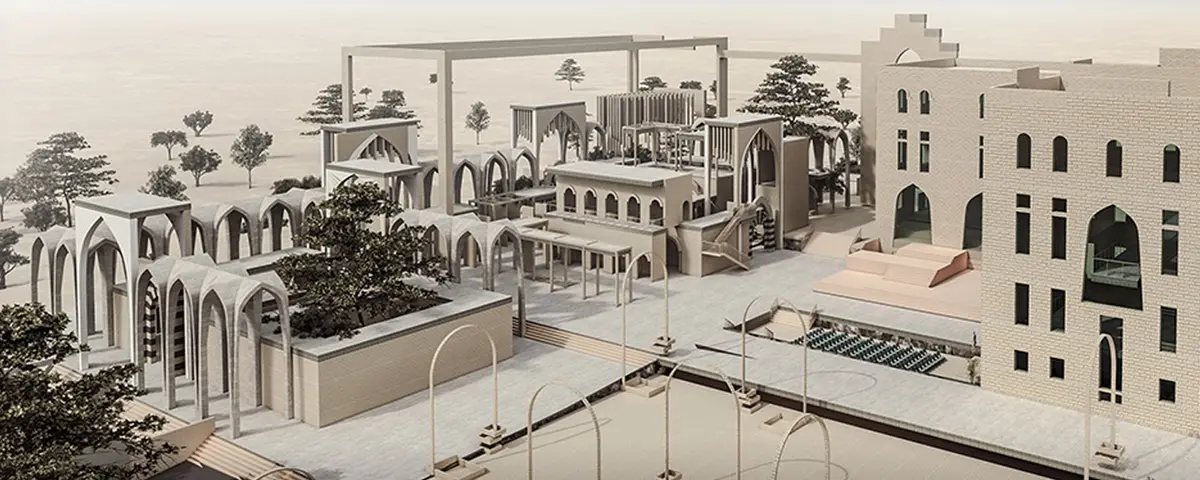
The aerial view reveals the project's organizational logic: the preserved citadel sits at the core of the plan, and a contemporary structural grid radiates outward from it. Repeating arched concrete structures and frame pergolas establish a vocabulary that is unmistakably rooted in Middle Eastern architectural heritage while maintaining a disciplined, modular clarity. The grid is not arbitrary; it draws its lines from the original architecture, creating harmony between old and new rather than forcing a confrontation.
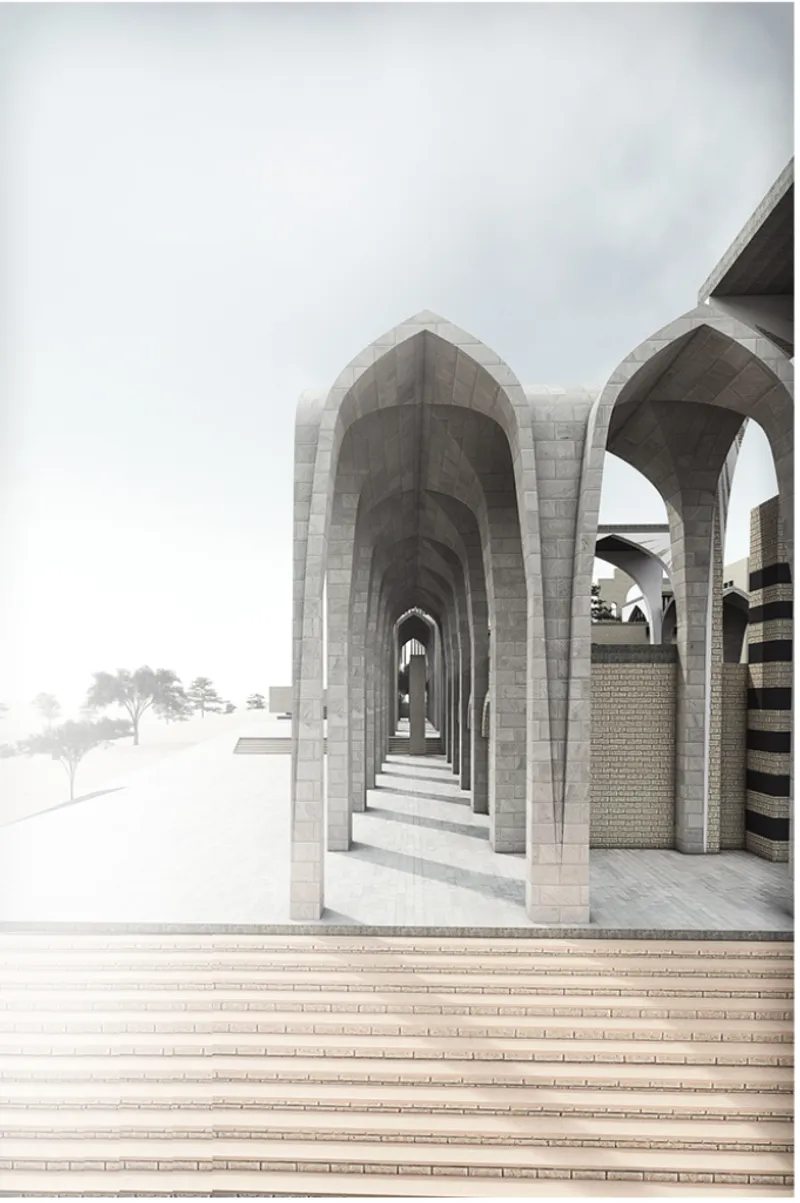
At ground level, that logic becomes visceral. A colonnade of pointed concrete arches creates a deep, receding covered walkway above wide tiled steps, guiding movement with a rhythm that feels both ceremonial and casual. These arcades are not decorative flourishes. They regulate light, define thresholds between indoor and outdoor realms, and establish the kind of spatial cadence that makes a place feel known even on a first visit. The phased approach to the design, layering a site profile, sensory elements, functional modules, and civic infrastructure, ensures that the campus can evolve without losing its identity.
Elevations That Read Like Cultural Stratigraphy
The elevation drawing communicates the project's ambition more directly than any render could. Multiple building volumes sit alongside scattered tree silhouettes, each arched element registering as a distinct note in a larger compositional score. The proportions are deliberate: monumental enough to signal civic importance, restrained enough to avoid spectacle. What strikes here is the integration of landscape. Trees are not afterthoughts pushed to the periphery; they occupy the same visual plane as the buildings, reinforcing the campus's commitment to sensory richness and ecological presence.
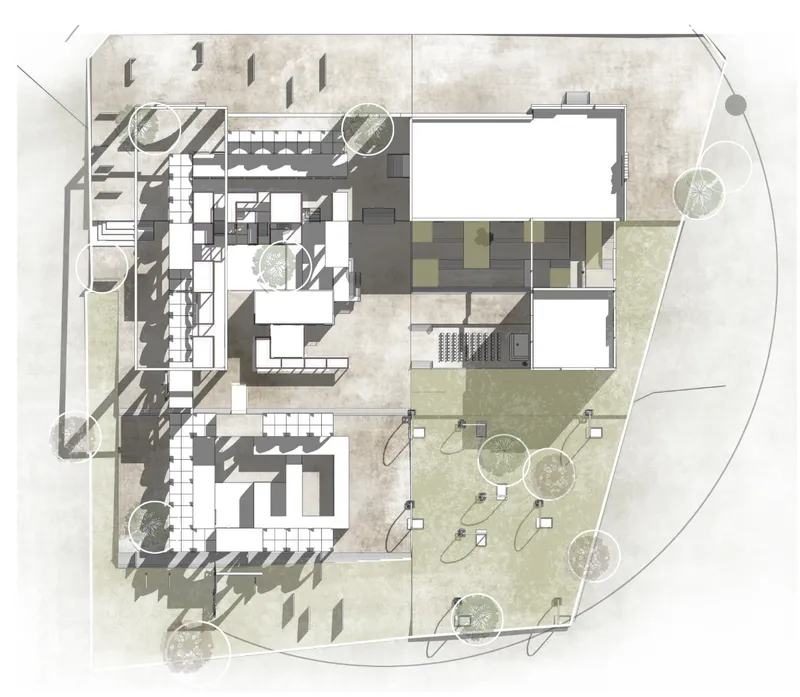
The rendered site plan confirms this reading. Clustered building footprints surround courtyards of varying scales, while the surrounding landscape stitches the campus into its wider context. The zoning strategy balances formality with flexibility: defined commercial and healthcare zones coexist with looser recreational spaces such as playgrounds and seating areas. Albaddad and Jibreel have clearly thought about how the campus will be inhabited over time, not just how it will look on opening day.
Courtyards as Breathing Rooms, Arches as Memory Devices

Three rendered views and white model perspectives reveal the intimate scale of the courtyards, spaces designed explicitly for gathering and storytelling. Arched openings frame views into and out of these rooms, controlling visual connections while maintaining porosity. Water elements and vegetation appear as recurring motifs, offering what the designers describe as symbolic regeneration: markers of life and continuity within a campus built on the memory of endurance. The white model strips the design to its essentials, confirming that the spatial power of Al Rozana does not depend on material finish but on proportional intelligence.
Section Cuts That Reveal Light as a Design Material

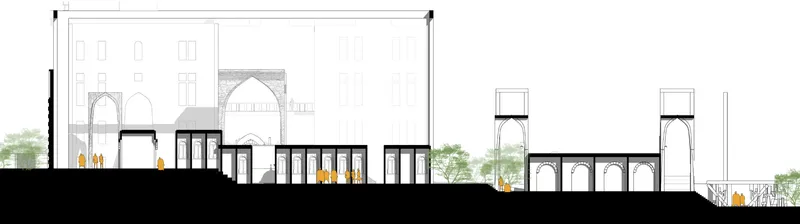
Elevation and section drawings expose the masonry facade with its arched openings and the interior program spaces nested within. Light penetrates deep into these interiors, casting dynamic shadows that animate the built form throughout the day. The sections show how the original citadel's structural logic informs the new construction: thick walls, deep reveals, and a careful orchestration of aperture sizes that modulate both climate and atmosphere. Governmental functions occupy the adapted historic structure, merging civic duty with cultural preservation in a single gesture.
The sectional intelligence here goes beyond thermal performance. By varying ceiling heights, floor levels, and the depth of arched bays, the designers create distinct experiential zones within a unified architectural language. Columned walkways reinforce circulation patterns that mirror the historical context, while the transition from enclosed room to semi-covered arcade to open courtyard follows a gradient of intimacy that supports everything from private reflection to communal celebration.
Why This Project Matters
Al Rozana resists the temptation to treat cultural heritage as a frozen artifact. By designing a campus that layers adaptive reuse, multi-sensory engagement, and community infrastructure onto a surviving citadel, Albaddad and Jibreel propose a model where memory is not something you visit but something you inhabit. The project's participatory design ethos, shaping public spaces around communal activities and festivals, ensures that the architecture becomes an agent of healing and empowerment rather than a monument to loss.
In a moment when so much heritage architecture faces erasure through conflict, neglect, or clumsy modernization, the real value of Al Rozana lies in its insistence that preservation and evolution are not opposites. The orthogonal grid respects the citadel's geometry. The vaulted arcades speak the language of the region without quoting it verbatim. And the functional program, spanning commerce, healthcare, governance, and recreation, guarantees that the site stays alive. Memory, this project argues, survives not in museums but in the daily act of occupation.
View the Full Project
About the Designers
Designers: Tuqa Albaddad, Waed Jibreel
Enter a Design Competition on uni.xyz
uni.xyz runs architecture and design competitions year-round that reward proposals with spatial conviction and real site intelligence.
Project credits: Al Rozana by Tuqa Albaddad, Waed Jibreel Memory (uni.xyz).


Popular Articles
Popular articles from the community


graciastudio Turns a Viewless Tijuana Lot Inward Around a Courtyard of Concrete, Timber and Trees
In Tijuana, Jorge Gracia's GA2 House stacks a timber-clad private floor over exposed concrete and replaces a missing view with a planted interior patio.


Singing Woman: An Opera House That Performs Before the Curtain Rises
Ovidiu Cristian Pavel's conceptual opera house translates Estonia's choral identity into a sculpted waterfront landmark facing the Baltic Sea.

FCC Arquitectura Expands a Portuguese Granite House with a Board-Marked Concrete Wing
In Portugal, JV House pairs a cleaned-up whitewashed and granite dwelling with a timber-shuttered concrete extension, courtyards and a garden pool.

ETEH Reworks the Shared Spaces of São Domingos School in Brazil Around Timber, Color and Hanging Plants
At São Domingos School in Brazil, 436 m² of hall, refectory and library are recast with timber joinery, a yellow and blue code and trailing greenery.

Similar Reads
You might also enjoy these articles

Cube Design Draws an Ecological Corridor Between Two Shenzhen Hills with the Nankai Building
Beside Shenzhen's container docks, the Nankai Building pairs stacked balconies with a climbing green screen to connect two hillsides across its height.

Praksis A and Studio Sted Bend a Red Timber Cabin Across the Granite of Norway's Southern Coast
On the southern Norwegian coast, a 105 m² cabin follows the rock on slender posts, pairing red cladding outside with pine, brick and plywood within.

David Ortega Stacks a Two-Story Mexico City Penthouse Around a Steel Stair and a Pergola-Shaded Roof Terrace
In Colonia Roma, a 300 m² penthouse uses oak joinery, a planted steel stair and a slatted roof pergola to make a new-build apartment feel like a house.

PARALELA and LB2 Thread a Public Walkway Through the Base of a Las Condes Residential Tower
In Las Condes, Santiago, the Hamlet Building gives its fenceless ground floor to a 70-metre wooded passage linking two streets and the metro.


Comments (0)
Please login or sign up to add comments
No comments yet. Be the first to comment!