
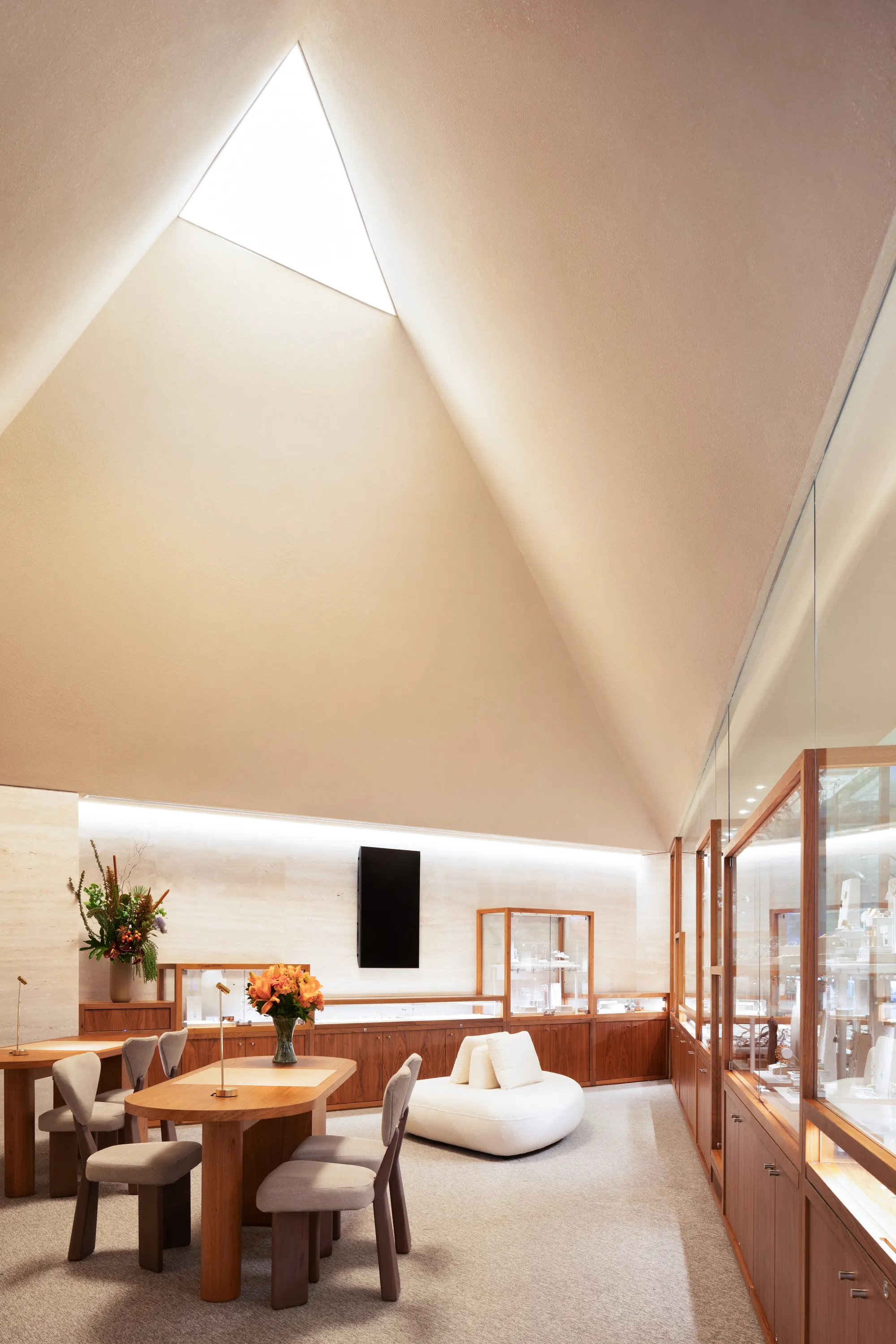
Alan Chu Carves a Jewelry Store from Crystal Geometry in São Paulo
Orit Store channels the lapidation of gemstones into travertine, walnut, and angled ceilings across 140 square meters of retail space.


Orit has been buying, selling, and exchanging luxury watches and jewelry in Brazil since 1958. When the brand commissioned Alan Chu and Cristiano Kato to design a new São Paulo outpost, the architects found their concept not in the display case but in what sits inside it. Crystals, before they become rings and pendants, are rough polyhedra shaped by pressure and fracture. Chu and Kato treated the 140 square meter retail floor the same way: they cut it into angular volumes, folded the ceiling into faceted planes, and wrapped the whole thing in Roman travertine the color of raw quartz.
The result is a store that feels less like a showroom and more like the interior of a geode. Every surface angle references the lapidation process, yet the palette of sand-toned stone, warm walnut millwork, and linen curtains keeps the space from tipping into theatrical excess. It is rigorous geometry softened by material warmth, and that tension is the project's real luxury.
Entering the Geode
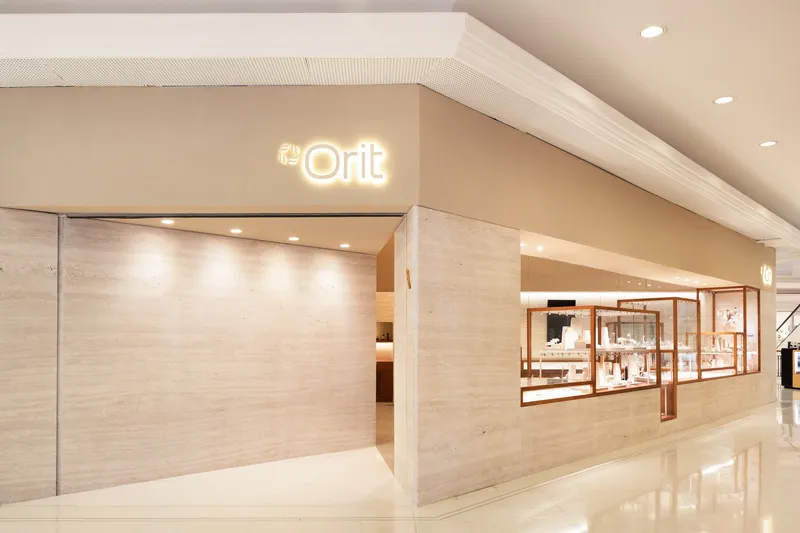
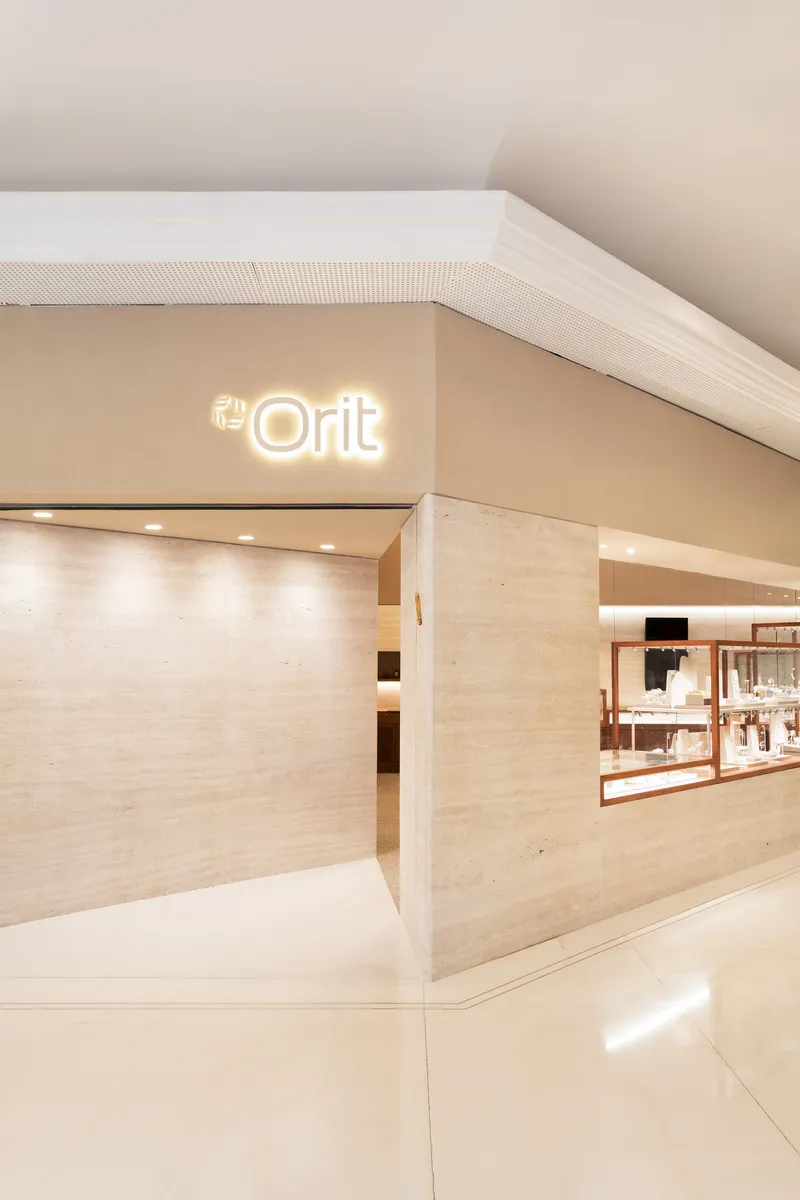
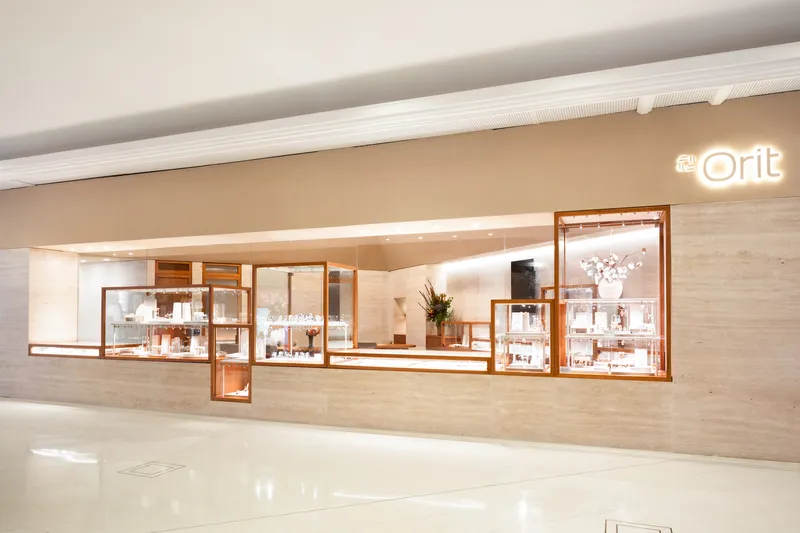
The storefront reads as a single monolithic block of pale travertine, its surface barely interrupted by illuminated signage and a deeply recessed entry. Rather than a transparent glass wall inviting passersby to window-shop, Chu chose opacity. The facade withholds the interior, turning the act of entering into a deliberate crossing from commercial corridor to controlled environment. A ribbed ceiling detail at the threshold compresses the space just enough to make the release inside feel generous.
That compression is more than a flourish. By narrowing the entry volume and lowering the ceiling with pronounced ribs, the architects set up a spatial sequence borrowed from sacred architecture: narthex before nave. When the ceiling lifts and the light shifts from artificial to a warm backlit glow, the customer is already emotionally primed. The polished white floor tiles amplify the effect, reflecting ceiling geometry downward and doubling the sense of height.
Light as Lapidation
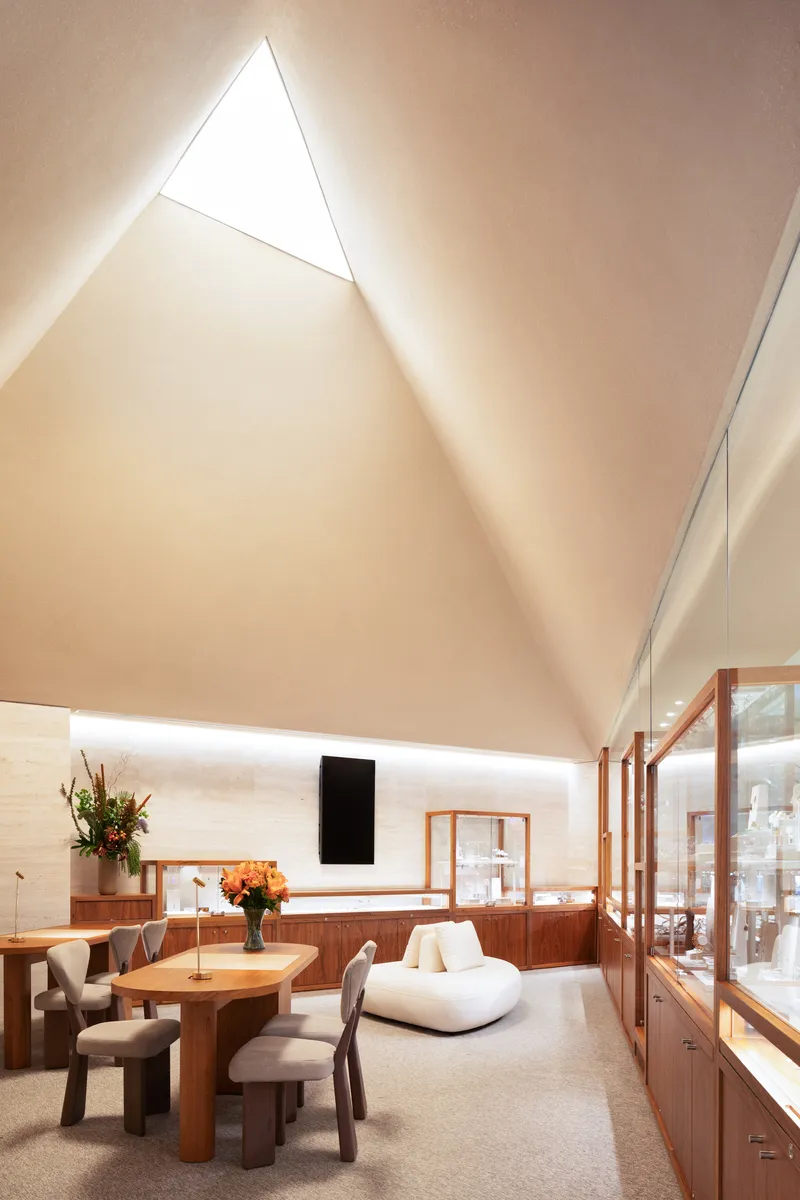
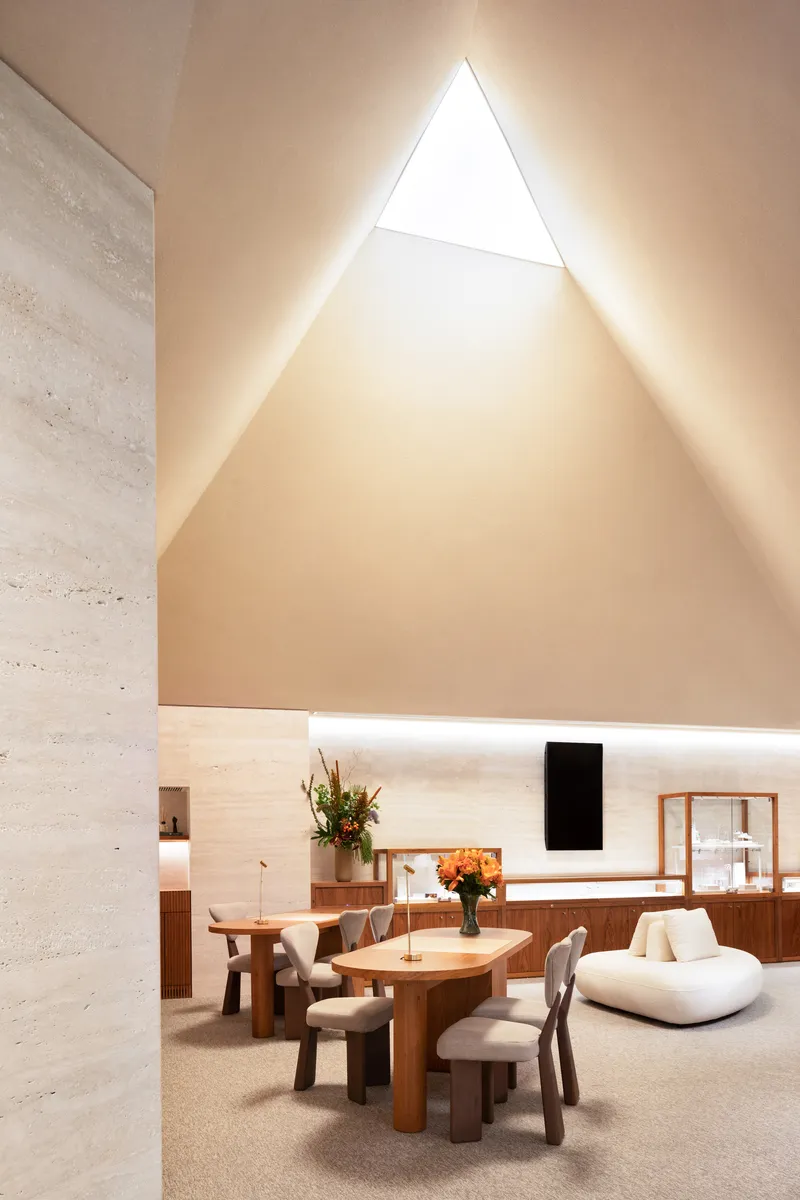

The triangular skylight at the peak of the pitched ceiling is the store's conceptual centerpiece. Backlit coves radiate from it like the facets of a brilliant-cut diamond, casting even, diffused illumination across the vaulted ceiling below. Studio 220v handled the lighting design, and their restraint is notable: there are no spotlights competing for attention, no theatrical color temperatures. The entire upper volume glows with a single warm tonality that makes the travertine walls seem to generate their own light.
For a jewelry store, where precise color rendering can make or break a sale, this ambient strategy is a bold choice. It trusts the individual vitrine lighting to do the close-up work while the architecture handles atmosphere. The effect is that of standing inside a lantern rather than under a lamp.
Walnut and Stone


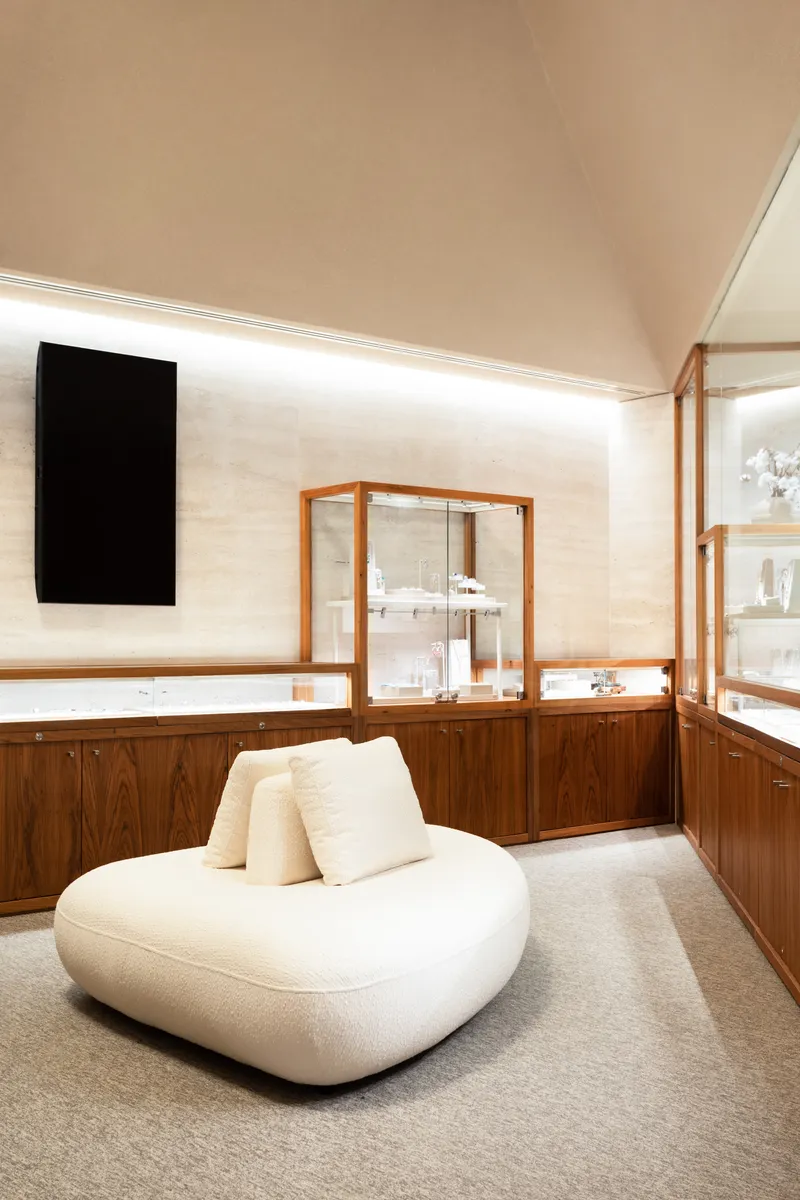
The material dialogue between Roman travertine and walnut millwork carries the entire interior. Staggered timber-framed glass display cases sit within the stone walls like specimens in a geological cabinet, their proportions deliberately varied so the eye never settles into a predictable rhythm. Concealed linear lighting above each case throws a thin wash down the travertine, highlighting the stone's natural veining without overpowering the objects on display.
At the built-in desk alcoves, ribbed glass cabinet doors add a third material texture, softening the view of stored inventory while catching and scattering the ambient glow. LED strip lighting integrated into shelf edges provides task illumination for appraisals and close inspection, a practical necessity dressed in the same restrained language as everything else. The credenza along the far wall, paired with a horizontal clerestory window, introduces the only slice of natural daylight at eye level, grounding the otherwise hermetic space.
Comfort Geometry


Luxury retail depends on dwell time, and Chu and Kato designed seating zones that reward lingering. Curved banquettes wrap white pedestal tables, while angled ceiling planes overhead create intimate sub-volumes within the larger triangular plan. A ribbed glass partition separates one seating cluster from the next, offering acoustic and visual privacy without hard walls. The upholstery is understated, letting the architectural envelope remain the dominant sensory experience.
Fresh floral arrangements on timber tables beneath the linear skylight soften the geometry and introduce organic color into the sand-toned palette. These are not decorative afterthoughts; they occupy the exact visual axis where the ceiling ridge meets the wall niche, drawing the eye upward and reinforcing the room's sectional ambition. The flowers do in miniature what the crystals do at geological scale: they introduce complex form within an ordered field.
Texture and Detail

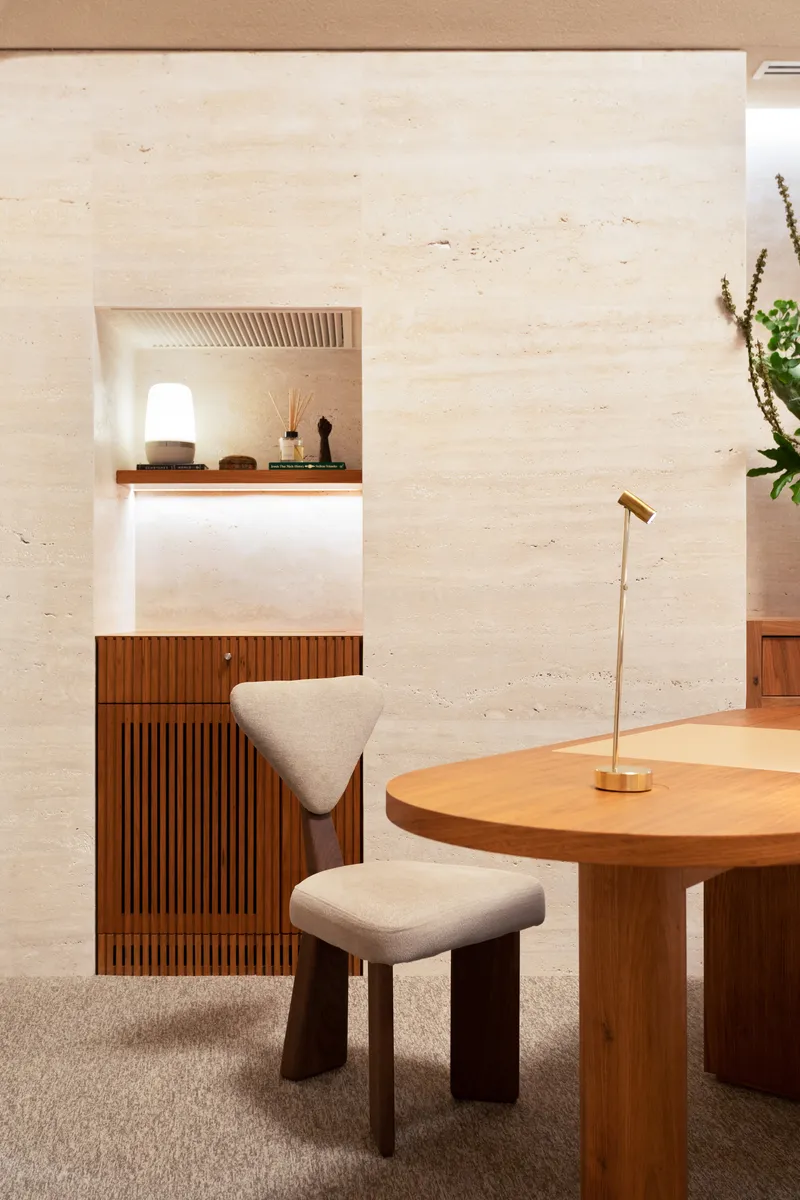

Rammed earth walls appear at strategic moments, introducing a coarser, more geological texture that contrasts with the polished travertine. Paired with walnut cabinetry and circular tables, these surfaces recall the uncut side of a gemstone: raw, layered, warm. The triangular upholstered stools beside these walls are compact and deliberately sculptural, their faceted forms echoing the ceiling above.
Reeded glass panels recur throughout, functioning as both spatial dividers and light modulators. Where the walnut cabinetry meets these panels, a thin shadow gap separates the two materials cleanly, a detail that speaks to the precision of construction by Hauz Engenharia. Nothing is fudged. Every junction is either a deliberate reveal or a flush alignment, and the consistency across 140 square meters gives the space a jewel-box precision that mirrors the merchandise it houses.
The Private Counter
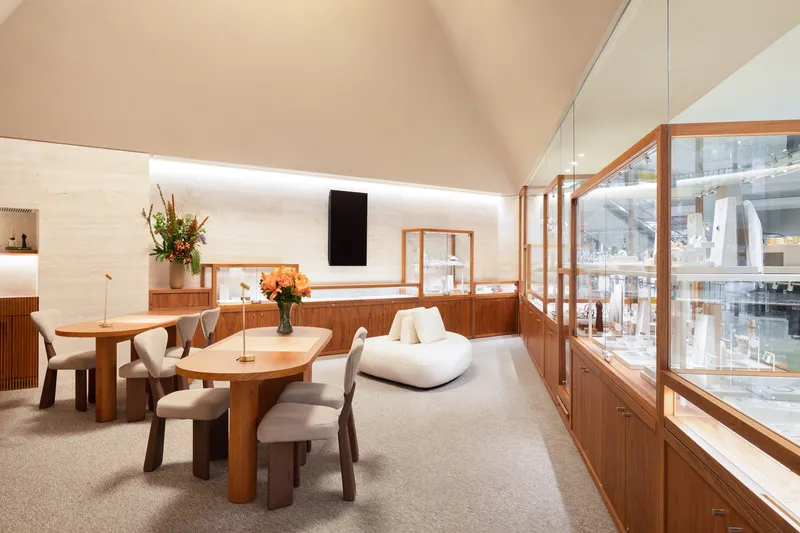
A clerestory window along one wall washes the upper portion of the timber-framed display cases with controlled daylight. Below, the proportions shift to a more domestic register: desk-height surfaces, upholstered chairs, and a sense of enclosure that encourages one-on-one consultation. The transition from the open vaulted center to these tighter peripheral zones follows the fractal logic of the concept. The plan is not a simple open floor; it is a series of nested geometries, each scaled to a different type of interaction.
Plans and Drawings

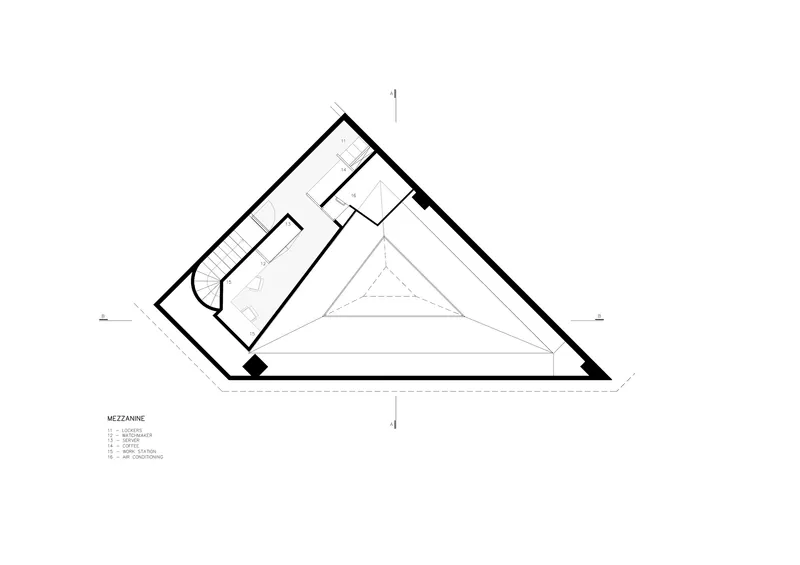


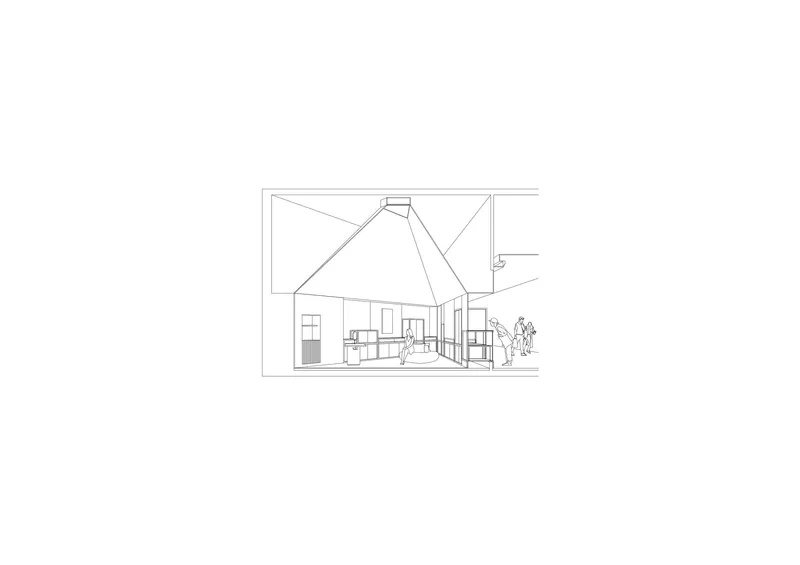
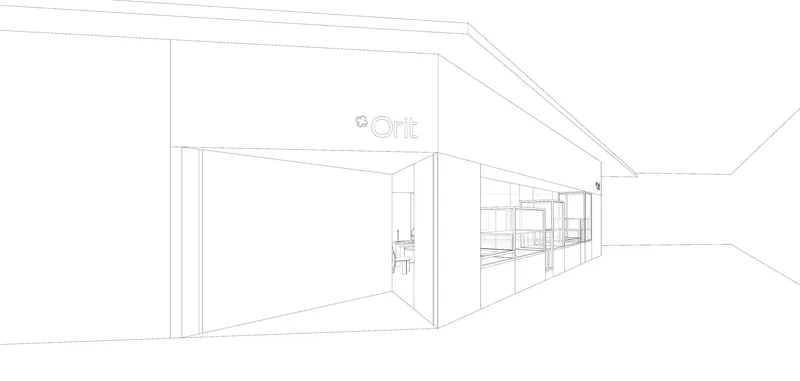

The ground floor plan confirms the triangular geometry that drives the entire project: a faceted perimeter wrapping workstations, vitrines, and a service core into a tight, efficient diagram. The mezzanine plan reveals a secondary level nested within the pyramidal roof, extending the usable program upward without adding footprint. Sections through the pitched roof volume show how the architects calibrated ceiling height to create spatial compression at the perimeter and release at the center, a strategy legible even in the perspective sketches, where figures stand beneath the pyramidal ceiling like visitors inside a crystal cavity.
The elevation drawing of the glazed facade with gridded windows and central entry door shows an alternative reading of the project: from outside, it is restrained, almost austere. The drama is entirely internal, reserved for those who step through the door. That deliberate contrast between exterior modesty and interior intensity is one of the project's strongest architectural decisions.
Why This Project Matters
Luxury retail architecture too often defaults to one of two modes: the white-cube gallery or the maximalist spectacle. Orit Store sidesteps both by grounding its extravagance in a single, legible concept. The idea that a jewelry store should feel like a cut stone is not especially novel, but the rigor with which Chu and Kato executed it is. Every ceiling angle, every material junction, every lighting decision traces back to the logic of lapidation, and the consistency gives the 140 square meter space a coherence that larger, more lavishly budgeted projects often lack.
More broadly, the project demonstrates what can happen when an architect treats a commercial brief as an opportunity for genuine spatial invention rather than brand decoration. Orit did not get a logo applied to a generic shell; it got an environment that embodies, at an architectural scale, the same processes that give its merchandise value. Pressure, precision, and the patient removal of everything unnecessary.
Orit Store by Alan Chu and Cristiano Kato. São Paulo, Brazil. 140 m². Completed 2022. Photography by Isabela Mayer.
About the Studio
Share Your Own Work on uni.xyz
If projects like this are the kind of work you want to make, uni.xyz is a place to publish your own, find collaborators, and enter design competitions.




Popular Articles
Popular articles from the community


The Earth Pod: 3D Printed Homes for Resilient Refugee Communities
The Earth Pod reimagines refugee housing through 3D printed homes made from clay, combining resilience, self-sufficiency, and rapid shelter.

Riyadh For All: Intergenerational Urban Design for Active Aging in Rabat
Riyadh For All reimagines urban design in Rabat with intergenerational co-living, adaptive courtyards, and Moroccan cultural exchange today.

Hill & Cross Opera: Sculptural Opera House Architecture Shaped by Tallinn’s Landscape and Identity
Hill & Cross Opera reimagines opera house architecture in Tallinn through its sculptural hill, civic plaza, glass wave and a luminous cross.

Conexión: Biophilic Design Reimagines High-Rise Living in Hong Kong
Conexión reimagines high-rise living in Hong Kong through biophilic design, green facades, shared spaces, daylight, water and nature within.

Similar Reads
You might also enjoy these articles

Bao Huynh Watercolor Atelier: A Serene Art Retreat in Hội An
Bao Huynh Watercolor Atelier in Hội An blends multifunctional art spaces, sustainable design, local materials, and family-friendly living in a serene environment.

Atelier Macri Concept Store Interior Design by CASE-REAL
Atelier Macri store features a "ko" counter, walnut wood details, cork displays, blending retail, gallery, and seamless customer experiences.

Manuel Vargas Izquierdo Stadium and High-Performance Sports Center: Architectural Excellence in Jalpa de Méndez
The Manuel Vargas Izquierdo Stadium blends sustainable design, inclusive sports facilities, and cultural-inspired architecture, revitalizing Jalpa de Méndez’s public spaces.

KAKR Buluh Awar Hall: Revitalizing Community and Ecology Through Bamboo Architecture
Community built bamboo hall revitalizes Buluh Awar village, empowering youth, restoring ecology, celebrating vernacular craftsmanship through sustainable architecture and culture.

Explore Commercial Buildings Competitions
Discover active competitions in this discipline


Challenge to design luxury tourism on rails


VR headsets Storefront design competition

Designing a staircase for a client
Comments (0)
Please login or sign up to add comments
No comments yet. Be the first to comment!