

Aleppo: A Tangible Heritage: Remaking the Civic Ground at the Foot of the Citadel
A phased placemaking plan replaces the Grand Serail with memorial walls, gardens and markets, turning the citadel's foot into a civic room for Aleppo.


Aleppo's citadel has watched over the city for centuries, yet the ground at its base has never become the public room it deserves to be. This proposal starts from that gap. It does not add a monument to a city already full of them. It removes one: the Grand Serail. It also reprograms the Justice Palace and hands the freed ground back to the people who live around it. The result is a regeneration plan that treats memory as a civic activity, something practised daily in markets, gardens and reading rooms rather than kept behind glass.
Designed by Maysa Sarieddine, Shantal Ayoub and Mariam Dandachi, the project received an Honorable Mention in the Memory competition on uni.xyz. The team frames their approach as "Place-Re-Making: A Cultural-Led Regeneration". The site is meant to hold three things at once: a centre for memorialising heritage, a place to honour lives lost in the war, and a stage for the ordinary rituals of urban life. Holding grief and everyday life in the same open ground is the project's most demanding ambition, and its most convincing one.
A Rust-Red Wall That Turns Remembrance Into a Route
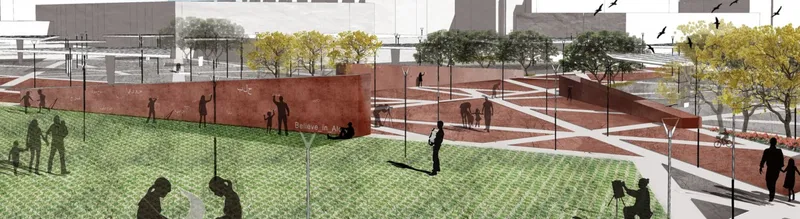
The opening rendering sets the tone with one gesture: a rust-red wall curving through lawn and paved plaza, with visitors walking alongside it. It works as a path rather than a barrier. The brief calls for memorial walls, green spaces and exhibitions to reinforce heritage pride, and this wall shows how that can happen without solemn isolation. You follow it, you lean on it, you pass it on the way somewhere else. Remembrance becomes part of movement instead of a destination you must choose to visit.
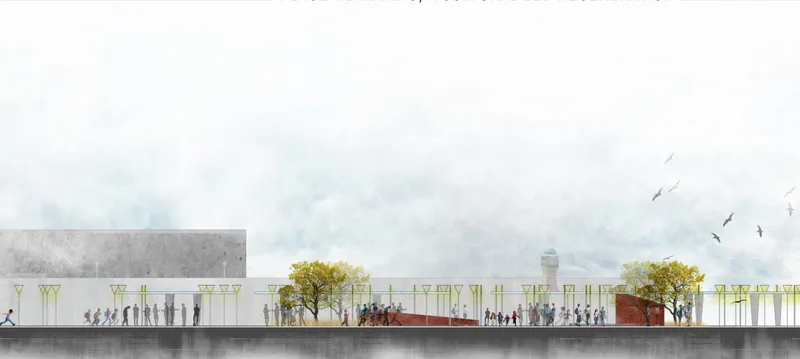
The elevation pulls back to show the full public frontage. Yellow-green posts set a rhythm along the edge, the red sloped wall anchors the composition, and crowds move beneath a misty sky. This drawing explains the team's idea of "active edges": a frontage designed to draw people in and keep circulation moving. The colour choices matter too. The red reads as a constant thread, while the lighter posts suggest the modular, adaptable structures the strategy depends on.
Diagonal Paths Cutting Through the Citadel's Forecourt
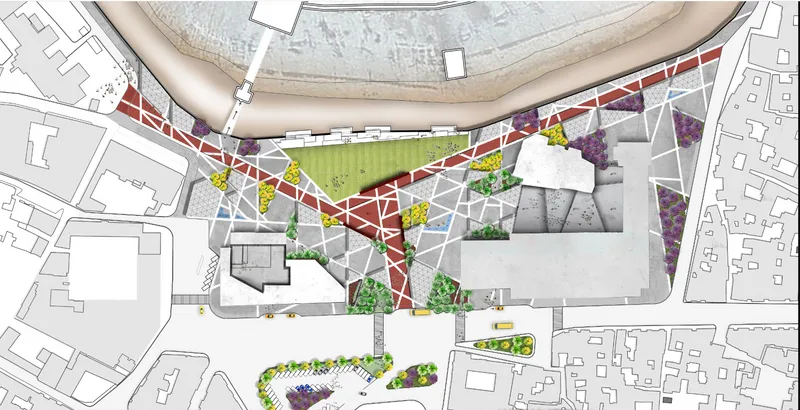
The site plan shows the project's structure most clearly. A red diagonal path network cuts across green lawns and planted beds, linking grey building footprints beside the large wall. The diagonals refuse the frontal, axial approach that a landmark like the citadel tends to impose. They create shortcuts, crossings and leftover pockets instead. Those pockets are where the team's "urban pocket" strategy takes hold: green spaces and cultural nodes holding markets, art and education.
The plan also shows how much of the site is given to layered vegetation. The team pairs vegetation layers with modular building designs as a strategy for flexibility, so the ground can change use over time without being rebuilt. For a city recovering from war, that adaptability is practical, not just aesthetic. A public space that can reorganise itself is better suited to an uncertain future than one fixed into a single image.
Food Carts and Canopies: Commerce as Civic Glue
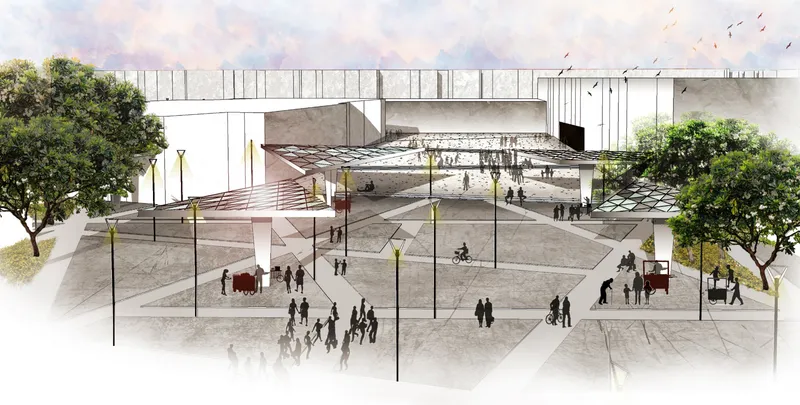
At dusk, the plaza fills with lamp posts, food carts and glazed canopies raised on tall piers, with trees framing either side. This is the most ordinary image in the set, and that is its strength. The team lists economic opportunity and social interaction alongside sensory experience as core aims of their placemaking, and the carts show what that looks like at street level. Small vendors, shade and light give people reasons to stay, and staying is what turns a historic forecourt into a living square.
This connects to the first implementation phase, "Stabilising the Community", which puts job training and advisory roles for restoration, temporary learning centres and health facilities first. The sequence is sensible. Before a site can celebrate culture, it has to support the people who will carry it, and modest infrastructure like canopies and market stalls is where that support becomes visible.
A Reading Room Under Blossoming Trees
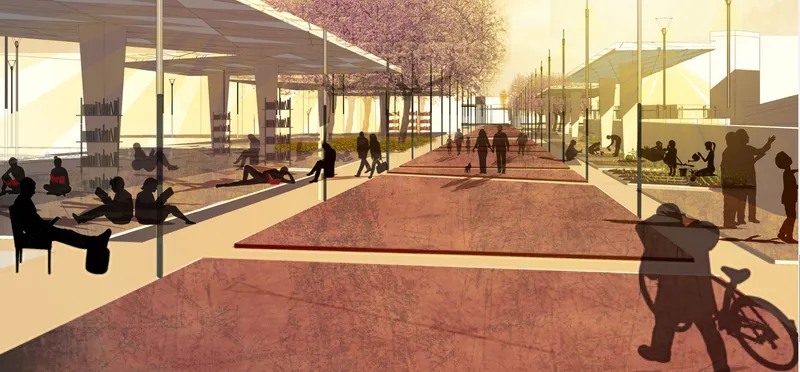
The final rendering moves into the second phase, "Shift to Culture". A red paved promenade runs beside a colonnaded canopy, and people read among bookshelves under blossoming trees in warm light. This is where exhibition spaces, workshops and cultural clubs take over from emergency functions. The colonnade gives the reading space a sense of enclosure without closing it off, so the library stays part of the promenade rather than a separate building you must enter.
The red paving continues the material language of the memorial wall, which quietly links the reading room back to the site's commemorative core. Remembering, learning and lingering share a single surface. The project argues, convincingly, that heritage survives best when it is used.
Why This Project Matters
Post-conflict reconstruction often swings between two extremes: faithful restoration that freezes a city in its past, or clearance that erases it. This proposal finds a third path. By removing the Grand Serail and reprogramming the Justice Palace, the team edits the site rather than rebuilding it. The citadel stays the protagonist, and the ground at its foot becomes a flexible civic platform where memory is woven into daily routine.
The phased strategy, which stabilises the community first and turns to culture second, shows a maturity rare in competition work. It recognises that cultural identity cannot be imposed through architecture; it has to be rebuilt by the people who hold it. Sarieddine, Ayoub and Dandachi give Aleppo a framework for that work: a red wall to follow, paths to cross, and shaded places to gather, read and remember.
View the Full Project
About the Designers
Designers: Maysa Sarieddine, Shantal Ayoub, Mariam Dandachi
Enter a Design Competition on uni.xyz
uni.xyz runs architecture and design competitions year-round that reward proposals with spatial conviction and real site intelligence.
Project credits: Aleppo: A Tangible Heritage by Maysa Sarieddine, Shantal Ayoub, Mariam Dandachi Memory (uni.xyz).


Popular Articles
Popular articles from the community


Opera on the Sea: Driftwood Logic Shapes a Timber Opera House on Estonia's Coast
Trevor Orgill's opera house translates the entangled drift of floating timber into a civic building where wood, water, and music converge.
Cloaked Colonization: A Mobile Underwater Habitat That Moves Like a Fish
Micah Abaya's shortlisted EHC Pacific entry reimagines ocean settlement as a dispersed network of self-sustaining architectural organisms.

Singing Woman: An Opera House That Performs Before the Curtain Rises
Ovidiu Cristian Pavel's conceptual opera house translates Estonia's choral identity into a sculpted waterfront landmark facing the Baltic Sea.
Extended Shell: Retrofitting Kolkata's Balconies as Living Urban Thresholds
A modular retrofit system recovers the social and environmental intelligence of Kolkata's historic verandas for contemporary Park Street residents.

Similar Reads
You might also enjoy these articles


Hodi-Mandai Geram
Project Function: Preservation and revitalization of the Intangible heritage and socio-spatial identity of the Hodi by Housing, Cultural Memory Center, Sacred Grove, landscape, local tourism economy


Olio Towers: A Mid-Rise for Performers That Fuses Housing, Rehearsal, and Stage
Located blocks from Houston's Theater District, this modular tower stacks living units around a central performance atrium.

Oasis: Modular Green Housing Carved into Dhaka's Urban Fabric
A shortlisted Plugin Housing entry reclaims unauthorized settlements in Dhaka with stepped concrete volumes, green roofs, and ventilation-driven design.

Black Hole: A Floating Megastructure for the Post-Physical Era
Emiliano Mazzarotto envisions a spherical, self-scaling arena where e-sports, digital hotels, and holographic stadiums replace traditional public space.

Comments (0)
Please login or sign up to add comments
No comments yet. Be the first to comment!