
Alex Lehnerer Architekten Builds a House Around a Gantry Crane in Schwabach
A 230-square-meter hybrid of apartment, studio, workshop, and garage treats industrial infrastructure as domestic furniture.


Most houses are designed around kitchens, living rooms, or views. This one is organized around a gantry crane. Alex Lehnerer Architekten's House with Crane and Fan in Schwabach, Germany, is a 230-square-meter building that refuses to separate work from life, tools from furniture, or production from domesticity. The program sheet reads like a contradiction: apartment, studio, garage, workshop. The building treats all of them as one continuous interior, stitched together by a bright yellow crane beam that runs the length of the upper volume.
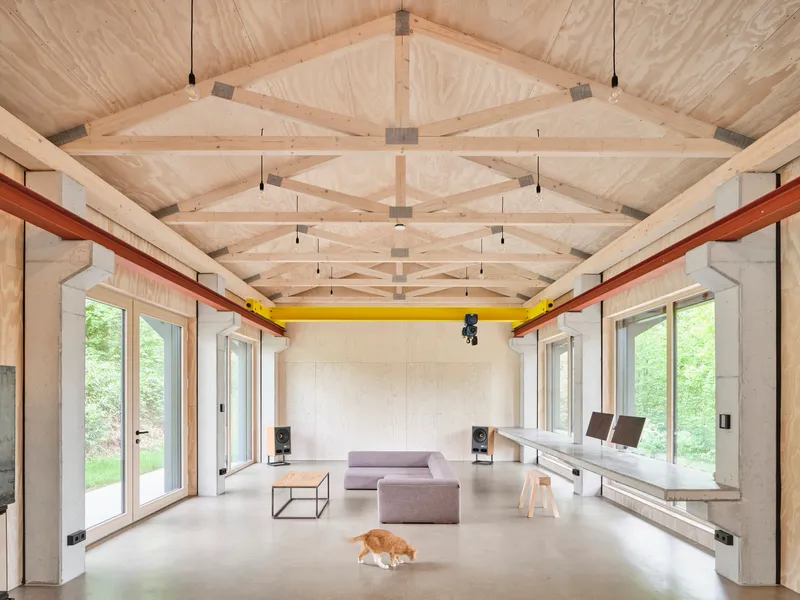
What makes this project genuinely interesting is not the novelty of mixing uses, which is common enough in live-work typologies, but the conviction with which it does so. There is no polite transition zone between the bathtub and the table saw. The same exposed timber trusses shelter both. A motorcycle hangs from the ceiling above a staircase. A cat lounges on a polished concrete floor that doubles as a workshop. The building is not performing hybridity; it is simply built that way, without apology.
A Quiet Shed in an Orchard


From the outside, the building barely registers as architecture. It sits low in a grassy orchard, clad in vertical dark grey timber siding with a corrugated metal roof, looking more like an agricultural outbuilding than a residence. The gabled form, the extended eaves, and the restrained material palette all defer to the landscape. A small white utility block attaches to one side, reinforcing the reading of a modest compound rather than a designed house.
The site slopes, and the building uses this gradient rather than fighting it. From the lawn side, large glass doors open directly onto the grass, giving the interior a pavilion-like openness. The corrugated canopy extends outward, creating a sheltered threshold that blurs where the garden ends and the building begins. At night, the glazed facade turns the interior into a lantern, revealing the full depth of the space behind the dark timber shell.
The Crane as Organizing Principle


The gantry crane is not decoration. It runs on a steel beam that spans the entire upper volume, painted in alternating yellow and red depending on where you look. In the workshop zone it hoists materials and machinery; in the studio it presumably moves heavy objects, models, or equipment. The crane beam becomes the datum line of the interior, a horizontal register that ties together spaces of wildly different character.
Beneath and around the crane, the interior is finished in plywood and exposed timber trusses. Large windows framed in plywood look out onto the surrounding trees. The material continuity is deliberate: whether you are in the workspace staring at a table saw or sitting in the studio zone, the ceiling, walls, and light quality remain consistent. The building argues that industrial and domestic environments need not be aesthetically opposed, that the same raw warmth of plywood can serve both.
Living Between Levels
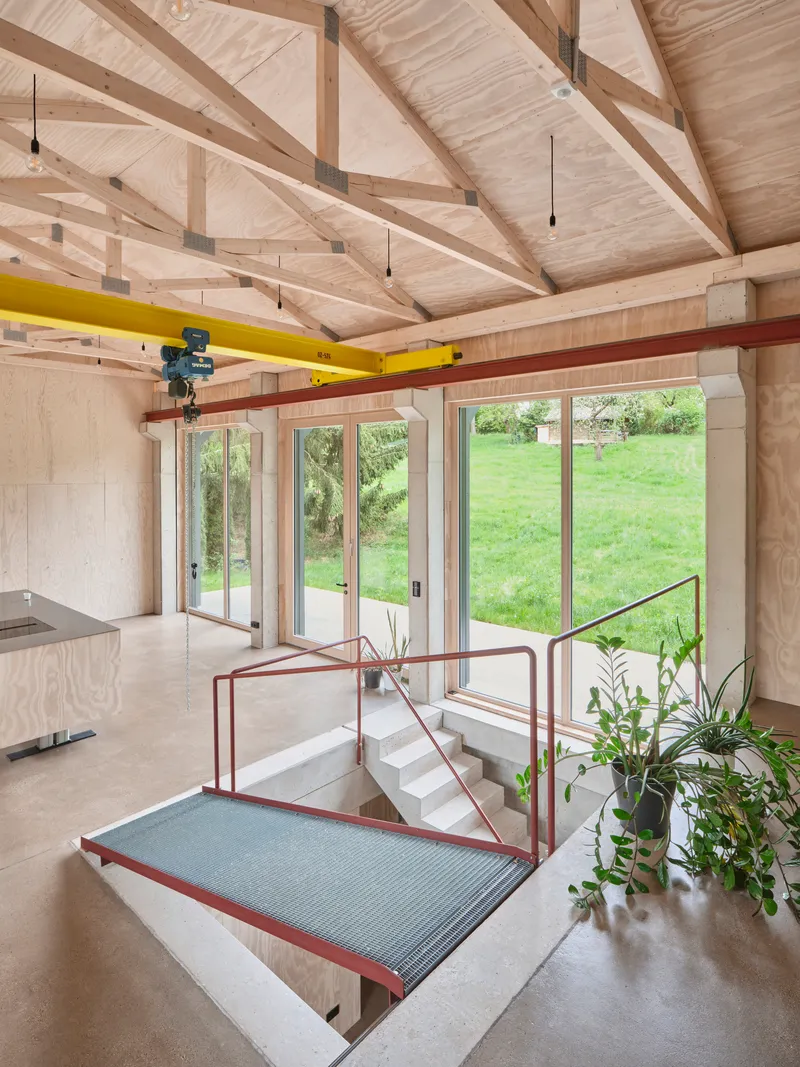

The section is where this house gets interesting. The sloped site creates a sunken lower level connected to the upper volume by a concrete staircase with red steel handrails. Potted plants cluster around the stair landing, and the descent opens onto views down the slope and out to the lawn. The shift in level creates spatial variety within what is, in plan, a simple rectangular footprint.
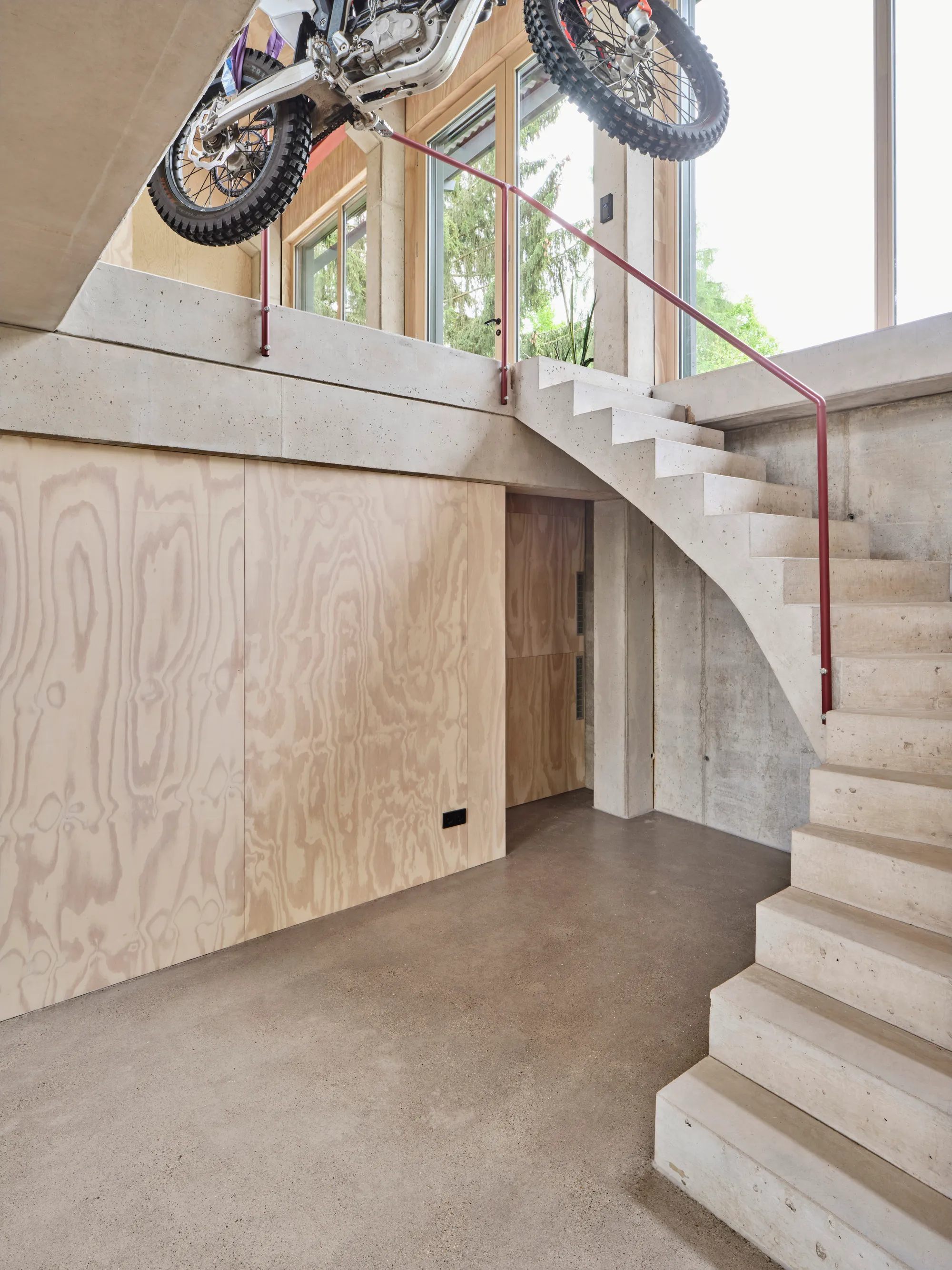
The staircase itself doubles as storage and spectacle. Beneath it, plywood shelving organizes tools and equipment, while above, a motorcycle hangs suspended from the structure. It is a moment that encapsulates the building's attitude: pragmatic and absurd at the same time, treating a vehicle as both a possession and an artifact. The cat, captured resting on the polished concrete floor near the glazed doors, seems entirely unbothered by any of it.
Details That Commit


Two circular porthole windows puncture a plywood wall, framing views as though you were on a ship rather than in a Franconian orchard. Below them, the red steel crane beam cuts a hard horizontal line. The gesture is playful but committed. These are not standard openings resized for whimsy; they are deliberate choices about how the interior relates to the landscape, offering framed glimpses rather than panoramic exposure.
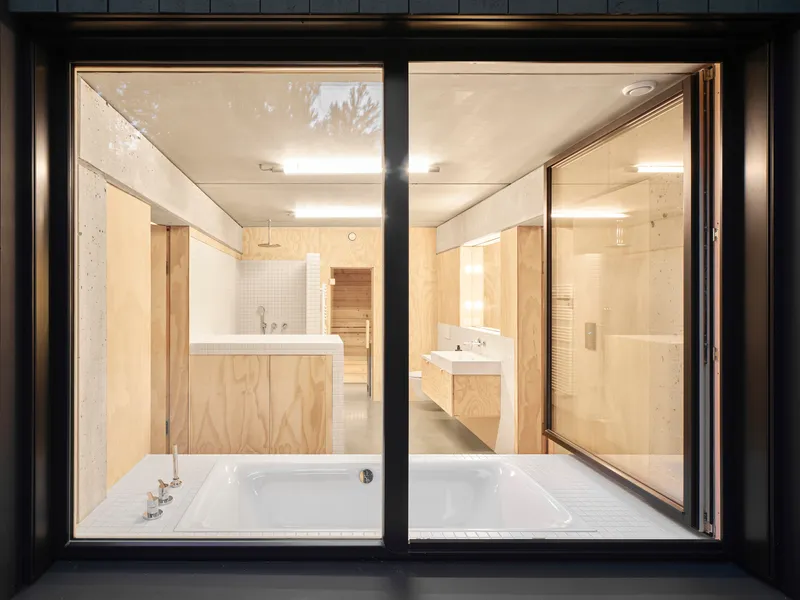
The bathroom, by contrast, goes all in on openness. A white tiled bathtub platform faces full-height glazed doors that open to a gravel garden. At night, the composition reads as a glowing vitrine from outside, the white tile and plywood cabinetry sharply defined against the darkness. Privacy is clearly not a priority, or perhaps the orchard provides it. Either way, the room demonstrates the building's refusal to treat any program element as less deserving of spatial generosity than any other.
The Workshop Facade
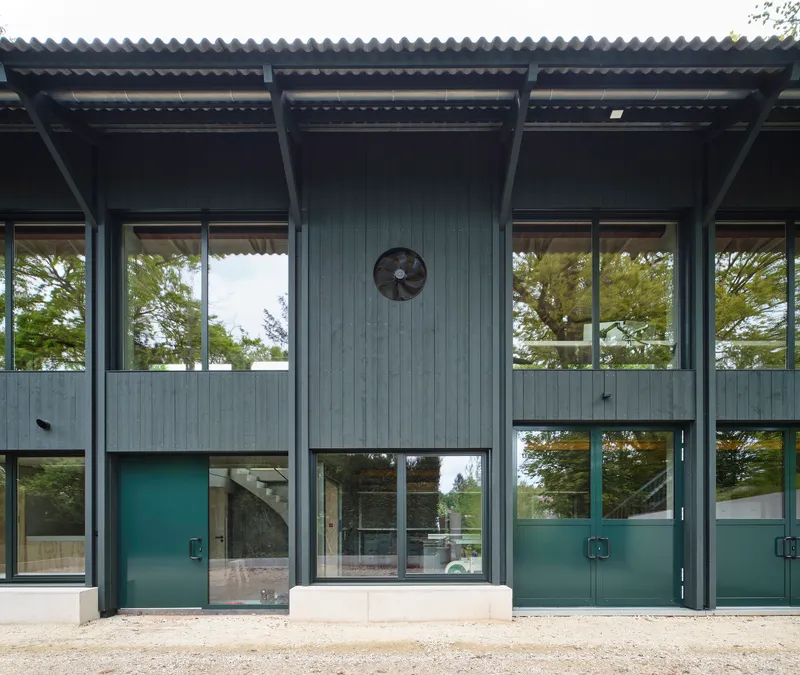


The working facade of the building, with its teal-painted steel doors, corrugated metal overhang, and large glazed panels, reads more like a well-maintained industrial shed than a house. Open garage doors reveal workshop equipment, table saws, and the yellow crane beam beyond. There is no attempt to conceal the productive side of the building; it faces outward with the same confidence as the domestic glazing on the garden side.
A construction photograph reveals the building's structural logic: rows of precast concrete columns set into a slab, with a yellow crane already visible on site. The fact that the crane appeared during construction and stayed for habitation is a satisfying detail. The building was literally constructed with the tool it now houses, collapsing the distance between process and product in a way that few projects manage.
Plans and Drawings

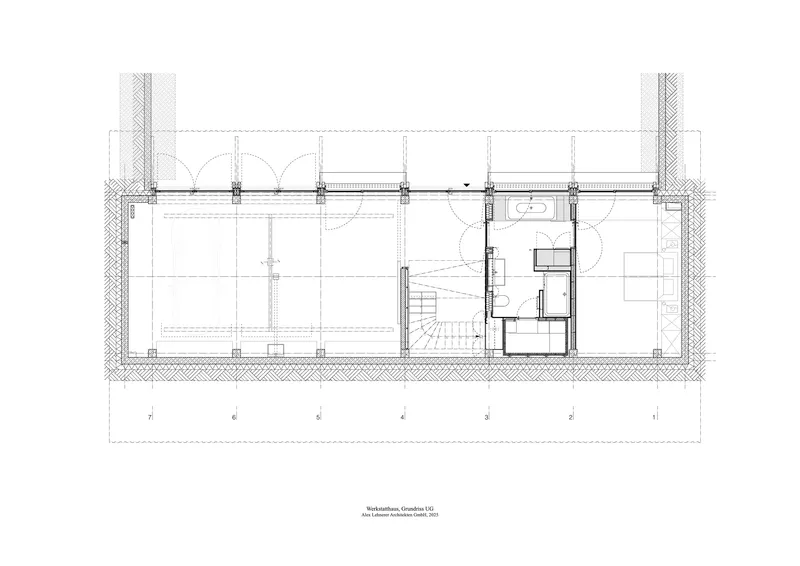

The ground floor plan reveals the openness of the main volume: a single large workspace with a central staircase and a kitchen area tucked to one side. The upper level is more compact, containing bathroom facilities and the staircase landing. What the plans make clear is how little subdivision exists. Walls are few; the building relies on level changes, furniture, and the crane beam itself to differentiate zones.
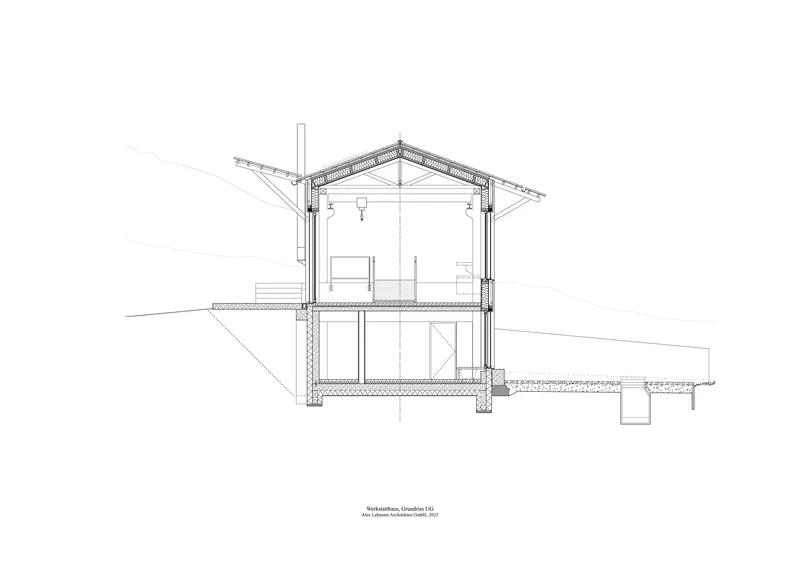
The longitudinal section is the most revealing drawing. It shows the full two-story interior volume with its exposed pitched roof structure, the staircase connecting the levels, and the way the building sits into the sloped site. The transverse section confirms the generosity of the roof space and the structural clarity of the timber trusses. Both drawings reinforce what the photographs suggest: this is a building where structure and space are the same thing, with nothing hidden behind drywall.
Why This Project Matters
The live-work typology has become a reliable trope in contemporary residential architecture, but it is usually executed with a clean separation between the two halves: the studio has its own entrance, the workshop is in the basement, the creative mess is kept behind a door. House with Crane and Fan dispenses with these polite partitions entirely. It proposes that a person who builds things with their hands can also live among those tools, that a gantry crane and a bathtub can coexist under the same roof trusses, and that domestic comfort does not require domestic conventions.
Alex Lehnerer Architekten has produced a building that is simultaneously simple and radical. Simple because it is, in the end, a timber-clad shed in an orchard. Radical because it takes the hybrid program seriously enough to let each element, the crane, the motorcycle, the cat, the porthole windows, occupy the space with equal weight. In a housing market that increasingly demands flexibility, this project is a useful provocation: what if the house was not a retreat from work but a place where work and life genuinely shared the same air?
House with Crane and Fan by Alex Lehnerer Architekten. Schwabach, Germany. 230 m². Completed 2024.
About the Studio
Share Your Own Work on uni.xyz
If projects like this are the kind of work you want to make, uni.xyz is a place to publish your own, find collaborators, and enter design competitions.


Popular Articles
Popular articles from the community


The Musturak Paradise: Senior Living Architecture for a Connected Future in Temara, Morocco
The Musturak Paradise reimagines senior living architecture in Temara via private homes, social spaces, culture, community, and shared care.

Hill & Cross Opera: Sculptural Opera House Architecture Shaped by Tallinn’s Landscape and Identity
Hill & Cross Opera reimagines opera house architecture in Tallinn through its sculptural hill, civic plaza, glass wave and a luminous cross.

The Earth Pod: 3D Printed Homes for Resilient Refugee Communities
The Earth Pod reimagines refugee housing through 3D printed homes made from clay, combining resilience, self-sufficiency, and rapid shelter.

Co-life: Sustainable Architecture for Age-Friendly Community Living
Co-life reimagines sustainable architecture for seniors through courtyards, rammed earth, shared gardens, and spaces designed for belonging.


Similar Reads
You might also enjoy these articles

Bao Huynh Watercolor Atelier: A Serene Art Retreat in Hội An
Bao Huynh Watercolor Atelier in Hội An blends multifunctional art spaces, sustainable design, local materials, and family-friendly living in a serene environment.

Atelier Macri Concept Store Interior Design by CASE-REAL
Atelier Macri store features a "ko" counter, walnut wood details, cork displays, blending retail, gallery, and seamless customer experiences.

Manuel Vargas Izquierdo Stadium and High-Performance Sports Center: Architectural Excellence in Jalpa de Méndez
The Manuel Vargas Izquierdo Stadium blends sustainable design, inclusive sports facilities, and cultural-inspired architecture, revitalizing Jalpa de Méndez’s public spaces.

KAKR Buluh Awar Hall: Revitalizing Community and Ecology Through Bamboo Architecture
Community built bamboo hall revitalizes Buluh Awar village, empowering youth, restoring ecology, celebrating vernacular craftsmanship through sustainable architecture and culture.


Explore Industrial Building Competitions
Discover active competitions in this discipline


Challenge to design a portable theatre


Challenge to design a portable music platform


Challenge to design an open learning module for the elderly
Comments (0)
Please login or sign up to add comments
No comments yet. Be the first to comment!