

Allen + Crippa and Berger and Partner AG Wrap a Swiss Concrete House in a Textile Dress
In the Rhine Valley near Werdenberg, a hybrid of concrete skeleton and curtain facade channels the logic of regional barn houses.


Most single-family houses in the Swiss Rhine Valley are polite neighbors: pitched roofs, rendered walls, shuttered windows. House with a Curtain, completed in 2021 by Allen + Crippa and Berger and Partner AG, refuses that script without picking a fight. Led by architects Timothy Allen and Ronan Crippa, the 180 m² house sits among its residential neighbors with a clear concrete skeleton, cantilevered floor slabs, and a layer of sheer textile that billows, shades, and ultimately defines the building's character more than any fixed wall could.
What makes the project genuinely interesting is the tension between its structural permanence and its atmospheric impermanence. The concrete frame is blunt, heavy, exposed. The curtain is light, translucent, always moving. Together they recall the logic of old barn houses in the region, where a robust timber skeleton supported a loose outer skin and the interior could be reconfigured season by season. The architects have translated that idea into a contemporary hybrid construction: concrete for thermal mass and structural clarity, prefabricated wood panels for the envelope, and stretched textile for weather protection and sun control. The result is a house that changes its mood with every breeze.
A Concrete Skeleton That Steps Out


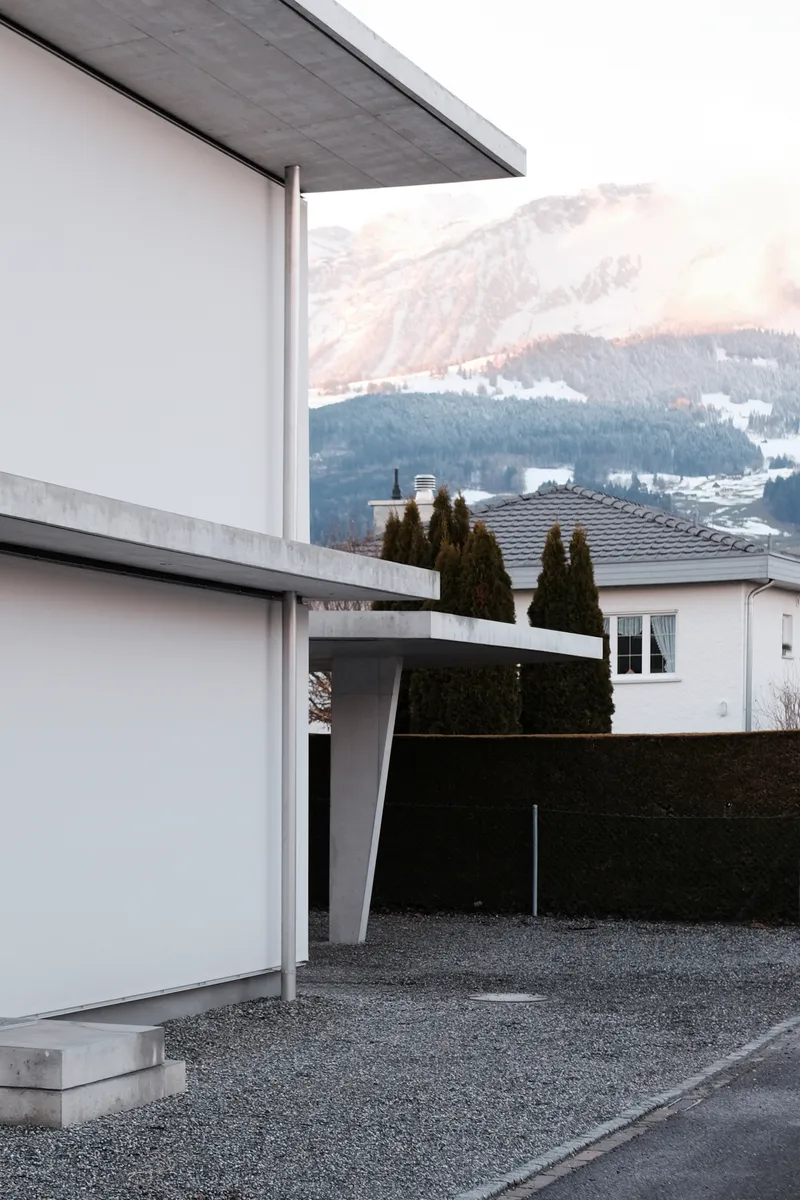
The load-bearing skeleton is unambiguously concrete. Floor slabs cantilever beyond the enclosure line to create deep overhangs on every level, generating covered terraces that blur the threshold between inside and outside. Slender cylindrical steel columns touch down at the perimeter to pick up the slab edges, keeping the ground plane open and visually light despite the considerable mass overhead. From the garden side, the two-story volume reads as a concrete table lifted on legs, with floor-to-ceiling glazing recessed behind the slab edges.
The cantilevered roofs do more than shade. On the first floor they direct the gaze outward to the large garden, while on the upper floor they frame the distant peaks of the Prealps. Each level gets its own horizon. A spout stages the drainage of these large roof areas and channels rainwater down to a well on the terrace, closing the loop for garden irrigation. Utility becomes spectacle.
The Curtain as Architecture


The sheer curtains are not decoration. They are, functionally, a second facade. Hung from the edges of the cantilevered slabs, they provide solar shading, privacy, and wind modulation all at once. When closed, the house becomes a softly glowing lantern. When open, the concrete frame is fully revealed. The architects describe the house as wrapped in a textile dress, and the metaphor holds: the fabric gives the rigid skeleton a constantly shifting silhouette.
The passive design logic is straightforward. Concrete mass stores heat during cool nights and releases it slowly during warm summer days. The curtains intercept direct solar gain before it reaches the glazing. The prefabricated wooden wall panels keep the actual insulated envelope slim. It is a layered climate strategy that avoids mechanical complexity by relying on material behavior and occupant control.
Served and Servant: An Honest Plan
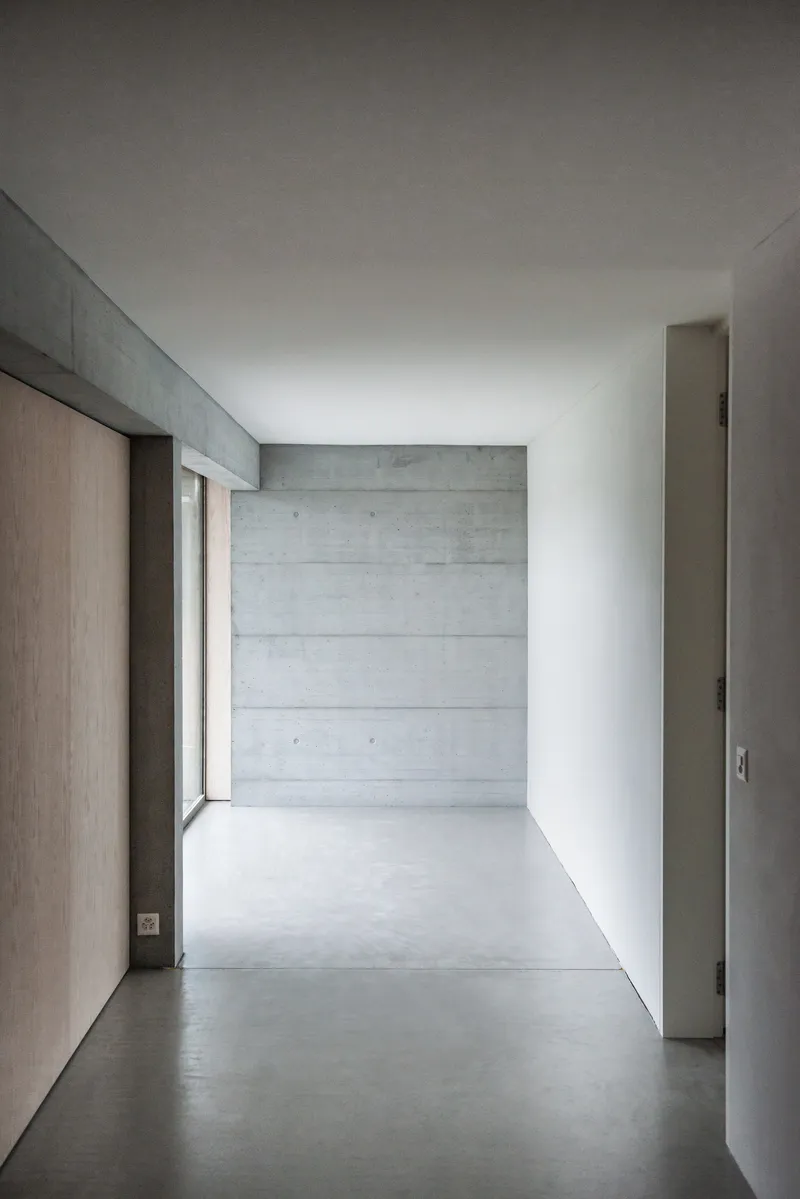
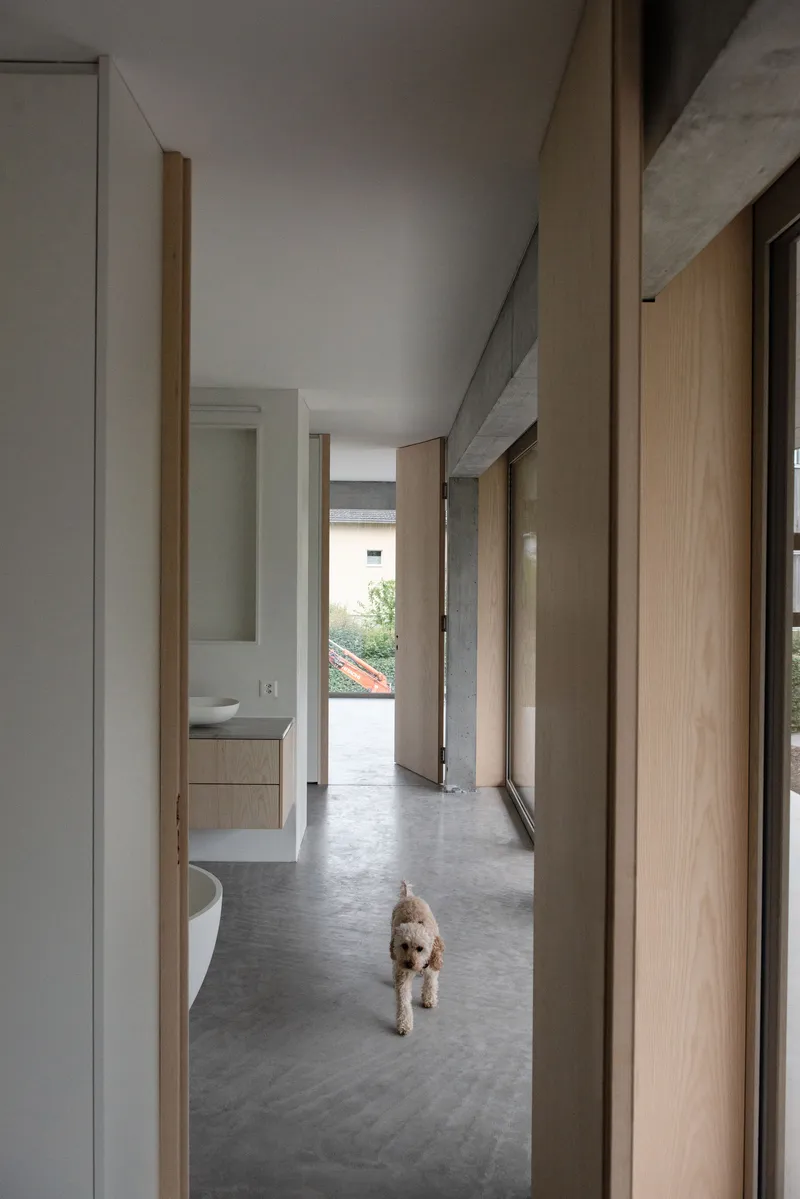

Three stories share an identical plan. Servant spaces, the staircase, bathroom, and pantry, stack along the back wall. Served spaces, living room, dining room, bedroom, occupy the front, opening fully toward the garden and the mountains. The repetition is deliberate. It keeps the concrete frame efficient, the services consolidated, and the inhabitable rooms generous.
Partition walls are designed as built-in furniture rather than permanent divisions. They can be adapted over time, reconfigured to accommodate new uses without touching the structure. The logic is borrowed directly from the barn typology: a fixed frame that tolerates programmatic change across generations. Light oak veneer and white fluted paneling line the interiors, creating a warm contrast to the rough board-formed concrete of the structural elements.
Interior Atmosphere and Material Palette


Inside, the material palette is deliberately restrained. Board-formed concrete retains the grain of its timber formwork, giving the structural frame a tactile, almost geological texture. Pale wood veneers wrap the furniture-walls, and white plaster softens the servant cores. The meeting points between these materials are handled with precision: concrete columns land beside fluted panels, timber doors sit flush within concrete beams.
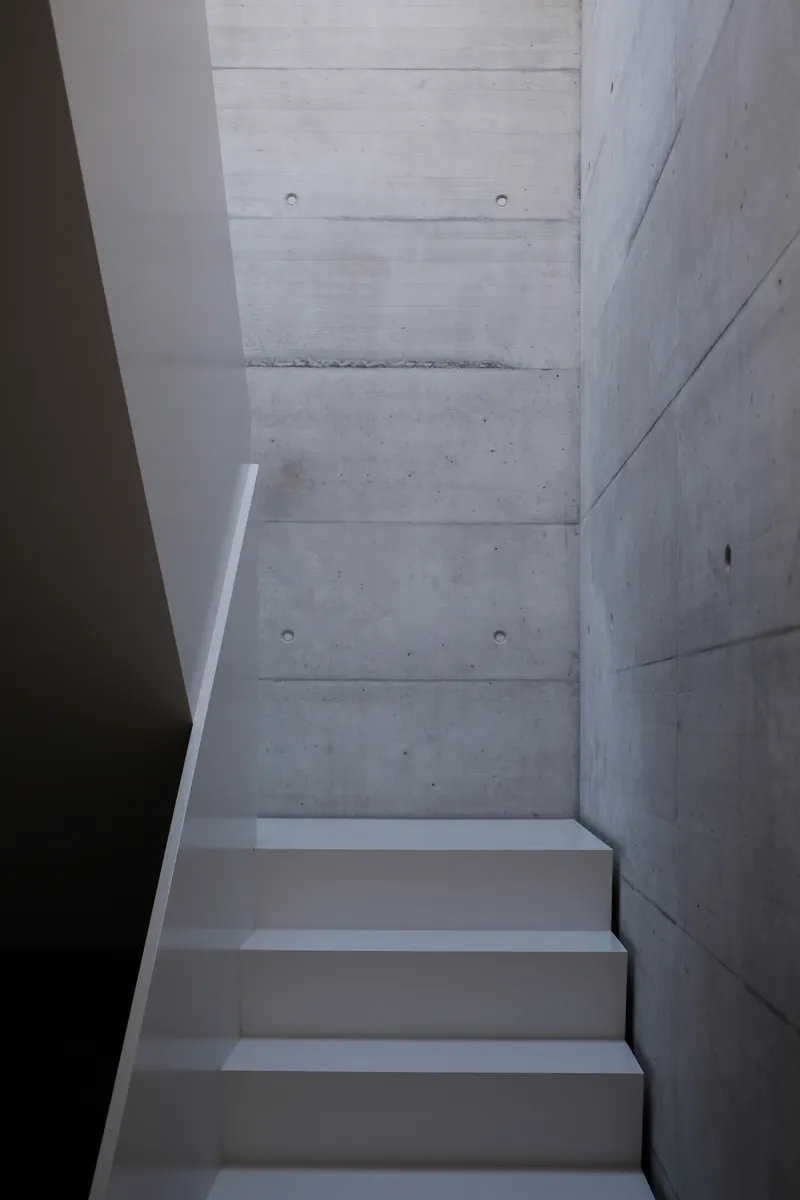


Two moments stand out. The staircase, ascending alongside the concrete wall, is treated in white plaster that picks up the rhythm of the tie holes left by the formwork. And the bathing chamber on the upper level, a concrete room lit only by a circular skylight, turns the act of washing into something almost ritualistic. Snow falls through the aperture in winter. The oculus is a small but confident gesture that speaks to the architects' willingness to push poetic ambition into domestic spaces.
Building the Hybrid


The construction photographs reveal how the hybrid system comes together. The concrete skeleton is cast in situ, slab by slab, with workers visible on fresh decks still wet from the pour. Reinforcement mesh is laid across timber formwork in a process that is conventional in method but precise in execution. The cantilevered slab edges, which define so much of the building's character, are clearly visible at this stage as exposed concrete planes waiting for their curtain.


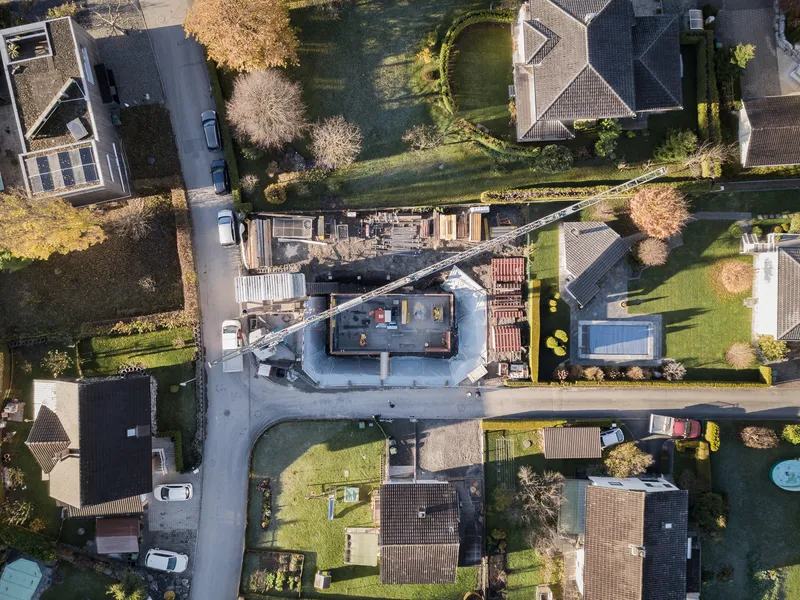
The prefabricated timber-framed wall modules arrive on site as complete panels, craned into position between the concrete columns. The aerial shots show the neighborhood context clearly: tidy residential plots, manicured gardens, pitched-roof houses in every direction. House with a Curtain does not look like its neighbors, but it shares their scale and setback. The architects understood that a radical construction system does not require a radical urban posture.
Structural Details

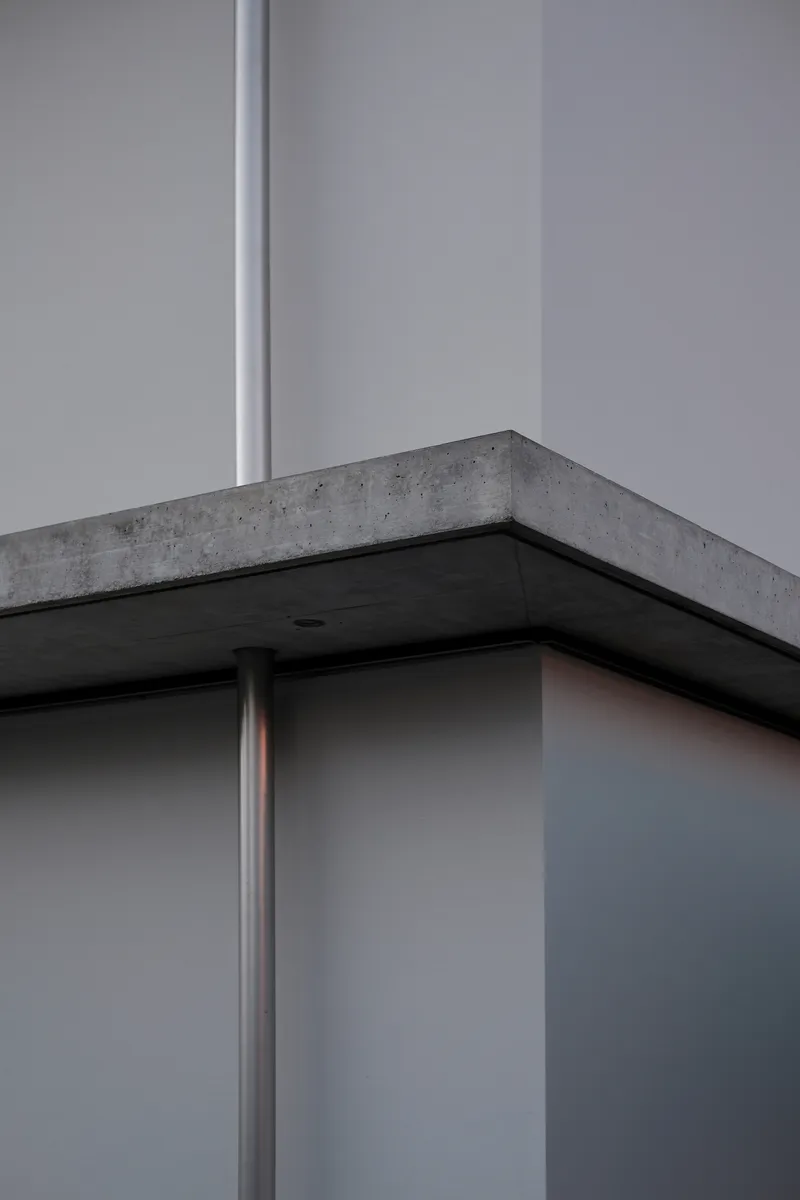
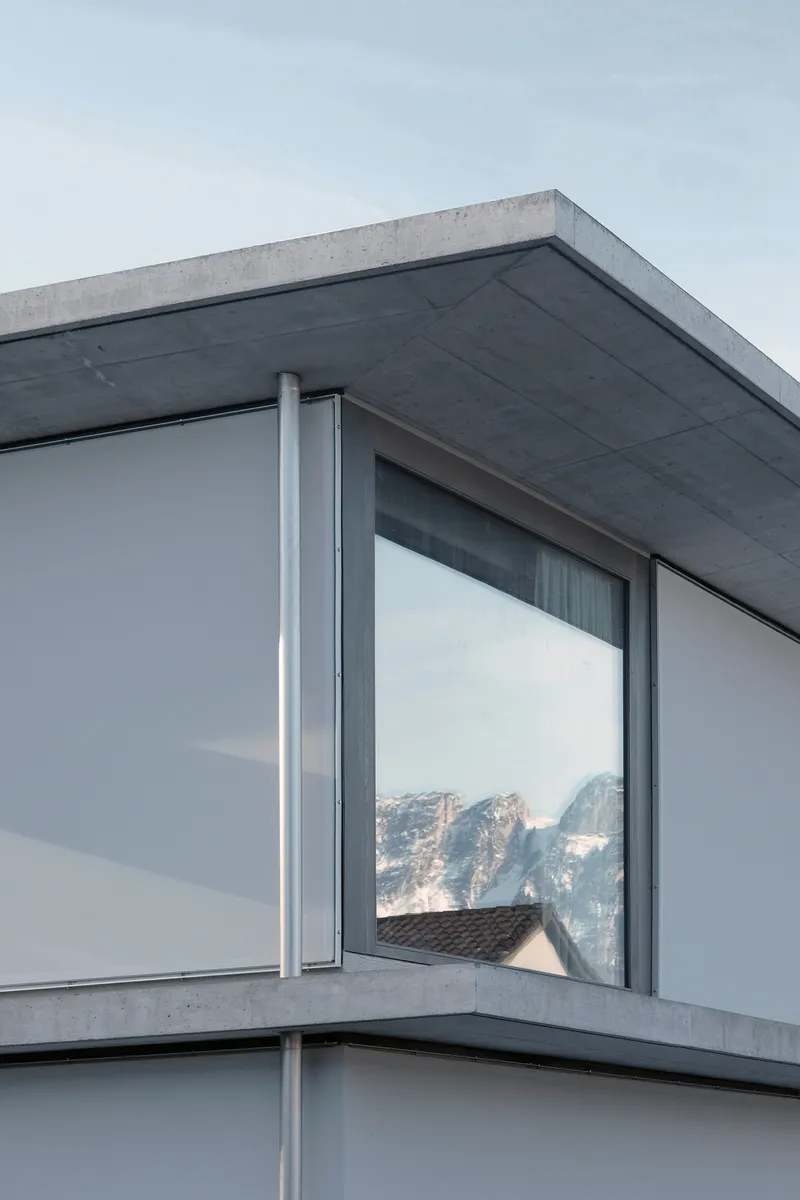
The junction between slab, column, and curtain is where the architecture either holds together or falls apart. Close-up photographs of the cantilevered slab edge show how the cylindrical steel column meets the concrete soffit, with a recessed black panel creating a shadow gap that lightens the visual weight of the overhang. The glazing is set back from the slab edge, allowing the curtain to hang freely in the gap. It is a detail that resolves structure, enclosure, and shading in a single, clean section.
Terrace and Garden
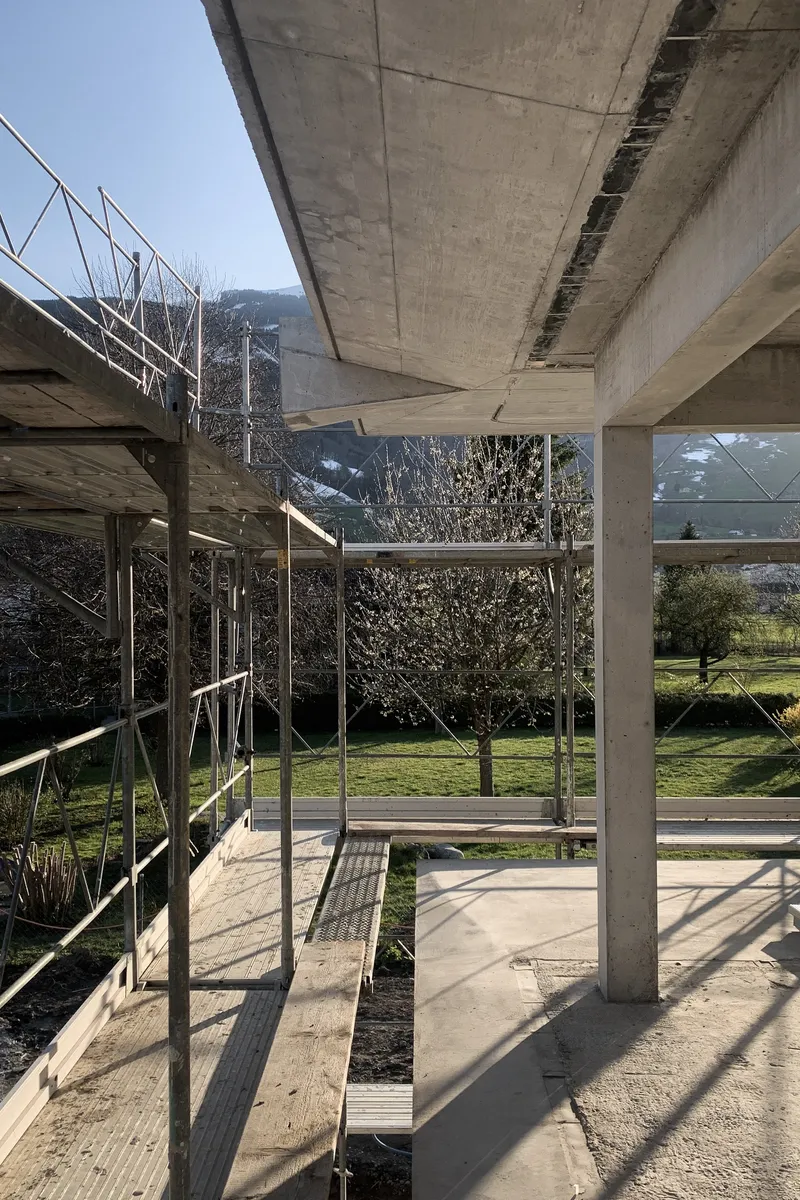


The terraces created by the cantilevered slabs are the social heart of the house. Shielded from sun and rain by the slab above and from neighbors by the curtains, they function as outdoor rooms that can be opened or closed depending on season and mood. The garden beyond is generous, edged by evergreen hedges, and oriented toward the Prealps. The architects have kept the landscape simple, letting the mountain panorama do the work.
Plans and Drawings
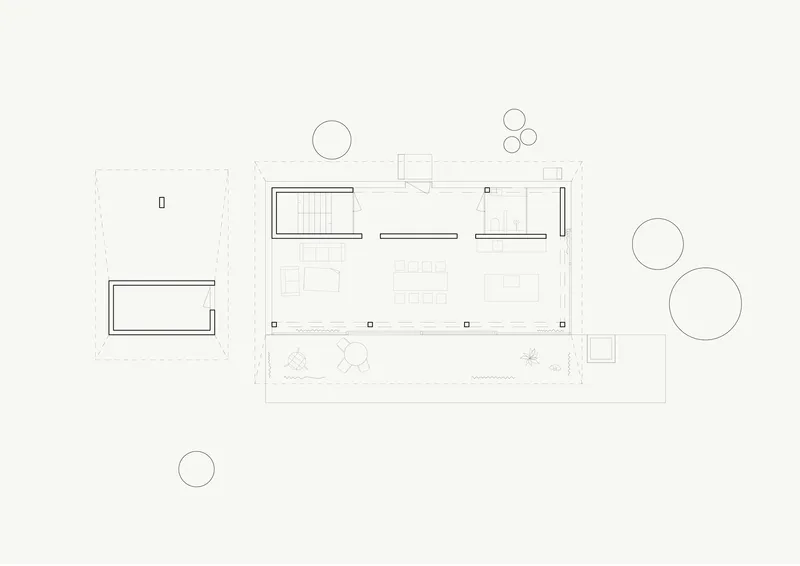
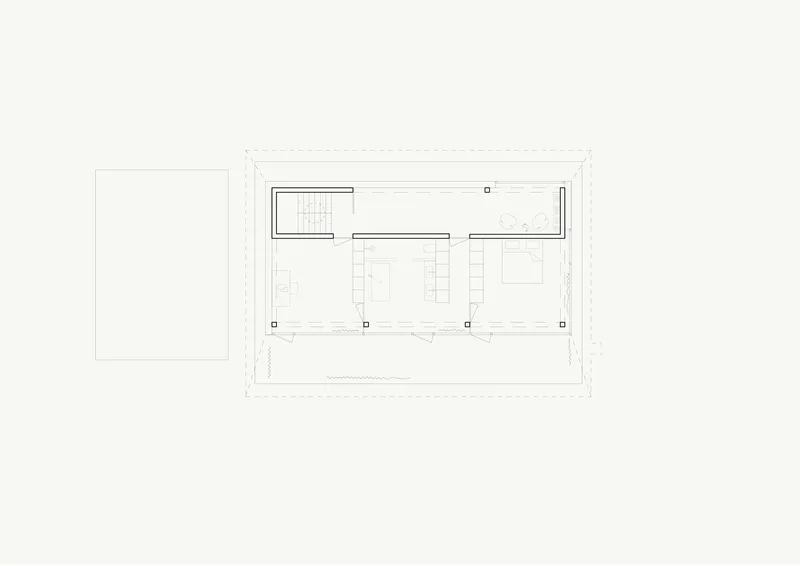

The plans confirm the simplicity of the served/servant division. The rectangular volume sits on a perimeter terrace with two detached pool structures flanking the garden. The section drawing reveals the full extent of the basement, the double-height proportions, and the relationship between the main volume and a single-story adjacent structure. Every floor is a variation on the same diagram, differing only in furniture layout.


The detail sections are where the textile facade logic becomes legible. Floor slabs, insulated panels, and railings are drawn at a scale that reveals the layered assembly: concrete slab, timber-framed wall, air gap, stretched textile. A small cat perched on the balcony railing provides scale and personality, a reminder that this is a house, not a manifesto. The detail drawings are clean, readable, and suggest that the construction team had clear instructions rather than ambiguous intentions.
Why This Project Matters
House with a Curtain matters because it takes a genuinely regional idea, the loose-skinned barn, and rebuilds it with contemporary materials without losing the principle. The curtain is not nostalgic scenography. It is a functional layer that changes the building's thermal performance, privacy, and visual presence throughout the day and across seasons. In a discipline that often treats the facade as a fixed composition, letting it move is a quiet act of defiance.
The project also demonstrates that hybrid construction, combining in-situ concrete with prefabricated timber, can produce architecture that is more than the sum of its environmental credentials. The material logic is clear, the plan is generous within a modest footprint, and the details are resolved with the kind of care that suggests experienced hands rather than first-time ambition. For a competition-winning project born during the architects' studies at ETH, House with a Curtain has matured into a serious building that earns its place in the Rhine Valley.
House with a Curtain by Allen, Crippa, Berger, and Partner AG. Werdenberg, Switzerland. 180 m². Completed 2021. Photography by Charly Jolliet.
About the Studio
Partner AG
Share Your Own Work on uni.xyz
If projects like this are the kind of work you want to make, uni.xyz is a place to publish your own, find collaborators, and enter design competitions.


Popular Articles
Popular articles from the community


Temporary Home for Dogs: A Reversed Zoo Rethinks Animal Shelter Architecture
In Bucharest, a sinuous corridor and freed landscape flip the logic of containment, designing a shelter that works to make itself unnecessary.

Opera by the Sea Estonia: Three Shells Dissolving Architecture into Tallinn's Coastline
A winning opera house proposal replaces monumental form with interconnected shells that blur the boundary between building, park and Baltic Sea.

Extended Shell: Retrofitting Kolkata's Balconies as Living Urban Thresholds
A modular retrofit system recovers the social and environmental intelligence of Kolkata's historic verandas for contemporary Park Street residents.

Cloaked Colonization: A Mobile Underwater Habitat That Moves Like a Fish
Micah Abaya's shortlisted EHC Pacific entry reimagines ocean settlement as a dispersed network of self-sustaining architectural organisms.

Similar Reads
You might also enjoy these articles

Bao Huynh Watercolor Atelier: A Serene Art Retreat in Hội An
Bao Huynh Watercolor Atelier in Hội An blends multifunctional art spaces, sustainable design, local materials, and family-friendly living in a serene environment.

Atelier Macri Concept Store Interior Design by CASE-REAL
Atelier Macri store features a "ko" counter, walnut wood details, cork displays, blending retail, gallery, and seamless customer experiences.

Manuel Vargas Izquierdo Stadium and High-Performance Sports Center: Architectural Excellence in Jalpa de Méndez
The Manuel Vargas Izquierdo Stadium blends sustainable design, inclusive sports facilities, and cultural-inspired architecture, revitalizing Jalpa de Méndez’s public spaces.

KAKR Buluh Awar Hall: Revitalizing Community and Ecology Through Bamboo Architecture
Community built bamboo hall revitalizes Buluh Awar village, empowering youth, restoring ecology, celebrating vernacular craftsmanship through sustainable architecture and culture.


Comments (0)
Please login or sign up to add comments
No comments yet. Be the first to comment!