

Alluvium: Slot Canyon Urbanism That Cools a Desert Community
Rammed earth walls, canyon corridors, and passive systems transform arid hardscape into a living, learning public landscape.


What if the most effective cooling system for a desert city was not a machine but a landform? Alluvium takes its name from the fertile sediment that flowing water deposits across barren terrain, and it operates on the same principle: channel natural forces through a sculpted surface and life follows. The project reimagines the slot canyon, that narrow geological formation carved by millennia of wind and water, as an urban typology. Rammed earth walls, sinuous corridors, and terraced ground planes guide airflow, filter daylight, and shelter a rich program of community spaces without relying on energy-intensive mechanical systems.
Designed by Marc Snyder, Rachel Bek, and Kevin Vu, Alluvium won the Form Follows Climate 2020 competition. Sited within a dense arid metropolitan fabric, the project pushes, pulls, and cuts the land to extend natural flows across the site, creating a restorative public landscape that counters the hardness of its urban surroundings with a gentle, community-oriented terrain.
Canyon Logic: Reading the Site Through Wind, Light, and Topography
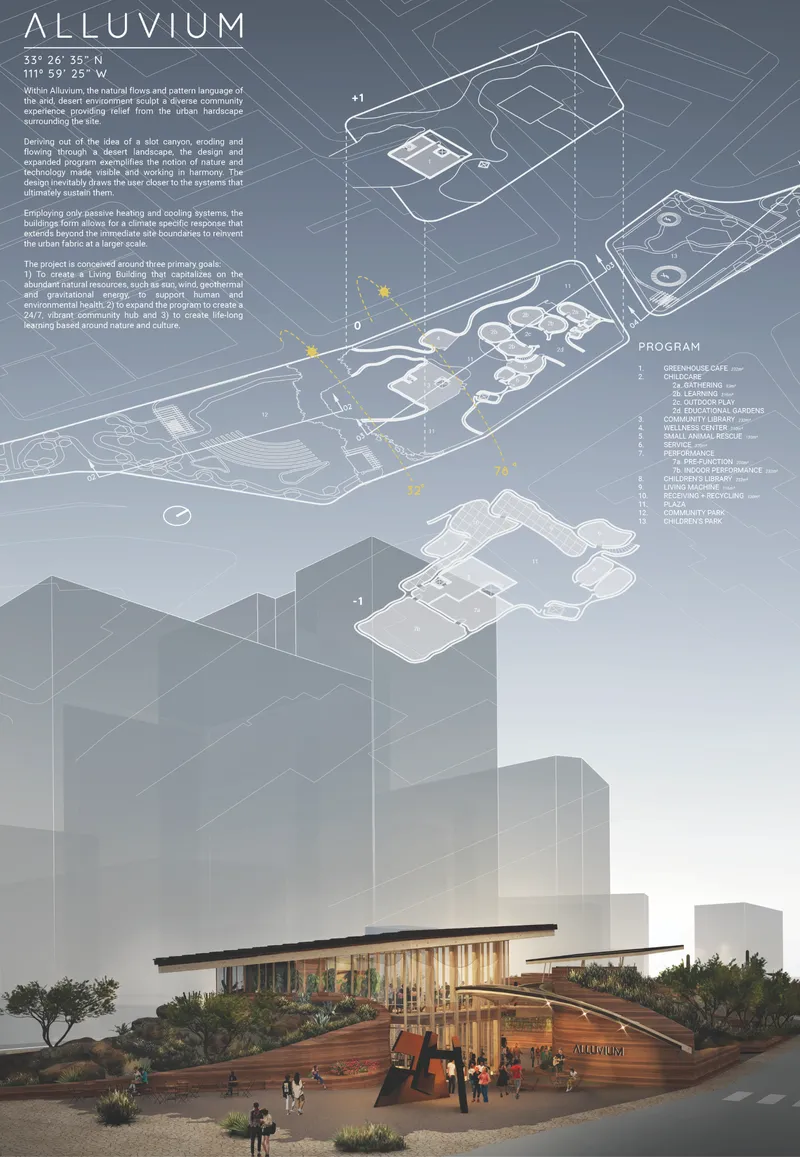

The isometric site plan overlay reveals just how thoroughly the canyon metaphor organizes circulation and climate response. From above, sinuous pathways and landscape depressions read as a network of micro-canyons threading through the program. At ground level, the entrance plaza wraps visitors in timber cladding that mediates the transition from exposed street to sheltered interior. Every contour is deliberate: the land is shaped so that shade, ventilation, and vegetation arrive precisely where they are most needed, offering relief from desert heat while establishing a powerful dialogue between built form and environment.
The courtyard rendering and its accompanying climate diagrams make the passive strategy legible. Curved timber volumes frame glazed facades that admit filtered daylight while canyon-like corridors pull cool air through inhabited zones and release warm air upward. Wind here is treated as an architectural material, shaping comfort and sensory experience rather than being excluded by sealed envelopes. Rammed earth construction acts as the thermal anchor of the project: its mass stores coolness at night and disperses it during the day, reducing heat buildup and regulating temperature across interior and semi-outdoor spaces.
Play Carved Into the Ground Plane
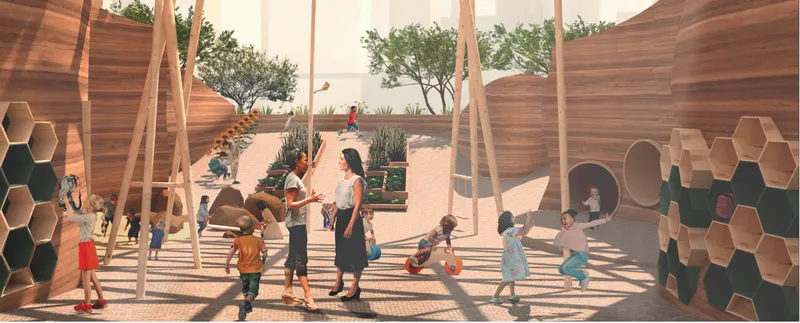
Beneath a covered canopy supported by timber columns, children and families move through a play area defined by hexagonal wall alcoves that double as climbing nooks and reading niches. Long afternoon shadows stretch across the sculpted landscape, a visual reminder that the canopy overhead is calibrated to the sun's arc. The design refuses to separate learning from play. Outdoor areas for climbing, sliding, and creative exploration sit alongside a childcare center with indoor-outdoor classrooms, a community library, and a children's library. Movement, interaction, and discovery are designed into every path.
Layered Thresholds Between City and Oasis
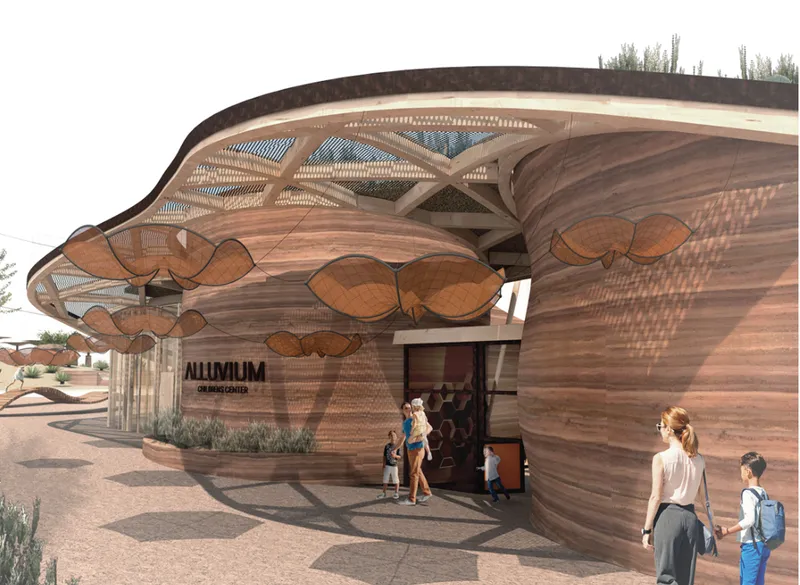
The entrance facade is a lesson in environmental mediation. Layered timber cladding and scalloped canopy elements create a series of thresholds that shelter visitors before they even cross a doorway. The layering strategy thickens the building's skin, introducing pockets of shade and slowing hot air as it passes through. In the desert landscape beyond, the facade reads as a geological outcrop: something grown from the ground rather than placed upon it. This approach reinforces the project's central thesis that climate-responsive architecture should not look like technology bolted onto a building but like an extension of the land itself.
An Interior Sky of Timber and Filtered Light
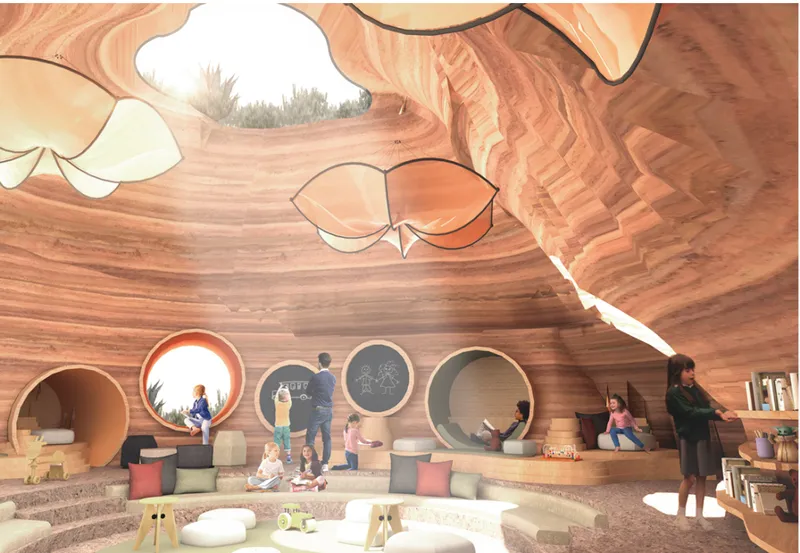
Inside, the ceiling becomes the most expressive element. Undulating laminated timber ribs arc overhead, perforated by circular apertures that admit daylight in carefully controlled pools. The effect recalls looking up from the floor of a slot canyon at patches of sky. Seated visitors below experience soft, shifting illumination rather than the harsh glare typical of desert interiors. These crafted openings work in concert with the rammed earth thermal mass and natural ventilation corridors, so the comfort felt in this space is achieved without mechanical air conditioning. Solar PV shingles on the roof above contribute electricity for lighting and essential systems, while a Living Machine collects, treats, and circulates water through hydrology, geology, and biology, closing the ecological loop.
Why This Project Matters
Alluvium succeeds because it refuses the false choice between environmental performance and social richness. A greenhouse café, cultural gardens, an amphitheater, pocket parks, and plaza spaces all coexist within a single integrated landscape that also happens to be a demonstration of passive cooling, natural water treatment, and renewable energy generation. The program is multigenerational by design: it anchors its neighborhood with spaces for food cultivation, public storytelling, literacy, and biodiversity, all shaped by the same canyon corridors that manage wind and light.
Snyder, Bek, and Vu have proposed something more radical than a green building. They have proposed a public ground that performs like an ecosystem, where every sculpted surface, every aperture, and every planted depression participates in a closed-loop exchange of energy, water, and human activity. In a moment when arid cities worldwide face escalating heat and resource scarcity, Alluvium offers a convincing argument that the most effective climate infrastructure may not be hidden beneath streets but woven directly into the places where communities gather, learn, and play.
View the Full Project
About the Designers
Designers: Marc Snyder, Rachel Bek, Kevin Vu
Enter a Design Competition on uni.xyz
uni.xyz runs architecture and design competitions year-round that reward proposals with spatial conviction and real site intelligence.
Project credits: Alluvium by Marc Snyder, Rachel Bek, Kevin Vu Form Follows Climate 2020 (uni.xyz).


Popular Articles
Popular articles from the community


Manzana Morphosis: Stretching Barcelona's Grid into a Living Landscape for 2050
A radical reworking of the Eixample manzana turns density into a tool for generous public space, vertical ecology, and environmental performance.

Cloaked Colonization: A Mobile Underwater Habitat That Moves Like a Fish
Micah Abaya's shortlisted EHC Pacific entry reimagines ocean settlement as a dispersed network of self-sustaining architectural organisms.

Opera by the Sea Estonia: Three Shells Dissolving Architecture into Tallinn's Coastline
A winning opera house proposal replaces monumental form with interconnected shells that blur the boundary between building, park and Baltic Sea.

Tsunami Convergenics: Turning Catastrophic Ocean Forces into Underwater Housing Infrastructure
A speculative underwater settlement off the coast of Onagawa, Japan, treats tsunamis and typhoons as energy sources rather than threats.

Similar Reads
You might also enjoy these articles

Play: Fragments of Their World: Remembered Architecture Rebuilt as a Modular Playground for Refugee Camps
Tom Gardner abstracts domes, arches and towers from the homelands of displaced families into a kit of child-scaled play parts for camp settlements.
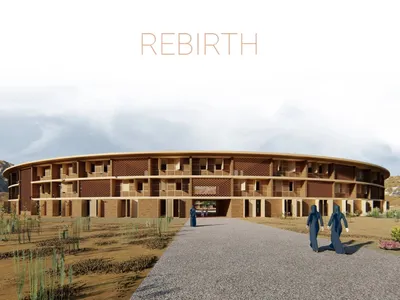
REBIRTH: A Circular Settlement Where Afghan Widows and Their Children Rebuild Life Together
A shortlisted Resile entry turns the circle into a protective ring of timber and brick, gathering homes, classrooms and gardens around a shared landscape.
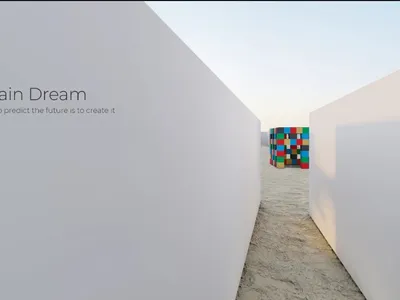
The Main Dream: A Recycled Plastic Kit That Lets Refugee Children Build Their Own Playground
Thirty-centimetre interlocking cubes that connect on three axes turn play into construction, letting children author the spaces they occupy.

Lunar Spiral: A Fibonacci-Driven Moon Settlement Rising from Shackleton Crater
Golden-spiral geometry organises buried infrastructure and orbiting habitable spheres into a lunar base designed to grow as life on the Moon expands.


Comments (0)
Please login or sign up to add comments
No comments yet. Be the first to comment!