
Wiercinski-Studio Packs a Cross-Cultural Dining Room into 50 Square Meters in Copenhagen
Amator Cph fuses Polish handcraft with Scandinavian restraint inside an 1870 Østerbro building, redefining the communal table.


A 50 square meter restaurant should not have this much to say. Yet Amator Cph, the debut Danish project from wiercinski-studio, manages to articulate a clear position on materiality, hospitality, and craft within the ground floor of an 1870 residential building in Copenhagen's Østerbro district. The space operates as breakfast and lunch spot by day, then shifts to private and corporate dinners by candlelight at night. That dual identity is not just programmatic; it is embedded in every surface and joint.
What makes the project genuinely interesting is the cultural negotiation at its core. The restaurant was conceived around the Danish idea of hjemme spisested, a home dining place, but its furniture was handcrafted in Poland and trucked to Copenhagen. Raw steel shows visible marks of the hand. Polish linen hangs wrinkled, deliberately. The oak is solid, not veneered. This is not Scandinavian minimalism performing its usual trick of erasure; it is a rougher, warmer register, one that treats imperfection as evidence of care rather than something to sand away.
Street Presence and the Single Pane
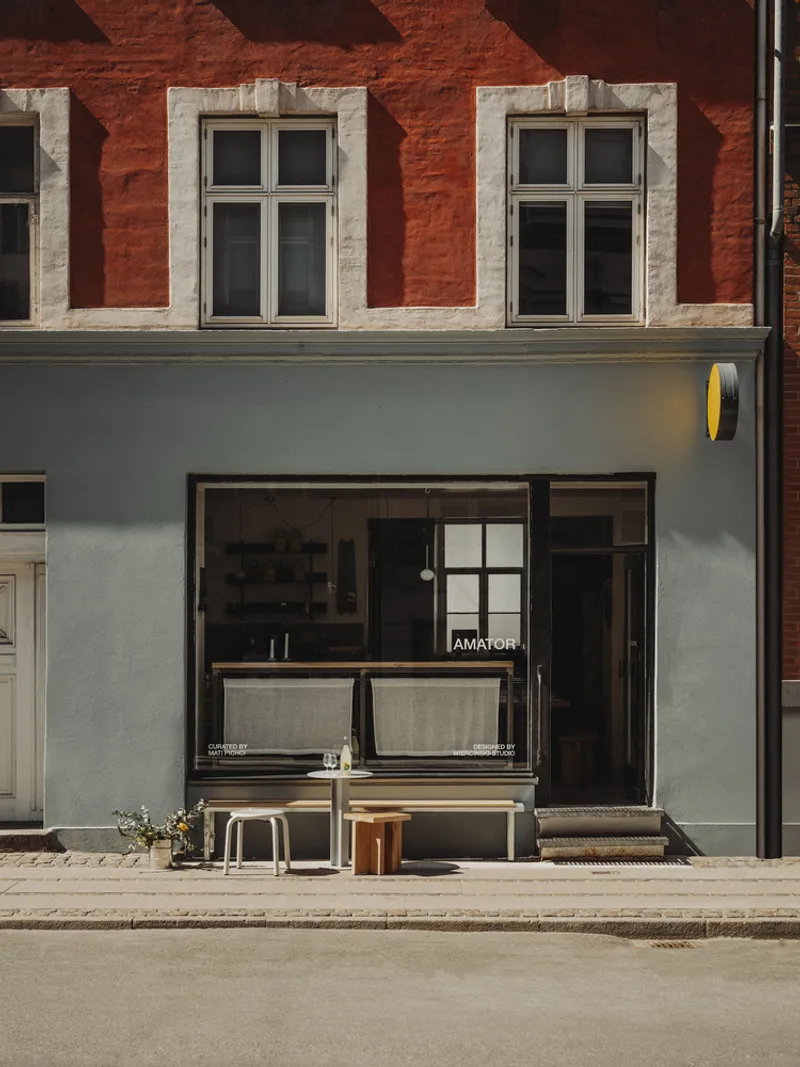
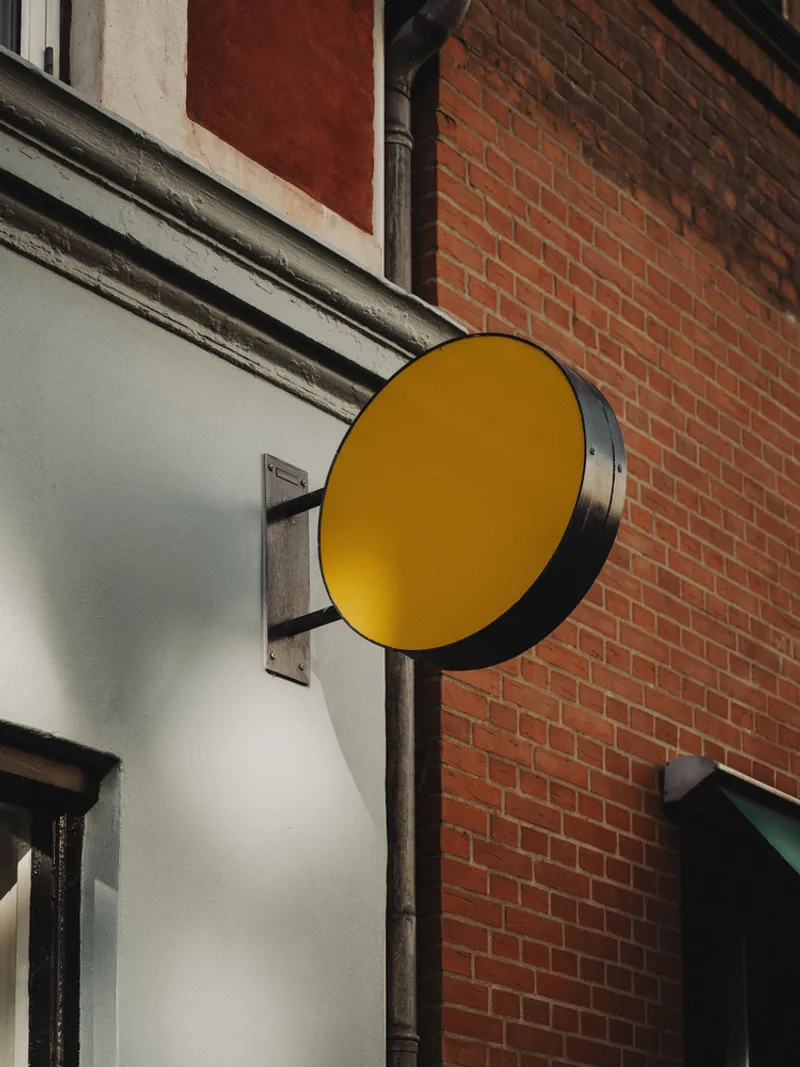
The exterior is deliberately quiet. A grey stucco base sits beneath red brick and white window surrounds, typical of Østerbro's residential fabric. The only signal that something unusual is happening inside is a circular yellow disc mounted on the facade corner, a nod to Amator's signature yellow dot branding. It reads more like a gallery marker than a restaurant sign, which is the point.
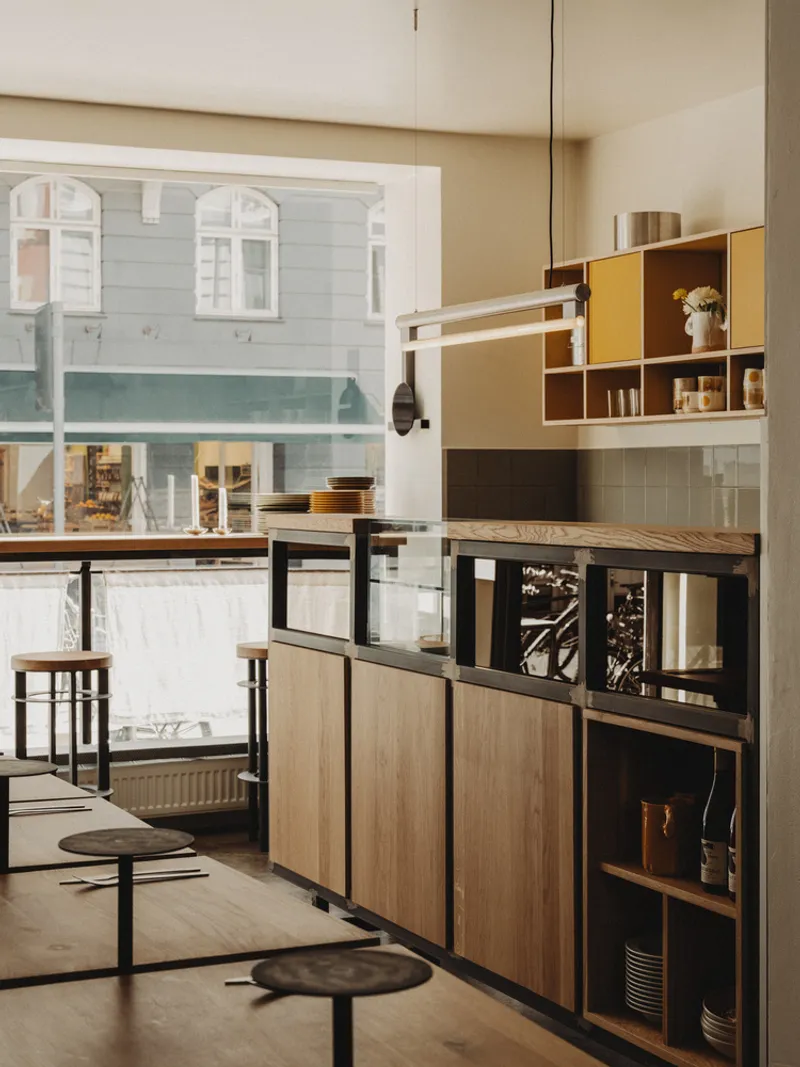
A single-panel glass facade does most of the heavy lifting here. It floods the interior with natural light during breakfast and lunch service, but more importantly, it turns the open kitchen into a streetside spectacle. Passersby see the chef at work. The kitchen is not hidden; it is the storefront display. That transparency collapses the distance between sidewalk and stove in a way that larger, more designed facades rarely achieve.
The Communal Table as Central Architecture
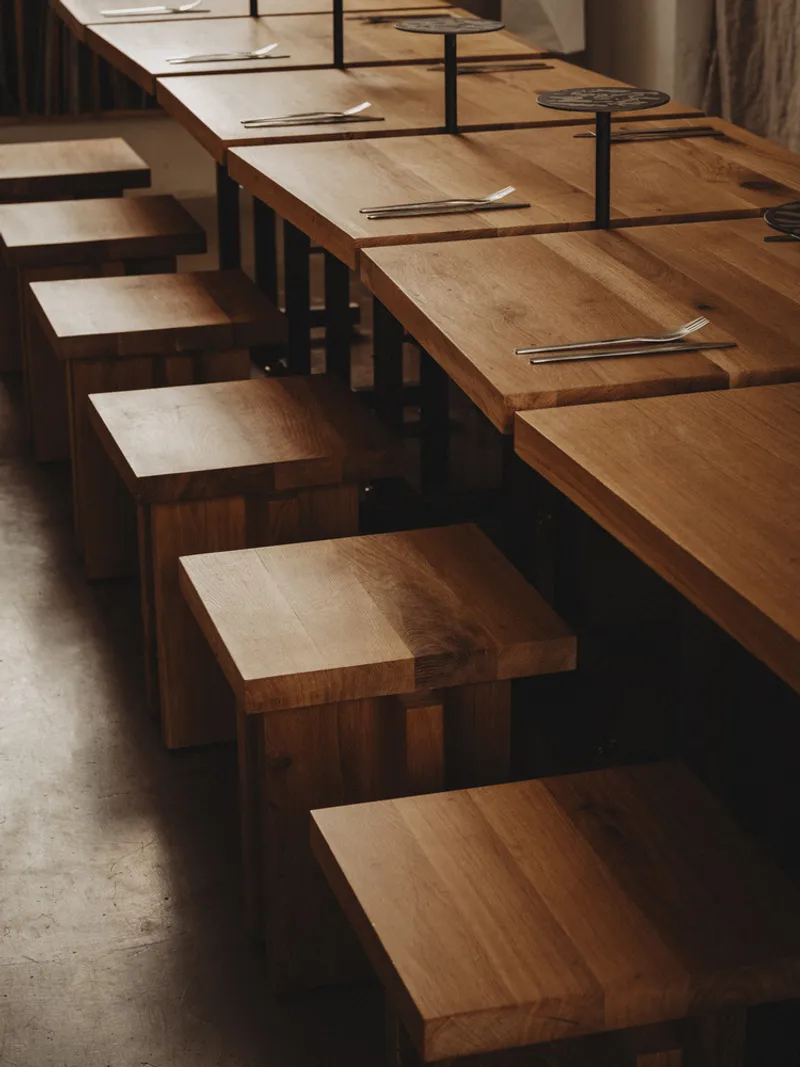
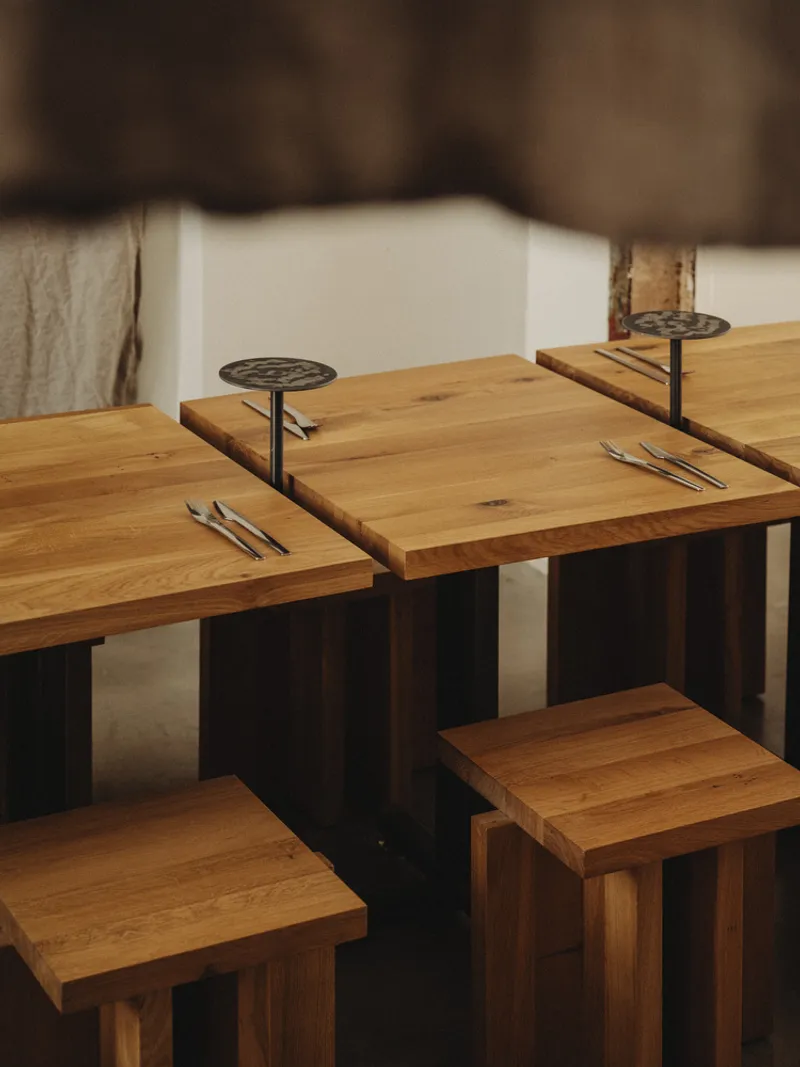
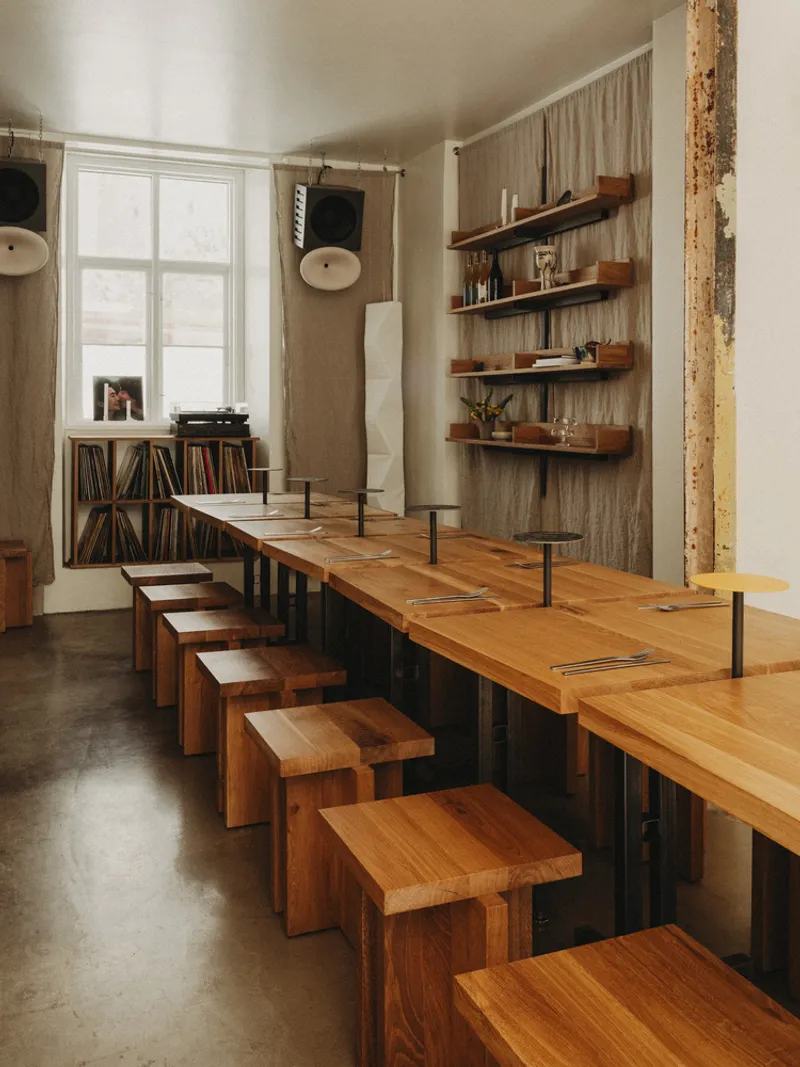
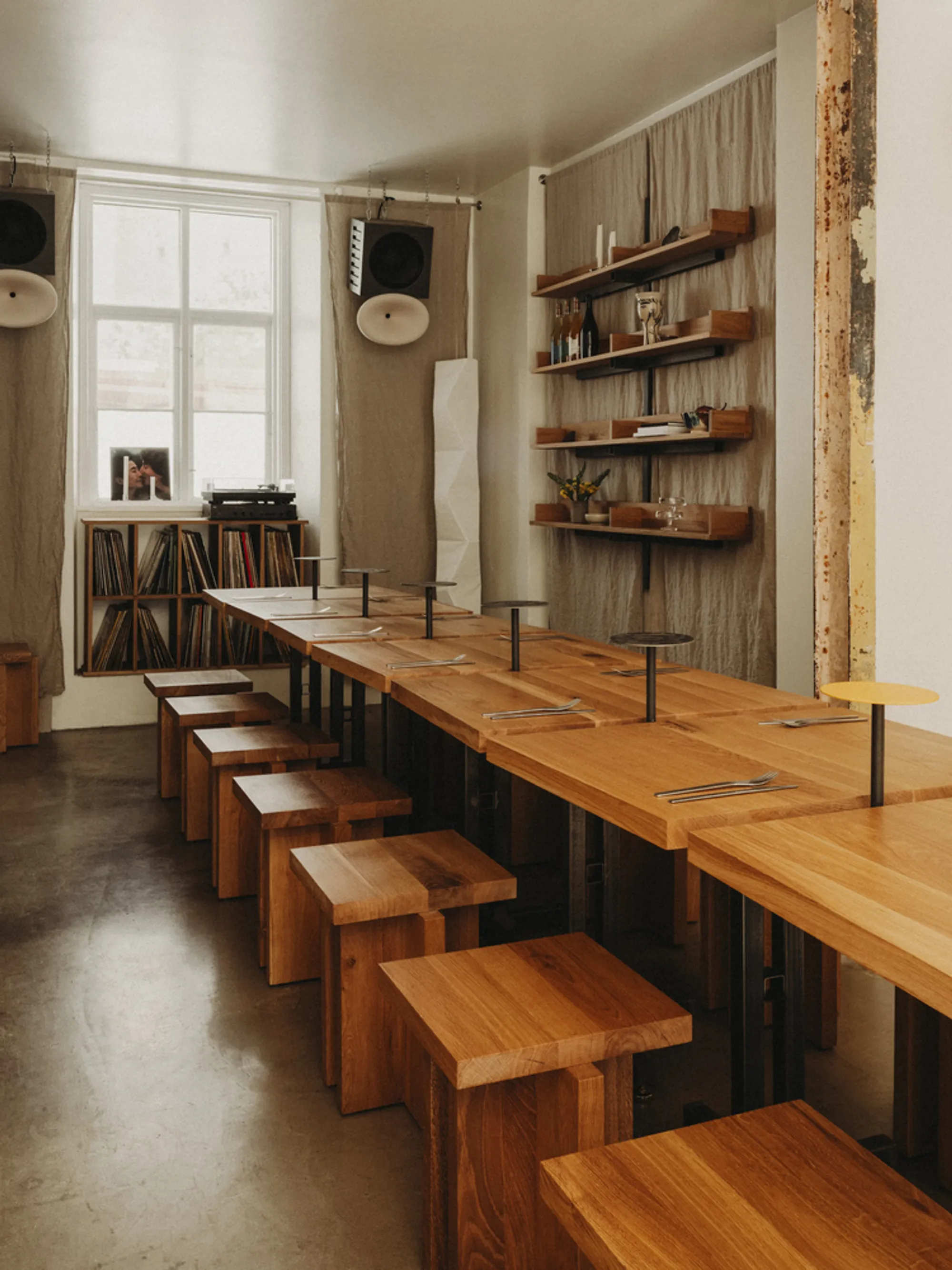
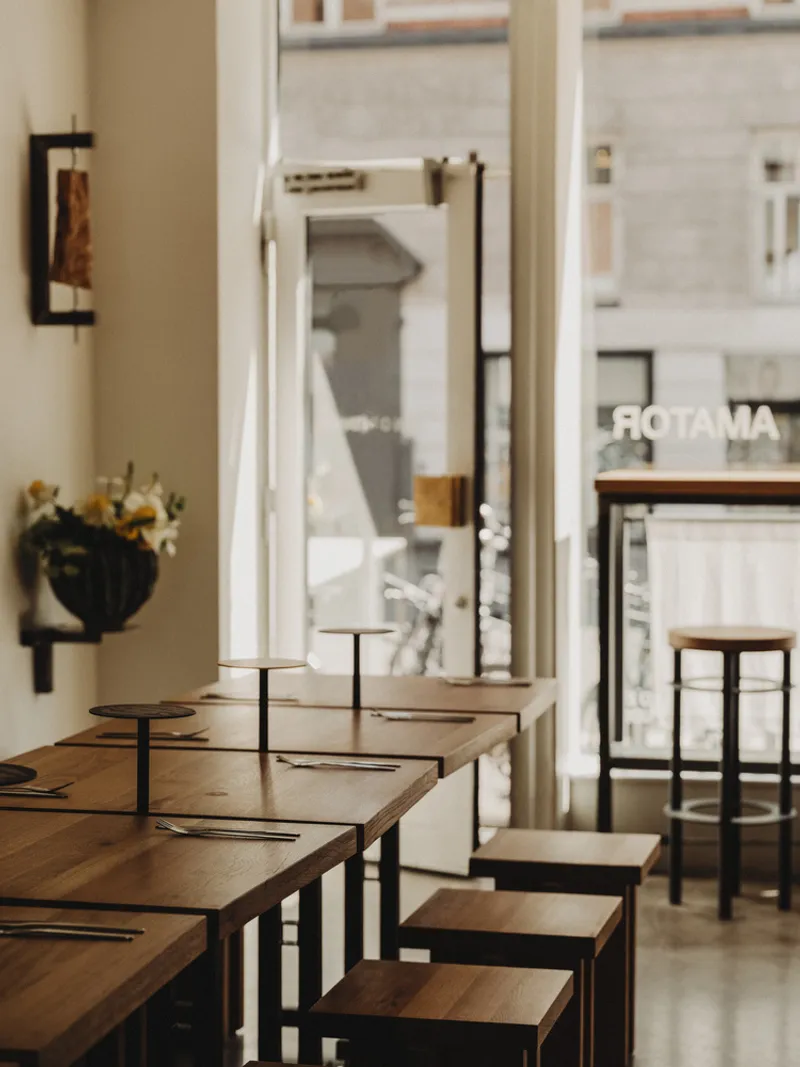
At the heart of the plan sits a communal table that is less a piece of furniture and more a spatial device. Individual angled oak tabletops connect via discreet steel rings to form a single long dining surface. The angles are deliberate: they create pockets of semi-privacy within the communal format, so two people can feel like they have their own table while still being part of a larger gathering. Integrated plates are built into the surface for serving, which means the table choreographs the meal as much as the chef does.
The modular logic allows the configuration to shift between daytime casual seating and evening dinner-party layouts. It is a smart response to the 50 square meter constraint: rather than accepting that a small restaurant means fewer covers, the design makes the table itself flexible enough to accommodate different group sizes without ever looking like a cafeteria rearrangement.
Craft Legible at Every Joint
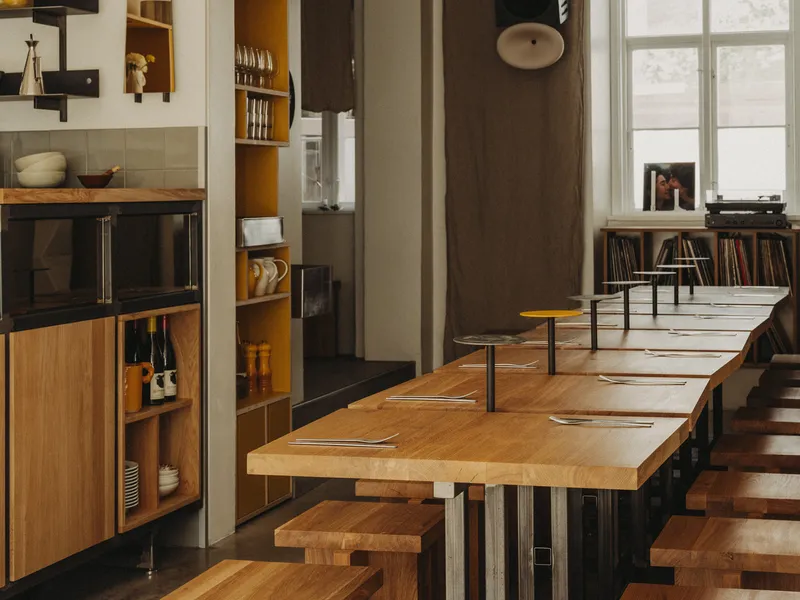
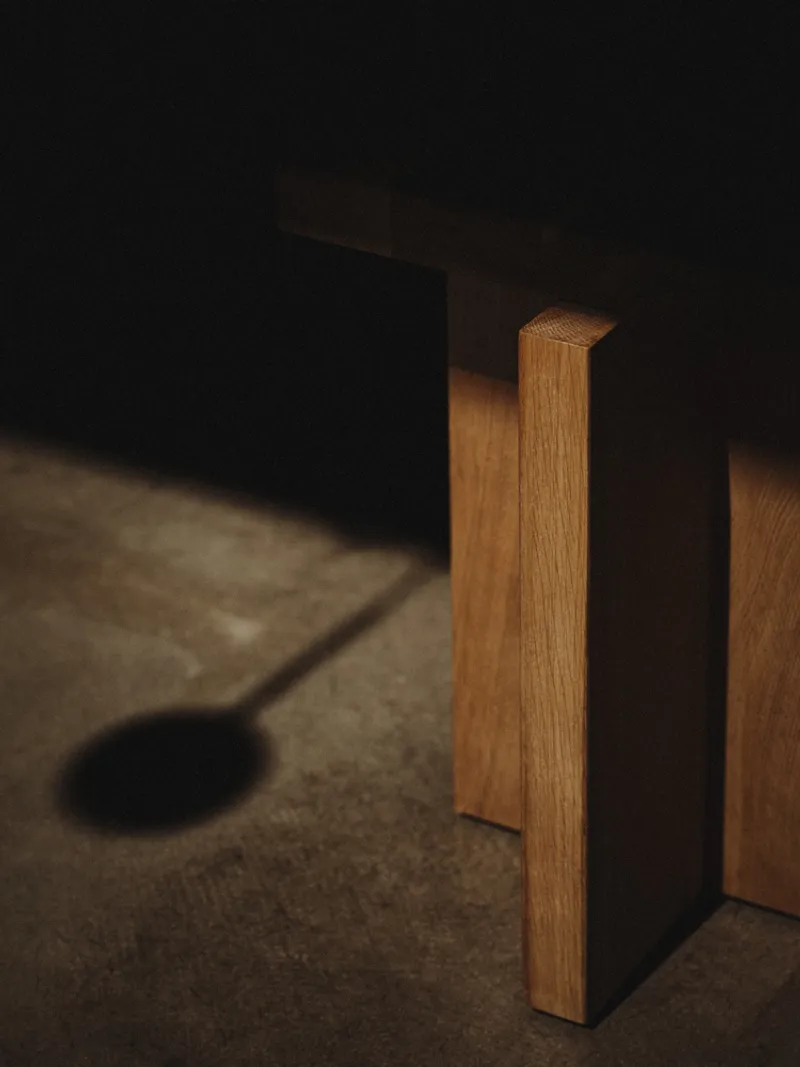
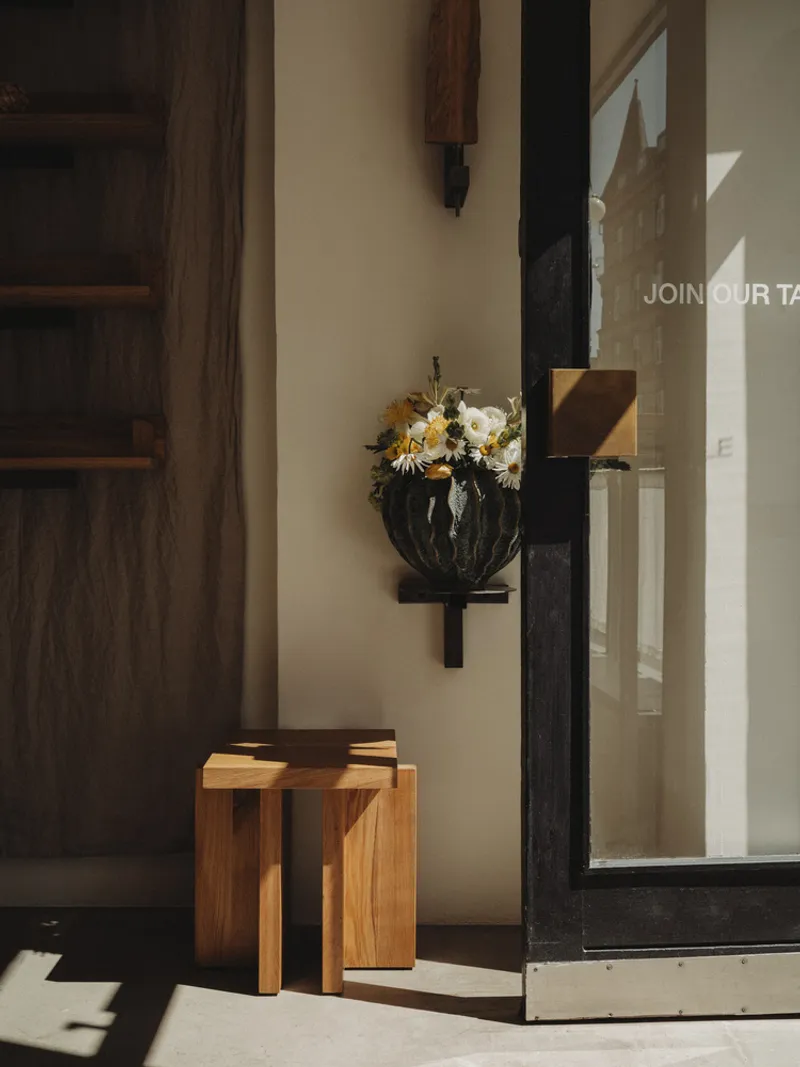
All furniture was custom designed and produced in Poland by skilled artisans, then transported to Copenhagen. The sculptural stools, the first objects from the upcoming wiercinski-objects collection, are compact and geometrically blunt, carved from solid oak blocks that double as visual anchors along the counter. Their form prioritizes spatial economy without looking like compromise.
Raw steel appears throughout: in the counter frames, the table legs, and a freestanding washbasin. Wiercinski-studio left the steel hand-worked and unpolished, so tool marks and weld lines remain visible. This is a conscious refusal of the slick metal finishes that dominate contemporary hospitality fit-outs. The material honesty runs parallel to the chef's straightforward, vegetable-forward cuisine. Both the food and the room avoid the temptation to over-refine.
Material Palette: Polish Linen, Brown Mirrors, Yellow Plywood
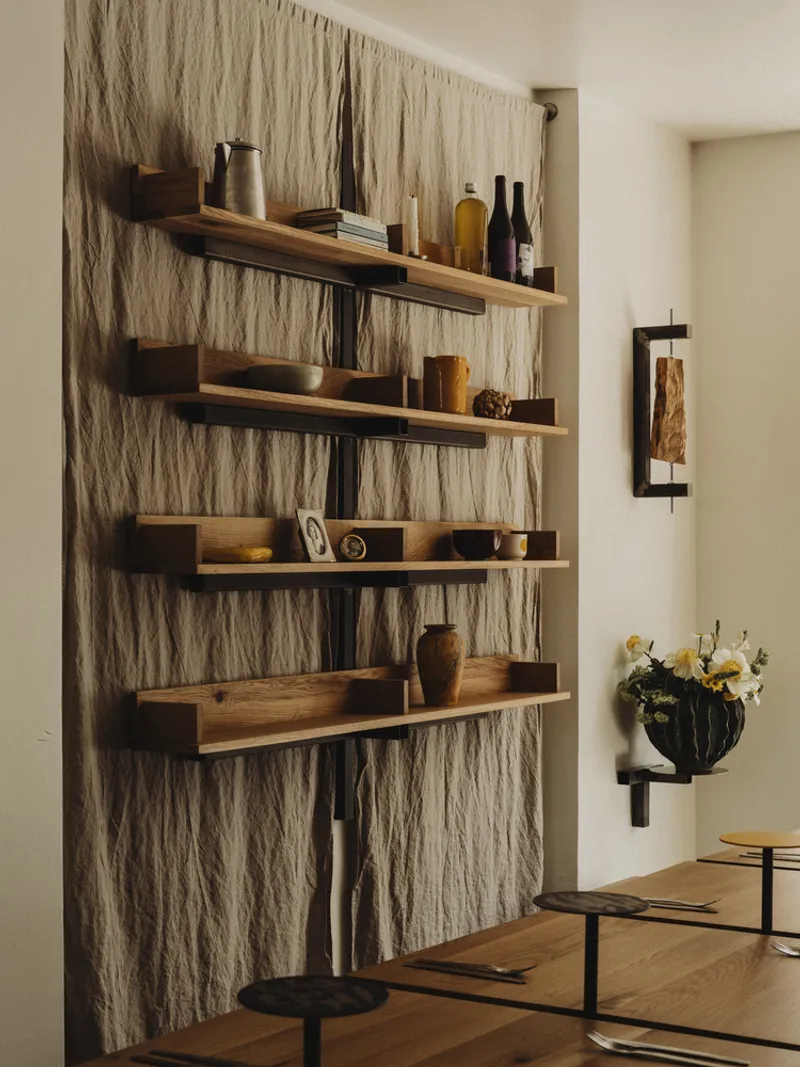
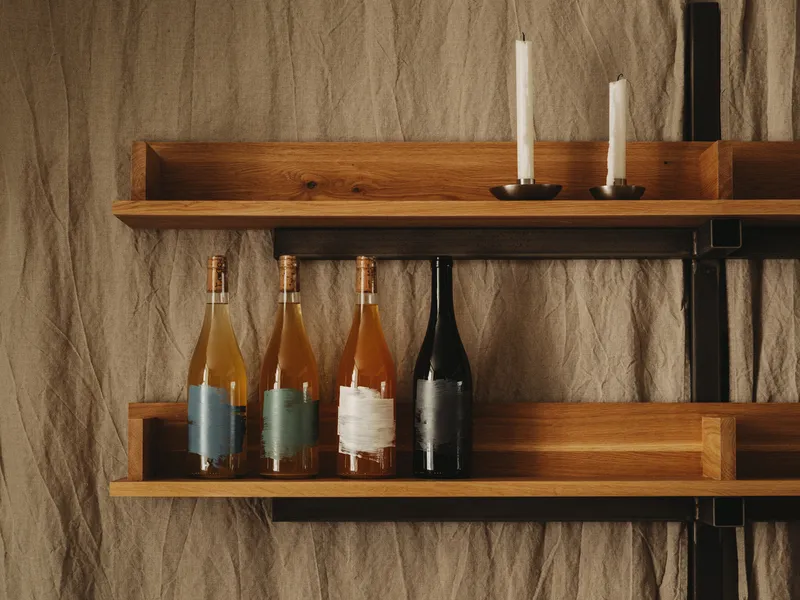
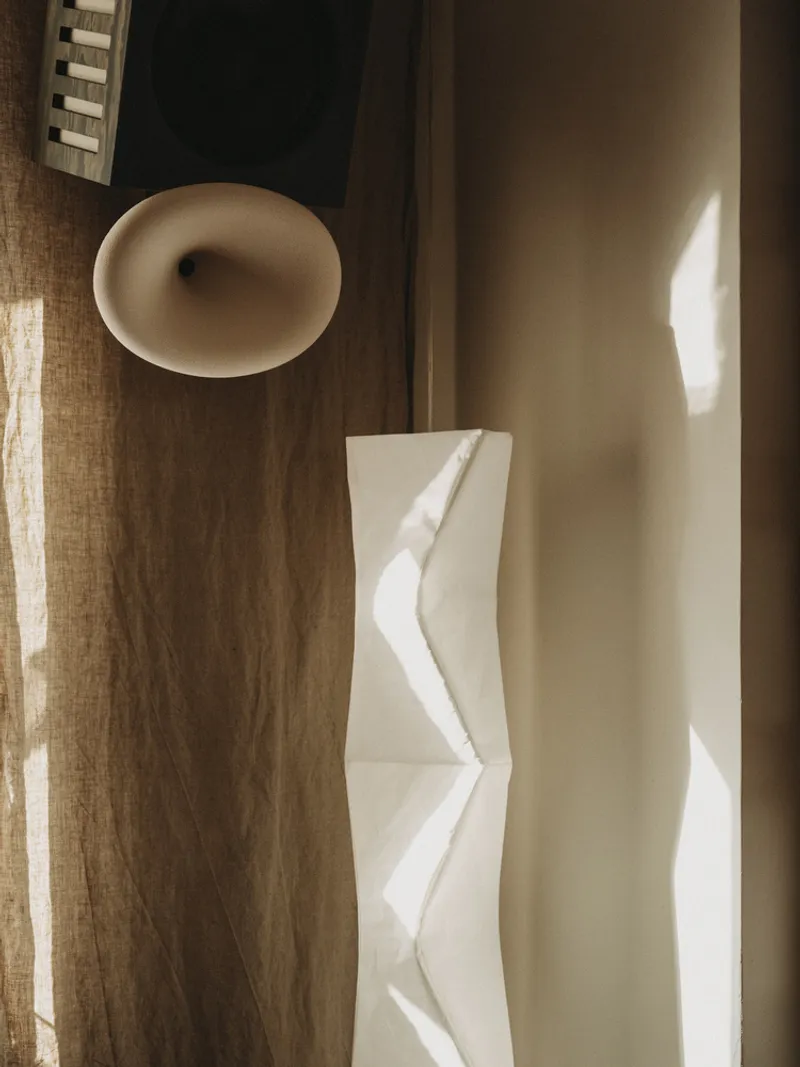
The walls behind the floating shelves are lined with wrinkled Polish linen, a soft, absorbent surface that contrasts with the steel and oak. Ceramics, wine bottles in leather sleeves, and white candles sit on these shelves, turning the perimeter into something closer to a domestic sideboard than a restaurant display system. The linen is not stretched taut or pressed flat; it is allowed to hold its natural texture, which lends the room a tactile warmth that photographs only partly capture.
A bar clad in brown mirrors divides the dining area from the open kitchen, adding visual depth to a room that could easily feel cramped. The brown tint keeps the reflection subdued, avoiding the theatrical flash of clear mirror. Meanwhile, yellow plywood makes carefully placed appearances, in the kitchen cabinetry and on accent shelves, referencing the restaurant's yellow dot identity. It is one of the few concessions to color in an otherwise muted room, and it lands precisely because it is used sparingly.
Light and Sconces: Daylight to Candlelight
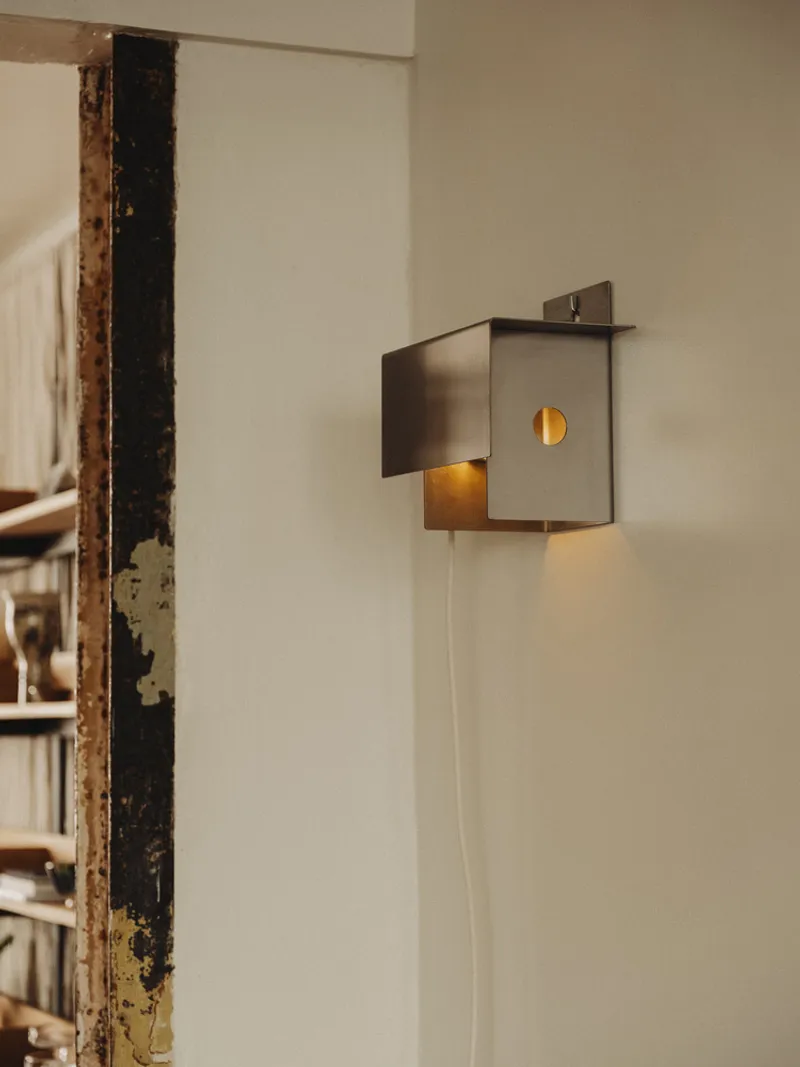
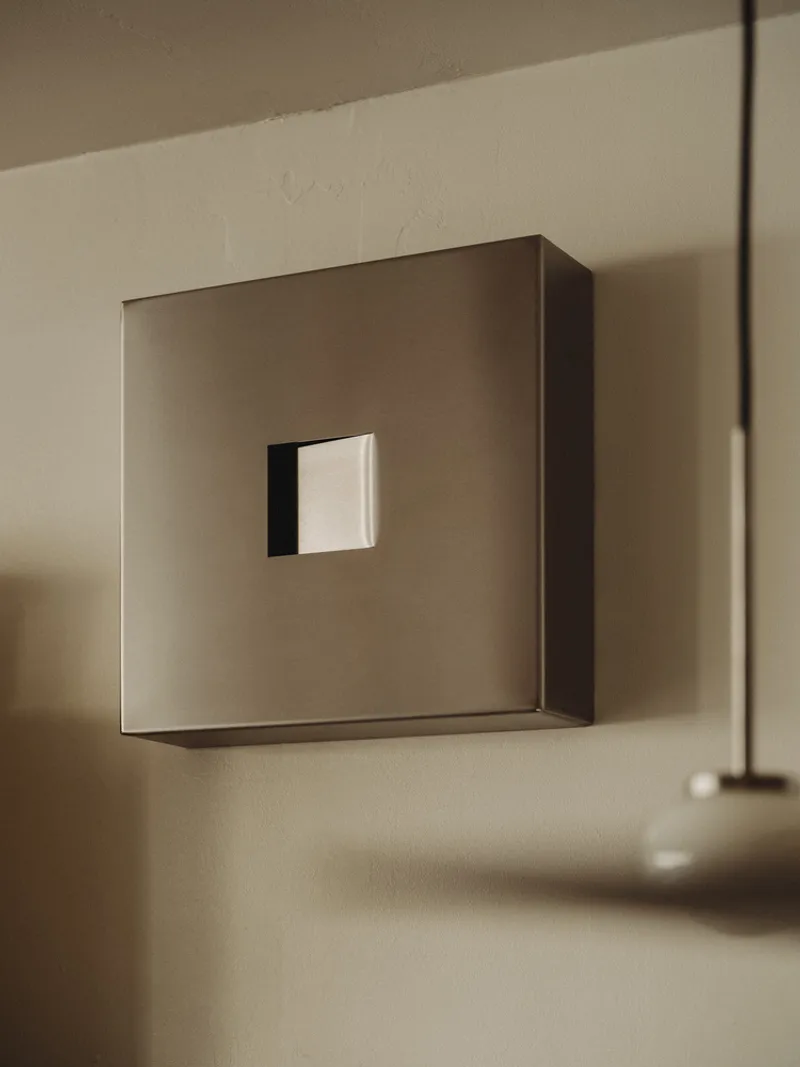
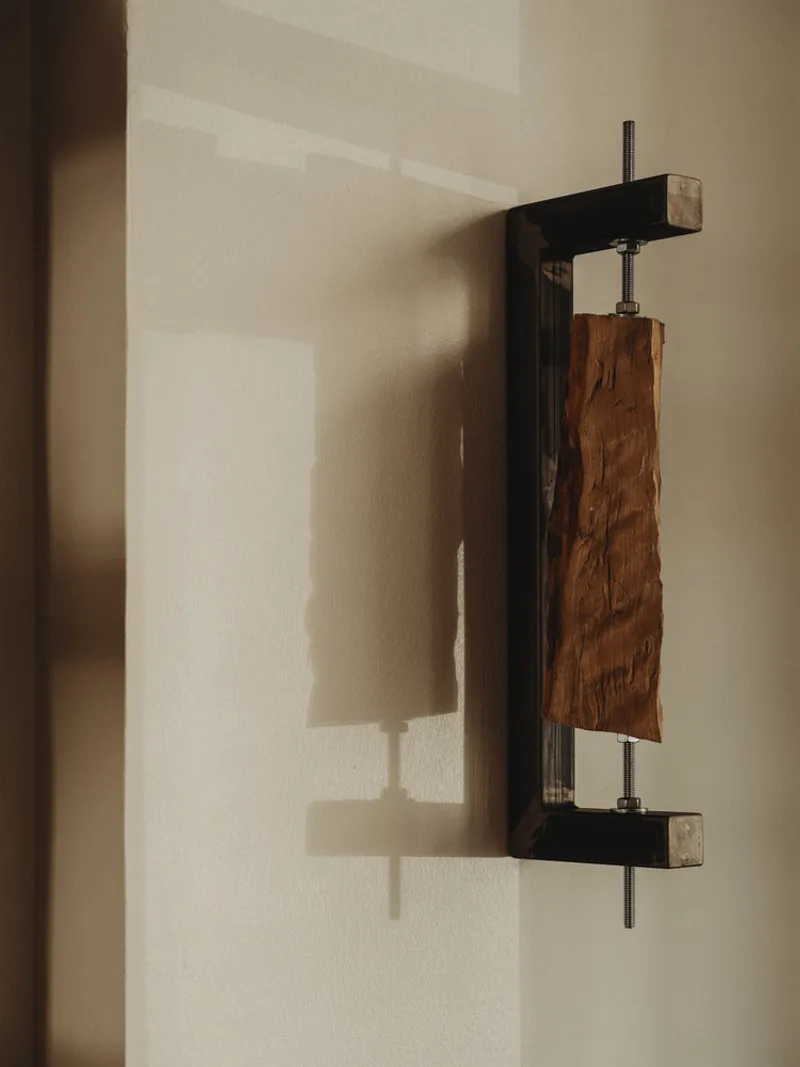
The lighting strategy is where the restaurant's dual program becomes most legible. During the day, the large glass facade and tall windows wash the interior in natural light, making the oak glow and the steel read as warm grey rather than industrial black. As evening service begins, the room transitions to bespoke stainless steel sconces and candles. The sconces are handcrafted objects in their own right: metal boxes with circular or recessed apertures that cast tight pools of light onto the walls, creating an intimacy that the daytime configuration deliberately avoids.
One wall-mounted sconce sits beside an exposed weathered timber beam, and the pairing is telling. Neither the beam nor the sconce pretends to be anything other than what it is. The 1870 building's bones and the 2024 additions share the frame without competing for attention.
Sound, Vinyl, and Sensory Range
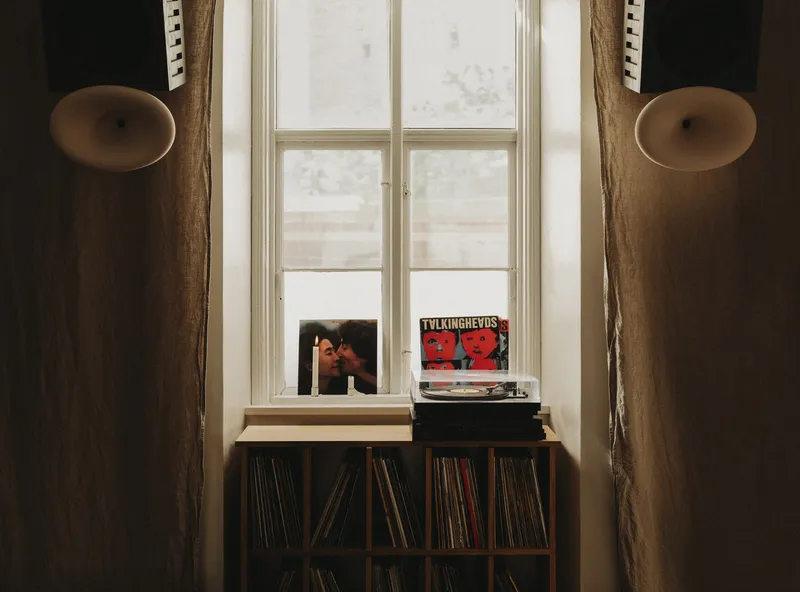
Beneath the rear window, a custom shelving unit houses a vinyl collection, with album covers propped against the glass as if in someone's living room. A hi-fi sound system by local Copenhagen brand Arda Audio, with custom-made speakers, provides the auditory layer. This is not background music piped through ceiling speakers; it is a deliberate curatorial choice that extends the restaurant's identity beyond the visual.
The vinyl shelf is important for another reason. It signals that the space is not just about efficiency or minimalism for its own sake. A record collection takes up room that a 50 square meter restaurant technically cannot spare. Keeping it says something about what the design values: atmosphere over optimization, ritual over throughput.
The Kitchen as Foreground
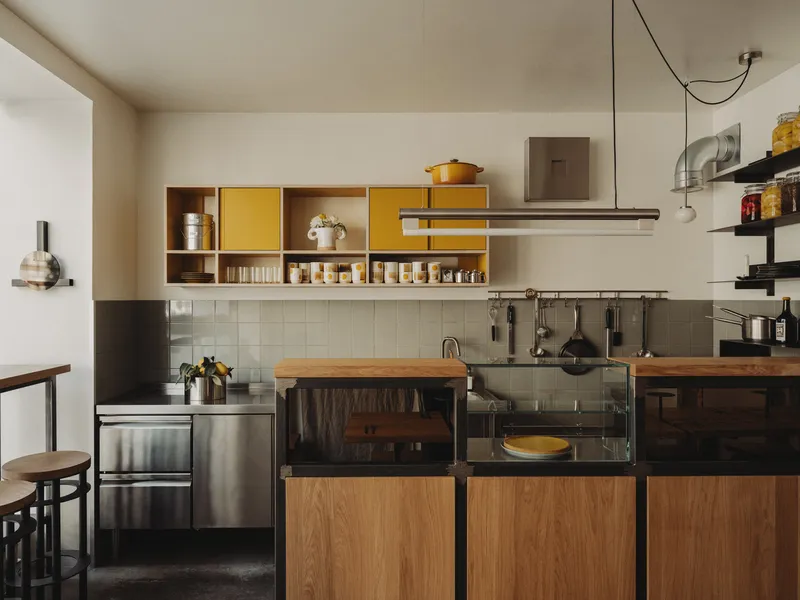
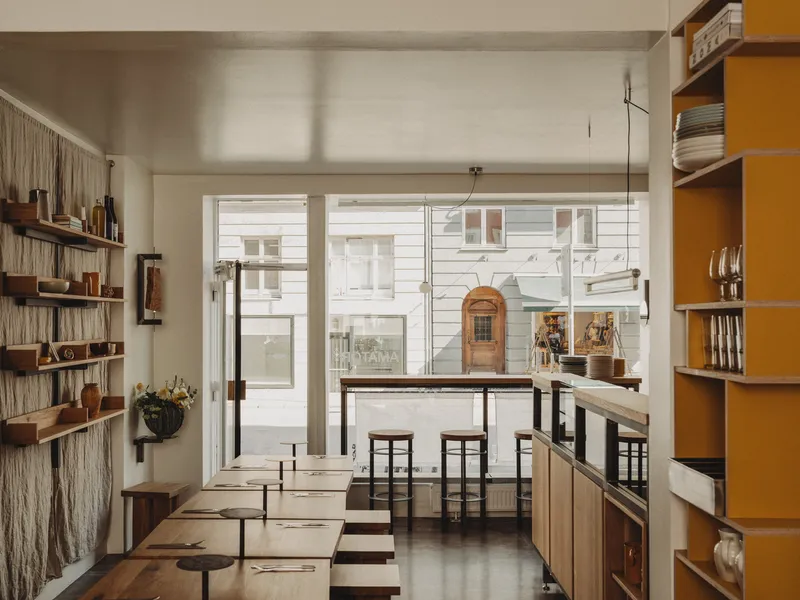
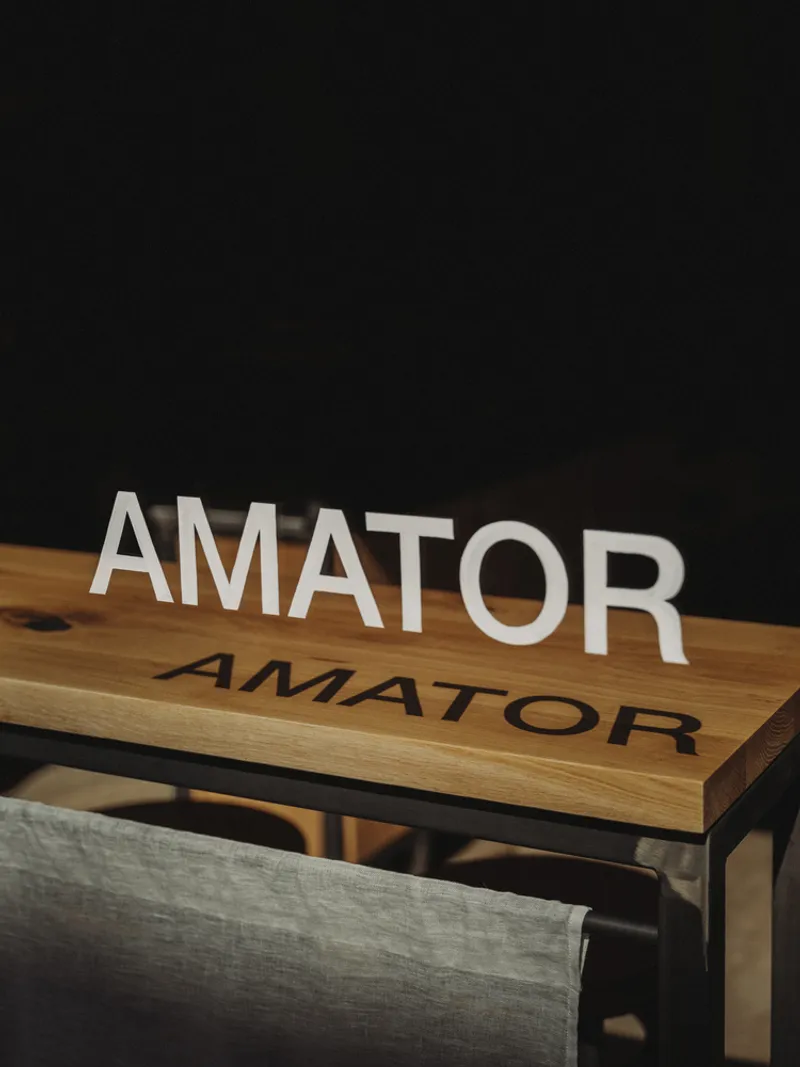
The open kitchen is visible both from the dining room and from the street, which gives it an exhibitionary quality without resorting to theatrics. Yellow accent cabinets and a white tile backsplash keep it legible as a working kitchen rather than a performance set. The stainless steel range hood is honest and utilitarian. Behind the brown-mirror bar, the chef works at eye level with seated guests, and the absence of a high pass or heat lamp reinforces the feeling that cooking and eating happen in the same room, not across a service divide.
A tree trunk fragment from a Polish forest sits near the entrance, a quiet anchor that connects the restaurant's raw material language to its origin story. It is an unusual object for a Copenhagen dining room, and that slight strangeness is part of the point. Amator Cph does not try to pass as a local vernacular exercise. It wears its cross-cultural seams openly.
Plans and Drawings
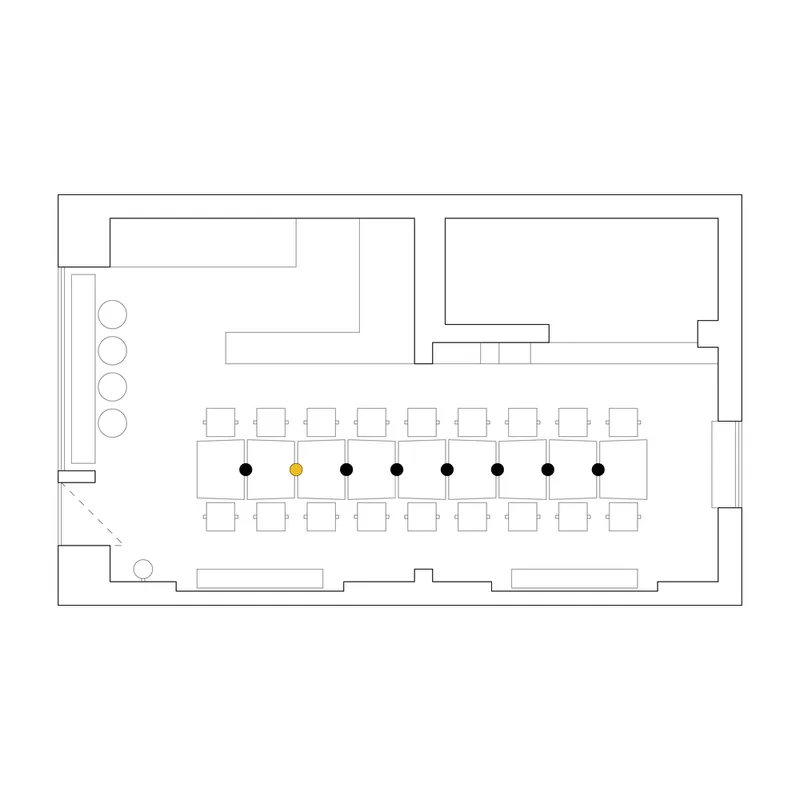
The floor plan reveals how tightly the 50 square meters are organized. A rectangular dining space runs along the facade, with the central communal table occupying the majority of the room's width. Perimeter service areas, including the kitchen, bar, and storage, are pushed to the edges, which keeps the center of the room feeling open despite the compact footprint. The plan reads as a single room with functional zones defined by furniture rather than walls, which is how the space maintains its domestic, living-room quality.
Why This Project Matters
Amator Cph matters because it offers a counter-model to the prevailing aesthetic of Nordic restaurant design, which tends toward either austere refinement or rustic maximalism. Wiercinski-studio's approach lands in a third space: handmade, deliberately imperfect, and culturally hybrid. By bringing Polish craftsmanship into a Danish domestic framework, the project argues that authenticity in hospitality design is not about purity of origin but about the honesty with which materials and making are presented.
It also demonstrates that constraint is a legitimate design tool, not just a limitation. Fifty square meters, a single communal table, and a handful of materials produce a room with more character and coherence than many restaurants five times its size. The lesson is structural: when the budget and footprint are tight, specificity wins. Every steel ring connecting the tabletops, every wrinkled linen panel, every yellow plywood accent is doing work. Nothing is decorative filler. That discipline is what separates a well-designed small restaurant from a merely small restaurant.
Amator Cph by wiercinski-studio. Located in Østerbro, Copenhagen, Denmark. 50 m². Completed in 2024. Photography by Paolo Galgani.
About the Studio
Share Your Own Work on uni.xyz
If projects like this are the kind of work you want to make, uni.xyz is a place to publish your own, find collaborators, and enter design competitions.



Popular Articles
Popular articles from the community


Hill & Cross Opera: Sculptural Opera House Architecture Shaped by Tallinn’s Landscape and Identity
Hill & Cross Opera reimagines opera house architecture in Tallinn through its sculptural hill, civic plaza, glass wave and a luminous cross.

Riyadh For All: Intergenerational Urban Design for Active Aging in Rabat
Riyadh For All reimagines urban design in Rabat with intergenerational co-living, adaptive courtyards, and Moroccan cultural exchange today.

The Musturak Paradise: Senior Living Architecture for a Connected Future in Temara, Morocco
The Musturak Paradise reimagines senior living architecture in Temara via private homes, social spaces, culture, community, and shared care.

Co-life: Sustainable Architecture for Age-Friendly Community Living
Co-life reimagines sustainable architecture for seniors through courtyards, rammed earth, shared gardens, and spaces designed for belonging.


Similar Reads
You might also enjoy these articles


Hodi-Mandai Geram
Project Function: Preservation and revitalization of the Intangible heritage and socio-spatial identity of the Hodi by Housing, Cultural Memory Center, Sacred Grove, landscape, local tourism economy


Olio Towers: A Mid-Rise for Performers That Fuses Housing, Rehearsal, and Stage
Located blocks from Houston's Theater District, this modular tower stacks living units around a central performance atrium.

Oasis: Modular Green Housing Carved into Dhaka's Urban Fabric
A shortlisted Plugin Housing entry reclaims unauthorized settlements in Dhaka with stepped concrete volumes, green roofs, and ventilation-driven design.

Black Hole: A Floating Megastructure for the Post-Physical Era
Emiliano Mazzarotto envisions a spherical, self-scaling arena where e-sports, digital hotels, and holographic stadiums replace traditional public space.

Explore Architecture Competitions
Discover active competitions in this discipline



Challenge to reimagine the Iron Throne


Photograph architecture without architects


Illustrate the lost glory of Angkor Wat - Render Challenge


Design challenge to reuse E-waste
Comments (0)
Please login or sign up to add comments
No comments yet. Be the first to comment!