
Ana Smud Wraps a Glass Pavilion in Timber and Garden to Build a Private World in Buenos Aires
LUAA House in Vicente López creates three distinct relationships with its surrounding landscape across three materially different floors.


Most houses in dense Argentine suburbs treat their gardens as leftover space, something that happens after the architecture is finished. Ana Smud's LUAA House in Vicente López reverses that hierarchy entirely. Here the 260-square-meter residence sits as a freestanding volume, pulled away from every party wall, so that the garden doesn't just surround the house but defines it. A crumbling brick perimeter wall was restored to seal the 5,000-square-foot lot from its neighbors, creating a pocket of green that feels nothing like the urban fabric outside.
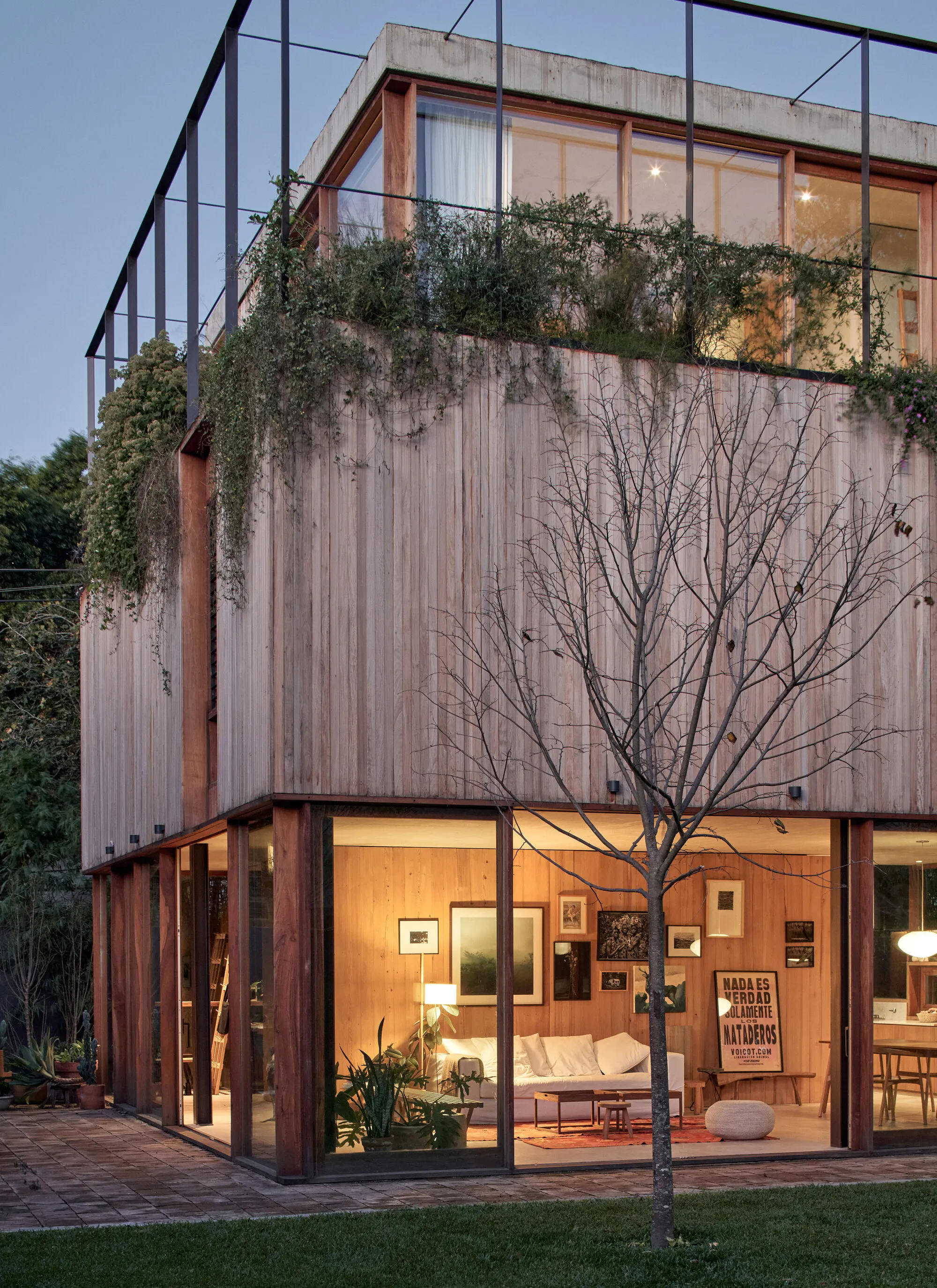
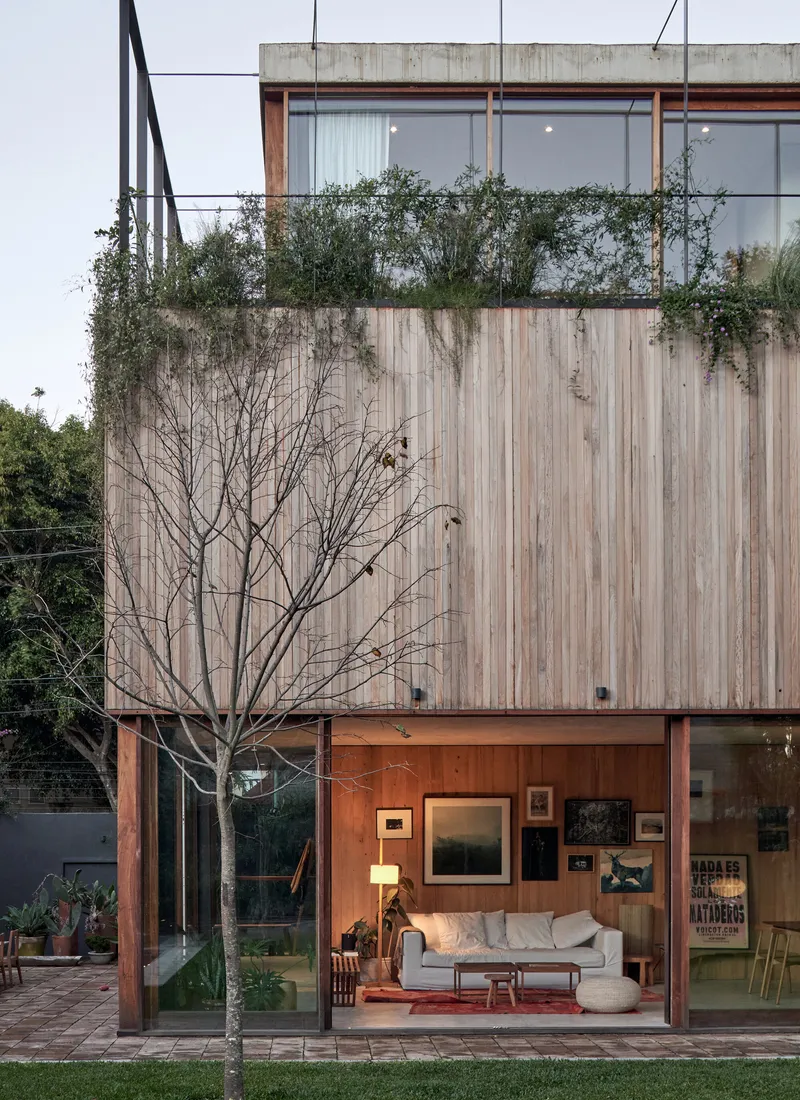
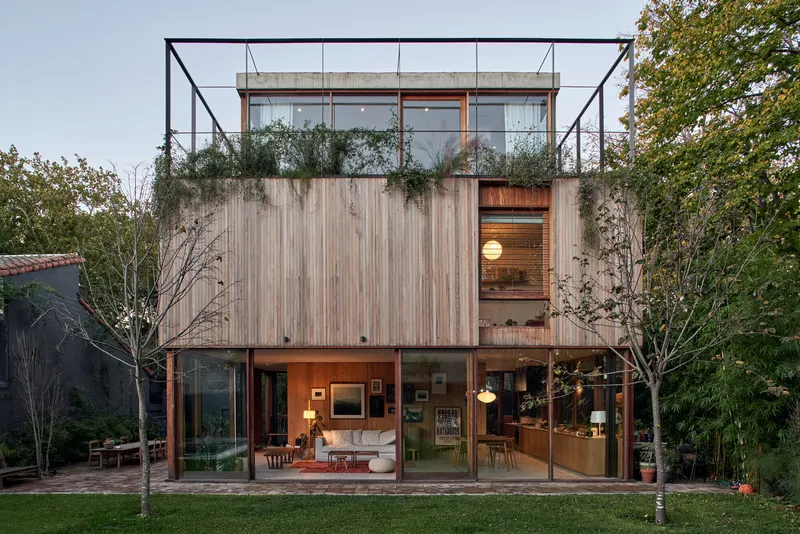
What makes the project genuinely interesting is its refusal to treat the three floors as repetitions of a single idea. Each level has a different material skin and a different posture toward the landscape. The ground floor is almost entirely glass, dissolving any threshold between interior and garden. The middle level is clad in vertical timber, filtering light through slatted screens. The top level pulls back behind a slender metal frame to create an open terrace. It is a house that changes character as you move upward, which is a rare and disciplined move in residential design.
A Brick Wall as First Architecture
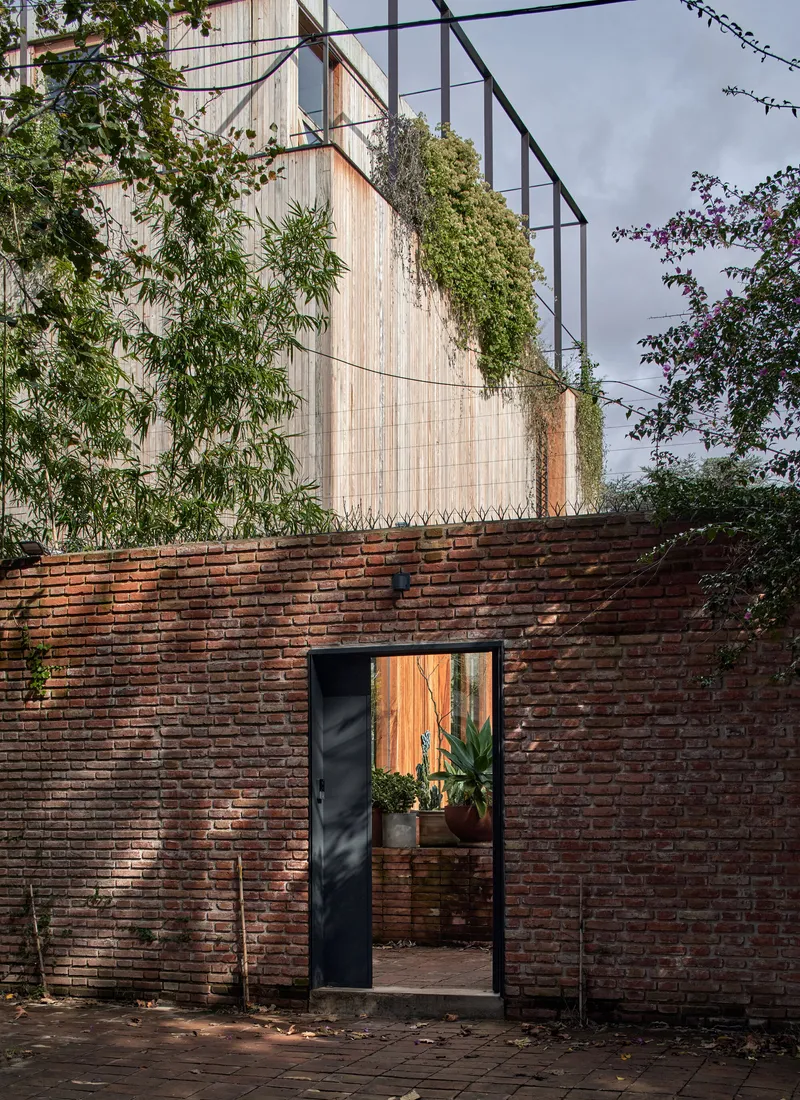
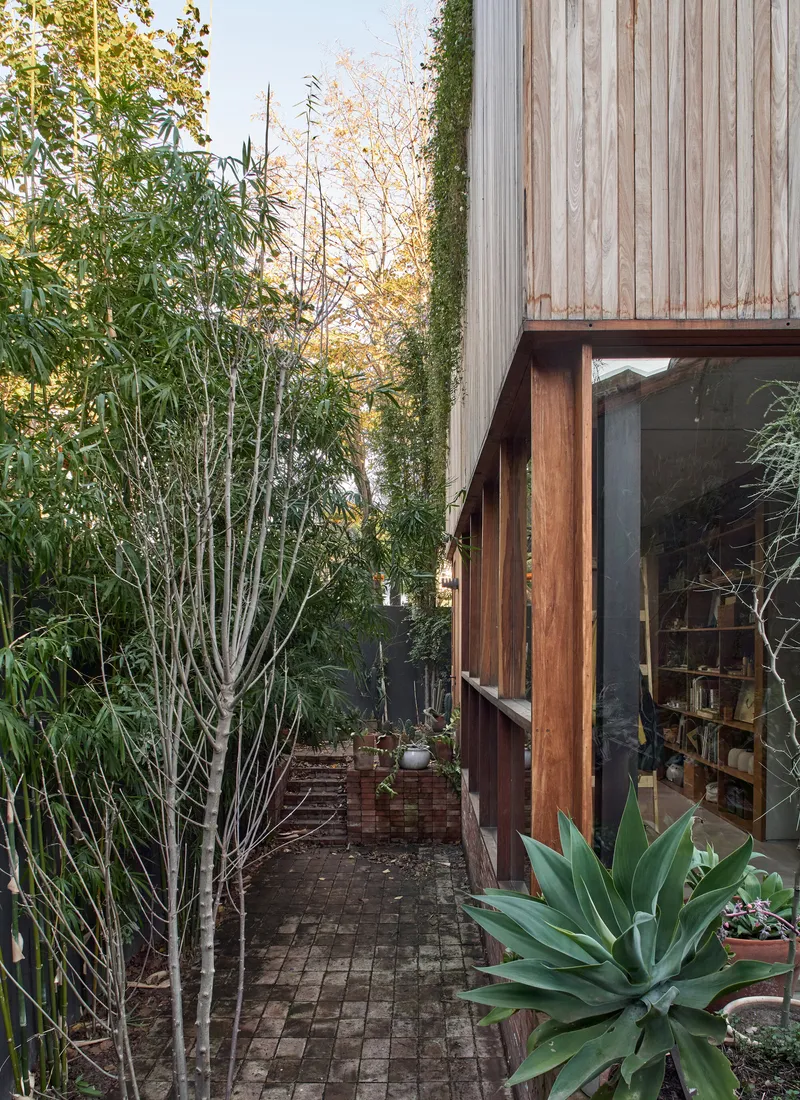
Before you encounter the house itself, you encounter the wall. The existing brick perimeter was in rough shape, but Smud chose to restore rather than replace it, preserving its weathered texture as a kind of geological threshold between the neighborhood and the private garden within. A single doorway punched through the brick frames a narrow glimpse of the timber volume beyond, turning arrival into a sequence of reveals rather than a single gesture.
Climbing vines and agave plantings soften the base, and the old brick reads as something that has always been there. It's a smart instinct: let the boundary feel ancient so the house inside can feel contemporary without apology.
Glass Ground: Living Without Walls
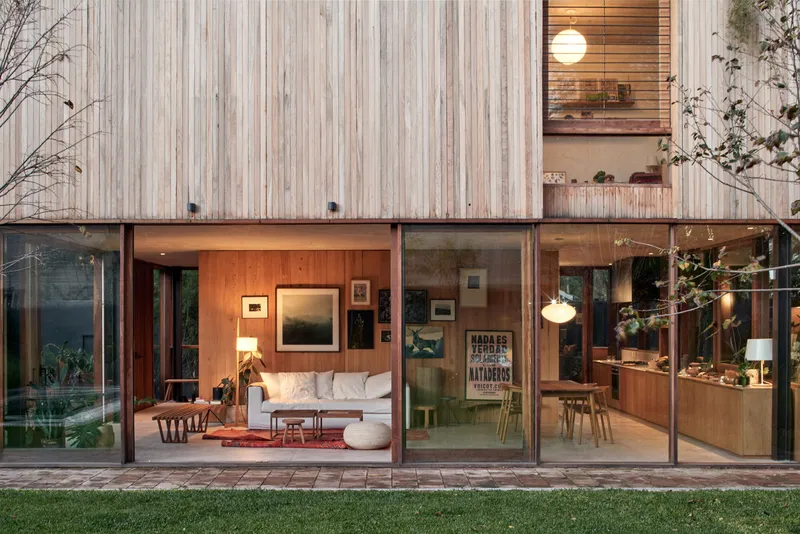
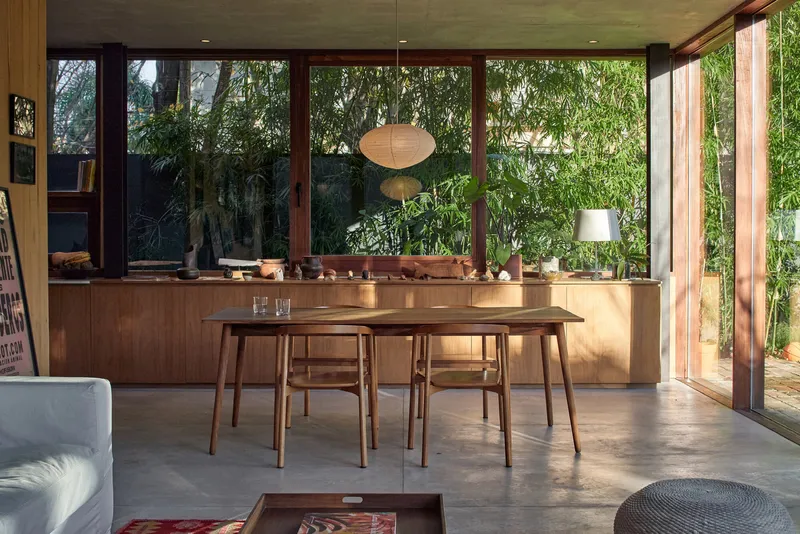
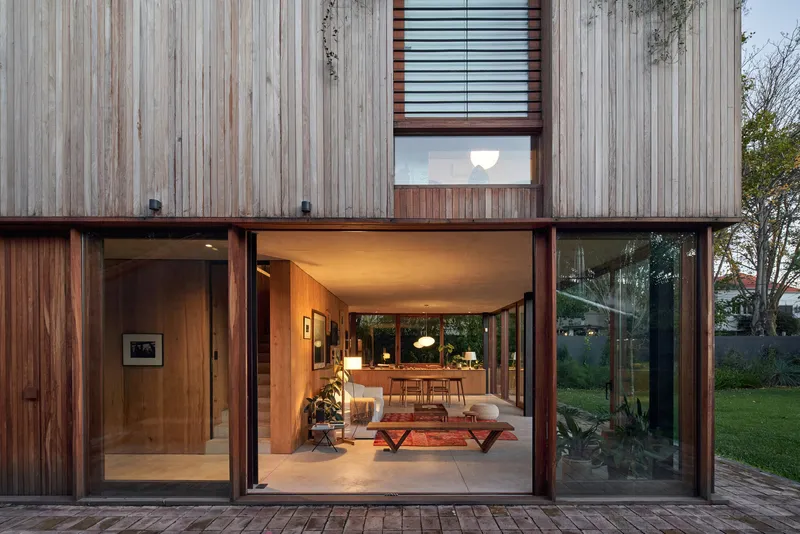
The entire ground floor operates as a glass pavilion. Floor-to-ceiling glazing wraps all four sides, and the structural columns retreat inward so nothing interrupts the transparency at the perimeter. At dusk, the effect is striking: the house glows from within while the garden presses in from every direction. Kitchen bases, work surfaces, and low furniture line the glass walls, keeping the center open and reinforcing the sense that this is a room you look through, not at.
Polished concrete floors run continuously from inside to the brick paving outside, eliminating the visual break at the threshold. Smud treats the ground plane as a single surface that simply passes through the glass. It is the oldest trick in modern residential architecture, but it works precisely because the garden enclosure is so complete. Privacy comes from the perimeter wall, not from the house itself, which frees the ground level to be radically open.
Timber Middle: Filtering the Canopy
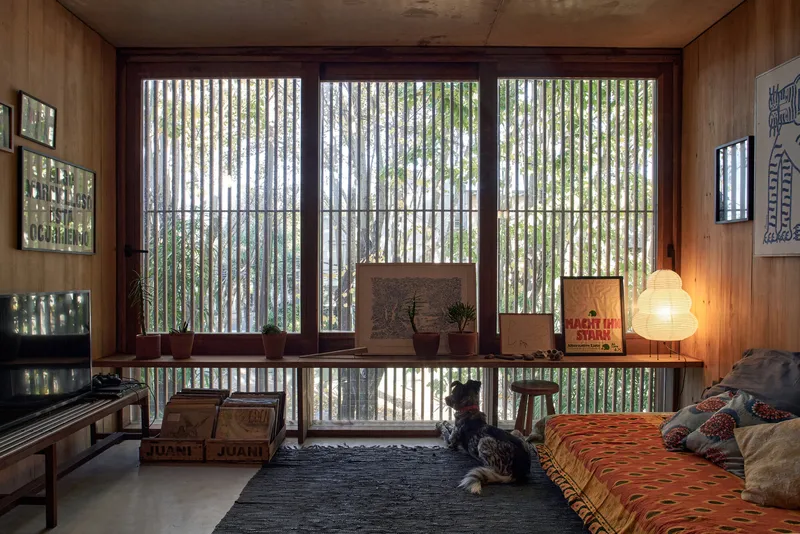
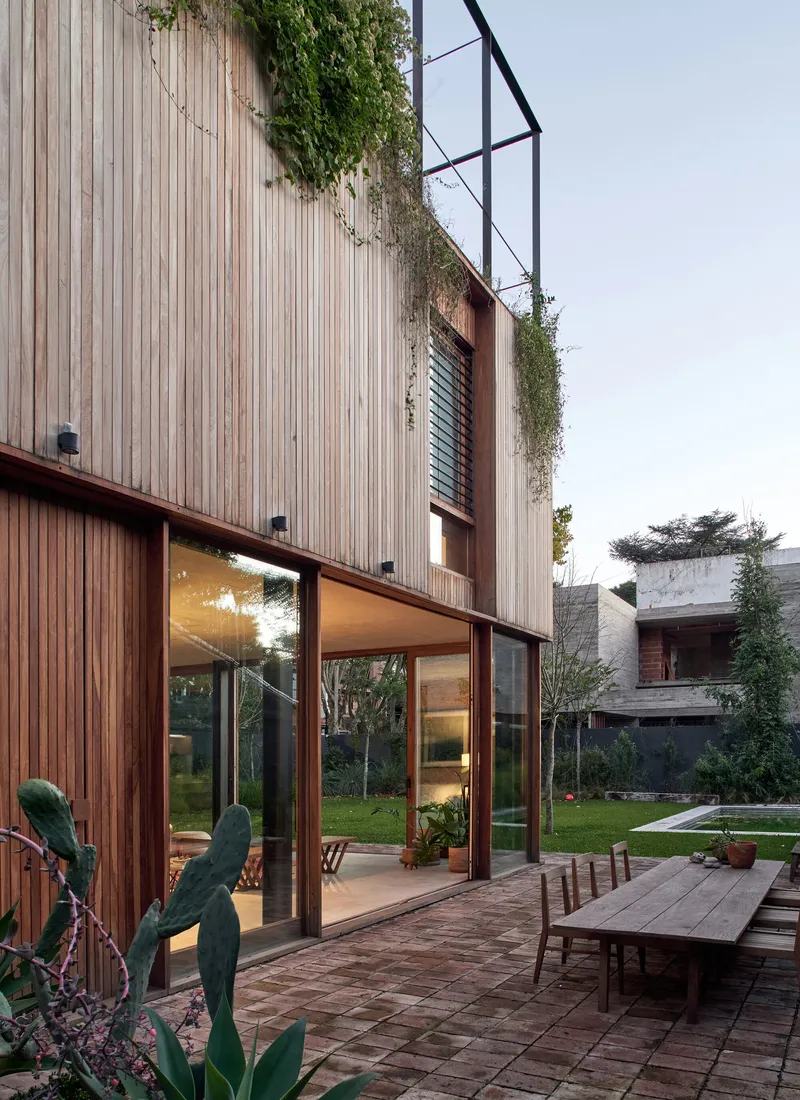
Step up one floor and the character shifts completely. Vertical timber cladding replaces glass, and light arrives filtered through slatted screens rather than flooding in directly. This is where the existing tree canopy matters most: Smud calibrated the spacing of the timber to work with the dappled shade of a mature tree on the lot, so the interior luminosity changes through the day and across seasons.
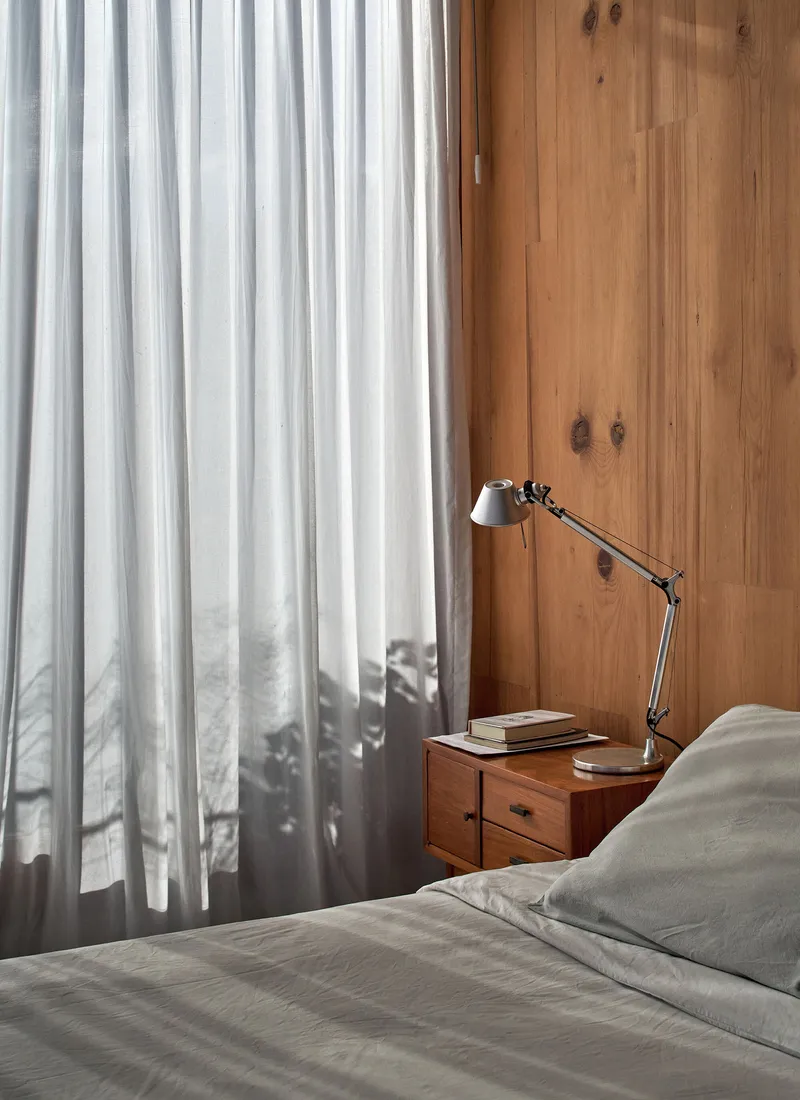
The effect inside is warm and enclosed without feeling dark. Two children sitting on the floor of a wood-paneled room receive soft, directional light through the screens, a quality that would be impossible to achieve with curtains alone. It is architecture doing the work of atmosphere, not decoration.
The Stair as Spine
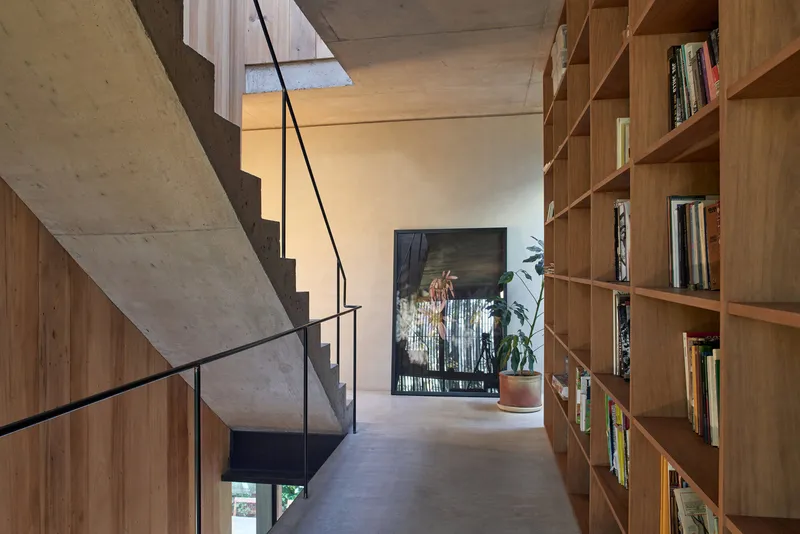
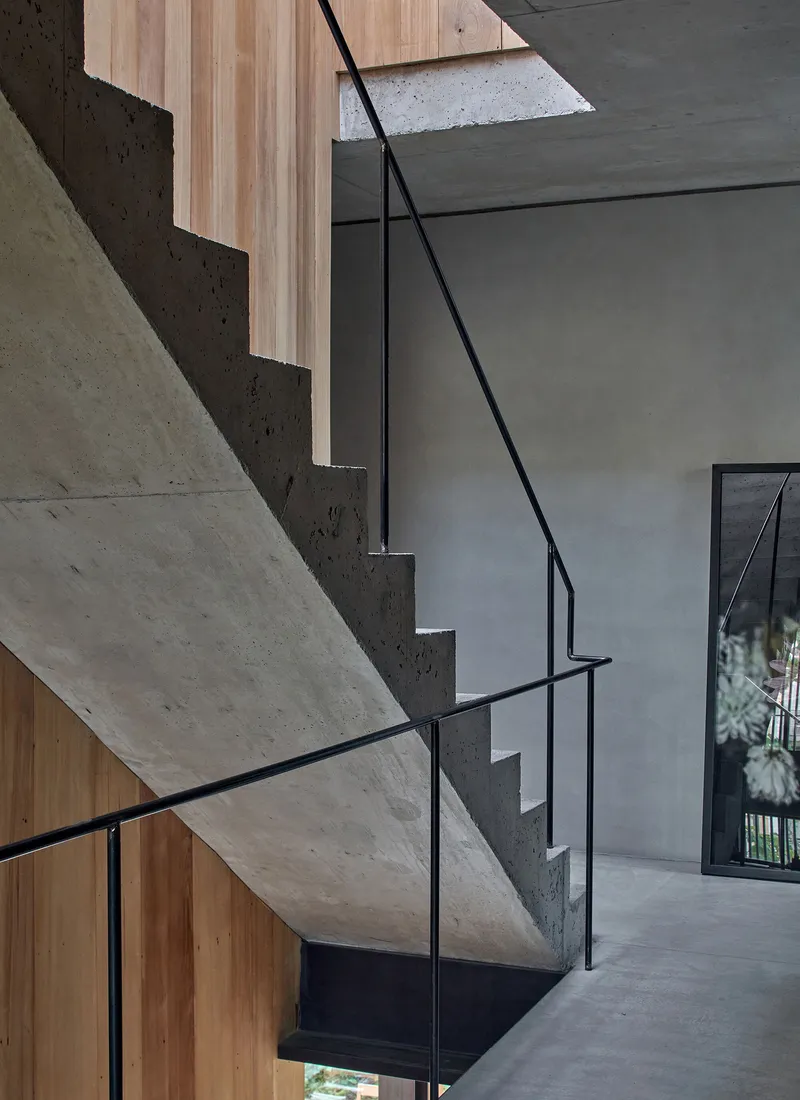
A central concrete stair ties the three floors together and doubles as the house's primary storage wall. Cantilevered treads extend from a timber-clad core lined with floor-to-ceiling bookshelves, turning a circulation element into a library. The black steel handrail is minimal, almost calligraphic against the warm wood behind it.
Smud keeps the stair tight and vertical, which reinforces the compact, almost tower-like quality of the overall volume. Every square meter of floor plate has to earn its place, and the stair earns double duty.
Interior Details: Concrete, Timber, and Restraint
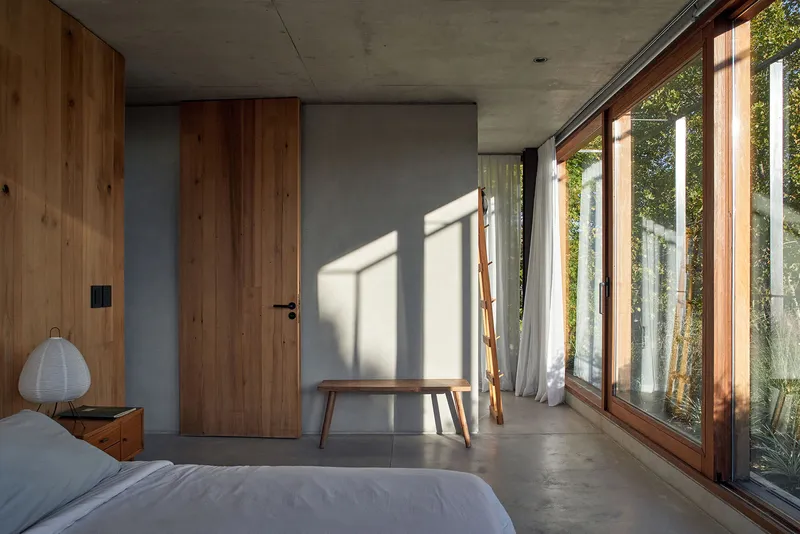
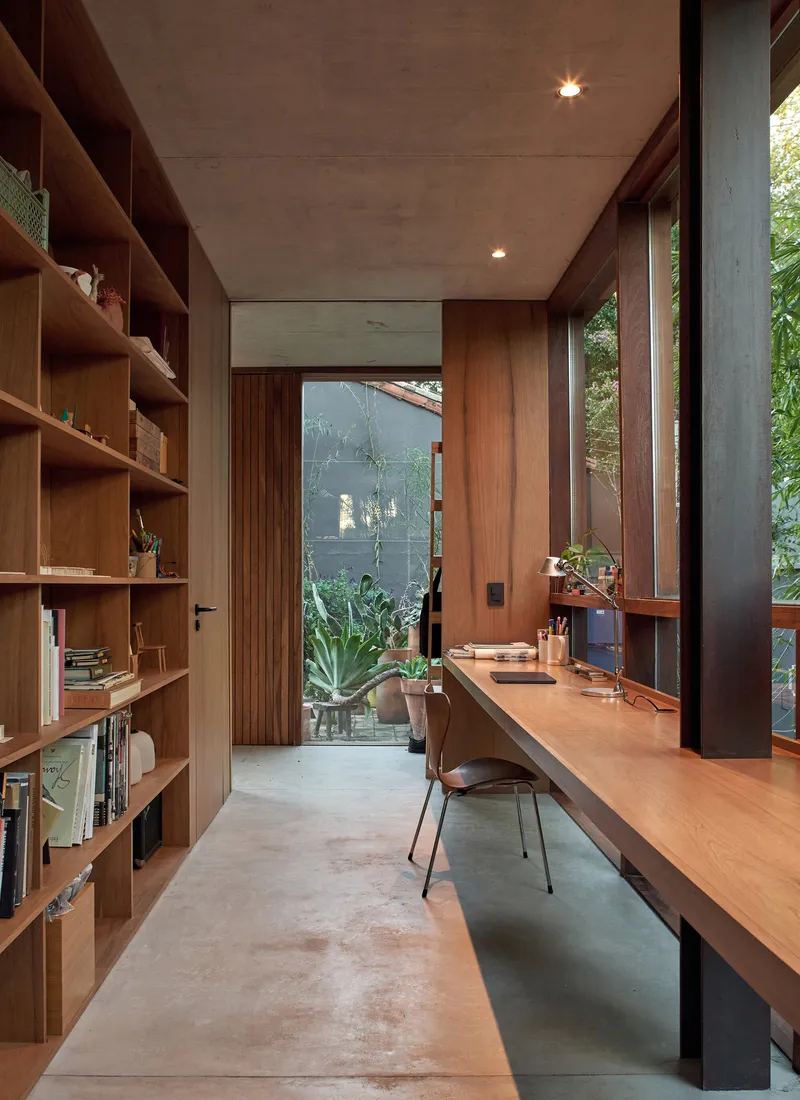
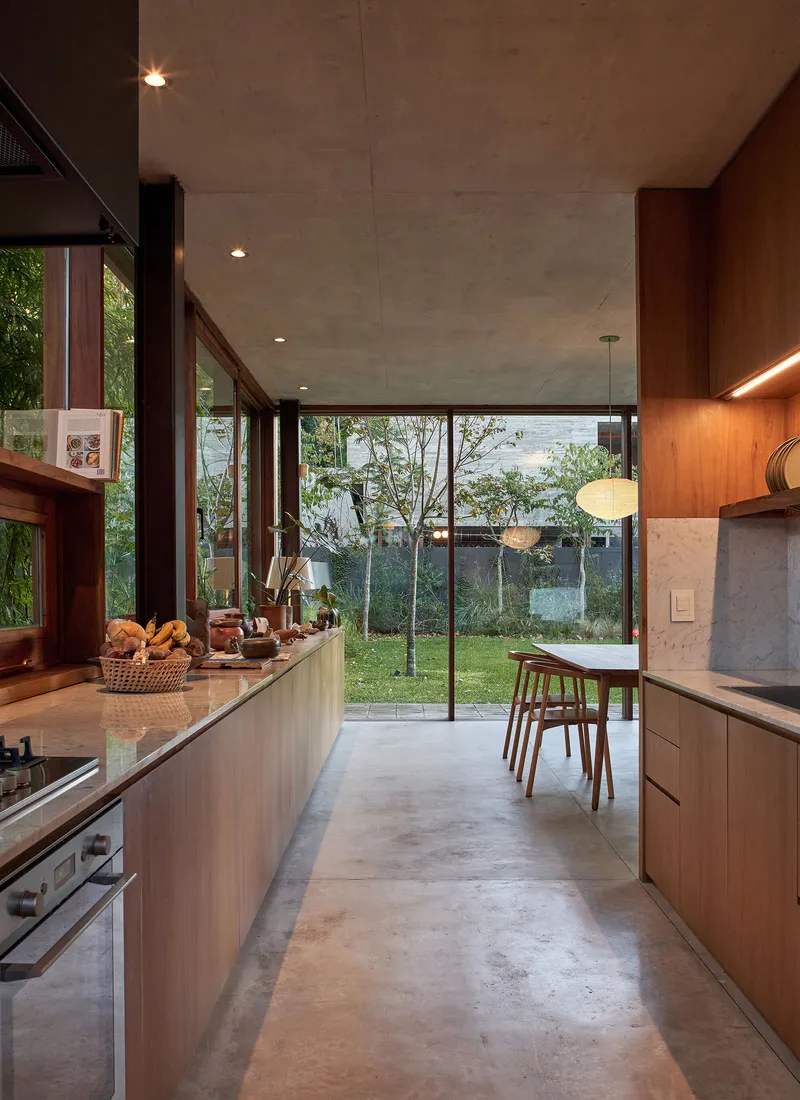
The material palette inside is deliberately limited: exposed concrete ceilings, polished concrete floors, and timber for everything the hand touches. Bedrooms pair raw concrete walls with timber-framed windows that cast angular shadows across the floor. The study features a built-in desk and shelving that feel like part of the architecture rather than furniture placed after the fact.
The kitchen opens directly to the garden courtyard through a full glass wall, maintaining the ground-level logic of transparency. There is no moment in this house where you forget the garden exists. Even the recessed ceiling lights are restrained, warm pools of illumination that defer to the natural light rather than competing with it.
Rooftop and Threshold
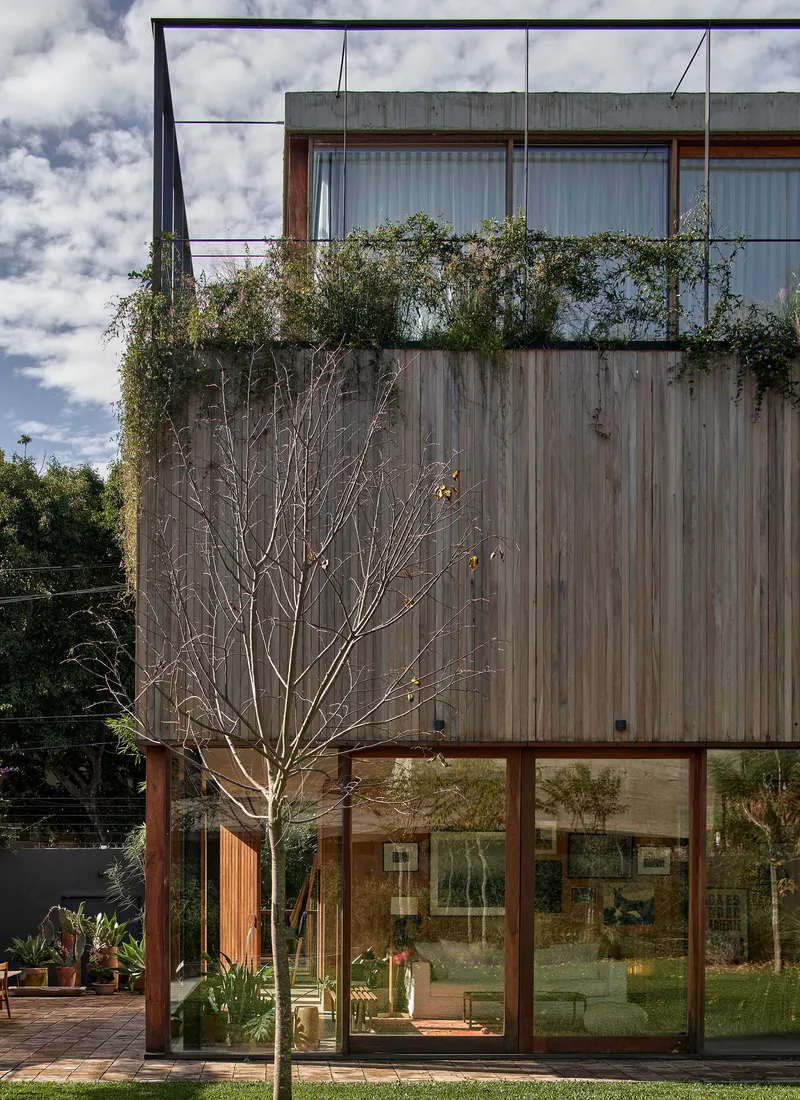
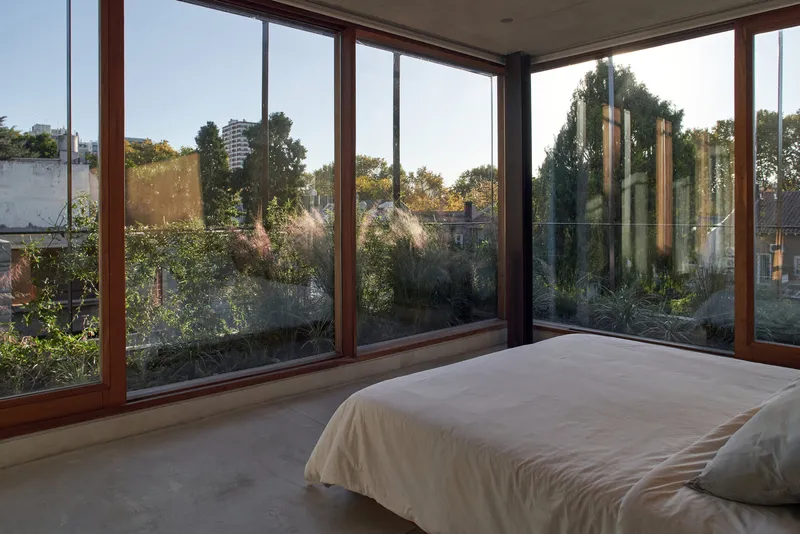
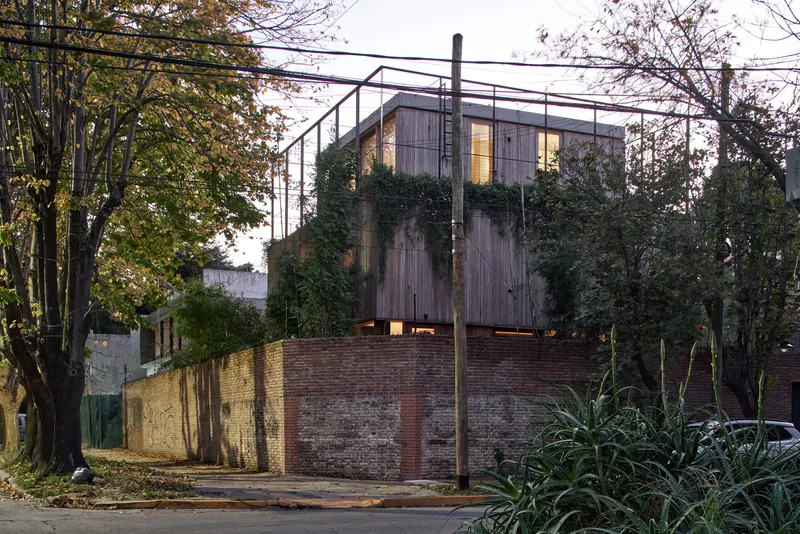
At the top level, the house opens again. Recessed glass walls sit behind a slender metal frame, and a planted terrace extends the garden vertically. From the street, this upper volume reads as a weathered timber box with greenery spilling over its edges, an object that belongs to the landscape rather than the city grid.
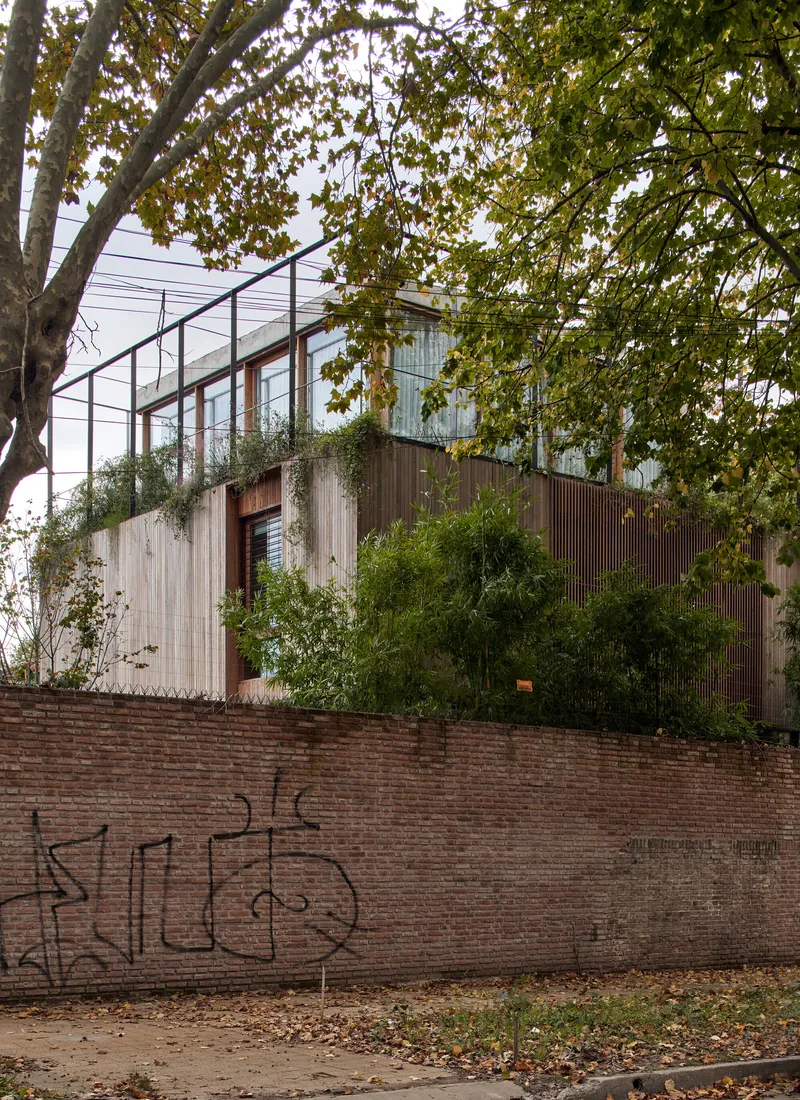
The street elevation is intentionally quiet. A timber-clad volume sits atop the restored brick retaining wall, and the house reveals almost nothing of its interior life to passersby. All generosity is directed inward. That asymmetry between public discretion and private openness is the project's strongest conceptual move.
Dusk Conditions
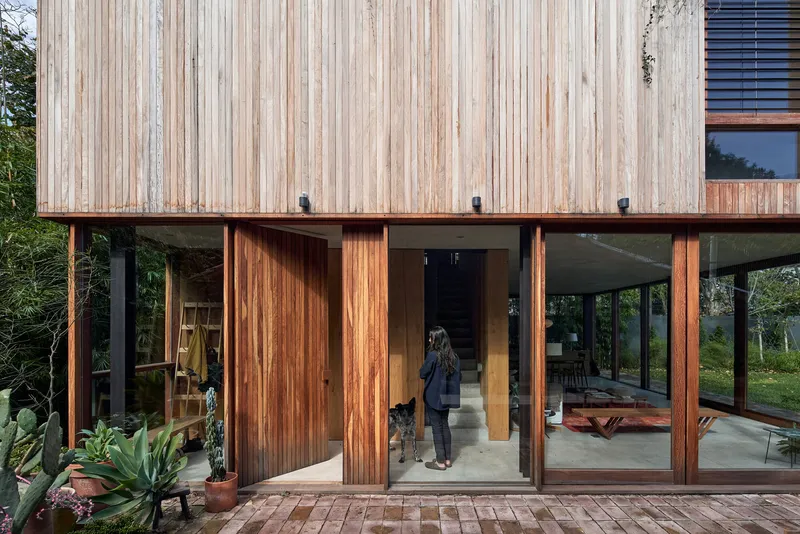
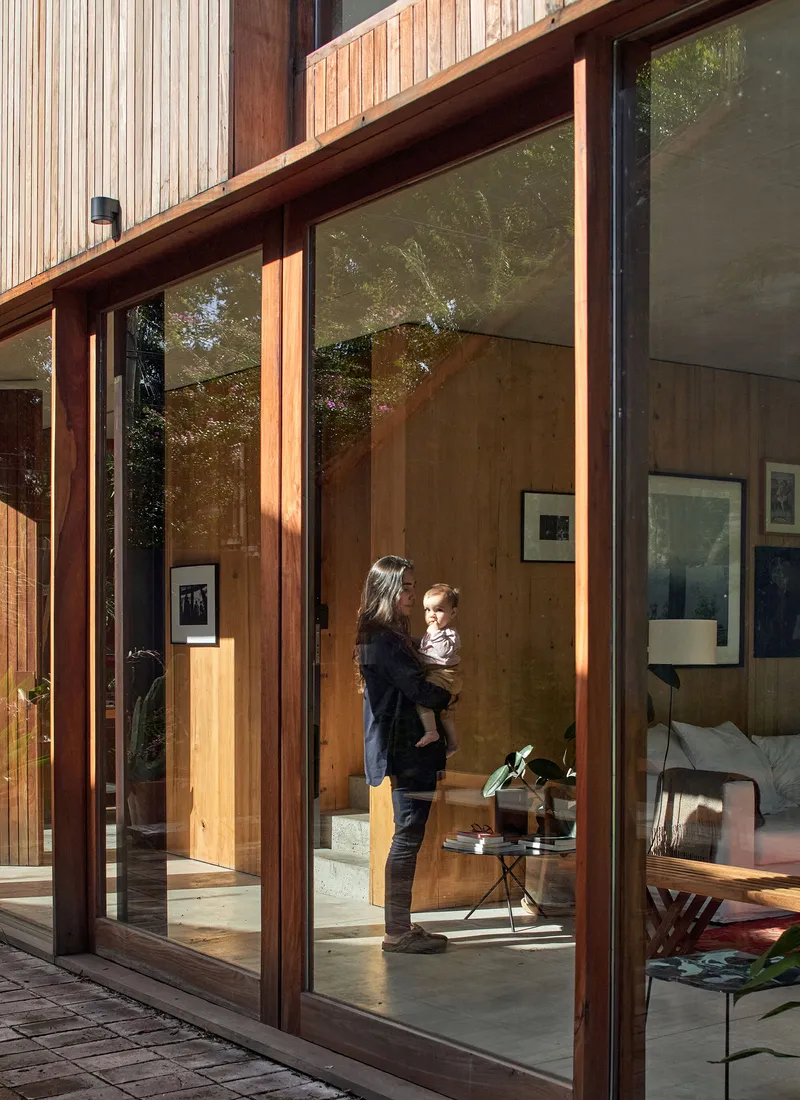
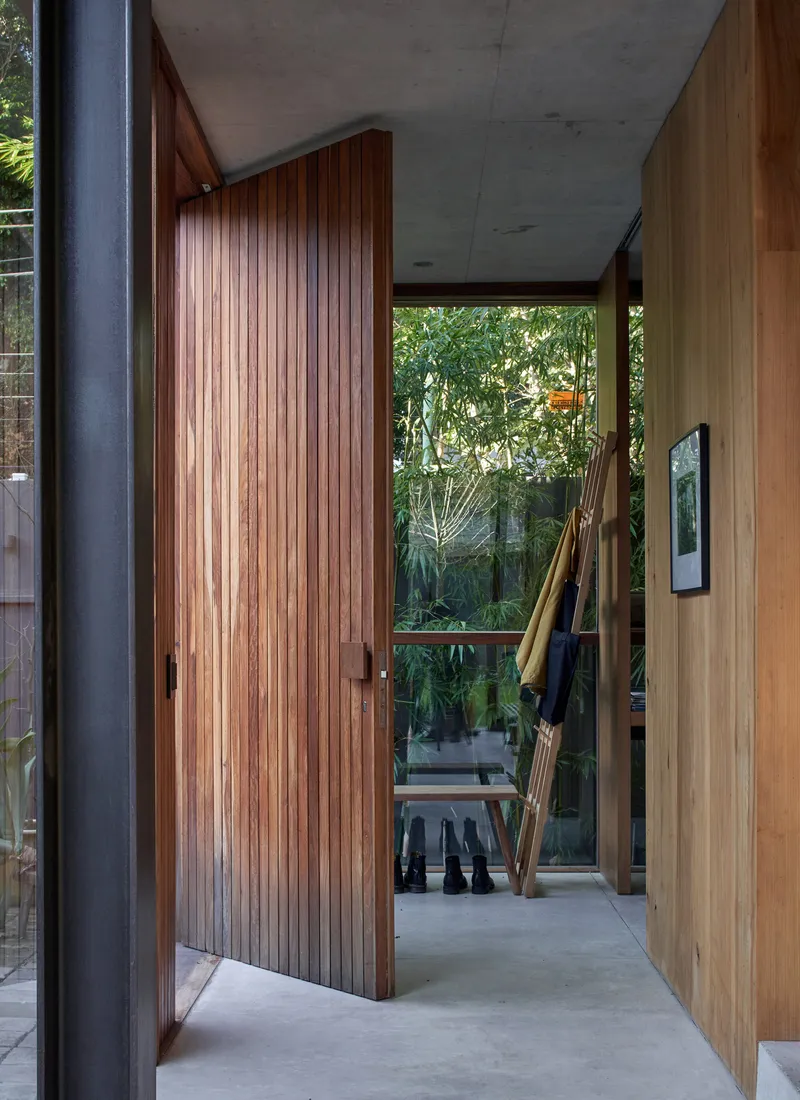
Several of the strongest images capture the house at the transition between day and night, and this is not accidental. The all-glass ground floor transforms after dark into a lantern within its walled garden, and the sliding timber doors at the entrance become screens that glow from behind. A figure with a dog entering at dusk, a parent holding a child in afternoon sunlight: these images show a house scaled to the rhythms of domestic life rather than to the ambitions of a portfolio.
Plans and Drawings
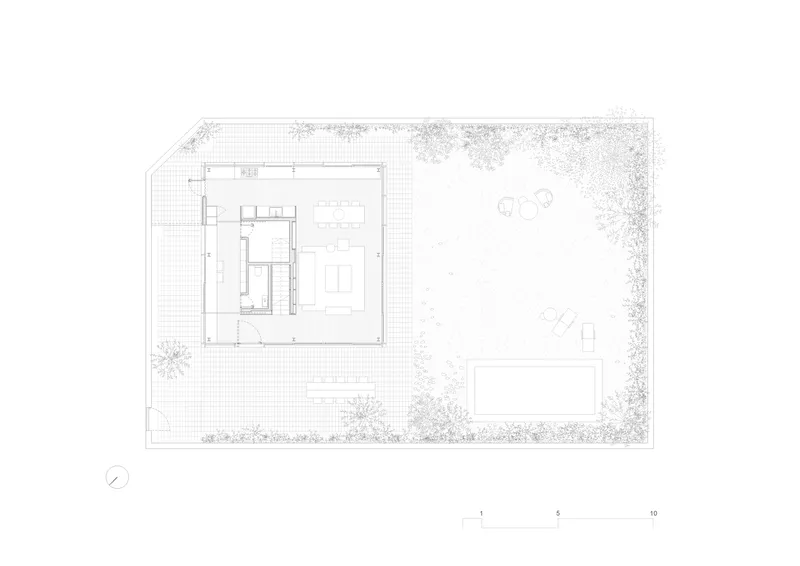
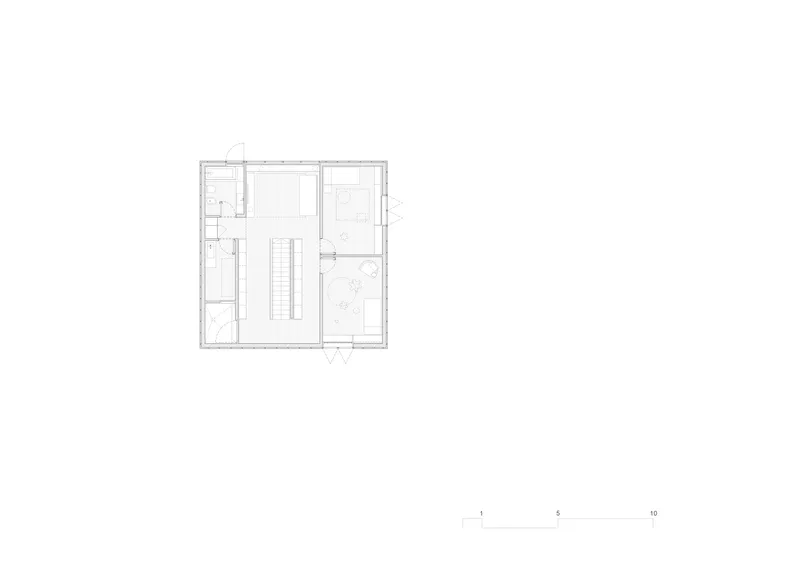
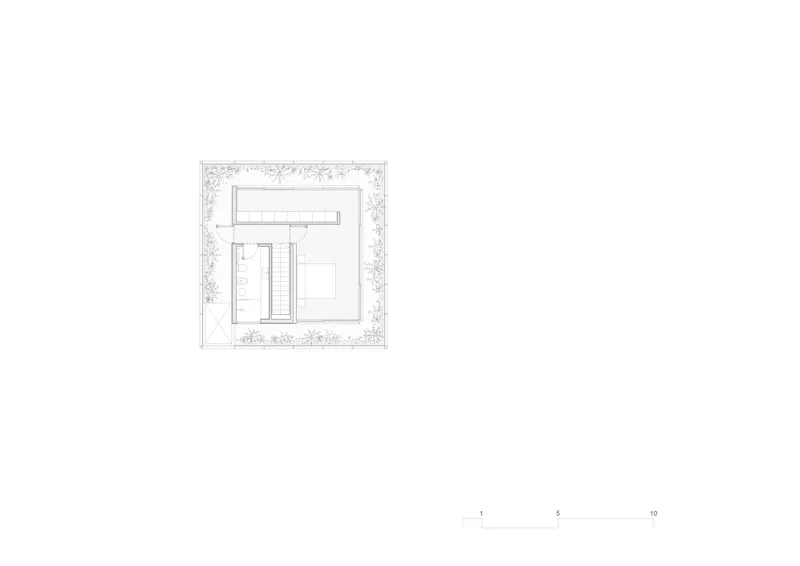
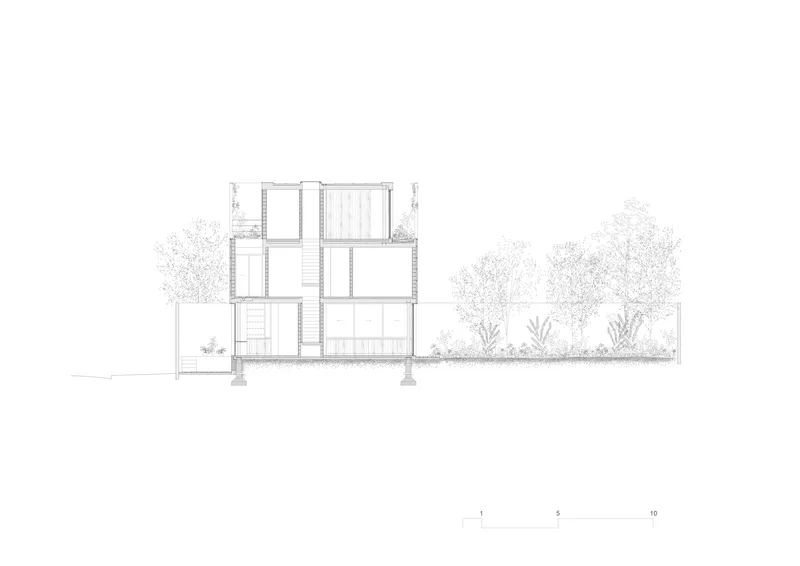
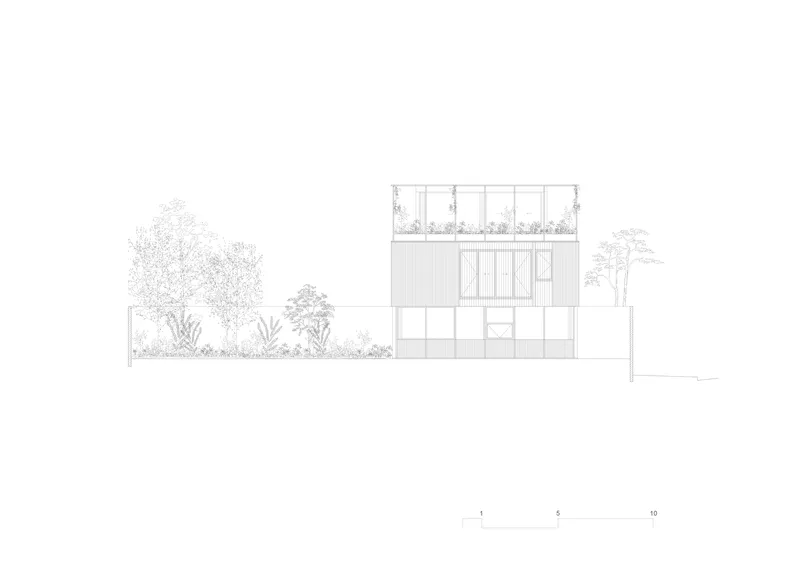
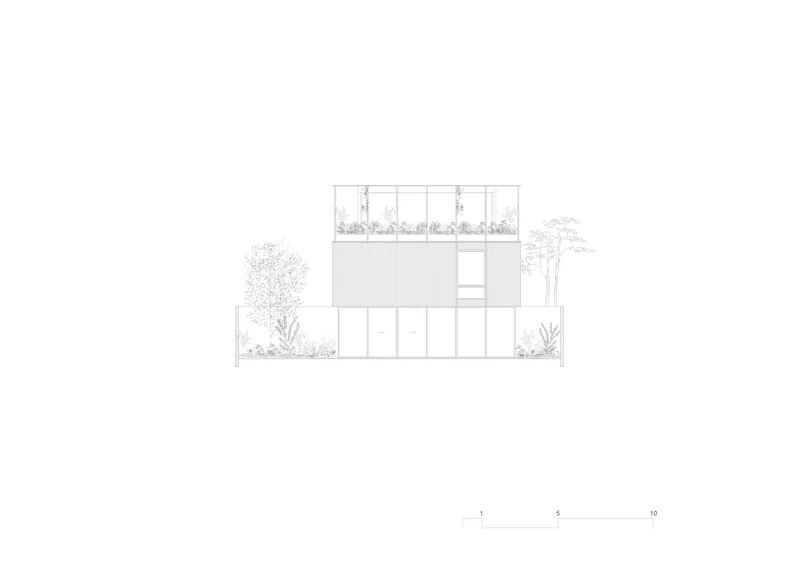
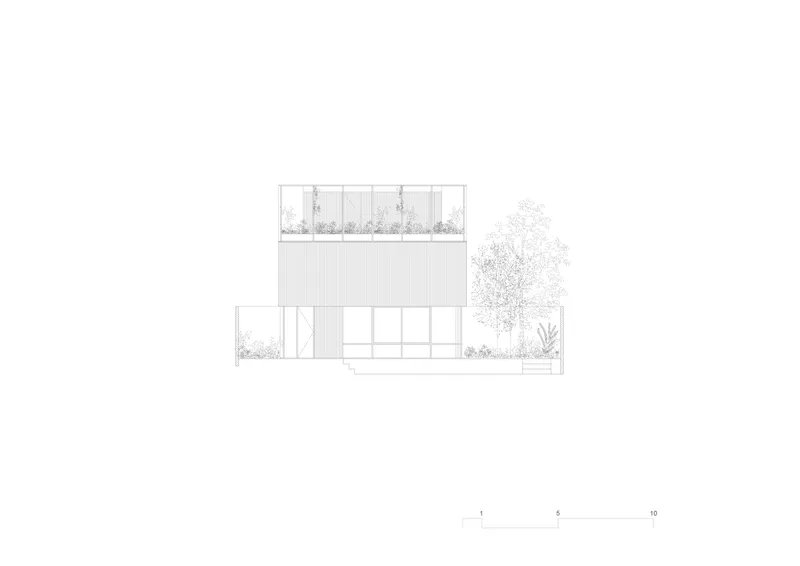
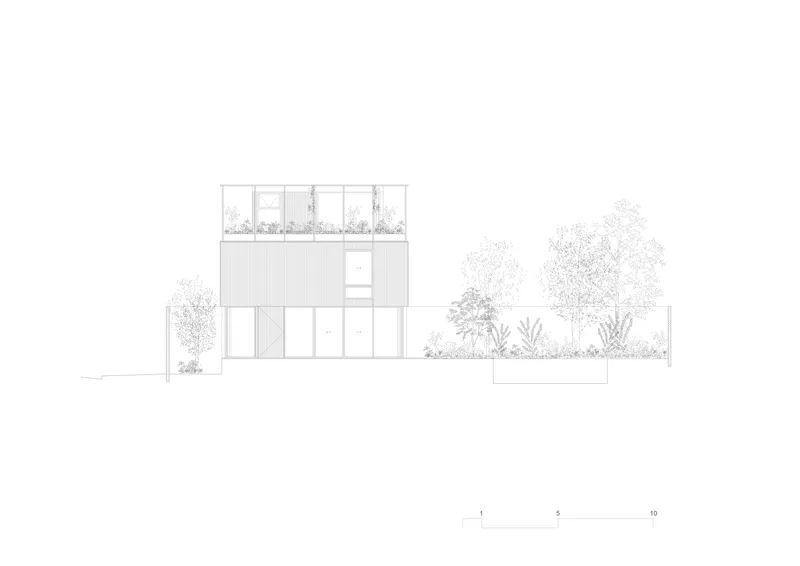
The site plan confirms what the photographs suggest: the house occupies a surprisingly small portion of its lot, with garden wrapping continuously around all four sides and a pool tucked to one edge. The section drawing reveals a compact three-story stack with the central stair acting as the organizational spine. Each floor plate is essentially the same footprint, but the four elevations show how radically the material treatment changes from level to level, glass giving way to timber giving way to metal frame and planting.
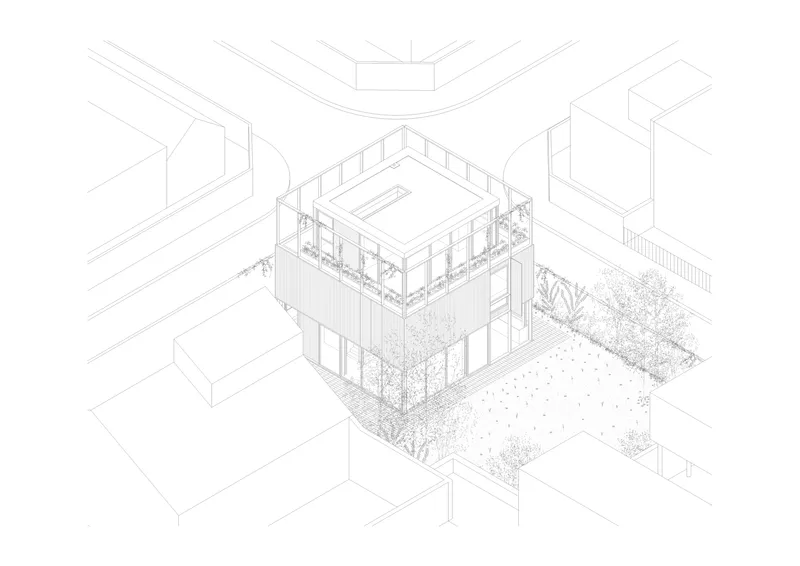
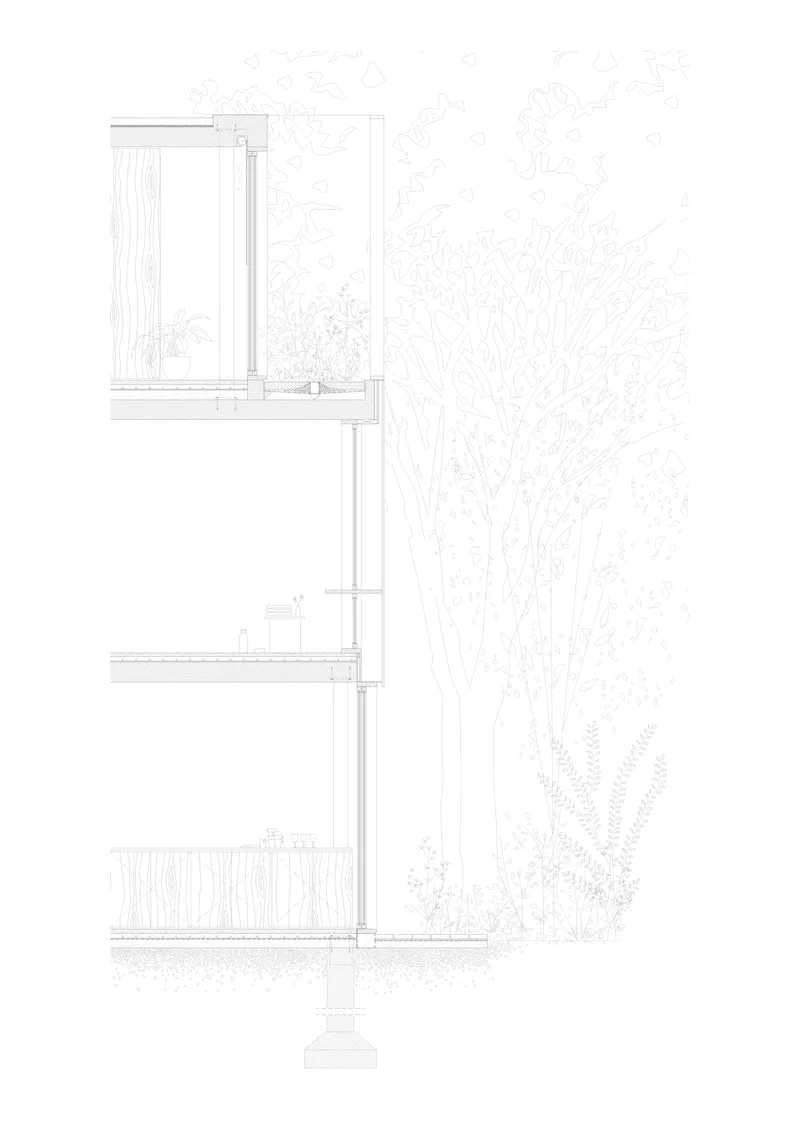
The axonometric drawing is the most revealing: it places the house within its block context, showing how the restored brick perimeter wall creates a sealed green room among tightly packed neighbors. The wall section detail documents the relationship between floor slabs, window openings, and the vertical green wall plantings that climb the exterior, evidence that the landscape strategy is integrated into the construction logic rather than applied afterward.
Why This Project Matters
LUAA House is a case study in how to make a dense suburban lot feel expansive without expanding the footprint. By restoring the existing perimeter wall and pulling the house away from every boundary, Smud turns what could have been a cramped infill project into a garden house with genuine spatial generosity. The decision to differentiate each floor materially, glass, timber, metal, gives the compact volume a vertical richness that most three-story houses lack.
It also demonstrates something that residential architects in Latin America have long understood but that doesn't always translate internationally: the garden is not a luxury amenity but a structural component of the architecture. Every design decision in this house, the column placement, the screen spacing, the floor finish, is calibrated to the presence of plants, trees, and sky. Remove the garden and the house makes no sense. Keep it, and you have one of the most considered small residences completed in Argentina in recent years.
LUAA House by Ana Smud. Located in Vicente López, Argentina. 260 m². Completed in 2024. Photography by Estudio Palma.
About the Studio
Share Your Own Work on uni.xyz
If projects like this are the kind of work you want to make, uni.xyz is a place to publish your own, find collaborators, and enter design competitions.



Popular Articles
Popular articles from the community


Co-life: Sustainable Architecture for Age-Friendly Community Living
Co-life reimagines sustainable architecture for seniors through courtyards, rammed earth, shared gardens, and spaces designed for belonging.

The Ocean Hive: Sustainable Architecture for a Self-Sufficient Civilization at Sea
The Ocean Hive imagines sustainable architecture at sea, where modular habitats, algae, wave power and ocean waste sustain a growing colony.

The Musturak Paradise: Senior Living Architecture for a Connected Future in Temara, Morocco
The Musturak Paradise reimagines senior living architecture in Temara via private homes, social spaces, culture, community, and shared care.

The Earth Pod: 3D Printed Homes for Resilient Refugee Communities
The Earth Pod reimagines refugee housing through 3D printed homes made from clay, combining resilience, self-sufficiency, and rapid shelter.


Similar Reads
You might also enjoy these articles

Bao Huynh Watercolor Atelier: A Serene Art Retreat in Hội An
Bao Huynh Watercolor Atelier in Hội An blends multifunctional art spaces, sustainable design, local materials, and family-friendly living in a serene environment.

Atelier Macri Concept Store Interior Design by CASE-REAL
Atelier Macri store features a "ko" counter, walnut wood details, cork displays, blending retail, gallery, and seamless customer experiences.

Manuel Vargas Izquierdo Stadium and High-Performance Sports Center: Architectural Excellence in Jalpa de Méndez
The Manuel Vargas Izquierdo Stadium blends sustainable design, inclusive sports facilities, and cultural-inspired architecture, revitalizing Jalpa de Méndez’s public spaces.

KAKR Buluh Awar Hall: Revitalizing Community and Ecology Through Bamboo Architecture
Community built bamboo hall revitalizes Buluh Awar village, empowering youth, restoring ecology, celebrating vernacular craftsmanship through sustainable architecture and culture.


Explore Residential Building Competitions
Discover active competitions in this discipline



Challenge to design a portable theatre


Challenge to design a portable music platform


Challenge to design an open learning module for the elderly


Challenge to design mud housing for contemporary communities
Comments (0)
Please login or sign up to add comments
No comments yet. Be the first to comment!