

Anabolic University
Partner with Xavier Albert Zhapan and Andrew Swan

The concept behind our project is revolving around the complexity of a living organism. The title “anabolic university” indicates the process of synthesizing a molecule from many smaller units and energy. By incorporating this idea into the university, it gets the opportunity to grow into something more. The housing units could move around a vertical university imply the characteristics of “Metabolism architecture.” And lastly, the concept of bringing virtual and augmented reality into the space of the university was inspired by the pandemic that we are currently experienced. The University landed in New York City by the Hudson River in the neighborhood of Hell’s Kitchen. This area had a lack of vertical constructions, there are mainly smaller buildings unlike the city of Manhattan. There are mainly commercial buildings therefore residential space is lacking as well. Dewitt Clinton Park is located across the street from the university, giving residence access to the green space that is very desirable in one of the busiest cities, such as New York. One other benefit from the location is its natural resources for sustainable energy. Having the university tower near the water allowed us to utilize the wind and sunlight, helping the tower function more sustainably. The objective of the main university body is to be the core of the tower, where students and faculty could actively learn and be hands-on with the degree platform. The university is equipped with many programs for students, such as Architecture, Fine Arts, Medicine, Culinary, Education, Business, Fashion Design, and Science (physics). There will be no in-person lecture class. Instead, the idea of a virtual world is set up for the student to learn all of their information. Students are required to go to the designated program to practice their craftmanship after class. With this setup of the university, we can prepare students for the real working environment after they graduate. For example, if you are an architecture student, attending school at this university. Comparing to the traditional university, where you have to go to the studio to either draft a precedent plan or make models out of chipboards, you will now be able to build your project on a true scale within studio class time. This way of learning does not just help the student experience the working environment after graduating, but it is also giving the unlimited opportunity for creativity. When we began looking at ideas of how to create a vertical university and hybridizing the housing into it our main idea was to create an anabolic design that constructs the smaller parts of housing and a university into a complex vertical tower. Housing is a moving complex detail on a grid that can cluster and create a larger housing structure revolving around the core of the tower and able to connect to the exterior of the core at different points of the university. To create a self-sustainable tower, we implemented metabolic ideas into the building that can help maintain the life of the university. In order to, keep the idea of movement, we created sliding solar panels that move at different times of the day to always have as much direct sunlight, as well as changing the façade at different times of the day. The façade is also affected by the rotation of the solar panel system as it has a wood material on the opposite side of the solar panel to create a more organic exterior with fewer effects on the environment. A windmill-type system is created on the top of the structure to not disrupt the façade and movement of the housing structure. The fans on top of the structure are attached to a tubular system that moves down the corners of the grided system and into the ground where a large pipe leads into the Hudson River. The fans are used to pump the water from the river into the underground reservoirs and cleaned through a pump system. This pump then pushes this water into the centralized above-ground clean water reservoir and the building system. The objective of this project was to have a university and housing tower that was able to sustain itself and use endless amounts of energy that can be used to keep these large buildings moving. The tower would be a metabolic system that has self-sustaining processes. These reservoirs of energy and water gained through these detailed systems would be able to give back to the city through the saved energy and water that is created in this building. It also revolves back around to the pandemic where resources are quickly used and things come to a halt, but in this building, it is always moving, creating energy, and clean water through these sustainable factors. As this project progresses not only is it able to introduce different types of housing into the grided system as the culture of the city changes. The housing that is placed in the grided system can be replaced as the future of our houses change. A house can be taken out of the grid recycled and be replaced by another housing unit. The interior core of the tower can also grow up as new university schools are introduced into the program of the building. The tower does not just stop here it can keep growing up through the gridded structure as well as extend out to other parts of the city creating a secondary grid of the city.


Popular Articles
Popular articles from the community

Faces of the Soviet Avant-Garde: Turning Moscow's Street Names into an Open-Air Museum
A network of sculptural installations across a Moscow residential district transforms forgotten architect names into spatial encounters with cultural memor

The Amber Palace Opera: A Geological Fiction Surfaces on Tallinn's Baltic Waterfront
Pierre Brillard reimagines a Baltic legend as a public landscape, opera house, and waterfront promenade rooted in Tallinn's coastal identity.

Opera by the Sea Estonia: Three Shells Dissolving Architecture into Tallinn's Coastline
A winning opera house proposal replaces monumental form with interconnected shells that blur the boundary between building, park and Baltic Sea.

Singing Woman: Contemporary Architecture Inspired by Estonia’s Voice and the Sea
Singing Woman turns Estonia’s song culture into flowing opera house architecture, blending public life, landscape, sea, and national memory.

Similar Reads
You might also enjoy these articles
The Rhythm of Seasons
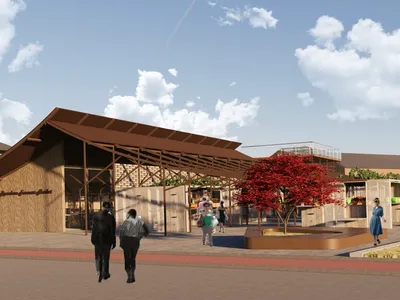
A Farmers' Market Connecting Nature and the City

More Than a Building-Designing a Living System
More Than a Building-Designing a Living System
Base Beyond
DESERT COMPOUND ARID: TOURISM OF ABSENCE AND ABUNDANCE

Comments (0)
Please login or sign up to add comments
No comments yet. Be the first to comment!