

andblack design studio Wraps an Ahmedabad Home in Pivoting Timber Louvers That Breathe with the Climate
A layered concrete and brick residence in Gujarat's arid heat uses operable screens to blur the line between garden and dwelling.


Ahmedabad is a city that punishes indecision about climate. Summers push past 45°C, dust storms are routine, and the monsoon arrives with almost theatrical violence. Any house that wants to stay open to its garden while keeping inhabitants comfortable has to negotiate these extremes in real time. andblack design studio answers that negotiation with a single, emphatic gesture: full-height pivoting timber louver panels that line the garden-facing terraces of The Louvered House, turning its entire west facade into a kinetic surface that occupants can reconfigure by hand throughout the day.
What makes the project worth studying is not the louver alone but the way it organizes every other material decision. Red brick anchors the interior courtyards, board-formed concrete defines the structural frame, and timber appears everywhere from soffits to staircases. These are common materials in Ahmedabad's residential architecture. The difference here is the discipline with which they are layered: each material occupies a specific depth within the section, creating a gradient from the dense, shaded interior to the sun-drenched lawn that feels calibrated rather than decorative.
A Facade That Moves


The garden elevation reads differently every hour. When the timber louver panels are closed, the house presents a taut, horizontally banded composition of concrete slabs and warm wood screens. Pivot them open, and the terraces merge into the lawn, eliminating the boundary between conditioned interior and planted exterior. It is a strategy borrowed from traditional Gujarati havelis, where carved wooden screens (jalis) modulated light and air, but scaled up to operate at the level of entire room partitions.
The cantilevered concrete balconies above give these panels their weather protection, acting as deep horizontal eaves that throw the louver zone into shadow for most of the day. The result is a double climate buffer: the louvers control airflow and privacy, while the cantilevers manage direct solar gain. Neither element could work as effectively without the other.
Concrete Frame, Brick Heart


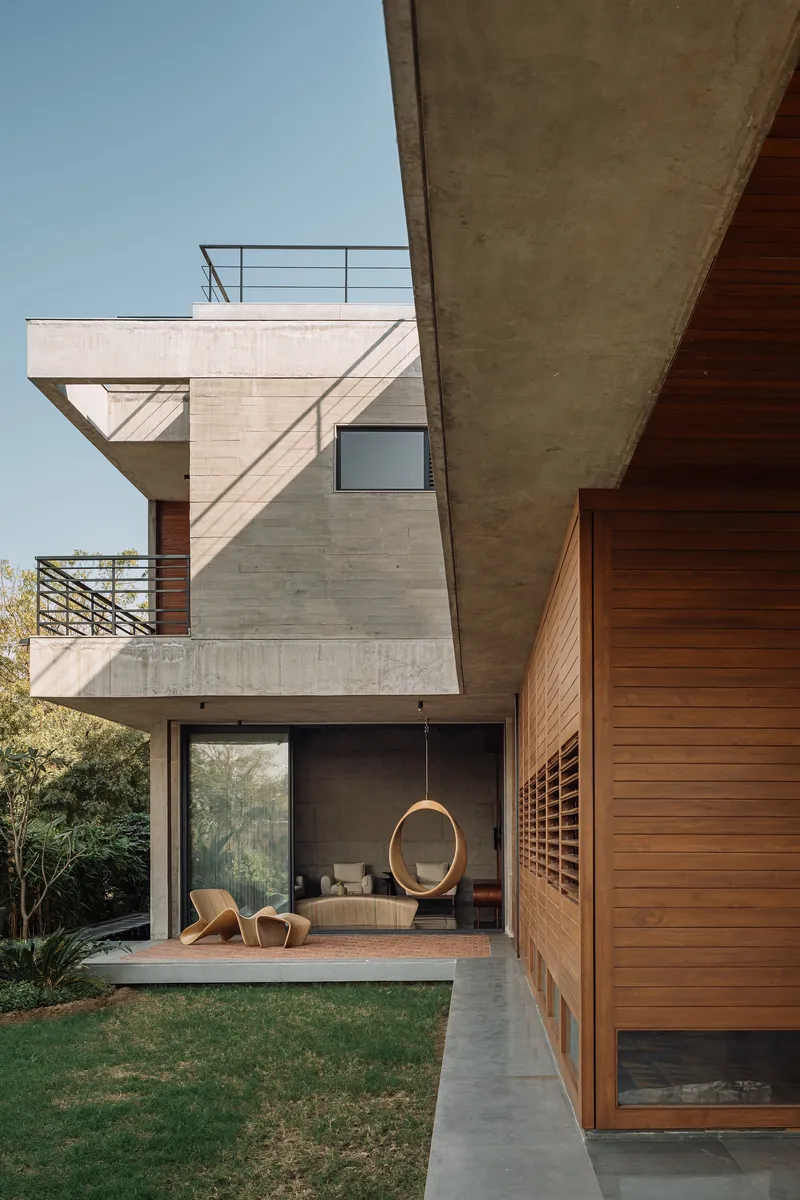
The structural logic is exposed and legible. Stacked concrete volumes step back as they rise, creating terraces at every level and ensuring that the upper floors never feel like sealed boxes. The board-formed finish on the concrete is left raw, its grain running horizontally to reinforce the building's preference for long, low proportions. Against this grey datum, red brick walls appear as warm, textured infill, particularly visible around the entry courtyard and along the interior circulation spine.
This contrast between the monolithic frame and the handmade wall is where the house gets its visual tension. Brick absorbs and re-radiates heat slowly, moderating interior temperatures, while the concrete slab edges channel breezes into the floor plate. It is practical thermodynamics dressed in good proportions.
Threshold and Entry


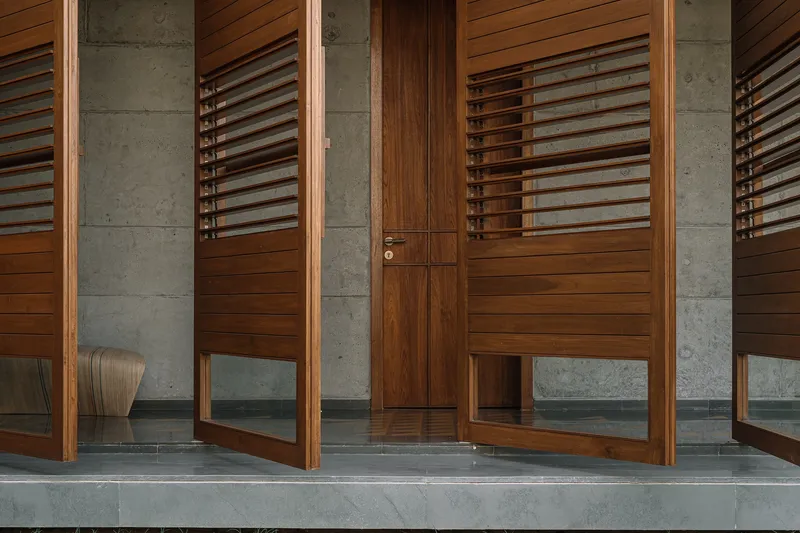
Arriving at the house is a sequence of compressions. A covered courtyard introduces the first pivot door, a monumental timber panel that swings open between concrete columns. The floor shifts to geometric tile in gold and grey triangles, a quiet signal that you have crossed from public to private ground. Overhead, a concrete soffit presses the space low before releasing it into the double-height volume beyond.
The threshold is not a single door but a series of calibrated transitions: tree canopy, covered court, pivot door, vestibule, then the main living hall. Each step adjusts light level, ceiling height, and temperature. By the time you reach the interior, your eyes have already adapted, and the drama of the double-height dining space lands with full force.
The Staircase as Sculpture


A cantilevered timber staircase occupies the center of the house and functions as its vertical spine. Its treads extend from a board-formed concrete wall, and its underside catches raking sunlight that shifts position throughout the day. Clustered pendant lights, made from layered wood rings, hang beside it at varying heights, turning the double-height volume into something closer to an installation than a circulation core.
The white relief-pattern screen wall behind the staircase adds another layer of texture without competing for attention. It reads as a pale, perforated backdrop that lets light bounce deeper into the plan. The combination of the stair's angular geometry with the screen's repetitive pattern creates a visual tension that rewards a second look from nearly every angle on the ground floor.
Living Spaces That Open Wide


The ground floor living room pushes toward the garden through floor-to-ceiling glazing that can slide entirely open. A board-formed concrete ceiling overhead and an exposed brick wall to one side keep the room grounded in material weight even as its boundaries dissolve. The dining area sits adjacent, beneath the staircase, where a round pink stone table with a fluted base holds its own against the scale of the space.
What andblack gets right is proportion. These rooms are generous but not cavernous. The ceiling heights are tall enough to invite cross-ventilation and accommodate the pendant cluster, yet the furniture groupings pull the scale back down to something intimate. It is an old trick, double-height volume counterbalanced by low, heavy furnishings, but it still works when executed with this kind of care.
Corridors and Filtered Light


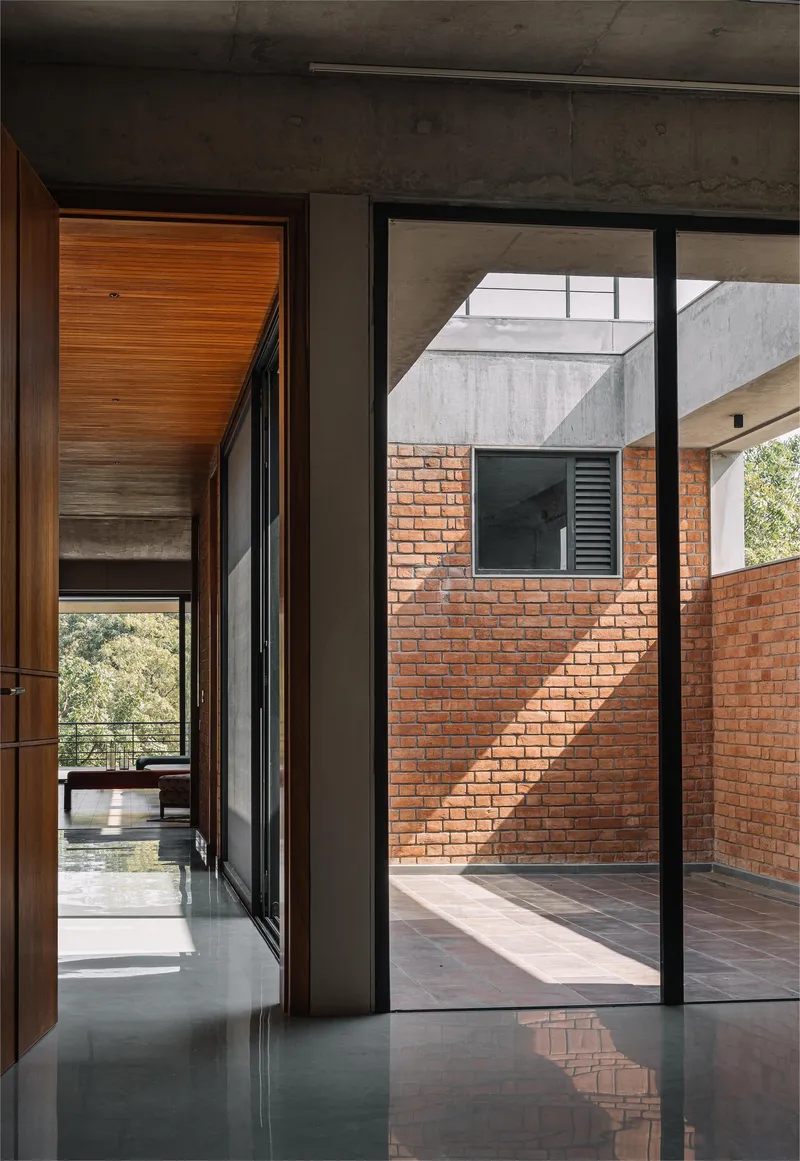
The corridors deserve their own discussion because they are not treated as leftover space. Pivoting timber louvered screens line one side, casting striped shadows across patterned terrazzo floors as daylight angles shift. Exposed wood ceilings run overhead, adding warmth to what could have been a utilitarian passage. The brick courtyard wall on the opposite side catches afternoon sun and glows red, turning the corridor into a gallery of material color.
These in-between spaces do real environmental work. They act as thermal buffer zones, separating the deep interior from the sun-exposed courtyard while allowing air to move freely when the screens are open. The shadows they produce are not incidental; they are part of the cooling strategy, reducing surface temperatures on the floor and walls during the hottest hours.
Private Rooms and Retreats


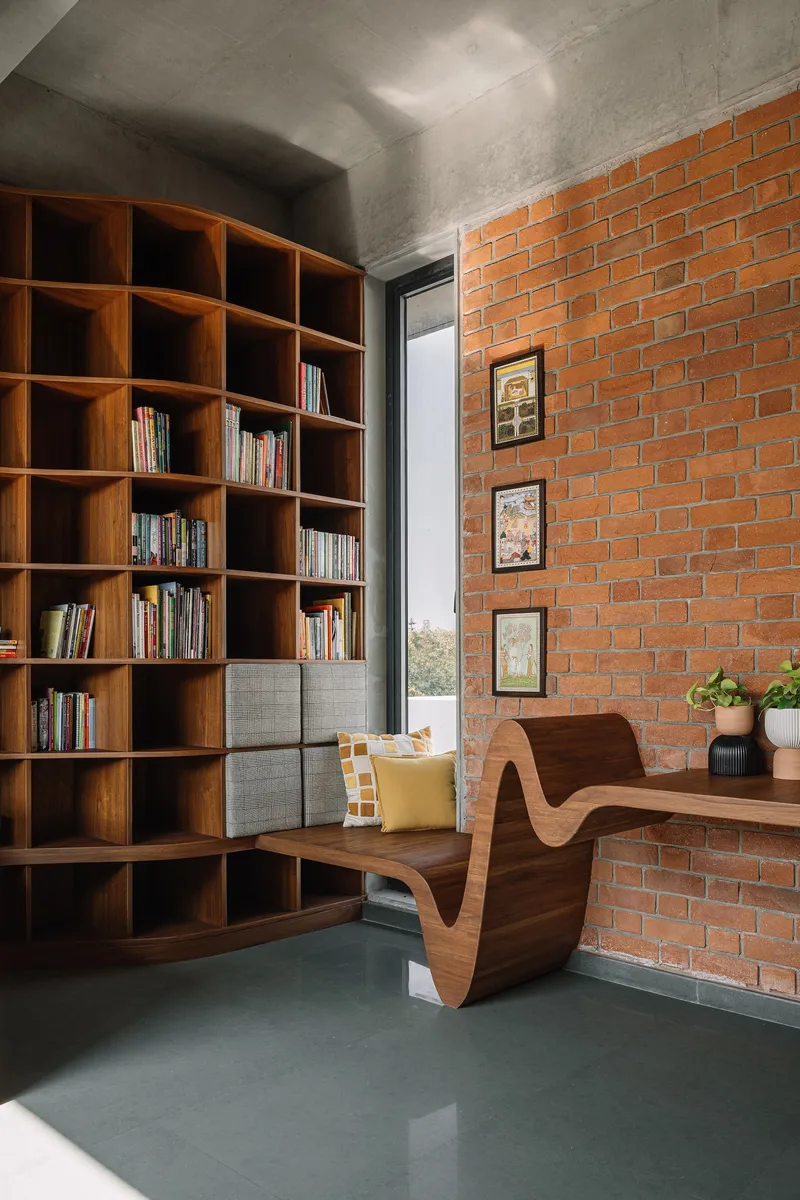
The bedrooms carry the same material language upstairs but dial down the scale. A four-poster bed with tall timber posts sits against a concrete wall, its frame acting almost like a room within a room. In another bedroom, a platform bed with cylindrical timber legs is centered between gridded wood paneling and exposed brick, a composition that is restrained without feeling spartan. A reading nook with a floor-to-ceiling timber bookshelf and a curved desk beneath a window offers the kind of small, considered moment that separates thoughtful residential work from mere square-footage delivery.
Terraces and Roofscape


Every level of the house offers outdoor space. The ground floor terrace, with its red brick wall and wicker lounge chair, feels like an extension of the living room. Higher up, a covered terrace with a timber slat ceiling and skylights opens onto distant treetops, offering a breezier, more elevated version of the same garden relationship. Hanging plants and tropical foliage are deployed deliberately at the edges, softening the concrete structure and drawing wildlife into the domestic frame.
The rooftop, visible in the drawings, includes small storage pavilions and a planted perimeter that ties the building back to its landscape. It is a practical acknowledgment that in Ahmedabad's climate, the roof is not dead space. It is the coolest outdoor zone after sunset and a potential social room for half the year.
Plans and Drawings


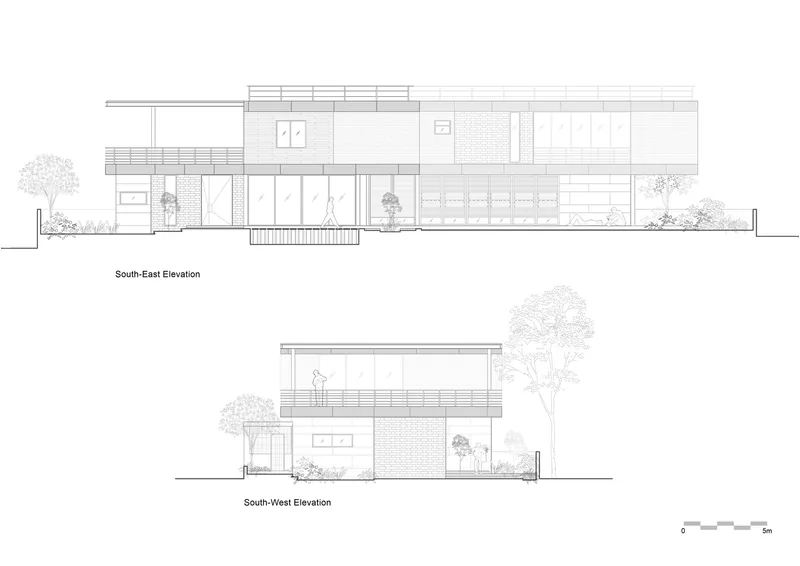
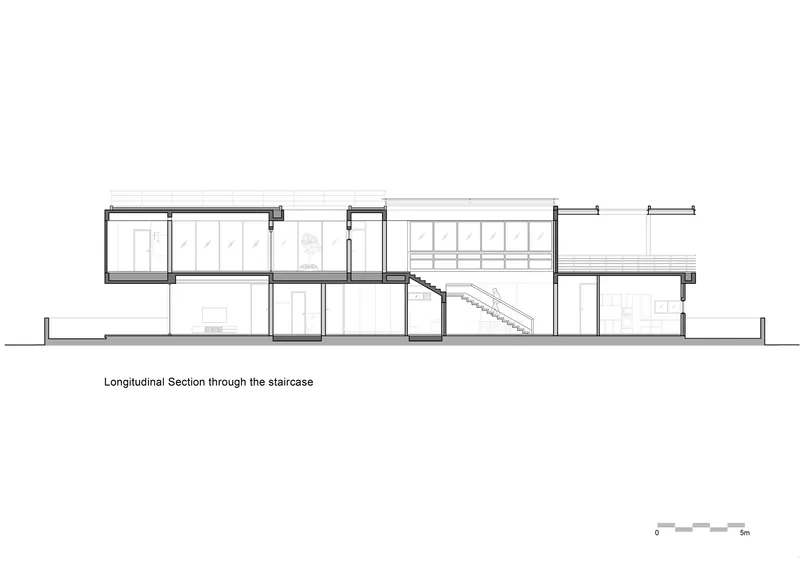
The ground floor plan reveals a linear layout oriented to maximize the garden frontage, with a swimming pool tucked along the boundary and living spaces arranged in sequence from entry to lawn. The first floor shifts the program to a bedroom wing, family lounge, and open terrace, maintaining the same east-west orientation. The terrace floor plan shows how the rooftop is organized around two small pavilions and a generous planted edge.
The elevation drawings confirm the horizontal emphasis: concrete slab edges, timber louver bands, and tree plantings read as continuous strata. The longitudinal section through the staircase is especially revealing, showing how split-level volumes allow each room to sit at a slightly different height, creating spatial variety within a compact footprint and enabling clerestory ventilation between zones.
Why This Project Matters
The Louvered House is not a radical proposition. Its materials are local, its structural system is conventional, and its environmental strategies are drawn from centuries of Gujarati building practice. What sets it apart is the rigor with which these familiar elements are composed. The louvers are not decorative; they are the primary climate mediator. The brick is not a surface finish; it is a thermal mass strategy. The concrete frame is not hidden; it organizes every view and shadow in the house. Each decision reinforces the others, and the result is a residence that feels inevitable rather than effortful.
For architects working in hot, arid climates, this project is a useful reminder that passive design does not require sacrifice. The house is generous, atmospheric, and full of carefully framed moments. It proves that the most effective environmental response can also be the most visually compelling one, provided every layer of the building is working toward the same goal.
The Louvered House by andblack design studio, Ahmedabad, India. Completed 2025. Photography by Ishita Sitwala.
About the Studio
Share Your Own Work on uni.xyz
If projects like this are the kind of work you want to make, uni.xyz is a place to publish your own, find collaborators, and enter design competitions.


Popular Articles
Popular articles from the community


Tsunami Convergenics: Turning Catastrophic Ocean Forces into Underwater Housing Infrastructure
A speculative underwater settlement off the coast of Onagawa, Japan, treats tsunamis and typhoons as energy sources rather than threats.

The Amber Palace Opera: A Geological Fiction Surfaces on Tallinn's Baltic Waterfront
Pierre Brillard reimagines a Baltic legend as a public landscape, opera house, and waterfront promenade rooted in Tallinn's coastal identity.

Singing Woman: An Opera House That Performs Before the Curtain Rises
Ovidiu Cristian Pavel's conceptual opera house translates Estonia's choral identity into a sculpted waterfront landmark facing the Baltic Sea.

Opera by the Sea Estonia: Three Shells Dissolving Architecture into Tallinn's Coastline
A winning opera house proposal replaces monumental form with interconnected shells that blur the boundary between building, park and Baltic Sea.

Similar Reads
You might also enjoy these articles

Pixel Gardens: One Repeated Module Stacked Into a Terraced Social Housing Tower for Famagusta
Salem Bader's shortlisted housing tower builds a vertical neighbourhood from one repeated module, offsetting units to carve terraces, light and air.

Bao Huynh Watercolor Atelier: A Serene Art Retreat in Hội An
Bao Huynh Watercolor Atelier in Hội An blends multifunctional art spaces, sustainable design, local materials, and family-friendly living in a serene environment.

Atelier Macri Concept Store Interior Design by CASE-REAL
Atelier Macri store features a "ko" counter, walnut wood details, cork displays, blending retail, gallery, and seamless customer experiences.

Manuel Vargas Izquierdo Stadium and High-Performance Sports Center: Architectural Excellence in Jalpa de Méndez
The Manuel Vargas Izquierdo Stadium blends sustainable design, inclusive sports facilities, and cultural-inspired architecture, revitalizing Jalpa de Méndez’s public spaces.


Comments (0)
Please login or sign up to add comments
No comments yet. Be the first to comment!