
Andréa Helou Turns a São Paulo House into a Children's Bookstore Built on Wonder
Casa Cosmos in São Paulo reimagines a narrow residential plot as a celestial landscape of books, courtyards, and play for young readers.


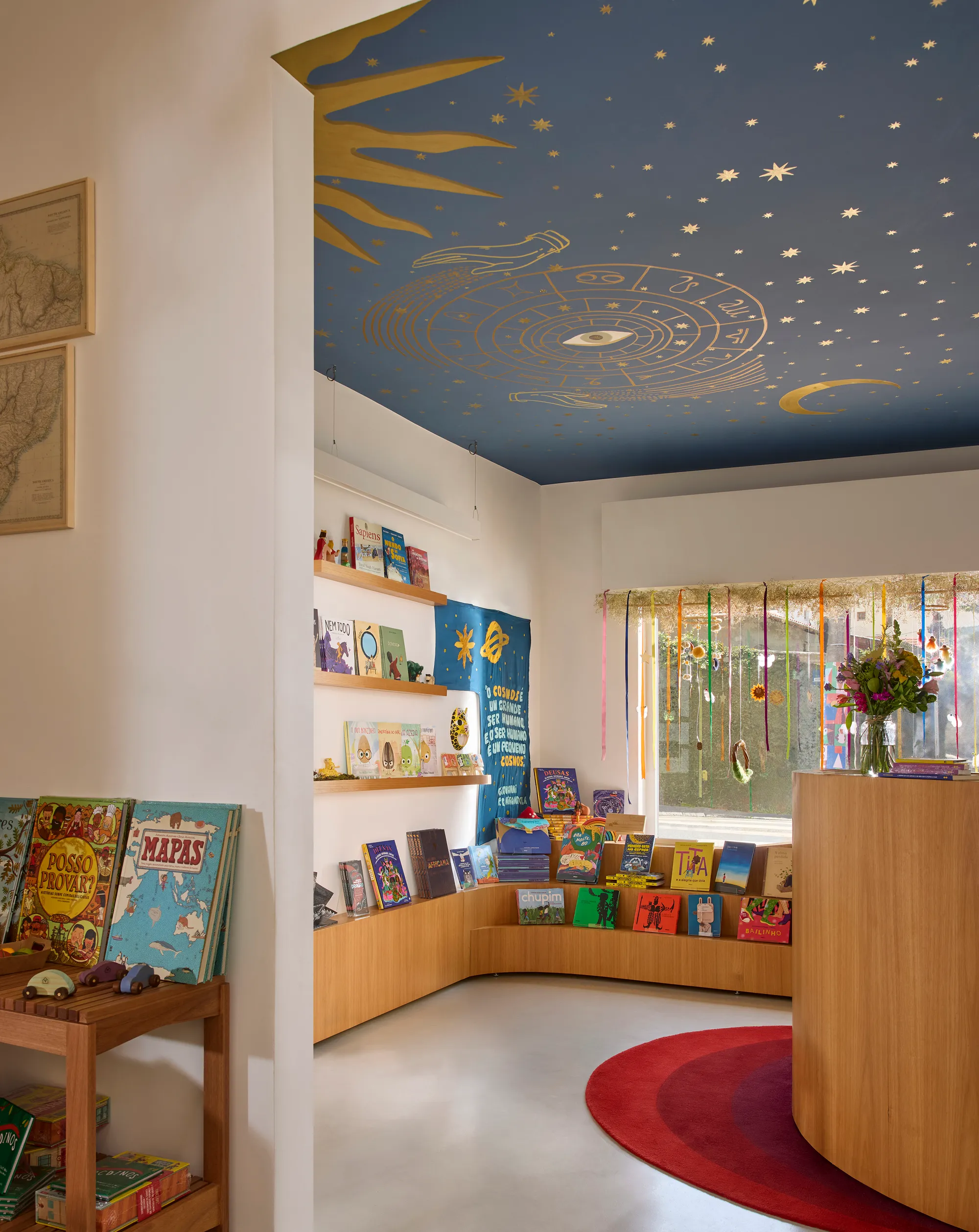
A children's bookstore has no obligation to look like a galaxy. But Andréa Helou clearly decided that selling picture books in a plain white box would be a missed opportunity. Casa Cosmos, completed in 2023 on a tight 140 square meter plot in São Paulo, takes a former residential structure and recasts it as a layered sequence of reading nooks, courtyards, and play spaces, each one themed around celestial imagery that children can touch, climb through, and inhabit. The project is less a renovation than a reframing: the bones of the old house remain visible, but every surface has been recruited into a narrative about curiosity.
What makes the project worth studying is the discipline behind the whimsy. São Paulo's dense urban fabric doesn't hand architects generous footprints, and Helou's response to the narrow site is precise: a linear sequence of rooms punctuated by a gravel courtyard that pulls daylight and social life into the center of the plan. The design toggles between intimacy and openness, timber warmth and rough concrete, hand-painted murals and raw brick. It treats children as serious architectural users, not miniaturized adults, and builds an environment scaled to their bodies and attention spans without condescending to them.
A Streetfront That Whispers
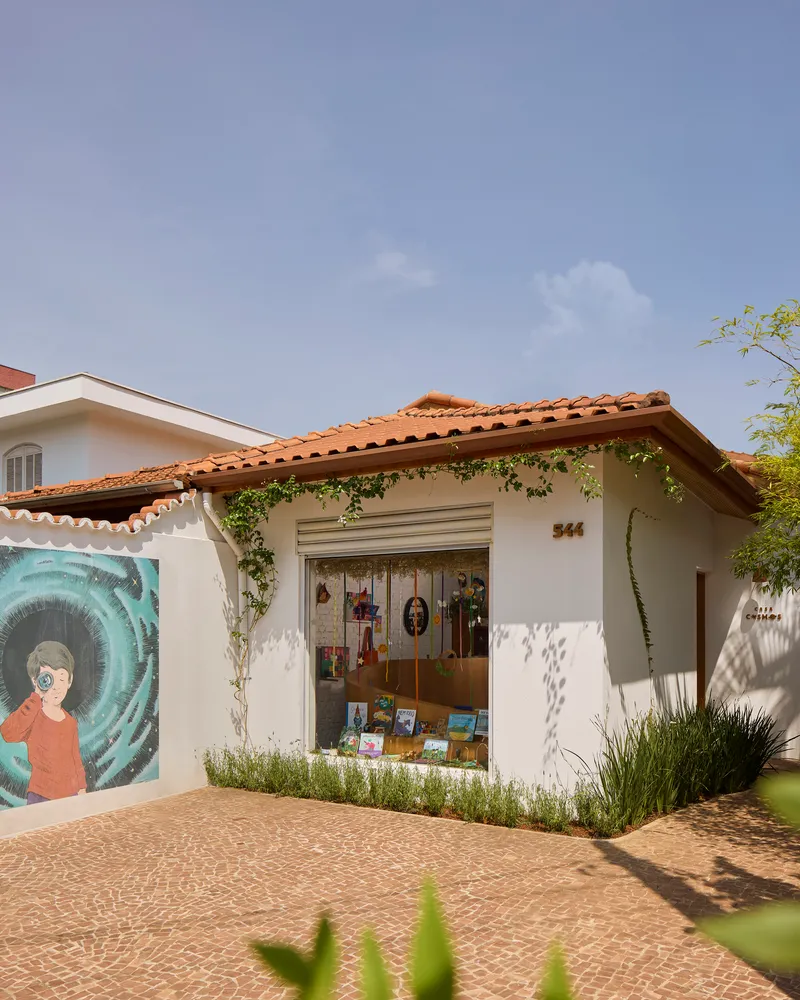

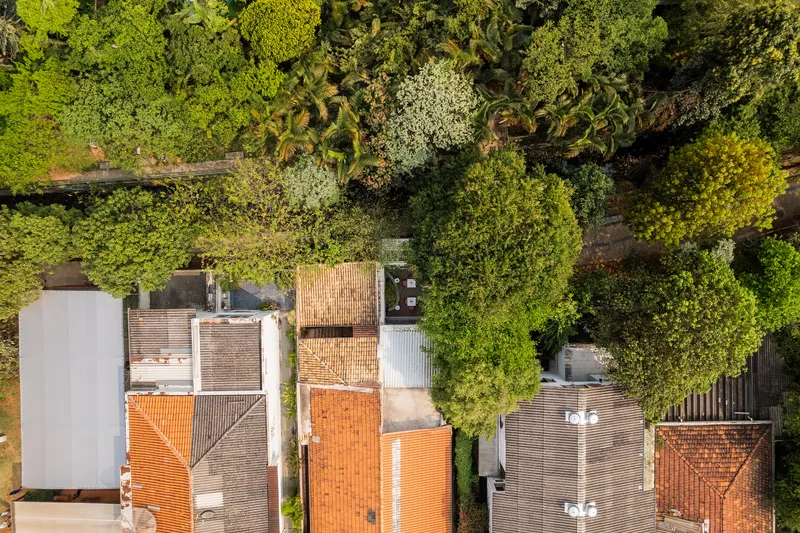
The facade barely announces itself. White stucco walls, a clay tile roof, a painted mural peeking out from behind climbing plants: Casa Cosmos reads from the street more like a well-loved home than a commercial venture. A circular orb light and a small hanging directory board are the only retail signifiers. The restraint is deliberate. Helou preserves the domestic grain of the neighborhood while signaling that something different is happening inside. From above, the building dissolves into São Paulo's dense canopy of terracotta rooftops and tree crowns, a modesty that earns trust before you even cross the threshold.
The Celestial Ceiling
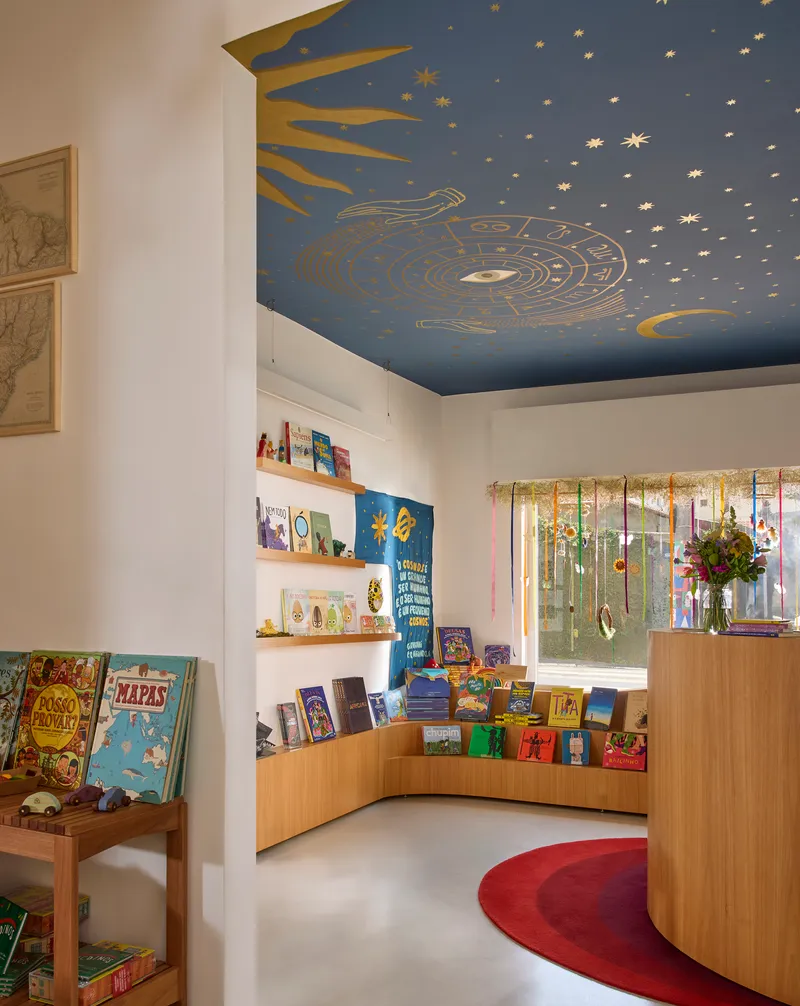
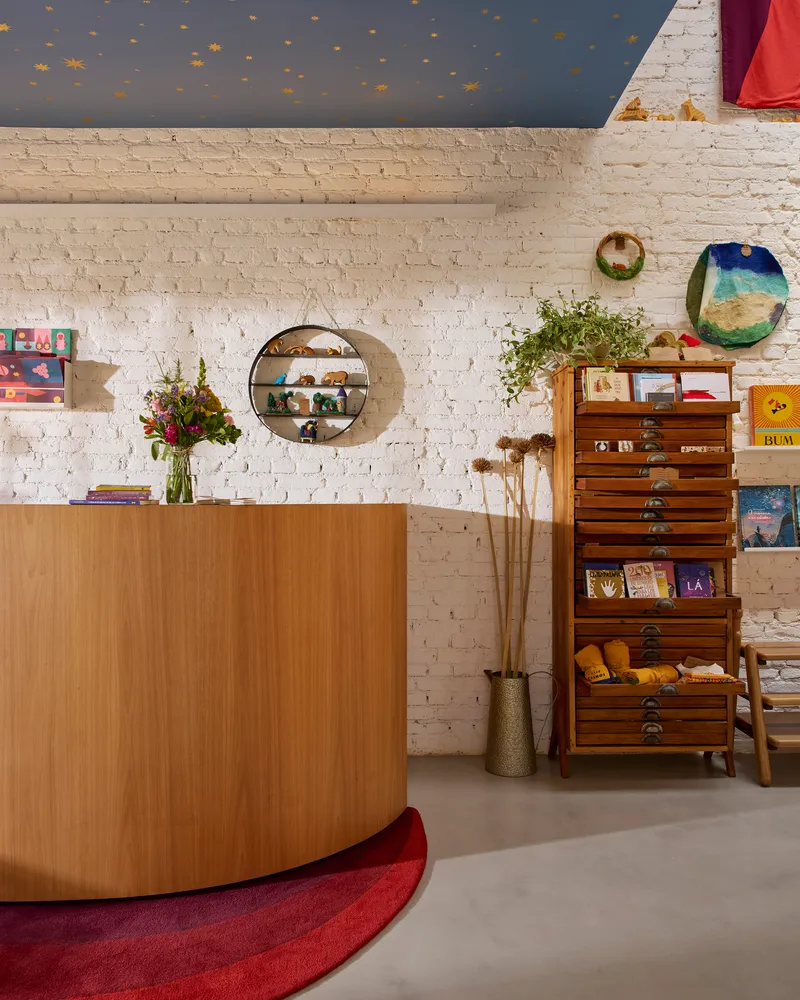
The most memorable gesture in the project is the hand-painted ceiling mural that crowns the main display area. A deep blue field carries a sun, a crescent moon, and scattered gold stars, framed by the curves of a timber display shelf below. It is unabashedly illustrative, the kind of ornament that contemporary architecture usually avoids. Here it works because Helou has been careful with every other surface: the whitewashed brick stays neutral, the timber slats overhead run in disciplined lines, and the curved service desk is restrained in profile. The mural earns its exuberance by contrast.
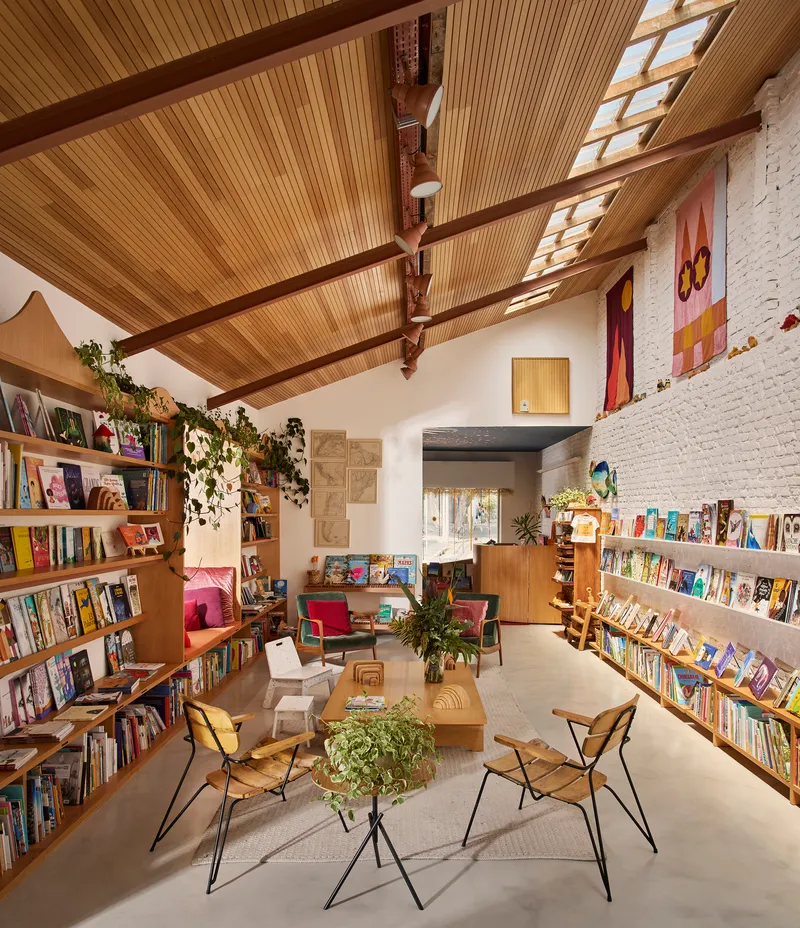
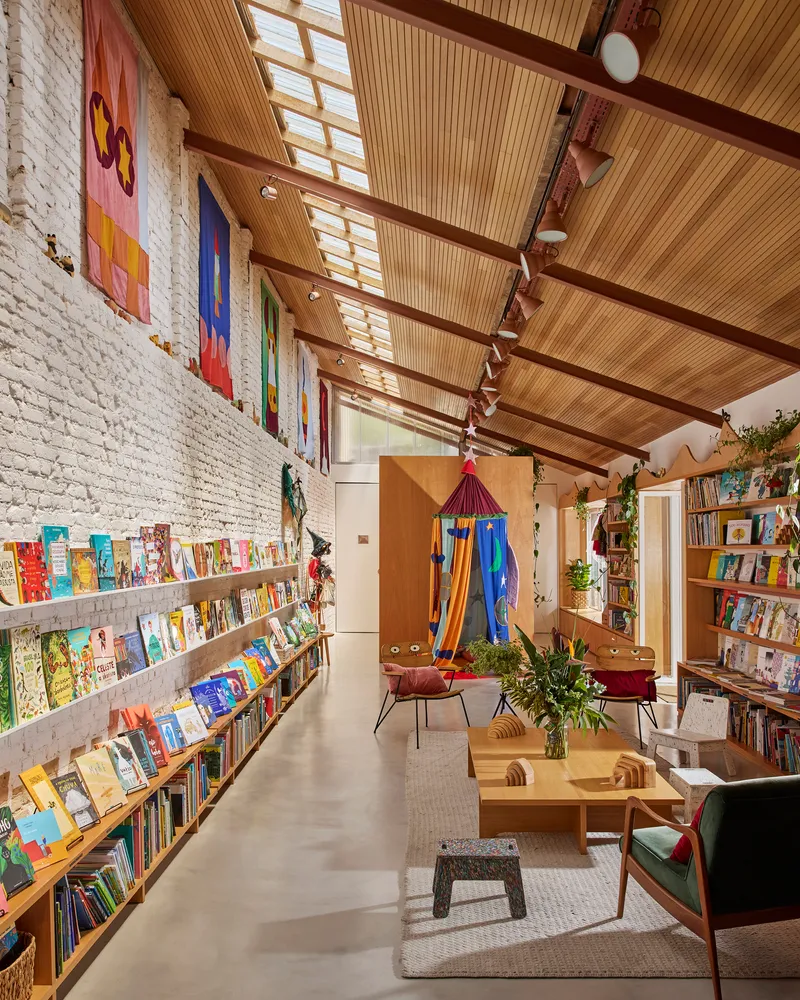
Elsewhere, the ceiling strategy shifts. Exposed timber beams and slatted panels filter skylight along the main interior axis, and trailing vines drop through openings to soften the overhead plane. The effect is of moving through a garden canopy, punctuated by sudden bursts of color and pattern.
Reading Nooks Scaled to Small Bodies
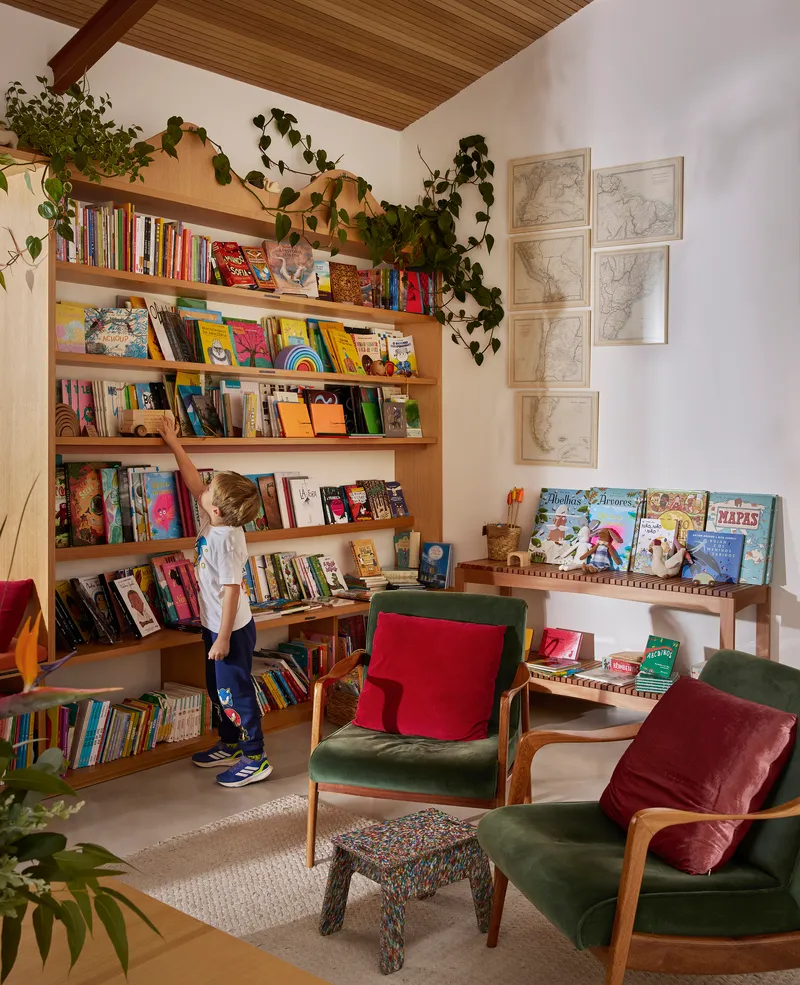
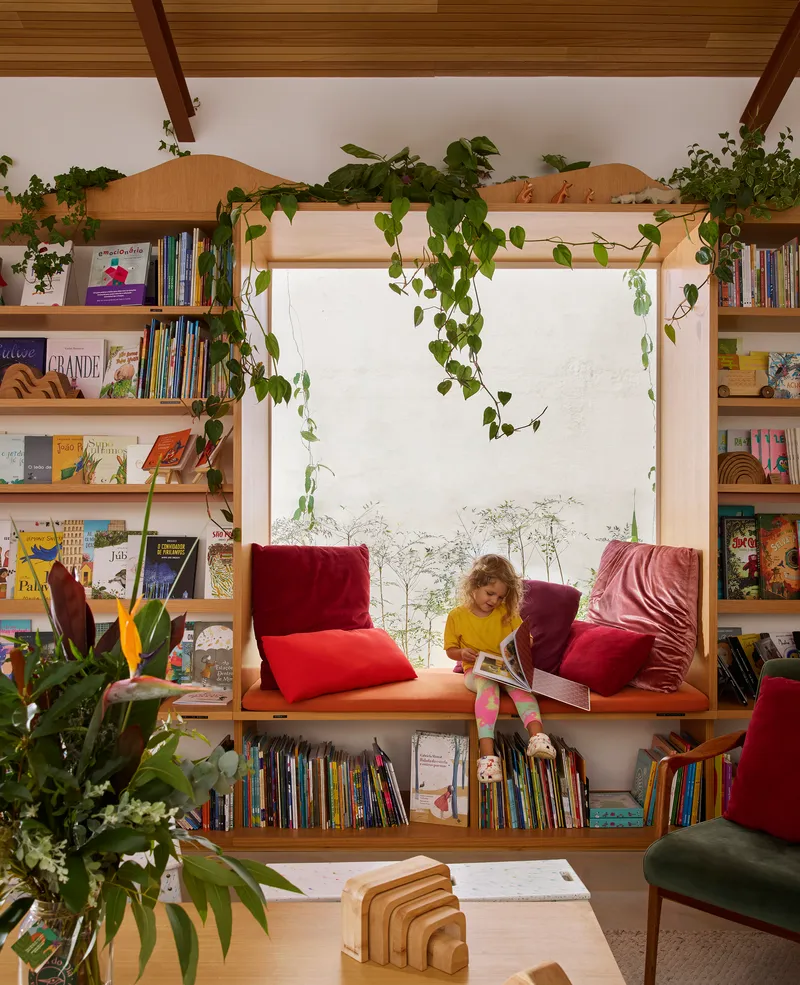
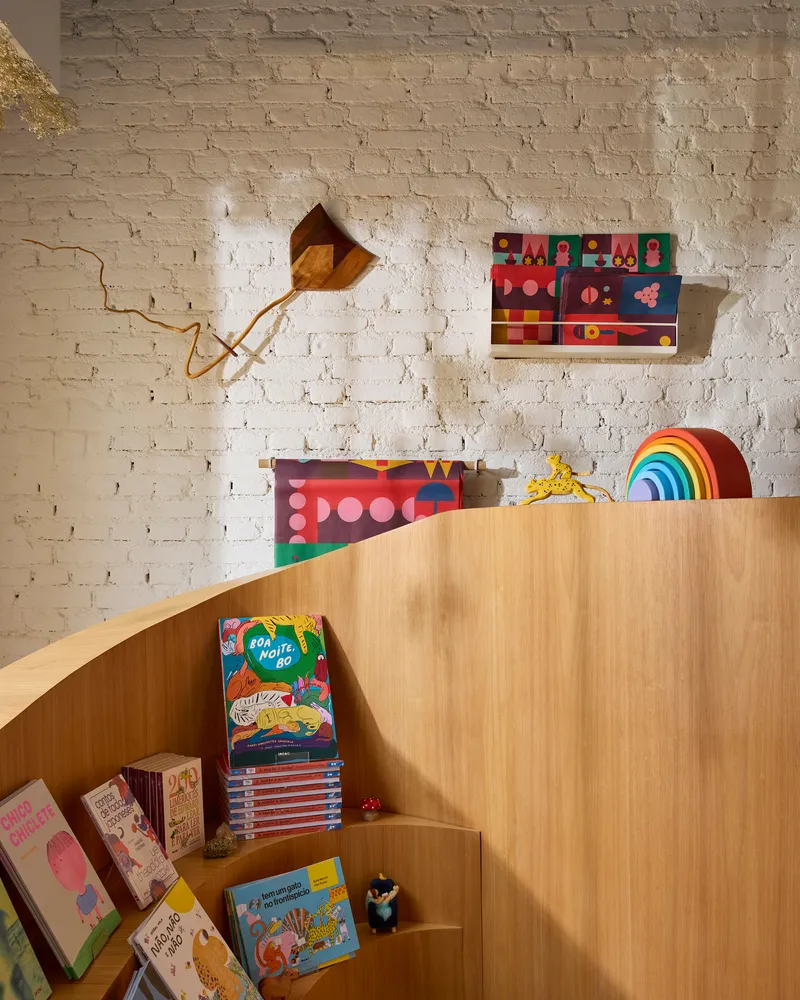
Helou distributes reading opportunities throughout the plan rather than concentrating them in a single room. A corner nook lined with timber bookshelves and trailing ivy invites solitary browsing. A built-in window seat tucks a child between plywood shelves and cascading potted plants, daylight falling through exposed beams overhead. Stepped display shelving against whitewashed brick presents book covers face-out at a height a four-year-old can reach, with mounted wooden kites and artwork pinned above to reward an upward glance.
The common thread is low furniture, soft thresholds, and generous natural light. These are not token children's corners bolted onto an adult space. They are the primary architecture, and the adults are the ones who have to stoop.
The Double-Height Playroom
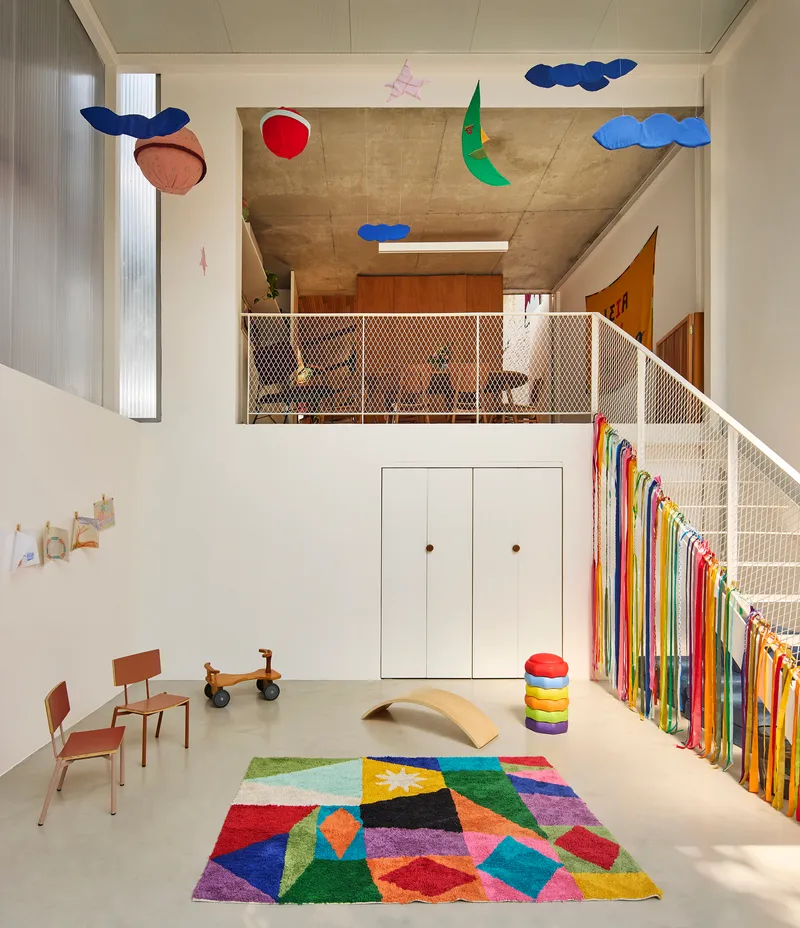
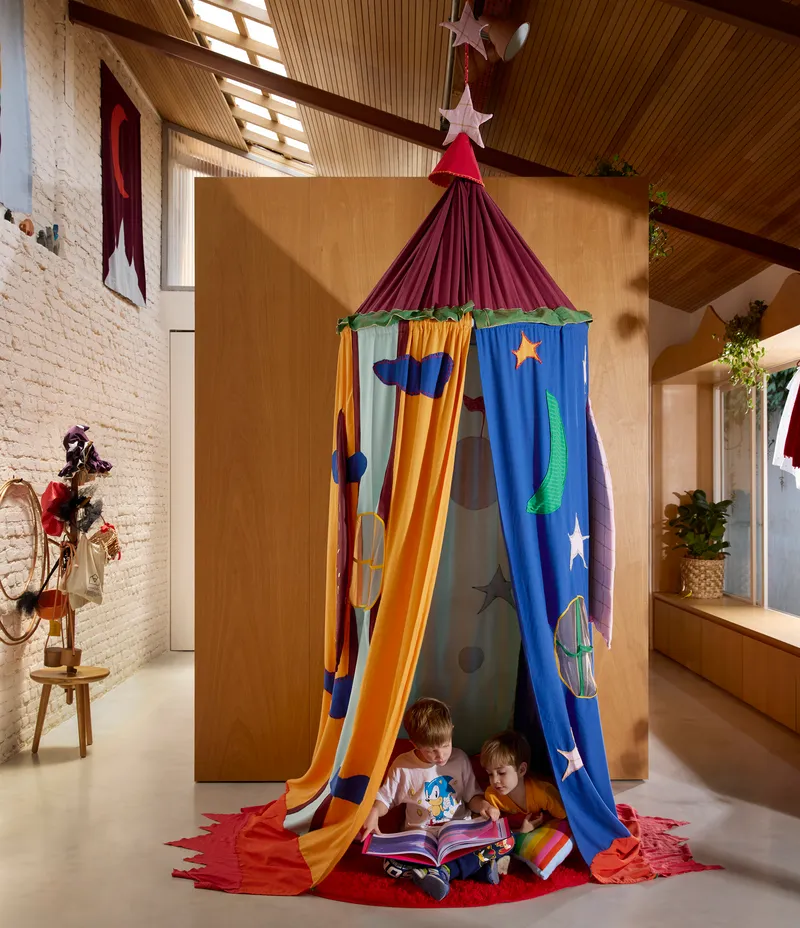
The tallest volume in the section is given over entirely to play. A mesh-railed mezzanine floats above a multicolored geometric rug, with suspended fabric mobiles turning slowly in the air between the two levels. The exposed concrete soffit is left raw, a deliberate counterpoint to the handmade quality of everything below it. A fabric tent stitched with celestial appliqués occupies the lower floor, offering a private enclosure within the larger room.
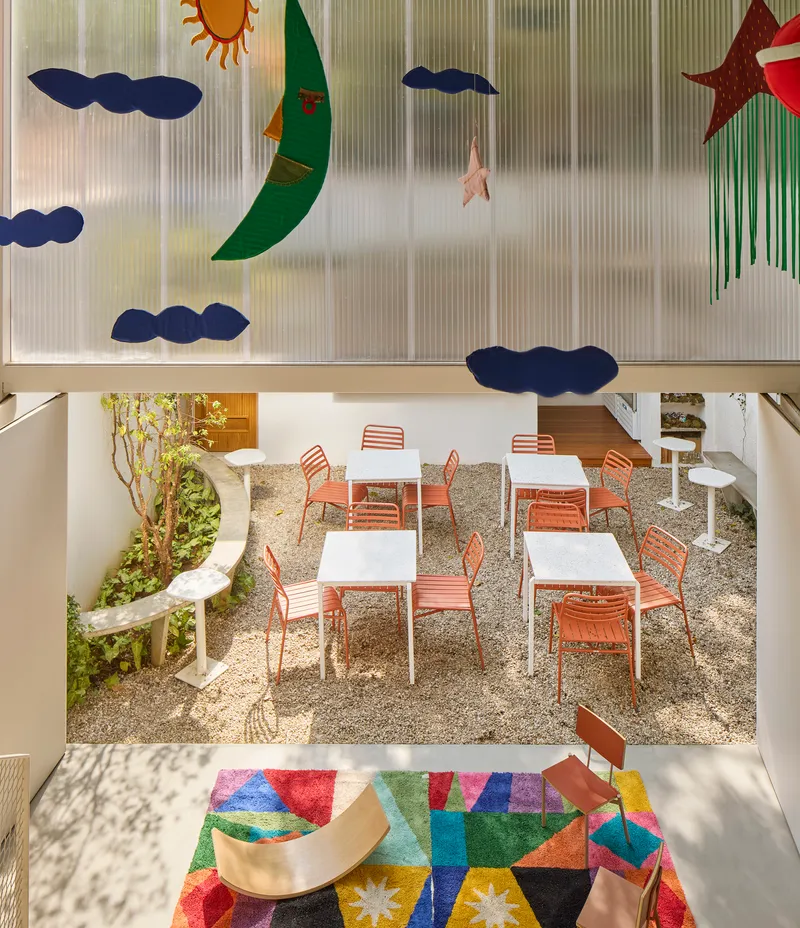
A translucent wall decorated with sun and cloud motifs separates the playroom from the courtyard, filtering light while maintaining visual connection. The ribbed polycarbonate surface glows from both sides, turning the boundary between indoors and outdoors into a luminous screen. It is a smart move: children can orient themselves in the plan by light quality alone.
The Courtyard as Social Center
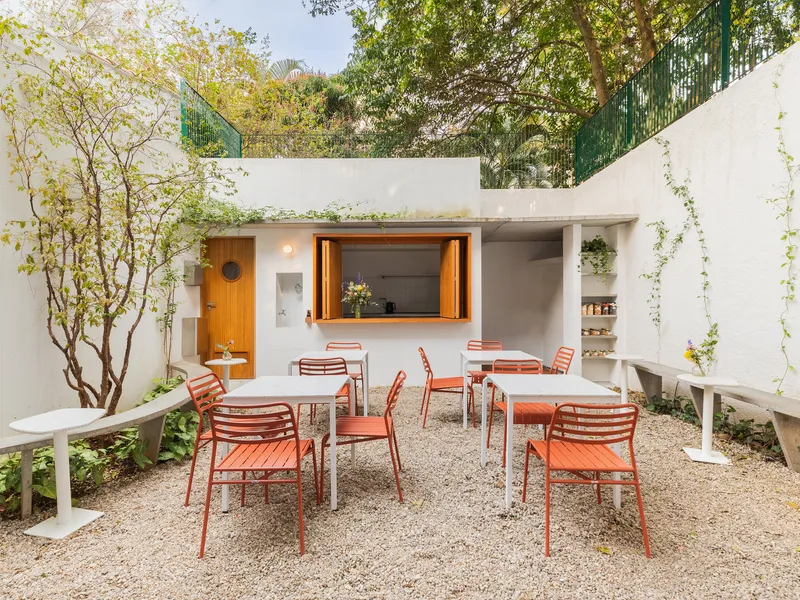
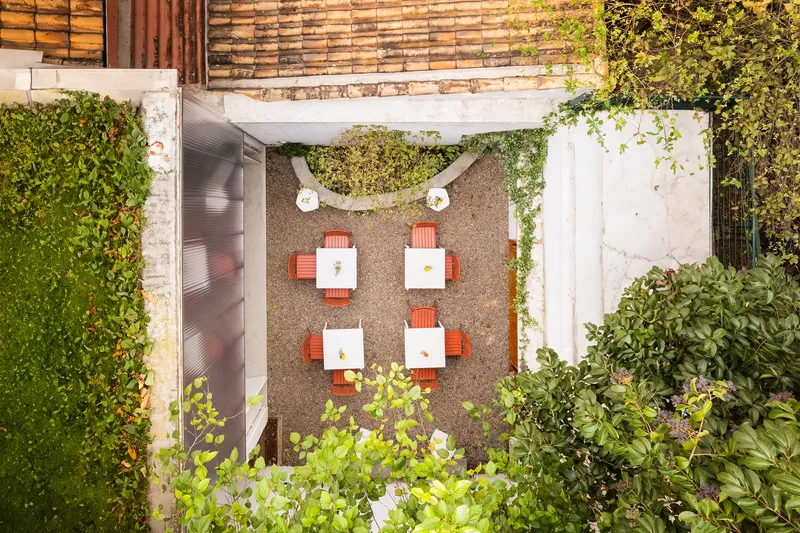
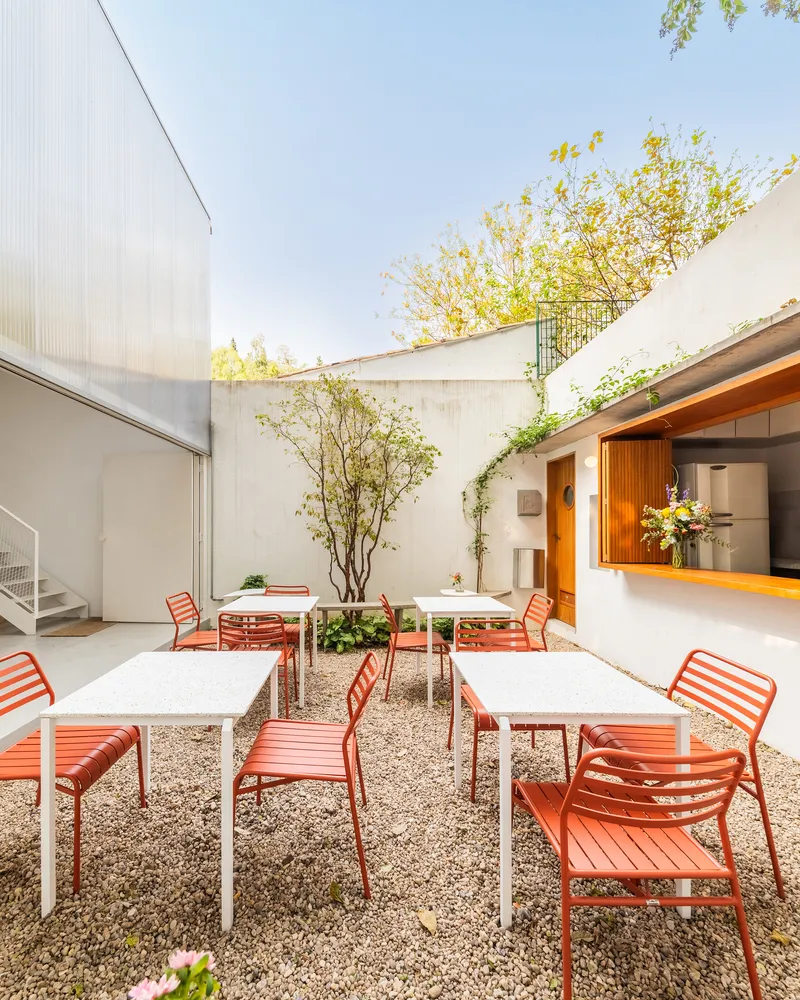
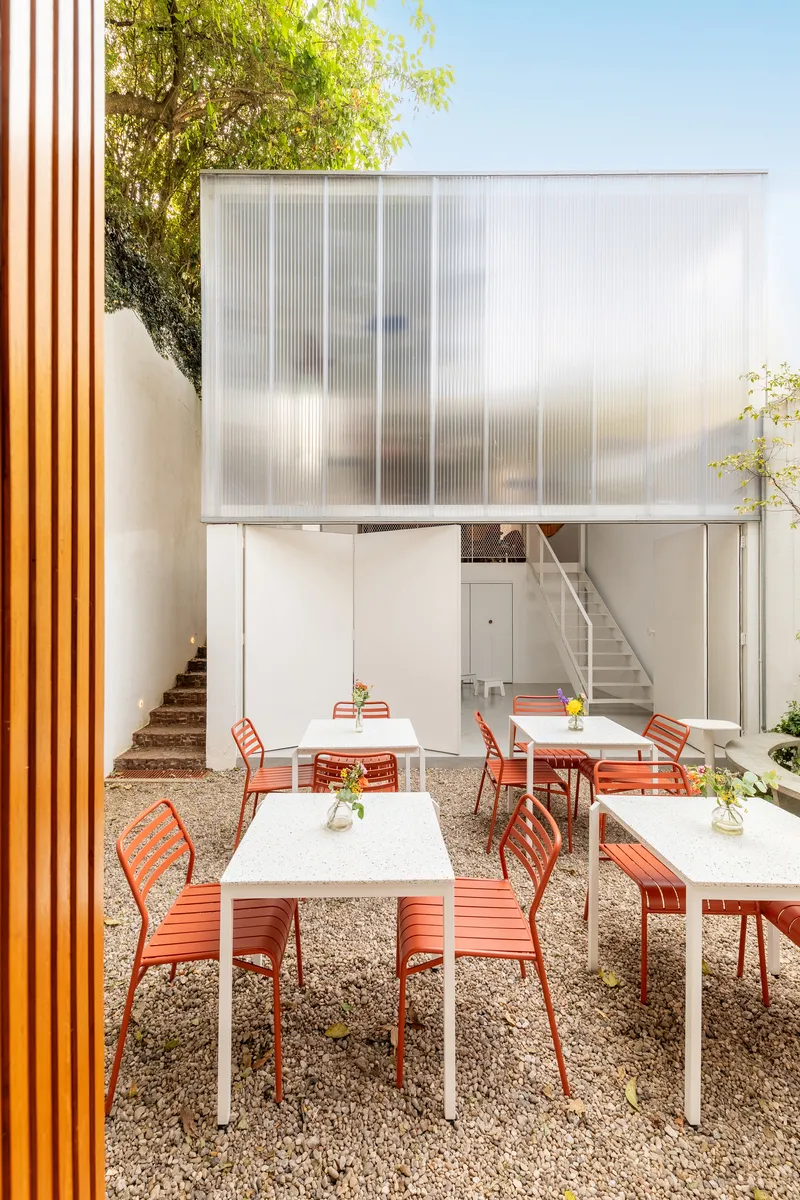
The gravel courtyard at the plan's midpoint does the heavy lifting in terms of environmental performance and social programming. Coral and red metal chairs cluster around white tables beneath deciduous trees, and a curved planted bed with a white bench anchors one edge. A timber service window with a circular porthole opens onto the courtyard from the café zone, creating a casual counter service that keeps parents fed while children read.
On a narrow site, the courtyard is a structural luxury. Helou could have roofed it and gained square meters. Instead, the void brings cross-ventilation, daylight, and a breathing room that makes the linear plan feel twice its actual size. The gravel paving keeps things permeable and low-maintenance, and the planting softens the concrete walls without requiring irrigation infrastructure.
Thresholds and Corridors
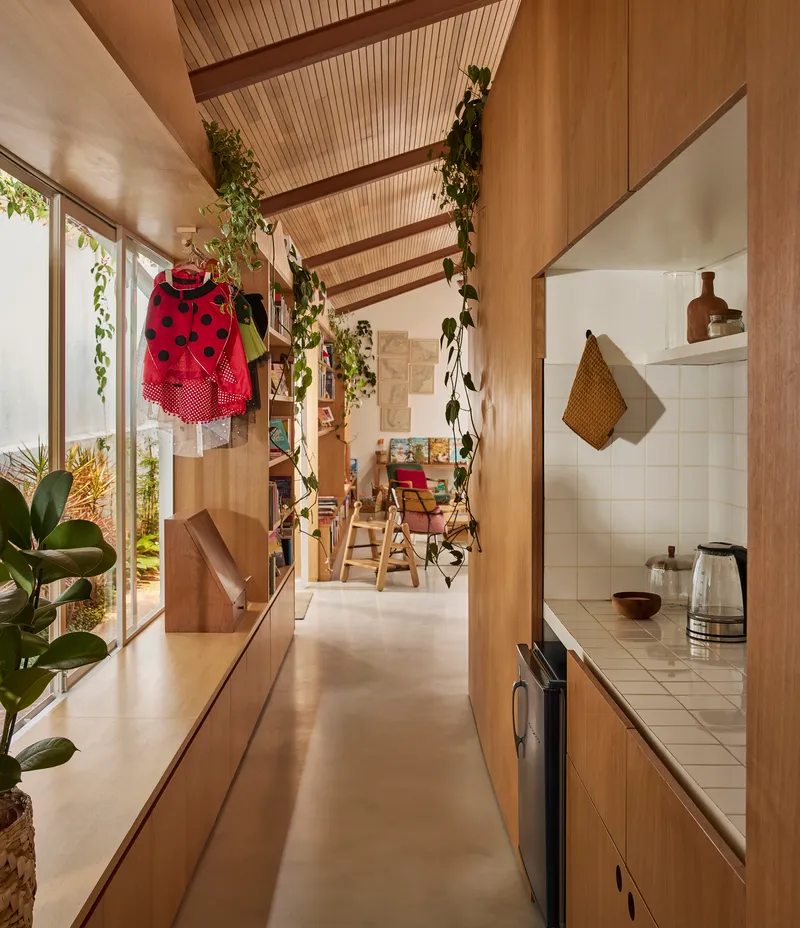
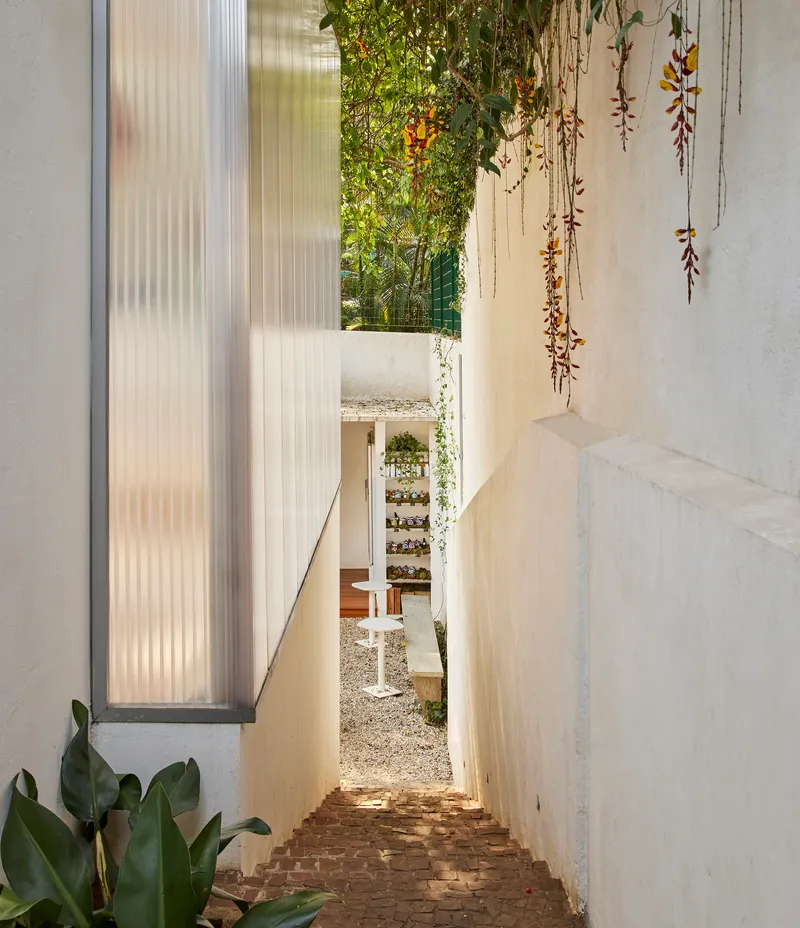
Circulation in a 140 square meter linear plan could easily feel like a hallway. Helou mitigates this with material variety and vertical surprise. A galley corridor lined with timber slats and hanging plants leads toward a white-tiled kitchen zone, the planting overhead transforming a pass-through into a moment of pause. A narrow exterior stairway descends between white walls with brick treads and trailing vines, its compression releasing into the courtyard below.
The translucent polycarbonate facade that rises above the courtyard dining area manages the transition between the building's two halves. A white metal stair visible behind the ribbed surface signals the section change from single to double height. These intermediate spaces are where the project's spatial intelligence is most legible: every corridor is also a garden, every stair is also a view.
Dining and the Café Zone
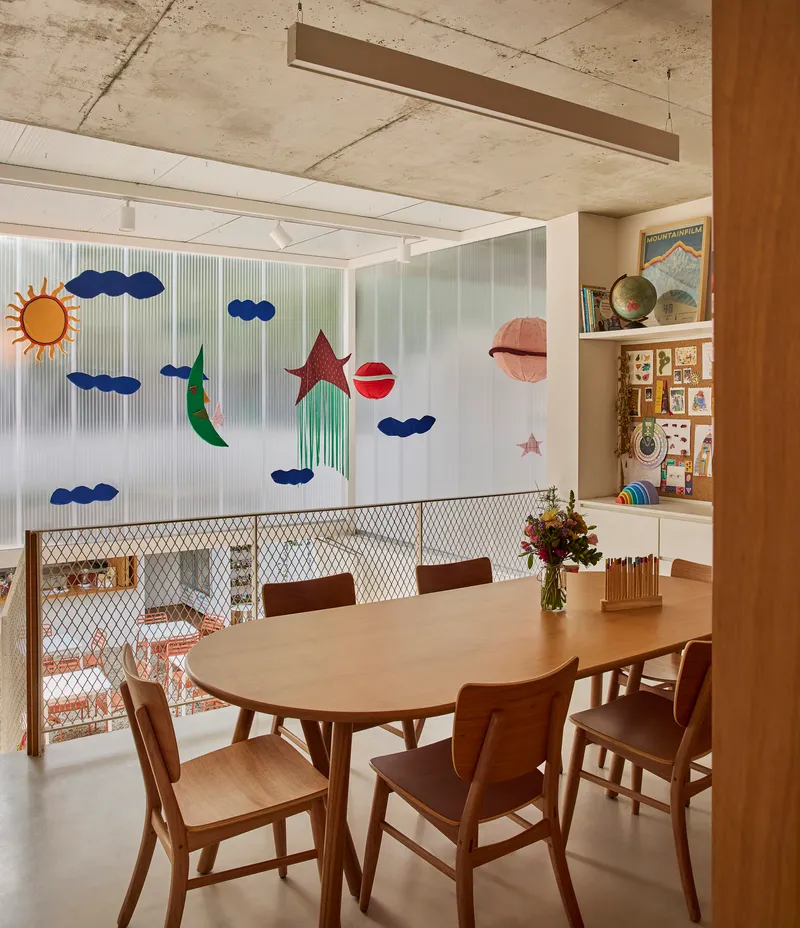
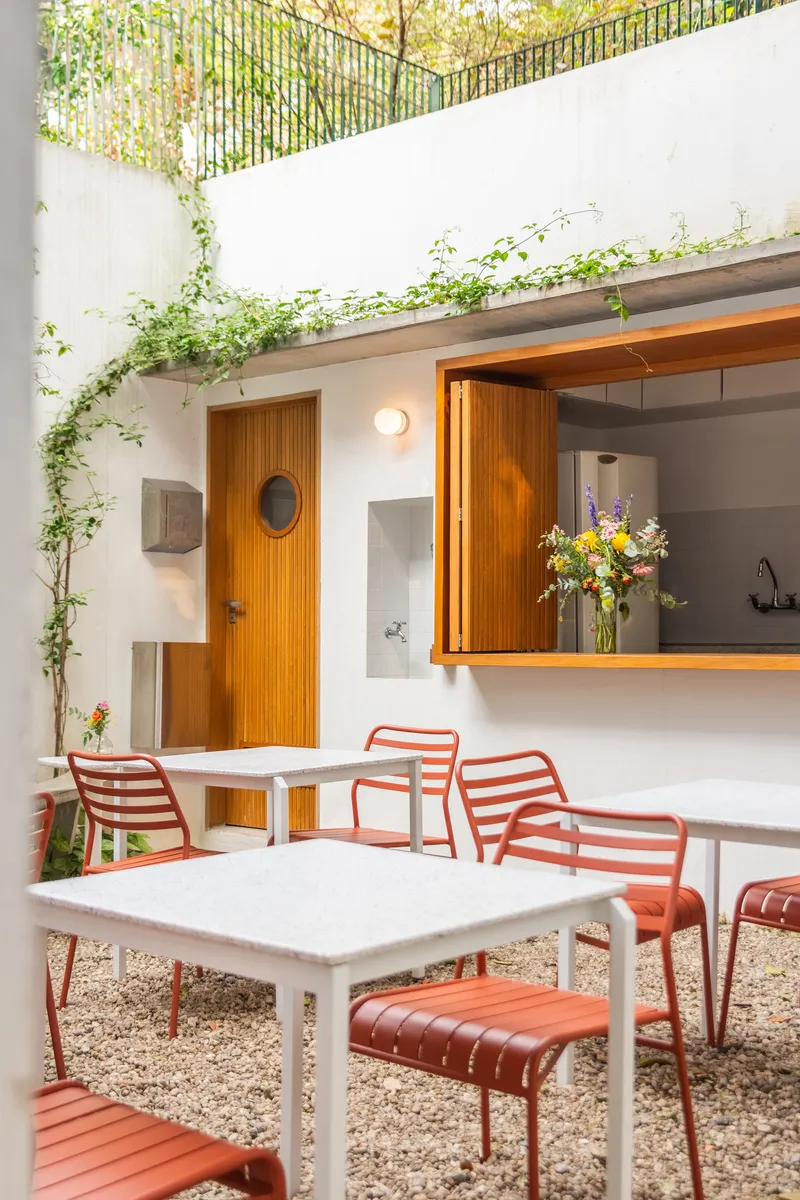
The café component occupies a zone between the courtyard and the interior reading rooms, bridging the commercial and the communal. A dining area beneath an exposed concrete ceiling sits behind a translucent partition decorated with sun and cloud motifs, the same celestial vocabulary that runs through the entire project. The timber service window with its porthole opening is a charming functional detail that doubles as a design signature.
Helou treats the café not as a revenue afterthought but as architecture that supports the bookstore's social premise. Parents linger because the space is comfortable, and children return because they associate the building with sustained time, not a quick transaction. The long view through the bookshop, past the painted brick wall and timber ceiling to the central reading area, is calibrated to draw visitors deeper into the plan.
Plans and Drawings
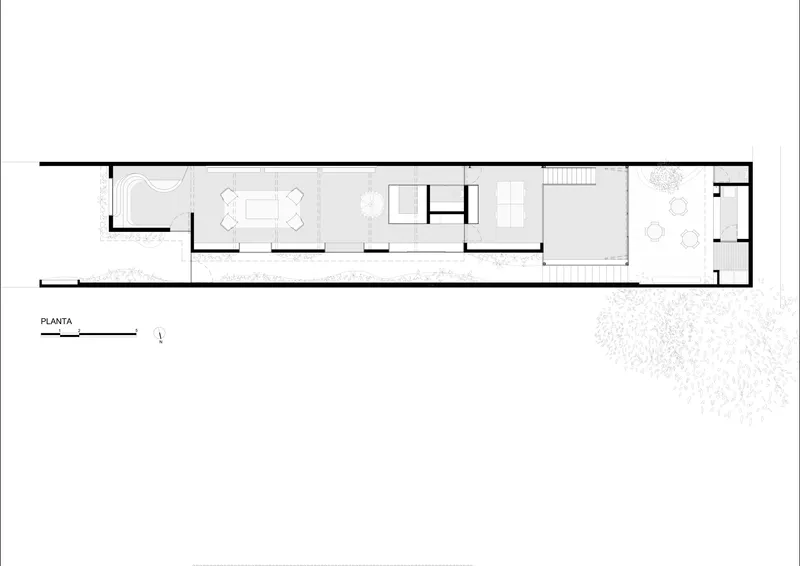
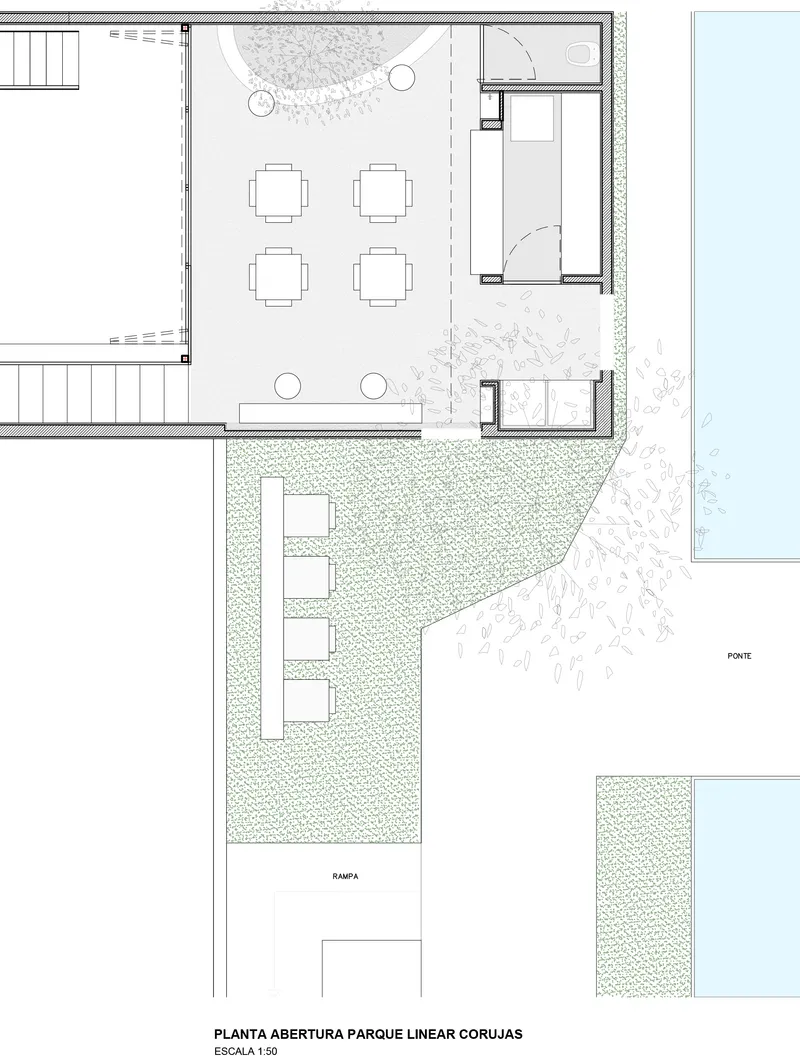
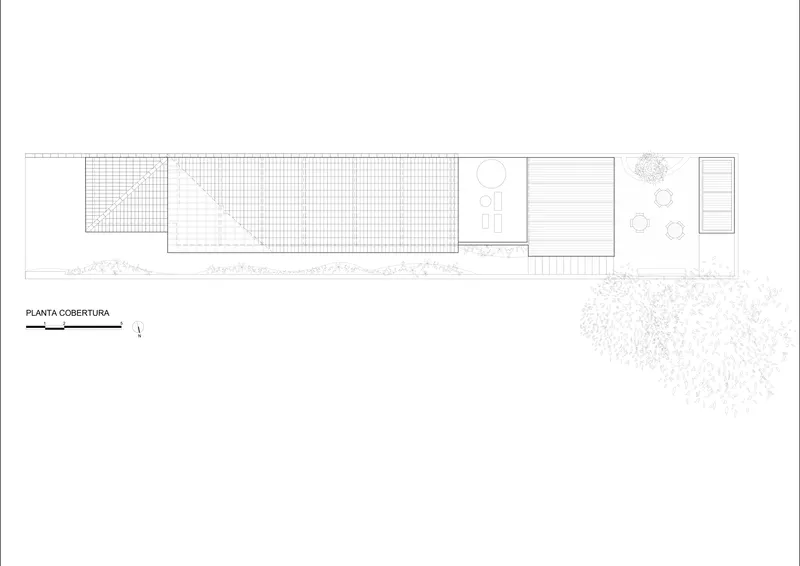
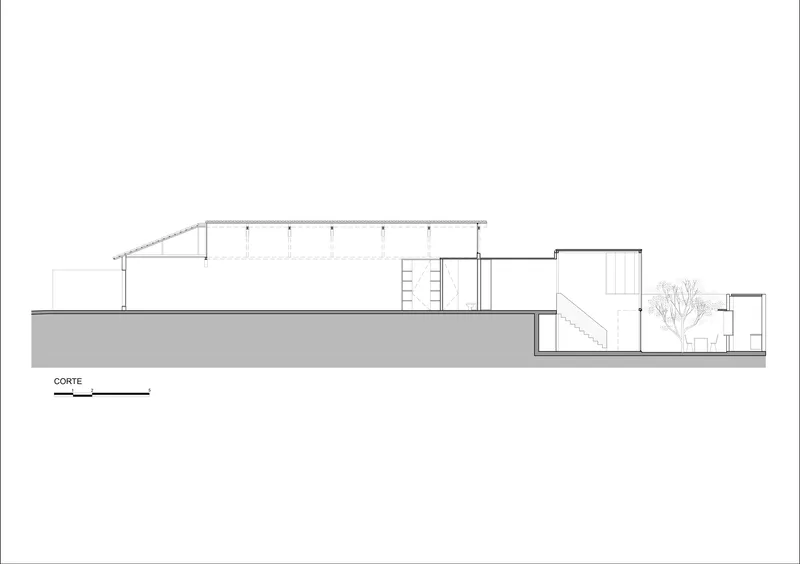
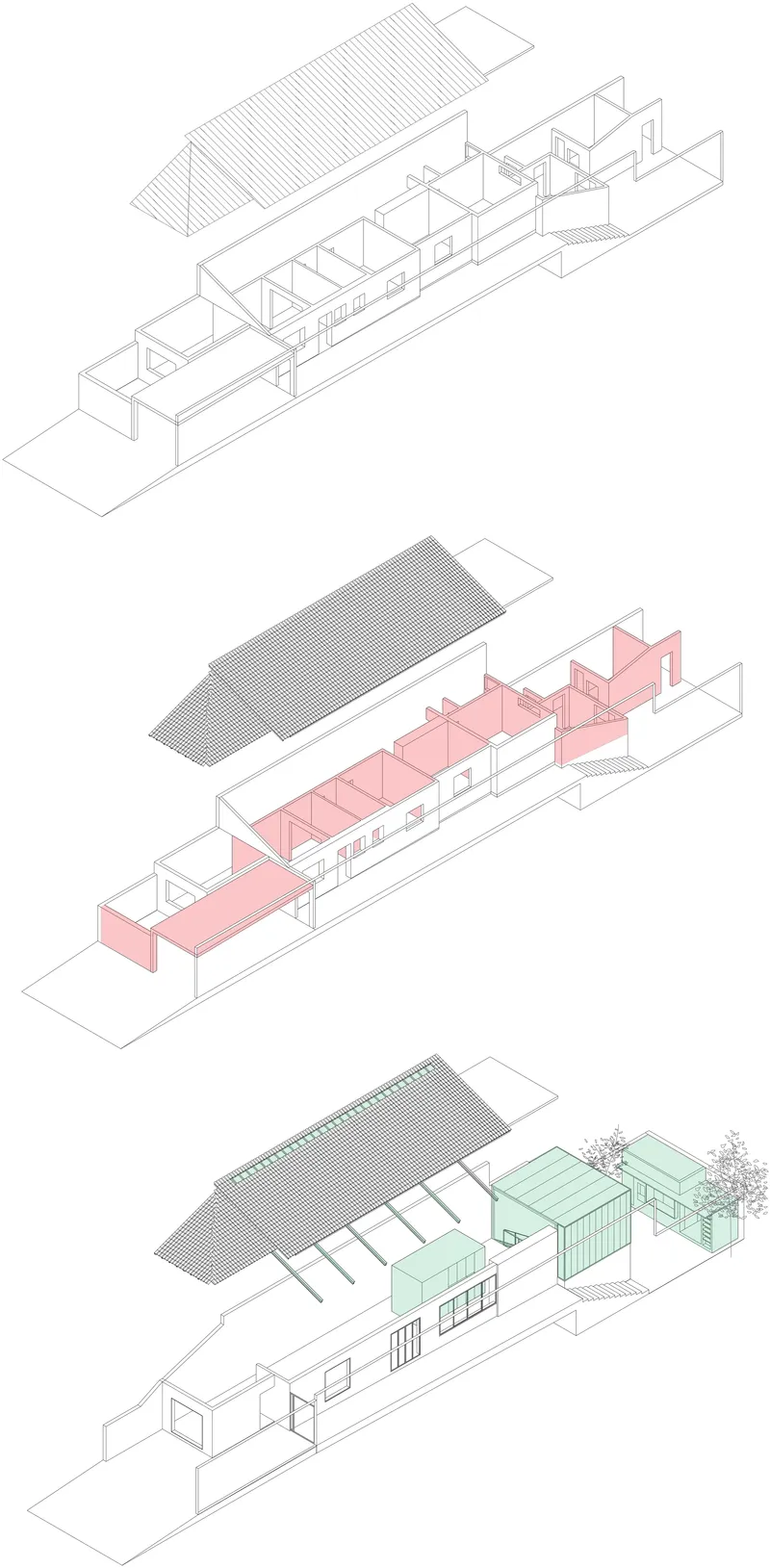
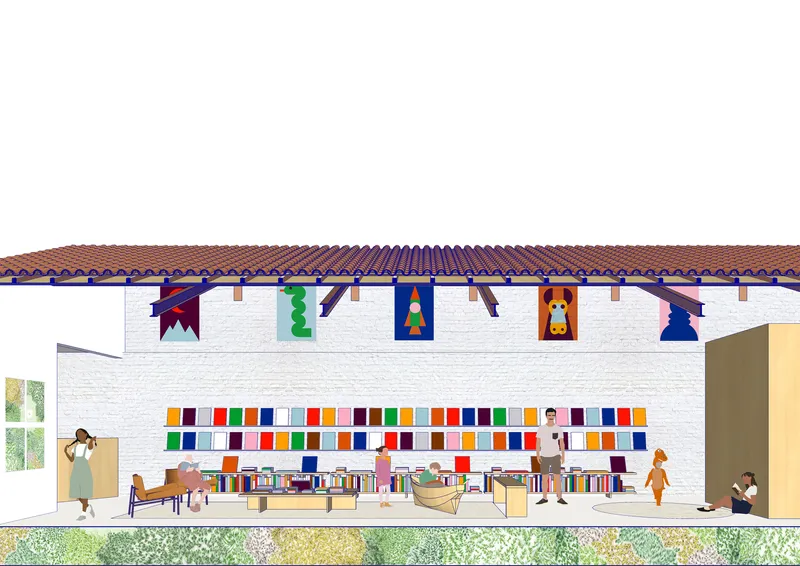
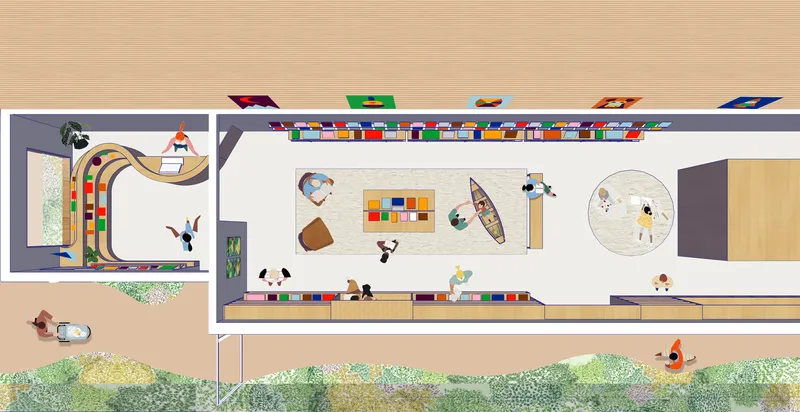
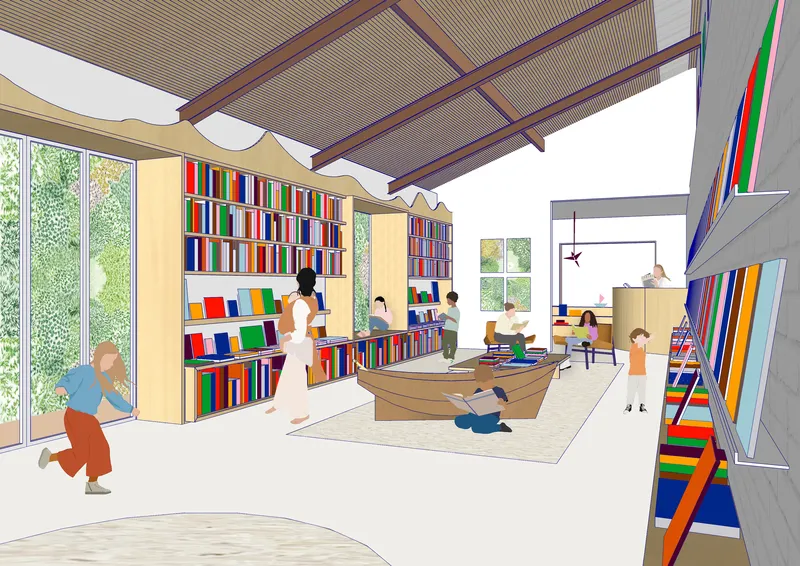
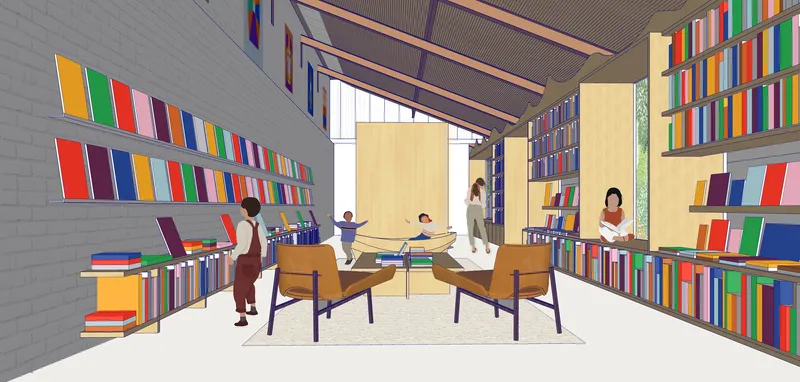
The drawings confirm what the photographs suggest: the plan is radically linear, a single room wide, with the courtyard inserted as an outdoor room roughly at the midpoint. The section drawing reveals the split-level strategy that creates the double-height playroom while keeping the reading zones at a more intimate scale. An exploded axonometric breaks the project into its constituent parts: structure, program zones, and glazed volumes, each legible as a distinct move. The rendered plans and sections, populated with tiny figures of children reading and playing, are a welcome reminder that this architecture was designed from the user's eye level up.
Why This Project Matters
Children's spaces in commercial architecture are usually an afterthought: a padded corner, a primary-colored wall, maybe a slide. Casa Cosmos treats childhood experience as the primary design brief and builds outward from there. The result is a space that takes material craft, environmental strategy, and programmatic sequencing seriously while remaining genuinely fun to inhabit. Helou demonstrates that designing for children does not require dumbing down the architecture; it requires sharpening it.
The project also offers a quiet argument about adaptive reuse in dense South American cities. Rather than demolishing the existing house and starting from scratch, Helou works with the found structure, exposing its beams and brick while layering new interventions on top. The courtyard, the mezzanine, the translucent walls: these are surgical insertions, not wholesale replacements. In a profession that too often equates ambition with square meters, Casa Cosmos proves that 140 square meters can contain an entire cosmos.
Casa Cosmos Bookstore by Andréa Helou. São Paulo, Brazil. 140 m². Completed 2023. Photography by André Klotz and Guilherme Pucci.
About the Studio
Andréa Helou
Official website of Andréa Helou, one of the studios behind this project.
andreahelou.comShare Your Own Work on uni.xyz
If projects like this are the kind of work you want to make, uni.xyz is a place to publish your own, find collaborators, and enter design competitions.




Popular Articles
Popular articles from the community


The Ocean Hive: Sustainable Architecture for a Self-Sufficient Civilization at Sea
The Ocean Hive imagines sustainable architecture at sea, where modular habitats, algae, wave power and ocean waste sustain a growing colony.

Co-Life: Senior Housing Design That Reconnects Older Adults With the City
Co-Life reimagines senior housing design through healing gardens, shared streets, workshops, and a sustainable community across generations.

The Earth Pod: 3D Printed Homes for Resilient Refugee Communities
The Earth Pod reimagines refugee housing through 3D printed homes made from clay, combining resilience, self-sufficiency, and rapid shelter.

Lunar Spiral: Space Architecture Shaped by the Mathematics of the Universe
Lunar Spiral reimagines space architecture through Fibonacci geometry, lunar regolith, levitating habitats, and self-sustaining Moon living.


Similar Reads
You might also enjoy these articles

Bao Huynh Watercolor Atelier: A Serene Art Retreat in Hội An
Bao Huynh Watercolor Atelier in Hội An blends multifunctional art spaces, sustainable design, local materials, and family-friendly living in a serene environment.

Atelier Macri Concept Store Interior Design by CASE-REAL
Atelier Macri store features a "ko" counter, walnut wood details, cork displays, blending retail, gallery, and seamless customer experiences.

Manuel Vargas Izquierdo Stadium and High-Performance Sports Center: Architectural Excellence in Jalpa de Méndez
The Manuel Vargas Izquierdo Stadium blends sustainable design, inclusive sports facilities, and cultural-inspired architecture, revitalizing Jalpa de Méndez’s public spaces.

KAKR Buluh Awar Hall: Revitalizing Community and Ecology Through Bamboo Architecture
Community built bamboo hall revitalizes Buluh Awar village, empowering youth, restoring ecology, celebrating vernacular craftsmanship through sustainable architecture and culture.


Explore Interior Design Competitions
Discover active competitions in this discipline


Challenge to design luxury tourism on rails


VR headsets Storefront design competition

Designing a staircase for a client
Comments (0)
Please login or sign up to add comments
No comments yet. Be the first to comment!