
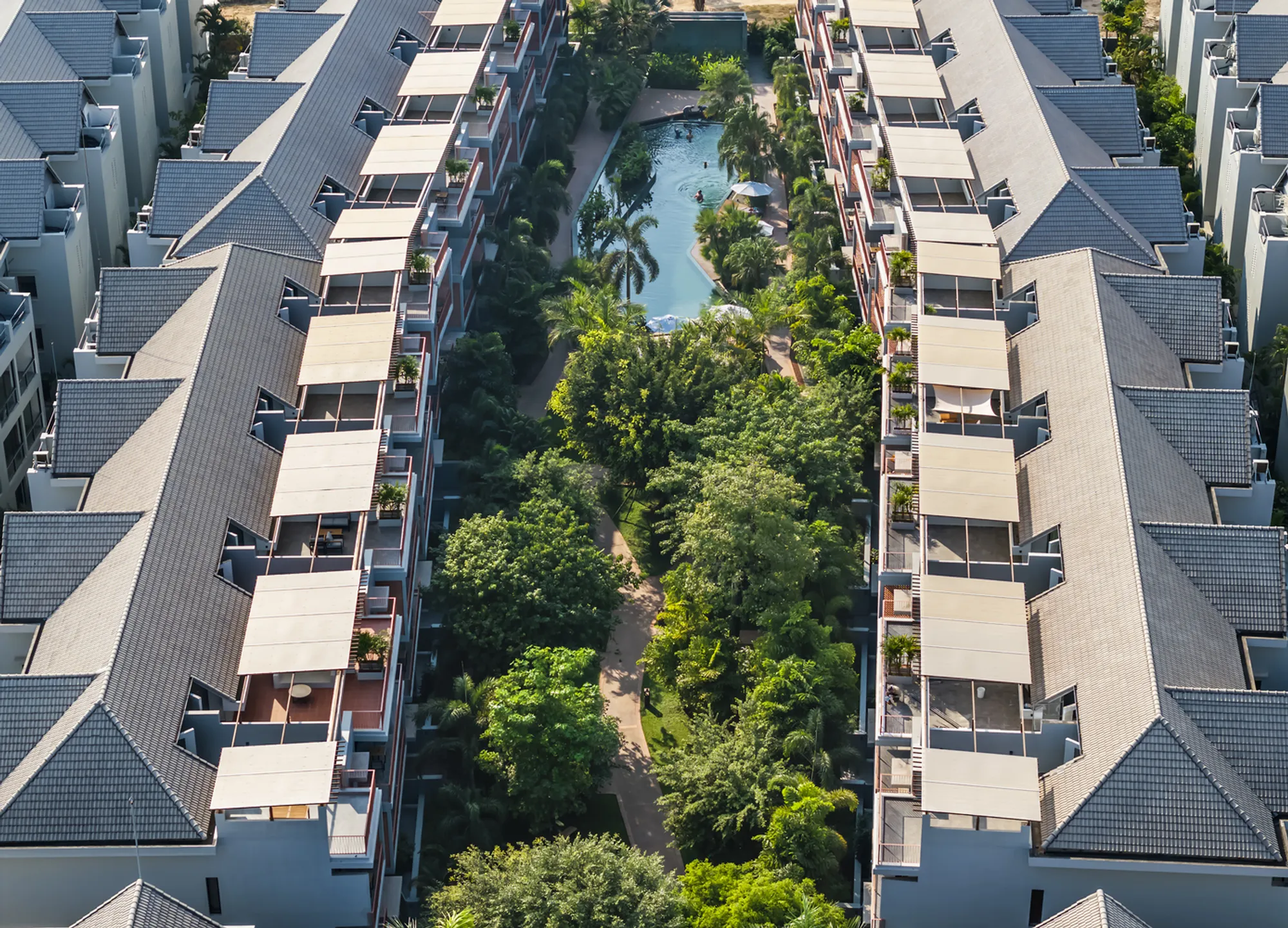
Bloom Architecture Resurrects a Stalled Cambodian Housing Estate as a Living Wellness Resort
In Siem Reap, a half-finished gated community abandoned after the 2008 crash becomes a green-wrapped retreat near Angkor Wat.


There is a particular species of building project that exists across Southeast Asia: the ambitious gated community, locally called a borey, that ran out of money before it ran out of ambition. In Siem Reap, Cambodia, five rows of concrete residential blocks sat idle for years after the 2008 financial crisis gutted the development that spawned them. What Bloom Architecture did with that carcass over a five-year engagement is not a renovation in any conventional sense. It is closer to an act of ecological recolonization, stripping the buildings down to their modular frames and letting vegetation, Khmer craft, and a new programmatic identity take root in the voids.
Angkor Grace Residence, completed in 2022, now holds 263 units across a 2.2-hectare site just minutes from the Angkor temple park. But the real story is the pivot: what was meant to be private housing became a wellness-oriented resort, with front-facing blocks converted into health facilities, vehicle roads replaced by landscaped green corridors, and a facade system designed to grow wilder over time. The architects describe the metal slats on the facade as lines on a music staff, onto which a tropical symphony of plant life will gradually be composed. For once, the metaphor tracks.
Salvaging the Skeleton
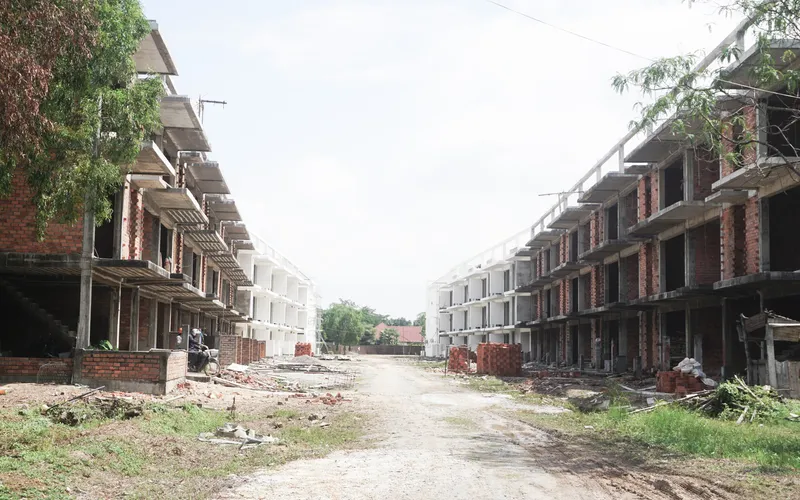
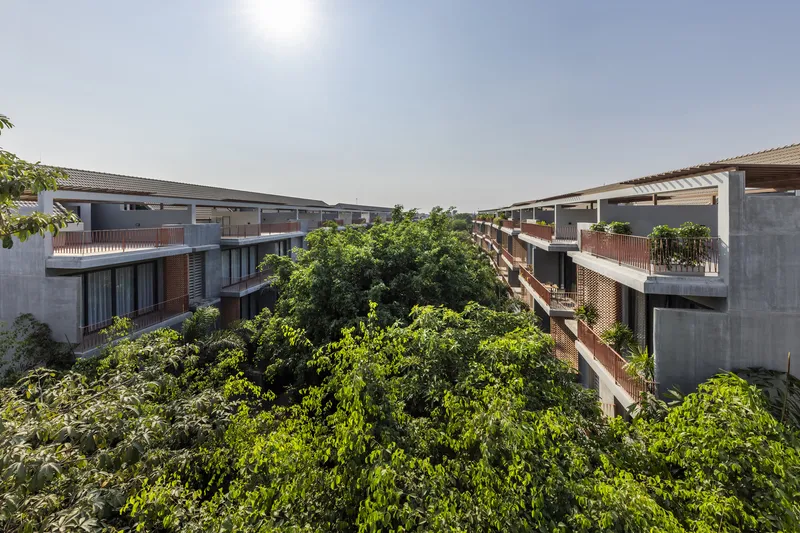

The before-and-after contrast here is stark. Construction photographs show a grim street of bare brick walls and unfinished slabs, the typical aftermath of speculative development gone sideways. Bloom's intervention began by subtracting rather than adding: internal structures, enclosed stairwells, and partitions were stripped out to expose an open, modular frame. Only then did the layering begin, with new facades, screens, and planting systems applied to the existing concrete bones.
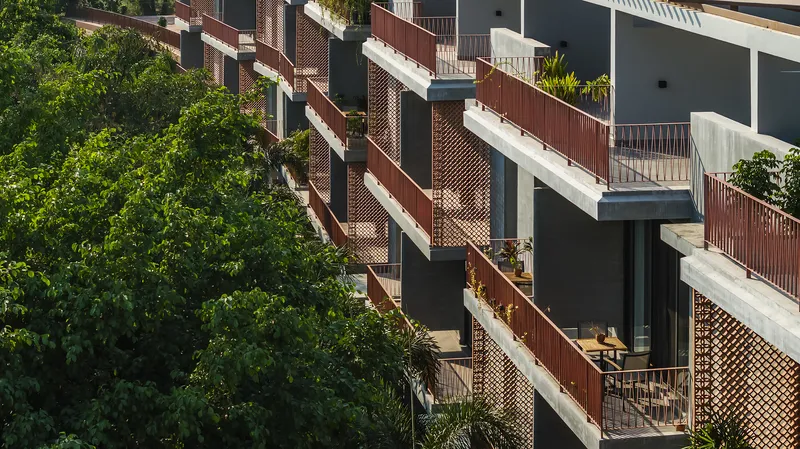
The decision to work with the existing structure rather than demolish it is both pragmatic and philosophical. The embodied energy in all that concrete and masonry is preserved, while the new identity of the project reads as genuinely distinct from the original developer's vision. Staggered balconies with perforated brick screens and planted terraces now wrap the blocks, creating a rhythm that owes nothing to the blunt repetition of the original layout.
A Facade That Grows

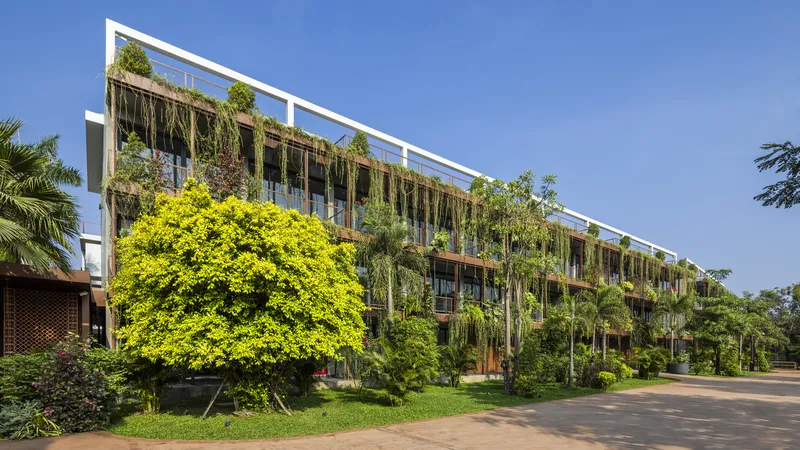
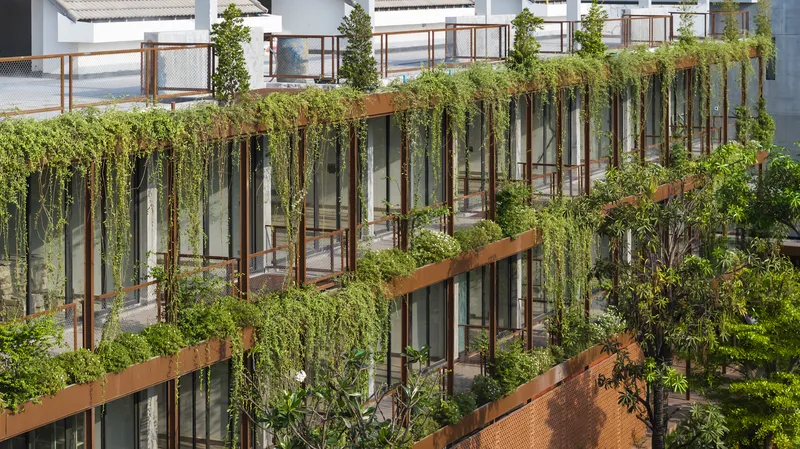
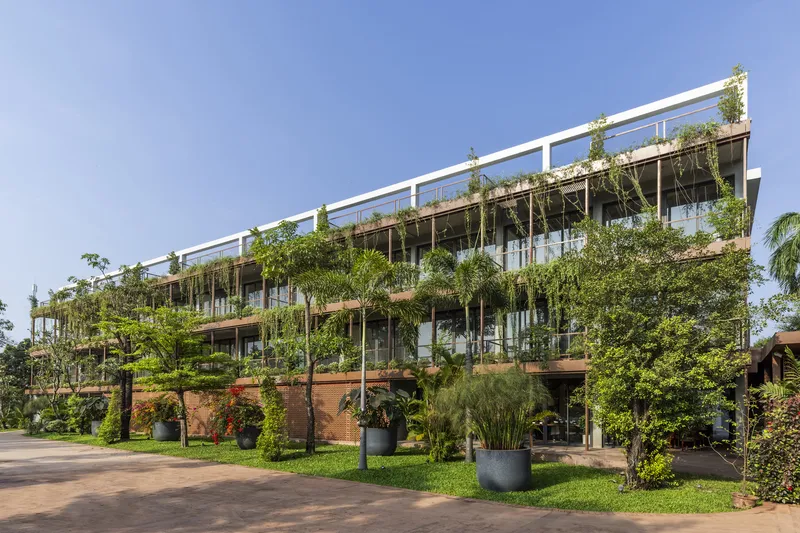
The most photographed element of Angkor Grace is its green facade, and it deserves the attention. Systematic metal slats in the red earth color palette of Siem Reap create a gridded armature across the building faces. Tropical plants cascade from every tier, trailing from balconies and spilling over edges. The effect is not a green wall in the manicured, corporate-lobby sense. It is deliberately loose, calibrated to thicken and evolve over seasons, blurring the boundary between architecture and landscape.
The horizontal white louver canopies that crown several blocks serve a dual purpose: they shade the uppermost units and provide a clean geometric cap that keeps the cascading vegetation from reading as neglect. It is a fine calibration. Without that sharp edge at the top, the whole composition could tip into ruin chic. With it, the wildness looks intentional, which it is.
Khmer Craft in the Screens and Bricks
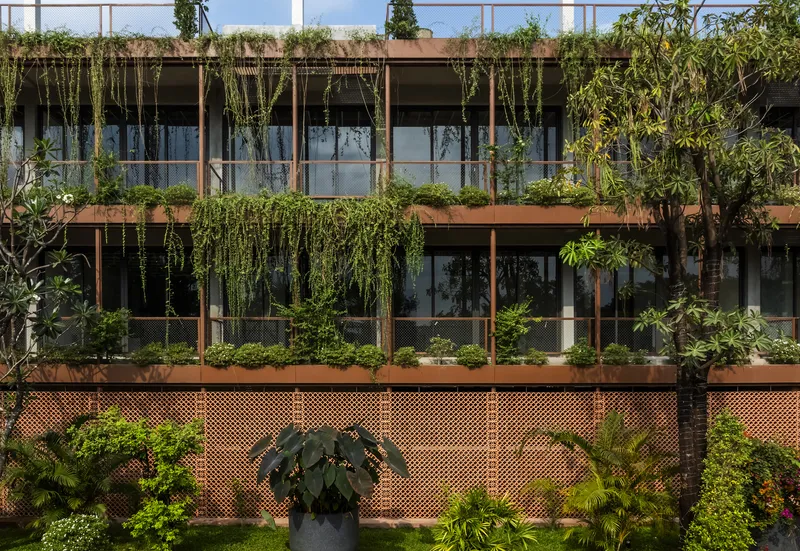
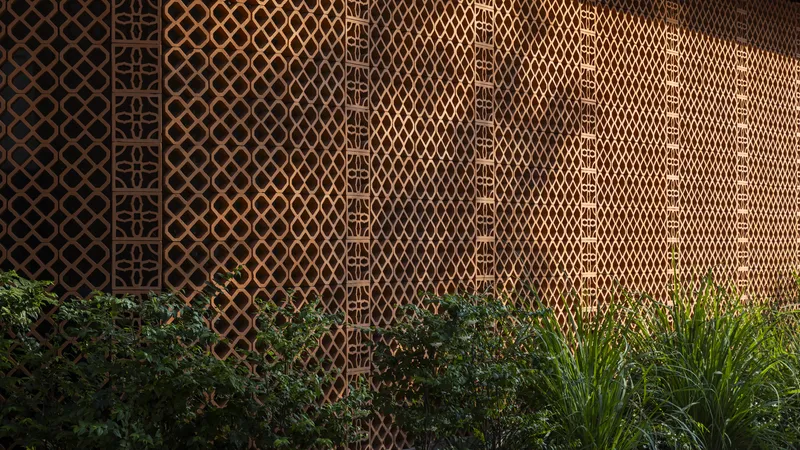
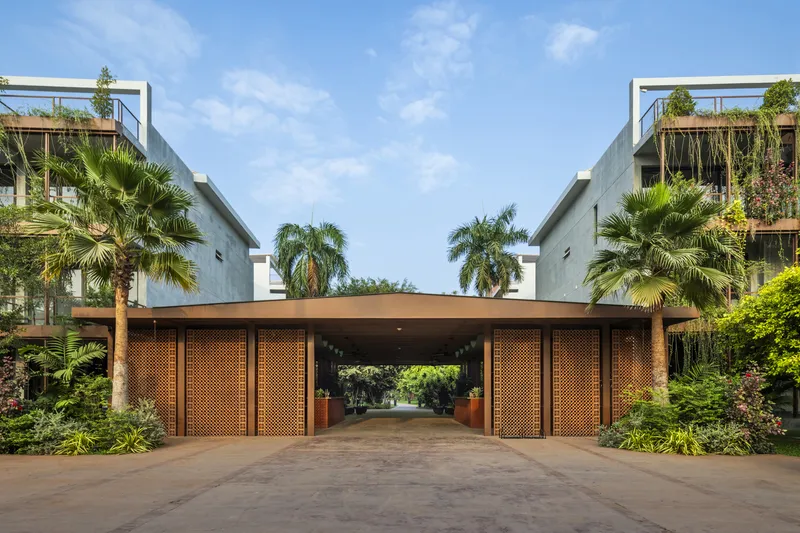
Locally made clay bricks and breezeblocks punctuate the project at ground level and in screen walls, each bearing traditional Khmer geometric patterns. These perforated elements are not decorative appliqué. They serve as permeable barriers that allow cross-ventilation while maintaining visual privacy, a passive cooling strategy that reduces dependence on mechanical systems in Siem Reap's tropical climate.
The diamond-patterned lattice panels, visible at several pavilion entries, glow warmly when backlit at dusk. Pigmented concrete in earthy red tones ties the ground plane to the region's famous laterite soil, the same material that underpins many of the Angkor-era monuments nearby. The palette is cohesive without being monotonous: brick, terracotta, timber, and red-tinted metal all belong to the same family of warm earth tones.
Green Corridors as Organizing Principle
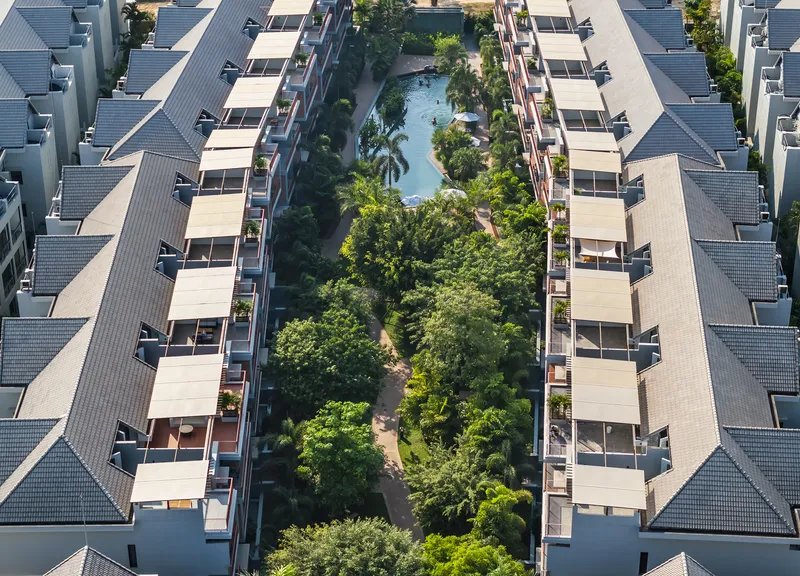
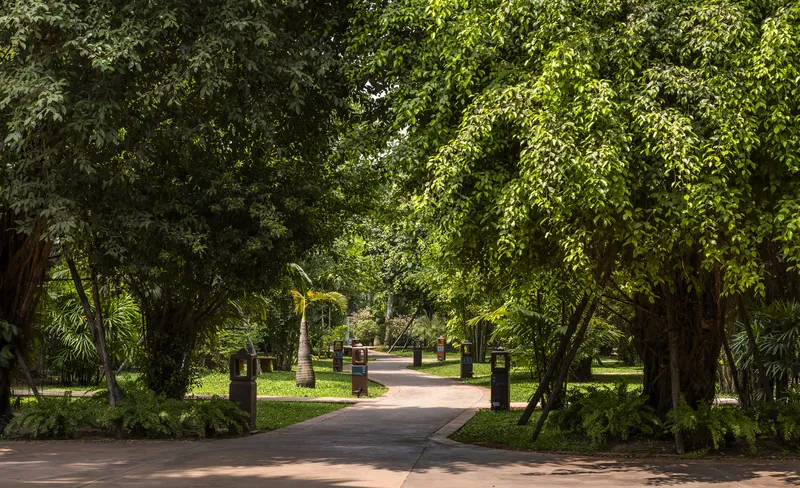
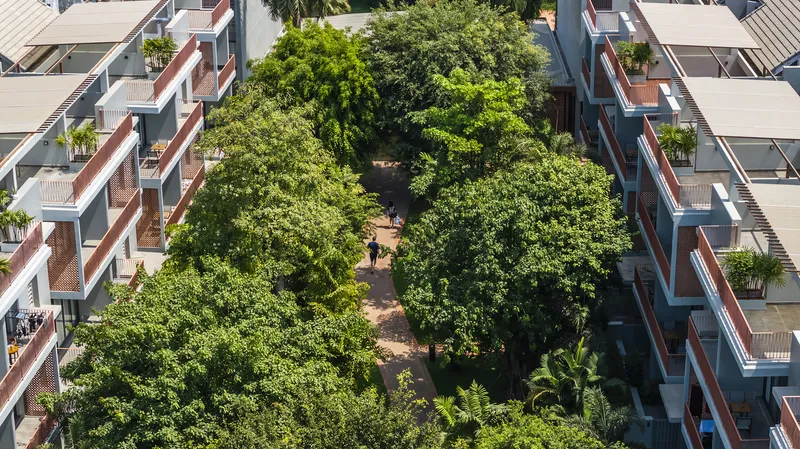
The original site plan allocated generous roads between the building rows, designed for car access. Bloom converted these into landscaped green corridors, drawing inspiration from the way the Siem Reap River meanders through the city. Mature trees, many planted early in the project timeline to ensure growth, now form a continuous canopy over paved pathways. The aerial views confirm the ambition: dense tree cover fills the gaps between parallel residential blocks, making the built form read as islands in a forest rather than buildings flanking a road.
These corridors also manage rainwater drainage passively and encourage pedestrian circulation, replacing the car-centric logic of the original borey with something closer to a temple precinct's processional sequence. The shift from vehicular to pedestrian is not just a wellness amenity; it fundamentally alters how guests perceive the scale and density of 263 units packed into 2.2 hectares.
Interiors and Thresholds
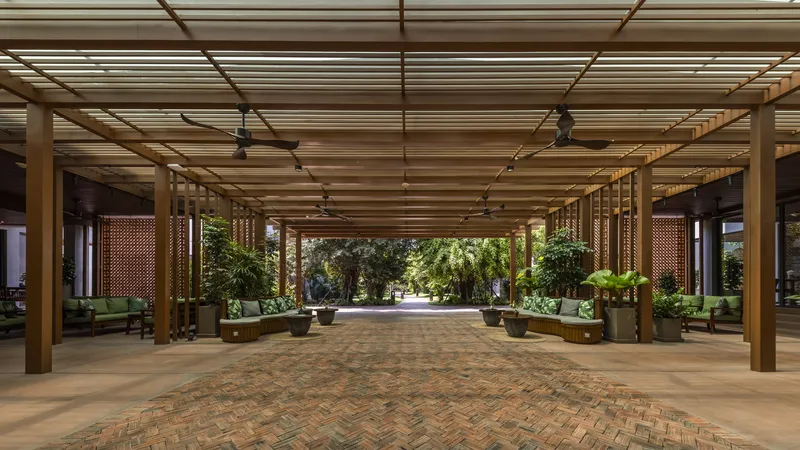
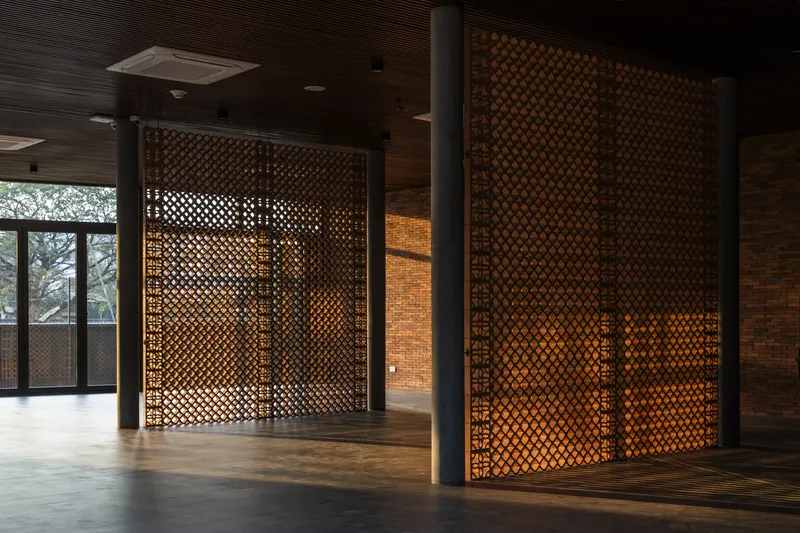
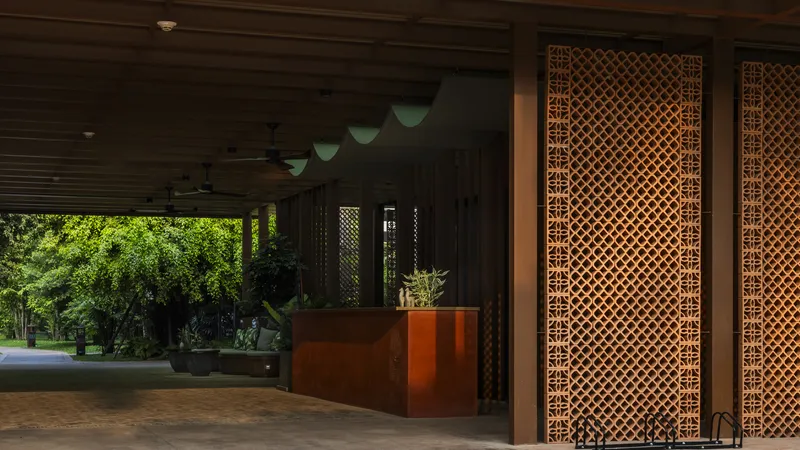
The arrival sequence is handled with restraint. Timber slat ceilings, herringbone brick paving, and perforated screens at the entrance lobby set up the material language without overwhelming it. The covered foyer frames a direct sightline to the landscaped garden beyond, compressing and then releasing the view in a way that rewards the walk-in approach.
Interior spaces are kept deliberately simple. A room with full-height glazing overlooking the tree canopy needs very little else. The perforated metal screens in the lobby catch warm light from behind, turning a functional partition into an atmospheric device. Timber reception desks and ceiling panels provide tactile warmth without competing with the greenery visible through every opening.
Water, Pavilions, and Communal Life
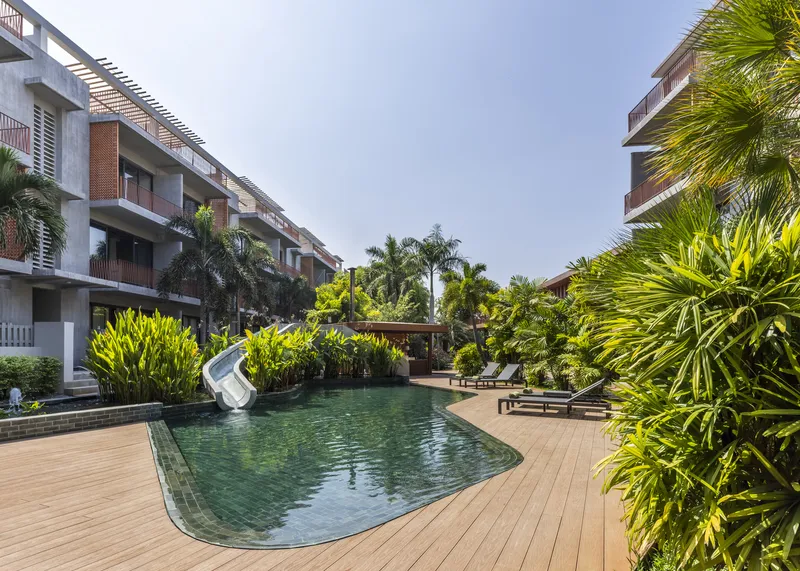
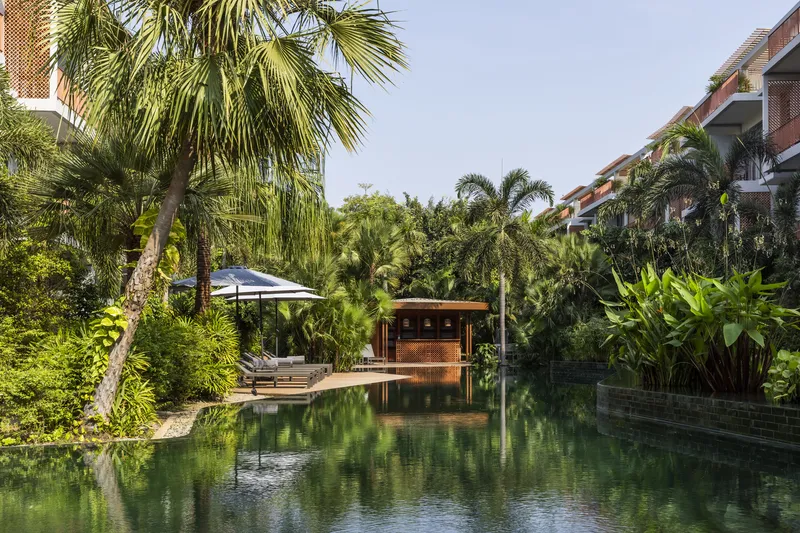
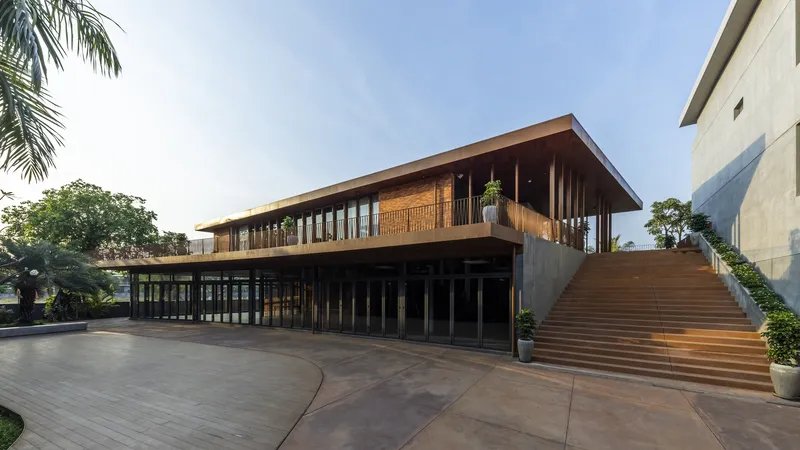
The courtyard pools and timber-decked social spaces sit at the heart of the green corridors, surrounded by dense tropical planting. The presence of water and vegetation creates a microclimate that is noticeably cooler than the surrounding streets, a practical outcome that aligns with the resort's wellness positioning. Poolside pavilions screened with timber louvres offer shade without enclosure, their proportions modest enough to feel like garden structures rather than resort amenities.
A two-story pavilion with a wide exterior staircase serves as the restaurant and function center, its timber louvres catching the warm light at sunset. The sweeping staircase gives the building a civic generosity unusual in a hospitality context, signaling that this is a gathering place rather than a service building.
Contextual Anchoring
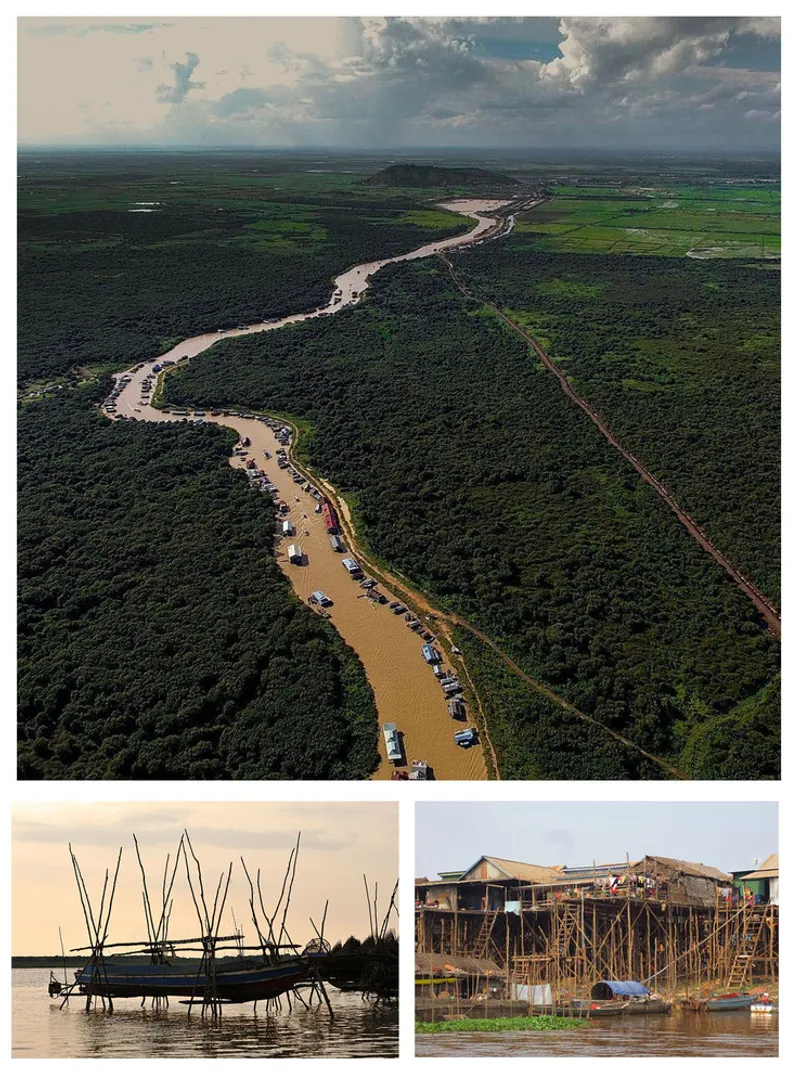
An aerial view of the Siem Reap River cutting through dense forest makes an implicit argument: this landscape is the real context, not the urban grid. Bloom's decision to reference the river's flow in the site plan connects Angkor Grace to a broader ecological and cultural geography. The nearby temples of Angkor are famous precisely because nature reclaimed them, tree roots splitting stone, moss softening carved lintels. Bloom inverts that narrative, designing architecture that invites the green takeover from day one.
At the building scale, planted terraces wrapped around mature tree canopy create an intimate dialogue between the built and the grown. Privacy partitions double as planting beds. Large planters at ground level anchor the vegetation to the earth rather than suspending it as a purely visual effect. The result is architecture that genuinely participates in its ecosystem rather than merely depicting nature as a theme.
Plans and Drawings

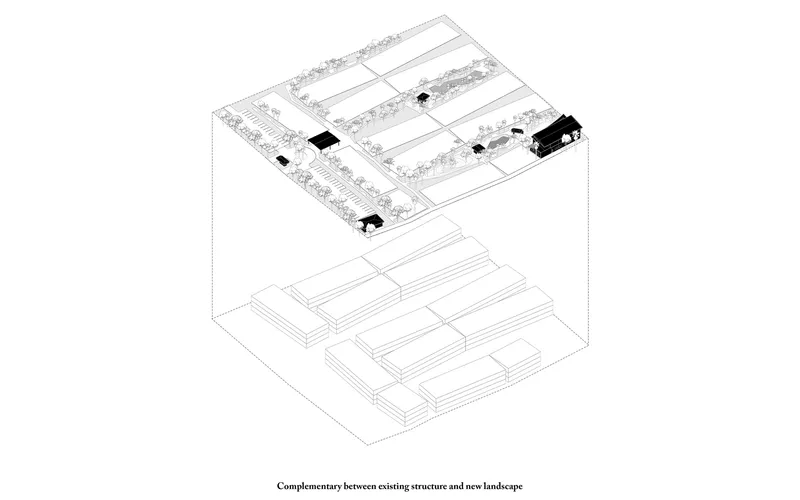
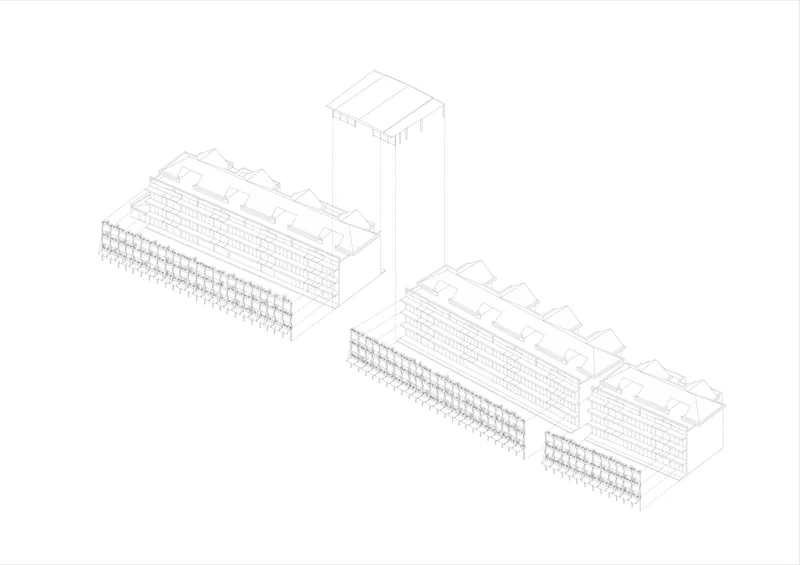
The site plan reveals the project's organizational clarity: five parallel residential blocks separated by landscaped green corridors, with a perpendicular row of buildings forming a unified street-facing facade. The axonometric drawing is particularly instructive, showing how the existing structural grid was retained and overlaid with new landscape interventions and scattered pavilions. The isometric of a single block exposes the sawtooth roof profile and repetitive louvered facade, confirming that the visual richness of the completed project comes from layering, not from complexity in the base structure.
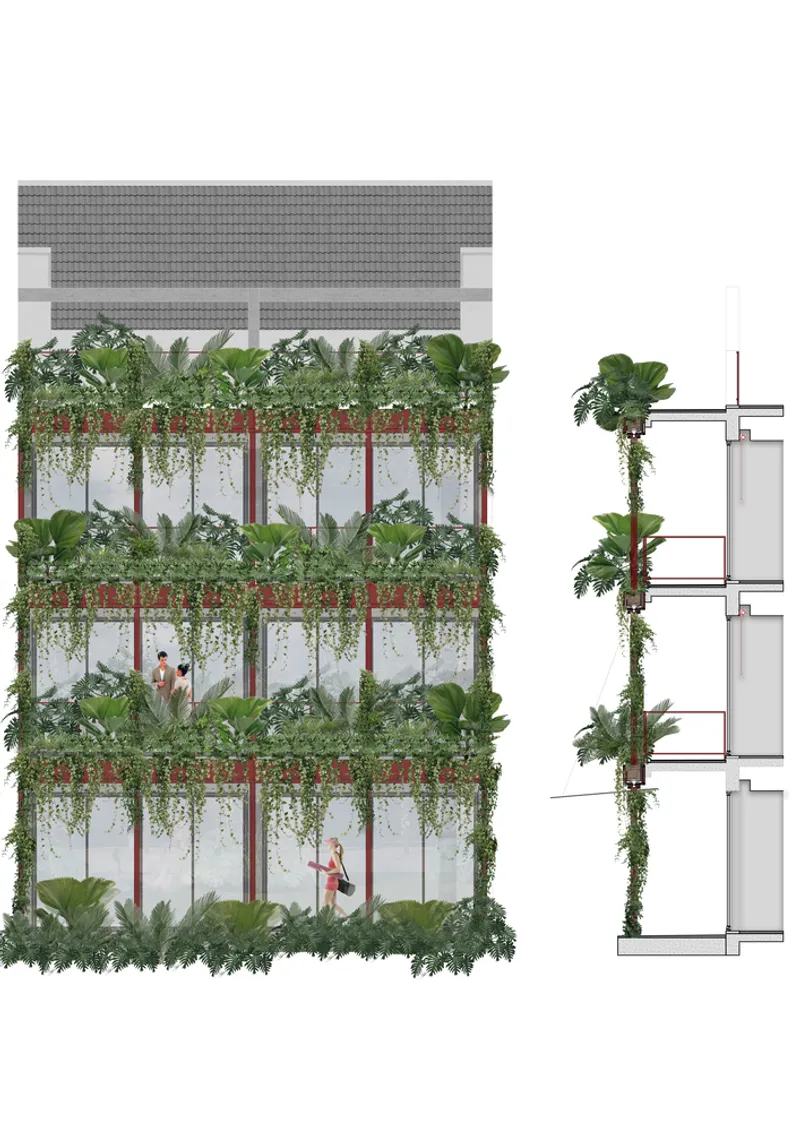
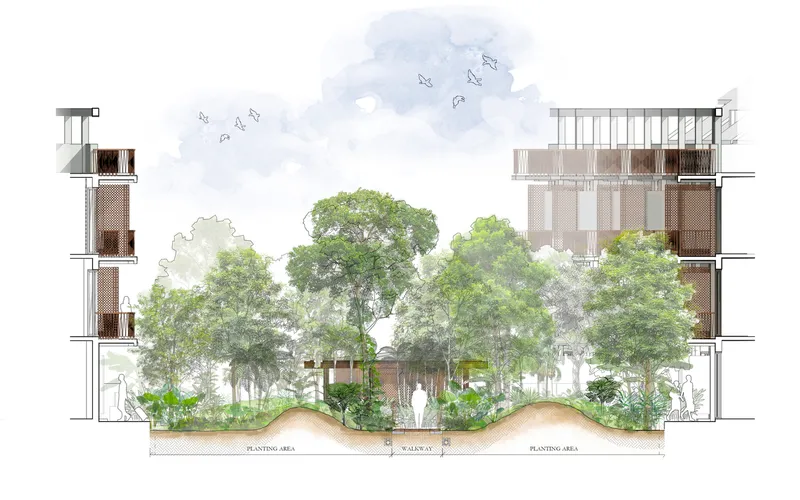
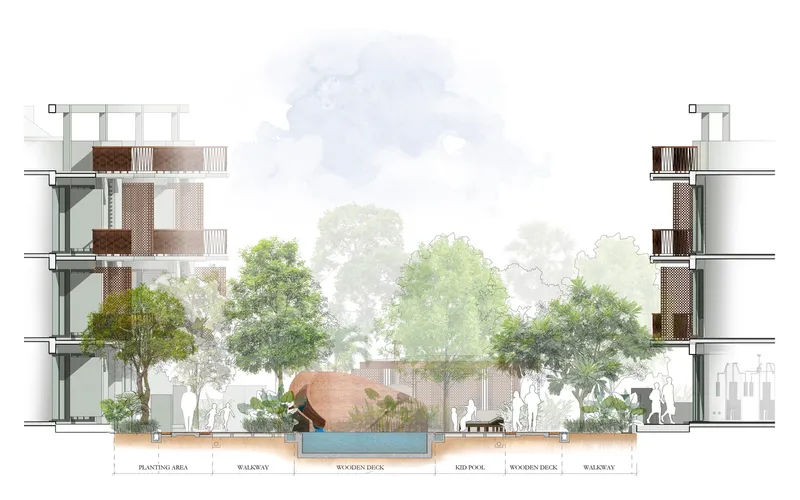
The section drawings are where the biophilic ambition becomes measurable. Cascading vegetation is drawn on every floor, filling the facade depth between the structural frame and the exterior metal slats. The central sections show how the green corridors work spatially: twin residential towers flank planted walkways with mature trees, rooftop terraces, and a kid pool nestled within the canopy. These are not landscape renderings pasted onto an architecture drawing. The planting is integral to the section, occupying real depth and real structure.
Why This Project Matters
Angkor Grace Residence matters because it demonstrates that adaptive reuse is not limited to heritage buildings or industrial warehouses. A failed speculative housing development, the least romantic building type imaginable, can be stripped, rethought, and reprogrammed into something with genuine architectural ambition. The fact that Bloom Architecture worked with the existing concrete frame rather than starting over is a lesson in resourcefulness that the profession needs to hear more often, particularly in fast-developing regions where half-finished structures are common and demolition is the default.
More broadly, the project offers a credible model for what climate-responsive hospitality can look like in the tropics. The passive strategies here, breezeblock ventilation, green facade shading, water-cooled courtyards, tree canopy corridors, are not technological novelties. They are traditional techniques deployed with contemporary precision and paired with a material palette drawn from the Cambodian landscape. The building will look better in ten years than it does today, and that trajectory, architecture improving with age rather than deteriorating, is the strongest argument this project makes.
Angkor Grace Residence by Bloom Architecture. Krong Siem Reap, Cambodia. 2.2-hectare site, 263 units. Completed 2022. Photography by Oki Hiroyuki.
About the Studio
Share Your Own Work on uni.xyz
If projects like this are the kind of work you want to make, uni.xyz is a place to publish your own, find collaborators, and enter design competitions.




Popular Articles
Popular articles from the community


The Earth Pod: 3D Printed Homes for Resilient Refugee Communities
The Earth Pod reimagines refugee housing through 3D printed homes made from clay, combining resilience, self-sufficiency, and rapid shelter.
AL-JANNAH: Sustainable Architecture and Permaculture for Afghan Widows
AL-JANNAH uses sustainable architecture and permaculture to create resilient oasis of housing, learning, work and renewal for Afghan widows.

Conexión: Biophilic Design Reimagines High-Rise Living in Hong Kong
Conexión reimagines high-rise living in Hong Kong through biophilic design, green facades, shared spaces, daylight, water and nature within.

The Ocean Hive: Sustainable Architecture for a Self-Sufficient Civilization at Sea
The Ocean Hive imagines sustainable architecture at sea, where modular habitats, algae, wave power and ocean waste sustain a growing colony.


Similar Reads
You might also enjoy these articles


Hodi-Mandai Geram
Project Function: Preservation and revitalization of the Intangible heritage and socio-spatial identity of the Hodi by Housing, Cultural Memory Center, Sacred Grove, landscape, local tourism economy


Olio Towers: A Mid-Rise for Performers That Fuses Housing, Rehearsal, and Stage
Located blocks from Houston's Theater District, this modular tower stacks living units around a central performance atrium.

Oasis: Modular Green Housing Carved into Dhaka's Urban Fabric
A shortlisted Plugin Housing entry reclaims unauthorized settlements in Dhaka with stepped concrete volumes, green roofs, and ventilation-driven design.

Black Hole: A Floating Megastructure for the Post-Physical Era
Emiliano Mazzarotto envisions a spherical, self-scaling arena where e-sports, digital hotels, and holographic stadiums replace traditional public space.
Explore Architecture Competitions
Discover active competitions in this discipline



Challenge to reimagine the Iron Throne


Photograph architecture without architects


Illustrate the lost glory of Angkor Wat - Render Challenge


Design challenge to reuse E-waste
Comments (0)
Please login or sign up to add comments
No comments yet. Be the first to comment!