
Anonym Builds a Raw Tropical House in Dense Bangkok That Weathers Gracefully with Time
On a narrow Prachauthit Road plot, FN House stacks concrete and copper volumes around courtyards that borrow light and greenery from neighbors.


Most houses in Bangkok's dense residential fabric turn inward to escape the chaos outside. FN House, designed by Anonym and completed in 2024, does something more nuanced: it presents a deliberately massive street face of stacked grey mortar and copper-clad volumes, then opens up behind that armor into courtyards, double-height glazing, and borrowed views of a neighbor's garden. The result is a 650-square-meter residence on a narrow 500-square-meter plot that reads as both fortress and pavilion, depending on where you stand.
What makes the project genuinely interesting is its material philosophy. Lead architect Phongphat Ueasangkhomset describes the approach as the "completion of incomplete," a deliberate strategy of using natural rust finishes, polished mortar, and white travertine that will patina and shift under Bangkok's tropical rain and western sun. The house is not designed to look perfect on move-in day. It is designed to look better in ten years. That is a rare and confident bet in a city where residential architecture often chases immaculate polish.
A Fortress Face, Then Retreat
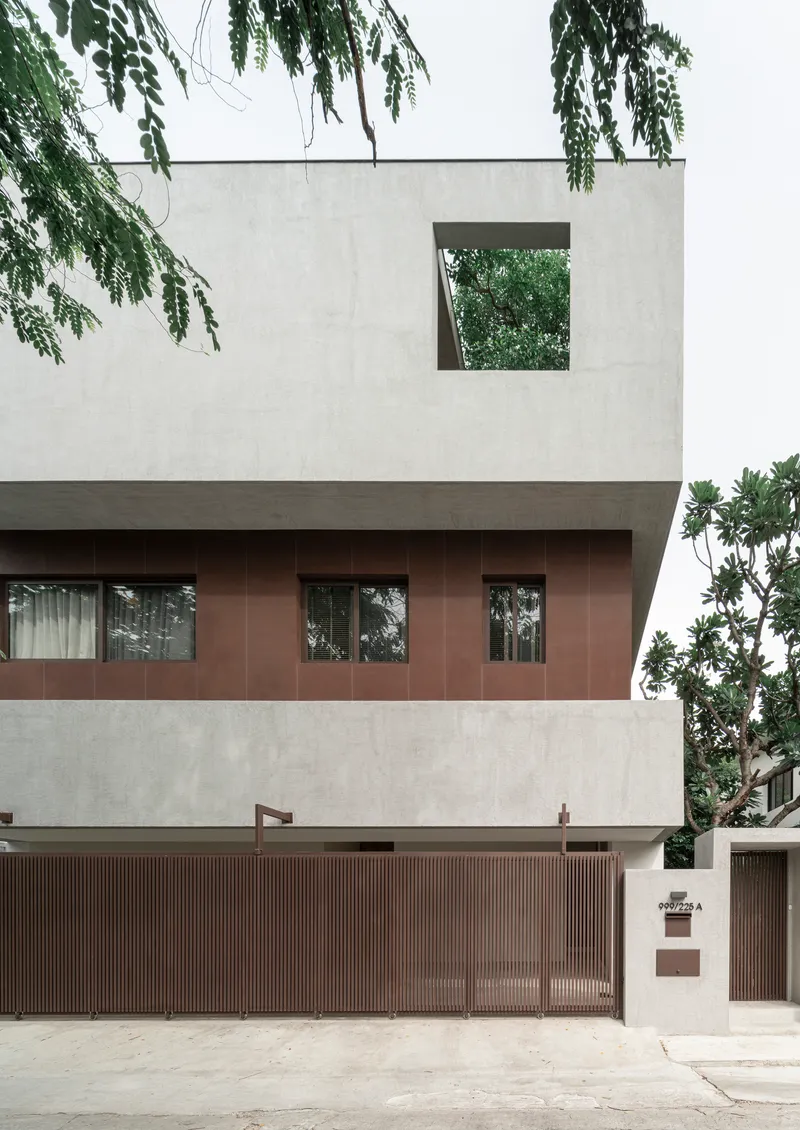
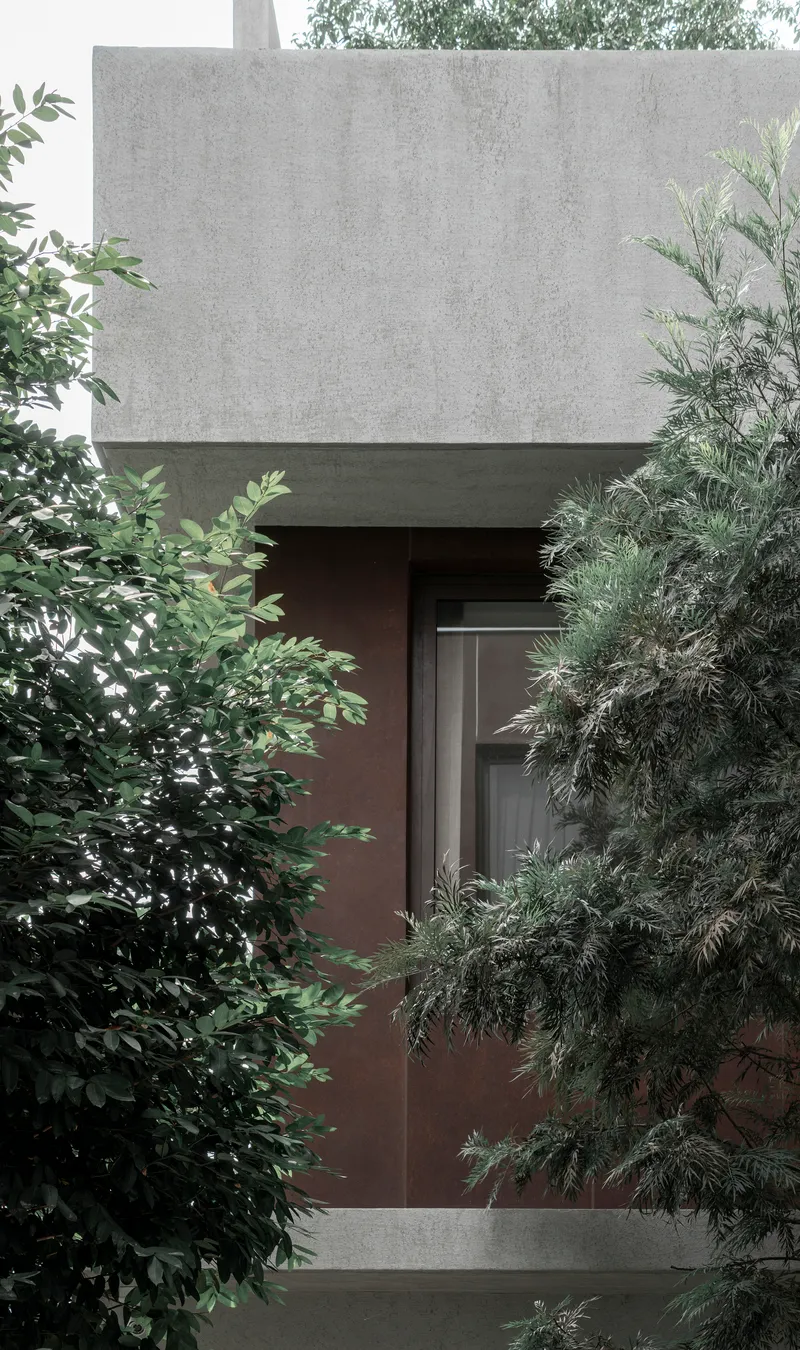
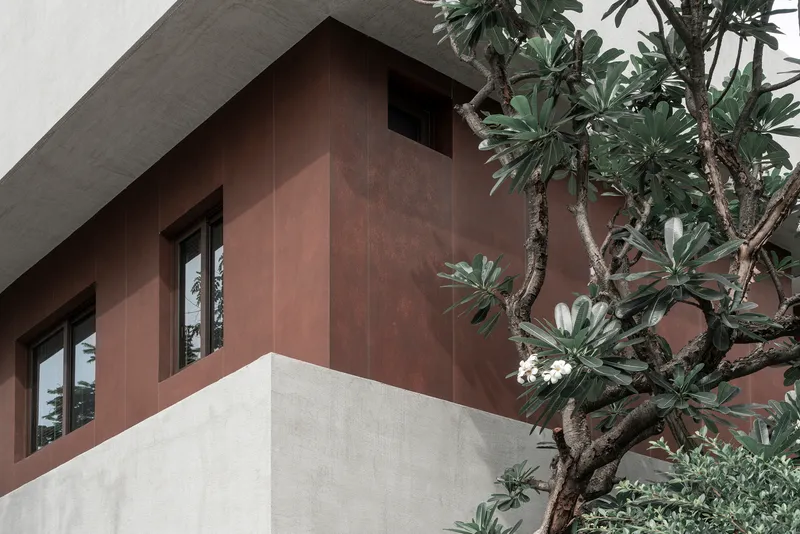
The street elevation is all geometric muscle. Stacked concrete and copper-clad volumes cantilever and recess, creating deep shadows and a sense of compressed scale that belies the three stories within. A recessed entrance, framed by mature trees and a single dark timber door, pulls you under an overhanging upper volume before revealing anything about the interior. It is a classic threshold move, controlling the sequence of discovery.
The copper panels are the facade's signature material. Where they meet the grey polished mortar, the joint is clean and deliberate, but the rust-colored finish itself is alive, already shifting tone. A flowering frangipani at the corner softens the geometry without domesticating it. The front of the house does not invite, exactly. It intrigues.
Courtyards as the Real Rooms
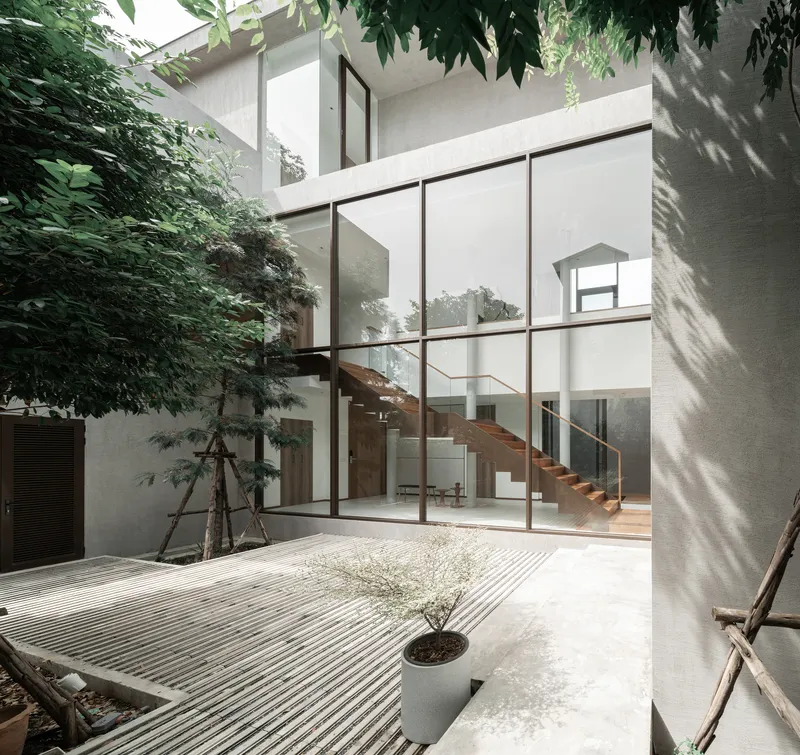
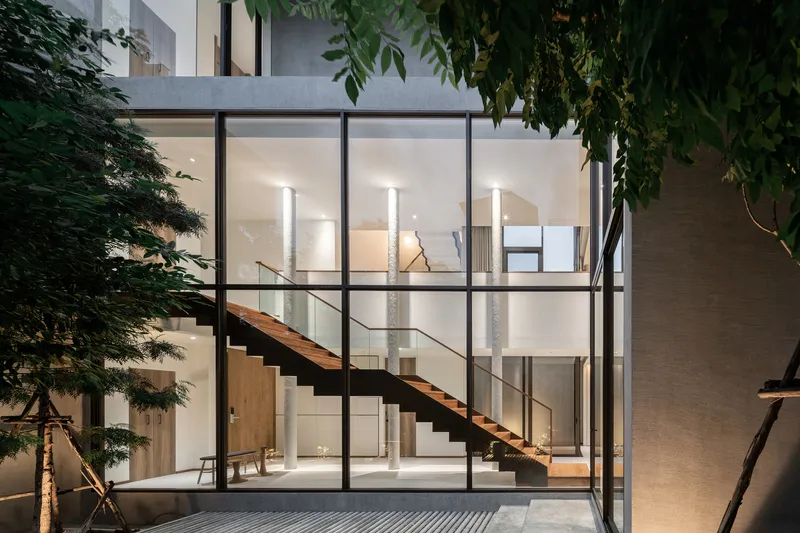
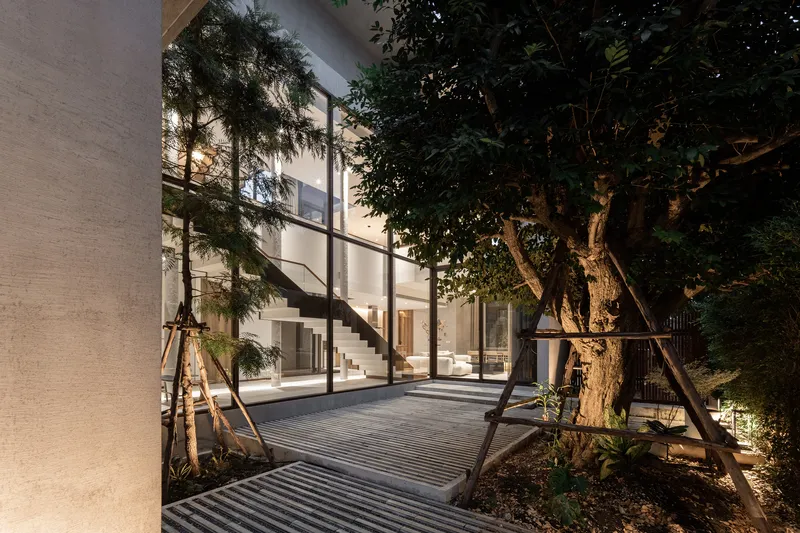
Step past the entrance and the plan pivots around a series of courtyard spaces that function less as decoration and more as the house's respiratory system. A central courtyard with ribbed concrete ground surface and planted trees draws light deep into the plan, while a glazed stairwell makes the vertical circulation feel like a lantern at night. The twilight views are striking: the gridded glass facade glows warmly, framing the staircase against surrounding trees.
A second courtyard with timber decking, a built-in bench, and a mature tree lit by pendant lights operates as an outdoor living room. These are not token green patches. They are the primary spatial strategy for a narrow urban plot, pulling ventilation from the west side where the neighbor's garden trees provide natural cooling, and pulling daylight from above through the double-height voids. The house breathes because these courts exist.
The Double-Height Living Core
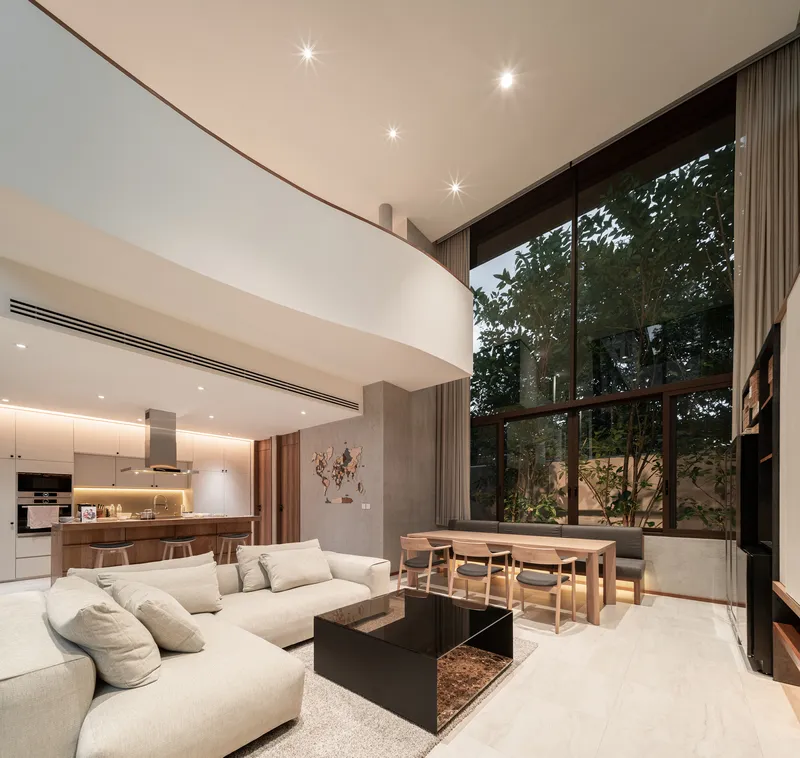
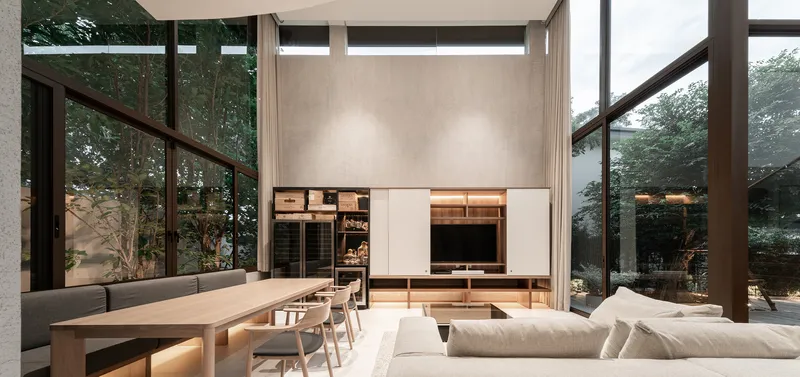
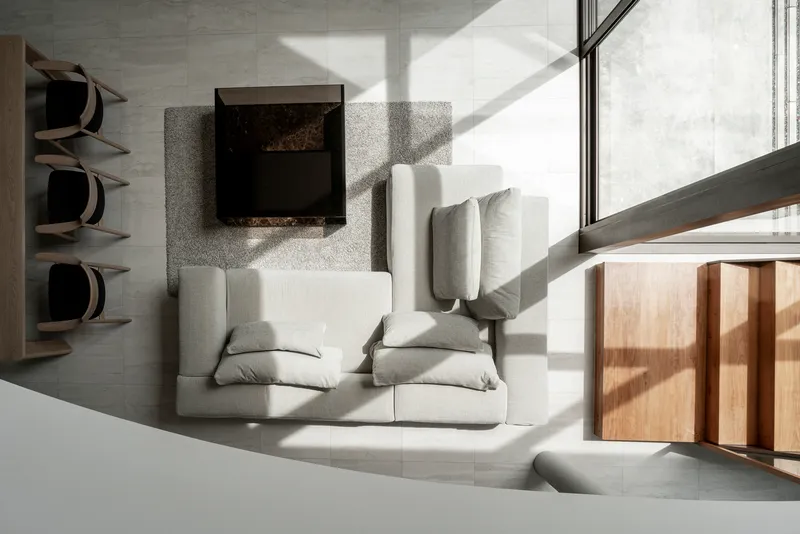
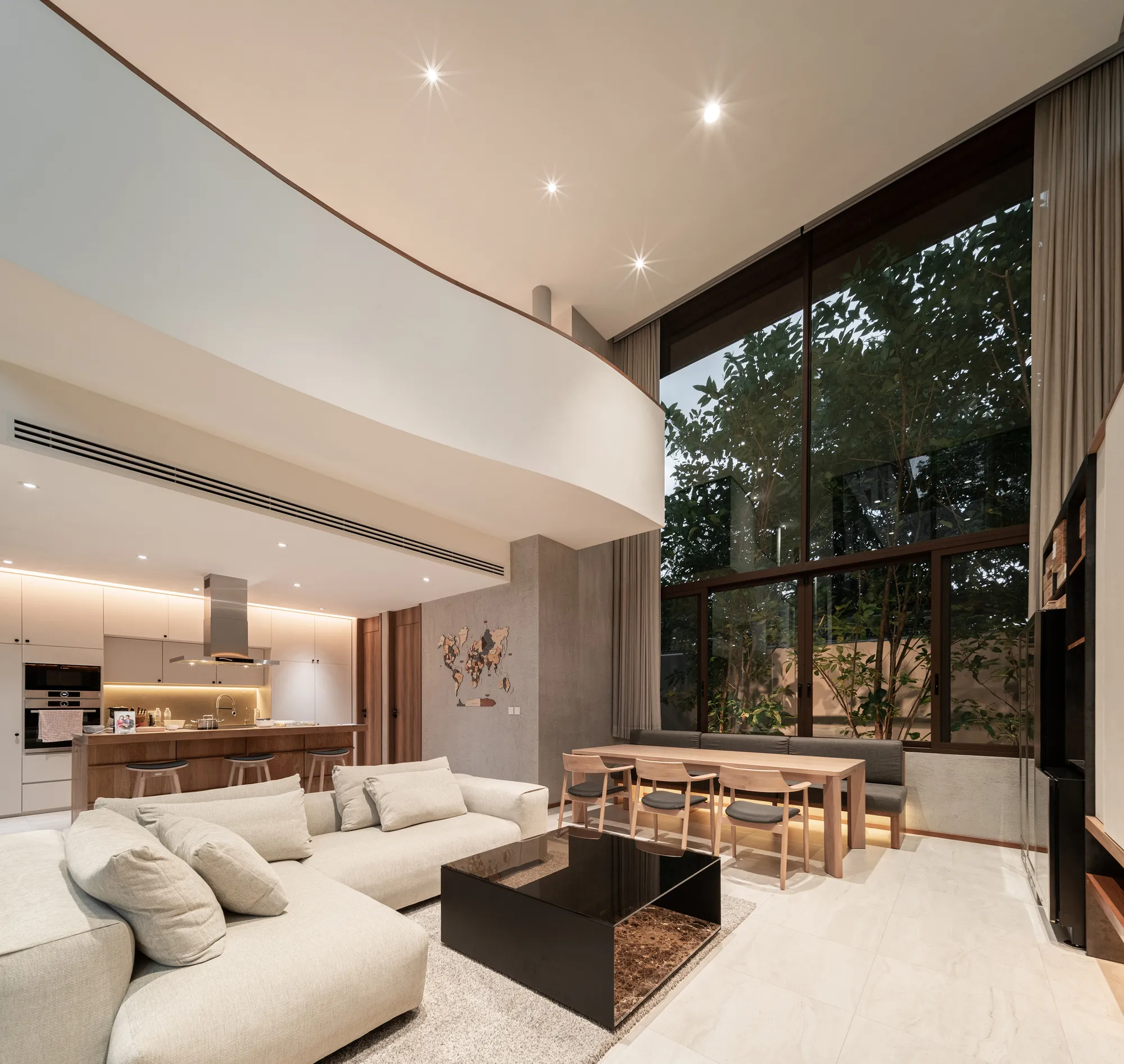
The main living and dining area sits at the back of the ground floor, elevated 1.2 meters above grade to capture views of the neighbor's large garden on the south side. This is clever site reading: rather than mourning the tight property boundary, Anonym borrows the green horizon next door and frames it through floor-to-ceiling glazing along the northern elevation. At approximately six meters, the ceiling height transforms what could be a compressed tropical interior into something generous and airy.
The dusk photographs reveal the full drama. The double-height space with its media wall, dining table, and full-height windows becomes a single luminous volume, the garden outside merging with the interior through the glass plane. Angular afternoon sunlight rakes across white upholstered seating, proving that the orientation strategy works: the house captures the quality light while buffering against western heat.
Vertical Circulation as Architecture
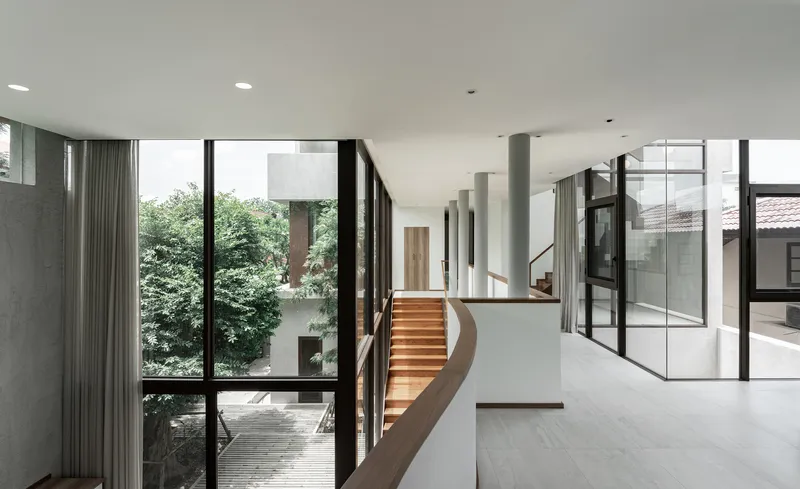
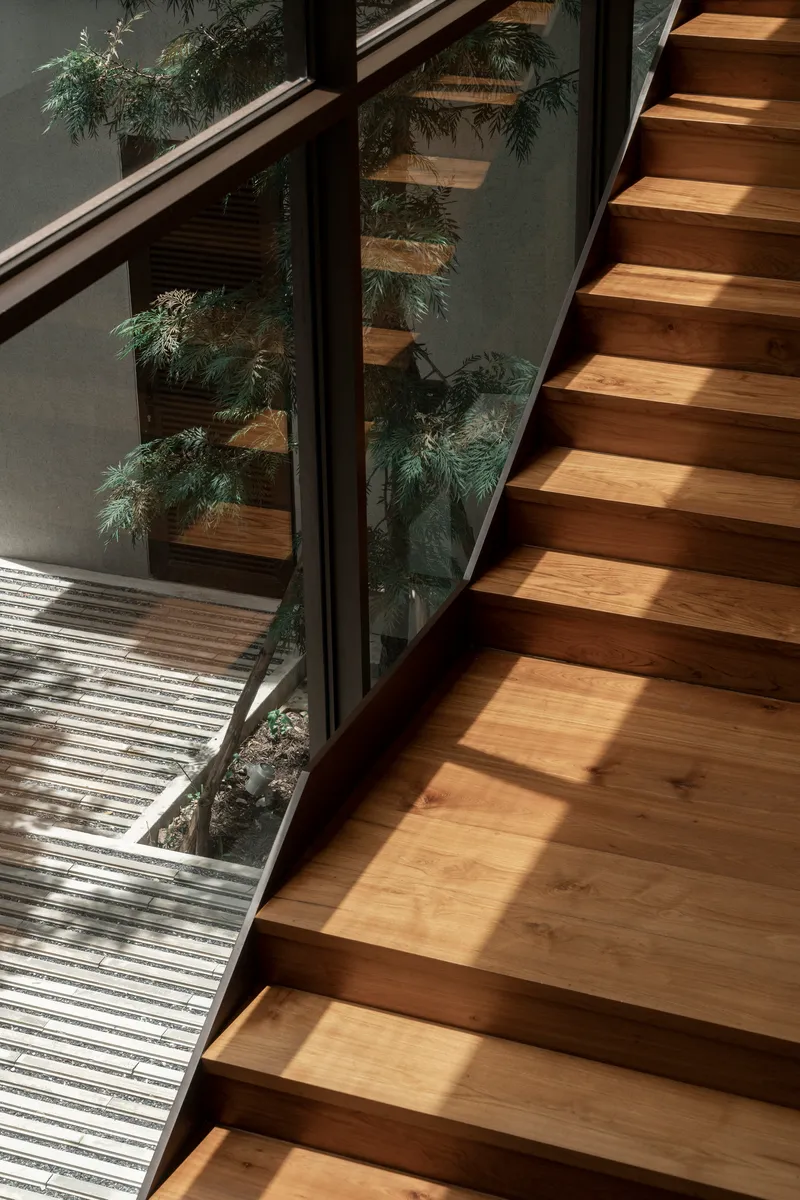
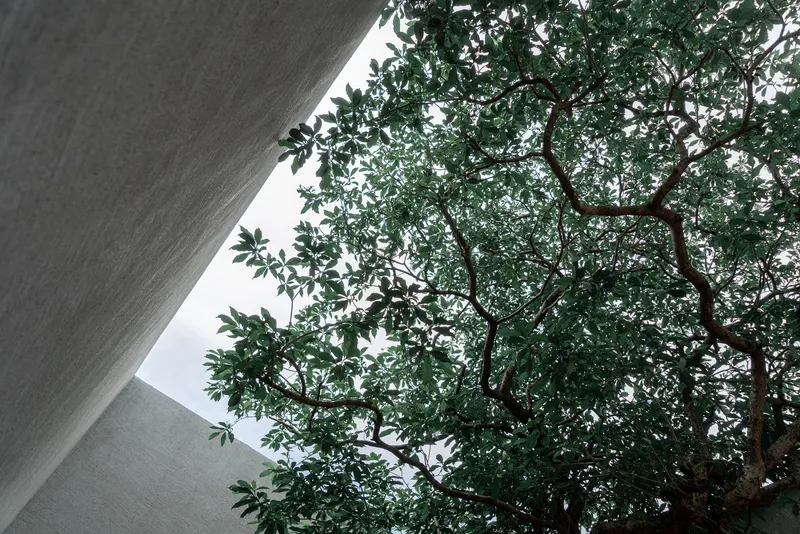
The timber staircase with its glass balustrade is not just a functional connector between the three floors. It is the architectural event that stitches the courtyards, the double-height living space, and the upper bedrooms into a coherent spatial narrative. From the upper landing, you look down through dappled light onto the courtyard garden. From below, you look up through a concrete void at the canopy of an interior tree. The staircase occupies the seam between inside and outside, always placing you in visual contact with greenery.
The curved mezzanine balcony on the second floor, which houses a common area, music room, and office, extends this vertical ambiguity. You are neither fully on one level nor another, hovering in a split condition that makes the house feel much larger than its footprint. Natural oak and warm white paneling line these transitional zones, softening the raw concrete vocabulary of the exterior.
Material Honesty Under Tropical Pressure
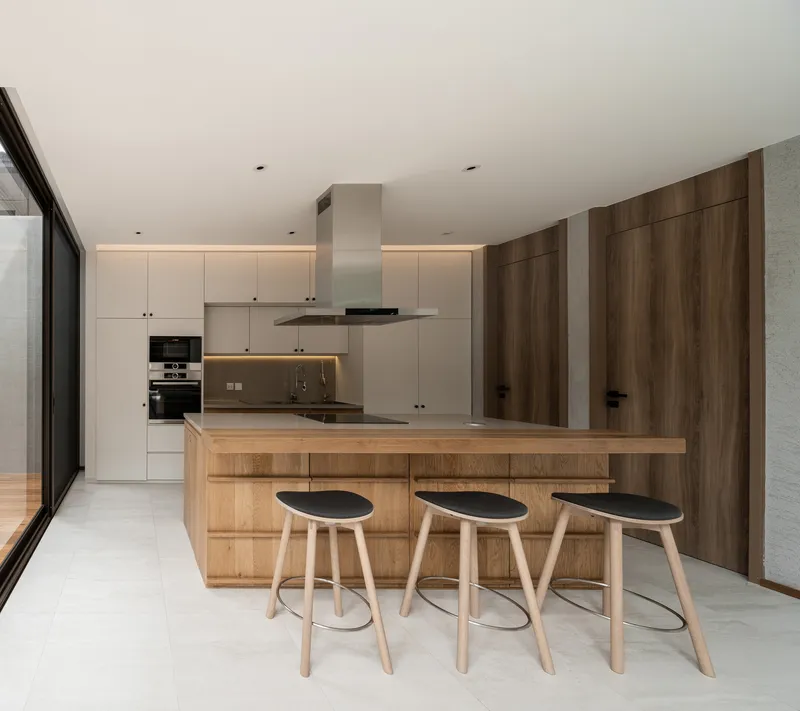
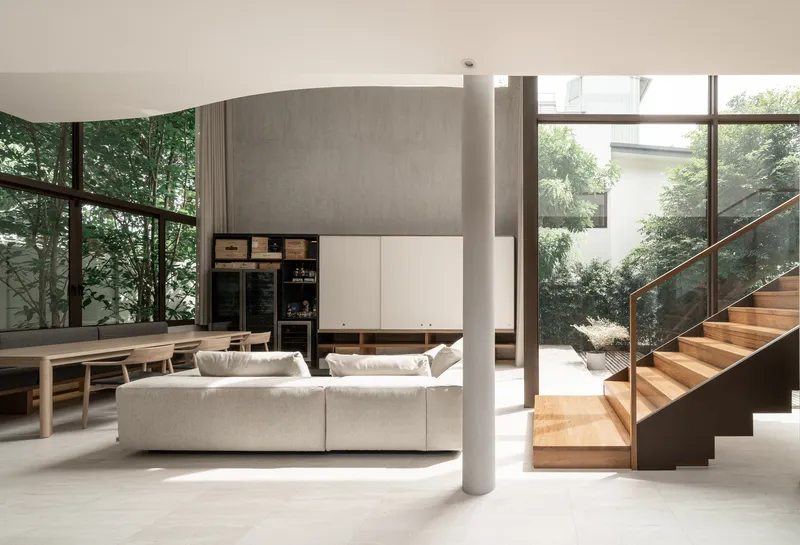
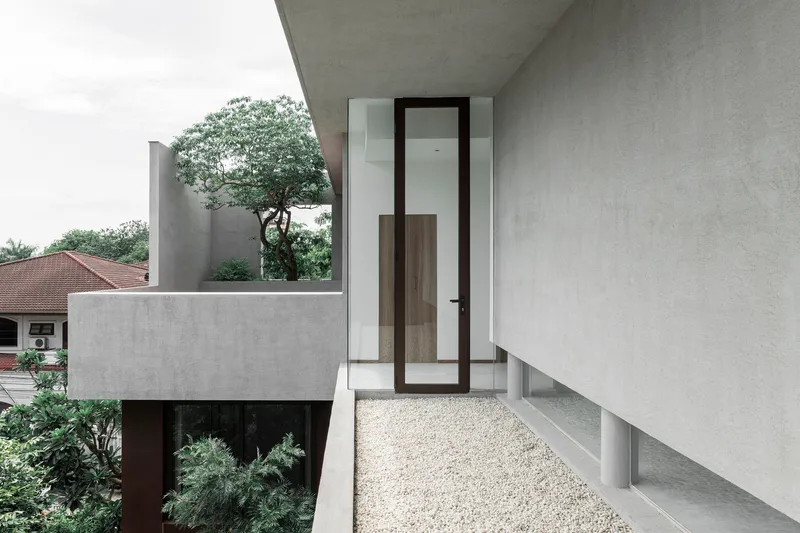
Inside, the palette shifts from the grey mortar and rust of the exterior to natural oak, white travertine tile, and warm white paneling. The kitchen, with its timber island and strip-lit cabinetry, is the clearest example of the interior restraint: everything is calm, precise, and deliberately unshowy. Three bar stools, clean counters, good light. The detailing is meticulous without calling attention to itself.
The upper terrace, with gravel flooring beneath an angled concrete overhang, demonstrates how the raw material strategy extends outdoors. This is a house where the materials are meant to dissolve the threshold between interior and exterior, and the consistent use of honest surfaces, concrete overhead, gravel underfoot, timber at hand, achieves that dissolution without tricks. Bangkok's heat and humidity will test these finishes relentlessly, and that is precisely the point.
Interior Atmosphere
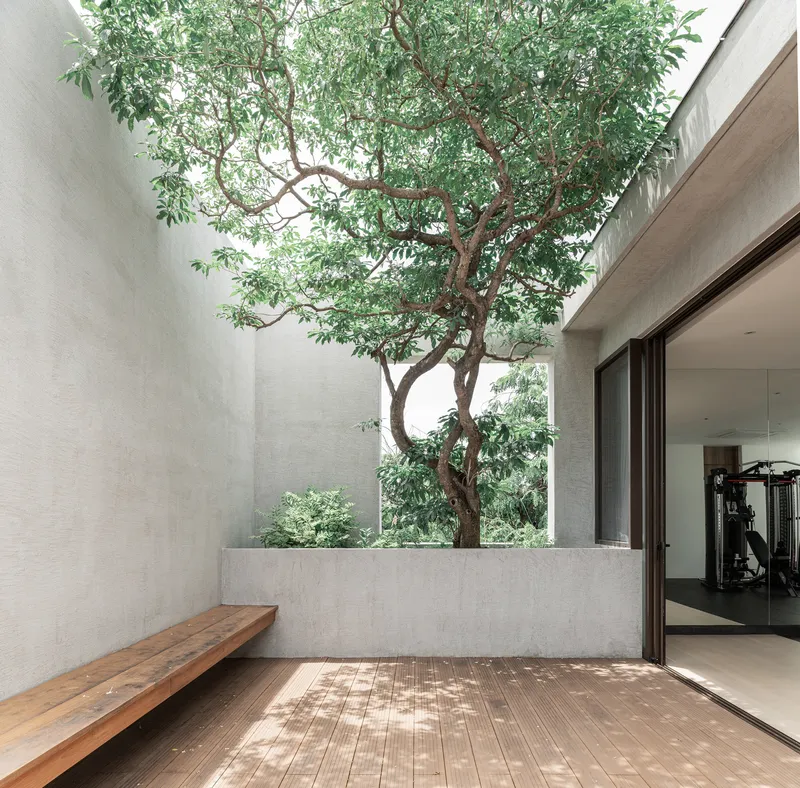
The courtyard bench beneath a tree, bathed in dappled sunlight, captures the emotional register the house aims for: sheltered but not sealed, composed but organic. The living area, with its cylindrical columns and floor-to-ceiling glazing, frames greenery on every axis. The program arrangement is straightforward: children's bedrooms at the front of the second floor, owners' bedrooms on the third at the back, a fitness center and small balcony at the third-floor front. Simple, functional, and organized so that the shared spaces always face the garden and the private rooms tuck against the quieter edges of the plot.
Plans and Drawings
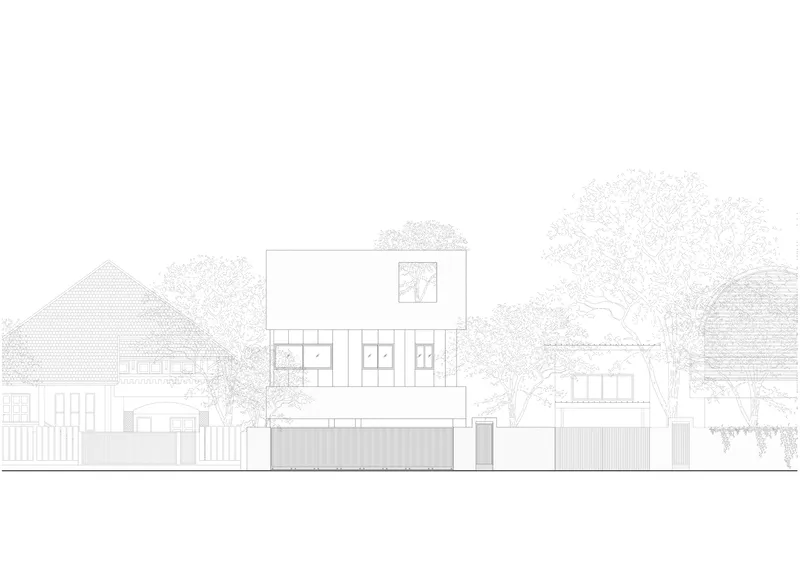
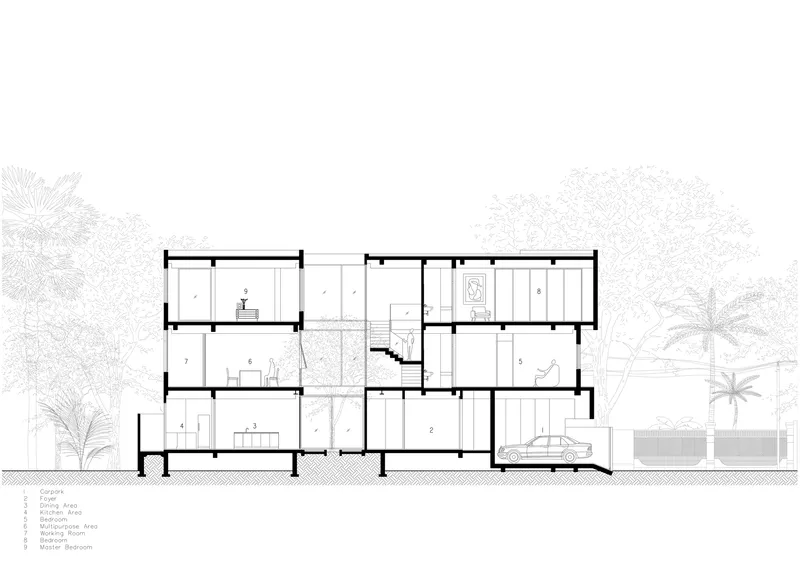
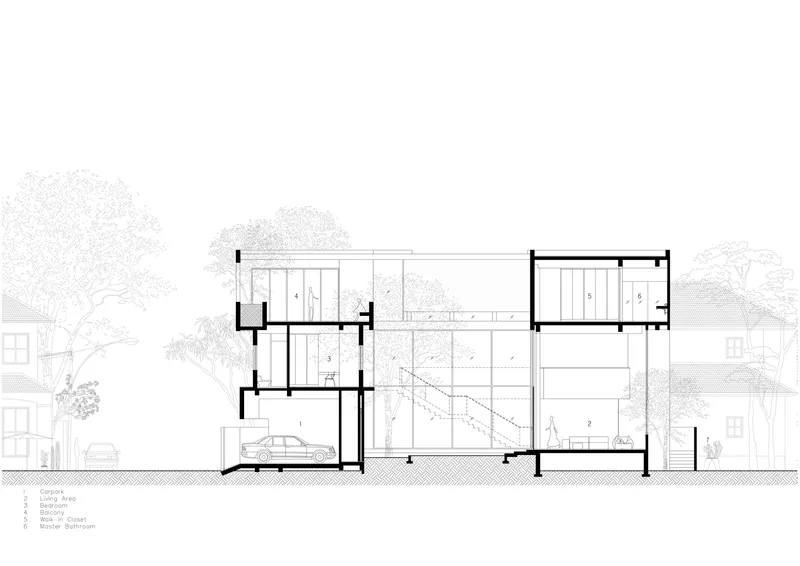
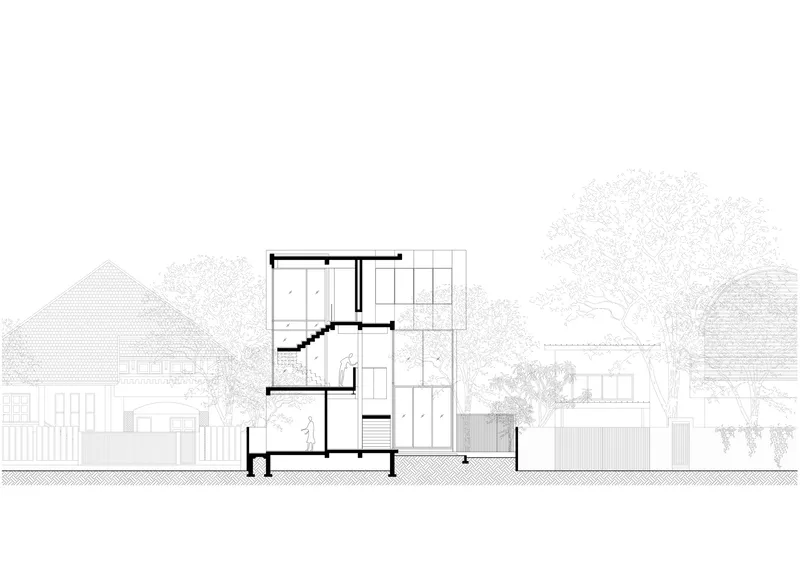
The street elevation drawing reveals how tightly FN House sits between adjacent residential buildings, its stacked volumes asserting presence without overwhelming the streetscape. The section drawings are where the real story unfolds. You can trace the central courtyard acting as a light well, the split-level interior organization, and the way the staircase knits together three distinct floor plates. The relationship to neighboring structures is also clear: the house leans toward borrowed landscapes while maintaining its own spatial autonomy through strategic setbacks and voids.
Reading the sections together, the 1.2-meter elevation of the main living spaces becomes legible as more than a flood precaution. It places the primary rooms at precisely the height needed to clear the neighbor's boundary fence and capture the garden view. That kind of dimensional specificity, calibrated to the immediate context rather than to abstract proportional rules, is what separates good residential architecture from merely competent house design.
Why This Project Matters
FN House matters because it takes a genuine position on how materials should age. In a market saturated with rendered-white villas that look tired after two monsoon seasons, Anonym has bet on rust, mortar, and travertine that will gain character under tropical weather. That is not a neutral aesthetic choice. It is a philosophical one about permanence, about designing for a decade rather than a photo shoot. The meticulous construction detailing ensures that the aging will be graceful, not chaotic.
Equally significant is the house's relationship to its dense urban context. Rather than retreating behind blank walls, it borrows light and landscape from adjacent properties, elevates its living spaces to steal a garden view, and uses courtyards to create microclimates that reduce mechanical cooling loads. These are not revolutionary strategies individually, but assembled together on a narrow Bangkok plot with this level of craft and spatial intelligence, they add up to a convincing argument for what thoughtful tropical urbanism can look like at the scale of a single home.
FN House by Anonym, Bangkok, Thailand. 650 m². Completed 2024. Photography by DOF SKYGROUND.
About the Studio
Share Your Own Work on uni.xyz
If projects like this are the kind of work you want to make, uni.xyz is a place to publish your own, find collaborators, and enter design competitions.




Popular Articles
Popular articles from the community


Play: Fragments of Their World
Familiar architecture becomes modular playground design, creating safe spaces where displaced children can learn, connect, imagine and play.

The Ocean Hive: Sustainable Architecture for a Self-Sufficient Civilization at Sea
The Ocean Hive imagines sustainable architecture at sea, where modular habitats, algae, wave power and ocean waste sustain a growing colony.

Lunar Spiral: Space Architecture Shaped by the Mathematics of the Universe
Lunar Spiral reimagines space architecture through Fibonacci geometry, lunar regolith, levitating habitats, and self-sustaining Moon living.

Riyadh For All: Intergenerational Urban Design for Active Aging in Rabat
Riyadh For All reimagines urban design in Rabat with intergenerational co-living, adaptive courtyards, and Moroccan cultural exchange today.


Similar Reads
You might also enjoy these articles

Bao Huynh Watercolor Atelier: A Serene Art Retreat in Hội An
Bao Huynh Watercolor Atelier in Hội An blends multifunctional art spaces, sustainable design, local materials, and family-friendly living in a serene environment.

Atelier Macri Concept Store Interior Design by CASE-REAL
Atelier Macri store features a "ko" counter, walnut wood details, cork displays, blending retail, gallery, and seamless customer experiences.

Manuel Vargas Izquierdo Stadium and High-Performance Sports Center: Architectural Excellence in Jalpa de Méndez
The Manuel Vargas Izquierdo Stadium blends sustainable design, inclusive sports facilities, and cultural-inspired architecture, revitalizing Jalpa de Méndez’s public spaces.

KAKR Buluh Awar Hall: Revitalizing Community and Ecology Through Bamboo Architecture
Community built bamboo hall revitalizes Buluh Awar village, empowering youth, restoring ecology, celebrating vernacular craftsmanship through sustainable architecture and culture.

Explore Residential Building Competitions
Discover active competitions in this discipline



Challenge to design a portable theatre


Challenge to design a portable music platform


Challenge to design an open learning module for the elderly


Challenge to design mud housing for contemporary communities
Comments (0)
Please login or sign up to add comments
No comments yet. Be the first to comment!