

(ab)NORMAL Turns an 80-Metre Polycarbonate Wall into a Fashion Stage at Manifattura Tabacchi
A translucent scenography for Polimoda's 2023 graduation show transforms a Pier Luigi Nervi factory in Florence into a theater of silhouettes.


Fashion runways tend to treat architecture as a mute backdrop, a container scrubbed of character so the clothes can speak. (ab)NORMAL took the opposite approach for Polimoda's 2023 graduation show in Florence. Their scenography, titled Anthos, placed a single translucent polycarbonate wall spanning over 80 metres through the belly of the B4 building at Manifattura Tabacchi, the rationalist former tobacco factory designed by Pier Luigi Nervi in the 1930s. Instead of hiding the backstage, the wall turned it into content: choreographed lighting projected the silhouettes of models, dressers, and stagehands onto the translucent surface, giving the audience a second show playing out in shadow behind the first.
What makes the project worth examining beyond its single night of use on June 15th, during the 104th Pitti Uomo, is its disciplined material logic. Every element, from the modular polycarbonate panels to the perimeter curtain that blacked out daylight, was selected with disassembly in mind. After the event, components were returned to suppliers for reprocessing. The installation existed for hours, but its lifecycle planning extended far beyond that window. In an industry addicted to spectacle and waste, Anthos is a case study in how temporary architecture can be rigorous without being austere.
A Wall That Performs
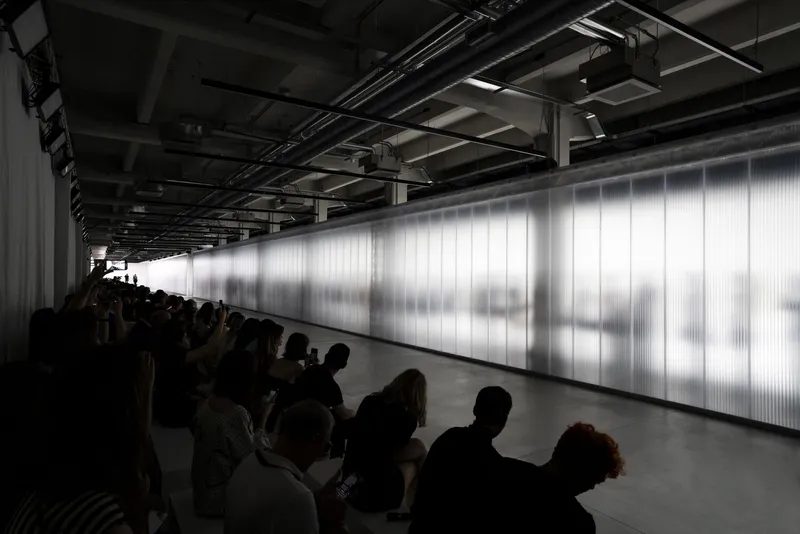
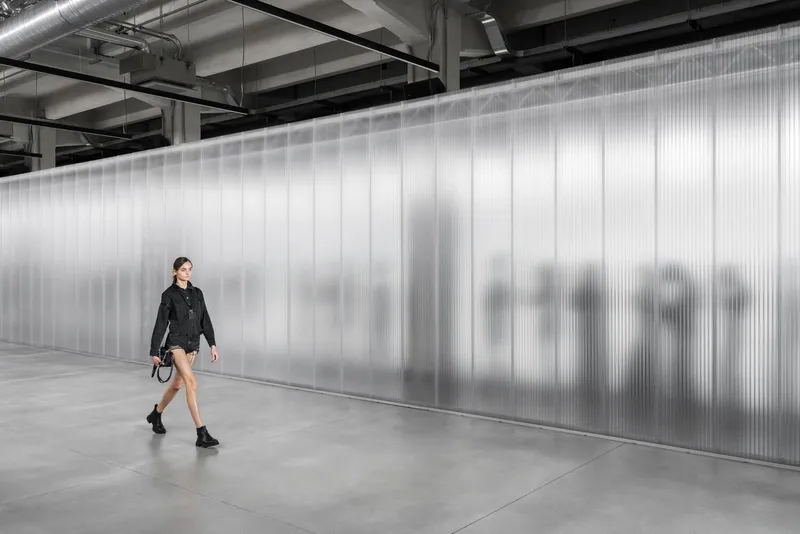
The central gesture of Anthos is the polycarbonate wall. It does three things at once: it divides the venue into audience and backstage halves, it filters and diffuses theatrical lighting, and it becomes a projection surface for the human activity behind it. When the lights shift, the wall oscillates between opacity and transparency, giving the audience glimpses of the backstage choreography that fashion shows normally conceal. The effect is somewhere between a shadow puppet theater and a Mies curtain wall, with bodies replacing mullions as the primary visual rhythm.
The decision to expose backstage activity is a deliberate inversion. Graduation shows celebrate process as much as product; the students behind these 25 collections and 100-plus looks are still learning in public. Letting the audience see the frenzy of last-minute adjustments, of dressers pinning hems and models pacing, honors that reality instead of papering over it.
Seating as Infrastructure
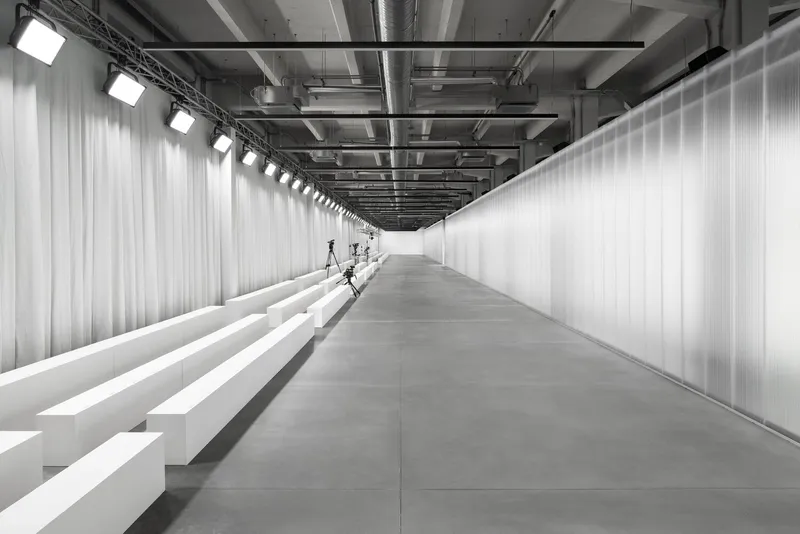
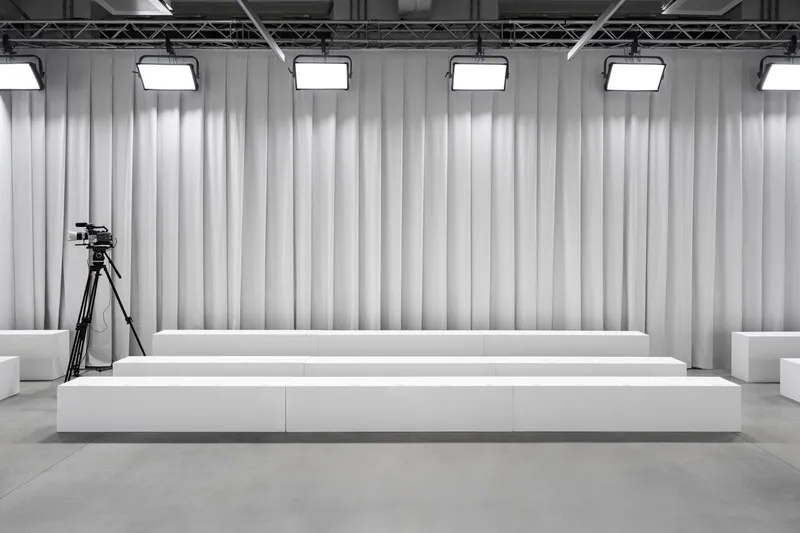
The tiered white seating runs the full length of the translucent wall, creating a single linear audience that reads more like a stadium sideline than a conventional front-row-and-back-row hierarchy. The stepped platforms hug the polycarbonate surface tightly, compressing the gap between spectator and screen so that every seat becomes, in effect, a front row to the silhouette show behind the wall.
Above, the exposed steel trusses and track lighting of the B4 building are left fully visible. The Nervi structure's industrial skeleton is not dressed up or diffused; it simply becomes the ceiling of the show. The only architectural additions are the curtain, the wall, and the seating. Everything else is Nervi, unretouched. That restraint keeps the installation legible as an insertion rather than a renovation, a temporary guest inside a permanent host.
Light as Material
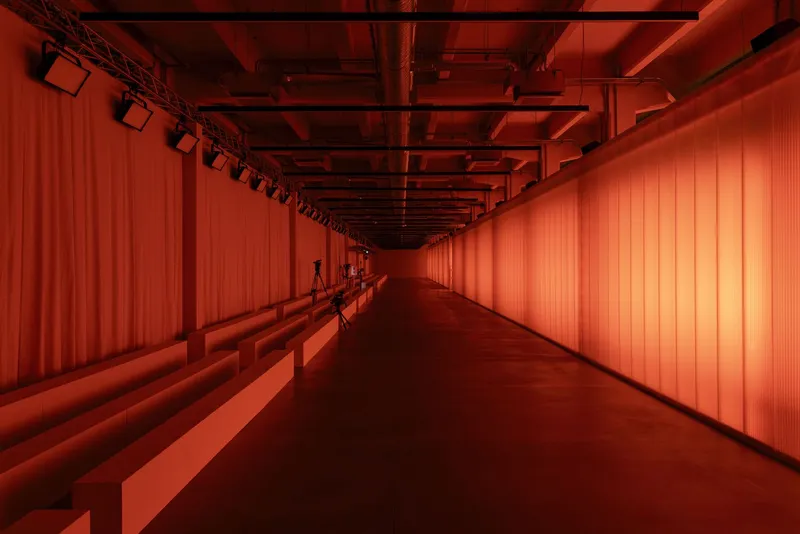
A scenographic white curtain wraps the perimeter of the space, sealing it off from the Florentine daylight that would otherwise flood through the factory's generous glazing. The result is total darkness at rest, a void that the lighting design then fills selectively. In one phase, warm red light washes the corridor, turning the polycarbonate panels into glowing amber screens. In another, sharp white backlighting isolates individual silhouettes with surgical clarity.
The lighting is doing the heavy architectural lifting here. Without it, the polycarbonate wall is a bland partition. With it, the wall becomes cinematic. That dependency on light is both the project's greatest strength and its most honest admission: this is scenography, not building. It exists in time, not just in space. The photographs capture static moments, but the installation was designed to unfold as a sequence, synchronized to the procession of student collections on the runway.
Circular by Design
Temporary installations in the fashion world are notorious for their wastefulness. Sets built for a single evening, photographed for social media, then sent to landfill. (ab)NORMAL structured every material decision around disassembly and reprocessing. The modular polycarbonate panels were returned to the manufacturer after the show for transformation into new products. The white curtain, the seating platforms, the lighting rigs: each element was designed to be unbolted, not demolished.
This is not greenwashing layered onto a conventional production. The circularity is embedded in the design logic from the start. A monolithic plaster wall would have been cheaper and more visually opaque, but it would have been rubble the next morning. The polycarbonate panels are more expensive per unit, but their material value survives the event. For a show celebrating emerging designers, many of whom are entering an industry under intense scrutiny for its environmental impact, that alignment between message and method matters.
Nervi's Factory, Reprogrammed
Manifattura Tabacchi is a 110,000 square metre complex northwest of Florence's historic center, originally built for cigar and cigarette production. Nervi's rationalist design, with its muscular concrete frames and clear-span industrial bays, has been the subject of an ambitious urban regeneration program since the factory closed in 2001. The B4 wing, newly inaugurated at the time of the Polimoda show, represents the latest phase of that transformation.
There is something fitting about a fashion school occupying a tobacco factory. Both industries are built on craft, repetition, and the transformation of raw material into consumer desire. Nervi's structural clarity, those exposed trusses and generous column-free spans, gives (ab)NORMAL the spatial freedom to insert an 80-metre wall without fighting the building. The architecture accommodates the scenography rather than competing with it, which is the highest compliment you can pay a host structure.
Why This Project Matters
Anthos demonstrates that temporary architecture does not have to be disposable architecture. The project's material discipline, its commitment to closed-loop processing for every component, sets a benchmark that the fashion events industry has been slow to adopt. It is one thing to talk about sustainability in a press release; it is another to design every connection for disassembly and every panel for reprocessing. (ab)NORMAL did the latter.
More broadly, the project reframes what a fashion runway can be. By turning the backstage into a visible performance layer, Anthos collapses the artificial boundary between creation and presentation. The audience does not just see finished looks walking a strip of floor; they see the labor, the nerves, the human machinery behind the spectacle. For a graduation show, where the point is to celebrate the work of becoming a designer, that transparency is not just clever staging. It is the right story to tell.
Anthos Scenography, Polimoda Graduation Show 2023, designed by (ab)NORMAL. Located at the B4 building, Manifattura Tabacchi, Florence, Italy. Completed 2023.
About the Studio
Share Your Own Work on uni.xyz
If projects like this are the kind of work you want to make, uni.xyz is a place to publish your own, find collaborators, and enter design competitions.


Popular Articles
Popular articles from the community


Jaramillo Van Sluys Arquitectura and Urbanismo Turn a Demolished Registry Lot in Quito into an Orchard Plaza
In Quito's Centro Histórico, a 2,800 m² plaza exposes the San Agustín convent wall and redraws its lost Augustinian orchard in volcanic stone.

Architekt Andreas Gruber Scatters 23 Dark Timber Chalets Across a South Tyrolean Forest Edge
In Molini di Tures, Amonti Chalets breaks a resort into a hamlet of gabled timber houses, with parking, storage and services pushed into the slope.

GROUP A Strips a 1969 Rotterdam Harbor Headquarters to Its Frame and Wraps It in Timber Louvers
In Rotterdam's M4H harbor district, Ferro Offices reuses a 1969 frame, adds one timber storey and reaches BREEAM-NL Outstanding.

David Macias Steps a Doorless Stone and Plaster House Down a Tropical Colombian Hillside
In the humid hills of Colombia, Threshold House replaces the front door with an open void and terraces its 850 m² down the slope instead of fighting it.

Similar Reads
You might also enjoy these articles


Hodi-Mandai Geram
Project Function: Preservation and revitalization of the Intangible heritage and socio-spatial identity of the Hodi by Housing, Cultural Memory Center, Sacred Grove, landscape, local tourism economy


Olio Towers: A Mid-Rise for Performers That Fuses Housing, Rehearsal, and Stage
Located blocks from Houston's Theater District, this modular tower stacks living units around a central performance atrium.

Oasis: Modular Green Housing Carved into Dhaka's Urban Fabric
A shortlisted Plugin Housing entry reclaims unauthorized settlements in Dhaka with stepped concrete volumes, green roofs, and ventilation-driven design.

Black Hole: A Floating Megastructure for the Post-Physical Era
Emiliano Mazzarotto envisions a spherical, self-scaling arena where e-sports, digital hotels, and holographic stadiums replace traditional public space.

Explore Scenography Competitions
Discover active competitions in this discipline

Challenge to design a portable theatre

Challenge to design a portable music platform

Challenge to design an open learning module for the elderly

Challenge to reimagine the Iron Throne
Comments (0)
Please login or sign up to add comments
No comments yet. Be the first to comment!