
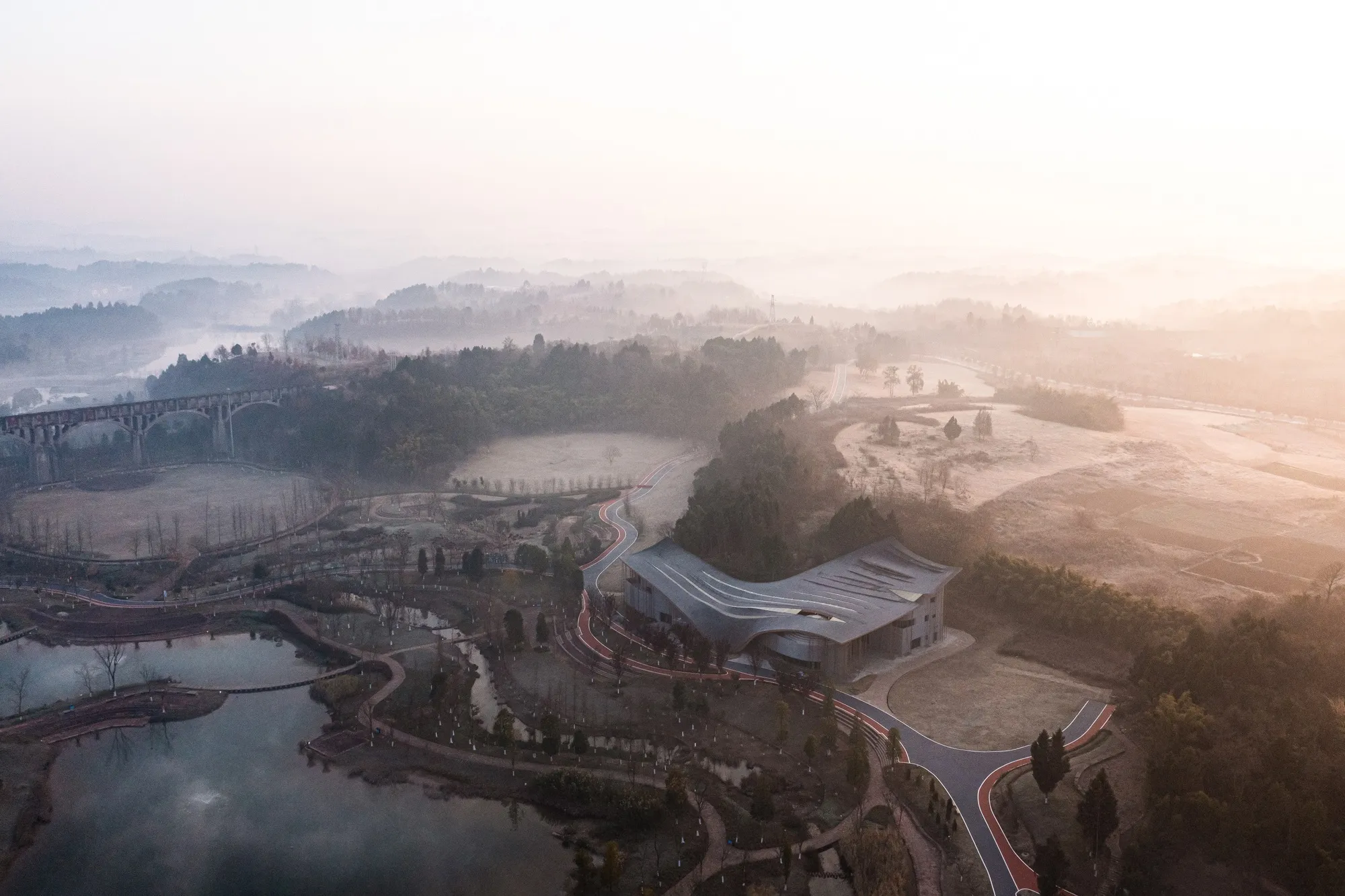
AOMOMO Studio Sculpts a Ribbon of Roof into a Canal Heritage Memorial in Sichuan
A 2,800 square meter memorial hall in Deyang, China channels the story of the Renmin Canal through undulating forms and layered landscapes.


Canals rarely get monuments. They are infrastructural facts, carved into the earth and taken for granted once the water flows. The Renmin Canal in Sichuan Province is different: its history stretches back to Han Dynasty irrigation works, and it remains a lifeline for the region's agriculture and identity. That a memorial hall was even commissioned says something about how seriously Deyang takes this lineage. That AOMOMO Studio and Shanghai Jiao Tong University responded with a building that literally behaves like water, rising and falling across the landscape in a continuous ribbon of roof, says something about ambition.
Sited on the former Chengde Industrial Park in Zhongjiang County, the 2,800 square meter memorial hall is part of the broader Kaizhou New City development on the eastern foothills of Longquan Mountain. The architects faced a double challenge: honoring a canal whose story spans two millennia while reclaiming a utilitarian industrial site for civic and cultural purpose. Their answer is a building that dissolves the boundary between architecture and landscape, threading exhibition spaces, archival facilities, public terraces, and planted gardens beneath a single, continuously undulating roof. The result is not a box with a lobby but a procession, a spatial narrative that mimics the canal's own path from mountain source to irrigated plain.
A Roof That Flows
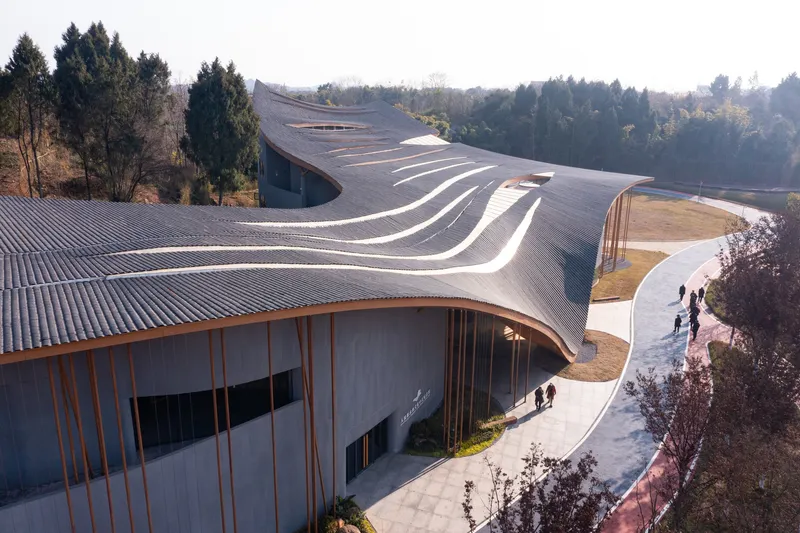
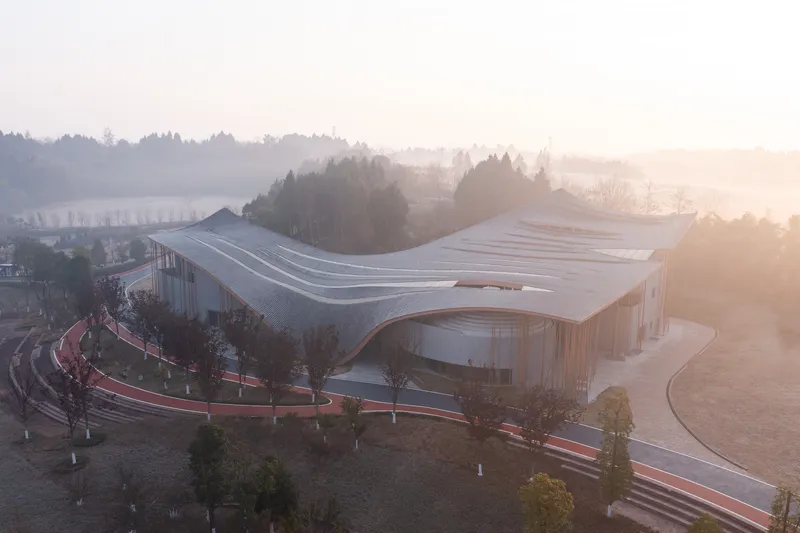
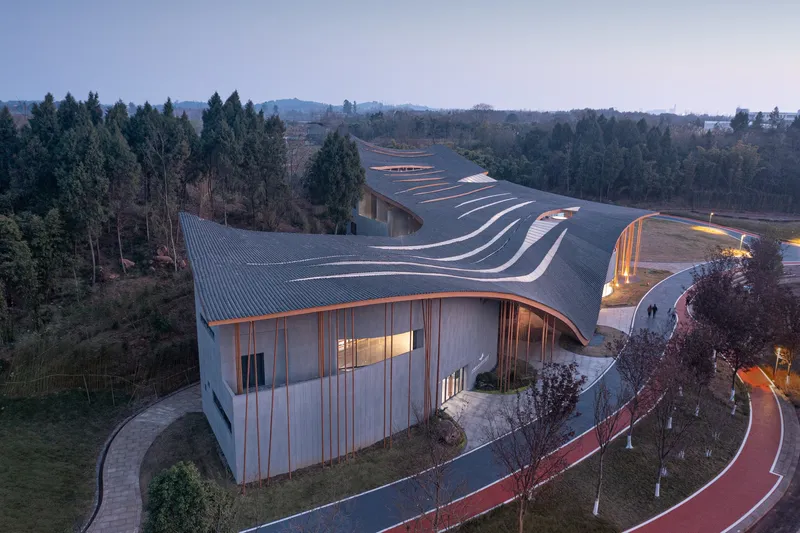
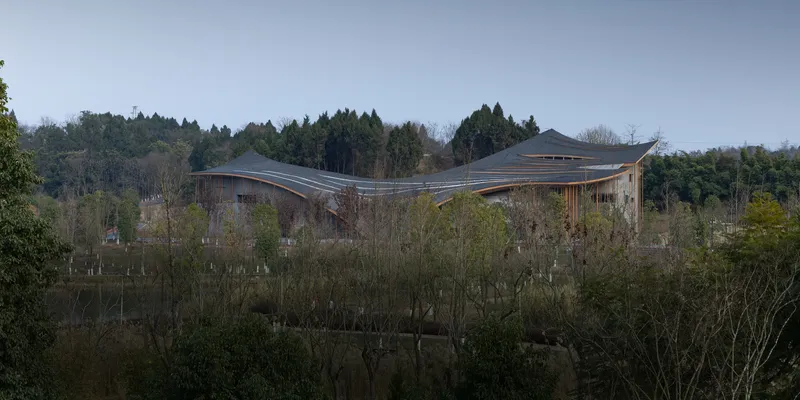
The building's dominant gesture is its roof: a corrugated metal and timber shell that rises, dips, and crests like a slow wave frozen mid-motion. From the air, the form reads as a ribbon laid across the terrain, connecting three organic-shaped volumes with sinuous pathways and garden courts. There is no single ridgeline, no conventional peak. Instead, the roof swells and recedes, registering changes in program beneath it. Where the exhibition halls demand height, the roof climbs; where covered walkways link pavilions, it drops to a human scale.
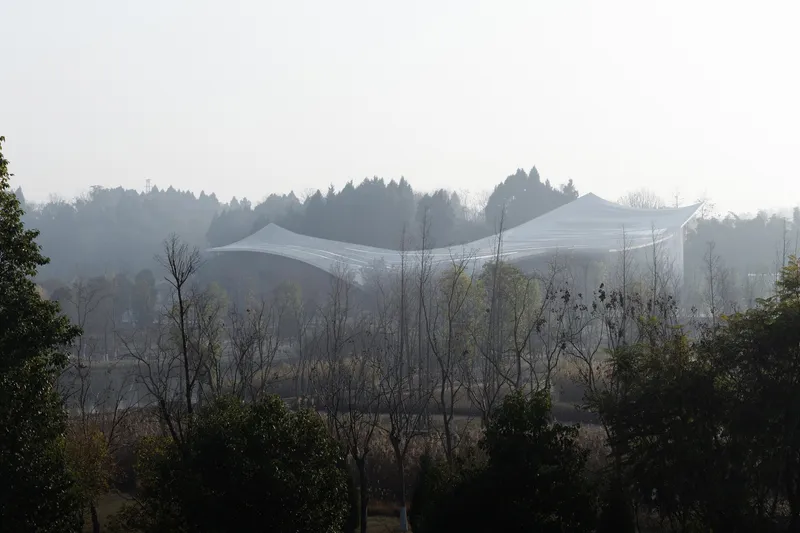
Seen from a distance in morning mist, the building almost disappears into the hills. The wavelike profile echoes the rolling topography of the Longquan foothills, and the ribbed metal cladding catches light in shifting bands of silver and grey. The architects clearly understood that a memorial to water infrastructure should not shout. It should settle into its site with the quiet authority of a well-graded canal.
Brick, Bronze, and Timber at the Threshold
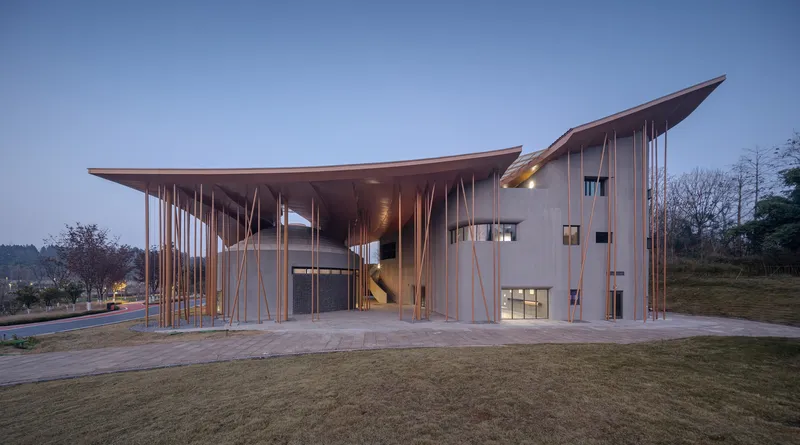
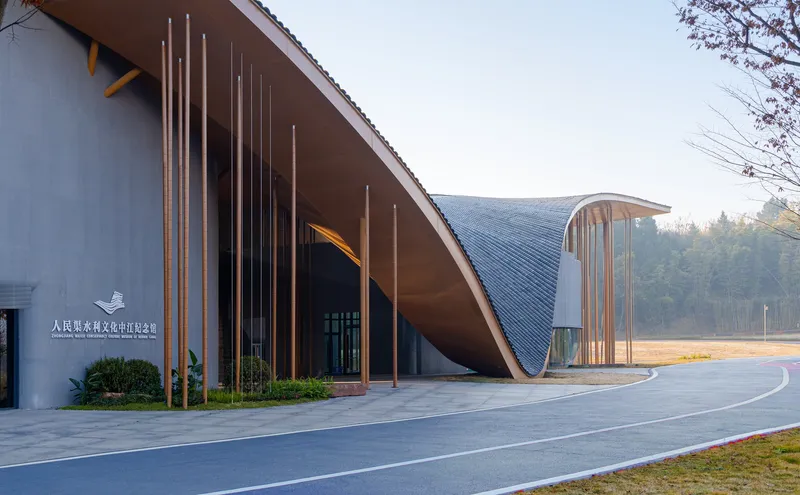
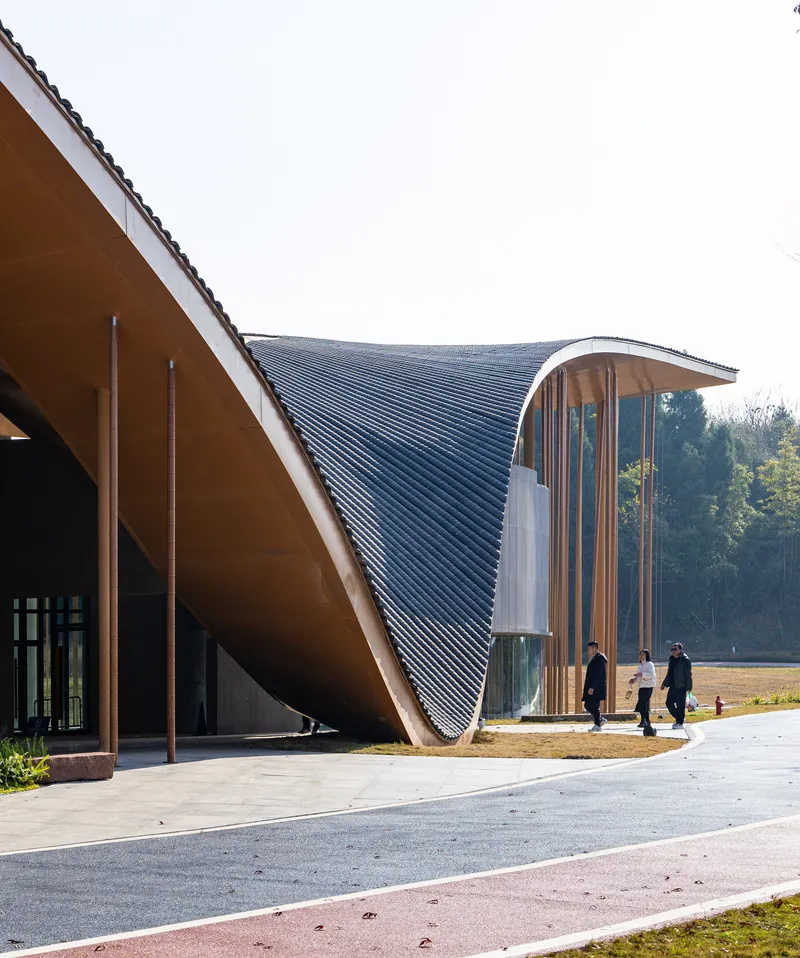
At ground level, the building trades its aerial fluidity for tactile warmth. The entrance facades deploy a palette of vertical timber fins, bronze tubes, and red brick that feels deeply rooted in the material culture of Sichuan. The entry canopy at the forecourt is a striking composition: slender vertical bronze elements hang from the swooping roof soffit, creating a permeable screen that filters light and frames views without enclosing them. It is simultaneously monumental and transparent.
The timber screen facade, illuminated at twilight, glows like a lantern. By day, the louvers modulate harsh sunlight; by night, they broadcast interior life outward. The curved metal roof meets glazed cylindrical volumes wrapped in vertical bronze fins, producing a layered reading of structure, enclosure, and ornament that rewards close attention. There is nothing gratuitous here. Every material earns its place.
Courtyards and Colonnades
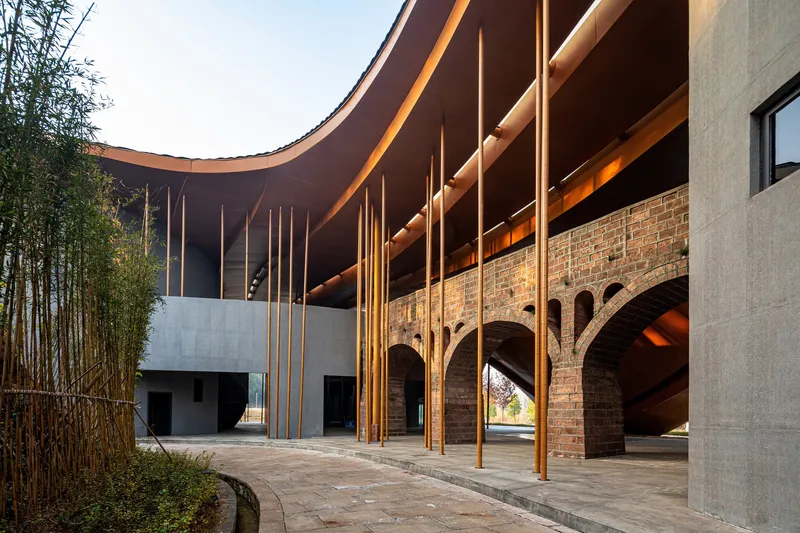
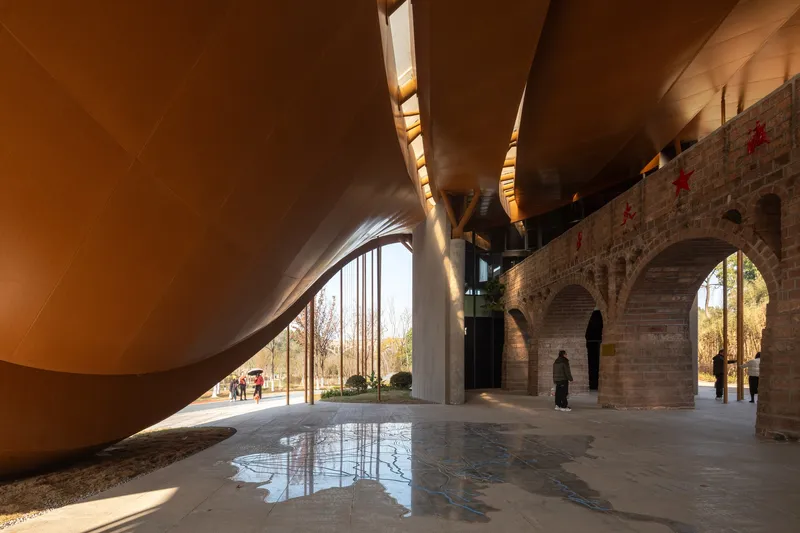
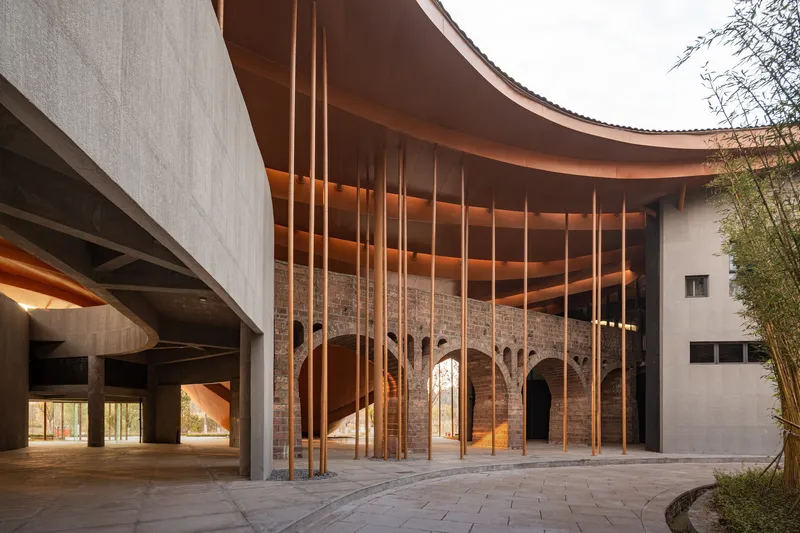
The plan dissolves the typical museum diagram of sealed galleries and instead strings together a sequence of covered courtyards, colonnades, and open-air passages. Brick arches, some deep enough to recall a viaduct, frame transitions between volumes. Vertical timber columns march beneath the curving roof, establishing a rhythm that visitors can feel in their stride. The courtyards breathe. They bring sky, breeze, and planted ground into what could have been an introverted institution.
The most evocative moment may be the covered courtyard where a curving timber ceiling meets an arched brick arcade. The juxtaposition is deliberate: the fluid contemporary roof and the time-tested masonry arch coexist without hierarchy. One reads as water, the other as earth. Together, they condense the project's central theme into a single spatial experience.
Interior Procession
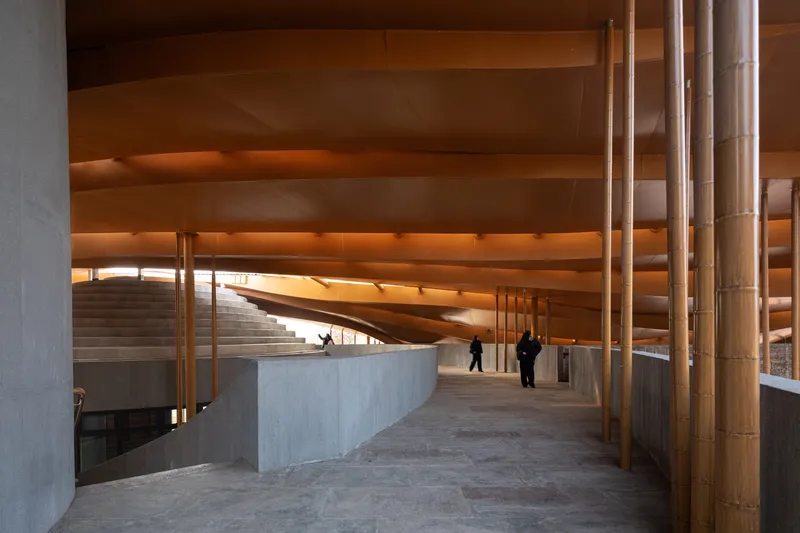
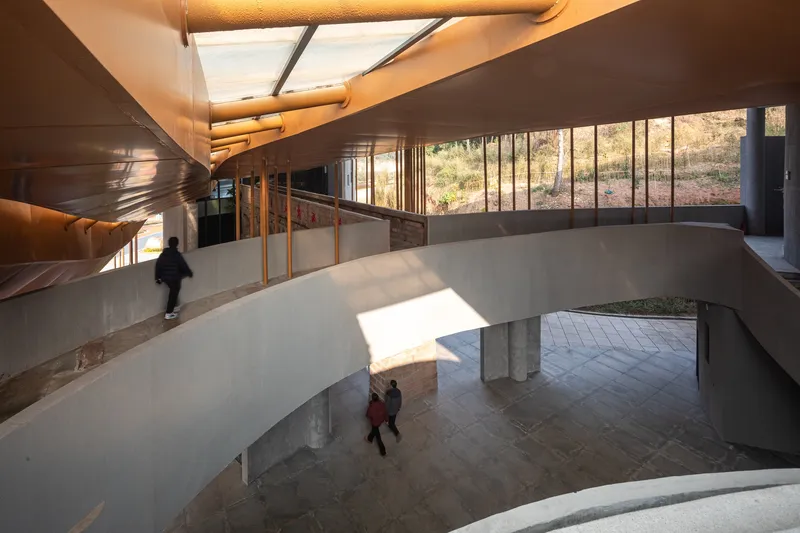
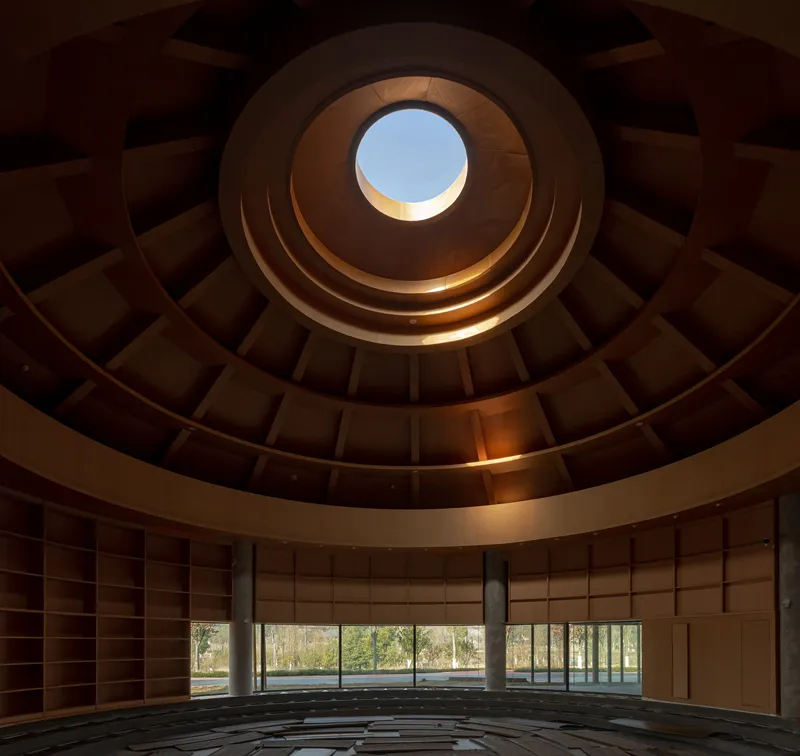
Inside, the narrative-driven spatial sequence becomes explicit. Bamboo columns and illuminated timber ceiling planes frame concrete stairs that draw visitors upward through the building's story, from the canal's ancient origins to its modern irrigation network. The upper-level circulation ramps gently along a glazed wall that overlooks the entrance hall below, maintaining visual continuity between floors and keeping the landscape in constant view.
The circular coffered dome is a showstopper. Concentric timber rings spiral inward to a central oculus that frames a disc of open sky, an unmistakable reference to the water well and the cyclical nature of irrigation. It is the kind of spatial moment that photographs cannot fully convey; you need to stand beneath it and look up to feel the pull of its geometry. The architects have been restrained elsewhere, so when they deploy this gesture, it lands.
Landscape as Exhibition
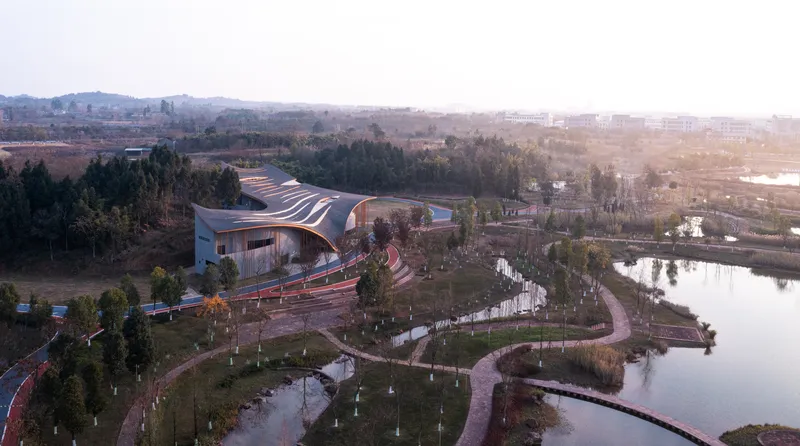
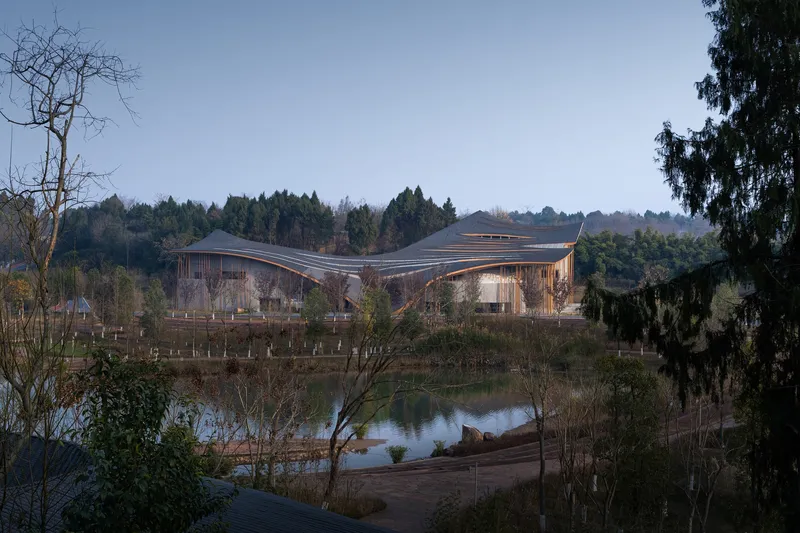
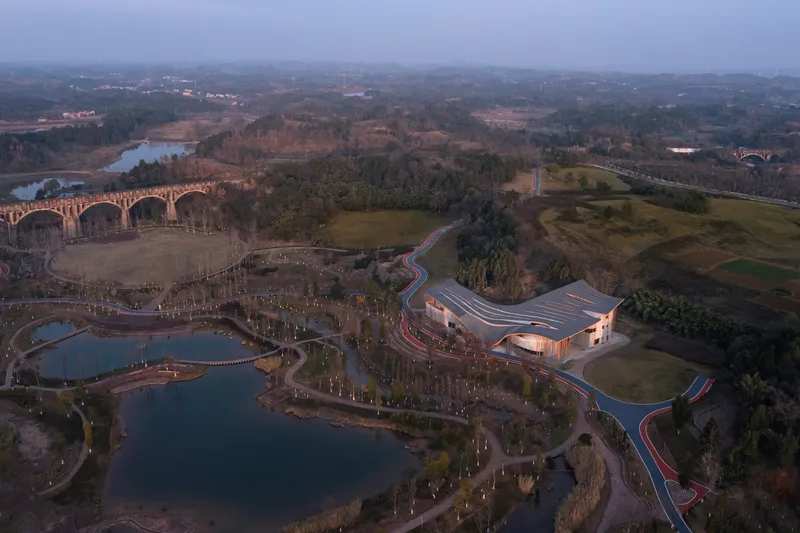
The building does not end at its walls. Red pathways wind through planted gardens and skirt the edge of a reflective pond. Water features, terraces, and grassy slopes extend the memorial's territory into the landscape, reinforcing the idea that this institution is about water in the broadest sense. The pond beside the building serves as both ornamental surface and pedagogical tool: it makes the relationship between architecture and hydrology visible at a glance.
An arched viaduct crossing a landscape of fields and ponds in the distance becomes part of the composition. Whether historic infrastructure or a deliberate landscape element, it ties the memorial to the regional canal network it celebrates. The layered views, from interior courtyard to garden to water to distant hills, create a depth of field that few cultural buildings achieve.
Detail and Atmosphere
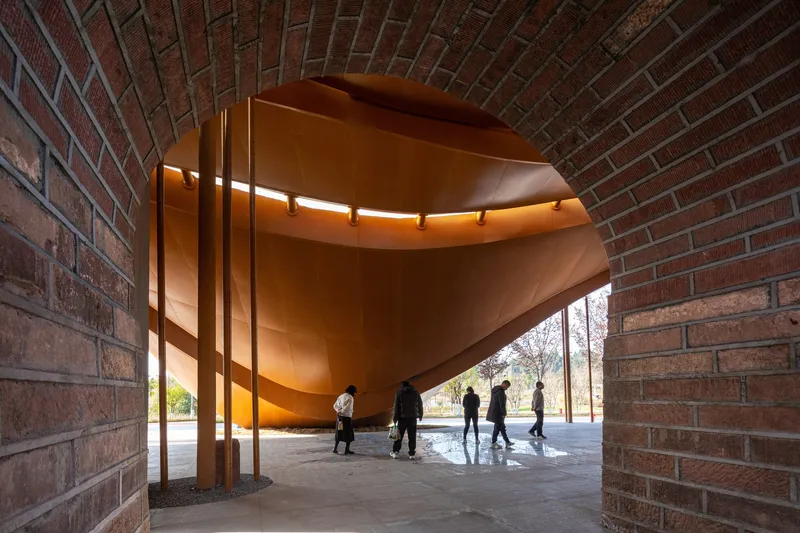
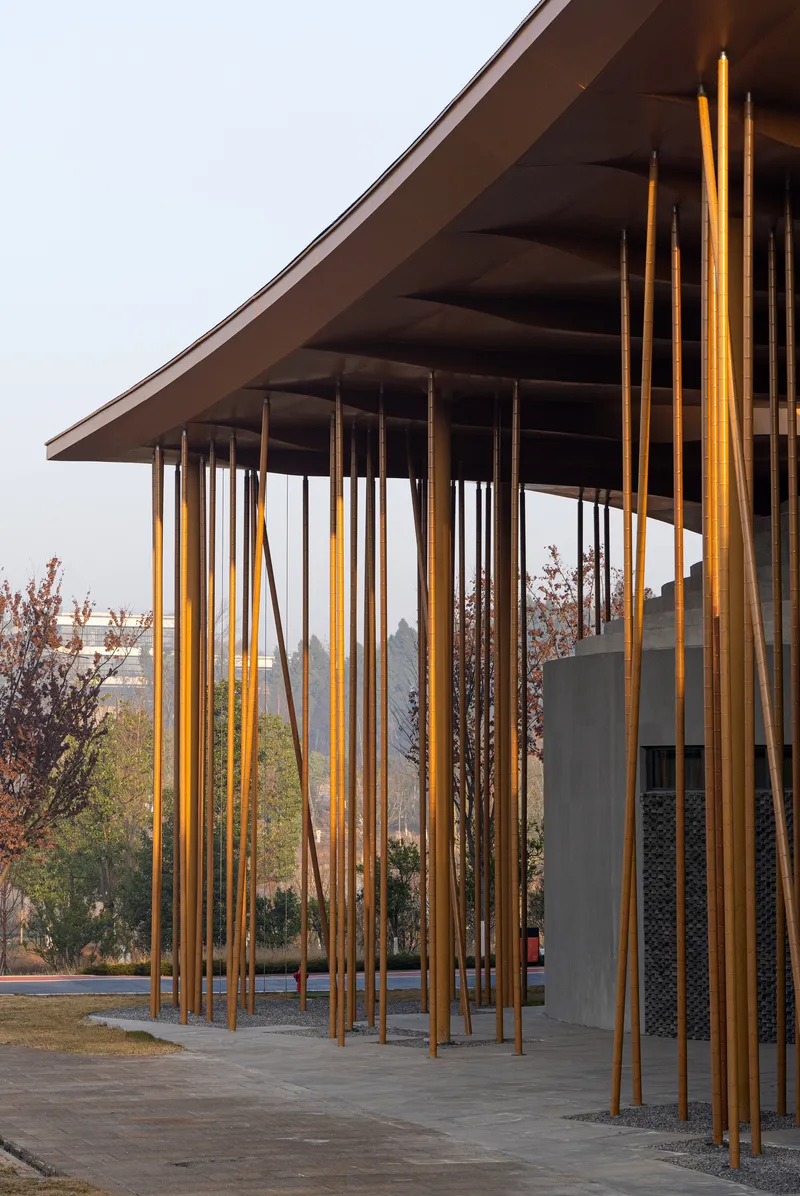
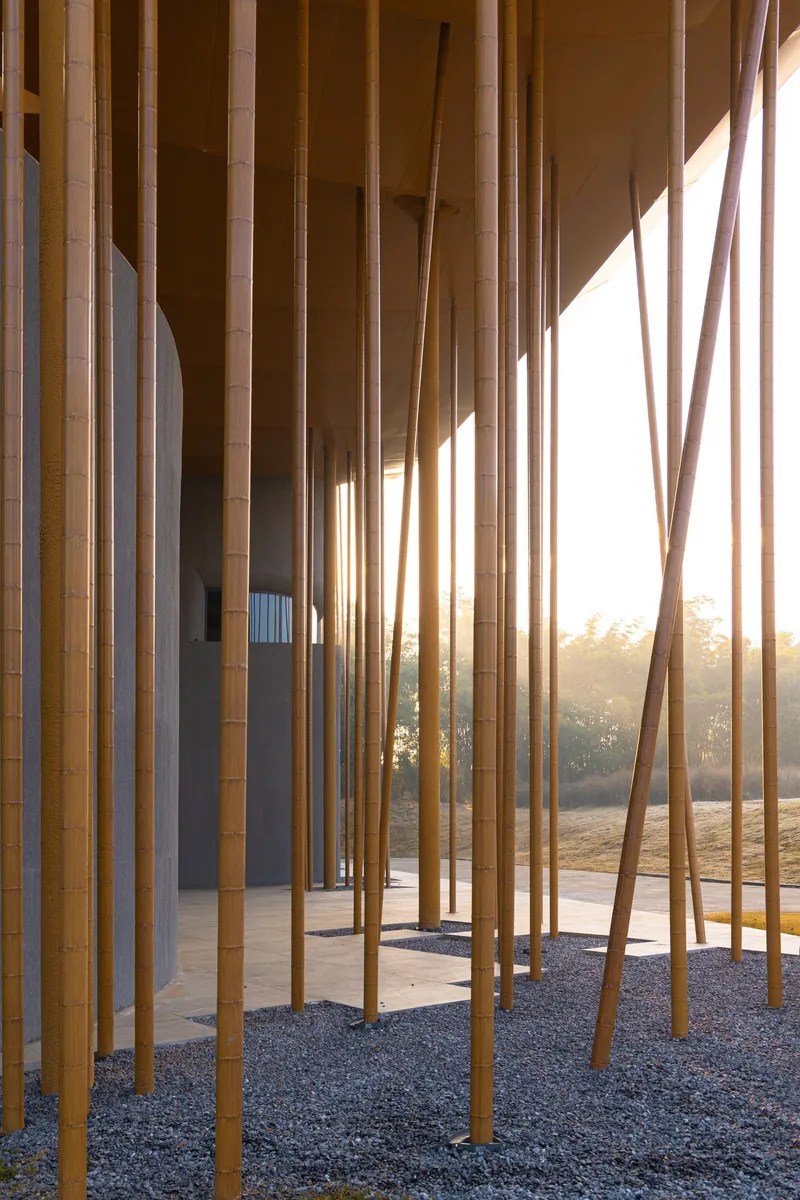
A copper-clad volume suspended between red brick walls. Slender golden columns supporting a sloping timber soffit in afternoon light. Vertical timber columns filtering golden sun onto a gravel courtyard. These are not isolated details but evidence of a consistent material intelligence running through the entire project. The warm metals, the honest concrete, the stone and timber, all speak to a palette the architects describe as inspired by water and earth.
The building is most alive at the golden hour, when low sunlight rakes through the colonnades and bronze elements glow. This is not accidental. The orientation of screens, the depth of overhangs, and the placement of courtyards all suggest careful calibration to the arc of the sun. The architecture does not merely sit in its landscape; it performs with it.
Plans and Drawings
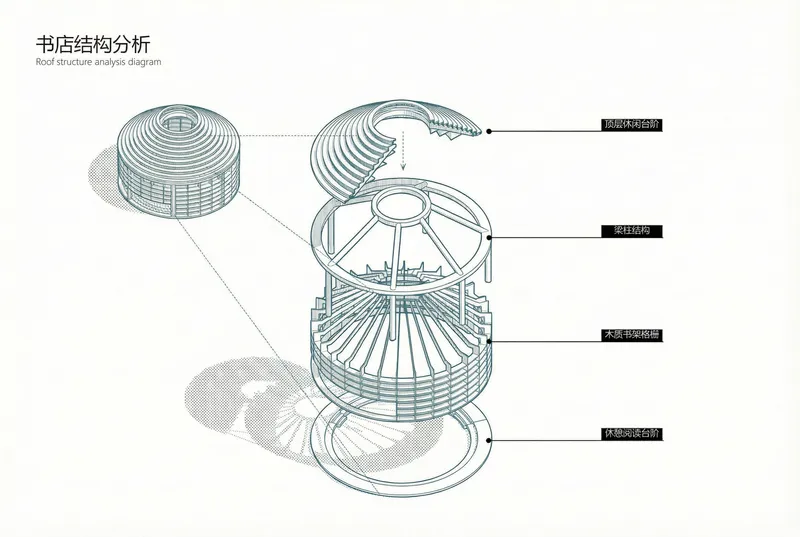
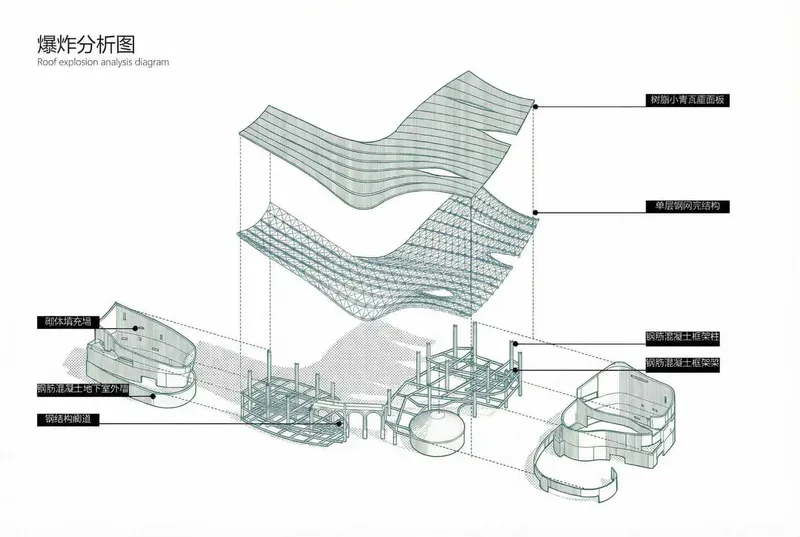
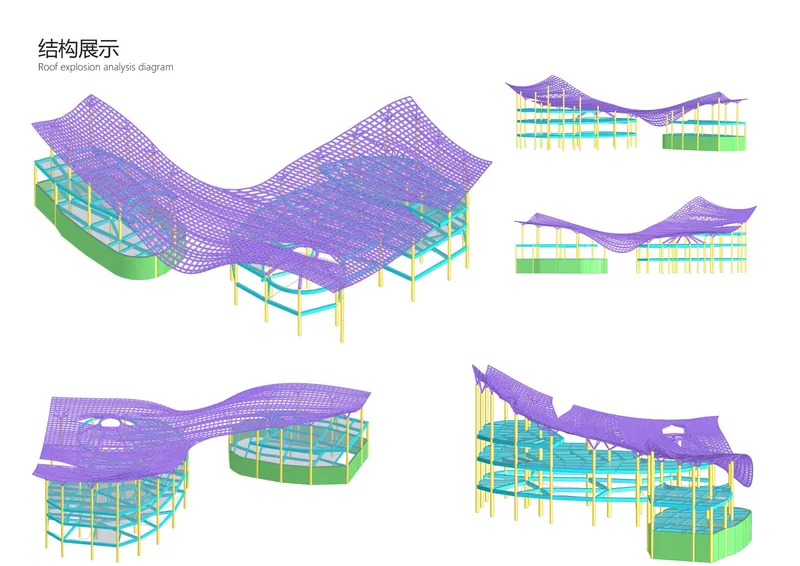
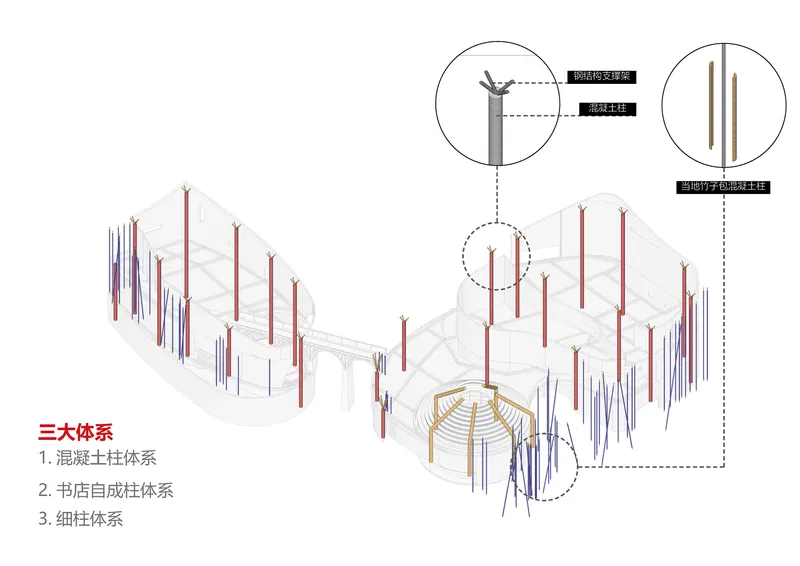
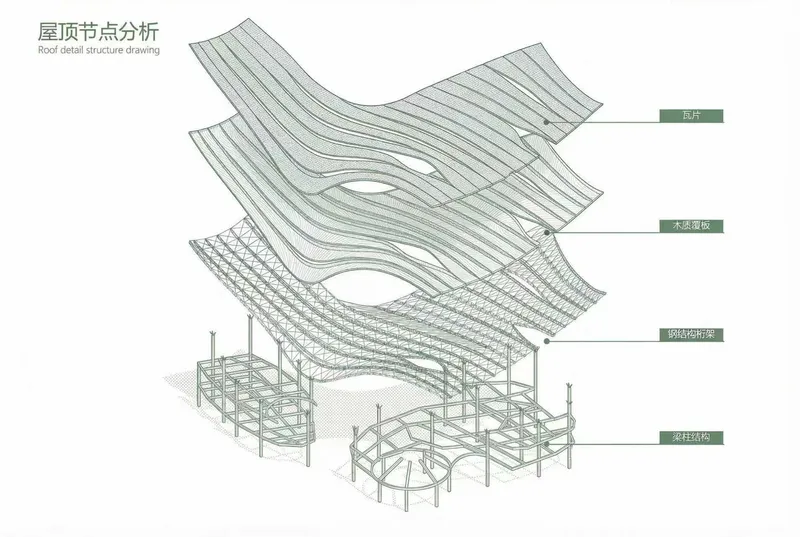
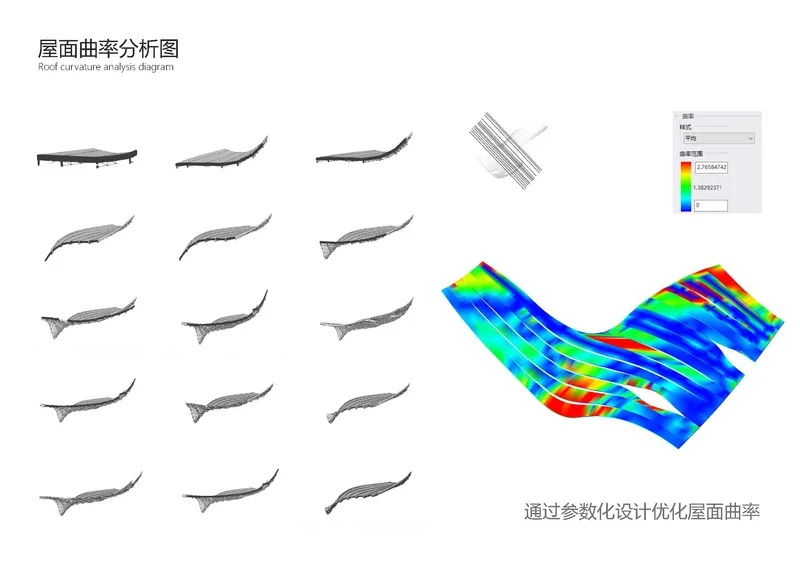
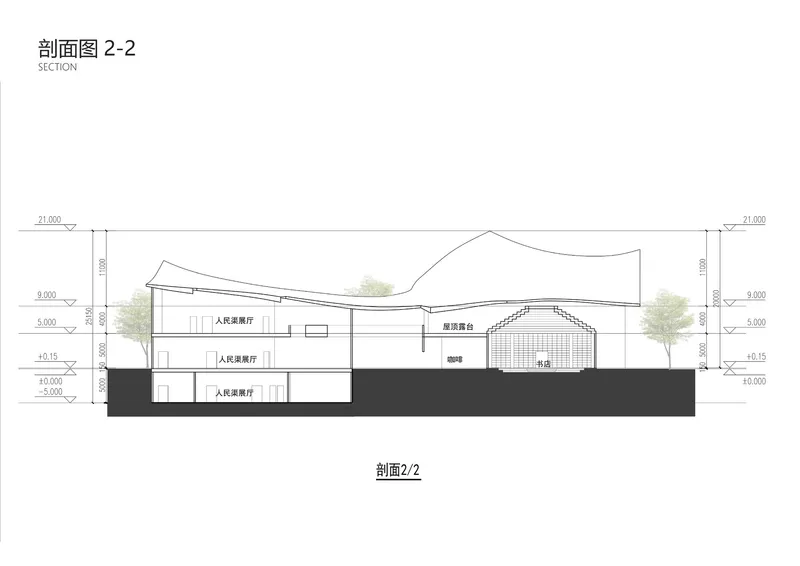
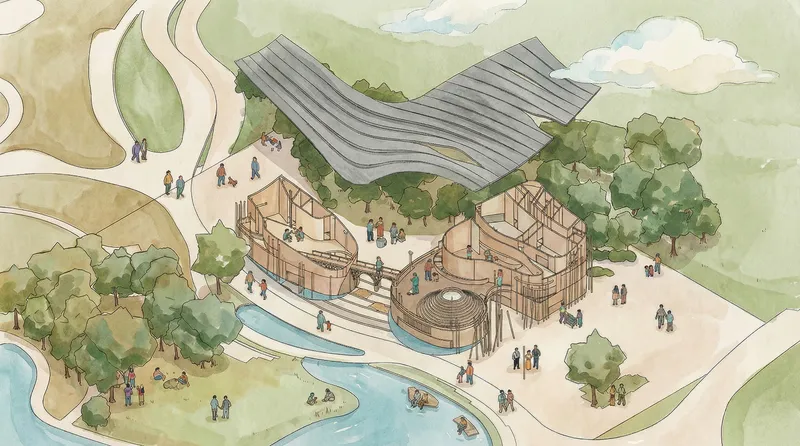
The axonometric and structural analysis drawings reveal just how much engineering underpins the roof's apparent ease. Three distinct column systems, including heavy red concrete pillars and clustered thin vertical supports, work together to hold up a parametrically varying shell. The structural mesh diagram shows a complex interplay of curved purple surfaces, yellow frameworks, and green floor plates that would be impossible to realize without computational design tools. The roof curvature analysis, rendered as a color-coded stress map, confirms that the undulations are structurally optimized, not merely sculptural.
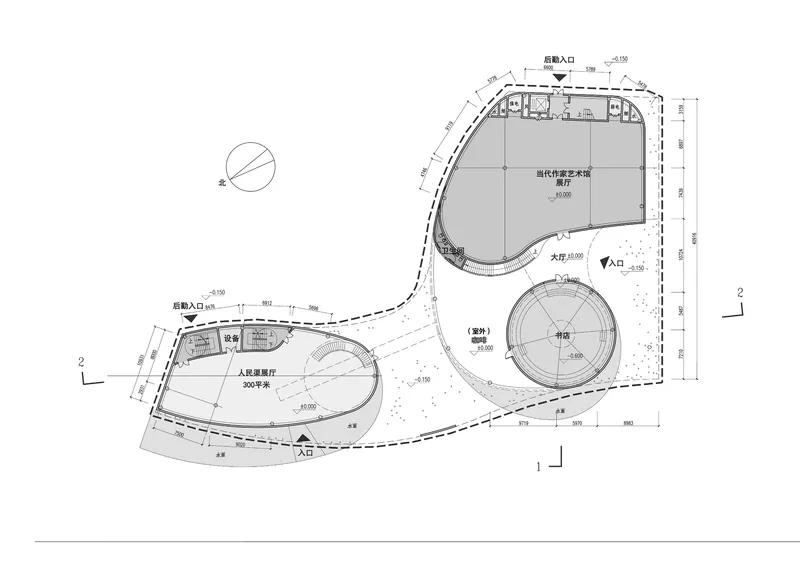
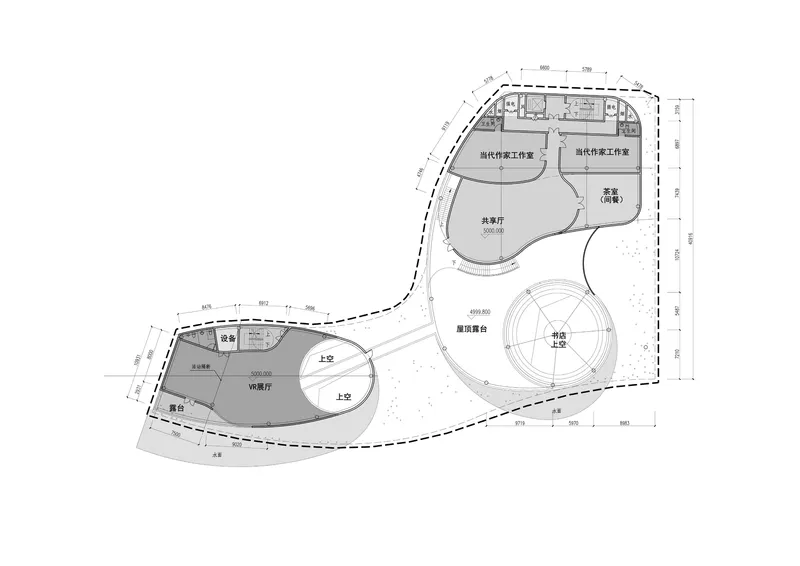
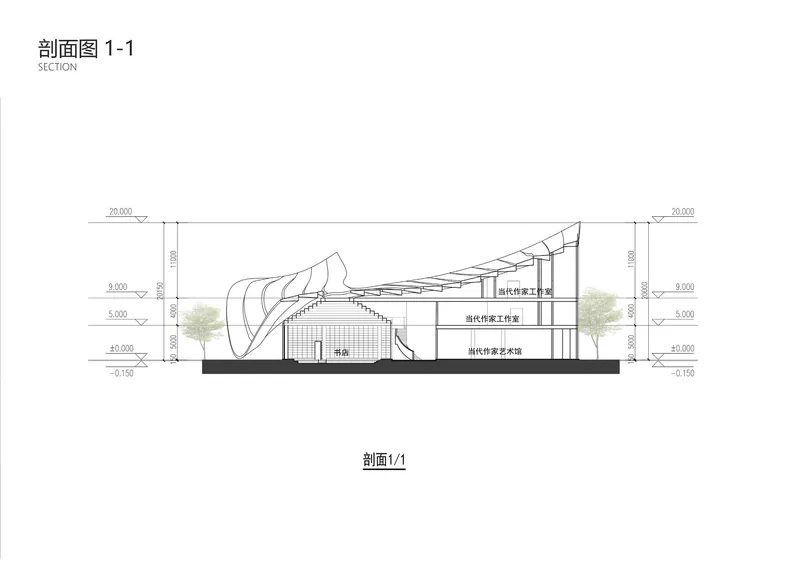
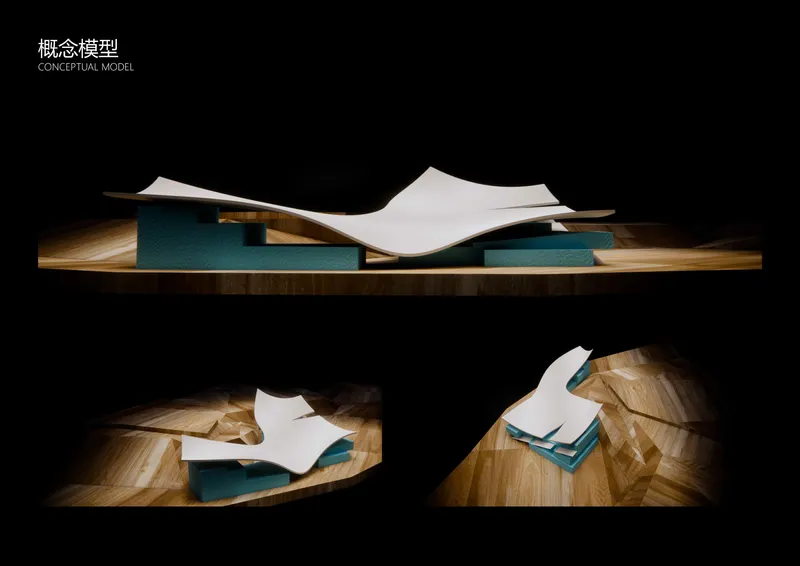
The site plan and floor plans show three organic-shaped volumes connected by circulation paths and oriented to maximize engagement with the surrounding landscape. Section drawings reveal how the flowing roof spans partially submerged volumes, tucking program below grade to reduce the building's visual mass. The physical model, with its undulating white roof over teal volumes on a timber base, captures the project's essential idea with elegant clarity. Historical construction photographs and archival diagrams of canal excavation anchor the design in the story it was built to tell.
Why This Project Matters
Memorial halls can easily become didactic containers: walls hung with timelines, vitrines of artifacts, and a gift shop. The Renmin Canal Memorial Hall resists that formula by making the building itself the primary exhibit. Its flowing roof, its water-and-earth material palette, its interlocking courtyards and landscape layers all work to embody the canal's story rather than merely illustrate it. Visitors do not just learn about water infrastructure; they move through a built analogy of it.
There is also something important about the site strategy. Reclaiming an industrial park for cultural and civic use, at the edge of a rapidly developing new city, is an act of intention. It says that Kaizhou New City will not be just another industrial hub but a place that values its deep agricultural and hydraulic heritage. AOMOMO Studio and Shanghai Jiao Tong University have given that intention a form worth the long drive to Deyang.
Renmin Canal Water Conservancy Culture Zhongjiang Memorial Hall by AOMOMO Studio and Shanghai Jiao Tong University. Located in Deyang, China. 2,800 m². Completed 2025. Photography by Shengliang Su.
About the Studio
Share Your Own Work on uni.xyz
If projects like this are the kind of work you want to make, uni.xyz is a place to publish your own, find collaborators, and enter design competitions.



Popular Articles
Popular articles from the community


Hill & Cross Opera: Sculptural Opera House Architecture Shaped by Tallinn’s Landscape and Identity
Hill & Cross Opera reimagines opera house architecture in Tallinn through its sculptural hill, civic plaza, glass wave and a luminous cross.

Play: Fragments of Their World
Familiar architecture becomes modular playground design, creating safe spaces where displaced children can learn, connect, imagine and play.

The Earth Pod: 3D Printed Homes for Resilient Refugee Communities
The Earth Pod reimagines refugee housing through 3D printed homes made from clay, combining resilience, self-sufficiency, and rapid shelter.

Conexión: Biophilic Design Reimagines High-Rise Living in Hong Kong
Conexión reimagines high-rise living in Hong Kong through biophilic design, green facades, shared spaces, daylight, water and nature within.


Similar Reads
You might also enjoy these articles

Bao Huynh Watercolor Atelier: A Serene Art Retreat in Hội An
Bao Huynh Watercolor Atelier in Hội An blends multifunctional art spaces, sustainable design, local materials, and family-friendly living in a serene environment.

Atelier Macri Concept Store Interior Design by CASE-REAL
Atelier Macri store features a "ko" counter, walnut wood details, cork displays, blending retail, gallery, and seamless customer experiences.

Manuel Vargas Izquierdo Stadium and High-Performance Sports Center: Architectural Excellence in Jalpa de Méndez
The Manuel Vargas Izquierdo Stadium blends sustainable design, inclusive sports facilities, and cultural-inspired architecture, revitalizing Jalpa de Méndez’s public spaces.

KAKR Buluh Awar Hall: Revitalizing Community and Ecology Through Bamboo Architecture
Community built bamboo hall revitalizes Buluh Awar village, empowering youth, restoring ecology, celebrating vernacular craftsmanship through sustainable architecture and culture.


Explore Cultural Architecture Competitions
Discover active competitions in this discipline



Challenge to design public laboratory


Bring back Drive In's
Comments (0)
Please login or sign up to add comments
No comments yet. Be the first to comment!